Marketing Career Path Roadmap: Complete Guide (2026)

Marketing careers look messy because marketing isn't one job. It's a bundle of jobs that all exist for one reason: help the business make (or keep) money by changing how people think and act.
Once you see that, the roadmap gets simple. You get paid more when you can move a more valuable business metric with less hand-holding.
This guide gives you:
The main marketing tracks (so you stop guessing what "next" means)
The level-by-level expectations (what actually changes from specialist to manager to director)
Salary benchmarks pulled from SalaryGuide data
A promotion and career development playbook you can use immediately
What Are You Really Looking For in a Marketing Career?
You're usually trying to solve one (or more) of these problems:
Pick a direction (generalist vs growth vs product marketing vs brand)
Stop doing random tasks and start building "promotion-proof" skills that get you hired
Predict salary growth and choose roles that compound earnings
Get the next title (and not accidentally take a lateral move in disguise)
Switch specialties without starting over at entry level
Build proof of work that gets interviews and higher job offers
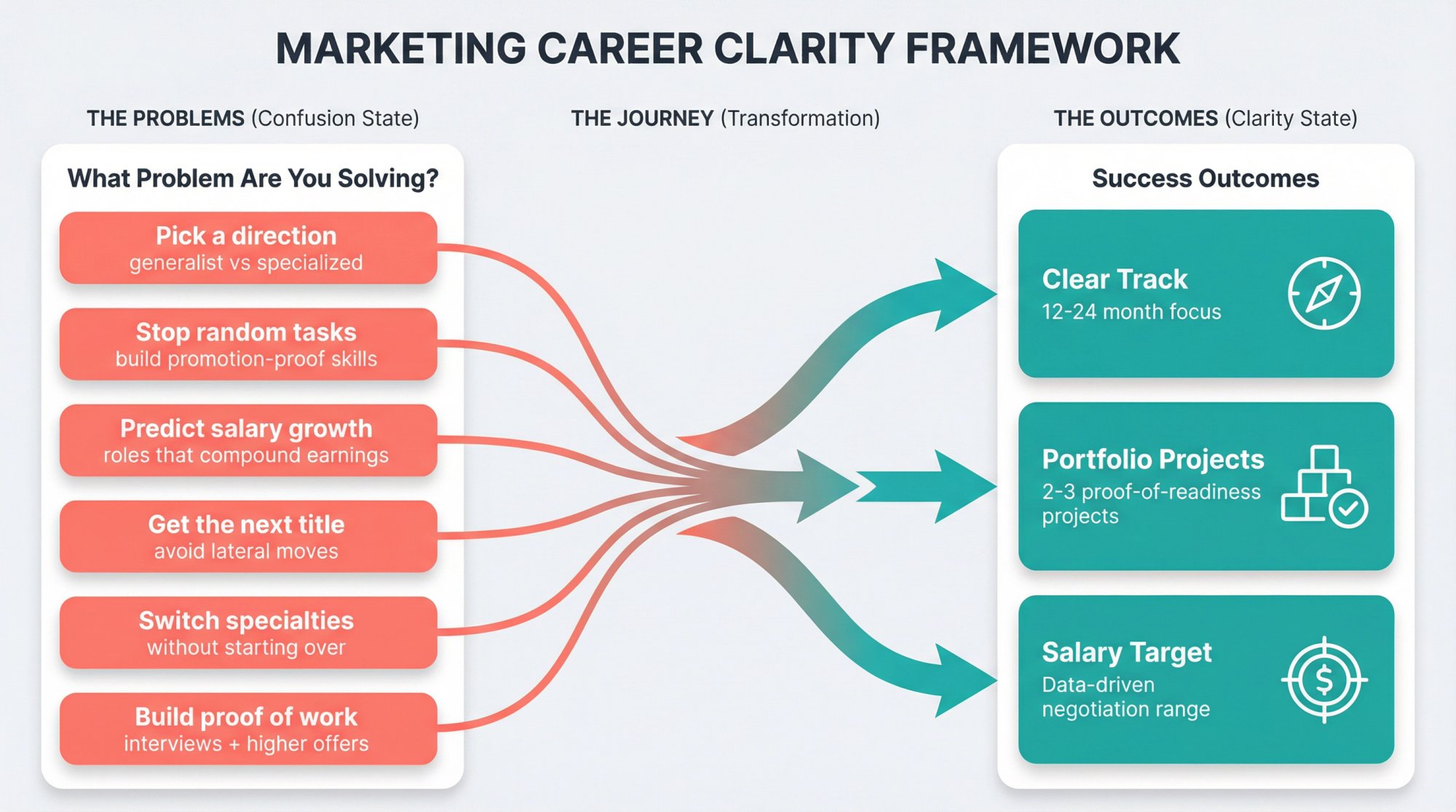
Success means you finish this article with:
A clear track to pursue for the next 12 to 24 months
2 to 3 "portfolio projects" to build that prove you're ready for the next level
A salary target range you can negotiate from data, not vibes
How Do Marketing Careers Actually Level Up?
Ignore titles for a second. Promotions in marketing are basically this: you move up when you go from "doing tasks" to "owning outcomes" to "building systems" to "setting strategy."
Here's the foundational framework.
Level = Scope × Leverage × Reliability
The promotion formula: Your level increases when you deliberately expand what you control (scope), create reusable assets others can deploy (leverage), and hit targets consistently, not just once with a lucky campaign (reliability).
Scope: bigger budget, bigger audience, bigger region, more channels, more stakeholders
Leverage: you build assets or systems others can reuse (automation, playbooks, dashboards, positioning, processes)
Reliability: you can hit targets repeatedly, not just once with a lucky campaign
The roadmap is about deliberately increasing those 3 things.
Marketing Specializations: Which Track Should You Choose?
Marketing is not one ladder. It's a set of ladders that connect.
Here are the major marketing career tracks you'll see in 2026 job markets:
| Track | What You "Own" | The Metric That Gets You Promoted | Common Endgame Roles |
|---|---|---|---|
| Generalist / Integrated | Campaigns across channels | Consistent execution + cross-team coordination | Marketing lead, director of marketing |
| Growth / Demand Gen | Acquisition + pipeline | CAC, ROAS, SQLs, pipeline, revenue | Head of growth, VP demand gen |
| Paid Media | Spend to results | ROAS, CPA, CAC, incrementality | Paid media lead, growth director |
| SEO / Content | Organic demand | Traffic quality, pipeline/revenue attribution, rankings, content engine | Head of SEO/content |
| Product Marketing | Positioning + go-to-market | Adoption, win rate, conversion, retention impact | Director PM, VP product marketing |
| Brand / Comms | Preference + trust | Brand lift, share of voice, earned impact, direct + branded search | Brand director, VP brand |
| Lifecycle / CRM | Retention + expansion | Activation, retention, LTV, churn, email/SMS revenue | Lifecycle lead, retention director |
| Marketing Ops / Analytics | The marketing "operating system" | Speed, data quality, attribution, automation, cost efficiency | Marketing ops director, RevOps |
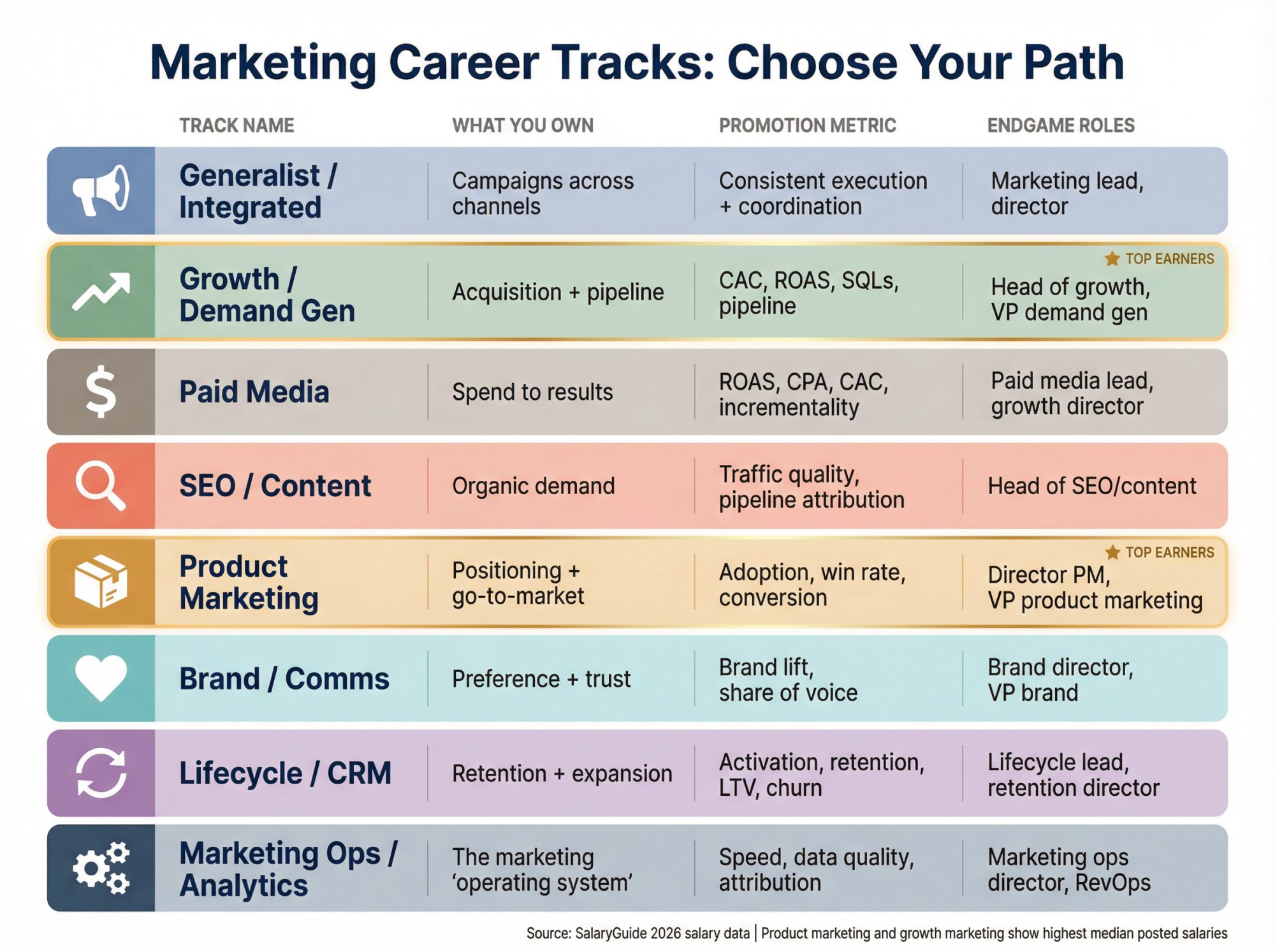
A useful reality check from SalaryGuide's current job-market snapshot: product marketing and growth marketing roles show higher median posted salaries than many other categories.
Marketing Career Levels: From Coordinator to CMO
Titles vary wildly between companies, but expectations don't. Here's the practical ladder.
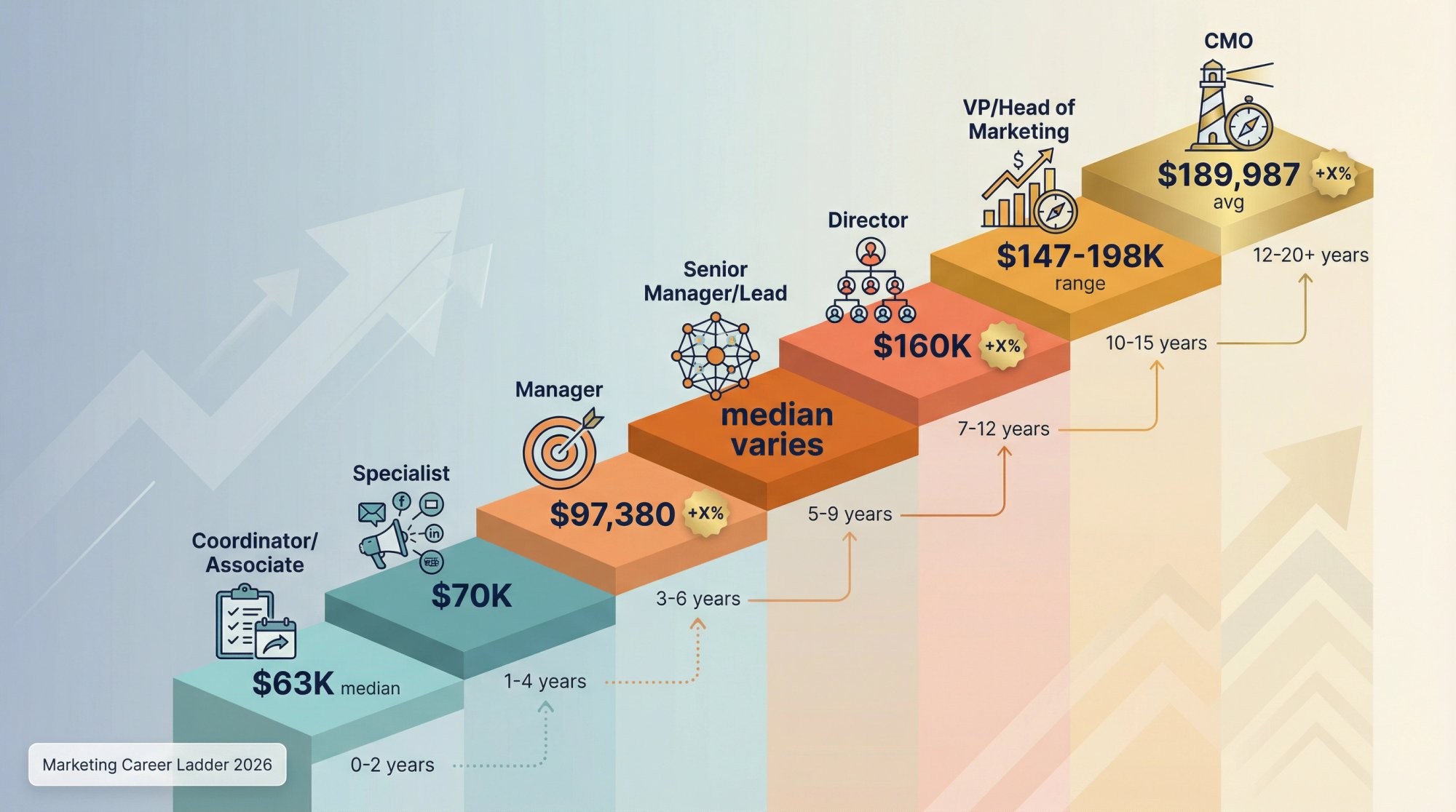
Level 1: Coordinator / Associate (0 to 2 Years)
Your job: Be the execution engine. Ship on time. Don't break stuff.
You own: campaign or task coordination, basic reporting, vendor and creative handoffs, calendars, briefs, QA, checklists
Your promotion signal: You reduce chaos. Fewer misses. Faster turnaround. Cleaner handoffs. Better documentation.
Salary benchmark (US): Marketing coordinator median $63,000 (25th: $58,000; 75th: $71,040) according to SalaryGuide
Level 2: Specialist (1 to 4 Years)
Your job: Become dangerous in one area (email, paid, SEO, social, events, etc.)
You own: a channel or function's execution, consistent weekly output, basic optimization loops (test, learn, repeat)
Your promotion signal: You can create measurable movement in one metric.
Salary benchmark (US): Marketing specialist median $70,000 (25th: $64,000; 75th: $85,000) according to SalaryGuide
Level 3: Manager (3 to 6 Years)
Your job: Own a goal, not a task list.
You own: strategy for a channel or segment, a budget (sometimes small at first), an experiment backlog, reporting that a VP could trust
Your promotion signal: You can hit a target repeatedly and explain why it worked.
Salary benchmark (US): Marketing manager median $97,380 (25th: $80,000; 75th: $120,500) according to SalaryGuide
In-house vs agency reality: SalaryGuide shows in-house marketing manager median $98,000 vs agency median $80,000 (in-house shown as +23% higher).
Level 4: Senior Manager / Lead (5 to 9 Years)
Your job: Scale what works.
You own: multi-channel programs, bigger budgets, mentoring or leading 1 to 3 people (even if unofficial), cross-functional alignment (sales, product, finance)
Your promotion signal: You build repeatable systems like a channel playbook, a reporting cadence, a launch process, or a creative testing framework.
Note: Titles differ a lot here. Some companies call this "lead," "senior manager," "growth lead," etc.
Level 5: Director (7 to 12 Years)
Your job: Run a marketing "business within the business."
You own: a team plus hiring plan, a quarterly plan tied to revenue or company goals, budget allocation and tradeoffs, stakeholder management at exec level
Your promotion signal: You make the org better, not just campaigns. Better prioritization. Better processes. Better people development. Clearer strategy.
Salary benchmark (US): Director of marketing median $160,000 (25th: $125,000; 75th: $205,000) according to SalaryGuide
Level 6: VP / Head of Marketing (10 to 15 Years)
Your job: Decide where the company should (and shouldn't) spend for growth.
You own: the marketing plan as a financial plan, forecasting plus performance narratives for leadership or board, team structure, cross-functional "operating rhythm"
What this role pays: Industry data suggests VP of marketing salary ranges typically fall between $147,750 to $198,250 (2026 benchmarks).
Level 7: CMO (12 to 20+ Years)
Your job: Own the company's growth story plus market position.
You own: brand, positioning, demand, retention (sometimes RevOps too), executive decision-making, long-term market strategy and risk
Salary benchmark: Chief Marketing Officer roles typically show average compensation of $189,987 in 2026 (with ranges from $96k to $296k depending on company size and industry).
Highest-Paying Marketing Specializations (2026 Data)
Titles can lie. Salary bands usually don't.
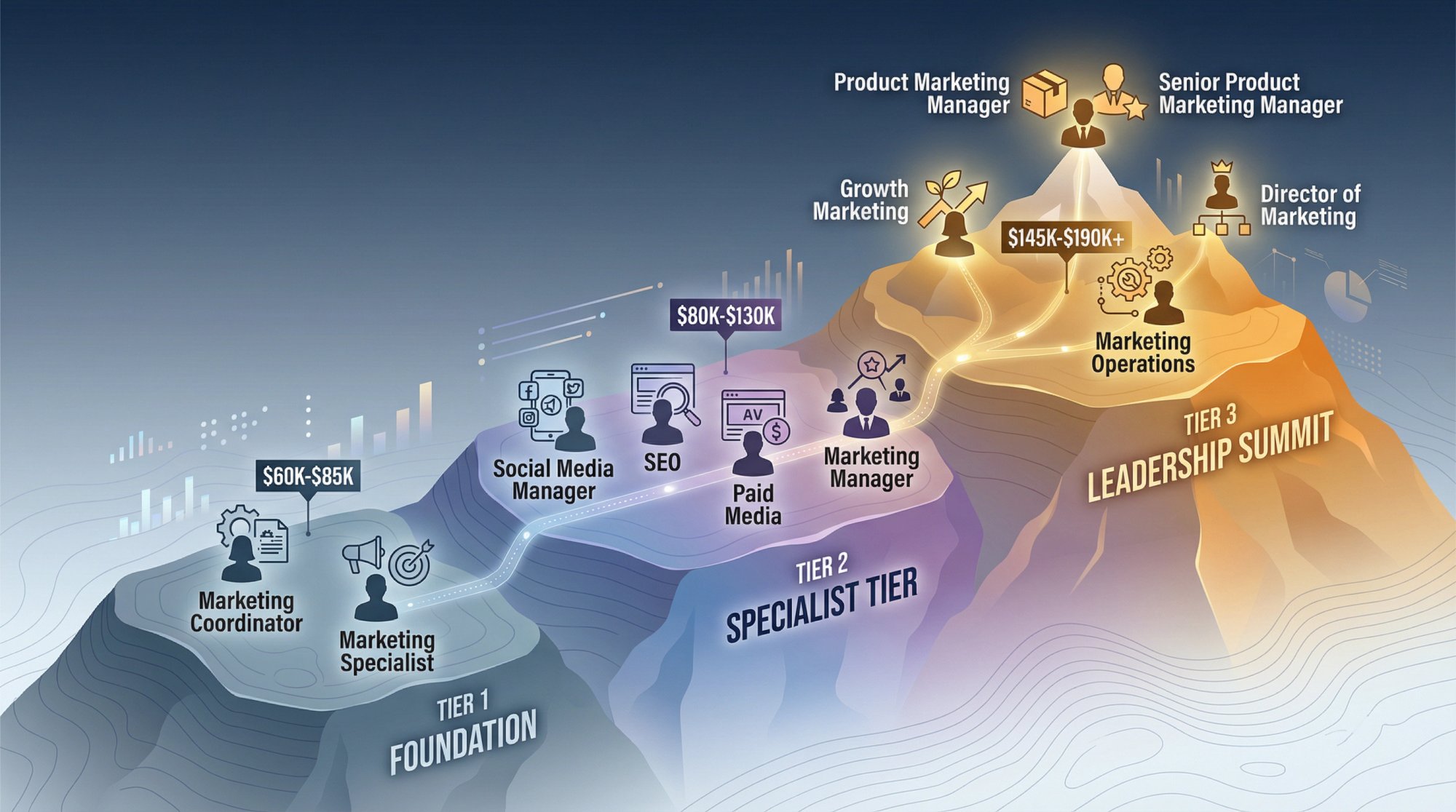
Below are SalaryGuide role benchmarks (US-focused), all showing "last updated February 9, 2026" on the salary pages:
| Role | Median | "Typical Middle" (25th to 75th) | Top 10% Marker |
|---|---|---|---|
| Marketing Coordinator | $63,000 | $58,000 to $71,040 | $80,200 |
| Marketing Specialist | $70,000 | $64,000 to $85,000 | $95,000 |
| Marketing Manager | $97,380 | $80,000 to $120,500 | $140,000 |
| Director of Marketing | $160,000 | $125,000 to $205,000 | $207,000 |
| Social Media Manager | $80,000 | $70,000 to $102,000 | $114,000 |
| SEO | $85,000 | $64,875 to $130,125 | $172,000 |
| Paid Media | $110,000 | $84,375 to $158,000 | $227,900 |
| Growth Marketing | $158,000 | $120,000 to $208,000 | $263,000 |
| Marketing Operations | $147,000 | $110,000 to $195,000 | $248,000 |
| Product Marketing Manager | $150,000 | $125,000 to $186,000 | $223,600 |
| Senior Product Marketing Manager | $188,000 | $168,000 to $213,000 | $229,900 |
| Field Marketing Manager | $126,500 | $120,000 to $140,000 | $150,000 |
Two critical 2026 takeaways: Ops + growth + product marketing are consistently higher-paying lanes (because they're closest to revenue, data, and strategy). And in-house usually pays better than agency across multiple roles.
Ops + growth + product marketing are consistently higher-paying lanes (because they're closest to revenue, data, and strategy). Check out SalaryGuide's growth marketing data to see this in action.
In-house usually pays better than agency across multiple roles. SalaryGuide salary comparisons show this explicitly for marketing manager, social media manager, paid media, SEO, and growth marketing.
Marketing Job Market Trends 2026: What You Need to Know
SalaryGuide's trends dashboard (last 30 days view) shows:
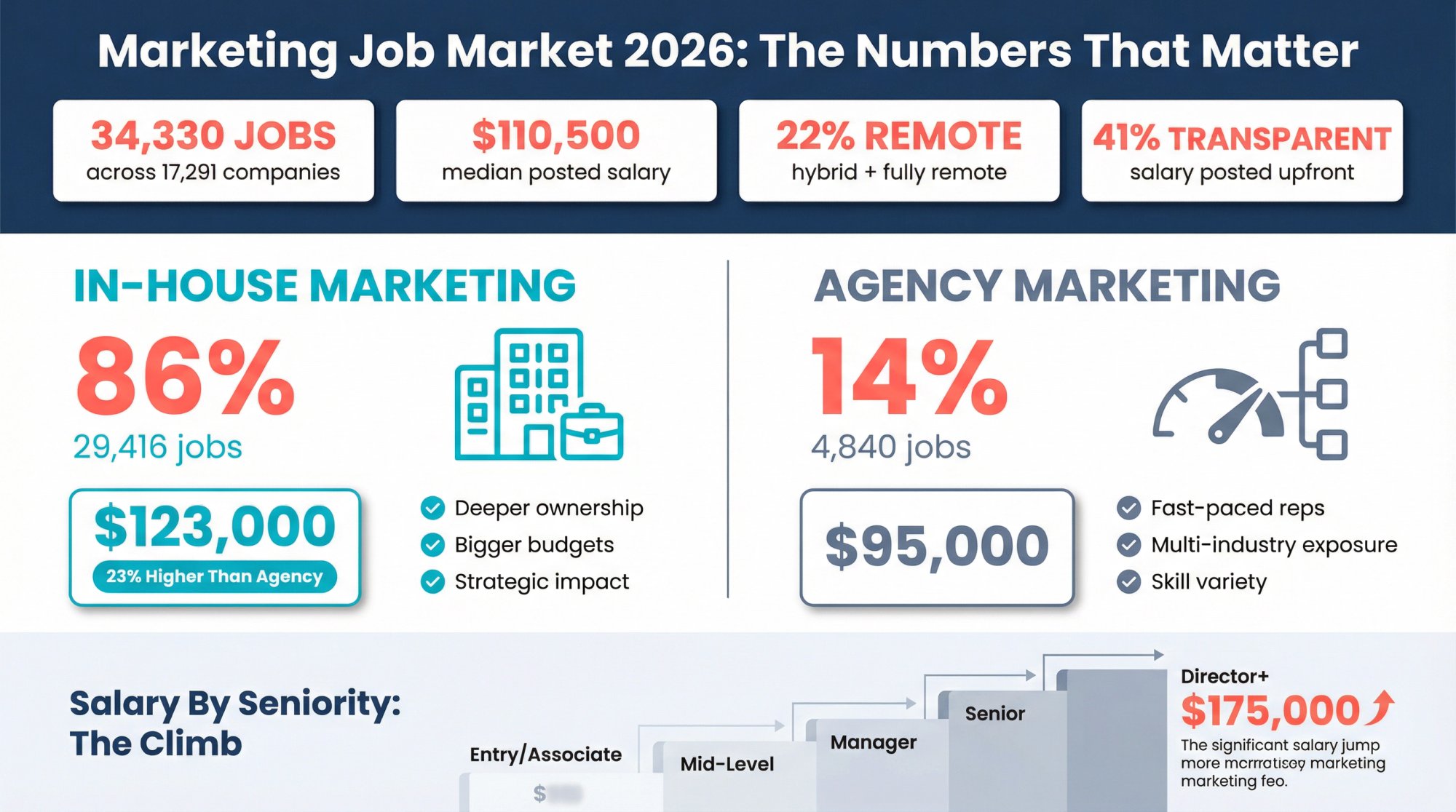
34,330 marketing jobs posted across 17,291 companies (unique positions; duplicates and recruiters filtered)
Median posted salary: $110,500
Remote share: 22%
Salary transparency rate: 41% of listings have salary posted
By seniority, the median posted salary jumps hard once you're in "director+" territory (shown as $175k median posted salary for director+ roles).
And in-house dominates volume:
In-house: 29,416 jobs (86%) with $123k median posted salary
Agency: 4,840 jobs (14%) with $95k median posted salary
How to use this: If you want faster pay growth, don't just chase a new title. Chase a lane where salaries are transparent more often (easier negotiation), budgets are real (impact is measurable), and "systems" matter (ops, analytics, lifecycle, growth, product marketing).
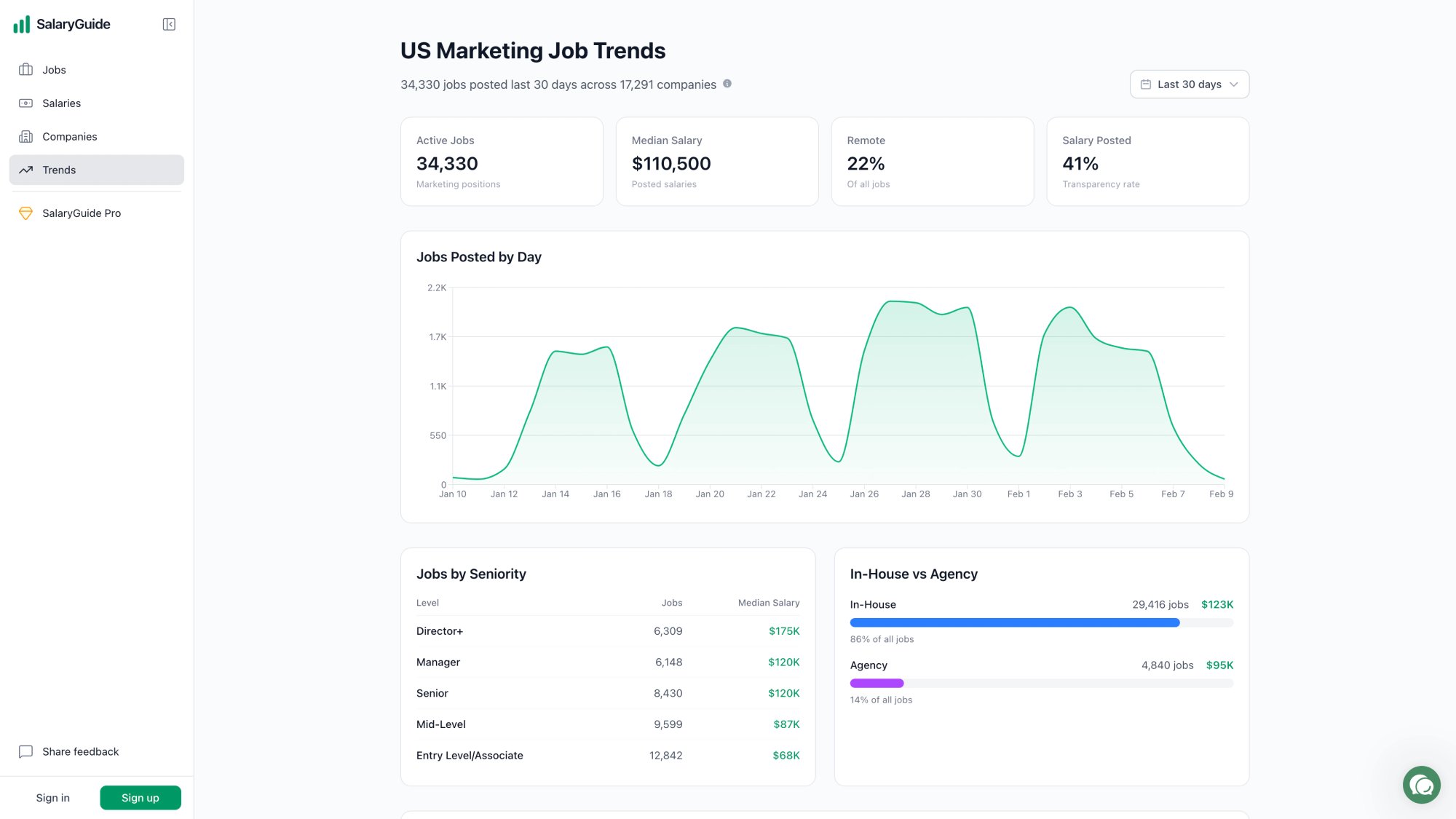
The dashboard updates daily with real-time market data, so you can track hiring momentum and salary shifts as they happen.
Your 12-24 Month Marketing Career Action Plan
Here's your practical action plan.
Here's a practical career development plan that works in any track.
Month 0 to 3: Build Your Measurement Muscle
If you can't measure impact, you can't negotiate impact.
Do these in your current role:
Define 1 to 2 north star metrics for your work (pipeline, revenue, retention, qualified leads, activation, etc.)
Create a weekly reporting habit (one slide or one dashboard)
Run 2 small experiments per month (tiny is fine; consistent is better)
Deliverable to ship: A one-page "growth log" with hypothesis, change made, results, and what you'll do next.
This becomes your portfolio and your promotion packet later.
Month 3 to 9: Own a Number, Not a Task
Pick one:
Own a funnel stage (activation, retention)
Own a segment (enterprise, SMB, a region)
Own a motion (webinars, partner co-marketing)
Your goal: be able to say "I moved X, by doing Y, which mattered because Z."
Month 9 to 18: Turn Your Work into a Repeatable System
This is where you "become a manager" even before you get the title.
Build one system:
An experiment pipeline
An automation flow (lead routing, nurture, scoring)
Systems create leverage. Leverage gets promotions.
Month 18 to 24: Widen Scope (The Real Promotion Trigger)
Scope can widen in 4 ways:
More channels
Bigger region or segment
Leading people (even indirectly)
Ask for scope before you ask for title. Once you're already doing the next level's scope, the title is paperwork.
How to Get Promoted in Marketing (5 Proven Strategies)
The truth: Your manager promotes you when you reduce their risk. Do these 5 things and you'll be "safe to promote" faster.
Here's the truth: your manager promotes you when you reduce their risk.
Do these 5 things and you'll be "safe to promote" faster:
1. Make outcomes predictable
"I can hit 120 SQLs per month" beats "I ran a cool campaign."
2. Communicate like a director
Weekly update format: what shipped, what moved (numbers), what's blocked, what you're doing next
3. Turn wins into artifacts
Every win becomes a doc, a dashboard, or a playbook.
4. Own cross-functional alignment
The higher you go, the more your job is "getting people to agree and move."
5. Build a promotion packet (seriously)
1 to 2 pages with scope you owned, metrics before and after, examples of leadership (mentoring, process improvements), and what you'll own at the next level.
Learn more about how to get promoted in marketing.
How to Switch Marketing Specializations Without Starting Over
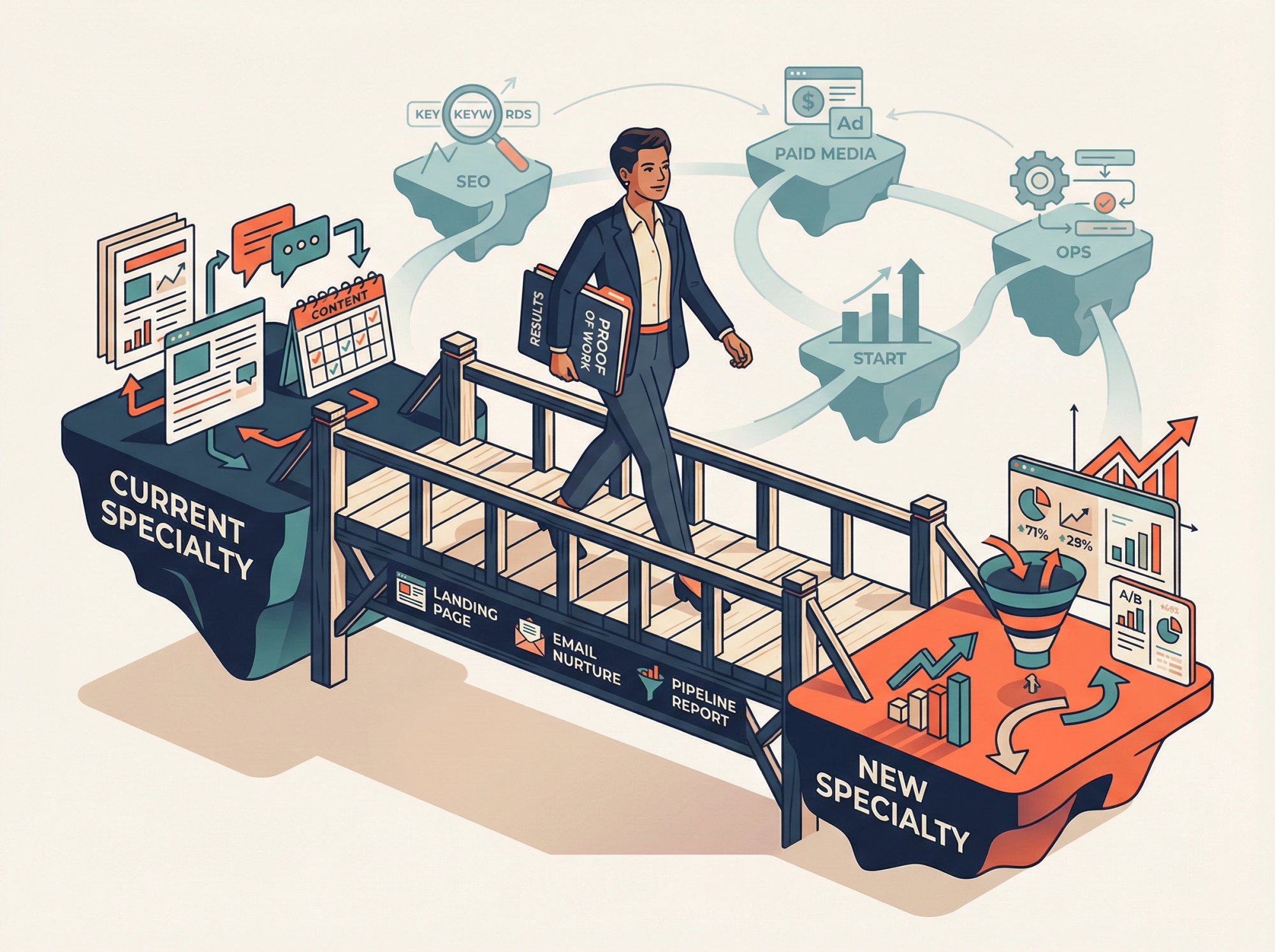
Switching tracks is easiest when you use a bridge project (a project that proves you can do the new lane while still in your current lane).
Examples:
Content to growth: Build a landing page plus paid retargeting plus email nurture for one content asset, then report pipeline impact.
Social to lifecycle: Create a "social to email capture" loop with a lead magnet, then run onboarding sequences and measure activation.
Marketing ops to growth: Automate lead routing plus create a reporting dashboard, then propose and run 3 experiments based on the data.
Paid media to product marketing: Partner on a launch with messaging, landing pages, and a competitive teardown, then measure conversion lift.
The trick: don't say "I want to pivot." Say: "I already did the work. Here are the results."
What Should a Marketing Portfolio Include in 2026?
Forget "I'm a hard worker." Everyone says that.
Your portfolio should prove three things.
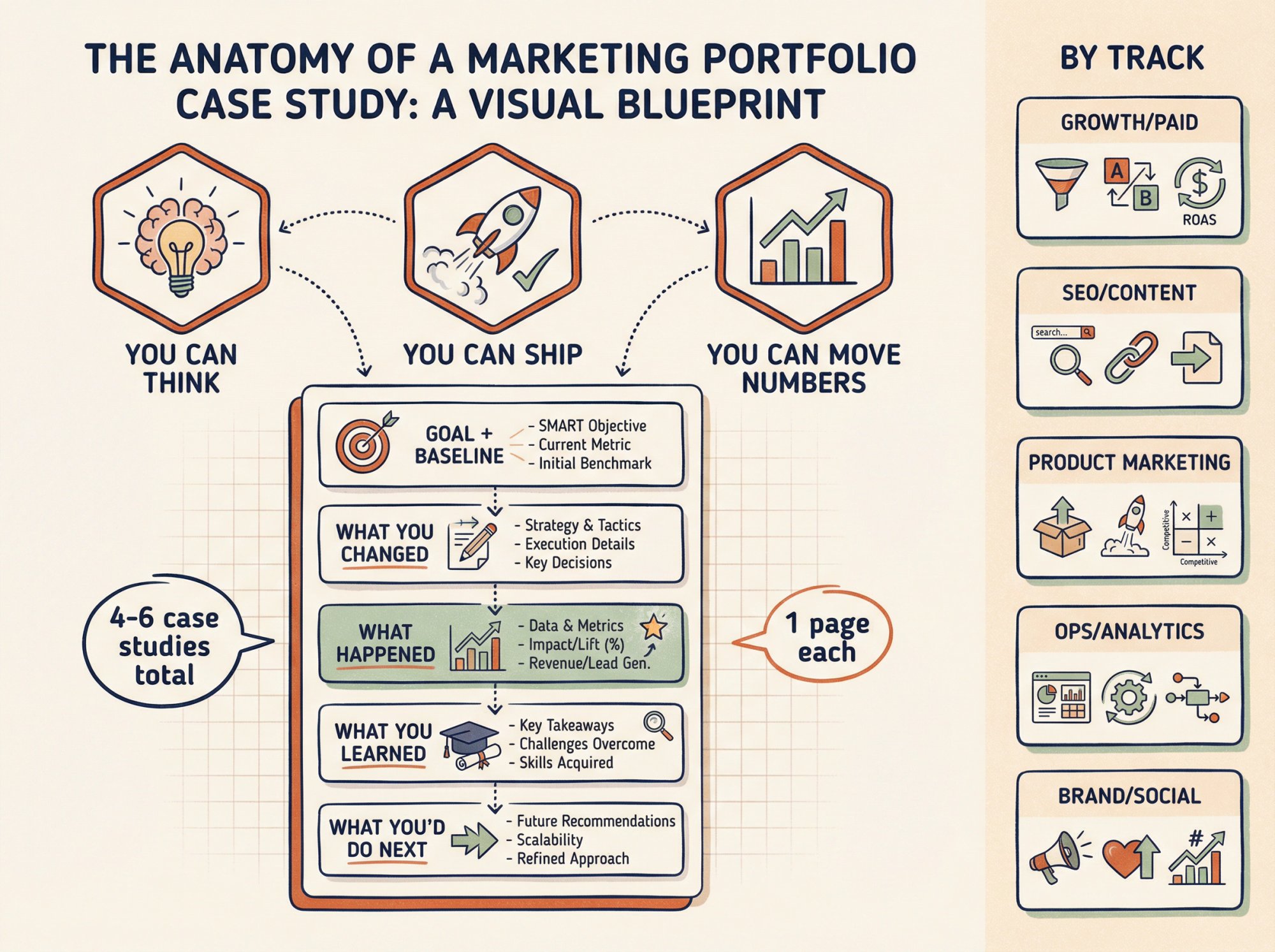
Your marketing portfolio should prove 3 things:
You can think: strategy plus hypothesis
You can ship: execution artifacts
You can move numbers: results plus learnings
Build 4 to 6 one-page case studies. Each should include goal plus baseline, what you changed, what happened, what you learned, and what you'd do next.
What to include by track:
Growth or paid: funnel math, experiment design, creative testing, ROAS or CAC story
SEO or content: content strategy, internal linking, conversion optimization, pipeline attribution story
Product marketing: positioning doc, launch plan, sales enablement, competitor teardown
Ops or analytics: dashboard screenshots, automation diagrams, data hygiene improvements
Brand or social: creative strategy, brand voice, community growth plus quality metrics
How to Negotiate Your Marketing Salary Using Data
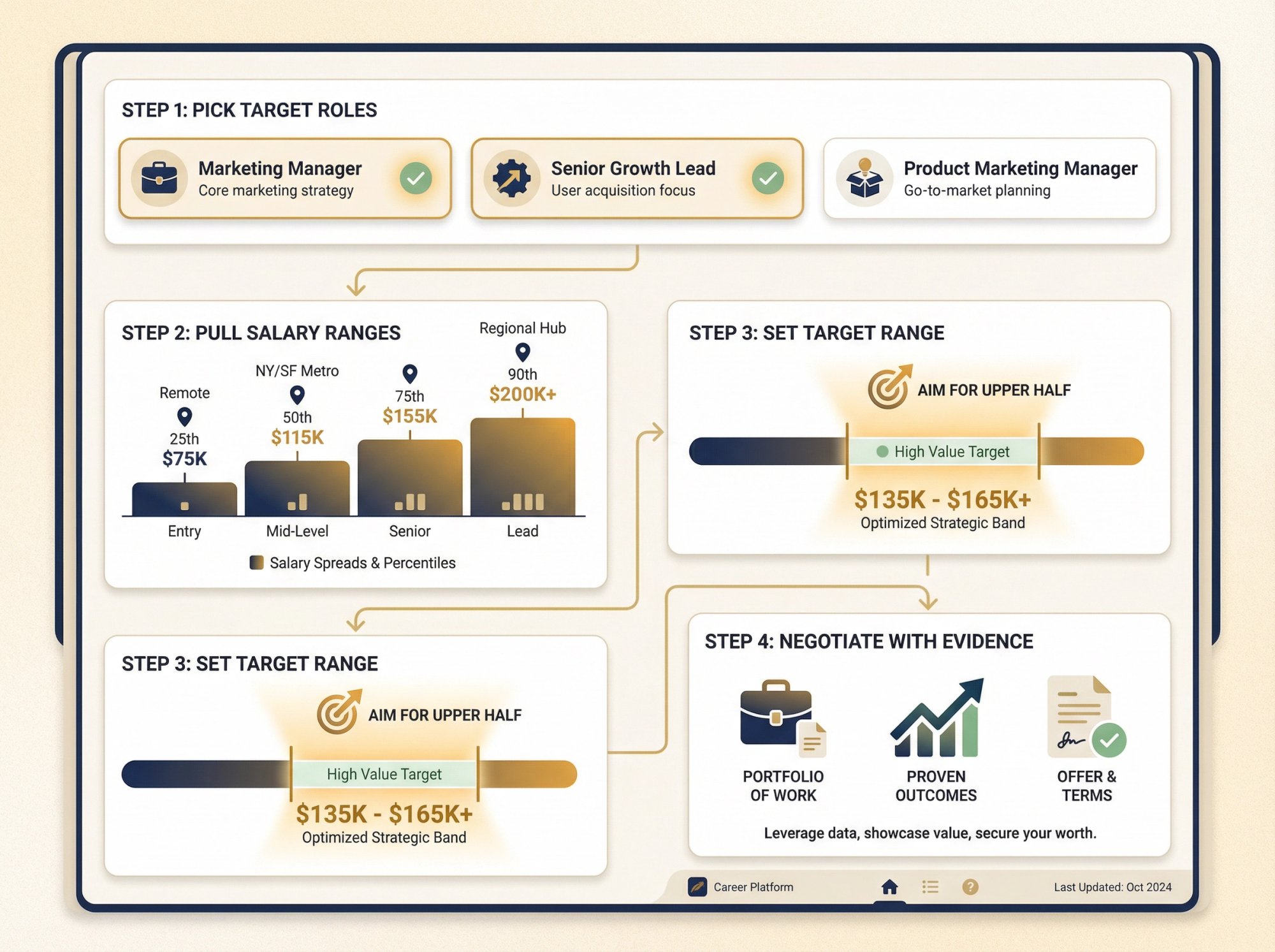
Use salary data as your "anchor," not your current pay.
Here's the simplest negotiation flow:
Pick 2 to 3 target roles you qualify for next (not dream roles)
Pull a salary range for each role and your location or experience
Set a target range (aim for the upper half if you can prove impact)
Negotiate using evidence (portfolio plus outcomes), not feelings
SalaryGuide's salary pages are built for this kind of prep. They show percentile ranges and, for many roles, in-house vs agency differences.
Using Salary Data to Plan Your Marketing Career
If you're building your next 12 to 24 months, these pages do the heavy lifting:
Trends dashboard: See what's hiring, what pays, and how much is remote or salary-transparent right now.
Salary pages: Benchmark your role by percentiles (and compare tracks like growth vs ops vs product marketing).
Job board: Use it to scout job descriptions for "next level" requirements and build your bridge projects.
Tools: Tighten your positioning fast (like the LinkedIn optimizer) when you're actively applying.
SalaryGuide Pro: If you want negotiation scripts, offer reviews, and coaching or community support, that's what Pro is built for.
Start at the homepage to unlock your personalized salary report by contributing your data anonymously.
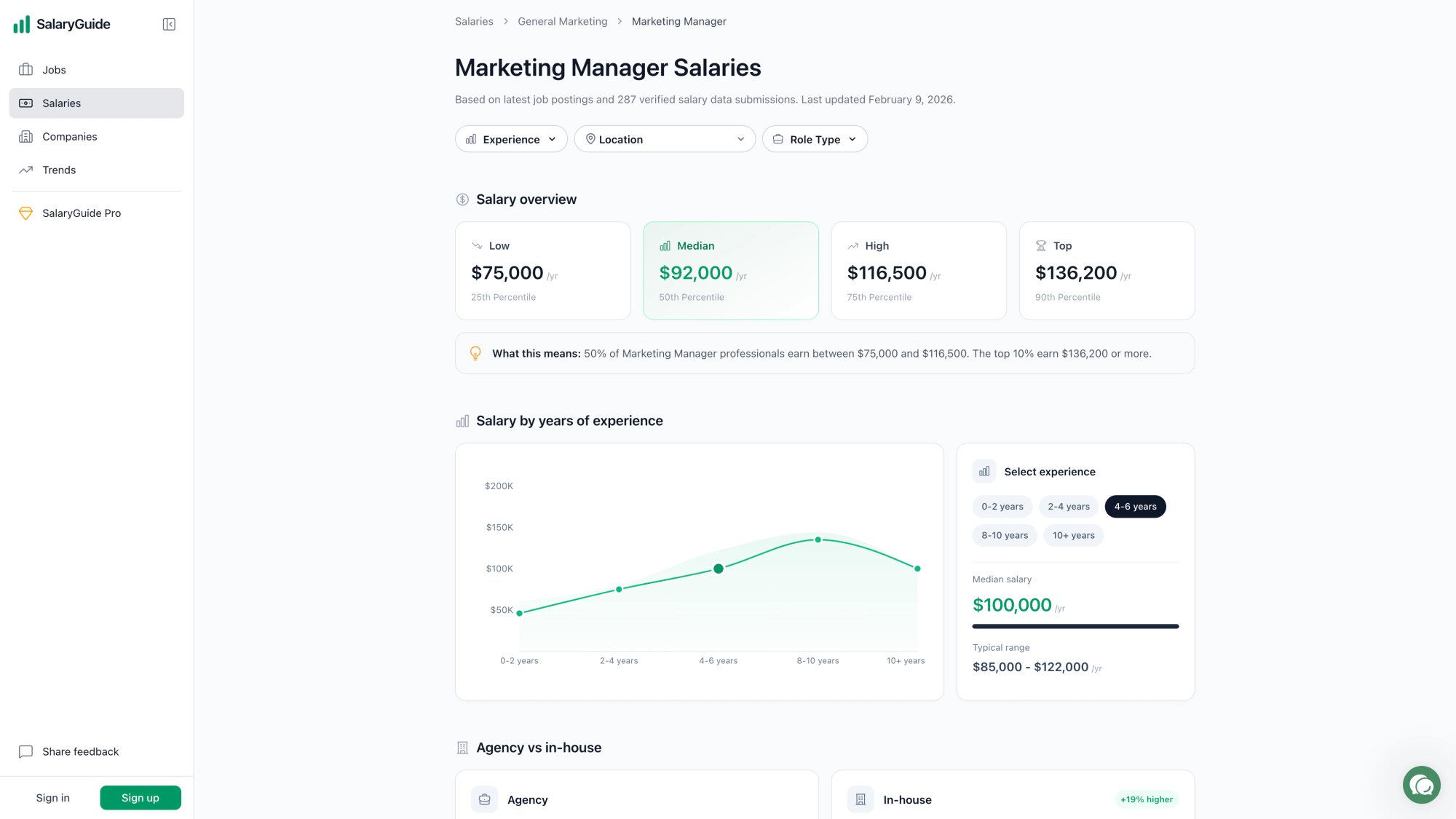
Each salary page shows percentile breakdowns so you can see exactly where you sit in the market and where you should aim for your next role.
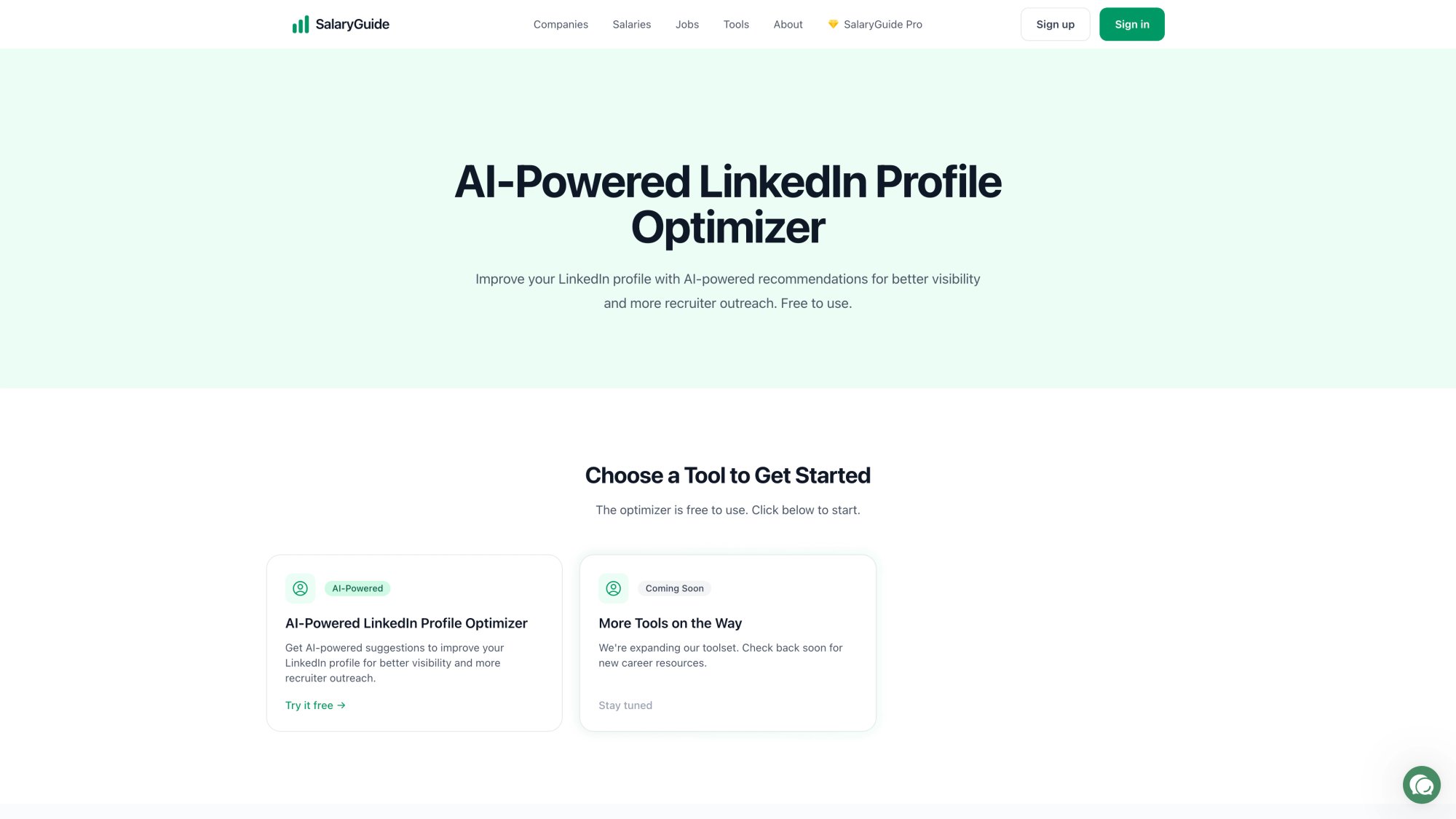
The tools page offers practical resources like the LinkedIn optimizer to strengthen your positioning before you start applying.
Frequently Asked Questions

How long does it take to go from entry level to director?
Common path is about 7 to 12 years, but it's not about years. It's about scope plus leverage plus reliability. If you build systems early and own outcomes, you can compress timelines.
Should I start in an agency or in-house?
Agency is often better for fast reps across many industries and channels. In-house is often better for deeper ownership, bigger budgets, and (often) higher pay in SalaryGuide's data.
Is marketing still a good career in 2026?
The U.S. Bureau of Labor Statistics projects 6% growth (2024 to 2034) for advertising, promotions, and marketing managers, with 36,400 openings per year on average (including replacement openings). Also, SalaryGuide's current job trends show tens of thousands of postings in the last 30 days, which is a real-world demand signal.
What marketing specialization pays the most?
According to SalaryGuide data, growth marketing ($158k median), marketing operations ($147k median), and senior product marketing manager ($188k median) consistently show the highest compensation ranges. These roles are closest to revenue impact and strategic decision-making.
How do I negotiate a marketing salary without sounding greedy?
Start with data, not feelings. Use platforms like SalaryGuide to pull percentile ranges for your role, experience, and location. Present your ask as "market-aligned" rather than personal need. Frame it around impact: "Based on the pipeline I generated and market benchmarks for this role, I'm targeting..."
Can I switch from agency to in-house (or vice versa)?
Yes. The bridge is proving you can handle the different pace and scope. Agency to in-house means showing deeper strategic thinking and longer-term ownership. In-house to agency means proving you can handle volume, variety, and fast turnarounds. Create 1 to 2 bridge projects that demonstrate the new skillset before you apply.
What skills matter most for getting promoted in marketing?
Three skills consistently unlock promotions across all tracks: (1) making your impact measurable with clear metrics, (2) building systems that others can use (playbooks, dashboards, processes), and (3) communicating outcomes to leadership in their language (revenue, efficiency, risk reduction).
Your Next Steps: 3 Decisions to Make Your Roadmap Work
Pick a track (growth, product marketing, ops, brand, etc.)
Pick your next level and build proof-of-work for it
Use salary benchmarks to choose roles plus negotiate like an adult
