How to learn digital marketing: a 90-day learning roadmap
Published by SalaryGuide, with recruiter insight from our sister company, Search for Hire.
Digital marketing covers a lot of ground. SEO, content, paid advertising, social media, email, analytics and conversion optimization can all sit under the same broad discipline.
Trying to learn all of them simultaneously is usually the wrong place to start.
A better approach is to understand how the main channels fit together, practice them through real work, learn how to measure the result and then decide where you want to develop deeper expertise.
This 90-day roadmap gives you a structure for doing that.
It won’t make you an expert in every marketing discipline in three months. It should, however, leave you with something far more useful than a collection of completed tutorials: a working understanding of digital marketing and evidence of how you have applied it.
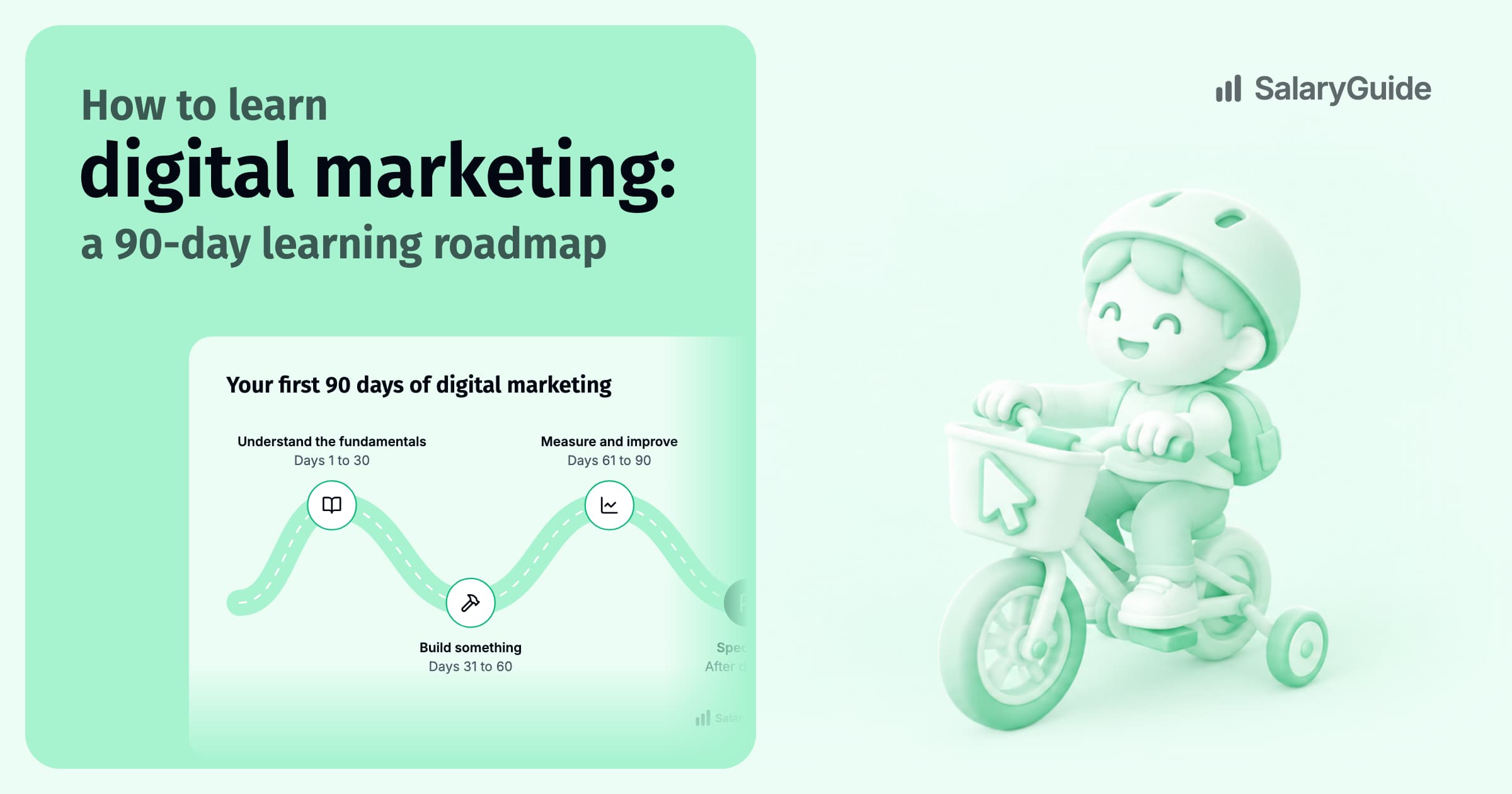
The four stages of learning digital marketing
A practical learning path can be broken into four stages:
| Stage | Objective | What you should produce |
|---|---|---|
| UNDERSTAND | Learn how digital marketing channels work together | A basic marketing plan and measurement framework |
| BUILD | Apply what you have learned | A real campaign, website, content asset or other project |
| MEASURE | Analyze performance and improve the work | Results, observations and documented decisions |
| SPECIALIZE | Choose an area for deeper development | A clearer learning and career direction |
The first three stages fit naturally into a 90-day learning plan.
Specialization comes afterward.
Days 1 to 30: UNDERSTAND the fundamentals
Your first month should be about understanding the system before trying to master individual platforms.
Start with the customer.
A business is normally trying to reach a particular audience, create demand or capture existing demand, persuade people to take an action and understand whether its marketing contributed to the result.
Different digital marketing disciplines solve different parts of that problem.
Learn how the main marketing disciplines fit together
You don’t need advanced expertise in every channel, but you should understand the basic purpose of each.
| Discipline | What you should understand initially |
|---|---|
| SEO | How businesses earn visibility when people search |
| Content marketing | How useful content attracts, educates and persuades an audience |
| Paid media | How businesses pay to reach or capture specific audiences |
| Social media | How brands distribute content and interact with audiences on social platforms |
| Email / CRM | How businesses communicate with leads and customers over time |
| Analytics | How marketing activity and user behavior are measured |
| CRO | How businesses improve the percentage of users taking a desired action |
| Copywriting | How messaging influences attention, understanding and action |
You are learning the relationship between these areas rather than attempting to become an SEO specialist, PPC specialist and CRM specialist at the same time.
For example, a business might:
create useful content → gain search visibility → attract visitors → capture leads → nurture them by email → generate conversions → analyze performance → improve the journey
Once you can see those relationships, individual marketing tactics make much more sense.
Learn the customer journey
A simple model is:
Awareness → Consideration → Conversion → Retention
At each stage, ask:
- What is the customer trying to achieve?
- What information do they need?
- Which channel could reach them?
- What action do we want them to take?
- How would we know whether the activity worked?
This prevents you from learning marketing as a collection of disconnected tools.
Learn basic measurement
Start thinking about measurement immediately rather than treating analytics as an advanced subject.
You should understand the difference between:
- an impression;
- a click;
- a session or visit;
- an engagement;
- a lead;
- a conversion;
- revenue;
- cost;
- conversion rate;
- cost per acquisition;
- return on advertising spend.
You do not need to memorize every metric available inside an analytics or advertising platform.
The more important skill is learning to ask:
What was the objective, what happened and what does the evidence suggest we should do next?
Choose one project for the next 60 days
By the end of the first month, choose something real that allows you to practice.
It could be:
- a simple website around a subject you understand;
- a small project for a club, charity or local organization;
- a marketing project for an existing business, where you have permission;
- a landing page and acquisition plan for a fictional product;
- a content-led site designed specifically as a learning environment.
Avoid creating separate artificial exercises for every marketing channel if you can.
One connected project teaches you more because you can see how the pieces interact.
Days 31 to 60: BUILD something
The second month is where passive learning should give way to application.
You are not trying to demonstrate that you know every feature inside a particular tool.
You are trying to demonstrate that you can take a marketing problem and make sensible decisions about it.
Start with an objective
Define what your project is trying to achieve.
For example:
Attract people interested in a particular subject and persuade some of them to sign up for an email update.
That gives you something around which SEO, content, copywriting, analytics, CRO and email can all be practiced.
Define the audience
Write down:
- who you are trying to reach;
- what problem or need they have;
- what might cause them to search or pay attention;
- what information could help them;
- what action you want them to take.
It doesn’t need to become a complicated persona exercise.
The purpose is simply to stop yourself creating marketing without knowing who it is for.
Create something useful
Depending on your project, this could mean:
- researching a search problem;
- producing a useful page or piece of content;
- writing a landing page;
- creating an email;
- planning social distribution;
- producing ad concepts;
- improving website messaging.
This is where disciplines such as content strategy and copywriting become practical rather than theoretical.
Practice SEO
At a beginner level, learn how to:
- identify what people are searching for;
- understand the likely intent behind a query;
- assess what existing search results are trying to satisfy;
- structure a useful page around that need;
- write clear titles and headings;
- create sensible internal links;
- understand basic crawling and indexing concepts;
- use search-performance data to evaluate what happens.
You do not need to learn every technical SEO issue before you can practice the fundamentals.
Practice paid media without treating spend as a requirement
You should understand the fundamentals of paid acquisition:
- campaign objective;
- audience or keyword targeting;
- creative;
- copy;
- landing-page relevance;
- conversion tracking;
- budget;
- CPC;
- CPA;
- ROAS.
You do not have to spend money simply to prove that you are learning digital marketing.
If you have access to a legitimate campaign, that can provide useful experience. If not, build a campaign plan instead.
Document:
- the objective;
- target audience;
- campaign structure;
- example creative and copy;
- proposed landing page;
- conversion event;
- metrics you would monitor;
- how you would decide whether to continue, change or stop the campaign.
The thinking matters as much as clicking buttons inside an advertising platform.
Practice email and CRM thinking
Email marketing is more than sending newsletters.
Learn to think about:
- why someone would subscribe;
- consent;
- segmentation;
- lifecycle stage;
- message relevance;
- triggers;
- calls to action;
- engagement;
- conversion;
- retention.
For your project, you might design a simple sequence:
Signup → Welcome → Useful follow-up → Relevant next action
Even if you do not deploy a sophisticated automation platform, you can demonstrate that you understand why each message exists.
Practice social media as a distribution channel
Don’t reduce social media learning to “post every day”.
Instead, choose a platform relevant to your project’s audience and consider:
- why that audience uses the platform;
- which content formats fit it;
- how your message should change for the platform;
- what response you want;
- how you would measure whether distribution worked.
This develops channel judgment rather than simply content-production volume.
Days 61 to 90: MEASURE and improve
Your final month should shift the emphasis from creating things to understanding what happened.
This is one of the most important transitions in learning marketing.
A marketer does not only execute work.
They need to evaluate it.
Start with the objective
Return to the objective you defined at the beginning.
Then ask:
- What did we want to happen?
- What actually happened?
- Where did users come from?
- What did they do?
- Where did they stop?
- Which evidence is reliable?
- What don’t we know yet?
- What would we change next?
That is a much stronger analytical habit than simply reporting whichever numbers increased.
Learn to diagnose performance
Suppose a landing page received traffic but generated few conversions.
That does not automatically tell you what is wrong.
Possible explanations include:
- the traffic was poorly matched;
- the offer was weak;
- the message did not match the acquisition source;
- the page created unnecessary friction;
- tracking was incorrect;
- the sample was too small to support a conclusion.
Good marketing analysis separates observation from explanation.
For example:
Observation: Visitors reached the page but few completed the form.
Possible explanation: The form may create too much friction.
Next step: Investigate behavior and test an appropriate change.
That distinction is worth learning early.
Understand experimentation
Conversion optimization is useful because it teaches disciplined decision-making.
A simple process is:
Evidence → Hypothesis → Change → Measure → Learn
Not every project will have enough traffic for a meaningful controlled experiment.
That is fine.
Do not manufacture an A/B test simply to say you have performed one. Learn the principles and use the level of evidence your project actually supports.
Document what failed
A project does not need spectacular results to be useful evidence.
If something underperformed, document:
- what you expected;
- what happened;
- what evidence you collected;
- why you think it happened;
- what you would change;
- what you learned.
Being able to analyze an unsuccessful decision is a real marketing skill.
What should you know after 90 days?
You should not expect mastery.
A better target is functional understanding plus evidence.
By the end of the roadmap, aim to be able to explain:
Strategy
- who the audience is;
- what the objective is;
- how different marketing channels could contribute;
- why you chose a particular approach.
Acquisition
- the basic difference between organic and paid acquisition;
- how search intent affects SEO;
- how paid campaigns connect audience, creative, landing pages and measurement;
- how social platforms can distribute messages and content.
Content and communication
- how content supports a marketing objective;
- how messaging changes by audience and channel;
- how copy can influence action.
Lifecycle
- why marketers collect permission to communicate;
- how email and CRM can support leads and customers at different stages;
- why segmentation and relevance matter.
Measurement
- how to define a conversion;
- how to choose metrics that relate to an objective;
- how to distinguish activity from outcomes;
- how to investigate performance;
- how to propose a sensible next action.
Most importantly, you should have examples showing that you have actually applied some of those ideas.
What evidence should you create while learning?
Do not wait until the end of the 90 days to think about evidence.
Keep a record as you work.
For each meaningful project, capture:
| Evidence | What to record |
|---|---|
| Problem | What were you trying to achieve? |
| Context | Who was the audience and what constraints existed? |
| Decision | What did you decide to do and why? |
| Execution | What did you actually create or change? |
| Measurement | How did you assess the result? |
| Outcome | What happened? |
| Learning | What would you retain, change or investigate next? |
This gives you the raw material for a marketing portfolio later.
For detailed guidance on turning that evidence into case studies, see our guide to building a marketing portfolio.
After 90 days: SPECIALIZE
Once you have worked across the fundamentals, you can make a more informed decision about where to go deeper.
This is where the useful material from a generic “marketing skills to learn” list becomes much more valuable.
Instead of attempting to learn ten skills simultaneously, choose an area based on the type of problems you enjoy solving.
If you enjoy search and research
Explore:
- SEO;
- content strategy;
- search behavior;
- technical website performance;
- content measurement.
If you enjoy numbers and experimentation
Explore:
- analytics;
- performance marketing;
- paid media;
- CRO;
- attribution and measurement.
If you enjoy writing and communication
Explore:
- content marketing;
- copywriting;
- email;
- brand;
- social media.
If you enjoy customer journeys and systems
Explore:
- CRM;
- lifecycle marketing;
- marketing automation;
- email;
- customer retention.
If you enjoy commercial growth problems
Explore:
- paid acquisition;
- growth marketing;
- CRO;
- analytics;
- lifecycle marketing.
These categories overlap. That is normal.
Digital marketers frequently develop broad knowledge while becoming substantially stronger in one or two areas.
For a deeper look at where those specialisms can lead, see our marketing career path guide.
How should you choose what to specialize in?
Don’t base the decision entirely on whichever skill happens to be fashionable.
Consider four things:
1. Aptitude
Which work are you becoming good at?
2. Interest
Which problems do you actually enjoy solving?
3. Evidence
Where have you already demonstrated useful capability?
4. Market demand
What are employers actually asking for in the roles you want?
Reviewing real job descriptions is useful here.
Look at recurring responsibilities and requirements rather than assuming that a particular course or certification automatically represents what employers need.
If you are starting without professional marketing experience, our guide to getting into marketing with no experience covers the separate process of turning that evidence into a credible route toward your first role.
Do you need digital marketing certifications?
Certifications can be useful when they give you structured learning or help you understand a platform.
They are not a substitute for practical application.
A useful test is:
Will this course help me understand something I need to know, and can I apply that knowledge afterward?
If yes, it may be worthwhile.
Avoid collecting certificates simply to make your resume longer.
Platforms, qualifications and course content also change, so assess current training based on the role and skill you are trying to develop rather than following a fixed list indefinitely.
Do you need a marketing degree?
Requirements vary between employers and roles.
Some positions or graduate schemes may specify a degree. Others place greater emphasis on relevant skills and evidence.
If you do not have a marketing degree, your practical work becomes particularly useful because it gives you something concrete to discuss.
The aim is not to prove that formal education has no value. It is to demonstrate what you understand and what you can do.
How long does it take to learn digital marketing?
There is no credible universal timeline for becoming job-ready or mastering digital marketing.
Your starting knowledge, available time, project access, chosen specialism and target role all affect the answer.
Treat the 90 days in this guide as a structured foundation period.
At the end, assess what you can actually demonstrate rather than whether a calendar says you should be ready.
Common mistakes when learning digital marketing
Learning without applying
Courses can explain concepts. Application reveals whether you understand them.
Use what you learn.
Trying to master every channel
Build breadth first, then depth.
You do not need expert-level SEO, PPC, CRM, social, analytics and content skills simultaneously.
Learning platforms instead of principles
Interfaces change.
Understanding audiences, intent, messaging, measurement, experimentation and economics is more transferable.
Avoiding analytics
Do not wait until you consider yourself “technical enough”.
Measurement should be part of your learning from the beginning.
Treating activity as evidence
Publishing ten posts or setting up a campaign tells someone what you did.
Strong evidence also explains why, what happened and what you learned.
Inventing impressive results
Do not exaggerate project outcomes to make your portfolio look stronger.
Accurate evidence and sensible analysis are more defensible than a fabricated success story.
Your 90-day digital marketing roadmap
Days 1 to 30: UNDERSTAND
- Learn the main digital marketing disciplines.
- Understand the customer journey.
- Learn fundamental marketing metrics.
- Study how channels work together.
- Review real marketing roles and their requirements.
- Choose one practical project.
- Define its audience, objective and measurement approach.
Days 31 to 60: BUILD
- Create the core project.
- Apply content and copywriting principles.
- Practice basic SEO.
- Understand paid campaign planning.
- Explore social distribution.
- Build basic email/lifecycle thinking.
- Implement appropriate measurement.
- Record your decisions as you work.
Days 61 to 90: MEASURE
- Review performance against the original objective.
- Separate observations from assumptions.
- Identify what worked and what did not.
- Form improvement hypotheses.
- Make appropriate changes.
- Measure again where possible.
- Document the project and your learning.
After day 90: SPECIALIZE
- Review which work you enjoyed.
- Identify where your strongest evidence sits.
- Compare your capabilities with real job requirements.
- Choose one area for deeper development.
- Continue building progressively stronger evidence.
Digital marketing learning checklist
By the end of your initial learning period, can you:
- explain how the main digital marketing disciplines fit together?
- define a target audience and marketing objective?
- explain the customer journey?
- create something for a real or realistic marketing problem?
- explain basic SEO and paid acquisition principles?
- explain how email, CRM and social support a wider journey?
- identify useful metrics for an objective?
- analyze what happened rather than simply report numbers?
- suggest a next action based on evidence?
- show at least one piece of practical work?
- explain what you learned from it?
- identify the marketing discipline you want to develop next?
If you can, you have moved beyond simply consuming digital marketing information.
You have started learning how marketers actually work.