How to Create a Career Development Plan for Marketers
Ever feel like you're just treading water in your marketing career, not quite sure what the next big move should be? If that sounds familiar, it's time to build a real career development plan. This isn't just a corporate checklist; it's your personal roadmap. It starts with an honest look at your skills and what you're genuinely passionate about, then moves to setting ambitious (but reachable) goals and laying out the exact steps to get there.
Why Your Marketing Career Demands a Plan
Marketing is a field that's always in flux—AI, economic curveballs, and shifting consumer habits mean you can't just sit back and wait for opportunities to fall into your lap. That's a recipe for getting left behind. A career development plan is what separates those who drift from those who navigate with purpose.
Without a clear direction, it's all too easy to get buried in the day-to-day grind, completely losing sight of your long-term ambitions. You end up on projects that do nothing for your growth or miss the chance to learn a game-changing new skill. Having a plan forces you to be proactive, to shape your own path instead of just reacting to whatever comes next. A great first step is simply understanding what's out there; you can explore career opportunities to get a feel for the landscape.

The Real Cost of Stagnation
In marketing, standing still means moving backward. The data backs this up. Zippia found that a staggering 76% of employees are actively looking for opportunities to grow their careers. If you aren't planning your own growth, you're competing with a massive pool of peers who are.
A structured plan gives you an immediate edge in several ways:
- Clarity and Focus: You're forced to define what success truly means to you. This clarity helps you say "yes" to the right projects and "no" to the wrong ones.
- Increased Motivation: When you know how today's tasks connect to your future goals, your daily work suddenly has a much deeper sense of purpose.
- Competitive Edge: A documented plan is proof of your ambition. It shows managers and recruiters that you're a strategic thinker, making you a much stronger candidate for that next promotion or role.
A well-crafted career development plan turns your professional life from a series of random events into a deliberate progression. It’s your personal business plan for the most important brand you’ll ever manage—yourself.
Building a Framework for Growth
Forget generic advice. This guide will walk you through a practical framework for building a plan that actually works for a modern marketer. We'll get into the weeds of conducting a deep self-assessment, setting goals that are actually relevant to where the industry is heading, and building an action plan to fill your skill gaps.
We'll even cover salary benchmarking, because your growth should absolutely be reflected in your paycheck. If you're wondering where you stand, our detailed guide on https://salaryguide.com/blog/how-much-do-marketers-earn is a great place to start.
Ultimately, this is about taking the wheel. A career plan is your commitment to yourself—a promise to start shaping your own future, starting right now.
Get Real With an Honest Self-Assessment
Before you can map out where you're going, you need to know exactly where you're standing. The first, most crucial step in any career plan is a candid look in the mirror. This isn't just about polishing your resume; it's about getting to the heart of your professional identity.
Think about what truly makes you tick at work. What projects have you worked on that made you genuinely excited to get out of bed? Was it the thrill of digging into data to figure out why a campaign worked, or was it the creative buzz of crafting a new brand voice? On the flip side, what tasks feel like you're wading through mud? Knowing what energizes you versus what drains you is the foundation for building a career you actually love.
Uncover Your Professional DNA
To get the full picture, you have to ask yourself some tough questions that go way beyond a typical performance review. The goal here is to get raw, unfiltered feedback—from yourself.
Start digging into these areas:
- Impact: Where have you really moved the needle? Think about specific wins where your actions directly led to better lead gen, higher conversion rates, or a jump in customer lifetime value. Get specific.
- Energy: What work leaves you feeling pumped up? Is it leading a brainstorming session, diving deep into a solo project, presenting to a crowd, or mentoring a junior team member?
- Feedback: What do your managers, peers, and clients consistently say about you? Look for the common threads in both the high-fives and the "areas for improvement."
This reflection gives you the story behind your skills. It provides the context you need to figure out what you want to do more of—and what you want to leave behind.
Run a Personal SWOT Analysis
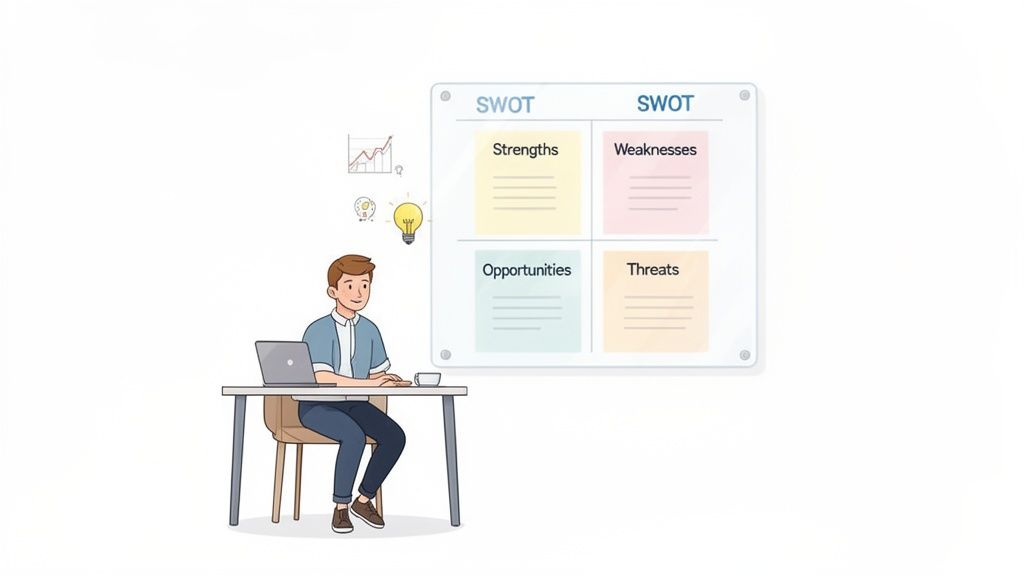
Once you've done some thinking, a SWOT analysis (Strengths, Weaknesses, Opportunities, Threats) is a fantastic tool for organizing all those thoughts. It’s a classic for a reason. Applying this business strategy framework to your own career is a game-changer, especially in a fast-moving field like marketing.
A personal SWOT isn't about judging yourself. It's about developing strategic self-awareness. It turns those vague feelings about your job into a concrete plan of action.
Here’s how a marketer might break it down.
Strengths (What you do well)
These are your superpowers—the skills and qualities that are your professional assets.
- Example: "I'm a wizard in Google Analytics 4. I can pull out deep user insights that my colleagues often miss."
- Example: "My email copywriting consistently pulls in open rates 15% higher than our industry average."
Weaknesses (Where you need to grow)
Time for some brutal honesty. What skills are holding you back? Where do you feel least confident? Acknowledging them is the only way to fix them.
- Example: "Presenting campaign results to leadership makes me a nervous wreck, which I know undermines my credibility."
- Example: "I have almost zero hands-on experience with marketing automation tools like HubSpot or Marketo."
Opportunities (What's happening out there)
These are the external trends or changes you can jump on. Think new tech, shifts in the market, or changes at your company.
- Example: "The company is finally investing in video marketing, which is a perfect chance for me to step up and lead a new project."
- Example: "Programmatic advertising skills are in high demand right now, and I could get certified online in a few months."
Threats (What could get in your way)
These are the outside forces that could make your current skills obsolete or jeopardize your role.
- Example: "AI content tools could make my current writing process less valuable if I don't learn how to use them to my advantage."
- Example: "My job is all about organic social, but algorithm changes are making it way less effective for our brand."
Laying it all out like this gives you a clear, comprehensive snapshot of where you are right now. This document is your foundation. It makes setting goals and spotting skill gaps a much more focused and effective exercise. To get a better handle on the skills you might need, it’s always a good idea to check out some common digital marketing job requirements for the kinds of roles you're aiming for.
Plotting Your Course: Set Career Goals That Actually Work
You’ve done the hard work of looking in the mirror with an honest self-assessment. That’s your starting line. Now, it's time to channel that insight into real forward momentum by setting goals that will genuinely push you without leading to burnout. This is where we move from wishful thinking to a concrete action plan.
One of the biggest traps I see marketers fall into is setting fuzzy targets. Think "get better at SEO" or "get a promotion someday." Goals like these feel good to say, but they're useless in practice because they have no direction and no finish line. A truly effective career plan is built on objectives with laser-like precision.
From Hazy Hopes to SMART Goals
The absolute best way to give your ambitions some teeth is to run them through the SMART framework. It’s a classic for a reason. This simple gut-check ensures your goals are Specific, Measurable, Achievable, Relevant, and Time-bound. It’s the difference between hoping for a promotion and engineering one.
Instead of saying, "I want to become a manager," you can build a goal with tangible milestones.
A much stronger goal for an aspiring leader would be: "To earn a Marketing Manager title within the next 24 months by successfully leading two major cross-functional projects, formally mentoring one junior team member, and completing a certified management training course."
See the difference? This version isn’t just about the what; it lays out the how and the when. It gives you a clear path with checkpoints along the way, making your big ambition feel much more manageable.
To show how this works across different marketing disciplines, let's look at a few examples.
Applying the SMART Goal Framework to Marketing Roles
This table illustrates how to transform vague career aspirations into powerful SMART goals with concrete examples for different marketing specializations.
| Component | Vague Goal | SMART Goal Example |
|---|---|---|
| Specific | I want to get better at SEO. | I will increase organic traffic for our top five product pages. |
| Measurable | I'll improve our organic traffic. | I will increase organic traffic by 20%. |
| Achievable | I'll double our traffic overnight. | The 20% increase is based on our past growth rate of 15% and new content initiatives. |
| Relevant | I just want to learn a new skill. | Increasing organic traffic directly supports the company's goal of reducing paid ad spend. |
| Time-bound | I'll do this sometime this year. | I will achieve this 20% increase within the next six months (by the end of Q2). |
As you can see, applying the SMART framework forces you to think through the logistics, ensuring your goal is grounded in reality and tied to meaningful business outcomes.
Think in Horizons: Short, Mid, and Long-Term Goals
A solid career plan doesn't just focus on your next move; it maps out the entire journey. The best way to do this is to set goals across three different time horizons, ensuring each one builds on the last.
Short-Term Goals (6-12 months): These are your immediate priorities. They're all about quick wins and skill acquisition to build momentum. Think about earning a Google Ads certification or volunteering to own your team’s next quarterly analytics report.
Mid-Term Goals (1-3 years): Here’s where you start making bigger moves. These goals should represent major career milestones, like stepping into a Senior Specialist role, managing your first direct report, or truly mastering a complex platform like HubSpot.
Long-Term Goals (5+ years): This is your north star. It’s the big-picture vision that guides everything else. Maybe it’s a Director of Marketing role, launching your own freelance consultancy, or becoming a go-to expert in a niche like conversion rate optimization.
Structuring your goals this way keeps your day-to-day efforts directly connected to your ultimate ambition. It's how you make sure the tasks you're doing today are paving the way for the career you want tomorrow.
Ground Your Ambitions in Reality
Setting personal goals is crucial, but doing it in a vacuum can set you up for disappointment. To be truly effective, your ambitions have to sync up with what's happening in the industry and the job market.
For example, as you map out your plan for the next couple of years, it's worth knowing that employers project just a 1.6% hiring increase for the Class of 2026. You can dig into the specifics in the full Job Outlook 2026 research.
This isn’t a reason to scale back your dreams. It's a signal to be smarter and more strategic. In a tight market, proactive planning for high-demand roles in SEO, growth, and content marketing is no longer optional—it's essential.
If you’re aiming for a competitive field like performance marketing, this data tells you to double down on skills the market craves: deep data analysis, complex budget management, and multi-channel campaign optimization. When you align your personal growth with what the industry values, you build a career that’s not only fulfilling but also incredibly resilient.
Build Your Strategic Action Plan
Once you know where you want to go, it's time to build the bridge to get there. This is the nuts-and-bolts part of your plan, turning your big career goals into a tangible, step-by-step roadmap. A real action plan isn’t just wishful thinking; it’s about breaking down your ambitions into concrete tasks focused on learning new skills and, more importantly, putting them to use.
The first step is a good, hard look in the mirror with a skills gap analysis. This sounds more intimidating than it is. Just pull up three to five job descriptions for the role you're aiming for. Open a simple spreadsheet, list every required skill you see, and then honestly rate your own proficiency for each one.
This simple exercise is incredibly revealing. It shows you exactly what’s standing between you and your next move—whether it's a specific marketing automation tool, advanced data visualization chops, or team leadership experience.
Design Your Personal Curriculum
With your skill gaps staring you in the face, you can now build a personalized learning plan. Think of it as creating your own professional curriculum, but one that’s 100% focused on your goals. This isn't about just watching a bunch of videos; it's a targeted strike to get the skills you need.
A great curriculum mixes things up to keep you engaged and make the learning stick.
- Formal Certifications: Look for industry-recognized credentials that pop on a resume. This could be a Google Ads certification or even a Project Management Professional (PMP) if you're eyeing a management track.
- Online Courses and Workshops: Sites like Coursera and LinkedIn Learning are goldmines for deep dives into specific topics. You could take a course on advanced conversion rate optimization (CRO) or find a workshop on public speaking to nail your next presentation.
- Reading and Research: Never underestimate the power of good old-fashioned reading. Set a goal to read one influential marketing book each quarter or to actually read and summarize the takeaways from three top-tier industry newsletters every week.
Thinking about your plan in stages—short-term, mid-term, and long-term—can make it feel much more manageable.
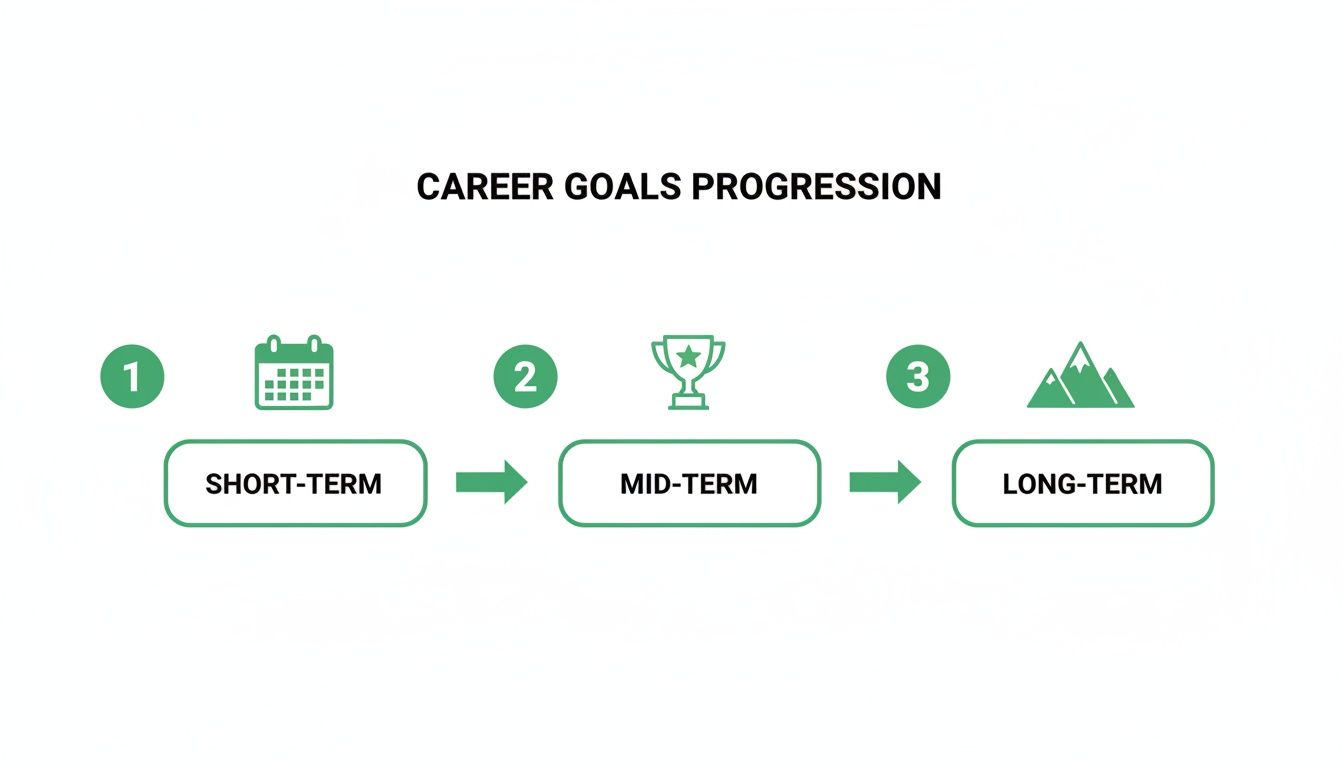
When you can see how today's small learning activity connects to that big mountain-top goal, it keeps you motivated. Every step suddenly has a purpose.
Turn Knowledge into Tangible Experience
Learning new things is great, but it’s only half the battle. The most crucial part of any action plan is putting that knowledge to work in the real world. You need to find ways to get hands-on experience you can actually put on your resume and talk about in an interview.
Theoretical knowledge gets you in the door. Demonstrated application of that knowledge gets you the job. Your plan must prioritize creating portfolio-worthy proof of your new skills.
Start looking for opportunities to apply what you've learned. Maybe that means volunteering to lead the next analytics report at work or offering to help build out a new email nurture sequence. If things are slow internally, look for small freelance projects on the side. Even creating a mock campaign strategy for a brand you admire can be a powerful way to showcase a new skill. The name of the game is creating concrete evidence that you can deliver results.
The Modern Career Is Not a Straight Line
It’s worth remembering that careers aren't a straight ladder anymore. Technology and the economy are always shifting, which means we all have to keep adapting. Projections even show that 1 billion workers worldwide will need to be reskilled by 2030 just to keep up.
This is exactly why having a smart, data-informed plan is so critical. By combining structured learning with practical application, you’re not just hoping for growth—you’re engineering it. This makes your plan resilient and ready for whatever comes next. For managers who want to build this kind of clarity for their teams, our guide on crafting a 30-60-90 day plan for managers is a fantastic starting point.
By following these steps, your career development plan transforms from a static document into a dynamic engine for your professional growth.
Grow Your Network and Professional Visibility
A brilliant career development plan is fantastic, but if it just sits in a private document on your hard drive, it's only doing half the job. To really get your career moving, you have to connect your new skills and big ambitions with strategic visibility. This is about more than just learning new things; it’s about actively building your professional reputation, both inside your company and out in the wider industry.
Getting noticed isn't about being the loudest person in the room. It’s about being recognized for the value you bring to the table. This takes a deliberate, consistent effort to connect with the right people and share what you know in ways that actually help them. Without this crucial piece, even the most talented marketer can get passed over for the best opportunities.
Cultivate Your Digital Presence
For marketers today, your online presence is your business card, resume, and portfolio all rolled into one. It’s often the first place a recruiter, a potential mentor, or your next boss will look you up. A huge part of this is truly understanding what is professional networking in a world that’s gone digital.
Start by thinking of your LinkedIn profile as more than just an online resume. It’s a living, breathing platform to show off your expertise.
- Engage with intention. Don't just be a passive scroller. Pinpoint 10-15 influential leaders or companies in the niche you're targeting. Make it a daily habit to leave just one insightful comment on their posts. You could ask a thoughtful question, add a unique perspective from your own work, or share a relevant experience.
- Share what you know. You don’t need a C-suite title to have valuable insights. Post about a recent campaign win, a new tool you're experimenting with, or your biggest takeaways from an industry report. Consistency is far more important than trying to go viral.
This simple shift turns you from a silent observer into an active voice in your industry’s conversation, slowly but surely building your personal brand.
Find and Nurture Key Relationships
The word "networking" can bring up some cringey images of awkward conference mixers and forced small talk. But its real power is in building genuine, mutually beneficial relationships. And one of the most powerful relationships you can build is with a mentor.
Finding a mentor rarely starts with a cold message asking, "Will you be my mentor?" It’s a process of building a connection first. Engage with their content online, find a common interest, or ask for a quick, 15-minute virtual coffee to pick their brain on a specific challenge you're facing.
When you do make an "ask," be incredibly specific. A vague request for guidance is easy to ignore. Instead, try something like this: "I'm working on getting better at managing budgets for large-scale PPC campaigns. Could I borrow 20 minutes of your time next month to hear how you approached that on a past project?" This respects their time and gives them a clear, easy way to help you.
The same idea applies to networking inside your own company. Don't just wait for your annual review to talk about your work. Set up brief, proactive check-ins with your manager to share wins, talk through roadblocks, and make sure your development goals are aligned with what the team needs. This keeps your contributions visible and top-of-mind.
Increase Your Internal Visibility
Your current job is the most immediate stage you have for growth. Getting noticed by the higher-ups isn’t about shameless self-promotion; it’s about showing your impact and taking ownership.
Here’s a game-changing insight for your plan: a recent report found that nearly 12,000 executives worldwide agree that AI alone isn't the answer to the talent shortage. They're emphasizing that upskilling and reskilling have to be human-focused and built into personalized plans. This is a massive opportunity for you to stand out by being the person who not only learns new skills but translates them into real success for the team.
To make this happen, here are a few practical steps:
- Volunteer for high-impact projects. Keep an eye out for initiatives that are visible to senior leadership or that solve a major business problem.
- Document and share your wins. Don't just assume your boss sees everything you do. Send a short weekly or bi-weekly email with bullet points highlighting your accomplishments and, most importantly, their impact on key metrics.
- Become a resource for others. If you’ve just mastered a new tool or figured out a better process, offer to host a quick lunch-and-learn for your team. This positions you as a knowledgeable expert and a collaborative colleague.
By weaving together a strong external network with intentional internal visibility, you create a powerful feedback loop. Your growing reputation will open doors to new projects and roles, which in turn give you more experience to share, fueling your career development all over again.
Your Career Planning Questions, Answered
Look, even the most buttoned-up career plan is going to bring up some questions. Once you start putting this stuff into practice, the "what ifs" and "how tos" naturally pop up. Let's walk through some of the most common hurdles marketers face when trying to make their career plan a real, living guide.
This document isn’t meant to be carved in stone. Think of it as a dynamic tool—something that needs to stay relevant as you, your skills, and your ambitions change over time.
How Often Should I Actually Look at This Thing?
One of the biggest mistakes I see is people pouring hours into a beautiful plan, only to let it collect digital dust in a forgotten folder. For this to work, you have to give it regular attention. It’s just like any marketing campaign you’d run; you need to monitor it, tweak it, and optimize it to get results.
A simple rhythm that works for most people is:
- Quarterly Check-ins: At the end of every quarter, block out an hour on your calendar. This is your quick pulse check. Did you finish that SEO course? Did you volunteer for that cross-functional project? It’s just about making sure you’re staying on track with your immediate goals.
- Annual Refresh: Once a year, it's time for a deeper dive. This is where you revisit your SWOT analysis, challenge your long-term goals, and map out what the next 12 months should look like. The person you were a year ago might have wanted something different, and that's not just okay—it's expected.
This cadence keeps your plan sharp and aligned with where you are now, without turning it into a soul-crushing admin task.
What Happens When My Career Goals Change?
Let me save you some suspense: they will. It’s practically a guarantee. You might stumble into a data analytics project and discover you love it, or realize that the management track you've been gunning for just isn't you. A change of heart isn't a failure. It’s a sign that you’re growing and learning what truly motivates you.
When your goals shift, don't just toss your plan out the window. Use it as the framework for your pivot.
- Go Back to Your Self-Assessment: Re-read what you wrote about your core strengths and what gives you energy. Why did things change? Nailing down the "why" is the key to setting a new course that feels right.
- Define Your New North Star: What does this new path look like in five years? Get a clear picture of your new long-term vision.
- Map Out a New Action Plan: You'll need to do a fresh skills gap analysis for this new direction. All the skills you’ve already built are still valuable assets; you just need to figure out what new ones you need to add to the mix.
Your career development plan is a compass, not a GPS with a locked-in route. Its real job is to help you navigate, especially when you decide to explore a completely new destination.
How Do I Get My Manager On Board with This?
Getting your manager in your corner can be a total game-changer for your growth. The trick is to frame your plan as a win-win, not just a list of things you want. You need to show them how your development directly fuels the team’s—and the company’s—success.
When you sit down to talk, tie your goals directly to business outcomes. For example, instead of just saying, "I want to learn about CRO," shift the conversation. Try something like, "I want to take a deep dive into conversion rate optimization. I think if I do, I can help us improve our landing page performance by 10% next quarter."
See the difference? That approach instantly changes you from someone just asking for training into a strategic partner who’s invested in driving real results. Any good manager will see the value in that immediately.
What Tools Should I Use to Track Everything?
Honestly, don't over-engineer this. The best tool is the one you’ll actually open and use consistently. You don’t need fancy project management software if a simple document gets the job done.
Here are a few simple but powerful options:
- A Google Doc or Notion Page: Super easy to access, edit, and share. You can create clean headings for your assessment, goals, action items, and notes.
- A Trello or Asana Board: This is perfect if you’re a visual person. You can create columns for things like "Goals," "Learning in Progress," and "Projects Completed" to get a quick snapshot of where you are.
Just pick something that feels natural to you. The goal is to keep your plan accessible and top-of-mind, not buried in a file you never look at.
Ready to find a marketing role that truly lines up with your new career plan? At SalaryGuide, we cut through the noise by sourcing jobs directly from company career sites, giving you a clear view of real opportunities. Find your next move at https://salaryguide.com.
