Your Guide to the 30 60 90 Day Plan for Managers
When you step into a new management role, it often feels like you're trying to drink from a firehose. A 30-60-90 day plan for managers is your best tool for taming that chaos, turning your first three months from overwhelming into genuinely impactful. Think of it as a strategic roadmap that lays out your goals, priorities, and actions for your initial quarter, helping you build credibility and notch some early wins.
Why a 90-Day Plan Is Your Secret Weapon
A well-thought-out plan is so much more than a to-do list. It's a powerful communication tool that aligns your vision with what leadership expects, right from the very beginning. Instead of trying to guess what success looks like, you’re co-creating that picture with your new boss and team. This proactive approach helps you sidestep the classic new-leader traps, like chasing the wrong priorities or having a slow start that makes everyone nervous.
Honestly, it's probably the single most important investment you can make in your own success. It helps you transition from being "the new manager" to an indispensable leader much faster than you might think.
The Strategic Phases of Your First Quarter
Your plan isn't about trying to boil the ocean. The real magic is in sequencing your efforts for maximum impact. Each 30-day block should have a distinct theme and purpose, guiding you methodically from observation to full ownership.
The visual below breaks down this natural progression, showing how you move from listening and learning to contributing, and finally, to leading with confidence.
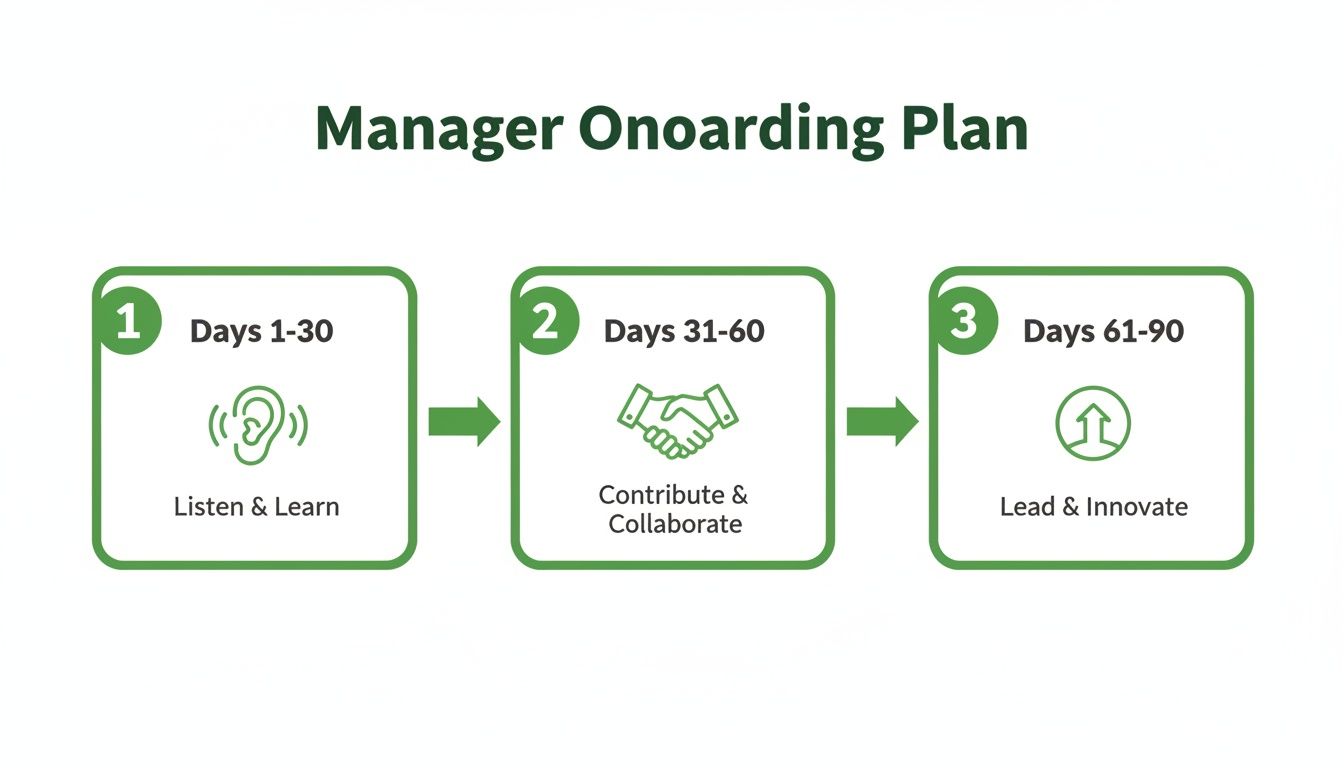
This phased approach is critical. It ensures you earn trust and gather essential context before you start proposing big changes, which is key to getting buy-in and achieving long-term success.
To make this even clearer, here's a simple breakdown of the mindset for each phase.
The Core Focus of Each 30-Day Phase
| Phase | Primary Focus | Key Outcome |
|---|---|---|
| First 30 Days | Listen & Learn | A deep understanding of the team, culture, processes, and key challenges. |
| Next 30 Days | Contribute & Collaborate | Actively participating in projects, identifying quick wins, and building key relationships. |
| Final 30 Days | Lead & Innovate | Driving initiatives, implementing strategic improvements, and taking full ownership of your role. |
By breaking it down this way, you can focus on the right activities at the right time, making the whole process feel much more manageable.
More Than a Plan—It's a Retention Tool
The value here extends far beyond your own performance; it directly impacts your team's stability and morale. In fast-paced fields like digital marketing, where good paid media managers are hard to keep, a solid 30-60-90 day plan has been shown to slash early attrition by up to 20% within the first 45 days. Why? Because a structured start makes new hires feel supported and gives them absolute clarity on what's expected.
A great onboarding experience is the first step toward great employee retention. When new hires see that you have a clear, thoughtful plan for their success, it builds immediate psychological safety and commitment.
This framework also sets a powerful precedent for your own performance reviews down the line. By establishing clear goals and metrics in your first 90 days, you create a transparent foundation for ongoing conversations about your progress. This turns the eventual 90-day review into a productive dialogue about concrete achievements, not just a vague chat about "how you're settling in."
The core benefits are crystal clear:
- Clarity and Focus: It gives you a north star, helping you prioritize what truly matters and tune out the noise.
- Stakeholder Alignment: It gets everyone on the same page—your manager, your direct reports, and other departments.
- Accelerated Impact: It helps you deliver meaningful results quickly, proving your value and competence right away.
- Reduced Stress: It breaks the monumental task of starting a new leadership role into bite-sized, manageable chunks.
Your First 30 Days: The Immersion Phase
Welcome to the new role. You’re probably feeling a powerful urge to jump in, make changes, and prove your worth right away. My advice? Resist it.
Your first month isn't about execution; it's about observation and absorption. Think of yourself as a sponge. Your single most important job is to learn—to soak up everything you can about the team, the company culture, and the way things really work around here. Trying to make big moves now is like trying to navigate a new city without a map. You'll move, but you'll probably get lost.

People and Conversations First
Forget the tech stack or the project backlog for a minute. Your first priority is your people. Your success as a manager will be built on the relationships you start forming right now, so make scheduling one-on-one meetings your top task.
Your meeting list should include:
- Every direct report: This is non-negotiable. Get to know their roles, what excites them, and what roadblocks they face.
- Your direct manager: Get crystal clear on their expectations for your first 30 days and set up a regular check-in.
- Key cross-functional partners: Find out who your team relies on in sales, product, customer success, etc., and connect with them.
- Other managers at your level: These peers will be an invaluable source of insight into team dynamics and shared challenges.
These conversations are your most critical data source. Show up with genuine curiosity, not an agenda.
Ask Questions That Actually Matter
You need to go deeper than "What do you do?" to get real insights. Your goal is to uncover the hidden pain points and unspoken opportunities that don't show up in any formal report.
Powerful Questions to Ask in Your One-on-Ones:
- "If you could wave a magic wand, what's the one thing you'd change to make your job easier?"
- "What is our team’s greatest strength? And where are we falling short?"
- "If you were in my shoes for a day, what would be the very first thing you'd focus on?"
- "Who are the unofficial experts on this team? The go-to people for specific things?"
- "What's one piece of team history or a past project I absolutely need to know about?"
These questions open the door to candid feedback and signal that you're here to listen and support, not just dictate. Take notes and start looking for the themes that keep popping up.
Your goal in these meetings is 80% listening and 20% talking. Capture notes, synthesize findings, and identify the patterns that emerge across conversations. This process will reveal the true landscape of your new role.
For managers, especially in functions like marketing, using a structured 30-60-90 day plan for managers is a game-changer for hitting the ground running. A well-organized onboarding can make a new hire productive 2.6x faster than an unstructured one. You can dive deeper into these findings and other onboarding best practices to see the impact.
Focus on Learning and Mapping
While people are your first priority, you also need to get your hands dirty with the tools, processes, and data. Set some clear learning goals for yourself this month.
Key Learning Goals for Your First Month:
- Understand the Tools: Get hands-on with the primary software your team uses every day, whether it’s Asana, Google Analytics, or the company CRM.
- Review Key Documentation: Dig into past performance reports, project plans, strategy docs, and any onboarding materials you can find.
- Analyze Historical Data: Get a feel for the baseline. Look at recent campaign performance, key metrics, and dashboards to understand what "good" looks like.
As you do this, you're not just collecting facts; you're building a mental map of the organization. You're figuring out who talks to whom, what processes are broken, and where the real leverage points are. This map will be your most valuable asset in the months ahead.
By day 30, you won't have a list of sweeping changes. Instead, you should have a clear stakeholder map, a summary of the key challenges and opportunities you've heard, and a personal plan to fill your own knowledge gaps. This foundation is what your future success will be built on.
Your Next 30 Days: The Contribution Phase
You’ve spent the first month absorbing everything you can—the people, the processes, the politics. Now it's time to shift gears from observation to action. This second phase, from day 31 to 60, is where you start translating that knowledge into tangible results that build momentum and credibility.
This is the "Contribution Phase" of your 30-60-90 day plan for managers. You’re moving from being a student of the business to an active participant. The goal isn't to boil the ocean or launch some massive, disruptive project. It's all about finding and executing on targeted improvements, often called "quick wins."
Identify High-Impact Quick Wins
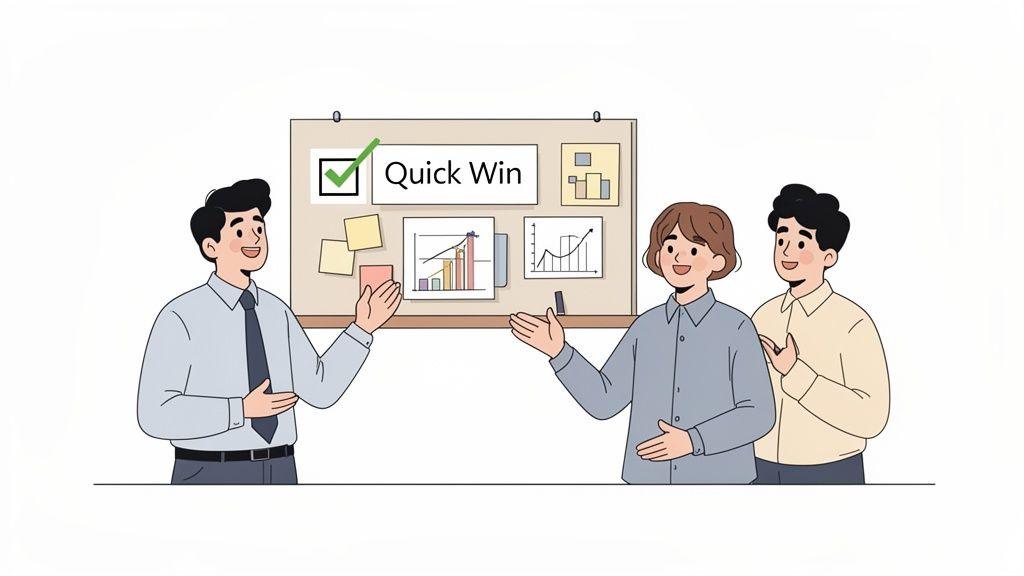
A quick win is a small, focused initiative that solves a real pain point, generates goodwill, and can be wrapped up in a few weeks. These wins are your chance to show your team you're there to help, not just to manage. The insights you gathered in your first 30 days are your treasure map for finding these opportunities.
Think back to your notes from all those one-on-ones. What were the recurring frustrations or bottlenecks people kept mentioning?
- Is there a clunky content briefing process that slows everyone down?
- Maybe an underperforming ad campaign could use a fresh set of eyes?
- Is communication between departments a constant source of friction?
These are prime candidates for your first real contributions. The trick is to choose something you can tackle with your team, not something you impose from the top down.
For example, a new Marketing Manager might hear that the social media specialist is drowning in manual reporting. A fantastic quick win would be to work with them to build a simple, automated dashboard that saves them hours each week. You solve a real problem and immediately build a strong ally.
Frame Your Ideas as Collaborative Proposals
Once you've zeroed in on a potential quick win, how you present it is everything. This can't feel like a directive. Frame it as a collaborative proposal to get buy-in from both your boss and the team members who will be involved.
A simple "Quick Win Proposal" can work wonders here. It’s just a short, informal document that lays out your idea clearly.
Key Elements of a Quick Win Proposal:
- The Problem: Briefly state the issue you've identified, referencing the pain points you heard directly from the team.
- The Proposed Solution: Describe your idea for a simple, focused improvement.
- The Impact: Explain the expected benefit. Will it save time, cut costs, improve morale, or boost a specific metric?
- The Ask: Clearly state what you need—which is usually just the time and collaboration of a few team members.
Presenting your ideas this way shows you’ve done your homework and that you respect the existing team and their expertise. It makes it easy for your manager to say "yes" and for your team to get on board.
This middle phase is all about building trust through action. Every small, successful collaboration proves you're a valuable partner and strengthens your mandate to lead bigger initiatives later on.
Start Facilitating and Problem-Solving
With a quick win approved, your role shifts to that of a facilitator. You’re not just delegating tasks; you're in the trenches with your team, removing obstacles and driving the initiative forward. This is where your management skills really start to shine.
This hands-on involvement will also be your first real test of navigating team dynamics. As you step into active management, you'll need to be prepared with effective conflict resolution strategies for when disagreements inevitably pop up.
Let's say your quick win is to overhaul that underperforming Google Ads campaign. Your role might involve:
- Scheduling a brainstorm with the PPC specialist and a copywriter.
- Pulling the performance data yourself to help guide the conversation.
- Protecting their time so they can actually focus on developing new ad copy and landing page tweaks.
- Communicating progress back up the chain to your manager.
By the end of this 30-day period, you should have at least one or two completed quick wins under your belt. More importantly, you'll have demonstrated your competence, built stronger relationships, and earned the trust you need to move into the final, most impactful phase of your plan. You’re no longer just learning the ropes; you're actively helping to weave them into something stronger.
The Final 30 Days: The Leadership Phase
Alright, you've made it through the first two months. You’ve spent that time listening, learning, and pitching in. Now, with that credibility banked, it’s time to step fully into your role as a leader. Days 61 through 90 are all about looking forward and starting to shape the future of your team and its work.
This is where your 30 60 90 day plan for managers truly blossoms. You’re no longer just managing the day-to-day; you’re setting the direction. You'll take all the insights you’ve gathered and start putting bigger, more strategic ideas into motion. This is your chance to solidify your position as a forward-thinking leader who delivers real, lasting value.
From Quick Wins to Strategic Initiatives
The focus makes a big shift here. You're moving past the small, immediate fixes and onto larger, more impactful initiatives. The goal is to launch projects that tackle the core opportunities and systemic challenges you uncovered in your first 60 days. This isn't about making a splash just for the sake of it—it's about making deliberate, well-informed moves that will pay dividends for the team and the business long-term.
For example, maybe a quick win was tweaking one ad campaign for better performance. Now, your strategic initiative could be to build out an entirely new creative testing framework for the whole paid media program. Or, if you streamlined a single content brief early on, you might now focus on rolling out a new content operations system for everyone to use.
Setting Ambitious and Achievable KPIs
To get these bigger initiatives off the ground, you need goals that are both clear and measurable. This is the perfect time to sit down with your team and your boss to define ambitious yet achievable Key Performance Indicators (KPIs) for the upcoming quarter and beyond. The focus moves from your personal performance to the team's collective impact on the business.
Effective KPIs for this phase might look like this:
- Process Improvement: Reduce the average time it takes to launch a marketing campaign by 20% by the end of the quarter.
- Team Growth: Create a skills matrix and individual development plans for 100% of your direct reports.
- Business Impact: Launch a pilot program for a new marketing channel that’s projected to increase lead generation by 15% in the next six months.
Goals like these show you’re thinking about scale, efficiency, and long-term growth. They prove you're not just a manager, but a business builder. This level of strategic thinking is a huge part of your own growth, and you can learn more about how to develop leadership skills that will benefit you throughout your career.
Your final 30 days are defined by ownership. You're no longer just observing or contributing to the system; you're actively redesigning parts of it for better performance and scalability. This is the ultimate proof of your value.
Building Your Strategic Roadmap
The tangible result of this leadership phase should be a strategic roadmap. Think of it as a clear, concise document outlining your vision for the next quarter or two. It should detail the key projects, what resources you'll need, potential risks, and how you’ll measure success.
Here’s a quick checklist to guide you:
- Define the Vision: Start with a simple, one-sentence statement describing the future state you want to create for your team.
- Identify Key Initiatives: List the 3-5 major projects that will turn that vision into a reality.
- Outline Resource Needs: Be specific about the budget, tools, and people required for each initiative.
- Conduct a Risk Assessment: Think about what could go wrong and jot down a brief plan to mitigate those risks.
- Set Clear Success Metrics: Attach specific, measurable KPIs to every project so there’s no ambiguity about what success looks like.
This roadmap isn't just a document for your desk drawer. It's a powerful communication tool for aligning your team and getting buy-in from senior leadership. By day 90, you should be ready to present this plan with confidence, showing that you have a firm grasp on both the present reality and the future potential of your department. You’ll wrap up this period not just as another manager, but as a leader who is already moving the business forward.
Communicating Your Plan and Winning Support
A brilliant plan is useless if it just sits on your hard drive. Honestly, the success of your 30 60 90 day plan for managers comes down to how well you share it with others. This is the moment your personal strategy transforms into a shared vision—a real roadmap that gets everyone excited and pulling in the same direction.
The first stop is your own manager. Don't just fire off an email with the plan attached. Get time on their calendar to actually walk them through it. I've always found it best to present it as a draft you're seeking their input on; it shows you respect their experience and value their perspective right from the start.
Getting Your Manager On Board
When you sit down with your boss, your main goal is to show alignment. You need to clearly draw a line from your proposed goals and actions directly to the team's bigger objectives and the company's mission. This proves you've been paying attention and you get the bigger picture.
Be ready to talk through a few key points:
- Key Priorities: Start with something like, "From what I've gathered so far, X, Y, and Z seem to be our biggest priorities. Here’s how my first 90 days will tackle them head-on."
- Success Metrics: Then move to measurement. "To make sure we're making real progress, I was thinking we could track these specific KPIs. Do these feel like the right ones to you?"
- Potential Roadblocks: Show you're thinking ahead. "I can see a potential hurdle with [specific issue]. Given your experience here, I'd love your advice on the best way to handle that."
This approach changes the whole dynamic. It's no longer just you presenting a document; it becomes a strategic conversation that gets them invested in your success.
Empowering Your Team with the Plan
When you share the plan with your team, the vibe needs to be totally different. This is about empowerment, not laying down the law. I've seen managers fail when they present their plan as gospel. Instead, position it as a flexible framework for your first three months, making it clear that their insights are essential.
Frame the plan as a conversation starter, not a set of commandments. Try opening with, "Here’s my initial thinking on how I can best support you and our goals. What am I missing? Where can we improve this together?"
This simple shift invites them into the process, making them feel heard and respected from day one. A manager who creates that kind of psychological safety is already on the path to success. After all, taking tangible steps to increase employee satisfaction is one of the most powerful things a new leader can do.
Maintaining Consistent Communication
Think of your plan as a living document, not a one-and-done report. Consistent communication is what keeps it alive and relevant. The key is to establish a simple, predictable rhythm for updates with both your manager and your team.
For your manager, a quick weekly progress email is perfect. A simple format works best:
- Last Week's Wins: Briefly highlight 2-3 key accomplishments.
- This Week's Focus: List your top 3 priorities for the week ahead.
- Roadblocks/Questions: Flag any challenges where you could use their guidance.
For your team, use your weekly meetings or check-ins to be transparent about how things are going. Share progress against the plan's goals and, importantly, celebrate the small wins along the way. Beyond just communicating your plan, implementing solid strategies to improve team communication builds the foundation for everything else. When you openly discuss what's working and what isn't, you build trust and keep everyone moving forward together.
Common Mistakes New Managers Make
Even with the best-laid plans, things can go sideways. I've seen it happen time and again. The real difference between a new manager who thrives and one who struggles often comes down to sidestepping the common traps that snag even the most talented leaders. Knowing what they are is half the battle.
One of the biggest blunders? Trying to overhaul everything on day one. You’ve just spent 60 days soaking up information and you're fired up to make your mark. But charging in with sweeping changes can come across as a direct criticism of everything your team has built, instantly creating resistance and eroding the trust you've been working so hard to establish.
Moving Too Fast Without The Full Story
Another classic rookie mistake is underestimating the institutional knowledge walking around the office. Your veteran team members are a goldmine of unwritten rules, historical context, and "how things really work around here." Brushing aside their experience in favor of your shiny new ideas is a surefire way to alienate key allies and repeat past failures.
I once saw a new manager push hard for a new project management tool, only to find out later that the team had tried a nearly identical platform two years prior—and it was a disaster. A tenured team member could have saved everyone months of headaches, but they were never really asked.
The urge to "fix" everything right away is powerful, but great leadership begins with respecting what's already in place. Your first big moves need to be collaborative and informed, not a top-down mandate. That's how you build momentum, not resentment.
Overlooking The People And The Progress
It’s easy to get so focused on the big, flashy goals in your 30-60-90 day plan for managers that you forget to celebrate the small victories. This is a subtle but incredibly damaging oversight. Those small wins are the fuel that keeps your team's morale high and shows everyone that you're all moving in the right direction.
Finally, a plan is a map, not a straitjacket. One of the most critical errors is failing to adapt when things inevitably change. Maybe a key stakeholder suddenly goes dark, or an early initiative just isn't getting traction. Your ability to pivot is far more valuable than your ability to rigidly follow a script.
If a partner from another department stops responding to your emails, your number one priority should be to figure out why and get them re-engaged—even if it means temporarily shelving another task. That kind of resilience and adaptability is what truly separates the great managers from the rest.
Have More Questions? We've Got Answers
Even after walking through the whole process, a few questions usually pop up when managers are putting together their first 30-60-90 day plan. Let's tackle some of the most common ones I hear.
Is it a good idea to bring my plan to the interview?
Yes, absolutely. In fact, I highly recommend it. Walking into an interview with a draft 30-60-90 day plan is a game-changer. It immediately shows you’re a serious candidate who thinks strategically and has already invested time in understanding the role and the company.
Just be sure to keep it at a high level. Focus on your approach—how you'll learn, how you'll start contributing, and your leadership philosophy. This shows incredible initiative without making you look like you have all the answers before you've even started.
What's the right level of detail for the plan?
You're looking for the sweet spot between a vague wish list and a rigid, minute-by-minute schedule. A good rule of thumb is to set 3 to 5 core goals for each 30-day period. Then, for each goal, list a few key actions you'll take to get there and define what success looks like.
Think of it less like a rigid itinerary and more like a roadmap. It gives you direction but leaves room to explore interesting detours once you're on the ground and learning the actual terrain. Don't get bogged down in creating a daily task list.
What happens if I can't get everything done on my plan?
First, don't panic. It's rare for anyone to stick to their initial plan perfectly. A 30-60-90 day plan is a living document, not a contract carved in stone. Its real value is in providing focus and structure for your first three months, not in hitting every single bullet point.
The most important thing is how you handle it when things inevitably change. If a new, more urgent priority comes up or you hit an unexpected roadblock, communicate that with your manager. Talk through why you need to adjust, get their input, and realign on the new path forward. This actually demonstrates adaptability and strong communication—two skills every great manager needs.
Ready to map out your next career move? SalaryGuide provides the salary insights and real marketing job postings you need to find and land your next leadership role with confidence. Start your search today
