10 Proven Marketing Budget Allocation Best Practices for 2026
Allocating a marketing budget often feels like a high-stakes guessing game. Spend too little, and you leave growth on the table. Spend too much in the wrong places, and you burn through cash with little to show for it. The difference between stagnation and scalable growth lies not in the size of your budget but in a strategic, data-informed approach.
Effective marketing budget allocation best practices are about making every dollar work smarter, not just harder. This process requires moving beyond simple percentage rules and adopting a more dynamic, performance-focused mindset. In this guide, we will move beyond generic advice and dive deep into 10 actionable frameworks, complete with models and real-world examples to help you invest with confidence. For a comprehensive understanding of evolving strategies in this area, you can explore the principles in this guide on A Modern Guide to Marketing Budget Allocation.
Whether you're a startup founder setting your first budget or a seasoned CMO optimizing a multi-million dollar spend, these strategies will provide the clarity needed to drive measurable results. We will cover everything from data-driven channel performance and the 70-20-10 model to aligning spend with your Customer Acquisition Cost (CAC) payback period and establishing a dedicated test-and-learn reserve. We’ll also explore how budgeting for talent is a critical, and often overlooked, part of the equation. This comprehensive roundup will equip you with the tools to stop guessing and start building a budget that fuels sustainable, impactful growth.
1. Data-Driven Budget Allocation Based on Channel Performance
One of the most effective marketing budget allocation best practices is to let performance data guide your spending. Instead of distributing funds equally or relying on intuition, this method requires you to allocate resources proportionally to the channels delivering the highest return on investment (ROI), conversion rates, and customer lifetime value (CLV). By rooting your decisions in concrete metrics, you create a transparent, justifiable, and highly efficient budget.
This approach shifts the focus from simply spending a budget to strategically investing it. It’s a dynamic process where funding follows success, ensuring that every dollar works as hard as possible to achieve your core business objectives, whether that's lead generation, sales, or brand awareness.
How It Works in Practice
The core of this practice involves meticulous tracking and analysis. A B2B SaaS company, for example, might notice that while paid social campaigns generate a high volume of leads, its organic SEO efforts produce leads with a 50% higher MQL-to-SQL conversion rate. Armed with this data, the marketing leader can confidently reallocate a portion of the paid social budget to bolster content creation and technical SEO, optimizing for lead quality over sheer quantity.
Similarly, an e-commerce brand might discover that its influencer marketing program on TikTok generates a 5x ROI, while its efforts on Facebook only yield a 2x ROI. The clear, data-backed decision is to scale up the TikTok budget and reduce or refine the Facebook strategy.
Actionable Implementation Tips
To effectively implement data-driven allocation, follow these steps:
- Unify Your Analytics: Consolidate data from all your marketing channels into a single dashboard (e.g., Google Analytics, Looker Studio, HubSpot). This provides a holistic view of performance and prevents siloed decision-making.
- Establish Clear KPIs: Define what success looks like for each channel. Key metrics often include Customer Acquisition Cost (CAC), Return on Ad Spend (ROAS), Conversion Rate, and pipeline value. For a deeper dive, explore how to measure marketing performance effectively to select the right KPIs for your business.
- Conduct Regular Performance Reviews: Don't wait for the annual budget review. Analyze channel performance on a monthly or bi-weekly basis to identify trends and opportunities for agile adjustments.
- Test and Scale: Reserve a small portion of your budget (5-10%) for experimenting with new channels. If a new channel shows promising initial results against your defined KPIs, you can confidently scale the investment.
2. The 70-20-10 Budget Allocation Model
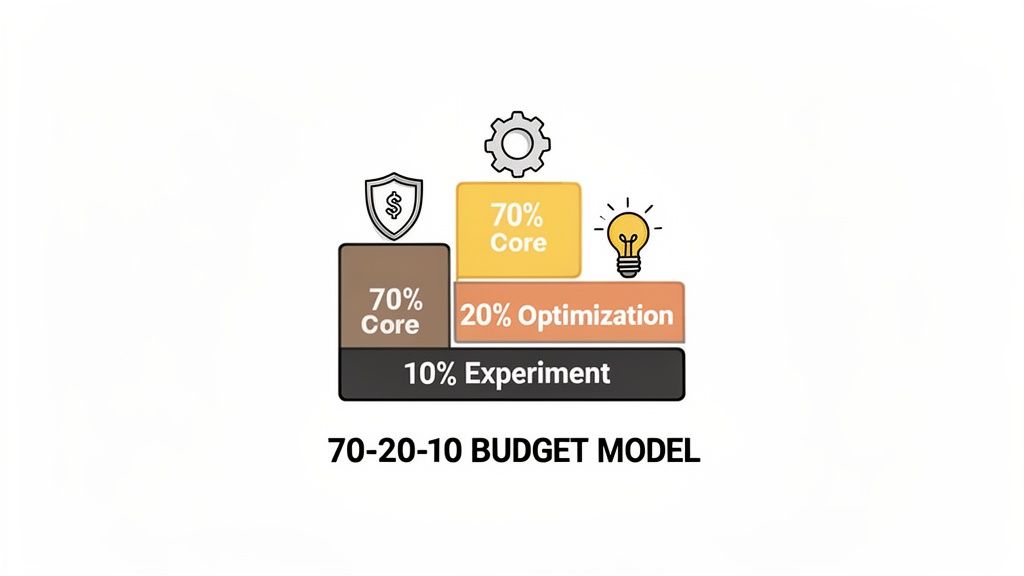
The 70-20-10 rule offers a structured framework for marketing budget allocation best practices that elegantly balances stability with innovation. This model advocates for dividing your budget into three distinct buckets: 70% for core, proven activities; 20% for emerging or optimizing channels; and 10% for experimental, high-risk initiatives. It ensures the majority of your funds are invested in what already works, while still carving out dedicated resources for growth and future-proofing.
This approach provides a clear, disciplined way to manage risk and foster innovation simultaneously. It prevents your marketing strategy from becoming stagnant by systematically funding new ideas, ensuring you can adapt to changing market dynamics without jeopardizing your primary revenue drivers.
How It Works in Practice
The power of the 70-20-10 model lies in its adaptability across different business types. An enterprise software company might allocate its 70% to well-established account-based marketing (ABM) and industry event sponsorships. The 20% could go toward optimizing its marketing automation sequences and testing new LinkedIn ad formats, while the 10% is reserved for a pilot program using AI-powered personalization tools.
Similarly, a digital-first e-commerce brand would dedicate 70% of its budget to its core SEO and content marketing engines that reliably drive organic traffic. The 20% might be used to refine and test lookalike audiences on established paid social platforms, while the 10% is used to experiment with emerging channels like TikTok shops or live shopping events. This structure creates a predictable foundation with a built-in mechanism for discovering the next big thing.
Actionable Implementation Tips
To apply the 70-20-10 model effectively, consider these steps:
- Define Your Categories: Clearly document what constitutes a "core" (70%), "optimizing" (20%), and "experimental" (10%) activity for your specific business. This shared definition prevents ambiguity and ensures team alignment.
- Establish a Graduation Process: Create a formal process for successful experiments to move from the 10% bucket to the 20% for optimization, and eventually into the 70% core budget. This ensures innovation feeds directly into your primary strategy.
- Set Metrics for Experiments: Before launching any 10% initiative, define what success looks like. Establish clear, measurable KPIs to determine if an experiment is worth scaling or should be discontinued.
- Review Allocations Quarterly: Market conditions and channel performance change. Revisit your 70-20-10 allocations each quarter to ensure they still align with your business objectives and recent performance data.
3. Customer Acquisition Cost (CAC) Payback Period Alignment
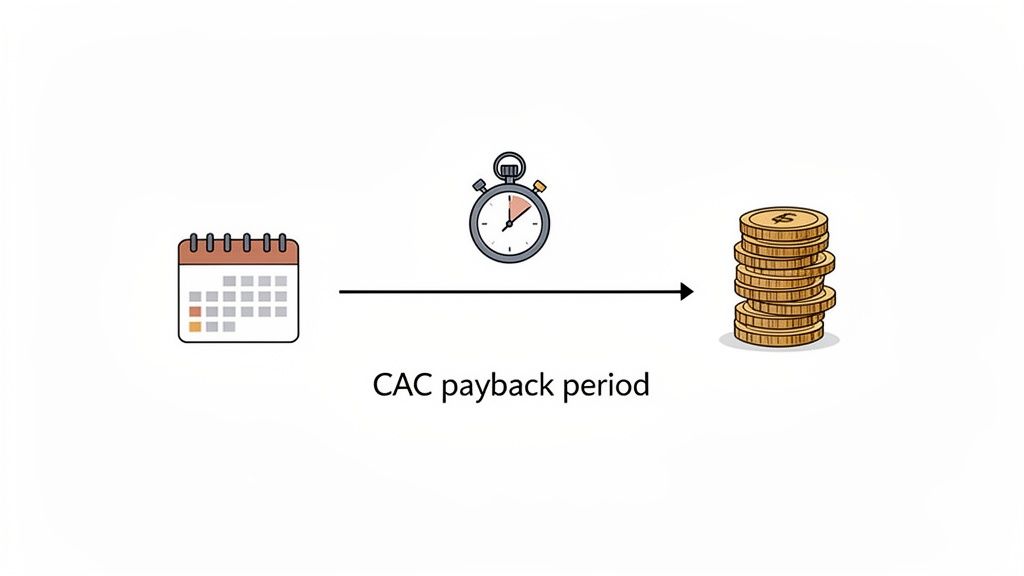
A crucial component of effective marketing budget allocation best practices involves aligning your spending with the Customer Acquisition Cost (CAC) payback period. This method prioritizes channels that allow you to recoup the cost of acquiring a new customer in the shortest amount of time. By focusing on channels with faster returns, you ensure your marketing engine is not just acquiring customers, but doing so in a financially sustainable way that fuels cash flow and enables reinvestment into growth.
This strategy moves beyond simple ROI by introducing the element of time. It forces a critical look at how quickly marketing investments translate into tangible, profitable returns, making it an essential practice for businesses focused on capital efficiency and sustainable scaling.
How It Works in Practice
The goal is to allocate more budget to channels that bring in profitable customers faster. For example, a SaaS company might find that customers acquired through organic search have a 4-month payback period, while those from high-cost paid search campaigns have a 12-month payback period. This insight would justify shifting funds from paid search to intensify SEO and content marketing efforts.
Similarly, an e-commerce brand might discover that email marketing campaigns to existing leads have a 30-day payback window, whereas a broad-reach display ad campaign takes 90 days. The clear directive is to double down on email marketing to maximize short-term cash flow, which can then fund longer-term brand plays. Accurate calculation of your How to Calculate Customer Acquisition Cost is fundamental to aligning your budget with payback periods and ensuring sustainable growth.
Actionable Implementation Tips
To effectively align your budget with CAC payback periods, follow these steps:
- Calculate LTV:CAC Ratio: Aim for a ratio of at least 3:1 (the lifetime value of a customer should be at least three times the cost of acquiring them). This ensures long-term profitability and sustainable growth.
- Track Payback by Cohort: Analyze payback periods for different customer cohorts (e.g., by acquisition channel, sign-up month). This reveals which segments are most profitable and which channels attract them.
- Include All Costs: Ensure your CAC calculation is comprehensive, including not just ad spend but also salaries, tool costs, and customer onboarding expenses for a true picture. Discovering how to improve marketing ROI is a key part of this process.
- Revisit Analysis Regularly: Market conditions, pricing, and channel effectiveness change. Re-evaluate your CAC payback periods quarterly to adapt your budget strategy and maintain capital efficiency.
4. Seasonal and Market Cycle Budget Adjustments
A static, year-round budget often fails to capture the natural ebbs and flows of consumer demand and industry behavior. One of the most critical marketing budget allocation best practices is to dynamically adjust spending based on predictable seasonal patterns, market cycles, and your specific business calendar. This strategy involves increasing your investment during high-demand periods and strategically pulling back during lulls to maximize efficiency and capture peak opportunities.
By anticipating these cycles, you align your marketing firepower with moments of maximum consumer intent. This proactive approach ensures you aren't overspending when customers aren't buying or, conversely, under-investing when your market is most active, leading to a much higher return on every dollar spent.
How It Works in Practice
This approach requires a deep understanding of your industry’s unique rhythm. For instance, a retail brand would be wise to increase its marketing budget by 40% or more in Q4 to capitalize on the holiday shopping frenzy and by another 20% during the back-to-school season. This isn't just about spending more; it's about shifting funds to high-impact channels like paid search and social ads when purchase intent is at its highest.
Similarly, an HR tech platform serving recruiters would see significant value in boosting its marketing spend in Q1 to align with New Year hiring surges and again in September for the fall hiring season. A B2B software company might increase its budget in Q2 and Q4, anticipating that its customers are trying to spend their remaining annual budgets before the fiscal year ends.
Actionable Implementation Tips
To effectively implement seasonal budget adjustments, follow these steps:
- Map Your Industry's Cycles: Analyze historical data to identify your distinct seasonal buying and hiring patterns. Pinpoint the exact weeks or months when demand consistently peaks and troughs.
- Build Historical Benchmarks: Create a 3- to 5-year database of your seasonal performance metrics (e.g., traffic, leads, sales). This data provides a reliable foundation for forecasting future needs and projecting growth.
- Create Seasonal Budget Templates: Develop flexible budget templates for peak and off-peak seasons. These should pre-allocate funds to different channels based on past performance during those specific times.
- Coordinate with Internal Teams: Align your seasonal marketing plans with sales and product teams. Their insights into customer behavior and upcoming launches can help you refine your timing and messaging for maximum impact.
5. Attribution-Based Multi-Touch Budget Allocation
A truly sophisticated approach to marketing budget allocation moves beyond crediting a single channel for a conversion. Attribution-based multi-touch allocation distributes funds based on the value each touchpoint contributes throughout the entire customer journey. Instead of relying on simplistic first-touch or last-touch models, this method provides a more accurate view of how different channels work together to drive results.
By understanding the nuanced interplay between awareness, consideration, and decision-stage marketing efforts, you can invest more intelligently. This practice ensures that top-of-funnel activities like content marketing and webinars receive appropriate credit and funding, even if they don't directly precede the final sale. It’s a holistic strategy for rewarding actual impact across the funnel.
How It Works in Practice
The goal is to assign proportional credit to multiple interactions. For instance, a B2B software company might find that a customer first discovers their brand through a LinkedIn ad (first touch), later attends a webinar (mid-funnel touch), and finally requests a demo after receiving a targeted email (last touch). A linear or time-decay attribution model would distribute budget credit across all three touchpoints, validating the investment in each.
Similarly, a recruitment platform could use this method to analyze how a combination of job board postings, a strong company page, and direct InMail messages all contribute to a successful hire. By crediting each step, they can justify budget allocation for brand-building and direct outreach activities, not just the final application source.
Actionable Implementation Tips
To effectively implement attribution-based budget allocation, follow these steps:
- Select the Right Model: Start with standard models like Linear, Time-Decay, or U-Shaped before attempting to build a complex custom one. Compare insights from different models to understand how each one values different stages of the customer journey.
- Use the Right Tools: Ensure your analytics platform, CRM, or Customer Data Platform (CDP) supports multi-touch attribution tracking. Tools like HubSpot, Marketo, or Google Analytics 4 offer various built-in models.
- Define Clear Conversion Events: Clearly define what constitutes a valuable conversion. This could be a demo request, a completed purchase, a key content download, or a qualified lead submission.
- Validate Assumptions: Regularly check your model’s assumptions against real-world data. Use customer surveys or interviews to ask new clients how they heard about you, providing a qualitative check on your quantitative data.
6. Competitive Benchmarking and Market Share Budget Allocation
Another one of the core marketing budget allocation best practices involves looking outward to understand your competitive landscape. This method uses competitor marketing spend, market share, and industry benchmarks to inform and validate your own budget. By analyzing how rivals and the broader industry allocate resources, you can set realistic spending levels, justify investments to leadership, and identify strategic opportunities.
This approach ensures your budget is not created in a vacuum. It helps you decide whether you need to spend aggressively to capture market share, match a competitor's presence in a key channel, or wisely invest in an area they are overlooking. It provides external context that complements your internal performance data.
How It Works in Practice
The goal is to understand the "cost of competing" in your specific market. For instance, a new fintech company might analyze how established banking incumbents allocate their budgets. They may discover that traditional banks over-index on television and print, creating an opportunity for the fintech to dominate underfunded digital channels like podcast advertising or programmatic audio with a comparatively smaller investment.
Similarly, a B2B SaaS company might use competitor analysis to find that top players dedicate 20-30% of their marketing budget to content and SEO. This industry benchmark provides a strong rationale for securing a similar allocation to effectively compete for organic search traffic and establish thought leadership.
Actionable Implementation Tips
To effectively implement competitive benchmarking, follow these steps:
- Leverage Competitive Intelligence Tools: Use platforms like Semrush, SimilarWeb, and the Meta Ad Library to estimate competitor spending on paid search, display ads, and social media. These tools reveal channel mix and campaign messaging.
- Analyze Allocation Percentages: Focus on how competitors distribute their budget across channels (e.g., 40% paid search, 30% content, 20% social) rather than just the absolute dollar amounts. This provides a more scalable model.
- Adjust for Your Market Position: If you are a challenger brand, you may need to over-invest in certain channels to gain traction. Conversely, a market leader might focus on defending its position. Your budget should reflect your strategic goals, not just mirror a competitor's.
- Combine with Internal Data: Never rely solely on external benchmarks. Cross-reference competitive insights with your own channel performance data to make the most informed decisions. What works for them may not work for you.
7. Funnel Stage-Based Budget Allocation (Awareness-Consideration-Conversion)
A powerful marketing budget allocation best practice involves structuring your spend around the customer journey. This method divides the budget according to the three core marketing funnel stages: awareness, consideration, and conversion. It ensures you allocate resources to channels and tactics that perform best at each specific stage, creating a balanced and holistic marketing engine.
This approach prevents the common pitfall of over-investing in one area, such as bottom-funnel conversion ads, while neglecting the top-funnel activities that fill the pipeline. By thoughtfully funding each stage, you build a sustainable system for attracting, engaging, and converting customers, aligning your budget directly with how buyers make decisions.
How It Works in Practice
The funnel-based model requires mapping your marketing activities to where they have the most impact. An early-stage startup, for instance, might dedicate 50% of its budget to awareness (content marketing, social media, PR) to build a brand, 30% to consideration (webinars, detailed case studies), and 20% to conversion (retargeting ads, sales support collateral).
In contrast, a mature B2B company focused on revenue optimization might shift its allocation. It could invest 30% in awareness (thought leadership, industry events), 40% in consideration (lead nurturing, email marketing), and 30% in conversion (sales enablement, demo optimization), reflecting its focus on converting an existing pipeline.
Actionable Implementation Tips
To effectively implement funnel stage-based allocation, follow these steps:
- Map Your Customer Journey: Before assigning percentages, outline the actual steps and touchpoints a customer takes from discovery to purchase. This ensures your funnel stages are based on real behavior, not just theory.
- Adjust Percentages by Growth Stage: Your allocation should evolve. Startups need to invest heavily in awareness, while scaled companies can dedicate more resources to consideration and conversion activities to maximize revenue from their established audience.
- Measure Funnel Conversion Rates: Track how effectively users move from one stage to the next. A low awareness-to-consideration rate indicates a bottleneck that may require a budget increase to improve mid-funnel content or engagement tactics.
- Use Stage-Specific KPIs: Measure each stage with relevant metrics. Track reach and impressions for awareness, lead magnet downloads and email sign-ups for consideration, and demo requests or sales for conversion.
8. Product-Line and Segment-Specific Budget Allocation
For companies with diverse offerings or target audiences, a one-size-fits-all budget is rarely effective. Segment-specific budget allocation involves dividing your total marketing funds by product line, customer segment, or geographic market. Resources are then assigned based on the unique revenue potential, growth opportunity, or strategic priority of each distinct area.
This approach ensures that high-priority segments receive the investment needed to thrive, preventing them from being underfunded by a generalized budget. It allows for more tailored strategies, messaging, and channel mixes, directly connecting marketing spend to the specific business goals of each segment, a core principle of revenue marketing.
How It Works in Practice
This method forces a strategic evaluation of where your business generates the most value. A SaaS platform, for instance, might allocate a larger budget to its enterprise segment due to higher lifetime value and contract sizes, even if the SMB segment has more customers. The marketing tactics for each would differ greatly: enterprise focusing on account-based marketing and high-touch sales events, while SMBs focus on scalable digital acquisition.
Similarly, a global CPG brand would allocate distinct budgets for its North American, EMEA, and APAC markets. The APAC budget might be heavily weighted toward emerging social platforms and local influencer collaborations, while the North American budget might focus more on traditional digital ads and retail co-marketing, reflecting different market maturities and consumer behaviors.
Actionable Implementation Tips
To implement a segment-specific budget effectively, consider these steps:
- Establish Clear Allocation Criteria: Decide how to divide funds. Base decisions on factors like historical revenue contribution, market size, growth potential (TAM), or strategic importance for entering new markets.
- Calculate Segment-Specific ROI: Track marketing-influenced revenue and customer acquisition costs for each product line or segment. This data will justify and guide future allocations. To go deeper, learn more about how to adopt a revenue marketing mindset.
- Balance Centralized and Segmented Resources: Avoid creating complete silos. Allow segments to draw from shared, centralized resources like brand design, analytics, or a content center of excellence to maintain efficiency and brand consistency.
- Invest in Growth Potential: Don't just fund the segments that are already largest. Allocate a strategic portion of the budget to high-potential or emerging segments that could become future revenue drivers.
9. Test-and-Learn Budget Reserve with Structured Experimentation
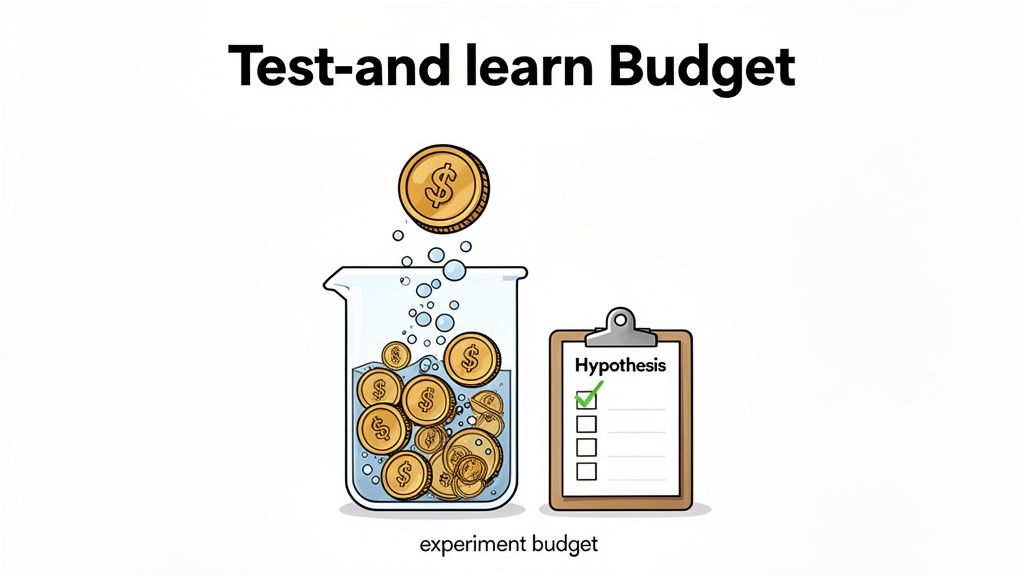
A forward-thinking marketing budget allocation best practice is to dedicate a protected portion of your funds, typically 5-15%, specifically for structured experimentation. This “test-and-learn” budget is not for unproven gambles; it’s a strategic reserve used to validate new channels, messaging, or creative formats with clear hypotheses, success metrics, and predefined decision criteria. It institutionalizes innovation and mitigates risk.
This approach treats experimentation as a core business capability, not an afterthought. It creates a systematic process for discovering new growth levers, allowing you to move from high-uncertainty ideas to proven, scalable strategies. By ringfencing these funds, you ensure that innovation doesn't get sidelined by the demands of existing, proven channels.
How It Works in Practice
The core of this method is its disciplined process. For instance, a tech company might hypothesize that its career page messaging is underperforming. It could allocate a small, controlled budget from its reserve to A/B test a new value proposition against the current one, measuring the impact on application conversion rates. If the new messaging shows a statistically significant lift, it can be rolled out broadly.
Similarly, an e-commerce brand like Shopify might use its test-and-learn budget to experiment with emerging social platforms before committing significant resources. They would define a clear goal, such as achieving a target ROAS or CAC within 90 days. If the test succeeds, it "graduates" to receive a larger, dedicated budget in the next quarter. If not, the learnings are documented and the remaining funds are reallocated to another experiment.
Actionable Implementation Tips
To effectively implement a test-and-learn budget reserve, follow these steps:
- Formalize the Process: Document every experiment with a clear hypothesis, budget, timeline, key metrics, and pass/fail criteria before it begins. This prevents shifting goalposts and ensures objective evaluation.
- Prioritize High-Impact Tests: Allocate your experimental budget to hypotheses that are high in uncertainty but also high in potential impact. Focus on discovering game-changing opportunities rather than minor optimizations.
- Establish a "Graduation Ladder": Create a clear pathway for successful tests to scale. A test that passes its initial criteria might earn a larger budget for a more extended trial before being fully integrated into the core marketing plan.
- Share All Learnings: Document and circulate insights from all experiments, especially the failures. A failed test that prevents a larger, costly mistake is a valuable outcome and contributes to organizational knowledge.
10. Workforce, Team Capability, and LTV-Based Budget Allocation
A powerful marketing budget allocation best practice is to align spending with your team's actual execution capabilities and orient it around maximizing customer lifetime value (LTV). This dual-focus approach ensures you aren't just allocating funds to a channel, but that you have the internal skills or external partners to succeed there. It also shifts the budget from a purely acquisition-focused model to a more sustainable one that balances acquiring, retaining, and expanding customer relationships.
This method grounds your budget in reality, preventing you from over-investing in areas where your team lacks expertise, like advanced paid media or technical SEO. It simultaneously encourages investment in retention, which often provides a higher and more predictable ROI than constantly chasing new leads. It’s a strategic framework that connects budget to both people and profit.
How It Works in Practice
The core of this practice is a candid assessment of skills and a clear split between acquisition and retention goals. For instance, a company with an exceptionally strong in-house content and SEO team should lean heavily into that strength, allocating a larger budget to content creation, link building, and organic growth. In contrast, if that same team lacks deep paid media expertise, it would be wiser to hire an agency or a specialist before pouring significant funds into complex PPC campaigns.
On the LTV front, a subscription business might notice high churn in the first 90 days. Instead of just increasing its top-of-funnel ad spend, it could allocate 40% of its budget to acquisition, 40% to retention (like improving onboarding and customer success), and 20% to expansion (upselling features). This balanced approach directly tackles a core business weakness and improves long-term unit economics.
Actionable Implementation Tips
To effectively allocate budgets based on capability and LTV, follow these steps:
- Conduct a Team Skill Audit: Objectively assess your team’s expertise across key marketing disciplines. Identify skill gaps and decide whether to train internally, hire new talent, or engage external partners.
- Segment Your Budget: Don't use a single marketing budget. Create distinct sub-budgets for Customer Acquisition, Customer Retention (e.g., loyalty programs, onboarding), and Customer Expansion (e.g., upsell campaigns).
- Tie Retention Spend to LTV: Calculate LTV and churn rates for different customer cohorts. Allocate more retention resources toward high-value segments or those with the highest churn risk to protect future revenue.
- Invest in Enablement: When allocating funds to a new tool or channel, also budget for the necessary training and development to ensure your team can use it effectively. A tool without the skill to wield it is wasted spend.
10-Point Marketing Budget Allocation Comparison
| Approach | Complexity 🔄 | Resources & Speed ⚡ | Expected Impact 📊⭐ | Ideal Use Cases 💡 | Key Advantage ⭐ |
|---|---|---|---|---|---|
| Data-Driven Budget Allocation — allocate by channel ROI and conversion metrics | 🔄🔄🔄 High (data integration & attribution) | High tooling & analyst effort; decision cadence monthly → medium speed ⚡⚡ | 📊 Optimizes ROI and conversion mix; predictable gains ⭐⭐⭐⭐ | Multi-channel organizations with mature analytics | Maximizes ROI and accountability |
| 70-20-10 Budget Model — 70% core, 20% optimization, 10% experiments | 🔄 Low (simple percentage framework) | Low setup; easy to operationalize; quick adoption ⚡⚡⚡ | 📊 Balances stability and innovation; consistent outcomes ⭐⭐⭐ | Teams wanting simple governance and innovation buffer | Easy to communicate and implement |
| CAC Payback Period Alignment — prioritize channels with faster payback | 🔄🔄 Medium–High (revenue attribution required) | Requires finance integration & cohort tracking; favors fast-return channels ⚡⚡⚡ | 📊 Improves cash flow and sustainable unit economics ⭐⭐⭐⭐ | SaaS/subscription and cash-constrained businesses | Ensures financially sustainable investments |
| Seasonal & Market Cycle Adjustments — shift spend by predictable demand cycles | 🔄🔄 Medium (forecasting + planning) | Needs historical seasonal data; timing-critical; medium speed ⚡⚡ | 📊 Captures peak demand and reduces wasted spend ⭐⭐⭐ | Retail, recruitment, event-driven or seasonal markets | Improves efficiency via timing of spend |
| Attribution-Based Multi-Touch — allocate by contribution across customer journey | 🔄🔄🔄 High (modeling, clean data, tech stack) | High analytics + martech needs; insight maturation slower ⚡ | 📊 Reveals true channel contribution across funnel; better ROI allocation ⭐⭐⭐⭐ | Complex B2B journeys, multi-touch buyer paths | Accurately credits touchpoints across funnel |
| Competitive Benchmarking & Market Share — set budgets using competitor/industry data | 🔄🔄 Medium (research + adjustment) | Moderate research tools; periodic updates; medium speed ⚡⚡ | 📊 Identifies underinvestment and market gaps; helps justify spend ⭐⭐⭐ | Market-entry, highly competitive industries, leadership buy-in | Provides external validation and context |
| Funnel Stage-Based Allocation (A‑C‑C) — budget by awareness, consideration, conversion | 🔄🔄 Low–Medium (mapping & alignment) | Moderate resources for tracking stage KPIs; adaptable cadence ⚡⚡ | 📊 Ensures balanced investment across journey; reduces stage gaps ⭐⭐⭐ | Startups scaling, teams optimizing funnel bottlenecks | Aligns spend to funnel priorities and metrics |
| Product-Line / Segment-Specific Allocation — split budgets by product, segment, region | 🔄🔄🔄 High (granular tracking & governance) | High tracking, localization, and coordination needs; medium speed ⚡⚡ | 📊 Targets growth where revenue/opportunity is highest; clearer accountability ⭐⭐⭐⭐ | Multi-product or global companies, segmented markets | Aligns spend to revenue and strategic priorities |
| Test-and-Learn Budget Reserve — protected % for structured experiments | 🔄🔄 Low–Medium (governance & design) | Small dedicated budget; rapid experiments; fast feedback loop ⚡⚡⚡ | 📊 Produces validated insights and reduces large-scale risk ⭐⭐⭐ | High-uncertainty channels, new launches, creative tests | Systematic experimentation and learnings |
| Workforce, Team Capability & LTV-Based Allocation — match budget to execution ability and LTV | 🔄🔄🔄 High (capability assessment + LTV modeling) | High investment in hiring/training and measurement; longer payoff ⚡ | 📊 Increases LTV and execution quality; sustainable growth ⭐⭐⭐⭐ | Organizations needing capability alignment or retention focus | Ensures budgets are executable and improves unit economics |
From Theory to Action: Building a Dynamic Budgeting Process
Navigating the complexities of marketing budget allocation can feel like charting a course through ever-changing waters. We've explored a comprehensive suite of strategies, from the foundational 70-20-10 model to the granular, data-rich approaches of multi-touch attribution and funnel stage-based allocation. The central theme connecting all these marketing budget allocation best practices is the shift from a static, annual plan to a dynamic, strategic framework.
Your budget is not merely a list of expenses; it's a powerful declaration of your strategic priorities. Whether you're aligning spend with your CAC payback period, dedicating reserves for structured experimentation, or adjusting for seasonal market cycles, you are actively steering your company toward its growth targets. The most sophisticated marketers no longer treat their budget as a rigid constraint but as a flexible, intelligent tool that responds to real-time performance data and market intelligence.
Key Takeaways for Immediate Application
To transform your budgeting from a reactive task into a proactive discipline, focus on these core principles:
- Embrace a Hybrid Approach: The most effective budgeting processes are rarely monolithic. You can use a high-level framework like the 70-20-10 rule to set broad parameters while applying granular, data-driven channel performance analysis and attribution modeling within each bucket. This blend of structure and agility provides both stability and responsiveness.
- Prioritize Regular Review Cadences: A budget set in January and ignored until December is a recipe for missed opportunities. Implement a rhythm of review, whether it's monthly performance check-ins or quarterly strategic realignments. This allows you to reallocate funds from underperforming channels to high-growth areas, maximizing your ROI throughout the year.
- Invest in People, Not Just Platforms: A brilliant strategy is powerless without the talent to execute it. As you allocate funds for ad spend, software, and technology, you must also budget competitively for your team. Your investment in skilled marketers, analysts, and creatives is the single most critical factor in turning your financial plan into tangible results.
Your Next Steps: Building a Smarter Budget Today
Moving forward, the goal is continuous improvement, not overnight perfection. Start by selecting one or two new practices from this guide to integrate into your next budget cycle. Perhaps it’s establishing a dedicated "test-and-learn" fund or conducting your first competitive spend analysis.
The ultimate aim is to create a budgeting culture that is data-informed, strategically aligned, and consistently optimized. When you master these marketing budget allocation best practices, you empower your team to make smarter decisions, prove marketing's value to the organization, and confidently drive sustainable business growth. Your budget transforms from a simple financial document into your most potent strategic asset.
A core part of your budget allocation is investing in the talent required to execute your strategy effectively. Ensure your compensation is competitive by benchmarking against the latest industry data with SalaryGuide. Explore the most comprehensive marketing salary data available at SalaryGuide to attract and retain the top-tier talent needed to maximize your marketing ROI.
