What is revenue marketing: what is revenue marketing explained clearly
Revenue marketing isn't just a new buzzword—it's a complete shift in how we think about marketing's role in a business. Put simply, it’s a strategy that treats marketing as a direct and accountable driver of company growth, not just a department that generates leads and hands them off.
The entire philosophy is built on aligning marketing and sales teams around one single, crystal-clear goal: generating predictable, measurable revenue. This means we stop obsessing over vanity metrics like clicks and social media likes and start focusing on what truly matters to the C-suite: pipeline, profit, and growth.
Shifting from Cost Center to Revenue Driver
Think about the old way of doing things. Traditional marketing often felt like a relay race. Marketing would run its leg of the race, generate a lead (the baton), and then toss it over the wall to sales. If the handoff was fumbled or the lead wasn't actually ready to buy, the opportunity was lost. Too often, the baton was dropped.
Revenue marketing throws that model out the window. It’s less like a relay race and more like a synchronized rowing team. Marketing and sales are in the same boat, pulling their oars in perfect unison, heading toward the same finish line: revenue. Every campaign, every piece of content, every sales call is a coordinated stroke, all designed to move the business forward, faster.
This isn't just a small tactical adjustment; it's a fundamental change in mindset. Marketing is no longer seen as a cost center with fuzzy, hard-to-measure results. Instead, it becomes a data-driven, accountable engine for growth, with a clear, undeniable line connecting its activities directly to the company's bottom line.
A Clearer View of Success
In a revenue marketing world, success is no longer defined by hitting a target for Marketing Qualified Leads (MQLs). We're looking at the entire customer journey, from the very first touchpoint all the way through to the final sale and even into customer retention and expansion.
This holistic approach ensures that marketing efforts aren't just creating noise at the top of the funnel. They are actively contributing to closed-won deals and long-term customer value.
The impact of this alignment is huge. Research shows that firms with strong coordination between their customer-facing teams see 2.4x higher revenue growth and 2x higher profitability growth than companies still stuck in silos. It’s a powerful argument for breaking down those walls.
Traditional Marketing vs Revenue Marketing at a Glance
To really hammer home the difference, it helps to see the two philosophies side-by-side. The table below breaks down how revenue marketing fundamentally reimagines marketing's purpose, metrics, and team dynamics.
| Aspect | Traditional Marketing | Revenue Marketing |
|---|---|---|
| Primary Goal | Generate leads and brand awareness. | Generate predictable revenue and pipeline. |
| Key Metrics | Clicks, impressions, leads (MQLs). | Customer Acquisition Cost (CAC), LTV, pipeline value. |
| Team Alignment | Siloed; operates separately from sales. | Integrated; shares goals and data with sales. |
| Accountability | Responsible for the top of the funnel only. | Accountable for the entire funnel, end-to-end. |
As you can see, the shift is dramatic. Revenue marketing demands a level of integration that simply doesn’t exist in traditional organizations.
This entire structure is often powered by a central function that ensures all commercial teams are aligned and working together for predictable growth. To get a better handle on the operational side of this, it's worth exploring this excellent guide on Revenue Operations. RevOps is truly the engine that makes the whole revenue marketing machine run.
Digging into the Core Principles of Revenue Marketing
To really get what revenue marketing is all about, we have to look past the buzzwords and get to the principles that make it work. These aren't just abstract ideas; they're the nuts and bolts that turn marketing from a line item on a budget sheet into a reliable engine for growth. It’s a complete shift in how teams work, how they measure what matters, and how they talk to each other.
This diagram shows how marketing, sales, and revenue all connect and feed into one another in a continuous cycle.
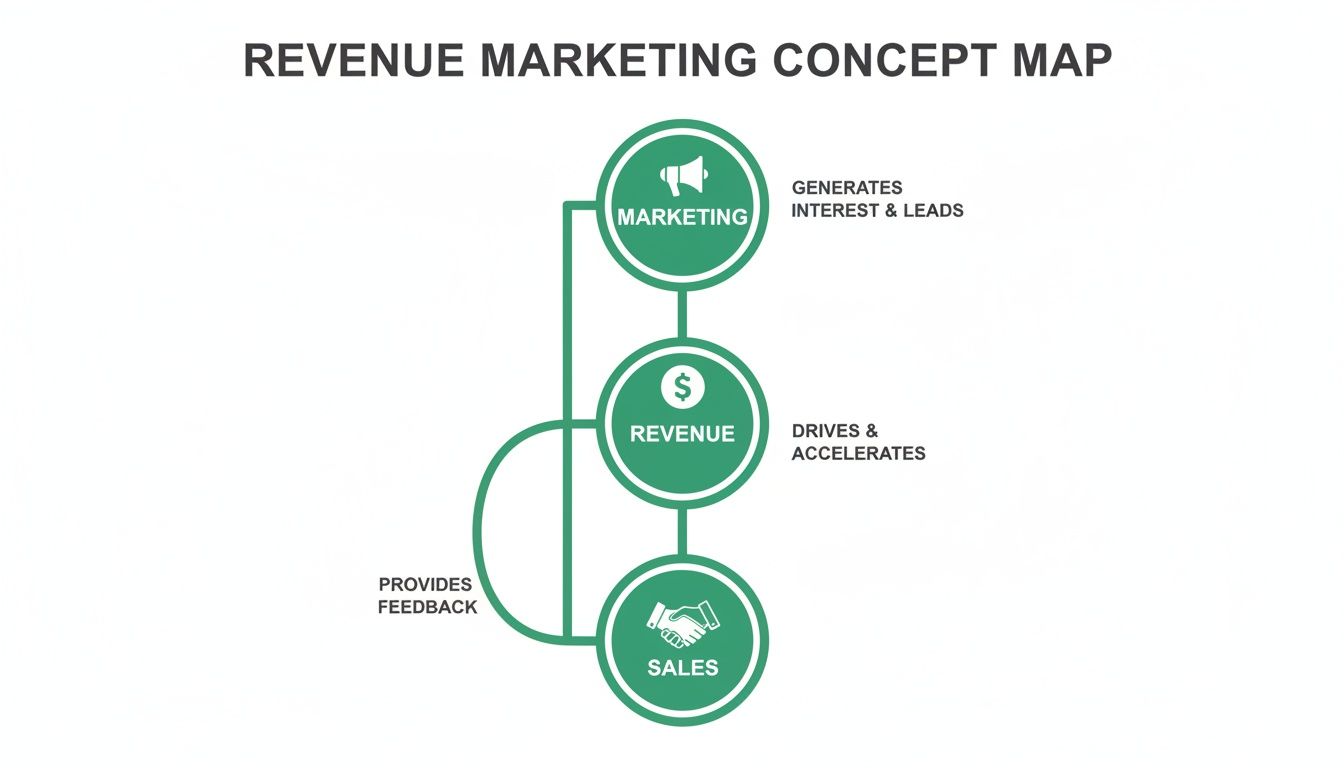
As you can see, it's a feedback loop. Marketing efforts generate revenue, and the results from sales provide crucial data that helps marketing get smarter over time. It’s a system designed to improve itself.
Full-Funnel Accountability
The biggest mental shift is end-to-end funnel accountability. In the old way of doing things, marketing's job was often considered "done" the second a lead was handed over to the sales team. If the deal didn't close? That was a "sales problem."
Revenue marketing blows that siloed thinking to pieces. Here, marketing’s ownership stretches across the entire customer journey—from the very first ad a person sees, all the way through to the signed contract, and even into keeping that customer happy and buying more. It’s about owning the revenue outcome, not just the marketing activity.
Think about it this way: a content marketer isn't just measured on blog views anymore. Their success is tied directly to how much sales pipeline and how many closed deals their content actually influenced. This forces marketing and sales to be true partners.
Data-Driven Alignment as the Foundation
Another pillar is data-driven alignment. This is all about creating a "single source of truth" that both marketing and sales agree on. No more arguments where marketing claims they sent 200 leads but sales says they only got 50 decent ones.
This alignment is usually built on a shared CRM and marketing automation platform. Every email opened, every demo requested, and every sales call is tracked in one place where everyone can see it. It means the whole team is looking at the same numbers and speaking the same language: the language of revenue.
The proof is in the numbers. One study found that tightly aligned organizations see 38% higher conversion rates and 36% higher customer retention. These aren't small gains; they're the direct result of everyone pulling in the same direction.
A Deep, Customer-First Mindset
Finally, revenue marketing is built on an almost obsessive focus on the customer journey. It’s about truly understanding every step a buyer takes, every question they have, and every pain point they feel. When you map this out, you can pinpoint the exact moments to deliver the right message that helps them move forward.
This customer-first view lets marketers ditch the generic, one-size-fits-all campaigns. Instead, they can create tailored experiences that guide people through the buying process naturally. It stops being about pushing a sale and starts being about helping a customer solve a real problem.
This is where marketing and sales find their most powerful common ground. When both teams are obsessed with solving the customer's problem, their actions naturally fall in line toward the shared goal of creating a happy, paying customer who wants to stick around.
A huge part of this is knowing which marketing activities are actually working. This is where attribution comes in. It’s the process of figuring out what marketing attribution truly means by connecting the dots between your campaigns and actual sales. It’s how you make sure every dollar you spend is pulling its weight.
How to Structure a Revenue-Focused Marketing Team
Switching to a revenue marketing mindset isn't just about tracking new metrics—it's about completely rethinking how your team is built. For years, marketing departments were organized into channel-specific silos. You had the email team, the social media team, and the content team, each working in their own lane, often struggling to connect their efforts to the bottom line.
A modern, revenue-focused team looks entirely different. It’s built around accountability, data, and a relentless focus on contributing directly to the sales pipeline. The organizing principle isn't activity; it's impact. This structure ensures every single person understands exactly how their work helps the company grow.
The key to making this work is a central operational hub, often called Revenue Operations (or RevOps). RevOps is the connective tissue that unites the entire customer journey, creating a seamless flow of data and strategy across marketing, sales, and customer success.
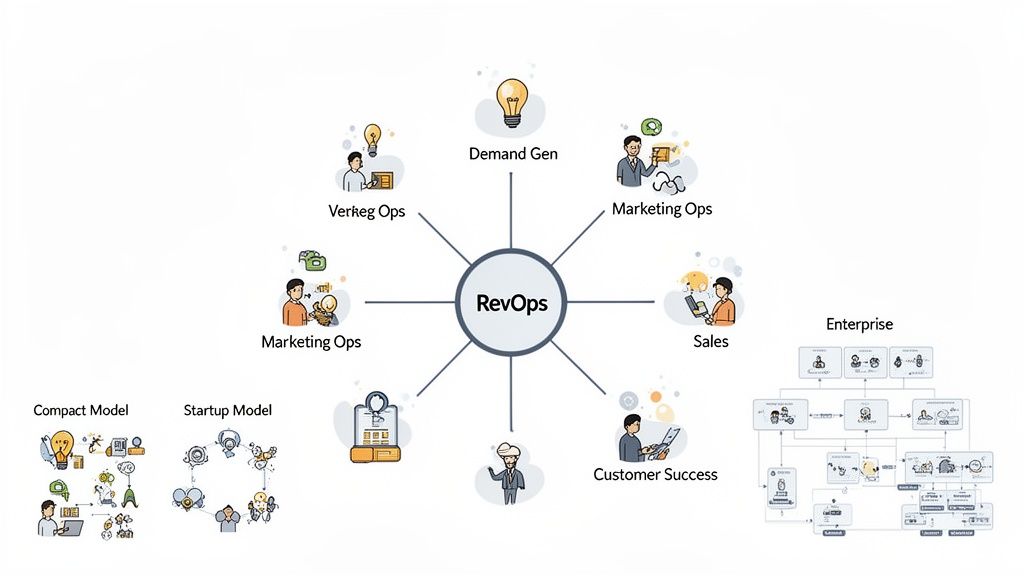
This integrated model isn't just a nice-to-have; it's the architectural foundation of any serious revenue marketing strategy.
Essential Roles in a Modern Marketing Team
While specific job titles can vary from company to company, a few key roles form the engine room of a high-performing revenue marketing team. These aren't your traditional brand-focused roles; they are defined by their direct link to the pipeline and their ability to use data to drive every decision. They are the architects of your revenue engine.
A well-structured team needs specialists who can own different parts of the revenue journey. The table below breaks down the most common and critical roles you'll find at the core of a revenue marketing organization.
Key Revenue Marketing Roles and Responsibilities
| Role Title | Core Responsibilities | Key Performance Indicators (KPIs) |
|---|---|---|
| Demand Generation Manager | Owns the top of the funnel by creating and executing multi-channel campaigns to generate high-quality leads. Tracks leads from creation to close to optimize for revenue, not just volume. | Marketing Qualified Leads (MQLs), Sales Qualified Leads (SQLs), Pipeline Sourced, Marketing-Influenced Revenue, Cost Per Acquisition (CPA) |
| Marketing Operations Specialist (MOPs) | Manages the marketing tech stack (e.g., Marketo, HubSpot), ensures data integrity, builds dashboards, and automates marketing and sales processes. | Lead Velocity Rate, MQL-to-SQL Conversion Rate, Data Accuracy, Campaign Attribution Accuracy, System Uptime |
| Revenue Operations Manager (RevOps) | Aligns processes, technology, and data across marketing, sales, and customer success. Creates a single source of truth for all revenue-related activities and forecasts. | Sales Cycle Length, Customer Lifetime Value (CLV), Revenue Predictability, Lead-to-Close Conversion Rate |
| Content Marketing Manager | Develops and executes a content strategy that supports the entire funnel, from top-of-funnel awareness pieces to bottom-of-funnel sales enablement materials. | Content-Sourced Leads, Content Engagement Metrics, Inbound MQLs, Influence on Pipeline |
| Digital Marketing/PPC Specialist | Manages paid media channels (e.g., Google Ads, LinkedIn Ads) with a focus on driving conversions and optimizing spend for maximum return on investment. | Return on Ad Spend (ROAS), Cost Per Lead (CPL), Click-Through Rate (CTR), Conversion Rate |
These roles are crucial because their contributions are directly tied to financial outcomes. It’s one thing to say you increased brand awareness; it’s another entirely to prove your campaigns generated $500,000 in new pipeline. That undeniable impact is why these roles often command higher salaries.
Structuring Your Team for Success
The "right" team structure really depends on your company's size and maturity. A scrappy startup will naturally look different from a large enterprise, but the underlying principles are the same: prioritize roles that directly influence revenue.
Lean Startup Model (Fewer than 50 Employees)
In a startup environment, people wear a lot of hats. The name of the game is agility and immediate impact.
- Head of Marketing/Growth: A strategic leader who owns the overall revenue number, likely managing both demand gen and ops functions.
- Content & Demand Gen Specialist: This hybrid role creates the fuel (blogs, webinars) and builds the engine (campaigns) to generate qualified leads.
- Sales & Marketing Ops (Shared): Often, one person supports both sales and marketing with CRM management and basic reporting to keep the two teams aligned from the start.
Enterprise Model (500+ Employees)
Larger companies have the luxury of building more specialized teams, which allows for deeper expertise in every area.
The enterprise structure is all about specialization and scale. Instead of one person handling content and demand gen, you have dedicated teams for each, all unified under a central RevOps function that ensures everyone is working from the same playbook and toward the same revenue goals.
- VP of Revenue Marketing: Reports to the CMO or CRO and is ultimately accountable for marketing-sourced pipeline and revenue targets.
- Director of Demand Generation: Leads a team of campaign managers who might be focused on different market segments or channels.
- Director of Marketing Operations: Manages a team of specialists who own the tech stack, analytics, and data infrastructure.
- Director of Revenue Operations: A senior leader focused on the strategic alignment of systems and processes across the entire commercial organization.
For a deeper dive into team design, exploring different ideas for a marketing department organizational structure can give you more blueprints for success. This approach ensures that as your company scales, your marketing team’s ability to predictably generate revenue scales right along with it.
The Essential Metrics That Actually Matter
In revenue marketing, the metrics you track are your ticket to the boardroom. Gone are the days of celebrating "vanity metrics" like impressions, social media likes, or even a flood of unqualified leads. The entire focus shifts to numbers that speak the only language that matters to the C-suite: money.
These are the metrics that prove marketing’s tangible value and justify every dollar in the budget. When you can connect your team's work directly to closed-won deals and long-term business growth, you stop being seen as a cost center and start being recognized as a strategic partner.
The Foundational Revenue Metrics
Let's start with the non-negotiables. These three KPIs are the bedrock of any serious revenue marketing strategy. They work together to paint a clear, undeniable picture of your marketing engine’s efficiency and profitability.
Customer Acquisition Cost (CAC): This is the bottom-line cost to get a new customer in the door. The formula is straightforward: (Total Sales & Marketing Spend) / (Number of New Customers). A low CAC is a sign of a healthy, efficient acquisition machine.
Lifetime Value (LTV): This metric forecasts the total revenue you can expect from a single customer over the entire course of your relationship. LTV shifts the focus from quick, one-off sales to building profitable, long-term partnerships.
LTV:CAC Ratio: This is the magic number. It pits the value of a customer against the cost to acquire them. A healthy ratio, often cited as 3:1 or higher, proves you have a sustainable and profitable business model. If you're at 1:1, you're essentially breaking even on every new customer, which isn't a recipe for growth.
Keeping these numbers straight is a core function for many marketing roles today. For a deeper look at the skills needed to manage this kind of data, check out our guide on marketing analyst job requirements.
Sourced vs. Influenced Revenue
Not all revenue is created equal, at least when it comes to marketing attribution. To tell an honest and complete story of your team's impact, it’s crucial to separate the revenue marketing sourced from the revenue marketing influenced.
Marketing-Sourced Revenue is straightforward: these are the deals that started because of a marketing initiative. Think of a prospect who downloads an ebook, gets nurtured through an email campaign, and then becomes a customer. Marketing gets full credit for originating that opportunity.
Marketing-Influenced Revenue, on the other hand, covers every deal where marketing had a meaningful touchpoint along the buyer's journey, even if sales or a partner brought in the initial lead. This could be a prospect attending a key webinar or reading case studies right before signing the contract.
By tracking both, you showcase marketing's full contribution. Sourced revenue proves you can generate net-new business, while influenced revenue demonstrates how your activities accelerate the sales cycle and help close deals, no matter where they came from.
Choosing the Right Attribution Model
So, how do you assign credit accurately? You need an attribution model. This is simply the rulebook your team uses to give credit to the various touchpoints that lead to a sale. There are several ways to do this, each with its own perspective.
First-Touch Attribution: This model gives 100% of the credit to the very first marketing channel a customer ever interacted with. It’s great for figuring out what drives initial awareness, but it completely ignores everything that happens after that first click.
Last-Touch Attribution: The polar opposite. This model gives all the credit to the final touchpoint right before the conversion. While simple to track, it tends to overvalue bottom-of-funnel activities (like a demo request) and ignores all the hard work that got the lead there.
Multi-Touch Attribution: This is where modern revenue marketing lives. Models like Linear, U-Shaped, or W-Shaped distribute credit across multiple touchpoints. It’s a bit more complex, but it provides a far more realistic view of which channels are actually working together to drive revenue.
Building Your Revenue Marketing Tech Stack
Technology is the engine that powers any serious revenue marketing strategy. To actually connect what marketing does to real, bottom-line revenue, you need a set of tools that talk to each other. The goal is to create a single, reliable view of the entire customer journey, from first click to final contract.
Building this tech stack isn't about collecting a bunch of flashy software logos. It's about designing an ecosystem where information flows freely between your teams, especially marketing and sales.
Think of it like building a high-performance vehicle. Your CRM is the chassis—the foundational frame everything is built on. Your marketing automation is the engine, driving engagement. And your analytics tools are the dashboard and GPS, telling you where you are, how fast you're going, and if you're on the right track. Each part is vital, but their true power is unleashed when they work together perfectly to get you to your destination: predictable revenue.
This diagram shows how these core technologies should connect, creating a constant feedback loop of data, action, and insight.
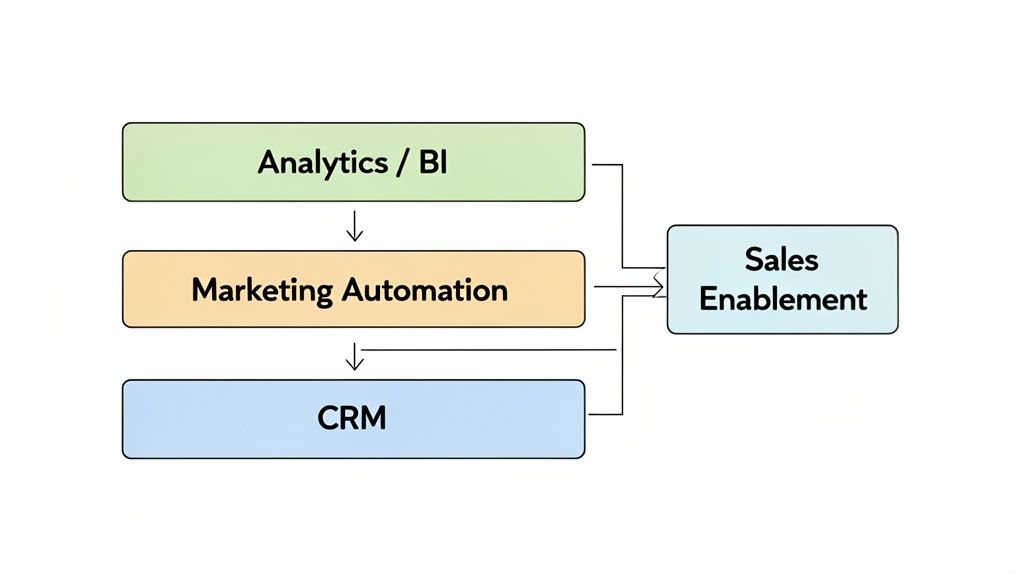
As you can see, the insights you get from analytics should fuel your automation campaigns. Those campaigns then enrich the data in your CRM, which in turn gives your sales team the intel they need to have smarter conversations.
The Central Hub: Customer Relationship Management (CRM)
At the absolute heart of any revenue marketing tech stack is the Customer Relationship Management (CRM) system. This has to be your undisputed source of truth for every piece of customer and prospect data. It’s the central repository where every interaction—from an anonymous website visit to the final sales call—gets logged and tracked.
A well-implemented CRM, like Salesforce or HubSpot CRM, is the ultimate silo-buster. When marketing and sales both work from the exact same dataset, everyone has the same context about a lead’s history, what they care about, and how engaged they've been. This shared view isn't just nice to have; it's the non-negotiable foundation for true alignment.
Without it, you’re just guessing. Marketing has no idea which leads actually become customers, and sales goes into calls cold, lacking the critical context to be effective.
The Engine: Marketing Automation Platforms
If the CRM is your central database, then the Marketing Automation Platform (MAP) is the engine that drives engagement at scale. Tools like HubSpot, Marketo, or Pardot (now called Marketing Cloud Account Engagement) are what allow you to build and automate personalized journeys for your leads based on their behavior.
This is where the real revenue marketing magic happens:
- Lead Nurturing: You can automatically send a series of targeted emails to a prospect right after they download an ebook or watch a webinar.
- Lead Scoring: This is huge. You can assign points to leads based on who they are (job title, company size) and what they do (visit the pricing page, open an email). This ensures sales only spends their valuable time on the hottest, most qualified prospects.
- Campaign Management: It’s your command center for building, running, and measuring multi-channel campaigns all in one place.
For example, when someone downloads a whitepaper, your MAP can automatically enroll them in a follow-up email sequence that offers a related case study, then invites them to a webinar, slowly and methodically guiding them toward being ready for a sales conversation.
The Compass: Analytics and Business Intelligence (BI) Tools
So, how do you know if any of this is actually moving the needle? That’s where Analytics and Business Intelligence (BI) tools come into play. Platforms like Tableau or Looker, or even the advanced reporting modules in your CRM, are what you need to track performance against actual revenue goals.
These tools are designed to answer the most critical questions in revenue marketing:
- What’s our Customer Acquisition Cost (CAC) for that LinkedIn campaign we ran last month?
- Which marketing channels are sourcing the most qualified pipeline?
- How long is our average sales cycle, and where are deals getting stuck?
By connecting the dots between marketing activities and financial outcomes, analytics tools give you the hard evidence of marketing's impact. They’re what let you walk into a board meeting and go from saying "we generated 1,000 leads" to "our Q2 campaign generated $750,000 in influenced pipeline."
The Bridge: Sales Enablement Platforms
Finally, Sales Enablement platforms such as Seismic or Highspot are the crucial bridge between the great content marketing creates and the conversations sales has every day. Think of these tools as a smart, central library for all your assets—case studies, battle cards, email templates, and product one-pagers.
This ensures your salespeople can find the perfect piece of content at the exact right moment to help move a deal forward. But more importantly, it creates a feedback loop. Marketing can finally see which assets are being used the most and, even better, which ones are correlated with winning deals. That’s invaluable data for refining your content strategy based on what actually helps close business.
Advancing Your Career with Revenue Marketing
Ever wonder why revenue-focused marketing roles seem to be popping up everywhere, with impressive salaries to match? It’s simple: they speak the language of the C-suite. When you can draw a straight line from your marketing campaigns to the company's bank account, your value is no longer a matter of opinion—it's a fact. That clarity is a powerful career accelerator.
Roles like Revenue Marketing Manager or Director of RevOps aren't viewed as just creative support functions; they're seen as core drivers of business growth. When "revenue" is in your title, you have a permanent seat at the strategy table, putting you on a much faster track to leadership.
Reframing Your Accomplishments for Real Impact
The great thing is, you don’t need a specific title to start thinking like a revenue marketer. The principles can elevate any marketing career, no matter your specialty. It all comes down to learning how to frame your wins in terms of business impact. This one shift in perspective is what separates a good marketer from an indispensable one.
Just take a look at how compensation can vary across different marketing roles.
You’ll notice a clear pattern: the closer a role is to revenue generation, the higher the earning potential. That’s why you see demand generation and growth marketing positions commanding such strong salaries.
Whether you're an SEO wizard, a content creator, or a paid media pro, you can use this mindset to build a stronger case for yourself in performance reviews and salary negotiations. It’s time to stop reporting on activities and start reporting on outcomes.
The most powerful shift you can make in your career is moving from saying "I increased website traffic by 30%" to "My SEO strategy generated $250,000 in sales pipeline last quarter." One is a marketing metric; the other is a business result.
From Channel Expert to Business Strategist
Making this leap means thinking beyond your specific channel and looking at the entire customer journey. Your job isn't just to get a click or a download anymore. It's to help get a deal across the finish line.
Here’s how you can start talking about your value in a new way:
- SEO Specialist: Don’t stop at keyword rankings. Start tracking how many marketing-qualified leads (MQLs) and sales opportunities came from organic search. Dig into your analytics to attribute real revenue back to that blog post you optimized.
- Content Marketer: Move past page views and social shares. Measure how many leads your content generates. Even better, track which of your case studies or whitepapers the sales team uses to actually close deals. You're not just creating content; you're enabling sales.
- Paid Media Manager: Forget fixating on Cost Per Click (CPC) or Click-Through Rate (CTR). The only metric that truly matters is Return on Ad Spend (ROAS). Show that for every dollar you spent on ads, you brought back five, ten, or even twenty dollars in revenue.
Adopting this proactive, business-first approach shows you get the big picture, making you a far more valuable player in any organization. If you're looking to map out what's next, exploring a complete digital marketing career path can show you how these skills translate into promotions and new opportunities. By consistently tying your work back to revenue, you stop being someone who does marketing and become someone who builds the business—and a more rewarding career for yourself in the process.
Answering Your Top Revenue Marketing Questions
Making the leap to a revenue-focused mindset always sparks a few questions. That's completely normal. It’s a big change from how marketing has traditionally operated, so let's clear up some of the common points of confusion.
Here are some straight-to-the-point answers to the questions I hear most often from marketers just starting to explore this approach. My goal is to clear up any doubts so you can feel confident putting these ideas into practice.
What’s the Real Difference Between Revenue Marketing and Demand Generation?
I like to think of it this way: demand generation is a vital play within the larger revenue marketing game plan. The main job of demand gen is to create awareness and capture interest, feeding a healthy pipeline of qualified leads to the sales team. It's all about filling the top of the funnel.
Revenue marketing, on the other hand, looks at the entire field. It’s a complete philosophy that takes ownership of the customer's journey from their very first interaction all the way through to renewal and even expansion. Demand gen's responsibility often stops once a lead is handed off. A revenue marketer’s job isn’t done until that lead closes, generates revenue, and ideally, becomes a long-term advocate for the brand.
In short: Demand generation creates the opportunity. Revenue marketing is on the hook for turning that opportunity into actual dollars and proving the ROI behind every marketing activity.
How Can a Small Business Adopt These Principles?
You don't need a Fortune 500 budget or a huge department to start acting like a revenue marketer. For small businesses, the key is to nail the fundamentals first.
- Align Sales and Marketing: Get a weekly meeting on the calendar with sales and marketing leaders. The only thing on the agenda? A collaborative pipeline review.
- Focus on One Key Metric: Don't get overwhelmed by tracking dozens of KPIs. Start by laser-focusing on your Customer Acquisition Cost (CAC). Knowing exactly what you spend to get a new customer is the first real step toward profitable, predictable growth.
- Use a Simple CRM: You don’t need a complex, expensive system from day one. A tool like the free HubSpot CRM can give you a single view of all customer data, which is crucial for breaking down those early-stage silos.
What Is the Very First Step to Get Started?
If you do only one thing, do this: Get 100% alignment between your marketing and sales teams on the definition of a qualified lead.
Seriously. Sit down with the sales leaders and hammer out a concrete, data-backed definition of both a Marketing Qualified Lead (MQL) and a Sales Qualified Lead (SQL). This single act of agreement is what ends the finger-pointing and ensures marketing is driving leads that sales is genuinely excited to follow up on. It's the bedrock of any successful revenue marketing engine.
Ready to connect your marketing skills to real career growth and earning potential? At SalaryGuide, we provide transparent salary data and job postings sourced directly from company sites, helping you understand your market value and find your next role. Explore marketing salaries on SalaryGuide and take control of your career.
