Build a Better Marketing Department Organizational Structure

11/28/2025
Cover image

Your marketing department organizational structure is the blueprint for how your team operates. It dictates who reports to whom, how projects get done, and how information flows. Think of it less like a static chart and more like a dynamic system designed for collaboration, efficiency, and—most importantly—growth.

Getting this structure right can be the difference between a high-performance marketing engine and a team that’s constantly stuck in neutral.

Why Your Marketing Structure Defines Your Success

A Formula 1 car at the center, surrounded by people connected by lines, representing a team structure.

Staring at a blank org chart can feel overwhelming, but how you organize your marketing talent directly impacts your bottom line. It isn't just an administrative chore; it’s a strategic decision that shapes your ability to adapt, innovate, and beat the competition. In fact, a solid marketing department structure is often a clear reflection of effective marketing strategies.

Think of it like building a high-performance F1 pit crew. Every member has a specialized job—one handles tires, another the engine, and a third aerodynamics. Their success isn’t just about individual skill; it’s about how they’re structured to work together seamlessly. A chaotic crew means slow pit stops and lost races, no matter how good the driver is.

The Shift Toward Specialization

The era of the marketing generalist is coming to an end. Modern marketing demands deep expertise in specific channels, whether it's SEO, paid media, content, or product marketing. This fundamental shift is completely reshaping how winning teams are built. Over the last decade, we've seen departments morph from broad, jack-of-all-trades teams into leaner, highly specialized units.

The data backs this up. The CMO Insights Report 2025 revealed that the share of marketing teams relying on generalist roles plummeted from 69% in 2024 to just 52% in 2025. This dramatic swing underscores a clear industry preference for deep expertise over broad, surface-level knowledge. You can dive deeper into the full CMO team structure report.

The Impact on Agility and Talent Retention

A well-designed structure does more than just define roles—it builds an environment where top talent can truly excel. When specialists have clear ownership and can see the direct impact of their efforts, job satisfaction and productivity skyrocket. That kind of clarity is a powerful retention tool.

Your organizational structure is the single biggest factor in determining your team's agility. A flat, pod-based structure can pivot on a dime, while a rigid, top-down hierarchy gets bogged down in approvals, missing market opportunities.

Ultimately, the right structure eliminates bottlenecks, simplifies communication, and focuses everyone on the same goals. It breaks down silos, ensuring your creative, data, and strategy experts work as a cohesive unit. A clear framework is also crucial for keeping your best people; our guide on how to reduce employee turnover shows just how much role clarity and career pathing matter for team stability.

Picking the Right Blueprint: 5 Core Marketing Team Structures

Deciding how to structure your marketing department is a lot like choosing the blueprint for a house. You wouldn't use the same plan for a small cabin that you would for a sprawling mansion—the design has to fit the purpose. The way you organize your team needs to directly support your company's size, goals, and unique culture.

Let's walk through five of the most common blueprints modern marketing teams are built on. Each one has its own strengths and is a better fit for different types of businesses. Getting a handle on these core structures is the first step to building a team that doesn't just work, but truly excels.

1. The Functional Structure

This is the classic, the one you'll see most often. The functional structure organizes your team by specialty. Think of it like a series of guilds in a workshop: you have your content team, your paid media team, your SEO team, and so on. Each group is led by a manager who's a deep expert in that specific area.

This approach is popular for a good reason—it builds serious expertise. When all your SEO specialists are in one group, they can bounce ideas off each other, solve tough problems together, and level up their skills much faster. The reporting lines are crystal clear, which makes it easy to manage. It's often the go-to model for small to mid-sized companies that need to be ruthlessly efficient. For a more detailed look, this guide on the functional organizational structure is a great resource.

2. The Product-Based Structure

Next up is the product-based structure, a perfect fit for companies juggling multiple, distinct products or services. Take a big consumer goods company like General Mills. They don't just have one massive marketing team for everything. Instead, they have dedicated teams for cereal, another for yogurt, and yet another for baking products.

Each product line essentially gets its own mini-marketing agency, complete with a marketing lead, content creators, and channel specialists. This structure guarantees that every product gets the focused attention it needs, with strategies tailored to its specific audience. The main downside? You can end up with duplicated roles across the different teams, which can get expensive.

3. The Regional or Geographic Structure

When a company goes national or global, the regional structure often makes the most sense. This blueprint organizes marketing teams around specific locations, like North America, EMEA (Europe, Middle East, and Africa), and APAC (Asia-Pacific).

This model gives local teams the power to tweak campaigns to fit cultural nuances, different languages, and unique market conditions. A message that lands perfectly in New York might fall completely flat in Tokyo, and this structure is built to handle that reality.

By putting decision-making closer to the customer, companies can react faster to local trends. The big challenge, however, is keeping the brand message consistent across the globe. It requires strong central leadership to make sure all the regional teams are rowing in the same direction.

4. The Matrix Structure

The matrix structure is a hybrid model that works a bit like a dynamic consulting firm. Here, an employee often reports to two people: a functional manager (like the Head of Content) and a project or product manager. This dual-reporting system is designed to tear down silos and get people from different departments working together smoothly.

For instance, a content writer would report to their content manager for skill development and quality checks, but they’d also report to a project manager for a specific product launch campaign. This setup is incredibly flexible and works wonders for complex projects that need a mix of different skills. The biggest hurdle is navigating the potential conflicts and confusion that can come from having two bosses.

5. The Growth or Pod Structure

Finally, we have the modern growth structure, which is often organized into agile "pods" or "squads." This model is all about speed and experimentation. Each pod is a small, cross-functional team that has all the skills it needs to hit a specific goal, whether that’s acquiring new customers or getting new users activated.

A typical acquisition pod might have a growth lead, a paid media buyer, an SEO expert, a content writer, and a data analyst all working together. This self-sufficient unit has a lot of autonomy, allowing it to test ideas, analyze results, and change direction on a dime without getting tangled up in red tape. It’s the model companies like Spotify have famously used to scale at a blistering pace. It's no surprise that people in these roles are highly sought after; you can see what the market looks like for growth marketing roles on SalaryGuide to get a sense of just how valuable this kind of experience has become.

Choosing Your Ideal Structure: A Practical Comparison

Knowing the different blueprints is one thing, but picking the one that will actually work for your business is the real challenge. The right marketing structure isn't about chasing the latest trend; it's about finding the perfect fit for your company's specific goals, size, and day-to-day reality.

Let’s be honest: this decision is all about trade-offs. Each model has its strengths and weaknesses. A structure built for speed might not have deep specialization. One designed for peak efficiency could accidentally stifle creativity. Your job is to figure out what matters most to your business right now.

To get you started, this decision tree can help you visualize which path might be right based on a few key characteristics of your company.

Decision tree for marketing structure selection, guiding through functional, product-based, and regional options based on product lines.

As you can see, factors like how many products you sell or where you sell them can quickly point you toward a functional, product-based, or even a regional setup.

Weighing the Key Decision Factors

When you're comparing the models, it helps to focus on a handful of core factors. These are the things that will truly affect your team’s performance and your ability to hit those ambitious marketing goals day in and day out.

Ask yourself these critical questions:

  • Speed and Agility: How fast can the team get a campaign out the door? Can they pivot quickly when the market shifts? Pods and tribes are built for this, while more traditional structures can sometimes move at a glacial pace.
  • Scalability: When your company grows, will your org structure break? You need a model that can handle more people, products, or markets without imploding. Functional and regional models often scale more predictably.
  • Cost Efficiency: Are you getting the most bang for your buck? A good structure minimizes redundant roles and keeps overhead in check. Functional structures are often the leanest because resources are shared.
  • Communication Flow: How does information actually travel? Is it getting stuck in silos? Matrix structures are specifically designed to break down walls, but they can add their own layer of complexity.
  • Innovation: Does your setup encourage people to try new things and experiment? This is where growth pods shine, giving small, autonomous teams the freedom to test, learn, and iterate quickly.

Marketing Organizational Structure Comparison

To make this choice more concrete, here's a side-by-side scorecard. It compares the five primary structures against the key business metrics we just discussed, helping you see the trade-offs at a glance.

Structure Type Best For Pros Cons Communication Flow
Functional SMBs, single-product companies Cost-effective, deep expertise, clear career paths Silos, slow to react, risk of channel-first thinking Hierarchical (top-down)
Product-Based Companies with multiple, distinct products Deep product knowledge, clear ownership, better product-market fit Duplicated roles, higher costs, potential brand inconsistency Decentralized to product GMs, then up
Matrix Large, complex organizations Cross-functional collaboration, flexible resource allocation Dual reporting confusion, potential for conflict, slow decision-making Complex (vertical and horizontal)
Hub-and-Spoke Global companies needing central control and local execution Brand consistency with local relevance, shared resources Slower than fully decentralized models, potential friction between hub and spokes Centralized strategy, decentralized execution
Growth / Tribes Startups, tech companies focused on rapid iteration High speed and agility, strong ownership, data-driven Can be resource-intensive, risk of strategic misalignment, hard to scale Autonomous within pods, cross-functional

This comparison really highlights the give-and-take. For example, the Functional model is a winner on cost efficiency because you aren't hiring duplicate roles. But that strength can also be a weakness, as it can be slower to innovate when specialists are siloed in their own departments.

On the other end of the spectrum, the Growth/Tribes model is built for speed and innovation. The downside? It can be less cost-efficient since each pod needs its own dedicated experts, which can also create scalability challenges down the road.

The perfect marketing org chart isn't set in stone. Think of it as a living system that needs to be reviewed and adapted as your company's strategy shifts, you launch new products, or you expand into new territories.

Making the Final Call

Your final decision will almost certainly be a balancing act.

If you're a startup with one core product and a tight budget, the efficiency and clarity of a Functional structure is almost always the best bet. It lets you build deep channel expertise right from the start.

But if you're an established company launching a completely new product line, a Product-Based or Matrix approach makes more sense. It allows you to dedicate a focused team to the launch without pulling resources and attention away from the core business, giving the new venture the dedicated marketing it needs to thrive.

Ultimately, your choice here directly impacts your budget and hiring plan. As you begin to map out the roles you need, getting compensation right is crucial for attracting top talent. For a practical framework on setting competitive salaries that align with your chosen structure, check out our guide on how to determine salary ranges.

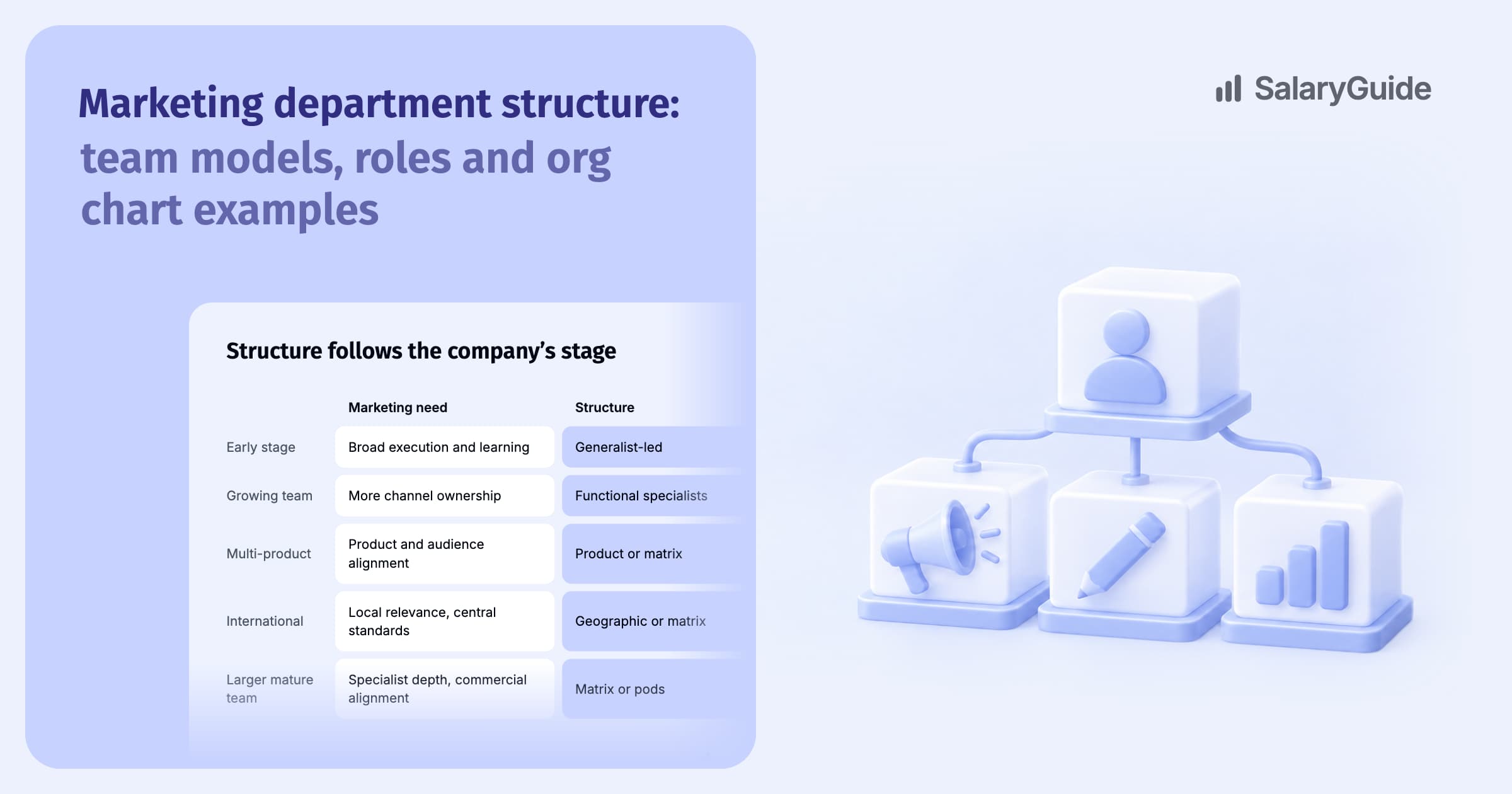
How to Structure Your Team at Every Growth Stage

Three illustrations depict growth stages: a startup's balance, SMB collaboration, and enterprise scale.

Your company’s growth journey isn't a straight line, and your marketing team's structure shouldn't be either. The scrappy, all-hands-on-deck approach that works for a five-person startup will absolutely crumble under the weight of a 50-person team. On the flip side, forcing a rigid enterprise model onto a young company would crush its agility.

The real key is to build the team you need right now, while keeping a close eye on what you'll need around the corner. Let’s walk through the blueprints for three distinct phases of business growth to give you a clear roadmap for scaling your marketing function the right way.

The Startup Stage (1-10 Employees)

In the beginning, things are a bit chaotic—and honestly, that's okay. The primary goal is just to survive and figure out if you've actually got product-market fit. Your marketing "department" might just be one or two people who have to wear a dozen different hats.

Your first hire should almost always be a "T-shaped" marketer. Think of them as a generalist with a superpower. This person has a broad understanding of many marketing disciplines (the top of the "T") but possesses deep, hands-on expertise in one or two critical areas, like content or performance ads. At this point, you're not building a formal org chart; you're building for maximum flexibility.

Your First Marketing Hires:

  • Marketing Lead / Head of Marketing: This is your player-coach. They need to be able to map out a strategy in the morning and be deep in the weeds executing it by the afternoon. This is your T-shaped marketer.
  • Content Creator / Marketing Coordinator: A versatile doer who can jump from writing a blog post to managing social media to helping get a campaign out the door.

This tiny team has to be ruthless with prioritization. They're laser-focused on the channels that offer the most direct path to customers, learning and iterating as fast as they can. The structure is flat, communication is constant, and success is measured in traction and what you learn along the way.

The Scaling SMB Stage (11-50 Employees)

Once you've found your footing and have a somewhat predictable revenue stream, it's time to get more organized. The T-shaped generalists who got you this far now need backup from specialists. This is where the Functional structure usually makes the most sense as the next logical step.

You'll start building out dedicated teams around core marketing functions. The goal shifts from pure survival to creating a repeatable, scalable growth engine.

You're no longer just doing marketing; you're building a marketing machine. The focus turns to creating processes, truly owning channels, and hiring for specific skills to fuel predictable growth.

Example SMB Marketing Team Structure:

  • Director of Marketing: Oversees the entire strategy and manages the newly formed team of specialists.
  • Content Marketing Manager: Owns everything from the blog and SEO to whitepapers and webinars.
  • Performance Marketing Manager: Manages all paid channels, like Google Ads and paid social.
  • Marketing Operations Specialist: Handles the tech stack, data integrity, and analytics.

Each manager owns their domain, which allows for much deeper expertise and more sophisticated campaigns. This specialization is what helps a business move from a series of opportunistic wins to a structured, data-driven marketing program.

The Enterprise Stage (50+ Employees)

At the enterprise level, complexity is the name of the game. You're likely dealing with multiple product lines, different geographic regions, or a whole portfolio of brands. The simple Functional model that worked so well before starts to break down here, creating silos and slowing down decisions.

This is where hybrid models become absolutely essential. Structures like the Matrix and Hub-and-Spoke are designed specifically to manage this kind of complexity. We're seeing a major trend toward these combined models, which help maintain brand consistency while still empowering individual business units. Brand marketing teams in large companies, for instance, often use matrix structures that blend central governance with marketers embedded in various divisions. According to insights on how large marketing teams are structured on MarketerHire.com, this strategy is highly effective for managing diverse product lines.

For example, a product marketer might report to both a central Head of Product Marketing (their functional manager) and a General Manager of a specific business unit (their project manager). This dual reporting ensures that specialized expertise is shared across the company while keeping everyone tightly aligned with the goals of individual products or regions.

Essential Enterprise-Level Roles:

  • Chief Marketing Officer (CMO): Sets the high-level vision and is responsible for connecting marketing directly to business outcomes.
  • VP of Marketing: Manages a large segment of the marketing organization (e.g., VP of Demand Generation, VP of Brand).
  • Director-Level Specialists: Lead teams of deep functional experts (e.g., Director of SEO, Director of Product Marketing).
  • Business Unit Marketers: Specialists who are embedded within teams to execute campaigns for specific products or regions.

This kind of sophisticated structure is all about balancing the need for centralized control with the agility required to compete effectively across many different fronts.

Defining the Key Roles on a Modern Marketing Team

An organizational chart depicting a marketing department structure with CMO, Head of Content, PFC Manager, and Marketing Ops roles.

Once you've landed on a blueprint for your marketing department, the real work begins: filling it with the right people. Think of your structure as the chassis of a race car. It's a great start, but you won't win any races without skilled drivers and a top-notch pit crew.

Each role has a specific job to do, and how well they all work together is what ultimately drives performance. So, let’s break down the essential roles that make up the engine of a modern marketing team. Getting a handle on their responsibilities, skills, and how to measure their success is the key to writing job descriptions that attract real talent and setting expectations that lead to growth.

Strategic and Leadership Roles

At the very top, you have the leaders who chart the course. These roles are less about getting into the weeds of daily tasks and more about steering the entire marketing ship, making sure it’s always moving toward the company's biggest goals.

The Chief Marketing Officer (CMO) or VP of Marketing is the captain. They're on the hook for the entire marketing vision, how the budget gets spent, and, most importantly, proving to the rest of the leadership team that marketing is delivering a return on investment (ROI).

  • Core Responsibilities: Setting the high-level strategy, owning the marketing budget, building and leading the team, and reporting on performance to the C-suite.
  • Must-Have Skills: Sharp business acumen, financial literacy, genuine leadership, and a deep comfort with data and analytics.
  • Key KPIs: Customer Acquisition Cost (CAC), Customer Lifetime Value (CLV), and overall marketing-influenced revenue.

Another critical leadership role is the Head of Content or Content Director. This person is the chief storyteller, responsible for the company’s entire content world. They shape the brand's voice and narrative everywhere it appears, from the blog and social media to videos and podcasts.

  • Core Responsibilities: Building a content strategy that actually helps people at every stage of their journey, managing writers and creators, and keeping the editorial calendar on track.
  • Must-Have Skills: Fantastic storytelling chops, a solid grasp of SEO, team management, and the ability to think strategically.
  • Key KPIs: Organic traffic, conversion rates from content, and lead generation.

Essential Channel Specialists

Right below the leadership layer, you'll find the specialists. These are the hands-on experts who own specific channels and are responsible for turning strategy into action. They’re the ones who get tangible results.

An SEO Manager is laser-focused on one thing: getting your company to show up in organic search results. They are the architects of your search engine presence, working to make sure customers can find you without you having to pay for every click.

  • Core Responsibilities: Digging into keyword research, running on-page and technical SEO audits, building high-quality links, and analyzing performance.
  • Must-Have Skills: A deep understanding of how search engines work, fluency in tools like Ahrefs and SEMrush, and strong analytical abilities.
  • Key KPIs: Organic traffic growth, keyword rankings, and conversions from organic search.

The PPC (Pay-Per-Click) Specialist, sometimes called a Paid Media Manager, is the flip side of that coin. They manage all the paid advertising, aiming to drive immediate, highly targeted traffic through platforms like Google Ads and LinkedIn.

This role requires a unique blend of creativity and data analysis. They must be able to write compelling ad copy while also meticulously optimizing campaigns based on performance metrics to maximize ROAS (Return on Ad Spend).

A Product Marketing Manager is the glue between the product, marketing, and sales teams. Their entire job is to understand the customer inside and out, craft positioning that resonates, and then launch products into the market successfully.

  • Core Responsibilities: Conducting market research, developing buyer personas, creating sales enablement materials, and planning product launches.
  • Must-Have Skills: Market analysis, strategic thinking, great cross-functional communication, and project management.
  • Key KPIs: Product adoption rates, feature usage, and sales-qualified leads (SQLs) from launch campaigns.

Finally, you have the Marketing Operations Manager. This person is the true backbone of the team, making sure all the systems, tools, and processes are running like a well-oiled machine. They manage the martech stack, own the data, and streamline workflows so everyone else can be more effective. Their work is what makes measurement accurate and growth scalable.

Implementing Your New Marketing Structure

Choosing a new marketing org structure on paper is one thing. Actually bringing that blueprint to life without causing chaos? That's the real challenge. A successful transition doesn't happen overnight; it’s a careful process of getting your people, workflows, and tools all pointed in the same direction.

The very first move is a thorough skills audit. Before you even think about posting a job description, you need an honest inventory of the talent already in the building. Map your current team’s strengths and weaknesses against the roles you’ve defined in the new org chart. This exercise quickly reveals where your biggest gaps are—maybe you're stacked with great content creators but have zero marketing ops expertise.

Fostering Collaboration and Communication

Once you know what you have and what you need, your next priority is making sure everyone can talk to each other effectively. A new org chart scrambles old reporting lines and workflows, and if you're not proactive, confusion and frustration will fill the vacuum. This is especially true in a matrix or hybrid model where someone might answer to two different managers.

You have to intentionally build bridges between teams to stop silos from creeping back in.

  • Schedule regular cross-functional meetings: Get content, paid media, product marketing, and others in the same room (virtual or otherwise) to share updates and plan together. Make it a non-negotiable part of the weekly rhythm.
  • Centralize your work: Use a shared project management tool like Asana or Trello. This creates a single source of truth so everyone can see who’s doing what and where potential roadblocks are.
  • Clarify who makes the call: Nothing grinds work to a halt faster than confusion over who has the final say. Document decision-making authority for different areas to avoid bottlenecks and internal turf wars.

Your marketing structure isn't just about who reports to whom; it's about how work gets done. The goal is to create a system where collaboration is the default, not an afterthought.

Attracting and Retaining Top Talent

After identifying the roles you need to fill, you have to go out and land the best people for the job. In this market, building competitive compensation packages is non-negotiable. Use reliable salary data to benchmark your roles and make sure your offers are strong enough to attract the specialists your new structure depends on.

Finally, remember that your marketing department organizational structure is not set in stone. Treat it like a living document. As your company grows, launches new products, or pivots its strategy, your team structure will need to evolve with it. The best marketing leaders I know are the ones who are constantly evaluating and tweaking their organizational design to stay ahead of what’s next.

Answering Your Top Questions

Building out your marketing team can feel like a puzzle. Let's tackle some of the most common questions that come up when you're trying to fit all the pieces together.

What's the Most Common Marketing Structure?

For most small and mid-sized companies, the go-to model is the Functional structure. It’s the classic approach where you group people by their specific expertise—think a content team, an SEO team, a social media team, and so on.

Why is it so popular? It's incredibly efficient. Organizing your team around marketing disciplines allows specialists to go deep in their field and perfect their craft. This focus makes it a straightforward and cost-effective way to get started.

How Often Should I Revisit My Marketing Team's Structure?

As a general rule, plan to review your team structure at least annually. You should also do a check-in anytime your business goes through a major shift, like launching a new product, expanding into a different market, or making a significant change in strategy.

Think of your org chart as a living document, not something set in stone. Its job is to support where your business is headed, not hold it back by clinging to the past.

What's the Real Difference Between Functional and Matrix Structures?

It all comes down to who you report to. In a pure Functional structure, an employee answers to one boss within their area of expertise. For example, a content writer reports directly to the Head of Content. Simple and clear.

The Matrix structure mixes things up. That same content writer might report to both the Head of Content (their functional manager) and a specific Product Marketing Manager they’re assigned to. This dual-reporting setup is designed to bust through silos and get different teams working together more fluidly on shared goals.


Ready to build a high-performing team with the right compensation strategy? SalaryGuide provides real-time salary data and career intelligence to help you attract and retain top marketing talent. Explore SalaryGuide's data and tools today.