The Top 8 Marketing Analyst Job Requirements for 2025

The role of a marketing analyst has become a cornerstone of modern business strategy. As companies increasingly rely on data to drive decisions, understanding the specific marketing analyst job requirements is crucial for both aspiring analysts and the organizations hiring them. This position is no longer just about knowing your way around a spreadsheet; it's about being a storyteller, a strategist, and a technical expert all rolled into one. A great analyst doesn't just report on what happened, they explain why it happened and prescribe what to do next.
This guide provides a comprehensive breakdown of the most critical requirements for success, offering a detailed roadmap to help you navigate this dynamic career path. We'll move beyond generic advice to give you a clear picture of what employers actually look for. Whether you're a student planning your career, a digital marketer aiming for a promotion, or a hiring manager building a team, this listicle will equip you with a precise understanding of the modern marketing analyst role.
We will cover the essential hard and soft skills that define top-tier candidates. You will learn about:
- The foundational data analysis and statistical skills needed.
- Proficiency in key marketing analytics tools and platforms.
- The importance of SQL and database management.
- Strategic business acumen and deep marketing knowledge.
- Effective data visualization and communication techniques.
By exploring these core competencies in detail, you'll gain the clarity needed to either land your target job or hire the right talent to propel your marketing efforts forward. Let's dive into the specifics.
1. Data Analysis & Statistical Skills
At the core of all marketing analyst job requirements is the ability to transform raw data into strategic insights. This involves collecting, cleaning, processing, and performing statistical analyses on large datasets. The goal is to uncover hidden trends, patterns, and correlations that inform and validate marketing decisions, from campaign optimization to long-term budget allocation.

This skillset is non-negotiable because it turns marketing from a purely creative endeavor into a data-driven science. Without it, companies are essentially guessing what works. Strong data analysis allows a marketing analyst to provide concrete answers to critical business questions like "Which channels are providing the highest ROI?" or "What customer segments are most likely to churn?"
How It's Applied in a Marketing Context
Effective data and statistical analysis manifest in various daily tasks. A proficient analyst doesn't just pull numbers; they interpret what those numbers mean for the business.
- Campaign Performance Measurement: Using A/B testing and statistical significance to determine which version of an ad copy, landing page, or email subject line drives better results.
- Customer Segmentation: Applying clustering algorithms or simple statistical methods in Excel to group customers based on demographics, purchase history, or online behavior for targeted campaigns.
- Predictive Analytics: Building simple regression models to forecast future sales based on past advertising spend, seasonality, and other market factors.
Key Insight: The true value of a marketing analyst isn't just in their ability to use tools like SQL or Python, but in their capacity to frame a business problem, select the right statistical method to analyze it, and clearly communicate the findings to stakeholders.
Actionable Tips for Skill Development
Building these foundational skills is a continuous process. Here are specific steps you can take to enhance your data analysis capabilities:
- Master Spreadsheet Functions: Before diving into complex languages, become an expert in Excel or Google Sheets. Focus on PivotTables, VLOOKUP/XLOOKUP, and statistical functions like
CORREL,T.TEST, andFORECAST. - Learn SQL for Data Extraction: SQL (Structured Query Language) is essential for pulling data directly from company databases. Practice with platforms like Mode or DataCamp to write queries that filter, join, and aggregate data.
- Explore Data Visualization: An insight is only useful if it can be understood. Learn to create clear, compelling charts and dashboards in tools like Tableau, Power BI, or even Excel to tell a story with your data. This is a crucial skill as you grow, and mastering it can directly impact your career trajectory and potential earnings. For those looking to advance, understanding how these skills influence higher-level roles is key; you can see how data proficiency impacts compensation by exploring the career path of a marketing analytics manager on SalaryGuide.com.
2. Marketing Analytics Tools Proficiency
While raw data skills are foundational, a marketing analyst must also be an expert operator of the specific platforms that collect and organize marketing data. Proficiency in industry-standard analytics and business intelligence (BI) tools is a critical job requirement, as these systems are the primary source for tracking user behavior, campaign performance, and customer journey metrics across digital channels.
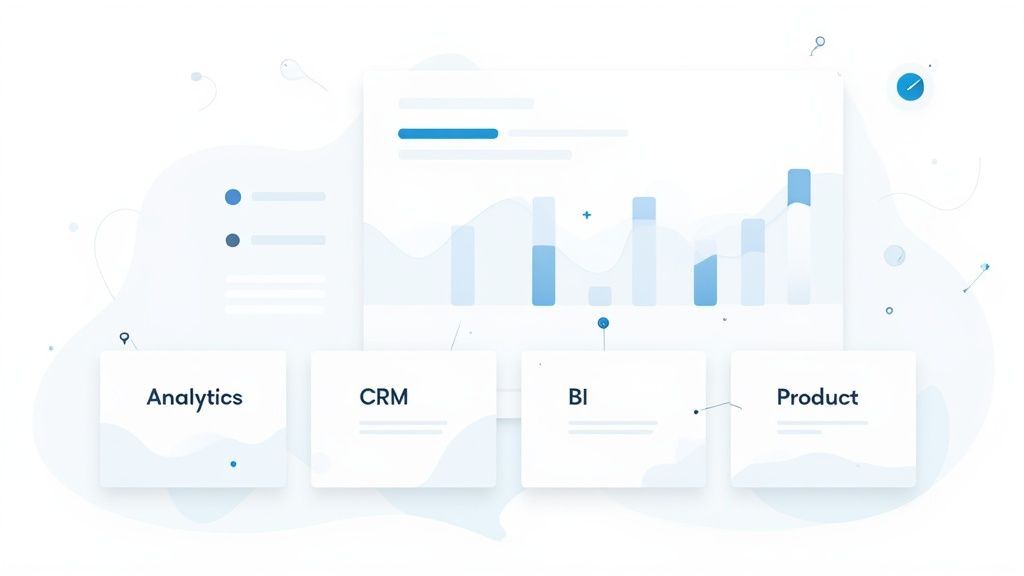
This expertise is essential because it allows the analyst to efficiently access, segment, and visualize data without constant reliance on engineering teams. Knowing the nuances of each platform, from setting up event tracking to building custom reports, enables an analyst to move quickly and provide timely insights that guide marketing strategy and tactical adjustments.
How It's Applied in a Marketing Context
Mastery of these tools goes beyond just pulling default reports. A skilled analyst leverages platform-specific features to answer complex business questions and measure the full impact of marketing activities.
- Web & App Analytics: Using Google Analytics 4 or Adobe Analytics to build funnels that track user progression from a landing page click to a final purchase, identifying key drop-off points.
- CRM & Marketing Automation: Analyzing data within platforms like HubSpot or Salesforce Marketing Cloud to understand lead quality, measure email engagement rates, and report on the sales pipeline generated by marketing campaigns.
- Product Analytics: Leveraging tools like Mixpanel or Amplitude to analyze in-app user behavior, track feature adoption, and measure the impact of product marketing initiatives on user retention.
Key Insight: Being proficient with marketing analytics tools means you can not only report on "what" happened, but you can also configure the platforms to dig deeper and understand the "why" behind user actions and campaign outcomes.
Actionable Tips for Skill Development
Gaining hands-on experience is the best way to develop proficiency. Here are practical steps you can take to master the tools of the trade:
- Get Certified: Start with the free Google Analytics Individual Qualification (GAIQ). This certification is widely recognized and provides a strong foundation in web analytics principles.
- Utilize Free Tiers and Trials: Most major platforms like HubSpot and Mixpanel offer free versions or extended trials. Use them to create a personal project, like analyzing traffic to your own blog or portfolio website.
- Deep Dive Before Going Broad: Instead of learning five tools superficially, focus on mastering one first, such as Google Analytics 4. Deep knowledge of one platform makes it much easier to learn others, as many share similar concepts.
- Explore Specialized Tools: As you grow, familiarize yourself with niche platforms. For instance, when analyzing social media campaigns, understanding the best influencer analytics tools for marketing can provide a significant competitive advantage by measuring creator ROI and audience engagement more effectively.
3. SQL & Database Management
While high-level dashboards provide a summary, true marketing analysis often requires digging into the raw data. This is where proficiency in Structured Query Language (SQL) becomes a critical requirement. SQL allows an analyst to directly query, manipulate, and extract specific information from relational databases, providing the granular data needed to answer complex business questions.

This skill is essential for achieving data autonomy. Instead of waiting for a data engineering team to create a report, a marketing analyst with SQL skills can self-serve, pulling the exact data segments they need on demand. This speed and flexibility enable more agile marketing operations, allowing teams to quickly pivot strategies based on real-time insights extracted directly from the source.
How It's Applied in a Marketing Context
SQL is the bridge between vast company databases and actionable marketing intelligence. An analyst uses it to perform tasks that are impossible with pre-built analytics tools alone, making it a cornerstone of the marketing analyst job requirements.
- Custom Audience Segmentation: Writing queries to pull lists of customers who have purchased a specific product in the last 90 days but have not opened a recent email campaign.
- Deep-Dive ROI Analysis: Joining customer data from a CRM with transaction tables and marketing campaign logs to accurately calculate the lifetime value (LTV) and return on investment (ROI) for specific channels.
- Behavioral Pattern Recognition: Extracting user event data from a website or app database to analyze the customer journey, identifying drop-off points or features that lead to conversion.
Key Insight: Mastering SQL empowers a marketing analyst to move beyond observing what happened (descriptive analytics) and start investigating why it happened (diagnostic analytics). This capability to build custom datasets is fundamental to uncovering deeper, more strategic insights.
Actionable Tips for Skill Development
Developing strong SQL skills is a tangible way to increase your value and effectiveness as a marketing analyst. Here are focused steps to build your proficiency:
- Start with Core Commands: Focus on mastering the fundamentals first. Get comfortable with
SELECT,FROM,WHERE,GROUP BY, andJOIN(especiallyLEFT JOINandINNER JOIN), as these form the basis of most marketing queries. - Use Interactive Practice Platforms: Utilize online platforms like HackerRank, LeetCode, or SQLZoo. They offer real-world problems and an interactive environment to write and test your queries, which is crucial for hands-on learning.
- Understand Database Structure: Learn to read Entity-Relationship (ER) diagrams. Understanding how tables are related is essential for writing efficient
JOINstatements and pulling accurate data without errors. - Practice in a Safe Environment: Whenever possible, use a non-production or staging database to test your queries. This prevents accidental changes or performance slowdowns on the live database that the business relies on.
4. Business Acumen & Marketing Knowledge
Beyond technical skills, a top-tier marketing analyst possesses a deep understanding of business strategy and marketing fundamentals. This involves grasping how different marketing initiatives contribute to overarching business objectives, such as revenue growth, market share, and profitability. The goal is to connect data-driven insights directly to business outcomes, transforming analytics from a reporting function into a strategic asset.
This requirement is critical because it provides the "why" behind the data. An analyst can calculate click-through rates and conversion metrics, but business acumen allows them to explain why those metrics matter to the bottom line. It enables them to prioritize analyses that address the most pressing business challenges and frame their findings in the language of executives, not just data scientists.
How It's Applied in a Marketing Context
Strong business and marketing knowledge ensures that analytical work is always relevant and impactful. An analyst with this skill set thinks like a business owner, constantly seeking ways to drive growth and efficiency.
- Financial Impact Analysis: Calculating and interpreting key metrics like Customer Acquisition Cost (CAC) and Lifetime Value (LTV) to assess the long-term profitability of different marketing channels and customer segments.
- Competitive Intelligence: Analyzing competitors' pricing strategies, promotional activities, and market positioning to identify threats and opportunities for their own company.
- Marketing Funnel Optimization: Understanding the complete customer lifecycle from awareness to advocacy, and using data to identify and fix leaks in the marketing and sales funnel.
Key Insight: The most effective marketing analysts are translators. They translate business goals into analytical questions and then translate analytical findings back into strategic, actionable business recommendations. This ability to bridge the gap between data and strategy is a core component of senior marketing analyst job requirements.
Actionable Tips for Skill Development
Developing strong business acumen is an ongoing effort that involves looking beyond the spreadsheet. Here are specific ways to build this crucial competency:
- Read Industry Publications: Regularly follow leading marketing blogs and business news sources like HubSpot, Moz, MarketingWeek, and the Harvard Business Review to stay updated on trends, strategies, and case studies.
- Take Business & Marketing Courses: Enroll in online courses on platforms like Coursera or LinkedIn Learning that cover topics like business strategy, marketing principles, and financial metrics for non-financial managers.
- Shadow Senior Marketers: Ask to sit in on strategy meetings or have informational interviews with experienced marketing leaders to understand their thought processes and how they make strategic decisions.
- Study Your Company's Business Model: Go beyond the marketing department. Learn how your company makes money, who its most profitable customers are, and what its biggest operational challenges are. This context is essential for a complete understanding of the digital marketing career path and how an analyst role fits within the broader organization.
5. Data Visualization & Communication Skills
An insight is powerless if it cannot be understood. This is why the ability to translate complex data findings into clear, compelling visual representations and narratives is a critical marketing analyst job requirement. It involves creating dashboards, charts, reports, and presentations that effectively communicate insights to non-technical stakeholders, bridging the gap between raw numbers and strategic action.

This dual skill set is essential because marketing analysts often present their findings to executives, product managers, and creative teams who may not have a statistical background. A well-designed visualization can convey the core message in seconds, where a spreadsheet of raw numbers would fail. It’s the final, crucial step in the analytical process that ensures data-driven recommendations are actually adopted by the business.
How It's Applied in a Marketing Context
Effective data visualization and communication are about storytelling. An analyst must craft a narrative that guides the audience from a business problem to a data-backed solution, using visuals as the primary evidence.
- Performance Dashboards: Building interactive Tableau or Power BI dashboards that provide a real-time view of campaign KPIs, allowing stakeholders to self-serve and explore performance data.
- A/B Test Reporting: Creating simple before-and-after bar charts or line graphs to clearly demonstrate the lift generated by a winning variation in an email or landing page test.
- Funnel Analysis: Designing a sales funnel visualization that highlights drop-off rates at each stage, immediately drawing attention to the most critical points of friction in the customer journey.
Key Insight: Great marketing analysts are translators. They convert the complex language of data (p-values, regression coefficients, SQL queries) into the universal language of business (ROI, customer lifetime value, market share) through clear visuals and simple explanations.
Actionable Tips for Skill Development
Improving your ability to visualize and communicate data is a direct investment in your influence and impact within an organization.
- Study Design Principles: Learn the fundamentals of effective visual display from experts like Edward Tufte or Stephen Few. Focus on maximizing the data-to-ink ratio and eliminating "chart junk" that distracts from the core message.
- Practice with Real-World Tools: Use platforms like Tableau Public or Looker Studio with free datasets to practice building different chart types. Replicate compelling visualizations you see in reports or online articles.
- Tell a Story: When building a presentation, structure it like a story. Start with the problem (the "inciting incident"), present the data as evidence (the "rising action"), and conclude with actionable recommendations (the "resolution").
- Master the Essentials: To effectively convey complex findings, a marketing analyst must master the art of visual storytelling. Learn about key data visualization best practices to ensure your charts are not just beautiful, but also insightful and easy to understand.
6. Digital Marketing Channel Knowledge
A marketing analyst doesn't operate in a data vacuum; their insights must be grounded in a solid understanding of the channels driving the data. This means having a comprehensive grasp of how different digital marketing channels like SEO, SEM, social media, email marketing, and content marketing function, what their key performance indicators (KPIs) are, and how they contribute to the overall business objectives.
This knowledge is a crucial marketing analyst job requirement because it provides context to the numbers. An analyst who understands the nuances of Google's algorithm or the user behavior on TikTok can provide far more valuable recommendations than one who only sees conversion rates. They can diagnose why a PPC campaign is underperforming or identify which content format resonates most with an email segment.
How It's Applied in a Marketing Context
Deep channel knowledge allows an analyst to move beyond simply reporting on metrics to actively diagnosing performance and recommending strategic shifts. It's about connecting the "what" (the data) with the "why" (the channel mechanics).
- Paid Search (SEM/PPC) Analysis: Evaluating Quality Score, click-through rates (CTR), and conversion rates in Google Ads to recommend bid strategy adjustments or ad copy improvements.
- Search Engine Optimization (SEO): Analyzing organic traffic trends, keyword rankings, and backlink profiles to identify opportunities for content creation or technical site improvements.
- Email Marketing Effectiveness: Segmenting email lists to measure open rates, click-through rates, and conversion rates for different audiences, then suggesting A/B tests for subject lines or calls-to-action.
- Social Media Performance: Tracking engagement rates, audience growth, and referral traffic from platforms like Instagram or LinkedIn to determine which content pillars drive the most value.
Key Insight: A great marketing analyst acts as a bridge between data science and marketing strategy. Their ability to speak the language of each channel specialist (the SEO manager, the PPC expert) makes their analytical insights more relevant, credible, and actionable.
Actionable Tips for Skill Development
Gaining expertise across multiple channels is an ongoing effort. Here are practical ways to build and maintain your digital marketing acumen:
- Get Hands-On Experience: If possible, spend time directly managing small campaigns in Google Ads, Facebook Ads Manager, or an email service provider. Direct experience is the fastest way to learn a platform's intricacies.
- Follow Industry Leaders and Publications: Regularly read channel-specific blogs like Search Engine Journal (for SEO/SEM), Social Media Today, and the HubSpot blog (for inbound and email marketing).
- Utilize Platform Certifications: Complete free training programs like Google Skillshop for Google Ads and Analytics or Meta Blueprint for Facebook/Instagram advertising. They provide a structured foundation of platform knowledge.
- Analyze Competitor Campaigns: Use tools like Semrush or Ahrefs to deconstruct what competitors are doing in paid and organic search. Observe their social media content and sign up for their email newsletters to benchmark their strategies. There is a wide range of marketing skills to learn, and understanding them in a competitive context is invaluable. To broaden your expertise, you can explore essential marketing skills on SalaryGuide.com.
7. Advanced Excel Skills
While a suite of modern BI and programming tools exists, expert-level proficiency in Microsoft Excel remains a cornerstone of marketing analyst job requirements. It is the universal language of business data, essential for quick data manipulation, cleaning, ad-hoc analysis, and creating models that are easily shared with non-technical stakeholders across the organization.
This skill is fundamental because many teams still rely on Excel for reporting, budget tracking, and initial data exploration. An analyst who can maneuver swiftly within a spreadsheet can deliver insights faster, build flexible ROI calculators, and prepare datasets for more complex analysis in other tools. It serves as the indispensable workbench for day-to-day data tasks.
How It's Applied in a Marketing Context
Advanced Excel skills go far beyond simple sums and averages; they enable sophisticated and rapid analysis that directly impacts marketing strategy. An analyst uses these capabilities to quickly pivot from raw data to actionable business intelligence.
- Data Cleaning and Preparation: Using text functions like
TRIM,SUBSTITUTE, andCONCATENATEto standardize messy data exported from various marketing platforms before analysis. - Performance Reporting: Creating dynamic PivotTables and charts that allow stakeholders to easily segment campaign performance by region, product, channel, or demographic.
- ROI and Forecasting Models: Building a marketing ROI calculator using
IFstatements and goal-seek functionalities to model outcomes based on different budget and performance scenarios. - Cross-Channel Data Matching: Employing
VLOOKUPor the more powerfulXLOOKUPto merge customer lists from an email campaign with sales data from a CRM to calculate conversion rates.
Key Insight: Mastery of Excel isn't about knowing every single function. It's about understanding how to structure data properly and combine a core set of functions (lookups, logical, text, and aggregations) to solve complex marketing problems efficiently.
Actionable Tips for Skill Development
Elevating your Excel skills from intermediate to advanced requires focused practice on specific, high-impact functionalities. Here are steps to become an Excel power user:
- Become a PivotTable Expert: Go beyond basic table creation. Learn to use calculated fields, slicers for interactive filtering, and grouping features to create powerful, easy-to-use reports.
- Master Key Functions: Prioritize learning
SUMIFS,COUNTIFS,INDEX/MATCH(as an alternative toVLOOKUP), and array formulas. These functions are critical for complex, multi-criteria analysis. - Learn Data Structuring Best Practices: Understand the principles of "tidy data," where each row is an observation and each column is a variable. This structure unlocks the full power of Excel's analytical tools. Keeping data organized is a key part of the foundational skillset needed to grow into leadership roles, a path you can explore further by understanding the career trajectory to a marketing director position on SalaryGuide.com.
8. Critical Thinking & Problem-Solving Ability
Beyond technical proficiency, one of the most vital marketing analyst job requirements is the ability to think critically and solve complex business problems. This involves deconstructing marketing challenges, asking incisive questions, forming testable hypotheses, and challenging assumptions. It's the capacity to see beyond the surface-level numbers and understand the underlying "why" behind data trends.
This skillset is the bridge between raw data and strategic action. A tool can show you that website traffic spiked, but a critical thinker will investigate the root causes, considering everything from a recent PR mention to a competitor's campaign failure. Without strong problem-solving skills, an analyst risks providing misleading or incomplete insights that could lead to poor business decisions.
How It's Applied in a Marketing Context
Critical thinking is not an abstract concept; it's a practical, daily activity for a successful marketing analyst. They constantly question data integrity and look for alternative explanations for observed patterns.
- Investigating Anomalies: When a key metric like conversion rate suddenly drops, a problem-solver digs deeper. They might hypothesize that a recent website update broke a checkout button, that a specific traffic source is sending unqualified leads, or that a new promotion is worded confusingly, and then systematically test each possibility.
- Designing Controlled Experiments: To isolate the true impact of a new marketing initiative from external noise like seasonality, an analyst designs A/B tests or other controlled experiments. This ensures that conclusions about campaign effectiveness are based on causal evidence, not just correlation.
- Recognizing Statistical Traps: An analyst might notice that while overall average order value is up, the AOV for key customer segments is actually down. This is an example of Simpson's Paradox, and identifying it requires a critical eye to avoid making incorrect strategic recommendations based on misleading aggregate data.
Key Insight: A great marketing analyst doesn't just answer the questions they are given; they use critical thinking to identify and ask the more important, unasked questions that uncover foundational business opportunities or risks.
Actionable Tips for Skill Development
Sharpening your problem-solving abilities is crucial for career growth. It elevates you from a data reporter to a strategic partner. Here are ways to cultivate this skill:
- Practice the 'Five Whys' Technique: When faced with a data point (e.g., "Email open rates are down"), repeatedly ask "Why?" to drill down to the root cause instead of stopping at the most obvious answer.
- Study Cognitive Biases: Learn about common mental shortcuts like confirmation bias or survivorship bias that can lead to flawed data interpretation. Being aware of them is the first step to avoiding them in your own analysis.
- Document and Test Assumptions: In any analysis, explicitly write down your assumptions (e.g., "We assume last year's seasonal trend will hold true this year"). Then, design a way to validate or invalidate that assumption with data.
Marketing Analyst Skills: 8-Point Comparison
| Skill | Complexity 🔄 | Resources ⚡ | Expected Impact 📊 | Ideal Use Cases 💡 | Key Advantages ⭐ |
|---|---|---|---|---|---|
| Data Analysis & Statistical Skills | Medium–High — statistical concepts + tooling | Tools (Excel, Python/R, BI), datasets, learning time | High — robust insights, forecasting, ROI measurement | A/B testing, trend analysis, predictive modeling | Enables data-driven decisions and credible recommendations |
| Marketing Analytics Tools Proficiency | Medium — platform-specific features and setup | Platform licenses, integrations, training | High — real-time dashboards and operational reporting | Multi-channel tracking, attribution, stakeholder reporting | Streamlines reporting and provides actionable real-time insights |
| SQL & Database Management | High — query logic, schema understanding, optimization | Databases (MySQL/Postgres/Snowflake), sandboxes, practice | High — direct raw-data access enables custom analyses | Large dataset extraction, joins for ROI, automated reports | Direct control of data, reduces IT dependency, improves accuracy |
| Business Acumen & Marketing Knowledge | Medium — broad domain understanding + context | Time, market research, courses, cross-functional exposure | High — insights aligned to business goals and revenue impact | Strategy alignment, prioritizing analyses, pricing/product decisions | Improves actionability of analytics and stakeholder trust |
| Data Visualization & Communication Skills | Medium — design principles + tooling + storytelling | BI tools (Tableau/Power BI), design time, feedback cycles | High — increases adoption and speeds decision-making | Executive dashboards, presentations, test result storytelling | Clarifies findings, drives buy-in, makes data accessible |
| Digital Marketing Channel Knowledge | Medium–High — many channels and rapid changes | Platform accounts, campaign data, ongoing learning | Medium–High — better channel optimization and attribution | Channel-specific analysis, campaign optimization, benchmarking | Enables relevant metrics analysis and actionable channel recommendations |
| Advanced Excel Skills | Low–Medium — accessible but deep feature set | Excel license, templates, practice time | Medium — fast prototyping and small-to-medium analyses | Ad-hoc analysis, data cleaning, ROI calculators, prototyping | Universal tool, quick to share, ideal for fast iterative work |
| Critical Thinking & Problem-Solving Ability | High — cognitive skill, context-driven rigor | Mentorship, case studies, practice; tool-agnostic | Very High — prevents errors, yields deeper, reliable insights | Root-cause analysis, experimental design, ambiguous problems | Produces rigorous, trustworthy insights and innovative solutions |
Building Your Career as a Marketing Analyst
The journey from an aspiring data enthusiast to a seasoned marketing analyst is a dynamic and rewarding one, built upon a foundation of diverse and evolving competencies. As we've explored, the core marketing analyst job requirements are not just a static checklist but a holistic blend of technical prowess, strategic insight, and powerful communication. Excelling in this role means moving beyond simply reporting on what happened; it means becoming the storyteller who explains why it happened and the strategist who predicts what will happen next.
A successful marketing analyst is a hybrid professional. They are part data scientist, part business strategist, and part creative problem-solver. Mastering SQL to pull raw data is just the first step. The real value emerges when you can apply statistical methods to that data, visualize the findings in a compelling Tableau dashboard, and then present your insights to a non-technical audience with clarity and confidence, directly influencing the next marketing campaign's budget and direction.
Synthesizing Your Skill Set for Maximum Impact
Think of the eight core requirements we covered not as isolated skills but as interconnected gears in a powerful machine. Your proficiency with marketing analytics tools like Google Analytics is magnified by your deep understanding of digital marketing channels. Your advanced Excel skills become exponentially more valuable when paired with strong business acumen, allowing you to model customer lifetime value or forecast campaign ROI.
To truly stand out, focus on building bridges between these competencies:
- Connect Technical Skills to Business Outcomes: Don't just mention you know SQL. Explain how you used it to segment a customer database, leading to a 15% increase in email engagement for a targeted campaign.
- Translate Data into Actionable Narratives: Instead of presenting a chart showing a dip in conversion rates, build a narrative. Use your data visualization skills to pinpoint the drop-off point in the funnel and use your critical thinking to hypothesize potential causes, like a broken checkout button or a confusing new ad creative.
- Embrace Continuous Learning: The tools and techniques in this field change rapidly. What's cutting-edge today might be standard tomorrow. Dedicate time to earning certifications, following industry blogs, and experimenting with new platforms. This demonstrates a proactive mindset that employers highly value.
Your Actionable Roadmap to Advancement
Navigating the path from a junior to a senior marketing analyst requires deliberate action. It’s not just about accumulating years of experience; it's about the quality and strategic application of that experience.
For aspiring and junior analysts:
- Focus on building a rock-solid technical foundation. Become an expert in Excel and at least one core analytics platform (like Google Analytics).
- Start a personal project. Analyze public datasets or your own small website's traffic to build a portfolio that demonstrates your skills.
- Seek mentorship. Learn from experienced analysts to understand how they approach complex problems and communicate with stakeholders.
For mid-level and senior analysts:
- Develop your strategic influence. Move from answering questions to asking the right questions that push the business forward.
- Mentor junior team members. Teaching others is a powerful way to solidify your own knowledge and develop leadership skills.
- Specialize in a high-demand area, such as marketing mix modeling, multi-touch attribution, or predictive analytics, to increase your value and earning potential.
Ultimately, the most critical requirement for a marketing analyst is an insatiable curiosity. It’s the drive to look at a spreadsheet of numbers and see a story waiting to be told, a problem waiting to be solved, or an opportunity waiting to be seized. By continuously honing the skills outlined in this guide, you are not just preparing for your next job interview; you are building a resilient, impactful, and future-proof career in the heart of modern marketing.
Ready to put your skills to the test and find your next role? SalaryGuide curates the best marketing analyst opportunities directly from company career pages, giving you direct access to top-tier employers. Use our platform to benchmark your salary expectations and discover jobs that perfectly match the marketing analyst job requirements you've worked so hard to master.
