Marketing Analytics Manager Salary A Guide to Your Earning Potential
Across the United States, the average base salary for a Marketing Analytics Manager typically lands somewhere between $110,000 and $165,000 a year. But if you stop there, you're missing a huge piece of the puzzle. The base pay is just the starting point; total compensation—which includes bonuses and equity—is what really paints the full financial picture.
Deconstructing the Total Compensation Package
It’s a classic mistake to get fixated on the base salary number alone. The real value of a job offer lies in its total compensation—the entire package of pay and benefits you receive.
Think of it like building a house. Your base salary is the solid, reliable foundation. It's the predictable income you can count on. But the bonuses, stock options, and other perks? Those are the extra rooms, the high-end finishes, and the killer backyard that turn a basic structure into a truly valuable home.
Grasping this difference is key. It allows you to negotiate for a much more rewarding package overall, not just a slightly higher salary. This is especially true in the tech world, where companies often use hefty bonuses and equity grants to attract the best people. In many cases, these components are just as valuable, if not more so, than the base pay itself.
The Three Pillars of Compensation
A Marketing Analytics Manager's compensation is usually built on three pillars. Each one plays a different role, from providing steady income to offering a shot at long-term wealth.
Base Salary: This is your guaranteed paycheck, the fixed amount you get every couple of weeks or once a month. It’s the predictable core of your income.
Performance Bonuses: These are variable payments, typically paid out annually, that are tied to performance—yours, your team's, or the company's. A strong bonus can add a significant chunk to your yearly earnings.
Equity and Stock Options: Often part of the deal at startups and public companies, equity gives you a slice of ownership. It’s a long-term play that can pay off handsomely if the company thrives.
This diagram shows how these different pieces come together to form your total compensation.
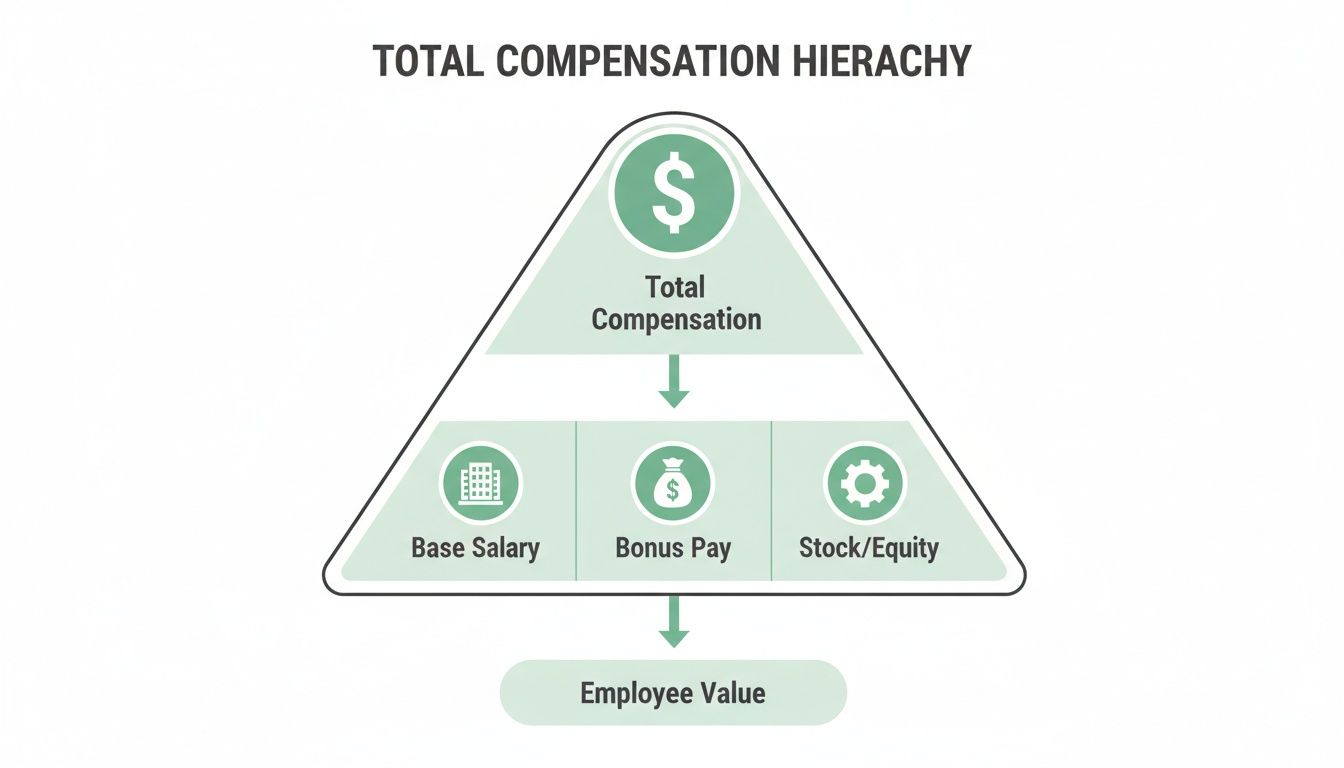
As you can see, total compensation is a layered structure where each element builds on the last, creating a package far more valuable than just the base salary.
The following table breaks down these components to give you a clearer idea of what to expect in a typical offer.
Understanding Your Total Compensation Package
| Compensation Component | Average Percentage of Total Pay | Description |
|---|---|---|
| Base Salary | 60-80% | The fixed, predictable income you receive regularly. This is the foundation of your pay. |
| Annual Bonus | 10-25% | A variable cash payment based on individual, team, or company performance metrics. |
| Equity/Stock | 5-20% | Ownership in the company, offered as stock options or RSUs. Its value can grow significantly over time. |
This breakdown makes it clear: if you're only discussing base salary during negotiations, you're likely leaving serious money on the table.
Putting It All Together
So, how does this translate to real-world numbers?
Data pulled from verified professionals shows just how much these other components matter. In the U.S., the average total compensation for an Analytics Manager is $204,000 a year. The range is massive, stretching from $156,000 on the lower end to an eye-popping $538,000 for top earners, depending on their experience, location, and company.
You can explore more detailed salary data for Analytics Managers on 6figr.com to see how these numbers shake out in different scenarios. It’s definitive proof that focusing only on the base salary means you're not seeing the complete picture.
How Your Career Level Shapes Your Earning Potential

Your salary as a Marketing Analytics Manager isn’t a static number. It's a living figure that grows as you move up the ladder, but it's not just about putting in the years. The real driver behind a bigger paycheck is the expanding scope and impact of your work.
Think of an early-career manager as a skilled data craftsperson. Their world revolves around flawless execution—building the perfect Tableau dashboard, fine-tuning Google Analytics tracking, and delivering crisp campaign reports. These are the vital, hands-on tasks that form the foundation of any data-driven marketing team.
But as you advance, you evolve from a craftsperson into an architect. Instead of just building a single dashboard, you're designing the entire data ecosystem for the marketing department. It’s this jump from tactical work to strategic leadership that really unlocks significant pay increases.
From Analyst to Manager
The first major leap in your career often happens when you move from a role like Senior Marketing Analyst into your first management position. You’re still using your core technical skills, but now you're adding people and project leadership to the mix.
- Tactical Focus (Analyst): Your primary job is to pull data, run analyses, and create reports when asked.
- Strategic Oversight (Manager): You start to own the analytics roadmap, delegate tasks, mentor junior analysts, and—most importantly—translate complex data for business leaders.
This transition typically comes with a 15-25% boost in base salary and makes you eligible for larger performance bonuses. Why? Because you're no longer being paid just for what you can do, but for your ability to multiply your impact through a team.
Manager to Senior Manager or Director
The next big step up is into a Senior Manager or Director role. At this stage, your focus shifts almost completely from hands-on tasks to high-level strategy and influencing the entire organization. A Director of Analytics isn't just managing analysts; they are fundamentally shaping how the company uses marketing data to fuel growth.
A Director of Analytics is the architect designing the entire data strategy for the marketing organization, ensuring every campaign, channel, and decision is grounded in robust measurement and actionable insights.
This elevated role means you're responsible for things that directly hit the bottom line. You might be setting the KPIs for the entire marketing department, fighting for the budget to buy new analytics tools, or presenting crucial insights to the C-suite. That increased strategic weight is why Director-level salaries often jump by 30-50% compared to manager-level roles.
The Path to Executive Leadership
The Marketing Analytics Manager role is an incredible launchpad for executive positions. When you have a deep, instinctual understanding of performance metrics, customer behavior, and ROI, you become a prime candidate for much broader leadership opportunities.
To make the most of this potential, it helps to map out your long-term goals. A good guide to professional development planning can be invaluable here.
Some common long-term career paths include:
- Head of Business Intelligence: Expanding your view beyond marketing to oversee data strategy for the whole company.
- Director of Marketing Operations (MarTech): Shifting focus to the technology stack that powers all data collection and campaign execution.
- VP of Marketing: Leading the entire marketing function, using your analytical mind to ensure the department runs like a well-oiled, efficient machine.
- Chief Marketing Officer (CMO): Reaching the top marketing spot, where you're responsible for the company's brand growth and overall marketing strategy.
Each step on this path represents a fundamental shift: from managing data to managing people, and finally, to managing the business strategy itself. This evolution is directly reflected in your earning potential, making this a career with truly exceptional long-term financial rewards.
Why Your Location Determines Your Paycheck
Where you live has a massive impact on your salary as a Marketing Analytics Manager. It’s not just a minor detail—it can be the single biggest factor influencing what you take home. This is all about the economics of talent hotspots.
Major tech hubs like San Francisco, New York, and Seattle are ground zero. These cities are packed with high-growth companies, all fighting over the same small pool of expert analysts. This creates a bidding war for talent, driving salaries way up. It’s simple supply and demand, and if you have the skills, you’re in the driver's seat.
This isn't just theory; the numbers back it up. In San Francisco, for example, the average salary for this role hits $135,689. It's also telling that managers in these top-tier markets are 52% more likely to be at public companies, where things like stock grants can sweeten the deal even more.
The Trade-Off Between Paycheck and Purchasing Power
But a huge salary on paper doesn't always translate to a bigger bank account. The sticker shock of living in a major metro area can eat into your earnings fast. That $150,000 salary in San Jose might actually feel smaller than a $120,000 offer in Austin once you pay for rent, taxes, and a cup of coffee.
This is why up-and-coming tech cities are becoming so attractive. They might not flash the highest salary numbers, but your money goes a lot further. A lower cost of living means your paycheck has more real-world power, which can lead to a better lifestyle, buying a home sooner, and having more cash left over at the end of the month.
Don't get fixated on the top-line salary number alone. You have to evaluate an offer based on what it means for your actual life. A smaller salary in a more affordable city can often be the smarter financial move.
To really get a handle on this, you need to understand how these adjustments work. Our guide explains in detail what a cost of living adjustment is and how it affects your real take-home pay. It's need-to-know info for comparing offers.
Remote Work and the New Salary Landscape
The explosion of remote work has thrown a wrench in the works, and companies are still scrambling to figure out how to pay people who aren't tied to a physical office. The result? A messy, inconsistent landscape where your zip code can still dictate your pay, even if your commute is just to the living room.
We're seeing three main approaches pop up:
- Location-Based Pay: This is the old-school model. Big companies often adjust your salary based on the cost of living where you are. A manager in Manhattan makes more than a teammate doing the exact same job from a small town in the Midwest.
- National Standard Pay: Some companies, often more modern in their thinking, are paying for the role, not the location. Everyone in the same job gets paid within the same salary band, period.
- Hybrid Models: A common middle ground is creating a few pay tiers. For example, Tier 1 is for expensive hubs like SF and NYC, Tier 2 is for mid-size cities, and so on. It's simpler than adjusting for every single town.
This new reality creates a lot of uncertainty. As a candidate, you have to bring this up early. Ask hiring managers directly about their remote pay philosophy. Your entire negotiation strategy will hinge on whether their policy is rigid or if there’s room to argue for a salary based on your value, not your address.
The Skills That Really Move the Needle on Your Salary
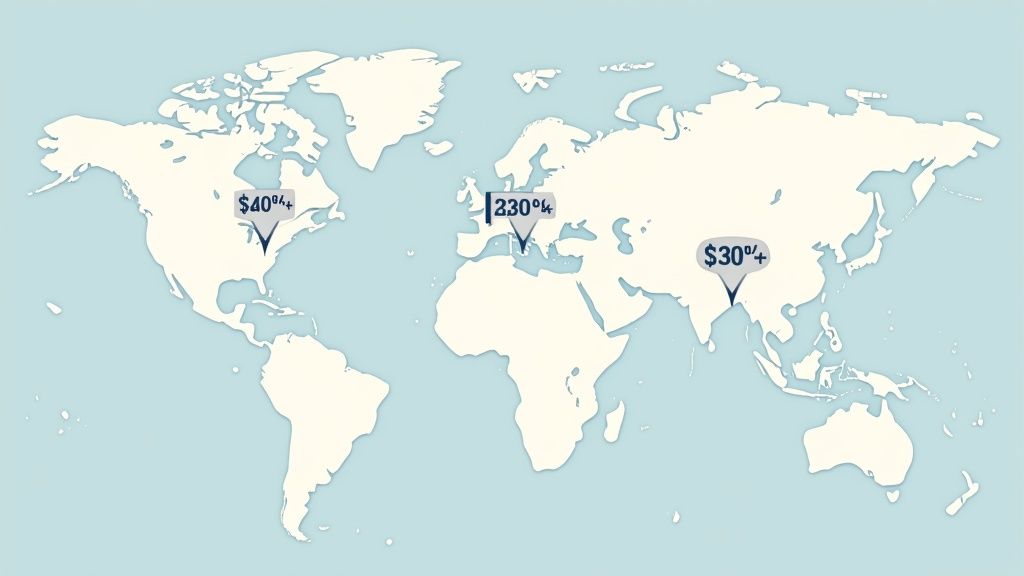
While your years of experience and where you live set the foundation for your salary, it’s your specific skillset that truly dials up your earning potential. Think of it this way: certain skills don’t just get you in the door—they give you the leverage to ask for a top-tier offer.
Your abilities are like a toolkit. A basic set of screwdrivers and wrenches will handle everyday tasks. But a specialized, high-performance kit lets you take on the most complex, high-stakes projects. For a marketing analytics manager, this means mastering a powerful mix of technical know-how and sharp business instincts.
The Technical Skills That Command a Premium
In the world of marketing analytics, technical fluency isn't a "nice-to-have"; it's your ticket to the game. It’s the language you use to pull insights from databases, the engine behind predictive models, and the canvas for bringing data to life. Managers who can roll up their sleeves and get into the technical weeds are consistently the highest paid.
There are a few core competencies that pop up again and again in high-paying job descriptions:
SQL Proficiency: This is the bedrock. A manager who can independently write queries to pull, join, and wrangle large datasets without waiting on an engineer is exponentially more valuable.
Python or R: These are the power tools for serious analysis. Knowing Python or R opens the door to predictive modeling, machine learning, and advanced statistical work—answering questions that are simply impossible with spreadsheets alone.
Data Visualization Tools: Being an expert in a platform like Tableau or Power BI is critical. The real magic is in turning dense tables of numbers into clean, intuitive dashboards that an executive can understand in 30 seconds.
The demand for these skills isn't just a hunch. We've seen job postings requiring Python and SQL proficiency jump by a staggering 60% since 2020. This tells a clear story: companies are putting their money behind managers who can own the entire analytics process, from raw data to final recommendation.
The "Soft" Skills That Deliver Hard Results
Technical chops will get you a seat at the table, but they won't make you the most valuable person in the room. The managers who break into the highest salary brackets are the ones who can flawlessly connect the data to the business. They are strategists and communicators first, data wizards second.
The most sought-after analytics leaders are storytellers. They can take a complex regression analysis and weave it into a compelling narrative that inspires the C-suite to take action.
This is where the real value—and the big money—is created. It's a combination of a few key skills that employers are actively searching for and are more than willing to reward.
Data Storytelling: This is much more than just presenting charts on a slide. It's about building a clear, persuasive argument from the data that points to a specific business decision.
Stakeholder Management: The best earners are masters of building relationships. They collaborate seamlessly with marketing, sales, product, and finance, making sure everyone is aligned and operating from the same data-driven truth.
Business Acumen: You have to understand the business inside and out—its goals, its market, its financial drivers. This context is what allows you to focus your analytical firepower on problems that actually move the needle on revenue.
To show you just how much these skills can impact your paycheck, here’s a breakdown of the abilities that give you the most negotiation leverage.
Top Skills Driving Higher Marketing Analytics Manager Salaries
| Skill Category | Specific Skill | Why It Commands a Premium | Potential Salary Uplift |
|---|---|---|---|
| Programming & DB | Advanced SQL & Python/R | Enables self-sufficiency, predictive modeling, and automation, reducing reliance on other teams. | +15-25% |
| Data Visualization | Mastery of Tableau/Power BI | Translates complex data into clear, actionable business insights for leadership. | +10-18% |
| Statistical Modeling | A/B Testing, LTV Modeling | Directly ties marketing activities to revenue and long-term customer value. | +12-20% |
| Business Strategy | Data Storytelling & Comms | Bridges the gap between technical findings and executive decision-making, driving action. | +15-22% |
| Platform Expertise | Google/Adobe Analytics Suite | Deep knowledge of core marketing platforms allows for more sophisticated and immediate insights. | +8-15% |
Ultimately, to maximize your salary, you need to prove you have both technical depth and strategic vision. Highlighting these high-impact skills to add to your resume is the most direct path to boosting your market value. And if you're looking to build out your capabilities, our guide on essential https://salaryguide.com/blog/marketing-skills-to-learn is a great place to start your development journey.
How Industry and Company Size Impact Compensation
When we talk about a Marketing Analytics Manager's salary, it's never just one number. The industry you’re in and the size of your company play a massive role in what you can expect to earn. These factors create completely different pay environments, each with its own balance of stability, risk, and potential reward.
Think about two parallel career paths. One is at a scrappy, high-growth tech startup; the other is at a sprawling Fortune 500 corporation. While the job title might be the same, the compensation philosophy is from another planet. Getting a handle on these differences is crucial for finding the right fit for your wallet and your appetite for risk.
The Startup vs. Corporate Divide
The clearest split in pay structure often comes down to the company's size and maturity. A pre-IPO startup and a publicly traded behemoth are playing entirely different ballgames, and how they pay their people shows it.
A startup, for instance, might offer a more conservative base salary but sweeten the deal with a hefty chunk of equity. This is the classic high-risk, high-reward gamble. Those stock options could make you a fortune if the company takes off, or they could end up as worthless digital paper. You’re essentially betting on the future.
On the flip side, a large, established company in finance or retail will almost always bring a higher base salary to the table, along with predictable annual bonuses and a solid benefits package. This route offers stability. You’re trading that lottery-ticket potential of equity for guaranteed, competitive cash, year in and year out.
The trade-off is simple: Startups offer a shot at a massive payday through equity, while big corporations provide a reliable paycheck with structured bonuses. Are you a gambler or a long-term investor? Your answer will guide your job search.
Why Data-Intensive Industries Pay a Premium
It’s also true that not all industries value analytics the same way. The ones where data is the absolute lifeblood of the business—the engine that drives every major decision—will always pay top dollar for analytics talent. In these companies, a sharp marketing analytics manager isn't just a support role; they are a core part of the machine that makes money.
This creates a pretty clear pecking order when it comes to pay.
Top-Tier Industries (Tech, Finance, E-commerce): These sectors live and breathe data. They rely on analytics for everything from acquiring customers and flagging fraud to building new products. Naturally, they offer the biggest paychecks to attract managers who can turn raw numbers into actionable strategy.
Mid-Tier Industries (Healthcare, CPG, Retail): These fields are becoming more and more data-centric, using analytics to map out patient journeys or fine-tune complex supply chains. The pay is strong, but it might not quite reach the peaks you see in tech and finance.
Developing Industries (Manufacturing, Non-Profit): While these sectors are starting to embrace analytics, the function is often still new. Salaries tend to be lower because the direct line between analytics and revenue is still being drawn and proven out.
Reading Between the Lines of a Job Description
You can usually get a feel for the industry and company size just by dissecting the job description, which gives you early clues about the compensation package. For example, a role at a major healthcare system will likely highlight experience with privacy rules and CRM platforms, often listing a salary range in the $100,000 to $135,000 ballpark for a manager.
A tech company’s posting, however, will probably be packed with terms like A/B testing, multi-touch attribution, and proprietary data tools. This signals a role that’s deeply woven into the product and engineering teams, which almost always comes with a higher base salary and a more aggressive performance bonus. Learning to spot these industry tells helps you size up your potential earnings long before you hit "apply."
A Practical Guide to Salary Negotiation
Once you’re armed with solid data about your market value, it’s time to negotiate for the marketing analytics manager salary you deserve. The trick is to treat this conversation less like a confrontation and more like a business deal. You’re the product, and your goal is to clearly communicate your value.
Before you ever hop on a call with a recruiter, get your number straight in your own head. Use the salary benchmarks from this guide to figure out a realistic range based on your specific experience, skills, and location. This prep work is crucial—it keeps you from getting flustered and gives you a firm, confident starting point for the whole discussion.
Building Your Business Case
When the conversation about salary begins, don’t just throw out a number. You need to build a compelling case for it. The best way to do this is by framing your past accomplishments around the actual business results you delivered.
Think in terms of tangible outcomes:
- Tie your skills directly to value: "My experience with Python and LTV modeling helped my last team shift $250,000 in ad spend toward channels that actually performed, which boosted our ROI by 18%."
- Show your leadership impact: "I mentored two junior analysts and built a set of standardized Tableau dashboards that saved our team over 10 hours a week, freeing everyone up for more important strategic projects."
- Highlight efficiency improvements: "I managed our switch to server-side tagging. That project alone improved our data accuracy and site speed, which led to a 5% increase in conversion rates."
This approach completely changes the dynamic. It’s no longer about what you want to be paid; it’s about what you deliver. You’re making it clear that you have a track record of creating value that far exceeds your salary.
How to Respond to the Initial Offer
When you get an offer, your first words should always be "thank you." Your second should be a request for a little time to review everything. Never, ever accept on the spot. You need a moment to step back and look at the entire package—base salary, bonus potential, equity, and benefits—and compare it to your research.
If the offer comes in lower than you hoped, you can push back politely and professionally. Try something like this: "Thank you so much for the offer. I'm really excited about the role. Based on my research for a Marketing Analytics Manager in this area with my skills in predictive modeling, I was anticipating a base salary closer to the $150,000 - $165,000 range."
A great negotiation isn't always about the base salary. If a company truly can't budge on that number, see what else is on the table. You might be able to get a bigger professional development budget, an extra week of vacation, or a guaranteed remote work arrangement.
Remember, negotiating is a completely normal part of hiring. For a deeper dive, our complete guide on asking for a raise has scripts and tips that work just as well for a new job offer. By building your case and communicating your value with confidence, you put yourself in the best possible position to land the compensation you've earned.
Frequently Asked Questions
Is Marketing Analytics Manager a Good-Paying Job?
Absolutely. The salary for a Marketing Analytics Manager is very competitive, and for a good reason. These aren't just number crunchers; they're the people who directly connect marketing spend to real revenue, which is a vital function in any business today.
Companies are more than willing to invest heavily in managers who can blend deep technical skills with sharp business strategy. Finding someone who excels at both is rare, making them incredibly valuable.
What’s the Next Step in This Career Path?
Once you’ve mastered the manager role, a few exciting doors swing open. The most direct path is moving up to a Senior Manager or Director of Marketing Analytics. In these roles, you're managing bigger teams and shaping the entire analytics strategy for the company.
But that's not the only option. Many leverage their skills to pivot into related leadership positions, like Head of Business Intelligence or Director of Marketing Strategy. With enough experience and a proven track record, some climb all the way to the C-suite as a VP of Marketing or even Chief Marketing Officer (CMO), where their data-driven mindset shapes the entire organization.
The career trajectory for a Marketing Analytics Manager often leads from tactical data oversight to strategic business leadership. It's a role that serves as an excellent launchpad into the executive suite.
Do I Really Need a Master's Degree to Earn a Top Salary?
A master's isn't a hard-and-fast rule, but it can definitely give you a significant edge in salary negotiations. An advanced degree in a relevant field like data science, statistics, or business analytics often translates into higher starting offers.
Think of it this way: it signals a deeper level of expertise that top-tier companies actively seek out, particularly for senior roles that demand sophisticated modeling or strategic leadership. While experience can get you there, a master's can often accelerate the journey.
At SalaryGuide, we pull back the curtain with transparent, real-time salary data and job postings sourced directly from company career pages. We're here to help you navigate your marketing career with confidence. Explore what you're really worth and find your next opportunity at https://salaryguide.com.
