The Chief Creative Officer Role Explained
So, what exactly is a Chief Creative Officer (CCO)? At the highest level, they are the senior executive in charge of a company's entire creative output and brand identity. They’re the ultimate brand storyteller, making sure everything the company puts out there—from a massive ad campaign down to the look of a new product—feels connected, makes an impact, and actually helps the business grow.
Think of them as the architect of a brand's soul.
The Conductor of the Creative Orchestra

Here’s a great way to think about it: picture a symphony orchestra. You have violins (graphic designers), cellos (copywriters), percussion (video producers), and woodwinds (UX designers). Each one is a master of their craft, but without a conductor, you just have a room full of talented people making noise.
The Chief Creative Officer is that conductor.
They don't need to be the best violinist or drummer in the room. Instead, they have a deep, intuitive understanding of how all these different parts need to come together to create something beautiful and moving. The CCO’s job is to guide the entire creative department, ensuring every single note—from the visual style of the website to the tone of a tweet—works in perfect harmony to build a powerful and consistent brand experience.
More Than Just a Title
The CCO role is so much more than just managing a team of artists and writers. It's a genuine C-suite position that sits right at the intersection of creative execution and hard-nosed business strategy. They are the ones who translate a goal like "increase market share by 15%" into a tangible creative campaign that gets people to act. This requires a rare mix of pure artistic vision and sharp commercial instincts.
A great CCO also fosters a culture where creativity can actually thrive, inspiring their teams to take smart risks and push beyond the obvious. Day-to-day, this means they are on the hook for:
- Setting the Creative Vision: They define the north star for the brand’s creative direction, looking years down the road.
- Guarding Brand Integrity: They are the fierce protector of the brand, making sure every single touchpoint feels authentic and consistent.
- Leading Creative Talent: They’re responsible for hiring, mentoring, and inspiring the creative teams to do the best work of their careers.
- Driving Business Growth: They connect the dots between creative work and business results, proving how great ideas impact the bottom line.
At its core, the Chief Creative Officer is the guardian of the brand's soul. Their mission is to ensure the company’s story isn’t just told, but felt by its audience, turning abstract concepts into memorable experiences that forge real loyalty.
To give you a clearer picture, this table breaks down the essential functions that define this dynamic leadership role.
Core Functions of a Chief Creative Officer at a Glance
| Core Function | Description | Key Activities |
|---|---|---|
| Strategic Vision | Defining and articulating the company's overarching creative direction. | Developing brand guidelines, leading creative brainstorming, and aligning creative strategy with business goals. |
| Team Leadership | Managing, mentoring, and inspiring the entire creative department. | Recruiting top talent, fostering a collaborative culture, and providing constructive feedback and professional development. |
| Brand Guardianship | Ensuring consistency and quality across all creative outputs and brand touchpoints. | Approving final campaigns, overseeing brand voice and style, and maintaining brand integrity across all channels. |
| Innovation & Ideation | Championing new ideas and pushing creative boundaries to keep the brand relevant. | Researching market trends, experimenting with new media, and encouraging a culture of creative risk-taking. |
Ultimately, these functions all work together, allowing the CCO to build and maintain a brand that is not only creatively excellent but also commercially successful.
Core Responsibilities of a CCO
Don't let the title fool you. While "Chief Creative Officer" sounds arty and straightforward, the reality is a demanding blend of visionary leadership, sharp operational management, and strategic business savvy. A CCO is responsible for far more than just signing off on a new logo. They are the ultimate guardian of the brand's entire creative world.
Think of them as the protector of the brand's soul—its voice, look, and feel—across every single touchpoint. They're just as invested in the emotional punch of a Super Bowl ad as they are in the seamless user experience of the company's mobile app. Their job is to make sure the brand's story is told consistently and powerfully, no matter where a customer encounters it.

Leading and Mentoring Creative Talent
One of a CCO’s most vital roles is leading and inspiring large, often diverse, creative teams. This goes way beyond managing projects and timelines. It’s about cultivating a culture where big ideas can flourish and creative risks are not just allowed, but celebrated. A truly great Chief Creative Officer is part mentor, part coach, and a full-time champion for their people.
Day-to-day, this means they're focused on:
- Attracting and Retaining Top Talent: Finding, hiring, and nurturing the best designers, copywriters, strategists, and producers in the game.
- Providing Clear Direction: Taking high-level business goals and translating them into clear, actionable creative briefs that get teams excited to do their best work.
- Fostering Professional Growth: Building clear career paths and making sure the team is constantly learning and developing new skills.
This leadership sets the entire tone for the creative department. The CCO’s standards and energy are what make the difference between good work and exceptional work. To see how this team plugs into the bigger picture, explore the typical marketing department organizational structure in our detailed guide.
Financial and Operational Oversight
Behind the creative vision is a seasoned executive with serious financial duties. CCOs are often in charge of multi-million dollar budgets and are held accountable for how every dollar is spent. It's their job to make sure creative efforts deliver a real return on investment.
A Chief Creative Officer must connect every creative decision back to a business outcome. They justify budgets, measure campaign performance, and prove to the rest of the C-suite that great creative work is a powerful driver of revenue, not just an expense.
This means they need to be masters of resource allocation, project prioritization, and process improvement. A huge part of the CCO's job is mastering creative operations management to keep the creative engine running smoothly, turning brilliant ideas into finished campaigns on time and on budget.
Championing Innovation and Brand Evolution
The world doesn't stand still. Markets evolve, consumer tastes change, and new technologies emerge constantly. The CCO is the one steering the ship, ensuring the brand not only keeps up but actively leads the charge. They are the chief advocate for innovation, always pushing for fresh thinking and new ways to connect with people.
This might mean guiding a legacy brand through a modern refresh or launching a disruptive product into a saturated market. For example, a CCO at a major retailer might kickstart a project to build augmented reality into their shopping app. At a fast-growing startup, they might be the one defining the brand’s identity from the ground up, crafting a story that truly connects with a new generation.
Driving Cross-Functional Collaboration
Creative work doesn't happen in a silo. The Chief Creative Officer is a critical bridge-builder, working hand-in-hand with other executives to create a unified strategy. They forge strong partnerships with the Chief Marketing Officer (CMO), Chief Product Officer (CPO), and sales leaders to ensure everyone is pulling in the same direction.
This teamwork is absolutely essential. When the CCO and the product team are in sync, the product's design and its marketing story feel like two halves of a whole. When they work closely with sales, they deliver creative assets that actually help close deals. This kind of leadership turns a creative vision from a simple artistic endeavor into a strategic asset that fuels the entire business.
Your Career Path to Chief Creative Officer
For most creatives, the title of Chief Creative Officer seems like a distant summit on a career mountain. It’s not a position you just stumble into. The journey from being a hands-on maker to an executive visionary is a deliberate climb, one that demands big shifts in both skill and perspective. While there's no single, set-in-stone path, a pretty common progression does exist.
Most people who end up as CCOs started their careers as creators—think Graphic Designers, Copywriters, or UX Designers. At this stage, it's all about the craft. Your success is measured by the quality of your own work, your technical chops, and how well you can nail a creative brief. This is where you build the creative muscle and genuine empathy for the work that you'll need to lead others later on.
The Shift from Maker to Manager
The first major leap is moving from doing the work to guiding it, often into a role like Art Director or Senior Copywriter. Suddenly, your responsibility extends beyond your own output. You're now mentoring junior creatives, helping shape concepts, and presenting work to clients or internal teams. Your focus moves from doing to directing.
This transition forces you to build a whole new set of skills:
- Team Leadership: You start mentoring others, giving feedback that helps them grow instead of just pointing out what’s wrong.
- Client Communication: You’re no longer just taking the brief; you’re helping write it, translating client needs, and defending the team’s creative choices.
- Project Oversight: You begin managing smaller projects, making sure they stay on track and actually hit their strategic goals.
The next big step is becoming a Creative Director. This is the role where you fully trade your maker hat for a leader hat. As a Creative Director, you're responsible for the creative output of an entire team or department. You set the vision for major campaigns, manage serious budgets, and are ultimately accountable for the results. In many ways, the skills overlap with those of a marketing director; in fact, understanding how to become a marketing director can give you a real edge at this stage.
Ascending to the Executive Level
The final climb to Chief Creative Officer requires another massive evolution. It's no longer about leading the creative department; it's about leading the creative vision for the entire company as a member of the C-suite. This demands a level of business savvy that goes way beyond a typical creative role.
Becoming a CCO means learning to speak the language of the entire business—finance, operations, sales, and product. Your success is no longer measured by how beautiful a campaign is, but by its direct, measurable impact on the company's bottom line.
At this level, you have to think like a business owner. You’re expected to understand P&L statements, justify creative investments with solid ROI projections, and connect everything your team does to the company's biggest goals. This jump from creative leader to business leader is often the toughest part of the journey, but it’s absolutely essential.
Building an Executive-Level Portfolio
As you climb, your portfolio has to grow up with you. An entry-level portfolio is a highlight reel of beautiful work. A CCO-level portfolio is a collection of business case studies. It needs to tell a story of strategic problem-solving, not just aesthetic talent.
Frame every piece of work around challenges and outcomes:
- The Business Problem: What specific market challenge was the company up against?
- Your Strategic Insight: What was the core idea that drove your creative approach?
- The Creative Solution: Briefly show the work itself.
- The Measurable Impact: How did the work actually perform? Think "25% increase in sales," or a "40% lift in brand awareness."
This kind of experience directly translates to your earning potential. A CCO just starting in the role earns an average of $108,206, while those with over a decade of executive experience can command salaries up to $315,000 per year. To see how experience shapes pay in more detail, you can explore detailed CCO salary data on PayScale.com.
What Does a Chief Creative Officer Actually Make?
So, what's the bottom line for a top creative leader? The compensation for a Chief Creative Officer is rarely a simple number on a paycheck. It's a full financial package that tells a story about their value to the business. Let's pull back the curtain on what a CCO really earns, from the annual salary and bonuses to the long-term incentives that reward true vision.
A Chief Creative Officer's pay isn't a one-size-fits-all figure. It’s shaped by a mix of factors—the company's size, its industry, and, of course, where it’s located. A CCO at a fast-growing tech startup in San Francisco might see a package heavy on equity, while their counterpart at a global fashion house in New York could have a higher base salary with massive performance bonuses tied to campaign results.
Breaking Down the Compensation Package
To understand a CCO's earnings, you have to look at all the pieces. It’s almost never just about the base salary.
- Base Salary: This is the bedrock of the package—the guaranteed income. It’s the starting point and is most directly influenced by experience, company revenue, and the local cost of living.
- Performance Bonuses: These are the annual kickers tied to hitting specific goals, both for the creative team and the company as a whole. Success could be measured by campaign ROI, a jump in market share, or hitting key brand awareness targets.
- Equity and Stock Options: Especially common in startups and public companies, equity gives a CCO a genuine stake in the company's long-term success. This can be a game-changing part of their total compensation, directly tying their creative vision to shareholder value.
- Long-Term Incentives (LTIs): Think of these as golden handcuffs, but in a good way. Often paid in cash or stock that vests over several years, LTIs are designed to keep top executive talent around and reward them for sustained performance and loyalty.
Experience Is Everything (When It Comes to Pay)
Experience is probably the single biggest lever on a CCO's salary. A leader with a killer portfolio filled with iconic brands and measurable business results can demand a serious premium. It's the difference between being a creative director and a creative force.
This chart shows just how dramatically a CCO's earning potential grows as they stack up years of strategic experience and big wins.
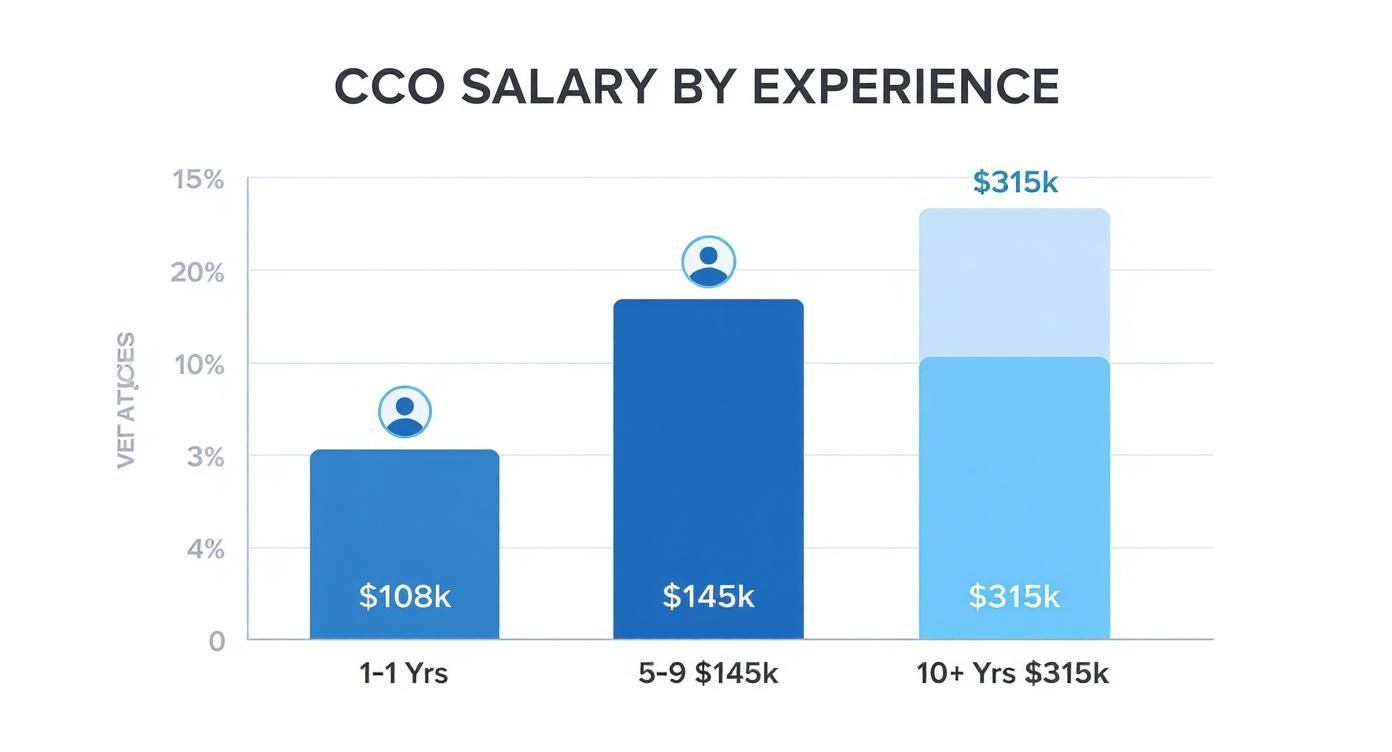
The data makes it crystal clear: while CCOs earn a great living early on, the real financial rewards come after a decade of proving you can lead and deliver.
The average salary for a CCO in the United States has also been on a healthy upward trend, which tells you just how much companies are valuing creative leadership. Back in 2014, the average annual salary was $186,925. Fast forward to 2025, and that number has climbed to $208,248—a pretty significant jump. This growth shows a real demand for visionaries who can cut through the noise.
A CCO's compensation is a direct reflection of their ability to turn creative vision into tangible business value. The best ones prove that brilliant creative isn't an expense—it's a powerful investment in growth.
How Location Shapes the Paycheck
Just like with any other executive role, where you work matters. A lot. Major cities with a high cost of living and a heavy concentration of big companies or hot industries will naturally pay more. A CCO job in a major metro can easily pay tens of thousands of dollars more than the national average.
CCO Salary Benchmarks by Major US City
Take a look at how CCO compensation can swing from one city to another. The difference between taking a job in Chicago versus San Francisco is significant.
| City | Average CCO Salary | Percentage vs. National Average |
|---|---|---|
| San Francisco, CA | $225,500 | +32% |
| New York, NY | $218,700 | +28% |
| Boston, MA | $215,188 | +26% |
| Los Angeles, CA | $206,500 | +21% |
| Chicago, IL | $182,400 | +7% |
| National Average | $170,889 | N/A |
These regional pay gaps are critical to weigh when you're looking at a new offer or planning your next career move.
The CCO salary landscape also fits into the broader trends across the marketing world. For a more comprehensive look at pay across different roles, our guide on how much marketers earn can help you see where these executive salaries fit in the bigger picture.
Negotiating Your Worth
When it's time to talk numbers, your portfolio is your best friend. But at the CCO level, it’s not about showing off slick designs; it's about telling a story of business success.
- Quantify Your Impact: Don't just show the work—show the results. Frame your wins with hard numbers. Talk about the campaign that led to a 20% jump in sales or the brand refresh that grabbed 5 points of market share.
- Benchmark Your Value: Go in armed with data. Know what the market is paying for a CCO with your experience, in your industry, and in your city.
- Negotiate the Whole Package: The base salary is just the beginning. Dig into the bonus structure, the equity potential, and any other long-term perks that make up the total compensation.
By anchoring your value in business impact and bringing a portfolio that proves it, you can confidently negotiate a package that truly reflects your worth.
How to Hire a Great CCO
Finding the right Chief Creative Officer is less like filling a role and more like finding a business partner. You’re not just looking for a brilliant artist; you need a strategic visionary who can turn ambitious business goals into creative work that actually moves the needle on revenue.
This calls for a hiring process that digs much deeper than the surface-level polish of a portfolio.
Crafting the Right Job Description
Your search kicks off with the job description. Ditch the generic wish lists and, instead, paint a vivid picture of the real challenges and opportunities waiting for them. The best CCOs are drawn to solving tough problems, not just managing a team.
Frame the role around a clear mission. Think: "Lead our brand refresh to capture a younger demographic" or "Build the creative engine that will power our global expansion." This instantly reframes the job from a list of tasks into a compelling challenge they can sink their teeth into.
To get this in front of the right people, you'll need to go beyond standard job boards and use innovative talent acquisition strategies.
Here’s what to focus on in your job description:
- The Mission: Start with the "why." What is the ultimate goal for this role over the next 1-3 years? Be specific.
- Strategic Impact: Make it crystal clear that this is an executive role. They'll be expected to connect creative output directly to business growth.
- Leadership Scope: Detail the team structure they'll inherit or build. Don't forget to mention the crucial cross-functional collaboration with marketing, product, and sales.
- Cultural Vibe: Describe the creative culture you have or want to build. Is it fast-paced and experimental, or more refined and brand-centric? Honesty is key.
Evaluating the Portfolio Strategically
A CCO’s portfolio isn't an art gallery; it's a collection of business success stories told through a creative lens. When you review their work, your focus should be on impact, not just pretty pictures.
A slick ad campaign is nice, but a slick ad campaign that boosted market share by 15% is what truly matters at this level.
Look for a clear narrative behind every project. The candidate must be able to walk you through the initial business problem, their strategic approach, the creative execution, and—most importantly—the measurable results. This is how you separate a great Creative Director from a true business leader.
A great CCO's portfolio proves they can solve business problems with creativity. The work should be presented as a series of case studies, each with a clear challenge, a smart solution, and a quantifiable outcome.
Mastering the Interview Process
Once you’ve shortlisted a few promising candidates, the interview is your chance for a deep dive into their leadership philosophy and strategic mind. Go beyond the softball "Tell me about your work" questions.
Instead, use behavior-based questions to uncover how they think and operate under pressure.
Try questions like these:
- Describe a time you had to sell a risky creative idea to a skeptical executive team. How did you build your case, and what was the result?
- How do you build a culture of innovation while still keeping the work on-brand and on-schedule?
- Walk me through a campaign that bombed. What did you learn from it, and how did it change your leadership style?
- How do you measure the ROI of your creative team's work? Give me a specific example.
These questions probe their ability to lead, persuade, and connect creative work directly to the bottom line. It's also smart to discuss salary expectations early, as compensation can swing wildly.
For instance, the salary for a Chief Creative Officer in Boston, MA, averages $215,188—that's 21% higher than the national average. Meanwhile, remote positions average around $198,333. To get a better handle on how geography impacts pay, you can explore detailed CCO salary data on Built In.
Got Questions About the CCO Role? Let's Clear a Few Things Up.
Even after laying out the responsibilities and career path, a few common questions always seem to pop up about the Chief Creative Officer role. It's a complex job, sitting right at that fascinating—and sometimes messy—intersection of art and commerce. This can lead to some confusion for everyone from aspiring creatives to the CEOs looking to hire one.
Let’s tackle some of the most frequent questions I hear. Think of this as the CCO cheat sheet.
CCO vs. Creative Director: What's the Real Difference?
This is easily the most common question, and for good reason. The titles sound similar, but the jobs are worlds apart. It’s a bit like comparing a film director to the head of the entire movie studio.
A Creative Director lives and breathes the work. They’re in the trenches, leading a team on specific projects, campaigns, or client accounts. Their focus is on executing a creative vision brilliantly and making sure the final product is on-brief, on-time, and exceptional. It's a hands-on, project-focused leadership role.
The Chief Creative Officer, on the other hand, operates from a 30,000-foot view. Their job isn’t just about the work but the entire creative ecosystem of the company.
The Creative Director wins the battle; the Chief Creative Officer wins the war. The CCO steps back from the daily creative grind to focus on long-term brand strategy, C-suite collaboration, and proving how creativity drives the company’s bottom line.
A CCO is busy:
- Defining the creative vision for the whole organization, looking years down the road.
- Owning the entire creative department's budget and demonstrating its ROI.
- Being the voice of creativity in the boardroom, influencing company-wide decisions.
- Mentoring the next generation of leaders, including the Creative Directors themselves.
Does a Chief Creative Officer Need a Design or Writing Background?
Most CCOs do come up the ranks as designers, copywriters, or art directors, but it's not a hard-and-fast rule. What matters most isn't your mastery of the Adobe Creative Suite or your ability to craft a killer headline. It's your ability to spot a brilliant idea, protect it, and guide it into the world.
A CCO's primary function is to lead, not to "do." So, could someone from a brand strategy, production, or even a pure marketing background step into the role? Absolutely, as long as they have:
- Impeccable taste. You just know great when you see it.
- A deep, empathetic understanding of the creative process.
- Serious leadership and communication chops.
- The business acumen to connect creative output to financial outcomes.
That said, a background in the craft gives you instant credibility. When your team knows you've been in their shoes, it builds a level of trust that’s tough to replicate otherwise.
How Has the CCO Role Changed?
The role of the CCO has gone through a massive transformation over the past decade. It's shifted from "chief aesthetics officer" to a vital strategic partner at the executive table. Not too long ago, the CCO was brought in at the end of a project to "make it pretty." Today, they’re in the room from the very first conversation.
Modern CCOs have to speak the language of data, technology, and business strategy. They need to be comfortable discussing performance metrics, customer acquisition funnels, and product roadmaps. This isn't just a change in the job description; it reflects a fundamental shift in business itself—the realization that creativity is a powerful commercial weapon, not just decoration.
For instance, a CCO today is just as likely to be nerding out over user experience (UX) data with the Chief Product Officer as they are to be reviewing storyboards for a new campaign. The role is now deeply integrated across the entire business, making it more influential than ever.
Ready to take the next step in your marketing career? At SalaryGuide, we provide the transparent data, verified job opportunities, and AI-powered tools you need to understand your worth and accelerate your growth. Explore SalaryGuide to unlock your career potential.
