How to Become a Marketing Director A Proven Roadmap
The journey to becoming a marketing director isn't a single leap; it's a calculated climb. You'll evolve from a hands-on specialist to a team leader, and ultimately, into a business strategist responsible for driving real revenue. This path is built over several years, requiring a potent mix of tactical expertise, leadership skills, and sharp financial acumen.
Your Career Roadmap to Marketing Director
Climbing the ladder from a junior marketer to a director is about more than just putting in the years. It’s a journey through distinct stages, each with its own set of expectations, skills, and measures of success.
You start by becoming an expert in a specific marketing channel. From there, you learn how to lead a team to execute. Finally, you transition into a role where you guide the entire marketing department’s strategy and prove its business impact. The secret is knowing what's expected at each level so you can start building those skills before you even need them.
This requires a fundamental shift in how you think about your work. As a specialist, your value is tied to your direct output—the copy you write, the campaigns you manage, the data you analyze. As a manager, your value becomes your team's output. As a director, your value is measured by your ability to tie marketing directly to the company's bottom line.
For a deeper dive into how these roles interconnect, take a look at the typical digital marketing career path.
Mapping the Milestones
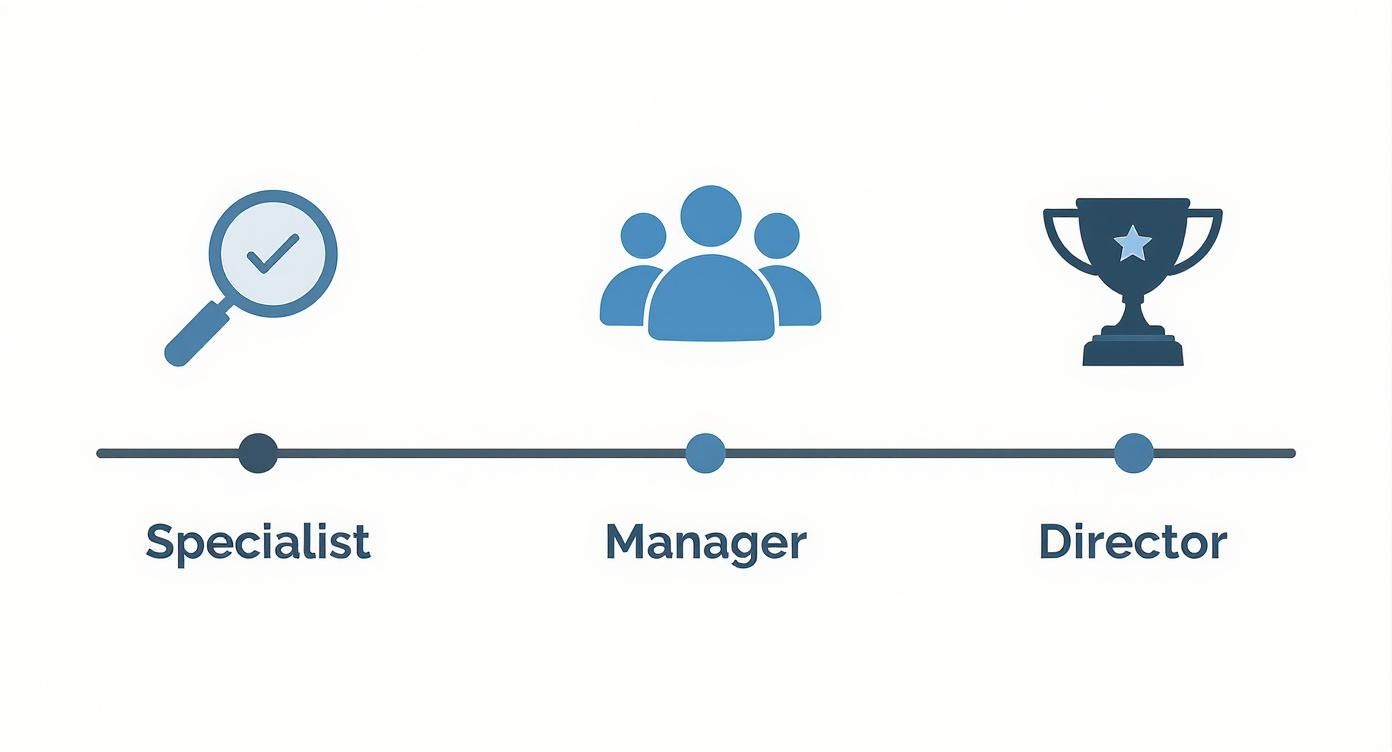
Let's break this journey down into its three core phases: Specialist, Manager, and Director. Each one builds on the last, demanding new skills and a much broader perspective.
The biggest mistake I see aspiring directors make is clinging to tactical skills for too long. Your goal has to shift—from doing the work to directing the work, and finally, to defining why the work matters for the business.
This graphic lays out the typical progression, showing how you move from pure execution to high-level strategy.
The table below gives you a more detailed snapshot of what to expect at each stage. Think of it as your cheat sheet for what to focus on as you grow.
Marketing Career Progression At a Glance
| Career Stage | Typical Timeframe | Core Skills to Master | Key Performance Indicators (KPIs) |
|---|---|---|---|
| Marketing Specialist | 1-4 years | Channel-specific expertise (SEO, PPC, Content), data analysis, campaign execution, project management tools. | Campaign ROI, conversion rates, traffic growth, cost per acquisition (CPA), engagement metrics. |
| Marketing Manager | 3-7 years | Team leadership, budget management, cross-functional collaboration, performance reporting, strategic planning. | Team performance, MQLs/SQLs, pipeline value, budget efficiency, reducing customer acquisition cost (CAC). |
| Marketing Director | 6-10+ years | P&L responsibility, business acumen, executive communication, market analysis, long-term strategic vision. | Revenue growth, market share, customer lifetime value (CLV), contribution to profitability, brand equity. |
Understanding this framework is the first critical step in plotting your own course. Let's dig into the details of each stage.
Building Your Foundation from Specialist to Manager
Every great marketing director started somewhere, usually deep in the weeds of a specific discipline. This is your specialist phase. Whether it's SEO, content marketing, or paid media, your job is to become the go-to person—the one who truly masters their craft. The goal here is to shift from just doing tasks to delivering and, crucially, documenting real wins for the business.
This jump from doer to expert is where you start building your case for future leadership. It's not enough to say you "ran social media campaigns." You need to speak in the language of impact. Think: "Over six months, I grew our Instagram engagement rate by 45% and drove 200+ marketing qualified leads (MQLs) directly from that channel." See the difference? One is a task, the other is a result.
From Execution to Expertise
As a specialist, your entire world revolves around building a portfolio of successful projects. You need to get your hands dirty and learn the mechanics of marketing inside and out. This is non-negotiable. After all, if you don't understand how the engine works, you can't possibly direct the team that builds and maintains it.
Your resume bullets should start sounding like this:
- SEO Specialist: "Developed and executed a content strategy that lifted organic search traffic by 30% year-over-year, securing top-three rankings for five of our most valuable keywords."
- Content Marketer: "Launched a new blog series that grew to 50,000 monthly readers and helped boost our newsletter subscribers by 15% in a single quarter."
- PPC Specialist: "Managed a $500k annual Google Ads budget, improving return on ad spend (ROAS) from 3:1 to 5:1 by overhauling campaign structures and creative testing."
A deep, practical knowledge of digital marketing is absolutely critical. For instance, knowing that the #1 spot on Google gets nearly 39.8% of all clicks isn't just a fun fact—it’s strategic intel. It tells you why SEO matters and helps you justify resources later. You can find more examples by looking at data-driven resume insights for marketing directors to see how seasoned pros frame their accomplishments.
The Leap to Marketing Manager
Making the move from specialist to manager is probably the biggest identity shift of your entire career. Suddenly, your success isn't about your output. It’s about the collective success of your team. You have to trade in your expert hat for a coaching hat, moving from doing the work to leading, empowering, and unblocking others.
This is where your people skills get put to the test. Communication, delegation, and mentorship become just as vital as your technical chops. Your day-to-day becomes less about pixels and copy and more about people and processes.
The hardest part of becoming a manager is learning to let go. You have to trust your people to execute, even if they tackle a problem differently than you would. Your job is to set the strategy, provide the resources, and offer support—not to do the work for them.
Developing Your Managerial Toolkit
The best way to get that promotion is to start acting like a manager before you have the title. Be proactive and look for opportunities to stretch beyond your current role.
Here’s how to start building that leadership muscle:
- Take on a stretch project. Ask to lead a small, cross-functional initiative. It’s a low-risk way to get your first taste of project management and show you've got initiative.
- Mentor a junior teammate. Offer to help an intern or a new hire get up to speed. This is a fantastic way to practice your coaching skills and show you’re invested in the team's growth.
- Get close to the numbers. Ask your boss if you can help with budget planning for an upcoming campaign. Understanding the financial side of marketing is a must for any leader.
- Find a mentor who's been there. Identify a manager or director you respect and ask if they'd be willing to offer some guidance. They can give you the unwritten rules for navigating company politics and developing a real leadership presence.
Taking these steps sends a clear signal to management that you’re ready for what's next. You’re not just a talented specialist; you’re an emerging leader who can multiply their impact through others. And that’s the first major milestone on your path to becoming a Marketing Director.
Mastering Leadership and Business Strategy
The leap from marketing manager to marketing director is a game-changer. It’s where you trade in your campaign-level focus for a seat at the business strategy table. The journey is less about becoming an expert in one more marketing channel and more about learning to speak the language of the C-suite: revenue, profitability, and market share.
Your perspective has to zoom out. You'll stop asking, "How can we boost this campaign's click-through rate?" and start asking, "How does marketing open up this new market segment for us?" This means truly getting inside the company's biggest goals and translating them into a marketing vision that actually drives the business forward.

Developing True Financial Acumen
As a director, the marketing budget is your world. You don’t just spend it—you build it from the ground up, defend it in front of the CFO, and prove its return on investment (ROI) every single quarter. This requires serious financial literacy. You have to be fluent in customer acquisition cost (CAC), customer lifetime value (CLV), and marketing-generated pipeline.
Let's imagine a real-world scenario. The CEO just announced a surprise 15% budget cut, effective immediately. A manager might panic and just slash ad spend across the board. A director, on the other hand, dives into the data.
You’d pinpoint which channels deliver the highest ROI and which have the longest sales cycles. Armed with that data, you'd present a strategic plan. You might propose pausing top-of-funnel brand campaigns while protecting spend on high-intent channels that are critical to hitting the current quarter's sales numbers. That’s how you show you see marketing as a revenue driver, not a cost center.
"A director thinks in terms of investment and return. You must be able to walk into a boardroom and confidently articulate not just what you want to spend, but precisely what the business will get back for every dollar invested."
From Team Management to Inspirational Leadership
Leading a team of five is one thing; leading a department of twenty-five is another entirely. At the director level, your job isn't just managing people—it's architecting the team's entire culture. You need to inspire, create a clear vision, and empower your managers to become effective leaders themselves.
This means you’re no longer in the weeds of day-to-day tasks. Your energy shifts to:
- Setting the Vision: Clearly articulating what marketing will achieve over the next year and tying it directly to the company's mission.
- Fostering a High-Performance Culture: Building an environment where people aren't afraid to experiment, where data guides decisions, and where the team feels safe enough to take calculated risks.
- Developing Future Leaders: Actively mentoring your managers. You'll identify their potential, coach them through their weak spots, and create opportunities for them to grow into more senior roles.
This is a huge step up that demands a new level of self-awareness. You're not just a boss; you're a leader. If you want to dig deeper, exploring these core leadership principles is a great place to start.
Navigating Cross-Functional Politics and Collaboration
A marketing director lives at the intersection of product, sales, and finance. Your success hinges on your ability to build rock-solid relationships with the heads of other departments. You're not just a marketer anymore; you're a business leader who understands everyone's challenges and goals.
The classic friction point is always marketing and sales. As director, it's your job to be the bridge. This looks like:
- Establishing a Service Level Agreement (SLA): Get in a room with the sales director and formally define what makes a lead an MQL versus an SQL. Agree on the handoff process so nothing falls through the cracks.
- Creating a Feedback Loop: Set up regular meetings where sales can share what they’re hearing from prospects and marketing can brief them on upcoming campaigns. It has to be a two-way street.
- Aligning Goals and Metrics: Make sure both teams are chasing the same revenue targets and are measured on shared KPIs, like pipeline contribution or lead-to-close rates.
Building these alliances requires sharp negotiation skills and the ability to influence without authority. You can sharpen these skills by mastering business communication. When you become a trusted partner to other leaders, you don't just get more done—you elevate marketing's role across the entire company.
Crafting a Director-Level Resume and Nailing the Interview
As you climb from managing campaigns to directing strategy, your resume and interview style need a major overhaul. It’s a completely different ballgame. A director-level resume isn’t about what you did; it’s about the business impact you created. The same goes for the interview—it's a strategic conversation, not just a Q&A about your skills.
Your mission is to change the narrative from execution to ownership. Hiring managers aren't looking for another person who can run a great campaign. They're searching for a business leader who just so happens to specialize in marketing.
From Job Duties to Business Impact
The single biggest mistake I see aspiring directors make is listing job duties on their resumes instead of quantifiable results. "Managed lead generation campaigns" is a task. It tells a hiring manager nothing.
This, on the other hand, gets their attention: "Grew marketing-sourced pipeline by $2M in Q3 by optimizing top-of-funnel conversion rates." That's a director-level achievement.
To get there, you need to be ruthless. Look at every bullet point on your resume and ask two simple questions: "So what?" and "How do I prove it?"
- Before: "Oversaw the content marketing team." (Okay, and?)
- After: "Led a five-person content team to increase organic blog traffic by 75% YoY, directly contributing to a 30% rise in inbound MQLs." (Now we're talking.)
This reframing proves you understand how marketing connects directly to revenue and growth. Every number tells a story about your strategic value.
A director's resume should read like a highlight reel of business wins. If a bullet point doesn't have a number, a percentage, or a clear business outcome attached to it, it probably doesn't belong.
This focus on proven results is directly tied to compensation. Building a track record of wins is what justifies a director-level salary. While an entry-level director might start around $53,000, that number climbs fast with experience. Seasoned directors with over a decade of documented wins often pull in salaries north of $130,000, which just goes to show the premium companies place on proven expertise. Dig into detailed salary data to see how experience influences marketing director compensation for yourself.
Preparing for a Strategic Interview
The interview for a Marketing Director role is a different beast entirely. They won't ask you to walk them through setting up a Google Ads campaign. The questions will probe your strategic thinking, your leadership philosophy, and your overall business acumen.
Get ready for big, open-ended prompts like these:
- "Looking at our current market position, how would you structure our marketing function for the next three years?"
- "Walk me through a significant campaign that failed. What did you learn, and what did you change organizationally as a result?"
- "How would you approach building and defending a marketing budget to a skeptical CFO?"
The trick is to answer not just as a marketer, but as a business partner. This requires a new level of preparation. Since many senior roles involve virtual interviews these days, it’s a good idea to brush up on mastering remote job interview questions to make sure your delivery is as sharp as your answers.
Answering with the STAR Method
To give your answers structure and punch, lean on the STAR method (Situation, Task, Action, Result). This simple framework keeps you from rambling and helps you tell a concise story that highlights your strategic mind.
Let's break down an answer to a classic question: "Tell me about a time you had to align marketing and sales."
- Situation: "At my last company, sales and marketing were completely siloed. Marketing was measured on hitting a lead volume target, while sales kept complaining about lead quality. It was causing a lot of friction and we were missing our numbers."
- Task: "My job was to bridge that gap. I needed to create a unified lead management process and get both teams focused on the only metric that really mattered: pipeline revenue."
- Action: "I started by pulling sales and marketing leaders into a series of workshops to co-create a universal lead definition and an SLA. From there, we implemented a lead scoring model right in our CRM and set up a weekly feedback meeting to keep the lines of communication open."
- Result: "Within six months, our MQL-to-SQL conversion rate shot up by 40%. More importantly, sales-accepted leads jumped by 60%, and we smashed our shared revenue goal for the next two quarters."
Navigating Your Job Search and Salary Negotiation
Landing a director-level role is a whole different ballgame compared to your previous job searches. You're no longer just one of a thousand applicants. Instead, executive recruiters and senior leaders are actively looking for you. This means your strategy needs to shift from simply applying for jobs to building a personal brand that pulls these high-level opportunities into your orbit.
Think of your LinkedIn profile. It's not just a digital resume anymore; it's your leadership platform. Instead of a dry list of job duties, you should be sharing sharp commentary on industry trends, celebrating your team's wins (and giving them the credit), and even publishing short articles on your strategic approach to marketing. This is how you signal that you're a thought leader and get on the radar of recruiters who specialize in placing top-tier talent.
Know Your Worth Before You Talk Numbers
You can't walk into a negotiation blind. Your expectations need to be grounded in hard data, not just a number you feel you deserve. The path to Marketing Director is marked by significant salary jumps at each step, and you need to know the current market rate for your skills.
Research shows the average global salary for a marketing director is around $160,000, with the top 10% of earners pulling in over $234,000. Here in the U.S., the median is even higher, often closer to $240,000. The data also shows a sweet spot for directors aged 36 to 41, which tells us that 10-15 years of hands-on, progressive experience is the typical runway to this level. For more detailed insights, it’s worth exploring the factors that influence a marketing director's salary.
Of course, these numbers are just a starting point. Your specific context matters—a lot.
- Company Size & Stage: A director role at a 50-person startup will look very different from one at a Fortune 500 company. The startup offer will likely be heavier on equity, while the corporate role will have more established salary bands.
- Industry: A director in a high-growth sector like SaaS or FinTech can often command a higher salary than someone in retail or non-profit, simply due to differences in company profitability and the specialized expertise required.
- Location: Don't forget the impact of geography. A San Francisco or New York City salary needs to account for a much higher cost of living than a comparable role in a smaller midwestern city.
This table breaks down how those variables can play out in the real world, giving you a clearer picture of potential compensation.
Marketing Director Salary Benchmarks
| Role Title | Experience Level | Typical US Base Salary Range | Potential Total Compensation |
|---|---|---|---|
| Marketing Director | Series B SaaS Startup (50-100 employees) | $140,000 - $170,000 | $170,000 - $220,000+ |
| Senior Marketing Director | Mid-Market Tech (500-1,000 employees) | $175,000 - $210,000 | $220,000 - $280,000+ |
| VP of Marketing | Enterprise Corporation (5,000+ employees) | $220,000 - $280,000+ | $300,000 - $500,000+ |
As you can see, the base salary is only one part of the story. Total compensation, which includes bonuses and equity, is where the real value often lies.
Negotiate the Entire Package, Not Just the Salary
When the offer letter arrives, the real work begins. Too many candidates fixate on the base salary and leave significant money and value on the table. A director-level offer isn't just a number; it's a complex package. Your job is to negotiate the total value.
Your negotiation isn't just about getting paid more; it's a demonstration of your strategic value. How you handle this conversation is the first real test of your executive communication and business acumen. A strong, data-backed negotiation sets the tone for your entire tenure.
Break down the offer and look at every component as a potential point for discussion.
- Base Salary: This is your foundation. Use the market data you’ve gathered to anchor your ask, connecting it directly to the specific impact and ROI you’ve proven you can deliver.
- Performance Bonus: Is the bonus structure clear? Ask for the details. What metrics is it tied to—company revenue, marketing-sourced pipeline, MQLs? Are the targets realistic? You can often negotiate the target percentage.
- Equity/Stock Options: This can be the most valuable part of your compensation over time, especially at a startup. Don't be shy. Ask about the vesting schedule, the total number of shares outstanding, and the company's last 409A valuation.
- Signing Bonus: This is a great tool for bridging a gap. If the company can't meet your base salary expectations, a one-time signing bonus can make up the difference, especially if you're leaving an end-of-year bonus or unvested equity behind.
When you present your counteroffer, frame it as a partnership, not a demand. Start by reiterating your excitement for the role, then lay out your case calmly and confidently, backed by your research. If you want to dive deeper into the tactics, our guide on countering a job offer provides scripts and step-by-step strategies. By negotiating the whole package, you ensure the final offer truly reflects the strategic leader they’re hiring you to be.
Your Questions About the Path to Marketing Director, Answered
The road to a director role is a long one, so it’s only natural to have a few questions. You've got the big picture—specialist, manager, leader—but what about the nitty-gritty details? Let's dive into some of the most common questions I hear from marketers on the rise.
How Long Does This Actually Take?
Look, there’s no magic number, but a realistic timeframe is somewhere in the ballpark of 10 to 15 years. This isn't just about punching a clock; it's about moving through very specific stages of professional growth.
Think of it like this:
- Years 1-5 (Specialist): You’re deep in the weeds of a specific channel like SEO, paid ads, or content. Your job is to get really good at execution and show you can deliver measurable results.
- Years 5-10 (Manager): This is where you learn to lead. You’re not just doing the work anymore; you're managing people, juggling budgets, and collaborating with other teams to get bigger projects off the ground.
- Years 10+ (Senior Manager/Group Manager): In this final stretch, you’re often running a larger team or a more critical piece of the marketing engine. It’s the last stop for honing your business sense before you step into a full-blown director role.
Of course, things like the size of your company, how fast your industry is growing, and your own performance can speed things up. The goal is to consistently prove you can drive business impact and lead others—don't just wait for the years to add up.
Is an MBA Really Necessary?
Short answer: no. An MBA isn’t a golden ticket, and plenty of incredible marketing directors got there through pure grit, experience, and a track record of success. At the end of the day, results speak louder than a degree.
That said, an MBA can give you a crash course in business fundamentals—strategy, finance, operations—that can take years to learn on the job.
An MBA really shines if you're trying to pivot into marketing from a totally different field. It’s also often a big plus if you're aiming for the C-suite in a more traditional, large-scale corporation where those credentials carry a lot of weight.
You have to weigh the huge cost and time commitment against where you want to go. If your heart is set on a fast-paced tech company, a portfolio full of tangible wins will probably get you further than a diploma.
What are the Career-Killing Mistakes I Should Avoid?
Getting to the director level is as much about avoiding the wrong moves as it is about making the right ones. One of the biggest traps I see is getting stuck in a tactical-only role for too long. You have to be proactive about finding opportunities to own a budget, lead a project that involves other departments, or present your team's results to the leadership team.
Another classic mistake is forgetting about the "soft skills." Your technical chops will get you to manager, but what gets you to director is your ability to lead, communicate effectively, and rally a team around a vision. Don't just obsess over the what—you have to master the how.
Finally, don't just jump from job to job without a plan. Every move on your resume should tell a story of deliberate growth. Are you learning a new skill? Taking on more responsibility? Make sure each new role is a clear step forward, not just a lateral shuffle.
At SalaryGuide, we believe that clear data leads to better career decisions. We provide the salary insights and job opportunities marketing professionals need to understand their worth and build a roadmap for success. Explore SalaryGuide today to benchmark your compensation and find your next role.
