Your Complete Social Media Manager Career Path Guide
Maya’s path—from coordinating weekend posts to becoming the voice of a global brand—reveals exactly how a social media manager career path unfolds. In this guide, we’ll chart every milestone, showing you how skills, experience, and salary grow from a junior specialist all the way to Director.
Exploring The Social Media Manager Career Path
A well-defined roadmap helps you set clear goals. You’ll know what’s expected at each level, which skills to master, and how compensation typically scales.
- Defines Roles And Responsibilities Early: You’ll see exactly which tasks match each job title.
- Guides Skill Development: Learn when to dive into analytics, refine your content strategy, or test paid ads.
- Clarifies Compensation Growth: Understand typical salary ranges at every stage.
We’ll walk through four stages—Coordinator, Specialist, Manager, Director—outlining timelines, key deliverables, and what success looks like in each role.
Stages Of The Career Journey
“Each stage builds on real metrics, from likes and shares to revenue impact and team leadership.”
Here’s a quick look at core responsibilities:
- Coordinator: Daily post scheduling, community replies, basic performance reports
- Specialist: Paid campaign setup, A/B testing, in-depth platform analytics
- Manager: Multi-channel strategy, ROI reporting, mentoring junior team members
- Director: Budget oversight, long-term planning, cross-department stakeholder alignment
Timelines will shift based on company size and industry. A small agency might move you up in 1–2 years, whereas larger brands often require proven, metrics-driven achievements.
Compensation trends typically align with experience:
- Coordinator: $50k–$65k average entry salary
- Manager: $85k–$110k for mid-career professionals
- Director: $120k+ in senior leadership
In practice, mapping your skill growth prevents career plateaus. Aim for certifications like Facebook Blueprint or Google Analytics IQ as you advance.
Real-world wins help you stand out. For instance, Maya pitched a user-generated content campaign in year two that sparked a 120% engagement spike—a highlight she proudly added to her portfolio.
Viewing each project as a metric-based experiment accelerates promotions.
When you’re ready to explore openings, SalaryGuide offers live, de-duplicated job listings so you focus on genuine opportunities without sifting through recruiter noise.
Next up, we’ll dive into must-have skills, transition strategies to adjacent roles, and proven interview tactics to keep your momentum going. Stay tuned below.
Career Path Stages And Responsibilities
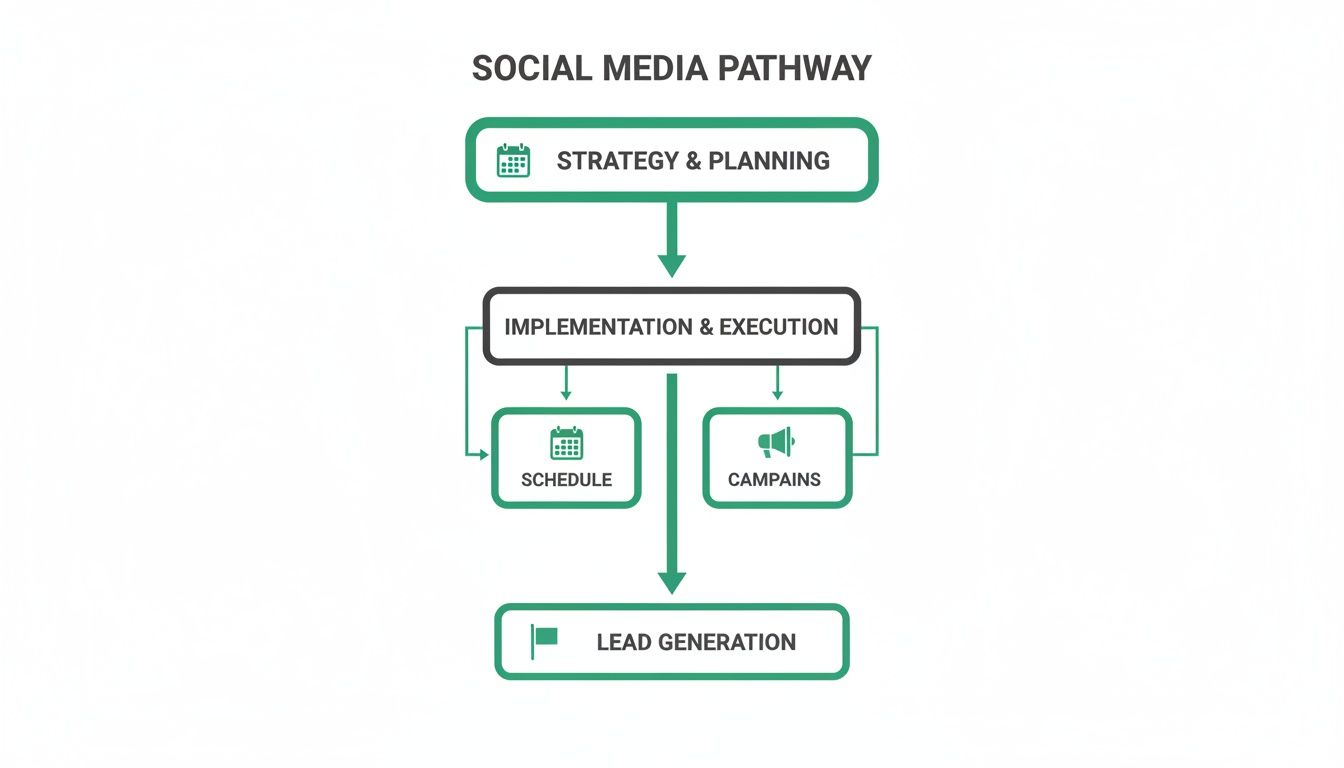
Climbing the social media career ladder feels a lot like scaling a staircase—each step brings new titles, fresh challenges, and bigger goals. You begin by mastering the nuts and bolts of community engagement, then gradually take on paid campaigns, strategic planning, and eventually, leadership.
As you rise, your toolkit expands—from scheduling posts and monitoring comments to budgeting six-figure campaigns and shaping company-wide social strategy. Here’s how that journey unfolds.
Early Stage Titles And Duties
At the Coordinator level, your days revolve around crafting consistent social calendars, responding to followers, and capturing engagement metrics. You’re the frontline of community building, learning how every like and share feeds into broader performance goals.
Once you step into a Specialist role, you add paid advertising into the mix. You’ll launch A/B tests, dive into demographic research, and refine budgets to boost click-through rates. These early moves set the stage for data-driven decisions down the road.
Below is a side-by-side look at each level:
Career Levels And Responsibilities
This table lays out titles, typical experience ranges, and the core duties you’ll own at each stage.
| Title | Experience Range | Key Responsibilities |
|---|---|---|
| Coordinator | 0–1 year | Scheduling posts, engaging with the community, basic reporting |
| Specialist | 1–3 years | Launching paid campaigns, A/B testing, deep-dive analytics |
| Manager | 3–5 years | Developing strategies, mentoring juniors, ROI reporting |
| Director or VP | 5+ years | Overseeing budgets, long-term planning, cross-department leadership |
Use this snapshot as a roadmap for what you’ll own at each level—then tailor your projects to highlight those exact skills.
Midlevel Manager Roles
Stepping into a Manager role means you’re now overseeing multiple social channels and guiding a small team. You’ll connect the dots between brand objectives and campaign tactics, then translate results into clear ROI reports for stakeholders.
Promotion to this level often happens after about 2 to 4 years of demonstrated success. Key responsibilities include:
- Strategic Planning: Setting goals, picking platforms, and allocating budgets to support broader marketing efforts.
- Team Collaboration: Coaching specialists, coordinating with designers and copywriters, and streamlining cross-functional projects.
- Performance Analysis: Building dashboards, spotting trends, and tweaking campaigns for continuous improvement.
Leadership Titles And Strategy
As a Director or VP, you’re responsible for the long-term vision. You negotiate substantial budgets, align social plans with company goals, and present insights directly to executive teams.
Moving into these titles typically requires at least 7+ years of experience and a track record of standout campaigns. You’ll mentor managers, foster alignment across departments, and steer high-impact initiatives that drive business growth.
Below are some industry projections that underscore why this path remains so promising:
The U.S. Bureau of Labor Statistics forecasts a 6% growth rate for Advertising, Promotions, and Marketing Managers from 2022 to 2032—well above the 3% average for all occupations. Meanwhile, Social Media Specialists are expected to see an 11% jump in roles between 2020 and 2030. Learn more about social media manager job outlook
You can also explore broader marketing trajectories in our digital marketing career guide: Read our guide on digital marketing career path
Next up, we’ll cover the must-have skills and certifications to accelerate your climb—so you can turn each rung of the ladder into a showcase of your expertise.
Key Skills And Essential Certifications
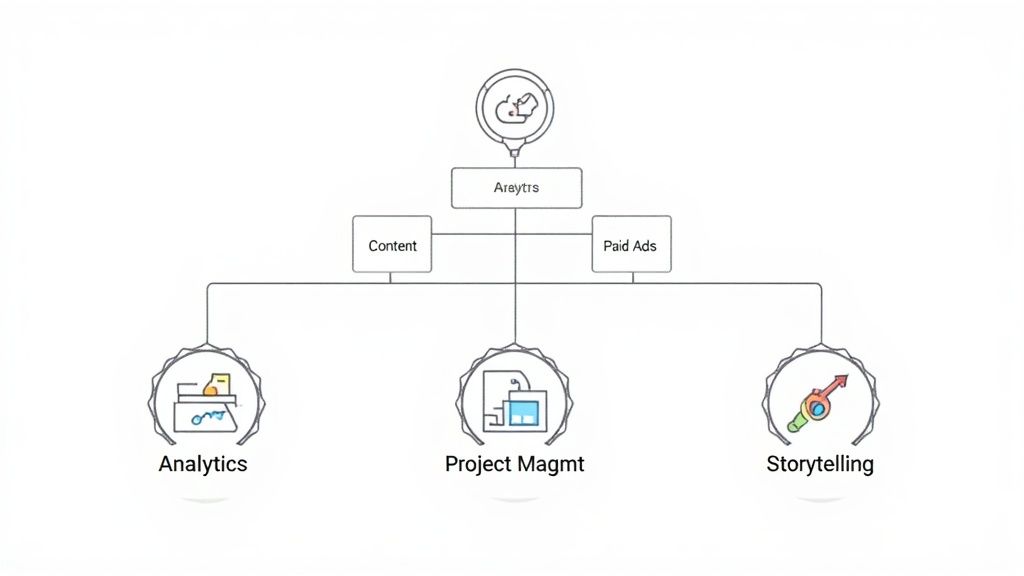
Every milestone in a social media manager’s career rests on a powerful toolkit. Hard skills drive your daily tasks and make your achievements easy to track.
Core Hard Skills
Platform Expertise
Master tools like Hootsuite or Buffer to nail your posting schedule. When you understand each algorithm’s quirks, you’re essentially reading a map before you hit the road.Analytics Fluency
Dive into Google Analytics or native dashboards to monitor engagement rate, click-through rate, and conversion metrics. Solid data habits turn hunches into clear strategies.Content Writing
Treat every caption like a mini-script that needs to grab attention in seconds. Crafting concise, compelling copy is your creative gym.Paid Advertising
Build campaigns on Meta Ads or Twitter Ads with careful budget splits. Testing creatives and refining audience segments helps you boost return on ad spend with precision.
Mapping Soft Skills To Success
Soft skills polish your hard tech abilities and set you apart in collaborative settings.
Creative Storytelling
Develop narratives that resonate, whether you’re launching a new product or running a seasonal promotion.Team Communication
Keep designers, writers, and stakeholders on the same page with clear, consistent updates.Project Management
Manage timelines and budgets so every campaign launches on schedule and on brand.
“Soft skills often tip the scale when technical ability is a given,” says veteran social strategist Kim Wong.
Early in your career, focus on crafting clear briefs and establishing feedback loops. As you progress, you’ll lead brainstorming sessions and steer multi-channel rollouts.
Certification Journey Roadmap
Think of certifications as new levels that unlock fresh challenges. The table below shows popular credentials and when to tackle them.
| Certification | Skill Gain | Recommended Stage |
|---|---|---|
| Facebook Blueprint | Meta ad setup and optimization | Coordinator |
| Google Analytics IQ | Web analytics and reporting | Specialist |
| HubSpot Social Media | Integrated inbound marketing | Manager |
A Coordinator might begin with Facebook Blueprint to learn the basics of ad setup. As a Specialist, you’ll add Google Analytics IQ to deepen your reporting skills. Finally, a Manager can round out the toolkit with HubSpot Social Media for a cross-channel view.
You might also be interested in our guide on marketing skills to learn at SalaryGuide.
Transitioning between levels works best when you pair new credentials with real-world experiments. Try an A/B test on post headlines and track click rates. Then lead a community project that boosts user-generated content by 25%.
Selecting The Right Courses
Picking courses that match your experience level speeds up your progress. Look for options that blend video lessons with live Q&A or community forums.
- Short-form video workshops for quick, actionable tips
- Intensive bootcamps for deep dives and hands-on labs
- Free webinars to stay updated on emerging trends
Budget-conscious learners can mix free YouTube modules with paid certifications to balance cost and credibility.
Bringing Skills Into Action
Once you’ve stacked your certifications, build a micro-portfolio around a volunteer cause or personal project. Document your hypotheses, tactics, outcomes, and lessons learned.
curl -X POST https://api.socialplatform.com/v1/posts
-H "Authorization: Bearer YOUR_TOKEN"
-d '{"message":"Launch day reminder","schedule_at":"2025-07-01T09:00:00Z"}'
Experimenting with automation scripts like this sets you apart in interviews. Present your case study on your resume or LinkedIn slide deck, and share test results in a blog post or short video.
“Walking through your process signals depth,” notes social media lead Jordan Perez.
Align your portfolio outcomes with job requirements to strengthen interview answers. This hands-on showcase becomes the bridge between learning new skills and earning your next promotion.
You’re ready to rise.
Salary And Compensation Benchmarks
Compensation often dictates your career trajectory as a social media manager. It helps you set realistic goals and measure progress from entry level up to director roles.
Think back to those coordinator days—juggling captions, replies, and community buzz for about $48,000 to $65,000 (2025 projections). Today, the average social media manager pulls in $91,508, with a median of $85,000, marking roughly a $5,000 increase from last year. On the senior end, top performers now exceed $256,000, compared to $229,000 for standard leadership roles. For a deeper dive, see the 2025 Social Media Salary Report.
Salary Benchmarks By Level
Below is a quick glance at how salaries stack up across common social media positions.
| Role | Average Salary | Median Salary | Top 10% Salary |
|---|---|---|---|
| Social Media Coordinator | $56,500 | $53,000 | $65,000 |
| Social Media Specialist | $68,000 | $65,500 | $80,000 |
| Social Media Manager | $91,508 | $85,000 | $110,000 |
| Senior Manager | $105,000 | $100,000 | $130,000 |
| Social Media Director | $120,000 | $115,000 | $150,000 |
These benchmarks highlight clear stepping stones. Coordinators rarely top $65,000, managers hover near six figures, and directors break into the $120,000+ territory.
Compensation Factors
Geography and industry shape your paycheck more than you might expect.
- Major hubs like New York or San Francisco add a 15% to 20% premium over smaller markets.
- “Negotiating location adjustments can add thousands to your offer.”
Your sector choice also makes a difference:
- E-commerce companies may pay more when social media drives direct sales.
- Media outfits often balance lower base pay with equity grants.
Visual Pay Trends
The screenshot below reflects median figures for social media manager roles on Glassdoor.

Here you’ll spot a median near $75,000, stretching past $100,000 in high-cost regions.
Negotiation Tips
Turn data into dollars with these tactics:
- Quantify past wins—engagement spikes, ROI lifts and cost savings—in hard numbers.
- Cite industry benchmarks to justify your target range.
- Frame bonuses, equity, and perks into your total-comp package.
Think of each point as a mini case study that reinforces your value.
Strategic Review Preparation
Before any review or offer talk, compile a brief dossier:
- Engagement growth percentages
- Cost-per-lead improvements
- Campaign milestones achieved
Presenting concrete metrics shifts the conversation from opinion to fact.
Tracking metrics before negotiation boosts average raises by 20%.
Total Compensation Components
Beyond base pay, consider:
- Annual performance bonuses of 5% to 15% of your salary
- Vesting equity grants that can tip your earnings into six figures
- Perks like health benefits, retirement matches, and training stipends
- Signing bonuses for senior hires
Factor everything in to compare offers accurately.
Using Benchmarks Strategically
Citing market data during interviews shows you know your field. Mention your role level, location, and sector norms to set context.
“Data-driven discussions set a professional tone and lead to fairer outcomes.”
Blend these figures with personal achievements to craft a persuasive compensation narrative.
Next Steps
Review past raises and offers to spot growth gaps. Set a clear salary range based on these benchmarks, then revisit them before reviews or new applications. Use this guide as both a roadmap and a conversation springboard for maximizing your earnings.
For broader marketing pay comparisons, explore our article How Much Do Marketers Earn.
Sample Job Descriptions And Responsibilities
Below you’ll find four real-world job postings that trace the typical journey from entry level to executive in social media management.
Each example breaks down must-have qualifications, day-to-day duties, key metrics, and how responsibilities expand over time.
- Social Media Coordinator zeroes in on content scheduling and community engagement.
- Social Media Manager dives into strategy, analytics, and cross-team collaboration.
- Digital Marketing Manager balances paid ads, content planning, and multi-channel projects.
- Director of Social Media shapes budgets, hones brand voice, and reports to executives.
“Analyzing job descriptions side by side helps you spot patterns in role evolution,” notes hiring manager Carla Jimenez.
Carla’s observation highlights how spotting these shifts can inform your resume and interview prep.
Role Overviews
The Social Media Coordinator often requires a bachelor’s degree (or equivalent) and 0–1 years of hands-on experience. You’ll spend your day slotting posts into the calendar, replying to comments and messages, and pulling together basic engagement reports. Success is measured by post reach, response time, and follower growth.
Stepping up to Social Media Manager usually means having 2–4 years of proven campaign work under your belt. Your scope expands to budget planning, managing small ad spends, and briefing creative teams. Look for metrics like ROI per campaign, conversion rates, and overall platform engagement.
At the Digital Marketing Manager level, most roles call for 4–6 years in both paid and organic channels. You’ll craft omnichannel strategies, oversee creative assets, and optimize ad spend to hit targets. Key performance indicators include cost per acquisition, revenue attribution, and content performance.
When you reach Director Of Social Media, employers expect 7+ years steering social strategy at scale. The focus shifts to high-level roadmaps, team leadership, and P&L oversight. You’ll be accountable for brand sentiment, annual engagement growth, and strict budget adherence.
Follow these steps to align your background with each role:
- Identify the core tasks that match your experience.
- Highlight the must-have qualifications in your application.
- Match the role’s success metrics to your achievements.
Comparison Table
| Role | Qualifications | Daily Tasks | Resume Keywords |
|---|---|---|---|
| Coordinator | BA or relevant cert, entry | Scheduling, community engagement, reporting | “post calendar,” “community KPI” |
| Manager | 2+ years, analytics skill | Campaign planning, team briefs, ad budgets | “ROI analysis,” “paid social” |
| Digital Marketing Manager | 4+ years, cross-channel | Strategy dev, creative oversight, optimization | “omnichannel,” “CPA optimization” |
| Director Of Social Media | 7+ years, leadership | Budget oversight, stakeholder alignment | “brand voice,” “P&L management” |
In this Social Media Manager posting, you’ll notice campaign ROI and cross-functional collaboration are top priorities.
When you tailor your application, pull out key phrases like “community engagement,” “ROI optimization,” and “brand voice.”
Although each level shifts focus, the thread of community building and analytics runs through every title. Keeping an eye on how these roles evolve will help you chart your own growth.
Best Practices
- Use bullets to spotlight your metrics.
- Copy job-listing keywords exactly to pass automated scans.
- Show impact with year-over-year engagement comparisons.
- Provide concrete examples of budget oversight and team leadership.
Before you hit “apply,” cross-reference live openings on SalaryGuide to see which responsibilities are trending now.
Scan fresh job ads each quarter—new duties emerge fast.
Refresh your resume and portfolio yearly to reflect the latest shifts in social strategy.
Flexibility is your secret weapon.
Transition Strategies To Adjacent Roles
Changing lanes in marketing can feel like merging onto a busy highway—you need clear signposts and a solid plan to keep momentum.
Below, you’ll find practical steps for social media managers who want to pivot into growth marketing, content strategy, or broader marketing roles.
Four Step Framework
Follow this roadmap to translate your social media know-how into a new specialty:
Map Overlapping Skills
Figure out how your campaign planning, community engagement, and data analysis translate to a different role.Build Targeted Side Projects
Launch a small experiment, like an email-sequence optimization or an SEO-focused blog post series.Network Across Teams
Introduce yourself to growth, product, and content colleagues. Learn their goals and offer to help.Pitch Pilot Initiatives
Propose a mini project, measure the outcome, and use those results to demonstrate your value.
When you map skills, you speak the language of your next team. Your storytelling talents, for instance, can drive engagement in content strategy—but you’ll also need solid numbers to back up your claims.
“Translating your social media wins into metrics that matter drives credibility,” says marketing strategist Ava Roberts.
Integrating demographic trends makes your pitch even stronger. Social media management in the U.S. is 76% women, a factor that shapes collaboration and creativity in content and growth paths. See the full breakdown on CareerExplorer.
The chart above highlights how women dominate community and creative efforts, influencing how social media managers move into adjacent roles.
Growth Marketing Case Study
Jamal was a mid-level social media manager who wanted more analytical challenges. He earned certifications in Google Analytics IQ and HubSpot, then teamed up with product folks to design retention tests.
Next, he pitched a pilot focused on free trial conversions—using targeted social ads and a two-step onboarding email sequence. In just four weeks, sign-ups climbed by 18%, securing his move into a Growth Marketing Lead position.
Use Jamal’s playbook:
- Highlight new certifications front and center.
- Show clear before-and-after results to prove impact.
- Package each experiment as a concise case study for interviews.
A portfolio of these mini-projects signals your readiness. Frame every pilot as a business initiative, not just a social media stunt.
Next Steps
Once your first pilot wraps up, set up an informational chat with a growth marketer or content strategist. Ask about their daily challenges and suggest collaborating on a quick test.
Each micro project becomes a stepping stone, guiding you from social media management to a broader marketing role.
Content Strategy Transition
If content strategy feels like your next stop, lean on your knack for captions and storytelling. Then expand into editorial planning, SEO-friendly headlines, and buyer persona research.
- Use editorial calendars to align themes with product launches.
- Run A/B tests on headlines and document which angles win.
- Partner with SEO and paid teams to weave keywords and budget insights into your briefs.
By mapping topic pillars across quarters, you’ll prove you can plan big-picture campaigns—not just daily posts.
Frequently Asked Questions
Many up-and-coming digital pros often ask what it really takes to kick off a career in social media management.
Q: What qualifications are essential for an entry-level social media role?
A: You don’t always need a marketing degree to get started. Employers tend to value strong writing, a basic understanding of analytics, and a portfolio of real-world campaign samples even more.
- Content examples: blog posts, social graphics
- Hands-on experience with tools like Hootsuite or Buffer
- Entry-level certifications such as the Google Analytics IQ exam
Q: How long does it take to move from Coordinator to Manager?
A: Typically, it takes 2 to 4 years, depending on the size of the company, measurable campaign results, and whether you volunteer for stretch assignments.
Q: Which certifications offer the best ROI?
A: Recruiters consistently point to Facebook Blueprint and Google Analytics IQ as top indicators of platform expertise and data fluency.
Quick Strategies
“A clear, data-driven case with key metrics can really speed up your promotion cycle,” says recruiter Alyssa Chang.
| Role | Timeline | Key Focus |
|---|---|---|
| Coordinator | 0–2 years | Building foundations and basic reporting |
| Specialist | 1–3 years | Managing paid campaigns, A/B testing |
| Manager | 3+ years | Shaping strategy, leading teams, ROI presentations |
Q: How can I negotiate a higher salary?
A: Compile a concise report showcasing your impact—improved ROI, campaign metrics, and salary benchmarks that align with your experience.
These FAQs strip away the mystery of advancing as a social media manager. Here are a few practical steps to keep the momentum going:
- Set up daily job alerts for “social media manager” on de-duplicated boards
- Match openings to your skills and target compensation range
- Each morning, review fresh postings and update portfolio pieces to mirror role requirements
- Use email alerts and RSS feeds to catch new opportunities in your industry
Explore live marketing roles and up-to-date compensation data on the SalaryGuide Compensation Tools.
