What Does a Content Strategist Do and How Do You Become One
Think of a content strategist as the master architect behind a brand's entire content world. They're the ones who create the master plan, answering the big questions: Why are we creating this content? Who are we actually trying to reach? And how will we know if it's working?
The Architect Behind the Content
Ever seen a house built without a blueprint? You could have the best builders, the finest materials, and a great location, but you'd end up with a chaotic mess. The rooms wouldn't flow, the plumbing would be a nightmare, and the whole structure would be fundamentally flawed. That's exactly what happens when a company tries to create content without a strategy.
The content strategist is the person who prevents that chaos. They aren't just thinking about the next blog post or social media update. Instead, they're building a complete, sustainable system where every single piece of content connects back to a larger business goal. They handle the high-level thinking, planning, and measurement that transforms random content pieces into a powerful engine for growth.
The Three Pillars of Content Strategy
At its core, the content strategist's job rests on three fundamental pillars. Each one supports the next, forming a solid foundation for any successful content program.
Planning: This is where it all begins. The strategist dives deep into audience research to truly understand customer needs and frustrations. They'll also run a competitive analysis to spot gaps in the market and figure out how to align every content idea with business objectives, whether that's generating more leads or building brand authority.
Governance: With a solid plan in place, the strategist then establishes the "rules of the game." This involves creating practical tools like style guides, defining a consistent brand voice and tone, and mapping out content workflows. The goal is to make sure everything published is consistent and high-quality, no matter who on the team creates it.
Measurement: A plan is just a theory until you test it. The strategist is responsible for defining the key performance indicators (KPIs) that matter most. Using tools like Google Analytics or SEMrush, they track content performance and use that data to constantly refine and improve the strategy.
A content strategist's primary job is to ensure that every piece of content is purposeful. It must have a clear audience, a specific goal, and a measurable impact on the business. Without these elements, content is just noise.
When it comes down to it, a content strategist provides clarity. They turn content from a simple line item in a budget into a valuable, revenue-driving asset by making sure it’s created with intention, managed with care, and measured for its real-world impact.
To make this even clearer, let's break down these responsibilities into a simple overview.
Core Functions of a Content Strategist at a Glance
This table provides a quick, scannable look at the primary duties that fall under a content strategist's purview.
| Functional Area | Key Responsibilities and Deliverables |
|---|---|
| Research & Analysis | Performing audience persona development, keyword research, competitive content audits, and topic gap analysis. |
| Strategic Planning | Creating the overarching content strategy, building editorial calendars, mapping content to the customer journey, and defining content pillars. |
| Content Creation & Ops | Developing content briefs, managing content workflows, and collaborating with writers, designers, and SEO specialists. |
| Governance & Standards | Establishing and maintaining style guides, voice and tone documentation, and content quality checklists. |
| Performance & Optimization | Defining KPIs, analyzing content metrics (traffic, engagement, conversions), A/B testing, and creating performance reports to inform future decisions. |
| Distribution & Promotion | Planning how and where content will be shared across different channels (social, email, paid) to maximize its reach and impact. |
As you can see, the role is a unique blend of creative vision, analytical rigor, and project management. It's about seeing the big picture while also managing the details that bring it to life.
What Does a Content Strategist Actually Do Day-to-Day?
The "architect" analogy is great for the big picture, but what does a content strategist actually do on a typical Tuesday? It’s not just about brainstorming big ideas. Their work is a hands-on mix of deep-dive analysis, team collaboration, and careful documentation that keeps the entire content engine running smoothly.
A huge chunk of their time goes into research and discovery. This isn’t a one-and-done task; it’s a constant process of digging into audience behavior, keeping a close eye on competitors, and tracking how existing content is performing. They’re always hunting for the insights that will shape what the company does next.
From Audits to Action Plans
One of the most fundamental jobs for a strategist is the content audit. Think of it like a complete inventory of everything a company has ever published. The strategist combs through years of blog posts, videos, white papers, and social updates, evaluating each piece for its performance, relevance, and how well it supports business goals.
This audit is where the gold is often found. It shows what’s working, what’s gathering dust, and where the real opportunities are hiding. For instance, they might find a few old articles on a niche topic that are somehow still pulling in steady traffic. That’s a huge clue. It could spark a plan to refresh and expand those posts into a full-blown topic cluster, aiming to dominate that corner of the search results.
A content strategist doesn't just invent new things from scratch. A lot of their magic comes from finding and unlocking the hidden value in what a company already has. An audit often proves that the best new ideas are buried in the archives.
Once these opportunities are uncovered, the strategist starts building the frameworks that guide the rest of the team. These are the crucial documents that get everyone on the same page, rowing in the same direction.
Here are a few of the key deliverables a strategist creates:
- User Personas: These aren't just basic demographic snapshots. They are rich, detailed profiles of the ideal customer, digging into their goals, their frustrations, and the real questions they're asking. A well-crafted persona is what helps a writer create something that truly connects.
- Editorial Guidelines: This is the brand's rulebook for communication. It defines the voice, tone, and style, ensuring that a blog post from a freelancer sounds like it came from the same brand as a social media update from the in-house team.
- Content Calendars: This is far more than a simple schedule. A strategic content calendar is a roadmap that lays out what gets published, where, and when, tying every single piece of content back to a specific campaign or business objective.
This cycle of planning, governing, and measuring is the core of a strategist's daily work.
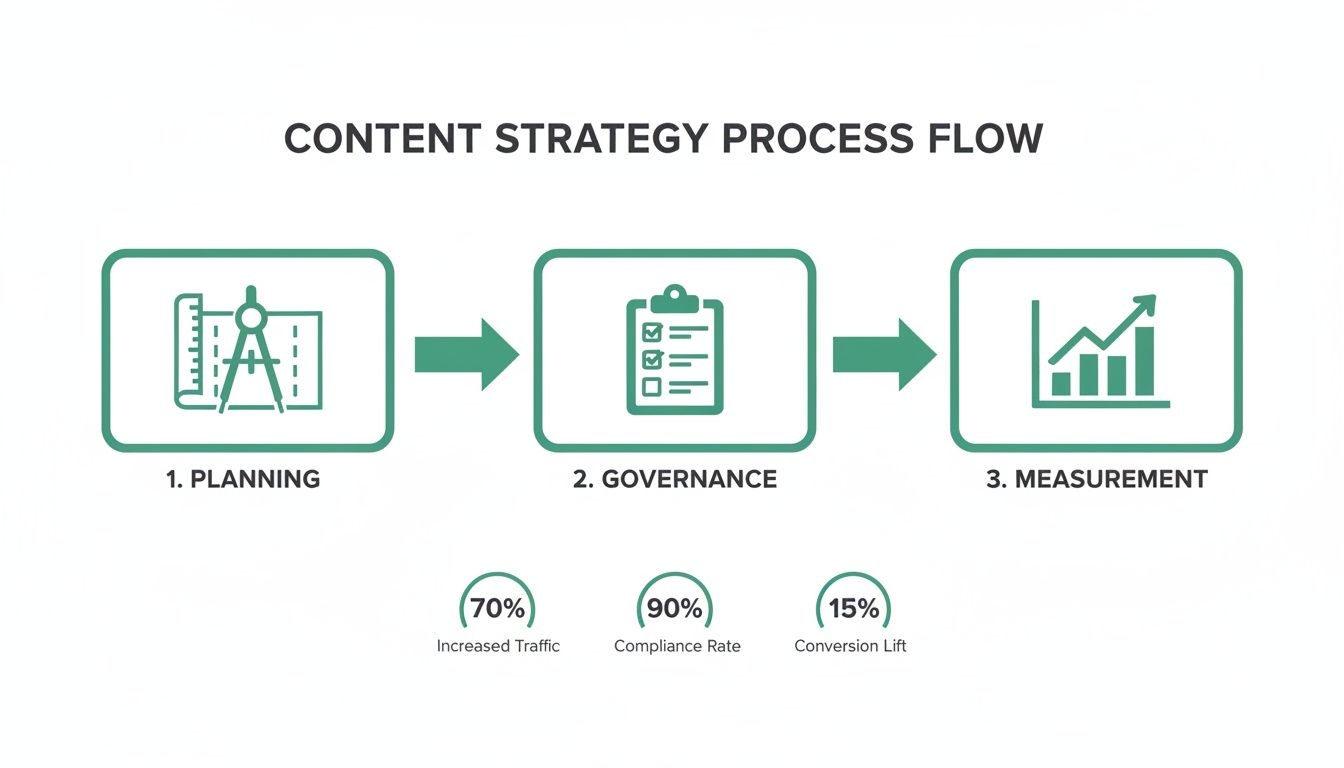
As you can see, their work flows from initial planning and blueprinting to setting clear rules of the road, and finally, to measuring the results to make the whole process smarter over time.
How the Role is Evolving
A strategist's daily to-do list is also being shaped by bigger shifts in the market. The role is gaining more respect—and budget—because of its direct link to business growth. We can see this trend in recent hiring data. The Q2 2025 U.S. marketing jobs report from Taligence.net showed a market correction, with total marketing jobs down 6.7% from the previous quarter.
But here’s the interesting part: demand for senior strategic roles jumped by nearly 35% year-over-year, and content marketing salaries rose by 7.1%. This tells us companies are placing a premium on experienced leaders who can prove their strategic value.
This shift means businesses are investing more in high-level thinkers who can connect content directly to revenue, not just people who can fill slots on a calendar. So, a modern strategist's day often includes analyzing performance data, building a business case for content investments, and presenting those findings to leadership. They are the essential bridge between the creative team and the C-suite, translating content metrics into the language of business impact.
5. The Essential Skills and Tools of the Trade
So, what separates a good content strategist from a truly great one? It's a unique mix of being a storyteller and a data scientist. You have to be able to connect with people on a human level while also being completely comfortable digging into a spreadsheet to find out what's really working.
Think of it this way: a strategist needs deep empathy to create an audience persona that feels like a real person, not just a collection of demographics. But they also need the analytical chops to look at performance data and pull out the story hidden in the numbers. It’s this blend that makes the role so powerful.
The Core Soft Skills Every Strategist Needs
Before we even get to the software, let's talk about the human side of the job. These are the skills that allow a strategist to take raw data, shape it into a clear vision, and get an entire team excited to build it.
- An Analytical Mindset: It’s not enough to see that traffic went up. A strategist needs to ask why. They have to be curious enough to dive into analytics and connect the dots between a piece of content and its real-world impact.
- Deep Audience Empathy: This is non-negotiable. You have to be able to step into your audience’s shoes and understand their world. What are their biggest headaches? What questions keep them up at night? Content that doesn't solve a real problem is just noise.
- Exceptional Communication: Your day might involve pitching a high-level strategy to the C-suite in the morning and then writing a crystal-clear brief for a freelance writer in the afternoon. The ability to articulate your vision and get everyone on the same page is crucial.
- Strategic Foresight: This is about seeing the forest, not just the trees. A great strategist ensures every blog post, video, and social media update connects back to larger business goals. It's about making sure your content isn't just busy work, but is actively moving the needle.
These skills are often the real difference-maker. If you're looking to round out your capabilities, it’s a good idea to explore the full range of modern marketing skills to learn, as many are directly applicable here.
The Strategist's Digital Toolkit
To bring a strategy to life, you need the right set of tools. These aren’t just fancy extras; they are the essential gear for research, project management, and, most importantly, measuring what actually works. The modern professional relies on a suite of leading content strategy tools to turn plans into results.
The toolkit usually falls into a few key categories.
1. SEO and Research Platforms
These are your map and compass. Tools like Ahrefs and Semrush are fundamental for understanding what people are searching for, what your competitors are doing, and where the real opportunities are. Without this data, you're just guessing.

A strategist uses this kind of information to spot emerging trends, find valuable keywords the competition has missed, and keep a close eye on the overall health of their content program.
2. Analytics and Performance Measurement
If SEO tools are the map, analytics platforms are your dashboard telling you how fast you're going and how much fuel you have left. Google Analytics is the standard for tracking website traffic, user behavior, and conversions. Strategists practically live in these reports to prove the ROI of their work and make smarter decisions for the future.
The best content strategy is a living document, constantly informed by performance data. Without measurement, strategy is just a collection of hopeful guesses. A strategist uses analytics to turn those guesses into certainties.
3. Project Management and Collaboration Software
A brilliant strategy is worthless if it sits in a forgotten folder. This is where execution comes in. Platforms like Asana, Trello, or Monday.com are the command centers for managing editorial calendars and complex projects. They keep writers, designers, editors, and everyone else in sync, ensuring great ideas actually get published on time.
Mastering these skills and tools is what empowers a content strategist to build a coherent, goal-driven plan that transforms content from a simple marketing tactic into a reliable engine for business growth.
Connecting Content Strategy to Business Growth
A brilliant content strategy is worthless if it doesn't deliver results. At the end of the day, a content strategist's main job is to turn creative plans into real, measurable business outcomes. They are the bridge between the content team's work and the company's financial goals, making sure every article, video, and social post is a calculated investment—not just a shot in the dark.
Without that strategic connection, content creation can quickly feel like an expensive hobby. The strategist is the one who elevates content from a simple marketing task to a genuine engine for growth. They're on the hook to show C-suite executives how a well-played content plan directly moves the needles they care about, from leads and sales to customer loyalty and brand authority.

From Traffic to Tangible Revenue
Let's imagine a B2B software company is struggling with a painfully long sales cycle. A sharp content strategist might dig in and realize that potential customers are stalling out in the consideration phase, unsure if the product is really the right solution for them. Instead of just churning out more top-of-funnel blog posts to attract traffic, the strategist builds a plan for targeted, high-value content that tackles this specific problem.
This plan could look something like this:
- In-depth case studies that walk through exactly how similar companies solved their biggest headaches.
- A detailed ROI calculator to give prospects the hard numbers they need to build a business case for their boss.
- Honest comparison guides that stack their product against competitors, which builds a ton of trust.
This kind of content directly addresses customer hesitation and gives the sales team powerful tools to speed up the decision-making process. The result? A shorter sales cycle and higher conversion rates—a clear, quantifiable win for the company's revenue.
A content strategist's purpose is to prove that content isn't an expense; it's a revenue-generating asset. Their job is to draw a straight line from a piece of content to a signed contract, and then measure every step along the way.
Unlocking Hidden Value and Building Authority
Business growth isn't always about chasing new leads. Sometimes, the biggest wins come from maximizing what you already have. A strategist will often kick things off with a content audit to find underperforming articles and videos that can be repurposed or optimized for a second life. By updating old blog posts with fresh data and a better SEO focus, they can often see a huge jump in organic traffic without creating a single new thing.
A huge part of this is leveraging content libraries for new revenue and brand relationships. This is about transforming a messy, disorganized folder of assets into a structured system that the sales, customer service, and marketing teams can all pull from.
The Growing Demand for Strategic Thinkers
Because of this direct link to growth, the demand for skilled strategists isn't going anywhere. Companies are finally realizing they need more than just good writers; they need leaders who can connect content directly to the bottom line. This shift is crystal clear if you look at the job market.
For instance, a 2025 analysis shows that content-focused roles are among the top 10% of in-demand marketing positions. With nearly half (48%) of marketing teams looking to bring on new permanent staff, their top reasons are launching new projects (63%) and driving overall company growth (48%). This really underscores the need for people who can fill those strategic gaps and steer these growth plans.
Ultimately, a content strategist provides the "why" behind every piece of content. They ensure that all the creative effort isn't just making noise, but is methodically building brand equity, nurturing customer relationships, and contributing directly to the company's long-term health.
Your Career Path and Salary Expectations
So, you're intrigued by what a content strategist does. The next logical question is: where can this career take you, and what can you expect to earn? This isn't just a single job; it's a journey with clear stages, where you gain more strategic influence—and a bigger paycheck—as you go.
Most people don't just land a "Content Strategist" title on their first day. The path usually starts in a related role, maybe as a Content Coordinator, Copywriter, or even an SEO Specialist. This is where you cut your teeth on the fundamentals: writing clean copy, editing, digging into basic analytics, and learning how content actually gets made and published.
Advancing Up the Content Ladder
Once you've got a solid foundation, you’ll be ready to step into the core Content Strategist role. This is a big shift. Instead of just creating individual blog posts or emails, you're now designing the entire content ecosystem. You go from following a content brief to writing it. You stop just executing tasks and start owning the "why" behind them.
From that point, the path opens up to more senior positions:
- Senior Content Strategist: Here, you're thinking bigger. You might be overseeing major campaigns, mentoring junior team members, and presenting performance reports straight to the leadership team. Your job is to prove the ROI of content across the entire business.
- Director of Content or Head of Content: This is a true leadership role. You’re not just planning the content anymore; you're building and managing the team that brings it to life. Think budget management, hiring, setting high-level goals, and making sure the content strategy aligns perfectly with the company's overall vision.
It’s a natural progression from hands-on creation to high-level strategic oversight. To see how this trajectory fits into the wider marketing world, you can check out a typical digital marketing career path for more context.
What to Expect for Compensation
The money in content strategy is strong, and for good reason—the role has a direct impact on business growth. You're the one figuring out how to use content to hit specific, important goals.
Market data backs this up. According to the 2025 Content Marketing Salary Report from Superpath, the median annual income for content marketers (a group that includes strategists) is around $100,000 in the United States. It's also worth noting that B2B content marketers often earn about $5,318 more per year than their B2C counterparts, which really shows the premium companies place on strategic, business-focused content.
A content strategist's salary grows with their ability to connect content efforts to revenue. Junior roles are compensated for execution, while senior roles command higher pay for their proven ability to drive measurable business results.
Of course, salaries fluctuate based on location, company size, and industry. A strategist in a San Francisco tech company will almost certainly earn more than one in a smaller market. Freelance and contract strategists also do very well, often charging high per-project or retainer fees that reflect their specialized expertise. As your portfolio of successful projects grows, so does your earning potential. It’s that simple.
How to Land Your First Content Strategist Role
Making the leap into a content strategist role is about proving you can do more than just write well. It’s about showing you can think strategically. Hiring managers are looking for people who understand the why behind the what—why one piece of content connects with an audience and drives action while another falls flat.
The first step is to assemble a portfolio that proves you have that strategic muscle. Great writing samples are a start, but they don't tell the whole story. To really catch a recruiter's eye, you need to showcase the planning, analysis, and measurement that happens long before a single word is written.
Building a Portfolio That Screams "Strategist"
A standout portfolio tells the story of how you diagnosed a problem, created a smart plan, and knew how to measure the results. It’s your chance to show you get the big picture—that you’re not just managing an editorial calendar, but actively steering the ship.
Instead of just showing finished articles, consider including some of these strategic assets:
- Mini Content Audits: Pick a brand—one you love or one with obvious room for improvement—and do a quick audit. You could analyze their last 10 blog posts, point out missed SEO opportunities, and propose a concrete plan to fix them.
- Sample User Personas: Develop a detailed user persona for a hypothetical company. Ground it in real market research to demonstrate you know how to uncover an audience's true needs and motivations.
- A Content Brief Example: Draft a rock-solid content brief for a sample blog post. Make sure it includes the target persona, primary keywords, key talking points, and a specific business goal. This proves you can provide clear, strategic direction to writers and creators.
Your portfolio is your primary tool for proving you're a strategist, not just a writer. Each piece should answer the question: "How does this demonstrate my ability to connect content to business goals?"
Putting these pieces together is fantastic practice for the job hunt. For a more detailed roadmap, check out our guide on how to build a marketing portfolio. It provides a step-by-step framework to help you organize and present your work effectively.
Nailing the Interview Questions
Once that killer portfolio gets your foot in the door, be ready to talk strategy from the get-go. Interviewers will throw real-world scenarios at you to see how you think on your feet and apply your strategic principles.
They'll ask questions designed to see how you solve problems. Get ready for questions like these:
"Imagine you've joined our team and our content is getting traffic but no conversions. What's your process for diagnosing the problem?"
This is your cue to talk about performing a content audit, digging into user behavior analytics, and figuring out where the content fails to align with the customer's journey."How would you measure the ROI of our content marketing efforts?"
Don't just mention traffic or likes. Talk about the metrics that matter to the business, like lead generation, cost-per-acquisition, and how content contributes to customer lifetime value."We want to become a thought leader in our industry. Outline the first 90 days of your content strategy."
Show them you can hit the ground running. Lay out a plan that starts with a deep competitive analysis, moves to defining core content pillars, and ends with a clear framework for measuring success.
A Few More Questions, Answered
Even with a detailed guide, a few questions always pop up about what it's really like to be a content strategist and how the role fits into the bigger picture. Let's clear up some of the most common ones.
What’s the Real Difference Between a Content Strategist and a Content Marketer?
Think of it like building a house. The content strategist is the architect, while the content marketer is the general contractor and the real estate agent, all in one.
The strategist draws up the blueprint. They're obsessed with the why, the who, and the how. They're digging into audience research, mapping out customer journeys, and creating the high-level plan that ensures every piece of content has a purpose and supports a business goal. Their job is to design a system that works.
The content marketer takes that blueprint and brings it to life. They're focused on the what and the where—writing the blog posts, producing the videos, and crafting the social media updates. Then, they make sure people actually see it by promoting it across the right channels. They execute the vision.
Do I Need a Specific Degree to Break Into This Field?
Absolutely not. There's no "Content Strategy" major that hiring managers are looking for. People come into this role from all sorts of backgrounds—journalism, marketing, communications, English, and even UX design. A degree can give you a good foundation, but it's not the ticket in.
What really gets you hired is a portfolio that proves you can think strategically. Can you show how you uncovered an audience insight? Can you walk someone through a content audit you performed? Can you explain the logic behind a content plan you developed? That hands-on proof is infinitely more valuable than a specific diploma.
The best content strategists are defined by their skills, not their degree. They prove their worth by connecting content directly to business goals—a skill that’s forged in experience, not just in a classroom.
Is AI Going to Make This Role Obsolete?
Not a chance. AI is becoming an incredibly powerful assistant, but it's not taking the driver's seat. A smart strategist now uses AI tools to work faster and more efficiently. For instance, you can use AI to kickstart topic ideas, analyze a competitor's content in minutes, or get a rough first draft on the page.
But AI can't replicate the distinctly human parts of the job. It doesn’t have the empathy to truly understand a customer's deepest frustrations. It lacks the business acumen to align a content plan with revenue goals. And it certainly can't dream up a unique brand voice that makes people fall in love with a company.
The role is simply evolving. Strategists are now learning to delegate the grunt work to AI, which frees them up to focus on the high-level critical thinking that actually drives results.
Ready to map out your own marketing career path? At SalaryGuide, we provide real-time salary insights and access to vetted marketing roles sourced directly from company career pages. Explore transparent compensation data and find your next opportunity with confidence. Discover your worth at SalaryGuide.
