How to build a marketing portfolio: case studies, examples & structure
Published by SalaryGuide, with recruiter insight from our sister company, Search for Hire.
A marketing portfolio is a curated collection of real work and case studies that shows how you approach marketing problems, what you personally contributed and what evidence supports the outcome.
That makes it different from a resume.
A resume tells someone where you worked and what you were responsible for.
A strong portfolio helps them understand:
- the situations you have worked in;
- the problems you have solved;
- the decisions you made;
- the work you personally owned;
- the evidence you used;
- what happened;
- what you learned.
It should not simply be a gallery of screenshots, campaign logos or tools you have used.
The aim is to make your capability easier to evaluate.
What is a marketing portfolio?
A marketing portfolio is a selected body of work used to demonstrate your marketing experience and judgment.
It might contain:
- case studies;
- campaign examples;
- content;
- research;
- dashboards;
- reports;
- briefs;
- experiments;
- landing pages;
- strategy documents;
- process diagrams;
- creative work.
What belongs in it depends on your discipline and the role you want.
An SEO portfolio will not necessarily look like a product-marketing portfolio.
A Marketing Operations specialist may have fewer visually impressive assets than a brand marketer but much stronger evidence around systems, reporting and process improvement.
The format is secondary.
The important question is:
Can someone reviewing this portfolio understand what I can actually do?
Who needs a marketing portfolio?
Not every marketing role requires a formal portfolio.
Depending on the position, employers may place more weight on:
- your resume;
- interview;
- work samples;
- technical assessment;
- references;
- previous employers;
- specialist expertise.
A portfolio can be particularly useful when you want to provide evidence beyond those formats.
That may include:
- aspiring marketers;
- people with limited formal marketing experience;
- career changers;
- freelancers;
- specialists whose work can be demonstrated through projects;
- marketers switching disciplines;
- experienced candidates who need to demonstrate strategy or commercial scope;
- senior marketers whose resume cannot easily show how they made decisions.
The more uncertainty a portfolio can remove about your capability, the more useful it becomes.
What should a marketing portfolio prove?
A useful portfolio should help answer four questions.
1. What kind of work can you handle?
Can you analyze, plan, execute, measure, lead or improve the kind of work the role requires?
2. What did you personally contribute?
What was yours rather than the wider team’s?
3. How do you make decisions?
What information did you use?
What alternatives or trade-offs did you consider?
Why did you choose the approach you took?
4. What evidence supports your conclusions?
What happened?
What can you reasonably attribute to your work?
What did you learn?
That is why a list such as:
Google Analytics, HubSpot, Ahrefs, Google Ads, Canva
is not a portfolio.
Those are tools.
The portfolio should show what you did with them and why.
Choose projects based on the role you want
Do not begin by asking:
“What are all the projects I have worked on?”
Begin with:
“What would someone in the role I want actually need to be able to do?”
Review several relevant roles.
Ask:
- What would this person own?
- What decisions would they make?
- Which capabilities appear repeatedly?
- Which outcomes would matter?
- Which examples from my experience reduce uncertainty about whether I could do the job?
SalaryGuide’s Marketing Career Path Roadmap can help if you are still deciding which marketing direction or level you are targeting.
Choose projects for signal, not quantity
There is no universal correct number of portfolio projects.
A case study earns its place by adding a useful signal.
For example, one might demonstrate:
- analytical thinking;
- strategic reasoning;
- execution;
- experimentation;
- commercial understanding;
- stakeholder management;
- leadership;
- process improvement;
- measurement;
- learning from failure.
If several projects prove exactly the same thing, you probably do not need all of them.
Equally, do not force variety for its own sake.
A specialist applying for a deeply technical SEO position may be better served by several relevant SEO cases than by adding an unrelated social campaign simply to appear broad.
How to structure a marketing portfolio case study
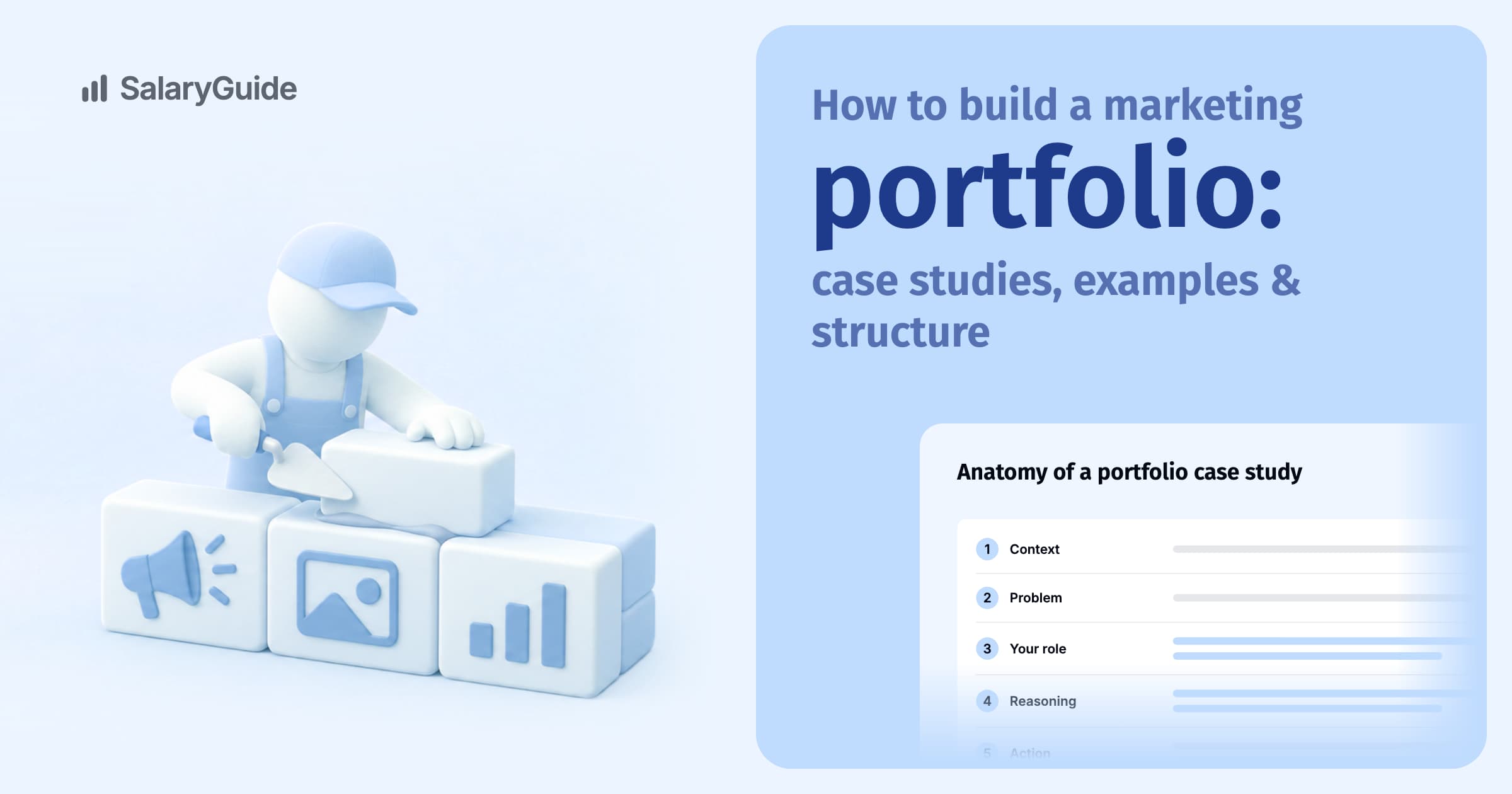
A strong marketing case study should create a clear evidence trail.
Use this framework:
CONTEXT
↓
PROBLEM / OBJECTIVE
↓
YOUR ROLE
↓
REASONING
↓
ACTION
↓
EVIDENCE
↓
LEARNING
CONTEXT: what was happening?
Give the reader enough information to understand the situation.
That might include:
- the type of business;
- audience;
- product;
- channel;
- campaign;
- market;
- existing process;
- relevant constraint.
You do not need a long company history.
Include only the context needed to understand the decision.
Example
Weak:
“I worked on SEO for a SaaS company.”
Stronger:
“The company relied heavily on paid acquisition and wanted to understand whether organic search could contribute more qualified demo demand.”
The second version explains why the work mattered.
PROBLEM / OBJECTIVE: what needed to change?
State the actual problem.
Examples:
- organic visibility was weak for high-intent topics;
- campaign acquisition cost had increased;
- a product launch lacked clear positioning;
- lifecycle messaging did not reflect different customer segments;
- reporting could not reliably answer an important business question;
- campaign production had become slow or inconsistent.
Where a formal objective existed, state it accurately.
Do not invent a numerical target because it looks more impressive.
YOUR ROLE: what did you personally own?
This is one of the most important sections.
Marketing work is often collaborative.
Say what you actually owned.
For example:
“I led the keyword and competitor research, recommended the content priorities and briefed the writers. A developer implemented the technical changes and the content team wrote the final articles.”
That is stronger than:
“We grew organic traffic.”
It helps the reviewer understand your contribution without taking credit for somebody else’s work.
Useful attribution language
Depending on the evidence, you might say:
- I owned
- I led
- I was responsible for
- I recommended
- I influenced
- I contributed to
- I supported
- I collaborated with
Choose the strongest wording you can genuinely defend.
REASONING: why did you choose the approach?
Do not jump straight from problem to activity.
Show your judgment.
Explain:
- what evidence you reviewed;
- what assumptions you made;
- what options you considered;
- what constraints existed;
- why you prioritized one approach over another.
Example
Instead of:
“I rewrote the landing page.”
show:
“User research and sales feedback suggested prospects did not understand the difference between the two plans. I prioritized clarifying that distinction before testing a larger visual redesign.”
Now the reader can see the decision, not merely the task.
ACTION: what did you actually do?
Explain the work clearly.
Depending on the project, this could include:
- research;
- analysis;
- campaign setup;
- content creation;
- experimentation;
- reporting;
- messaging;
- process change;
- stakeholder coordination;
- implementation;
- team leadership.
Do not bury the case study in every small task.
Include the actions that help explain the outcome.
EVIDENCE: what happened?
Use evidence that relates to the original objective.
That might include:
- revenue;
- pipeline;
- qualified leads;
- conversions;
- CPA;
- ROAS;
- traffic;
- search visibility;
- rankings;
- retention;
- activation;
- engagement;
- campaign efficiency;
- production time;
- reporting accuracy;
- process time saved;
- stakeholder adoption;
- qualitative customer feedback.
Not every project needs revenue attribution.
Not every useful outcome is a percentage.
The right evidence is the evidence that helps answer:
Did the work move the problem in a useful direction?
LEARNING: what did you learn or change next?
Do not end every case study at the highest number on the graph.
Explain:
- what worked;
- what did not;
- what surprised you;
- what you changed;
- what you would test next;
- what you would do differently with more time or better information.
That is especially valuable when a result was mixed.
It demonstrates that you can interpret evidence rather than simply report it.
Marketing portfolio case study template
Use this reusable structure for each project:
| Section | What to include |
|---|---|
| Project | Short, descriptive project name |
| Context | Business, audience, channel or situation needed to understand the work |
| Objective / problem | What needed to change, improve or be understood |
| My role | What you personally owned and what belonged to others |
| Reasoning | Evidence, assumptions, options and trade-offs behind your approach |
| Actions | The most important work you carried out |
| Evidence / results | Relevant quantitative or qualitative evidence |
| Learning / next step | What you learned, changed or would do next |
Do not feel obliged to make every section the same length.
The purpose is clarity.
What evidence should you include?
Evidence can take several forms.
Performance evidence
For example:
- campaign results;
- conversion;
- pipeline;
- revenue contribution;
- acquisition efficiency;
- retention;
- traffic;
- search visibility;
- engagement.
Work artifacts
For example:
- landing pages;
- campaign creative;
- content;
- emails;
- briefs;
- reports;
- dashboards;
- workflows;
- research summaries;
- experiment plans;
- positioning documents.
Decision evidence
For example:
- why a channel was prioritized;
- why budget moved;
- why a test was chosen;
- why one customer segment was targeted;
- why a process changed.
Operational evidence
For example:
- reduced production time;
- better reporting;
- clearer ownership;
- improved data quality;
- fewer manual steps;
- improved hand-offs.
Qualitative evidence
For example:
- customer feedback;
- stakeholder adoption;
- feedback from relevant colleagues;
- research insights;
- documented change in how a process was used.
Evidence is useful when it supports the case study.
Do not include artifacts merely because you have them.
Screenshots are supporting evidence, not the story
A dashboard screenshot does not explain:
- what the objective was;
- what you controlled;
- why a metric moved;
- what decision you made;
- what happened next.
Likewise, a screenshot of a landing page does not prove that you:
- wrote it;
- designed it;
- chose the positioning;
- ran the experiment;
- owned the result.
Every visual should have a reason to be there.
Use captions where useful.
For example:
Landing-page variant used in the second experiment. I owned the messaging and test design; Design produced the final visual treatment.
That is much more informative than dropping an unexplained screenshot into the page.
How to show results without overstating attribution
Marketing results are often produced by several people, channels and market conditions.
Be precise about what the evidence supports.
If you owned the outcome directly
You might say:
“I owned the paid-search campaign and reduced CPA from [A] to [B] during the period.”
provided the data supports that conclusion.
If you led one part of a wider outcome
Use wording such as:
“The campaign I led contributed to $4m in qualified pipeline.”
rather than:
“I generated $4m.”
if Sales, other marketing channels or wider processes also contributed.
If your channel was one contributor
For example:
“Organic search was one of the acquisition channels contributing to the increase in qualified inquiries.”
If attribution is uncertain
Say so.
For example:
“Organic conversions increased after the content and technical changes, although other site and demand changes during the period mean the increase should not be attributed solely to this work.”
Accuracy makes the case study more credible.
Separate ownership from organizational outcome
A useful structure is:
I owned:
what you directly controlled.
I influenced:
decisions or work you materially shaped.
I contributed to:
broader outcomes involving other teams.
That distinction is particularly important at senior levels.
What metrics should you include?
Use the metrics that were relevant to the objective.
Possible measures include:
- revenue;
- pipeline;
- qualified leads;
- conversions;
- conversion rate;
- CPA;
- CPL;
- ROAS;
- traffic;
- search visibility;
- rankings;
- retention;
- activation;
- engagement;
- campaign efficiency;
- operational time saved.
But none is automatically required.
Avoid metric theater
Do not include a metric simply because the number looks large.
Ask:
What does this number tell the reviewer about whether the work solved the problem?
Ten million impressions may be meaningful for one campaign and irrelevant for another.
Follower growth may matter for a community objective but be weak evidence for a demand-generation case.
Revenue may be highly relevant but impossible to attribute cleanly.
Context matters.
Use baselines where they help
A result such as:
“CPA fell to $42”
is difficult to interpret without knowing what came before.
Where you have permission and reliable data, comparison can make the result more useful.
For example:
“CPA fell from $61 to $42 after the targeting and landing-page changes.”
Do not invent a baseline that was never measured.
What if the project failed?
You do not need to hide every project that underperformed.
A failed or mixed project can demonstrate useful judgment if the case shows:
- a reasonable hypothesis;
- a sound method;
- honest measurement;
- recognition that the result did not support the hypothesis;
- a useful decision afterward.
Example
“We expected reducing the number of form fields to improve completed demo requests. The test did not produce a meaningful improvement, so we did not roll the change out. Further analysis suggested traffic quality was a larger constraint than form length, which changed the next experiment.”
That is useful evidence.
It shows:
- hypothesis;
- test;
- measurement;
- restraint;
- learning.
Do not turn failure into fake success.
The objective of a portfolio is not to prove that every decision you have ever made worked.
It is to show that you can make, evaluate and improve decisions.
What should you show by marketing discipline?
Different disciplines produce different evidence.
Use these examples as prompts rather than mandatory checklists.
SEO
Useful evidence might include:
- search or audience research;
- technical diagnosis;
- content strategy;
- page or site improvements;
- internal linking;
- measurement;
- search visibility;
- organic traffic;
- conversion evidence where defensible.
A technical-audit screenshot is useful only if you explain what you identified, what you prioritized and what happened afterward.
Paid media
Useful evidence might include:
- campaign structure;
- audience decisions;
- creative reasoning;
- landing-page testing;
- budget allocation;
- experiments;
- CPA/CPL;
- ROAS;
- conversion.
Do not assume ROAS is available or appropriate in every campaign.
Content marketing
Useful evidence might include:
- audience research;
- editorial strategy;
- content briefs;
- distribution;
- organic performance;
- lead generation;
- conversion;
- sales enablement;
- business or customer outcome.
A writing sample alone demonstrates writing.
A case study can demonstrate why the content existed and what role it played.
CRM / lifecycle
Useful evidence might include:
- customer journey;
- segmentation;
- messaging;
- automation;
- experiments;
- activation;
- conversion;
- retention;
- operational improvement.
Product marketing
Useful evidence might include:
- customer research;
- positioning;
- messaging;
- launch planning;
- go-to-market work;
- competitive analysis;
- sales enablement;
- adoption evidence.
Be clear which launch decisions you owned and which were shared with Product, Sales or leadership.
Marketing operations / analytics
Useful evidence might include:
- reporting;
- measurement design;
- attribution work;
- CRM/process improvement;
- automation;
- data quality;
- dashboard design;
- decision support;
- reduced manual work.
A screenshot of a dashboard is much stronger when the case explains which decision it helped somebody make.
Brand / social
Useful evidence might include:
- audience insight;
- messaging;
- campaign strategy;
- creative direction;
- community work;
- content;
- reach;
- engagement;
- traffic;
- conversion;
- commercial evidence where genuinely attributable.
Do not manufacture a direct-revenue story when awareness or community was the actual objective.
Growth / demand generation
Useful evidence might include:
- funnel diagnosis;
- experimentation;
- acquisition;
- conversion;
- lifecycle;
- landing pages;
- cross-channel decisions;
- pipeline;
- customer acquisition;
- retention.
Show the reasoning that connected the experiment to the wider funnel.
How to build a portfolio with no professional marketing experience
You can create a portfolio before you have held a formal marketing job.
The work simply needs to be labeled honestly.
Suitable evidence might come from:
- personal projects;
- university work;
- student societies;
- volunteering;
- internships;
- freelance projects;
- work experience;
- a bounded marketing project inside another job.
For example:
Self-directed SEO project
is a perfectly acceptable label.
What matters is whether you can explain:
- the problem;
- what you researched;
- what you decided;
- what you did;
- what happened;
- what you learned.
Do not invent a client, testimonial, budget or commercial result.
A hypothetical exercise can demonstrate thinking, but it should be clearly described as hypothetical rather than professional client work.
If you still need to create legitimate marketing experience before you have enough evidence to present, use How to Get Into Marketing With No Experience.
How to handle confidential work
Many marketers cannot publicly show some of their strongest work.
You may be dealing with:
- customer data;
- revenue;
- pipeline;
- internal dashboards;
- unreleased products;
- strategy documents;
- paid-media accounts;
- private campaign information;
- client work;
- commercially sensitive research.
The safe rule is:
Do not publish confidential client, employer or customer information you do not have permission to share.
Possible alternatives
Depending on what your agreement and employer/client allow, you may be able to:
- obtain permission;
- anonymize the organization or project;
- redact private information;
- describe the approach without exposing the underlying document;
- use permitted percentages or ranges instead of commercially sensitive absolute figures;
- recreate a simplified process diagram rather than expose a live internal dashboard;
- discuss the work privately during an interview rather than publish it publicly.
Do not assume anonymizing a company name automatically makes information publishable.
Do not assume replacing an absolute figure with a percentage removes confidentiality.
If you are unsure what you are allowed to share, ask or leave it out.
Where should you host a marketing portfolio?
There is no universal best format.
Options include:
- personal website;
- portfolio platform;
- PDF;
- presentation;
- Notion-style page;
- private shareable document.
Choose based on what makes the relevant evidence easiest to review.
Personal website
Useful when:
- you want a permanent public destination;
- your work benefits from links or embedded media;
- you want cases to remain easy to update.
PDF or presentation
Useful when:
- you want to tailor the portfolio for a particular role;
- work needs more controlled distribution;
- cases are presentation-led;
- you do not need a public website.
Private document or page
Useful where:
- you want limited access;
- some work should not be permanently public;
- the role does not require a highly designed portfolio.
The format matters less than:
- accessibility;
- readability;
- relevance;
- credibility;
- working links;
- appropriate privacy.
Do not spend weeks designing a portfolio system before you have strong cases to put inside it.
How much detail should a case study include?
Enough to understand the decision.
Not enough to bury the evidence.
A reviewer should be able to identify reasonably quickly:
- what the problem was;
- what you owned;
- what you decided;
- what you did;
- what happened;
- what you learned.
Use:
- clear headings;
- short paragraphs;
- meaningful visuals;
- concise tables;
- prominent results where appropriate.
Do not force a case study into a fixed word count or page count.
A complex leadership project may need more explanation than a contained experiment.
How should senior marketers build a portfolio?
As seniority increases, useful evidence usually changes.
A senior portfolio should not simply contain more campaign screenshots.
It may need to demonstrate:
- strategy;
- scope;
- budgets;
- resource allocation;
- organizational change;
- hiring;
- team development;
- cross-functional leadership;
- commercial outcomes;
- prioritization;
- decision-making;
- trade-offs;
- systems and process improvement.
Example
A junior paid-media case might focus on:
- campaign execution;
- testing;
- analysis;
- optimization.
A senior performance-marketing case may instead focus on:
- reallocating budget across markets;
- deciding channel priorities;
- changing measurement;
- coordinating teams;
- balancing efficiency and growth;
- the commercial outcome.
The evidence should reflect the responsibility of the role you are targeting.
If you are deciding what kind of responsibility you want to move toward, use the Marketing Career Path Roadmap.
Should your portfolio change for different jobs?
The underlying cases do not need to be rewritten from scratch for every application.
But the emphasis should change.
For each target role, ask:
- Which case is most relevant?
- Which capability does this employer need to see first?
- Is irrelevant work distracting from stronger evidence?
- Does the opening page or index make the best cases easy to find?
- Are the case-study titles understandable without insider knowledge?
A product-marketing employer may care more about your customer research and positioning case than your older social-media project.
An SEO employer may need your technical and content evidence near the front.
A Marketing Director role may need leadership and commercial scope before tactical examples.
The goal is not to produce a different identity for every employer.
It is to make the most relevant evidence easiest to find.
How to use your portfolio in applications and interviews
Keep it practical.
In an application
Link or attach the portfolio where appropriate and point the employer toward the most relevant evidence.
Do not rely on:
“Portfolio available here.”
if there is one case that directly relates to the role.
You can say:
“My portfolio includes a case study on [relevant problem], where I led [relevant responsibility].”
Before an interview
Choose the cases most relevant to the role and prepare to explain:
- context;
- objective;
- your role;
- reasoning;
- action;
- evidence;
- learning.
Expect deeper questions about:
- trade-offs;
- attribution;
- what you would change;
- what somebody else on the project owned;
- which assumption was most uncertain.
The case study gives the interviewer a starting point.
Your ability to explain the judgment behind it is what gives the evidence depth.
Common marketing portfolio mistakes
Listing tasks instead of decisions
“Managed email campaigns” tells the reviewer very little.
Explain what problem you were solving and what decisions you made.
Screenshots with no context
A screenshot is not self-explanatory.
Tell the reader what they are looking at and why it matters.
Exaggerating attribution
Do not claim an entire business outcome when your contribution was one part of it.
Hiding your role
“We launched” can make it impossible to understand what you personally did.
Taking credit for team work
Describe collaborators and shared ownership accurately.
Inventing metrics
Do not add a number because you think every case needs one.
Presenting hypothetical work as client work
Label self-directed and hypothetical projects clearly.
Publishing confidential information
Do not publish private data simply because it makes the case look stronger.
Choosing irrelevant projects
Your most impressive project is not always your most relevant one.
Too much design, too little evidence
A beautifully animated portfolio cannot compensate for weak case studies.
Broken or outdated links
Check live links, embedded media and screenshots before sending the portfolio.
Sending the same emphasis to every role
Move the most relevant evidence forward.
No reflection
A perfect-sounding project with no uncertainty, trade-offs or learning can be less convincing than an honest case showing how your thinking evolved.
Marketing portfolio checklist
Project selection
- Does each case add a useful signal?
- Is the evidence relevant to the roles I am targeting?
- Am I removing repetitive or irrelevant work?
Case-study structure
- Is the context clear?
- Is the problem or objective clear?
- Have I explained what I personally owned?
- Have I shown my reasoning?
- Are the actions understandable?
- Is the evidence relevant?
- Have I included what I learned or changed?
Attribution
- Am I distinguishing what I owned from what I influenced or supported?
- Can I defend every numerical claim?
- Have I avoided claiming a team outcome as solely my own?
Evidence
- Does each screenshot or artifact have a purpose?
- Are the metrics connected to the objective?
- Have I avoided vanity metrics without context?
- Have I included qualitative evidence where it genuinely matters?
Confidentiality
- Do I have permission to publish the information shown?
- Have I removed or protected sensitive customer/client/employer information?
- Am I assuming anonymization makes something safe when it may not?
Presentation
- Is the important evidence easy to find?
- Do links work?
- Is the format easy to access?
- Can someone understand the case without me sitting beside them?
Role fit
- Are the strongest cases for my target role easy to find?
- Does the portfolio demonstrate the level of responsibility I am applying for?
- Would a different role require me to change the emphasis?
A strong marketing portfolio should let somebody answer:
What problems has this person worked on, what did they personally own, how did they make decisions, what evidence supports the result and what did they learn?
If your portfolio makes those answers clear, it is doing far more than simply showing your work.