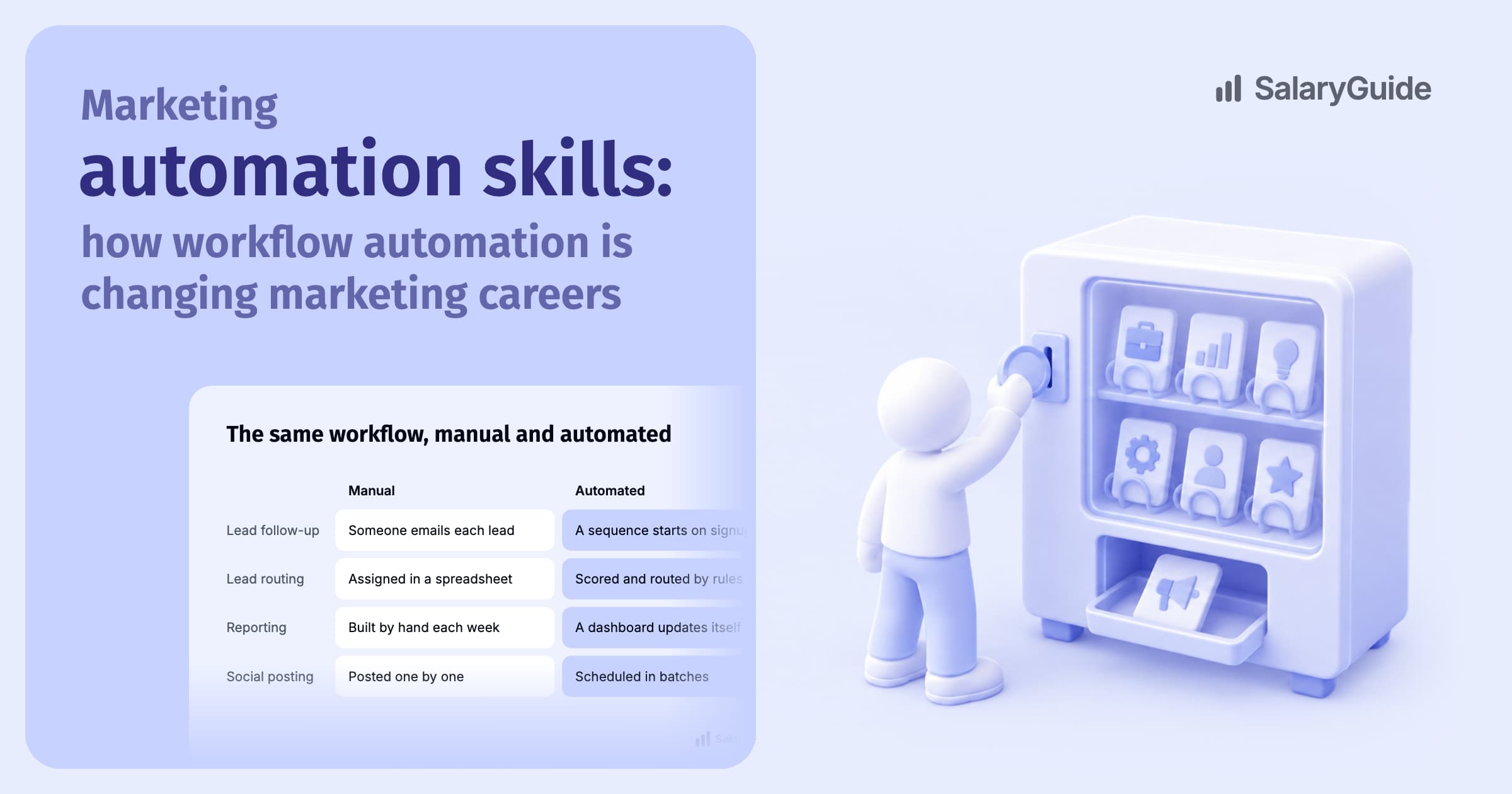
Mastering Marketing Workflow Automation for Your Career

Imagine having a digital project manager for your marketing team—one that works 24/7, never makes a mistake, and handles all the repetitive stuff so you don't have to. That’s marketing workflow automation. It’s the system that gets all your marketing tools talking to each other, moves data where it needs to go, and pulls the trigger on actions without you lifting a finger.
This frees you up from the copy-paste grind and lets you focus on what really matters: strategy, creativity, and growth.
What Is Marketing Workflow Automation?
At its heart, marketing workflow automation is about building a digital assembly line for all your marketing tasks. Think of it like a factory. Each machine has a specific job, and they all work together in a perfect sequence to build a finished product. In our world, the "product" is a seamless customer journey, and the "machines" are your workflows.

These digital assembly lines run on simple “if-then” rules. For example:
- If a visitor downloads your new ebook, then add them to a "Welcome" email series.
- If a lead clicks on your pricing page for the third time this week, then send an alert to a sales rep.
The magic is in connecting these simple triggers and actions to create sophisticated, personalized experiences for every single person who interacts with your brand.
Workflow automation isn't about replacing marketers; it's about empowering them. By handing off the tedious, predictable tasks to software, you reclaim valuable time for creativity, analysis, and strategic thinking—the work that truly drives growth.
Ultimately, the goal is to get rid of manual roadblocks, slash human error, and deliver a consistent, high-touch experience at scale.
To better understand how these pieces fit together, let’s break down the essential functions of a typical automation platform.
Marketing Automation Core Functions at a Glance
This table gives a quick overview of the key capabilities that make marketing automation such a powerful tool.
| Core Function | What It Does | Benefit for Marketers |
|---|---|---|
| Lead Nurturing | Sends a timed sequence of targeted emails or messages based on user actions. | Builds trust and guides prospects toward a purchase decision without manual follow-up. |
| CRM Integration | Syncs lead data, activities, and communication history between marketing platforms and your CRM. | Gives the sales team a complete picture of a lead's journey and ensures no one falls through the cracks. |
| Campaign Triggering | Launches marketing campaigns (e.g., social ads, emails) based on specific triggers or events. | Delivers the right message at the perfect moment, increasing relevance and engagement. |
| Behavioral Tracking | Monitors how users interact with your website, emails, and content. | Uncovers what your audience truly cares about, allowing for deep personalization. |
| Reporting & Analytics | Collects and visualizes data on campaign performance, lead conversion, and ROI. | Provides clear, data-backed insights to prove marketing's value and optimize future strategies. |
Each of these functions acts as a building block, allowing you to construct complex and effective workflows that run on their own.
Why This Matters for Your Career
Knowing how to build and manage automated workflows is no longer a "nice-to-have" skill—it's a massive career advantage. In a world where paid media specialists, SEOs, and growth marketers are constantly juggling dozens of initiatives, automation is what separates the pros from the amateurs.
The numbers back it up. Businesses using automation see an average return of $5.44 for every $1 spent, an 80% increase in leads, and 77% higher conversion rates. It’s a game-changer.
Mastering this skillset helps you:
- Show Your Strategic Value: You're no longer just executing tasks. You're designing systems that directly grow revenue and keep customers happy.
- Become Hyper-Efficient: Get more done in less time. This lets you take on bigger, more complex campaigns and prove you're a top performer.
- Eliminate Costly Mistakes: Automation removes the risk of human error from things like manual data entry or missed follow-ups, keeping your campaigns and data clean.
For a great starting point, check out this no-fluff guide on marketing automation for small business. It lays a solid foundation for the real-world examples and practical steps we'll dive into next, giving you a clear path to leveling up your marketing career.
What You Really Get From Automating Your Marketing Workflows
Forget the buzzwords about "efficiency" for a moment and let's talk about what marketing workflow automation actually fixes. Picture a typical marketing team running on manual power. The content manager is stuck in a loop of copy-pasting blog updates across social channels. The paid media specialist is drowning in spreadsheets, trying to stitch together campaign ROI from a dozen different ad platforms. And the marketing director? They're frustrated, because getting a clear, real-time snapshot of performance feels impossible.
This isn't just inefficient—it's a recipe for friction, errors, and missed chances. Manual tasks create bottlenecks that slow down launches and keep your team from jumping on timely insights. It's a constant cycle of playing catch-up instead of getting ahead. Now, let’s look at how automation completely changes the game.
Get Rid of Costly Human Mistakes
Every time someone has to manually enter data or copy and paste information, there's a risk of something going wrong. A simple typo in a lead's email address makes it worthless. One wrong number in a report can send your entire strategy in the wrong direction. These little mistakes add up, chipping away at the quality of your data and undermining all your hard work.
Marketing workflow automation is like having a quality control system that never gets tired or distracted. When a new lead signs up, their info is instantly checked and synced to your CRM, exactly as they entered it. Campaign data gets pulled automatically from all your ad platforms into one clean dashboard, no manual wrangling required.
By taking people out of the loop on repetitive data transfers, automation ensures your team—and your sales counterparts—are always working with clean, reliable information. That trust is the bedrock of making smart, data-driven decisions.
This means the marketing director gets reports they can actually count on, and the content manager can be confident every link in a promotion is correct without having to triple-check everything.
Nurture Every Single Lead with Precision
When you're handling follow-ups by hand, things get inconsistent fast. A busy sales team will naturally focus on the "hottest" leads, but what about the prospects who just downloaded an ebook? They often get forgotten. This is a huge leak in your funnel, because those early-stage leads are the customers you need to be building relationships with for the future.
Automation makes sure no lead ever slips through the cracks. It lets you build out personalized nurturing sequences that engage people based on what they actually do.
- The New Subscriber: Someone downloads your "Beginner's Guide"? They can be automatically dropped into a welcome email series that walks them through the basics.
- The Engaged Prospect: A person keeps visiting your pricing page? That can trigger an instant alert for a sales rep to reach out with a personalized offer.
- The Quiet Lead: A contact hasn't opened an email in 90 days? Send them a re-engagement campaign to win them back or, if not, to clean up your list.
This kind of personalized attention, delivered at scale, turns your marketing funnel into a well-oiled machine that systematically builds relationships and guides people toward making a purchase.
Scale Your Wins Without Scaling Your Workload
What happens when a campaign is a smash hit? In a manual world, success often just means more work. More leads to process, more reports to compile, more follow-ups to juggle. Your team's own capacity becomes the very thing holding back growth.
This is where workflow automation delivers its biggest punch. It separates your results from the hours your team has to put in. Once you build a successful automated workflow for a campaign, you can scale that campaign 10x without adding 10x the work.
For instance, a content manager can set up one workflow that automatically promotes every new blog post to social media, adds it to the next email newsletter, and pings the sales team about the new asset. That single setup works whether you publish one blog post or a hundred. It frees up your team to focus on creating the next great strategy, not just maintaining the last one. Automation is what makes your marketing repeatable, sustainable, and truly scalable.
Essential Marketing Workflows You Can Automate Today
Theory is one thing, but seeing marketing workflow automation in action is where the lightbulb really goes on. Instead of just talking about what's possible, let's walk through three high-impact workflows you can set up right now.
For each one, I'll break down the specific trigger that kicks things off, the sequence of automated actions that follow, and the business goal you're aiming for. This is how you translate a smart idea into real, measurable results.
Nurturing New Leads On Autopilot
One of the most valuable things you can automate is your lead nurturing sequence. This ensures every new person who shows interest gets a consistent, relevant experience right from the start, building a relationship when their engagement is at its peak.
Trigger: Someone fills out a form on your website to download a guide or watch a video.
Automated Actions: The system instantly gets to work.
- The new contact is added to your CRM, automatically tagged with the resource they downloaded (e.g., "eBook-Q3-Social-Trends").
- Within minutes, an email lands in their inbox with a link to the resource and a quick thank you.
- Two days later, a follow-up email arrives with a related blog post or video, adding more value on the same topic.
- A few days after that, a third email invites them to a webinar or offers a demo, presenting a clear next step.
Primary Goal: You create a warm, guided journey for every new lead. This builds trust and moves them through the funnel without anyone on your team having to manually send a single email. No more leads going cold.
Orchestrating Flawless Campaign Launches
Launching a marketing campaign can feel like trying to conduct an orchestra where every musician is in a different room. An orchestration workflow connects your project management and communication tools so everyone hits their notes at the right time.
Trigger: A task in your project management tool (like Asana or Trello) is moved to the "Ready for Launch" column.
Automated Actions: This one simple action triggers a domino effect.
- A notification is instantly posted in your team's Slack or Microsoft Teams channel announcing the launch.
- The social media scheduler (think Buffer or Hootsuite) gets the green light to publish all the pre-loaded promotional posts.
- A new folder is automatically created in Google Drive or SharePoint to collect all the campaign assets and performance data in one tidy place.
Primary Goal: Campaign launches become smooth and predictable. The whole team stays in the loop automatically, and the chance of a critical step being missed drops to virtually zero.
Automating Content Promotion And Distribution
Let's be honest: creating great content is only half the job. Getting it in front of the right people is what actually drives results. A content promotion workflow makes sure every piece of content you create gets the initial (and ongoing) visibility it needs to succeed.
This is where you see automation dramatically cut down on errors, improve how you connect with leads, and set the stage for real growth.

By automating these key touchpoints, you're not just saving time—you're building a more reliable and scalable marketing engine.
Trigger: A new article is published on your blog.
Automated Actions:
- Your system drafts several social media posts—each with a different hook, image, or stat—and schedules them out over the next week.
- The post is automatically added to the queue for your next email newsletter. To get a feel for this process, you can check out what a typical Email Marketing Specialist job description covers.
- A task pops up for your community manager to share the link in relevant LinkedIn groups or online forums.
Primary Goal: You maximize your content's reach with very little hands-on effort. This creates a consistent promotional rhythm that drives more traffic and engagement for everything you publish.
The impact here is bigger than you might think. Businesses using marketing automation see a 451% increase in qualified leads. They also generate 80% more leads overall. And while automated emails account for just 2% of sends, they drive an incredible 41% of orders. You can dig into more of these stats on Thunderbit.com.
These templates are just starting points. The real power comes when you identify your team's most repetitive, time-consuming tasks and build workflows that give you that time back to focus on big-picture strategy.
How to Implement Marketing Workflow Automation
Getting started with marketing workflow automation can feel like a monumental task, but you don't have to boil the ocean. The best approach is to start small, prove the concept, and build from there. Think of it like a home renovation—you don't knock down all the walls at once. You start with one room, get it right, and then move on to the next.
This simple, four-step framework will help you get from identifying your first automation opportunity to measuring its impact.

This isn't about diving into complex code. It's about finding real problems and solving them with smart, targeted automation.
Identify Your Biggest Bottlenecks
Before you can automate a single thing, you have to know where the friction is. The goal here is to pinpoint the most repetitive, mind-numbing, and error-prone tasks that are bogging your team down.
A quick process audit is the perfect way to start. Sit down with your team and ask some direct questions:
- What’s the one task you absolutely dread doing every week?
- Where does information seem to fall through the cracks between tools?
- Which processes depend entirely on someone manually copying and pasting data?
- What simple, preventable mistakes keep happening over and over?
You’re looking for patterns. Maybe you'll find out that someone spends five hours a week just downloading lead lists from Facebook Ads and uploading them to the CRM. Or perhaps the handoff of a new MQL to the sales team is clunky and inconsistent. These are your low-hanging fruit—the perfect first targets for automation.
Choose The Right Automation Tools
Once you know what you’re trying to fix, you can start looking for the right tool. There are a ton of options out there, but they generally fall into three buckets. Your final choice will come down to your budget, your team's technical skills, and the specific job you need to get done.
- All-in-One Platforms: Think of systems like HubSpot or Marketo. These are the powerhouses that bundle everything—email, CRM, analytics, and workflow builders—into one place. They're fantastic for sophisticated lead nurturing and managing entire campaigns from a single dashboard.
- Flexible Connectors: Tools like Zapier or Make are the universal translators of the software world. They act as the glue between all the different apps you're already using. Need to get your project management tool to talk to your email client? This is how you do it, and it's a great, budget-friendly way to get started.
- Specialized Tools: Don't forget to check the tools you already pay for. Your email marketing platform probably has automated welcome sequences baked in, and your social media scheduler might have rules for automatically resharing your best content. You might be surprised by the power you already have at your fingertips.
Start Small And Scale Smart
The single biggest mistake I see teams make is trying to automate everything at once. It’s a recipe for confusion, frustration, and a project that stalls out before it ever really begins. The trick is to pick one high-impact workflow as a pilot project. Choose something that is relatively simple to set up but will deliver a clear, immediate win for the team.
A great example is automating the first follow-up email to a new lead. It’s a straightforward task, it ensures no lead ever goes cold, and you can see the results almost instantly.
By launching a single, successful pilot, you do two crucial things. First, you prove the value of marketing workflow automation to the higher-ups. Second, you build your team's confidence and create the momentum you need to tackle bigger, more complex projects later.
Once that first workflow is humming along, you can take what you’ve learned and move on to the next bottleneck on your list.
Measure, Analyze, And Optimize
Automation is not a "set it and forget it" magic button. To truly unlock its value, you have to constantly track its performance, analyze what's happening, and look for ways to make it even better. Before you even launch your workflow, decide on a few key performance indicators (KPIs) to watch.
A few good metrics to start with are:
- Time Saved: How many hours a week did this task used to take? Calculating this gives you a powerful and easy-to-understand ROI metric.
- Conversion Lift: Are you seeing more leads from your automated sequences become customers? Compare the conversion rate of your new workflow to the old manual process.
- Error Reduction: Keep an eye on the number of data entry mistakes or missed follow-ups. A drop in this number is a clear sign of improved data hygiene and process reliability.
Check in on these metrics regularly. You might find that tweaking the timing of a follow-up email by a few hours boosts open rates, or that adding one more step to a workflow shaves off even more manual work. This cycle of continuous optimization is how you turn a simple automation into a true growth engine for your entire team. To see how these enhanced roles fit into the bigger picture, explore our guide on the modern marketing department organizational structure.
How Automation Impacts Marketing Careers and Salaries
One of the biggest myths floating around is that marketing workflow automation is here to steal jobs. The reality is actually the complete opposite. Automation doesn't replace marketers; it makes them more powerful.
Think about it: by letting software handle all the repetitive, manual tasks, you get to focus your time on what really matters—the strategic, creative, and analytical work that drives growth and builds a career.
This change is having a huge impact on marketing career paths and paychecks. Professionals who can build and manage automated systems aren't just seen as marketers anymore. They're the strategic architects of a company's growth engine, and that expertise leads directly to promotions and much higher earning potential.
The Rise of High-Value Marketing Roles
The need for marketers who are skilled in automation has created a whole new class of specialized, high-paying jobs that simply didn't exist a decade ago. These roles are essential for any company that wants to scale, and they come with premium salaries because the value they deliver is immense.
Two of the most common roles you'll see are:
- Marketing Operations Manager: This person is the marketing team's MVP. They own the tech stack, keep the data clean, and make sure every process runs like a well-oiled machine. They build the workflows that get leads to the right salesperson, track campaigns accurately, and keep the entire marketing funnel flowing.
- Marketing Technologist: This is a hybrid role for someone who is part marketer, part tech geek. They find, set up, and integrate new tools, making sure all the different systems can talk to each other. Their work gives the rest of the team the power to run smarter, more effective campaigns.
These roles are in such high demand because they go way beyond just launching another campaign. They're about building the entire infrastructure for scalable, repeatable success, which makes them absolutely vital to any modern marketing department.
Your Resume in an Automated World
Knowing your way around specific automation tools is now a major selling point on your resume. It's no longer enough to just list "email marketing" as a skill. Hiring managers want to see real proof that you can build and manage complex, automated workflows.
When you list experience with platforms like HubSpot, Marketo, or even flexible tools like Zapier, you're sending a clear signal that you get how modern marketing works. It shows you can think systematically and use technology to solve real business problems. You're not just a task-doer; you're a system-builder.
Automation transforms your role from one of manual execution to strategic oversight. It’s the career equivalent of trading in a hand shovel for an excavator. Both move dirt, but one operates on a completely different scale of impact and value.
The data backs this up. Even though a surprising 94% of companies still do some repetitive tasks by hand, the trend is clear. Automation boosts job satisfaction for 90% of knowledge workers and increases productivity for 66%.
For marketers, it unlocks the ability to reallocate their energy where it counts—75% of professionals who use automation are able to shift their focus to higher-level strategy. You can dig into more fascinating data on how automation is reshaping marketing careers.
Future-Proofing Your Career and Salary
If you're looking for one of the most effective ways to future-proof your career, learning marketing workflow automation is it. As more and more businesses adopt these technologies, the value of people who can master them will only go up.
Just look at the direct benefits:
- Higher Salary Potential: Marketers with proven automation skills consistently earn more than their peers. Being an expert in a major platform can easily add thousands to your salary.
- Better Job Security: When companies need to tighten their belts, they keep the people who build and manage the efficient systems, not the ones doing the manual tasks those systems replaced.
- A Clear Path to Leadership: When you understand the operational core of the marketing department, you have a direct line to management and executive roles. You can speak the language of efficiency, ROI, and scale.
At the end of the day, embracing automation isn't just about learning a new piece of software. It’s about adopting a mindset focused on efficiency, constant improvement, and strategic impact. This approach doesn't just make you better at your job—it makes you exponentially more valuable to any company you work for.
So, What's Your Next Move?
You’ve got the map. You know what marketing workflow automation is and what it can do. The most important thing to remember is this: it's not some scary, overly technical beast meant only for developers. It's a skill, and a powerful one at that, which is becoming non-negotiable for anyone serious about growing their marketing career.
The real goal is to start developing an "automation first" reflex—always asking yourself, "Is there a smarter, faster way to get this done?"
This whole shift starts with one small, concrete action. What that action is depends on where you are right now, but the idea is the same for everyone: start small and build from there.
Your First Step, Based on Your Role
Don't try to boil the ocean. Pick one high-impact area and nail it. This gets you a quick win, boosts your confidence, and makes the value of automation crystal clear to everyone else.
Here are a few practical starting points:
- For Early-Career Marketers: Start with yourself. Find one repetitive task you do every single week—maybe it's pulling numbers for a social media report or resizing images for the blog. Automate that. It’s a simple way to build a skill you’ll use for the rest of your career.
- For Marketing Managers: Get your team in a room for a brainstorming session. The only agenda item? Identify your top three workflow headaches. Pick the most painful one and make it your mission to automate it. You'll turn a source of collective groaning into a team win.
- For Senior Leaders: Think bigger. Start by mapping out how a real investment in automation technology or training connects directly to your department's goals for the next quarter. Pitch it in the language of ROI, scale, and staying ahead of the competition.
Thinking with an automation mindset isn't just about learning new software. It’s about fundamentally changing how you solve problems. It's a constant hunt for efficiency that will make you an invaluable player in any modern marketing team.
Ultimately, getting good at automation is one of the clearest paths to leveling up in your career. To see what other skills are in high demand, check out our guide on essential marketing skills to learn and stay ahead of the pack.
Got Questions? We've Got Answers
Stepping into marketing workflow automation can feel a bit like learning a new language. It's normal to have a few questions. Let's tackle some of the most common ones I hear from marketers so you can move forward with total confidence.
Is This Going to Make My Job Obsolete?
Absolutely not. Think of it as a promotion, not a replacement. Automation is brilliant at handling the mind-numbing, repetitive tasks that eat up your day. This frees you and your team up to focus on what humans do best: big-picture strategy, creative brainstorming, and digging into complex customer insights.
The whole point of marketing workflow automation isn’t to replace talent—it’s to unleash it. When you hand off the robotic work, you get to put your brainpower where it truly counts.
Essentially, your role shifts from being bogged down in the doing to leading the thinking. That makes you far more valuable, not less.
This Sounds Expensive. Can a Small Team Even Afford It?
It's a common myth that automation is only for massive companies with deep pockets. While some enterprise-level platforms do have a hefty price tag, the market is full of powerful, budget-friendly tools perfect for small but mighty teams.
Tools like Zapier or Make are fantastic for connecting the apps you're already using without breaking the bank. Plus, many of the email marketing platforms you know and love now include surprisingly robust automation features in their standard plans, giving you a perfect on-ramp.
Okay, I'm In. What Should I Automate First?
This is the fun part! Start with a quick win. Look for the most repetitive, time-sucking task your team does over and over again—bonus points if it's also prone to human error. You want something with a clear, measurable outcome that doesn’t require a super complicated setup.
Here are a few classic starting points:
- New Lead Handling: Automatically push contact info from a website form straight into your CRM. No more copy-pasting.
- Content Promotion: Set up a trigger that schedules social media posts the moment a new blog article goes live.
- Welcoming New Subscribers: Instantly send a personalized welcome email to every single new person who signs up.
By picking a simple but high-impact workflow, you’ll immediately see the value and get your whole team excited about what’s possible.
Ready to understand your value and find your next role in the new world of marketing? At SalaryGuide, we connect marketing professionals with real, recently posted jobs directly from top companies. Explore real marketing salaries and find your next opportunity today.