Pay Transparency Laws by State: A Quick Guide to Compliance and Trends
Trying to get a handle on pay transparency laws by state can be a real headache. The rules change dramatically from one state line to another, but the core idea is the same: employers have to share salary information at some point during the hiring process. The goal is to level the playing field and promote genuine pay equity.
The Evolving Landscape of Pay Transparency
The nationwide push for pay transparency marks a significant shift in how companies handle compensation and recruitment. It's a direct response to persistent wage gaps and the growing demand from today's workforce for more openness from employers. By mandating salary disclosures, these new laws are flipping the script on traditional salary negotiations, giving both job seekers and current employees the data they need.
To navigate this new reality, it's crucial for everyone to understand what is pay transparency and why it matters. This guide will serve as your state-by-state reference, breaking down the specific regulations you need to know.
Types of Pay Transparency Legislation
Not all pay transparency laws are cut from the same cloth. The requirements fall into a few main categories, creating a complex patchwork of rules that can be particularly tricky for companies hiring across multiple states.
Here's a look at the common types of legislation:
- Mandatory Salary Ranges in Job Postings: This is the strictest approach. States like California and New York now require companies to include a pay range in all public job advertisements.
- Disclosure Upon Request: Some states, like Maryland, have a softer requirement. Employers only need to provide the pay scale if a candidate specifically asks for it.
- Salary History Bans: This is the most common related rule. It forbids employers from asking applicants about their previous salaries, a practice that has been shown to lock in pay inequality from one job to the next.
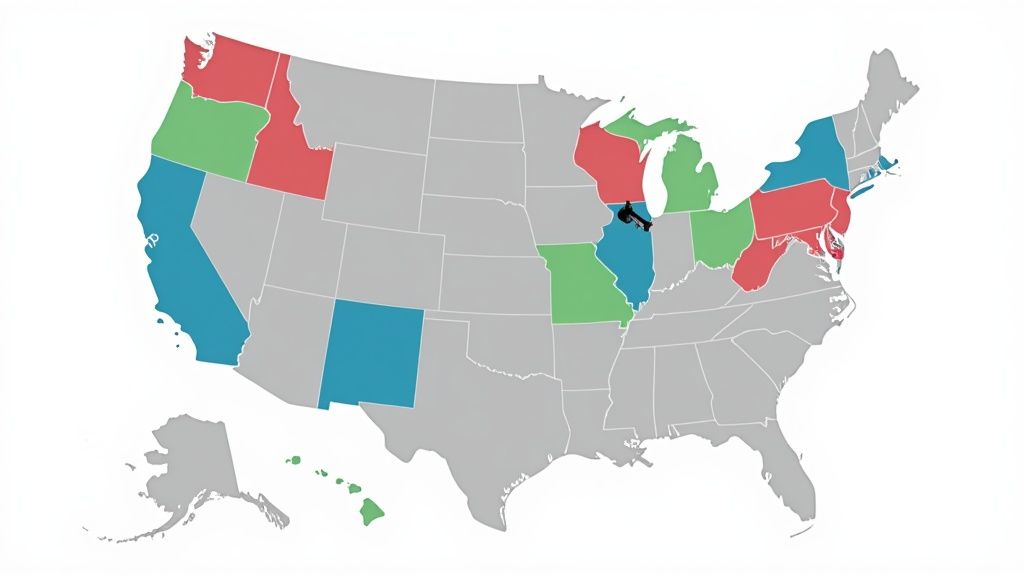
As of May 2025, the map shows just how varied adoption has been. Roughly 14 states and the District of Columbia have passed some form of pay transparency law. That means about 26% of states have clear disclosure mandates, while the vast majority—around 71%—still have no statewide laws on the books.
Getting this right is about more than just checking a legal box; it’s a fundamental culture shift. As companies adjust, embracing transparent communication in the workplace is key to building trust and fostering stronger employee relationships. This guide will give you the practical knowledge you need to manage these changes effectively.
Quick Lookup Table for State Law Requirements
Trying to keep all the different state pay transparency laws straight can be a real headache. Whether you're a recruiter trying to stay compliant or a job seeker who wants to know your rights, you need clear, fast answers. That's exactly what this lookup table is for.
I've boiled down the essential details of each state's law into a simple, scannable format. You can see right away which rules apply to a small business with just one employee versus a larger company with 15 or more. The table also pinpoints exactly when an employer has to share the pay range—is it required in the job post, only if you ask for it, or later on in the process?
How to Use This Table
Think of this as your go-to reference for a side-by-side comparison of active pay transparency laws. It’s perfect for quickly checking your obligations as an employer or understanding your rights as a candidate. You'll also find a column indicating which states have banned asking about salary history, a crucial part of the pay equity puzzle that stops past (and potentially biased) pay from dictating future earnings.
The goal here is to help you make informed decisions without getting lost in complicated legal jargon.
A question I get all the time is how these laws handle remote jobs. The general rule of thumb is that the law of the state where the employee actually works is what counts, not where the company's HQ is. For example, if you live and work in Washington for a company based in Texas, Washington's pay transparency law almost always applies to your role.
With that in mind, here is a detailed breakdown of the requirements state by state.
State-by-State Pay Transparency Law Summary
This table offers a snapshot of the key provisions in each state with an active pay transparency law. It's designed to give you the most critical information—like employer size, when to disclose pay, and whether salary history questions are off-limits—in a single glance.
| State | Employer Size Threshold | Pay Range Disclosure Requirement | Salary History Ban | Effective Date |
|---|---|---|---|---|
| California | 15+ employees | Must be included in all job postings. | Yes | Jan. 1, 2023 |
| Colorado | 1+ employee | Must be included in all job postings, including promotions. | Yes | Jan. 1, 2021 |
| Connecticut | 1+ employee | Must be disclosed upon applicant's request or before an offer. | Yes | Oct. 1, 2021 |
| Hawaii | 50+ employees | Must be included in external job postings. | Yes | Jan. 1, 2024 |
| Illinois | 15+ employees | Must be included in job postings for roles in or reporting to Illinois. | Yes | Jan. 1, 2025 |
| Maryland | All employers | Must be provided to an applicant upon request. | Yes | Oct. 1, 2020 |
| Nevada | All employers | Must be provided to an applicant after their interview. | Yes | Oct. 1, 2021 |
| New York | 4+ employees | Must be included in job postings for roles performed in or reporting to NY. | Yes | Sep. 17, 2023 |
| Rhode Island | 1+ employee | Must be provided upon request or before discussing compensation. | Yes | Jan. 1, 2023 |
| Washington | 15+ employees | Must be included in job postings, even for remote roles open to WA residents. | Yes | Jan. 1, 2023 |
As you can see, the requirements vary significantly from one state to the next. Always double-check the specifics for the state where you're hiring or applying to ensure you're fully informed and compliant.
States Requiring Salary Ranges in Job Postings
The biggest shift in pay transparency comes from states that now require employers to put salary ranges right in the job posting. This is a game-changer. It gives candidates crucial information from day one and completely changes the hiring dynamic. States like California, Colorado, New York, and Washington are really leading the charge on this front.
These laws go way beyond just banning questions about your old salary. They force companies to be upfront about compensation. Let's break down what that means for employers and job seekers in these pioneering states.
California: A High Bar for Transparency
California's law (SB 1162) is one of the most comprehensive out there. Since January 1, 2023, any employer with 15 or more employees—with at least one in California—has to include a "pay scale" in every job posting.
This isn't just for jobs physically located in the state. If a remote role could be filled by someone in California, the pay range has to be on the posting, no matter where the company is based.
What’s a "pay scale"? The law defines it as the salary or hourly wage range the employer reasonably expects to pay. And they're serious about it. Posting a vague or ridiculously wide range won't cut it. Penalties for not providing a legitimate, good-faith range can run from $100 to $10,000 per violation.
Colorado: The Original Trailblazer
Colorado’s Equal Pay for Equal Work Act really set the standard back when it took effect on January 1, 2021. The law is incredibly broad, applying to any employer with at least one employee in Colorado.
It requires that all job postings, including those for internal promotions, disclose the pay range. But it goes a step further, also requiring a general description of benefits and other potential compensation. Colorado has been aggressive with enforcement, with fines ranging from $500 to $10,000 per violation. This tough stance has made companies everywhere reconsider how they advertise remote jobs, since any role open to a Colorado resident has to play by their rules.
New York and Washington: The Movement Expands
Following the lead of California and Colorado, both New York and Washington have rolled out their own robust disclosure laws, continuing the trend.
- New York: As of September 17, 2023, businesses with four or more employees must post a good-faith salary range for any job that will be done, even partly, in New York. This includes remote positions that report to a New York office or manager.
- Washington: Since January 1, 2023, companies with 15 or more employees have to list the salary range and a summary of benefits for any job that a Washington resident could fill. The state even made it clear that employers can't get around the law by adding "Washington applicants will not be considered" to their postings.
This infographic gives you a quick visual of the different approaches states are taking to tackle pay equity.
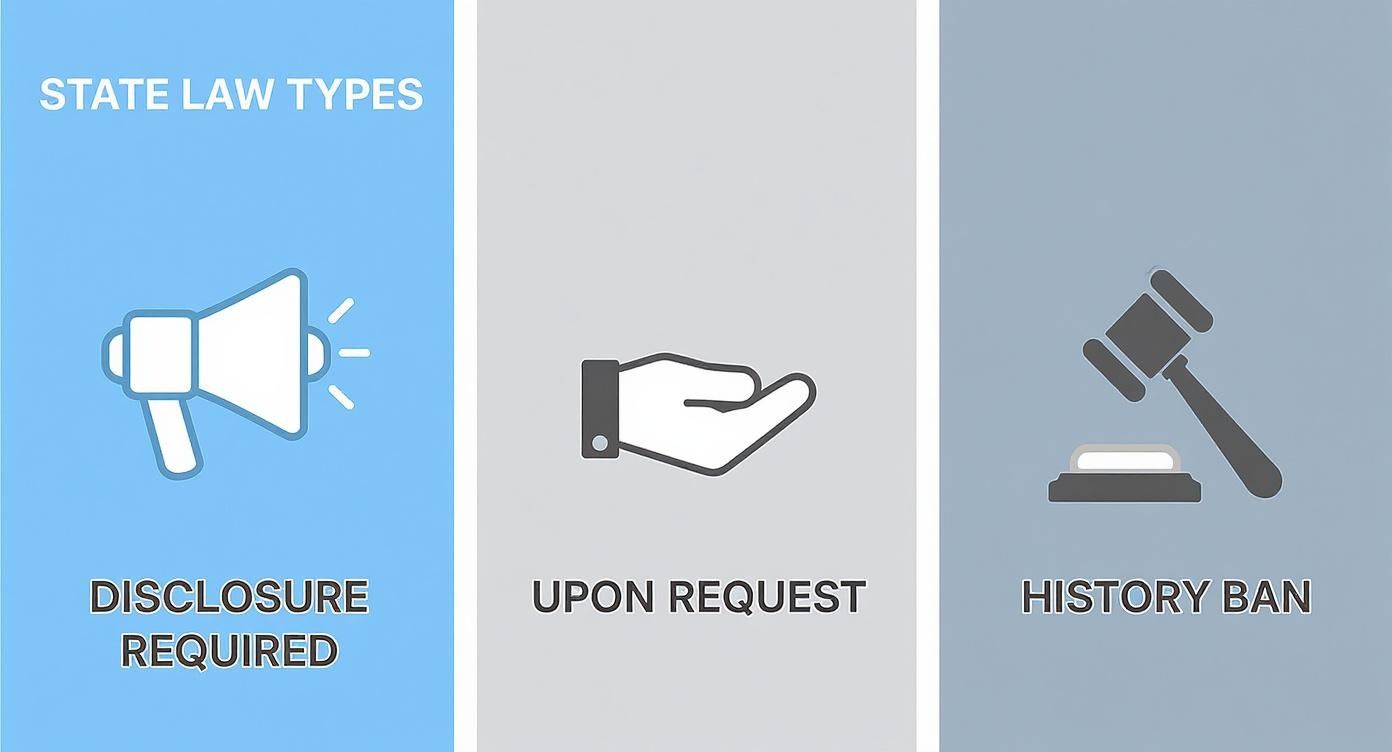
As you can see, states are using a mix of tactics, from mandating upfront salary disclosures to simply banning salary history questions, all with the same end goal: fairer pay.
What Exactly Is a "Good Faith" Pay Range?
One of the most common questions from employers is what "good faith" actually means. It's not just about picking two numbers out of thin air. A good-faith pay range is what you genuinely believe you would pay for the position at the time you post it.
For employers, this means you need to do your homework and be ready to justify your range. If you're struggling with this, our guide on how to determine salary ranges offers a practical roadmap for setting compliant and competitive pay scales.
This trend isn't slowing down. More states and even individual cities are getting on board. The year 2025 is set to be a big one, with new laws taking effect in places like Hawaii and Illinois. This wave of legislation is solidifying pay transparency as the new standard for hiring across the country.
Understanding Laws Requiring Disclosure Upon Request
Not all pay transparency laws require employers to put salary ranges directly in the job posting. Many states have taken a different route, mandating disclosure only at specific moments later in the hiring process. This approach still champions pay equity, just in a different way than the upfront laws you see in places like California or Colorado.
Instead of including salary details in the initial ad, these laws kick in when a candidate asks for the information or when the hiring process reaches a certain stage, like after the first interview. This sets up a unique dynamic. Employers still need to have their pay ranges sorted out and ready to go, but the onus is often on candidates to know when and how to ask for that information.
Key Triggers for Disclosure
Under these laws, the salary conversation doesn't always start automatically. The employer's obligation to share the pay range is conditional, and knowing the specific triggers is crucial for everyone involved.
Here are the most common triggers you'll see:
- Upon Applicant Request: This is the most straightforward trigger. If a candidate asks for the pay range, the employer has to provide it. You'll find this model in states like Maryland and Rhode Island.
- After an Interview: Some states, like Nevada, require employers to disclose the pay range only after a candidate has completed an interview.
- Before or At the Time of an Offer: In this case, like in Connecticut, employers must provide the salary range when a candidate asks for it or before they extend a formal offer of compensation—whichever happens first.
This layered approach gives employers a bit more breathing room at the beginning of the process but still ensures candidates have the information they need before any final negotiations get underway.
A Closer Look at Specific States
So, how do these "upon request" laws actually work day-to-day? While the general idea is the same across the board, the devil is in the details. It really underscores why you need to be familiar with the specific pay transparency laws by state.
Maryland: Maryland's law has been in effect since October 1, 2020, and it applies to every employer in the state, no matter how small. It's simple: an employer must give an applicant the wage range for a position as soon as they ask for it. No ifs, ands, or buts.
Connecticut: Active since October 1, 2021, Connecticut's law covers any business with at least one employee. Here, employers have to disclose the salary range at the earliest of two points: either when the applicant requests it or before they make a formal offer of compensation.
Nevada: Nevada’s law, also effective October 1, 2021, has a unique twist. It requires all employers to automatically provide the pay range to an applicant after they have had an interview for the job. This rule also applies to current employees who are interviewed for a promotion or transfer.
Even if these laws aren't as strict as job posting mandates, they represent a major step forward. They give candidates a legal right to access salary information, which completely changes the power balance in negotiations and helps put an end to offers based on a candidate's suppressed past earnings.
Ultimately, these laws demand a proactive mindset from both employers and job seekers. Companies need to have clear, well-documented pay scales ready for every single role. At the same time, candidates need to be aware of their rights and feel confident enough to ask for the information they're legally entitled to.
States That Ban Salary History Inquiries

Beyond just posting salary ranges, one of the most significant steps toward pay equity is the salary history ban. These laws make it illegal for employers to ask job applicants about their previous or current salary. The reasoning is straightforward but powerful: if someone was underpaid in their last job—whether due to their gender, race, or simply poor negotiation—using that old salary to set their new one just keeps the wage gap alive.
A salary history ban breaks that cycle. By taking a candidate's past earnings off the table, these laws compel companies to base their offers on what the job is actually worth in the current market, the candidate's qualifications, and the company’s own pay scales. This is why you'll find these bans are a cornerstone of many pay transparency laws by state, with over 20 states and a growing list of cities now forbidding the question.
What Questions Are Off-Limits?
Staying compliant with a salary history ban means knowing exactly what you can and can't ask. It's crucial that hiring managers are trained to steer clear of any questions, direct or indirect, that touch on a candidate's pay history.
Here are the kinds of questions that are almost universally prohibited:
- "What was your salary at your last job?"
- "Could you provide a W-2 or recent pay stubs?"
- "What is your current compensation package worth?"
- "What are you making right now?"
It's also illegal to screen out candidates based on their salary history if you happen to find it through a background check or from a recruiter. The rules can get a bit nuanced if a candidate brings up their salary on their own, without being asked. For instance, in a state like Delaware, an employer can only verify that voluntarily disclosed information after a formal job offer has been extended.
Shifting the Conversation to Expectations
So, if you can't ask about the past, how do you talk about money? The answer is to shift the entire conversation from past earnings to future expectations. This isn't just about staying on the right side of the law; it leads to healthier, more direct conversations about compensation.
Instead of digging into what a candidate used to make, hiring managers need to reframe their questions to focus on what the candidate is looking for in this new role.
Practical Example: A hiring manager in Illinois, where the salary history question is banned, needs to gauge if a candidate is within their budget. Instead of asking, "What did you make at your last company?" they should pivot to, "What are your salary expectations for this position?" This is a compliant question because it's forward-looking.
Here are a few safe and effective questions to use:
- "What are your salary expectations for this role?"
- "The posted salary range for this position is $75,000 - $90,000. Does that align with what you're looking for?"
- "Considering your skills and experience, what kind of compensation are you seeking?"
This requires a real change in mindset for many recruiters and hiring managers. It moves the dialogue from "What were you worth over there?" to "What is this job worth to us, and what value can you bring to it?" Ultimately, this approach respects the candidate while tying compensation to the fair market value of the job—which is exactly what these pay equity laws are designed to achieve.
A Practical Guide to Compliance and Enforcement
https://www.youtube.com/embed/Hp_3-1sWGlw
Knowing the details of the various pay transparency laws by state is one thing, but actually putting that knowledge into practice is a whole different ballgame. It's not enough to just tack a salary range onto a job description and call it a day. To do this right, you need a clear, actionable plan that meets your legal obligations while also building a healthier, more open company culture.
A solid compliance strategy really has to start from the inside out. Before you can post any salary ranges with confidence, your company needs to build a logical and defensible compensation philosophy. This means clearly linking pay to real-world factors like specific skills, years of experience, and what the market is actually paying for that role.
Your Compliance Checklist
To get ahead of the curve and build a proactive framework, you'll want to focus on a few critical actions. These steps will help you sidestep potential risks and get your team ready for the operational shifts that come with this new level of transparency.
- Conduct an Internal Pay Audit: The first step is to look in the mirror. You need to analyze your current compensation data to find—and fix—any pay gaps that exist along gender, racial, or other protected lines. This gives you a baseline of where you are and what needs to change. Getting a handle on the core principles here is crucial; our detailed guide explains more about what is pay equity.
- Establish a Compensation Philosophy: It's time to put your pay strategy down on paper. Create clear, consistent guidelines for how you determine compensation across the board. Document everything—your salary structures, job levels, and the specific criteria you use to set pay—to ensure your approach is fair and makes sense.
- Train Your Team: Your HR staff and hiring managers are on the front lines, so they absolutely need to be in the loop. They require thorough training on what the laws demand, what questions they can and can't ask candidates, and how to talk about compensation in a way that is both compliant and professional.
The Consequences of Non-Compliance
Let's be clear: ignoring these laws is a significant business risk. The penalties aren't just a slap on the wrist. Enforcement is ramping up, and the fines can be steep. Depending on the state, penalties can range from a warning for a first offense to hefty fines for repeat violations, sometimes running into the thousands of dollars per posting.
These consequences aren't just theoretical. They highlight just how important it is to be proactive. As companies navigate these new rules, understanding how to create legally sound agreements becomes even more critical. Learning how to write a contract that protects your business is a great way to make sure all your employment documents are buttoned up. Taking these steps doesn't just keep you out of legal hot water; it also cements your reputation as an employer who is fair, transparent, and trustworthy.
The Future of Pay Transparency Legislation
If you think pay transparency is just a passing trend, think again. The momentum is real, and it’s not slowing down. What started as a handful of local ordinances is quickly becoming the new national standard for how companies talk about compensation. The future is pointing toward broader, more detailed, and potentially federal-level rules that will keep changing the game for hiring and retention.
The writing is on the wall: more states are jumping on the bandwagon with new bills every legislative session. Expect to see the map of states with active laws fill in considerably over the next few years. All this activity at the state level is building a solid case for a potential national mandate.
The Push for a National Standard
Right now, there's no federal law requiring pay transparency, but proposals like the Salary Transparency Act show there's a serious appetite for a single, nationwide standard. For national employers, this would be a game-changer, untangling the complicated web of different rules they currently have to follow from state to state.
As more states pass their own laws, the pressure on federal lawmakers to step in only grows. It's predicted that by 2026, roughly 16 U.S. states plus Washington D.C. will have some form of pay transparency law on the books. Each one comes with its own unique details on employer size and when disclosures are required. You can dig into more insights on this growing legal landscape and see which states are already on board.
What's on the Horizon? Trends and Global Influences
The next generation of pay transparency legislation is set to move far beyond simply posting salary ranges on job ads. Lawmakers are now exploring more sophisticated requirements aimed at actively closing wage gaps, not just pointing them out.
Here are a few key trends to keep an eye on:
- Mandatory Wage Data Reporting: Some proposals would compel larger companies to report anonymized pay data to government agencies. This gives regulators a bird's-eye view of pay disparities across entire industries and demographics.
- Required Corrective Actions: Future laws might not just stop at reporting. If a company's pay audit uncovers significant wage gaps, they could be legally required to create and implement a plan to fix them.
- Global Influence: The European Union’s Pay Transparency Directive is setting a high bar worldwide. As American companies with a global footprint adapt to these stricter rules abroad, it's likely to speed up the adoption of similar policies here at home.
These emerging rules signal a major shift from passive transparency—just disclosing ranges—to active equity, which means actually fixing the problems you find. For employers, this means the work doesn't stop once a salary range is posted. The future of compliance will demand ongoing analysis and a real, provable commitment to fair pay. Getting ahead of these changes isn't just smart; it's essential for any forward-thinking organization.
Your Pay Transparency Questions Answered
The patchwork of pay transparency laws by state can be a real headache, leaving both employers and job seekers with a lot of questions. The details matter, and a lot of the nuances aren't obvious right away. Let's clear up some of the most common points of confusion.
My goal here is to give you straightforward, practical answers on everything from remote job postings to what a "good faith" salary range actually is. Getting these details right is the key to staying compliant or making a smart career move.
How Do These Laws Apply to Remote Jobs?
This is the big one. How do you handle pay transparency for remote or hybrid roles? The rule of thumb is this: the law that applies is based on where the employee will actually be doing the work, not where the company’s main office is.
Think of it this way: if your company is headquartered in Texas (which has no state-level law) but you post a fully remote job open to anyone in the U.S., that job posting must comply with Colorado's law if a Colorado resident could apply and work from there. That means you have to include the pay range and benefits summary, even if you don't have a single desk in Colorado.
This is a huge deal for companies hiring across state lines. To keep things simple, many have just started putting salary ranges on all their national remote job ads. It’s often easier than trying to track and manage different rules for every single state.
What Is a Good Faith Salary Range?
You’ll see the term "good faith" in almost every one of these laws, but what does it really mean? Simply put, it’s the salary range the employer honestly believes they are willing to pay for the job at the time of posting. It can't just be a ridiculously wide or made-up range to get around the rules.
For example, slapping a "$50,000 to $250,000" range on a mid-level marketing job probably isn't going to cut it. A legitimate, good-faith range is one that's grounded in reality—reflecting current market rates, your company's own pay scales, and the actual skills required for that specific position.
What Should I Do If a Job Posting Breaks the Law?
So, you've found a job posting that seems to be breaking the rules—maybe it's a role based in New York City without a pay range listed. You've got a couple of options. Most states allow you to file a formal complaint with their Department of Labor or a similar agency.
For a job seeker, that can feel like a pretty formal step. A more low-key approach is to apply anyway and bring it up in the first conversation with a recruiter. You can simply ask for the range and mention the local law.
For employers, it's smart to have a process for handling these situations. Some states, like Washington, even offer a grace period to fix a non-compliant ad before you face any penalties, so being able to respond quickly is crucial.
Ready to find marketing roles with the salary information you need upfront? SalaryGuide sources jobs directly from company career pages, giving you access to real, transparent opportunities. Explore jobs and salary insights on SalaryGuide.com.
