What Is Pay Equity A Guide to Fair Compensation
When we talk about fairness in the workplace, the term "pay equity" often comes up. But what does it actually mean?
At its core, pay equity is the simple, yet powerful, idea that people should receive the same compensation for work of equal or comparable value—regardless of their gender, race, or any other part of their identity.
It’s a concept that goes far beyond just looking at job titles. Instead, it prompts us to look at the real value different roles bring to an organization, based on things like skill, effort, and responsibility.
Understanding Pay Equity vs Equal Pay

To really get a handle on pay equity, we need to draw a clear line between it and its close cousin, "equal pay." People often use these terms as if they mean the same thing, but they address very different aspects of fairness at work. Mixing them up can cause companies to miss deep-rooted, systemic pay issues hiding in plain sight.
Equal pay is the more straightforward of the two. It means that two people doing the exact same job for the same company should get the same paycheck. Think of two Senior SEO Specialists with similar experience and performance—their compensation should be identical. The focus here is on the same work.
Pay equity, on the other hand, zooms out for a much broader perspective. It tackles the more complex and nuanced question of "comparable worth."
To make this distinction clearer, let’s break down the key differences side-by-side.
Pay Equity vs Equal Pay At a Glance
| Concept | Pay Equity | Equal Pay |
|---|---|---|
| Scope | Compares different jobs of comparable value to the organization. | Compares the same or substantially similar jobs. |
| Focus | Correcting systemic pay gaps between different roles, often across gender or racial lines. | Ensuring individuals in the same role are paid the same. |
| Legal Basis | Often supported by state or provincial laws (e.g., Pay Equity Acts). | Mandated by federal laws like the Equal Pay Act of 1963 in the U.S. |
| Example | Ensuring a predominantly female marketing team isn't paid less than a predominantly male IT team if their jobs require similar skill, effort, and responsibility. | Two graphic designers with the same experience and duties receive the same salary. |
This table shows how pay equity challenges us to look beyond job titles and truly evaluate what each role contributes.
The Core of Comparable Worth
Let's put this into a real-world context. Imagine a company has Marketing Coordinators (a role mostly held by women) and Warehouse Associates (a role mostly held by men). The day-to-day tasks are completely different.
A pay equity analysis would dig deeper, evaluating their overall value to the business by looking at factors like:
- Skill Required: The level of education, specialized training, and expertise needed.
- Effort Exerted: The mental or physical demands of the job.
- Responsibility Level: The degree of accountability for results, budgets, or team supervision.
- Working Conditions: The physical environment, including any potential hazards.
If this analysis shows that the Marketing Coordinator and Warehouse Associate roles bring comparable value to the company, pay equity principles say their compensation should be in the same ballpark. This is how we begin to fix historical biases where entire professions, often those dominated by women, have been systematically undervalued and underpaid.
Pay equity is about correcting systemic imbalances, ensuring that compensation is based on the intrinsic value of the work itself, not on the gender or demographic makeup of the people who typically perform that work.
A Tale of Two Marketing Roles
Let's look at an example inside a marketing department. A Content Strategist and a Data Analyst might have very different daily to-do lists. One is deep in creative and editorial work, while the other is immersed in numbers and analytics.
However, both roles require a high degree of specialized skill, a ton of intellectual effort, and significant responsibility for driving business outcomes. A pay equity analysis ensures that one role isn't paid substantially less just because of outdated salary patterns or historical biases about which type of work is more "valuable."
This distinction is so important because a company can truthfully claim it provides "equal pay for equal work" and still have major gender-based pay gaps. This happens when female-dominated roles across the entire organization are paid less than male-dominated roles of comparable value.
The struggle for pay equity is a global one. As of 2024, women worldwide still earned only about 83 cents for every dollar earned by men, according to data compiled by EqualPayToday.org.
As more organizations aim for genuine fairness, many are embracing greater salary transparency. Publishing compensation data helps hold companies accountable and gives employees the information they need to advocate for themselves. You can dive deeper into this trend in our guide on what is pay transparency.
Why Pay Gaps Persist in the Modern Workplace
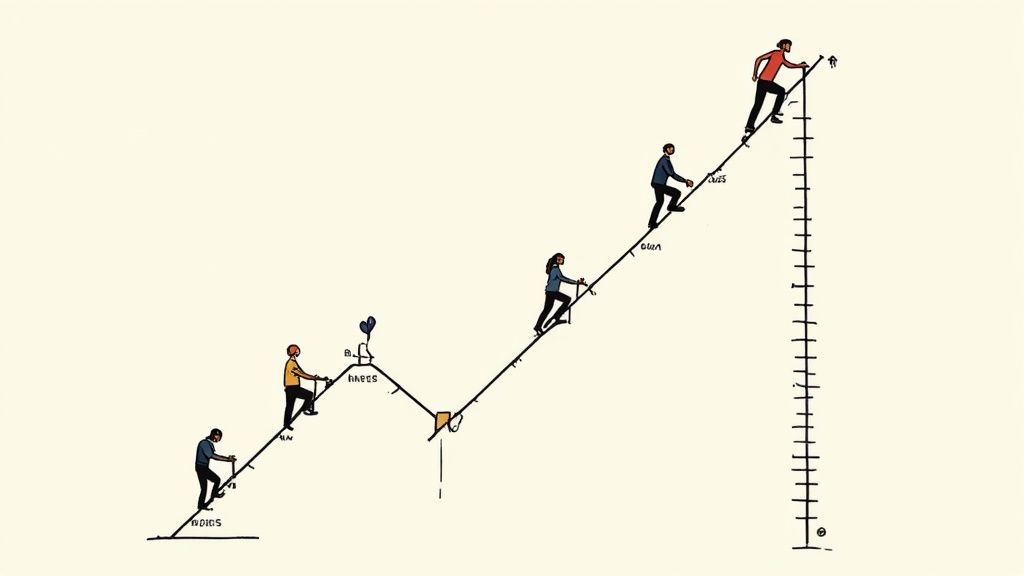
So, if the ideas of equal pay and pay equity are pretty easy to grasp, why are we still talking about pay gaps? It’s a fair question, and the answer is complicated. These gaps rarely come from a single, malicious decision. Instead, they’re the result of deep-seated societal patterns and subtle, often unintentional, biases that stack up over an entire career.
These differences in pay don't just happen. They're fed by systemic issues that quietly shape everything from who gets hired and promoted to how we value entire professions. To get to the root of the problem, we have to pull back the curtain on these quiet but powerful forces.
The Role of Occupational Segregation
A huge piece of the puzzle is something called occupational segregation. This is what happens when certain jobs get unofficially labeled as "men's work" or "women's work." Think about nursing and elementary school teaching, which are dominated by women, versus construction and software engineering, which are mostly men.
Historically, roles filled primarily by women have been valued—and paid—less than male-dominated jobs, even when the skill, effort, and responsibility are the same. It has nothing to do with the actual importance of the work and everything to do with the unconscious value society has placed on it.
This systemic undervaluation is a core reason why a company can have perfect equal pay (paying men and women in the same role identically) but still have a massive gender pay gap overall.
When a whole field is underpaid, it’s a structural problem that an individual can’t negotiate their way out of. It’s why a true pay equity analysis is so important—it forces a comparison of different jobs based on what they're actually worth to the business, not just what the market has traditionally paid.
Unconscious Bias in Hiring and Promotions
Even when everyone is in the same field, unconscious bias can still create and widen pay gaps. These are the mental shortcuts and stereotypes we all have that kick in without us even realizing it, influencing our judgment.
Take the hiring process. A manager might see an assertive male candidate as a "go-getter" but view a woman with the exact same traits as "abrasive." This tiny shift in perception can impact who gets the job and, crucially, their starting salary. A slightly lower starting offer might not seem like a big deal, but over a career of 3% annual raises, it snowballs into a massive lifetime earnings gap.
And this bias doesn't magically disappear after someone is hired. It continues to pop up in:
- Performance Reviews: Subjective feedback can be tinged with stereotypes, causing men to get slightly better ratings for doing the same quality of work.
- Project Assignments: Men are often given the high-stakes, "stretch" assignments that lead to visibility and promotions.
- Promotion Velocity: Men frequently climb the ladder faster than their female colleagues, which naturally accelerates how much they earn over time.
The Motherhood Penalty and Caregiver Bias
Another major factor is the "motherhood penalty." This is the well-documented reality that working mothers face disadvantages in pay, promotions, and even how competent they’re perceived to be compared to men and women without children.
Think about two marketing managers who both have a new baby. The father might take a few weeks off and return to his career, his trajectory unchanged. The mother might take a longer leave, and when she comes back, she might be seen as less committed, get passed over for a big promotion, or be nudged into a role with "more flexibility" that also happens to pay less.
It's not just about parental leave, either. It’s about the lasting assumption that mothers are the default caregivers. This can lead to them being excluded from opportunities involving travel or long hours—whether they want to be or not. All of this causes a slow but steady split in career paths and, ultimately, in paychecks.
Of course. Here is the rewritten section with a more natural, human-written tone:
The Business Case for Prioritizing Pay Equity
Let’s be clear: addressing pay inequity is, at its heart, about doing the right thing. But it’s also one of the smartest business decisions you can make. When companies stop treating fair pay as a compliance checkbox and start embedding it into their culture, they unlock some serious competitive advantages. This isn't just about dodging lawsuits; it's about building a stronger, more resilient, and more profitable company from the ground up.
Frankly, ignoring pay equity just isn't an option anymore. The legal ground is shifting under our feet, turning what was once a moral conversation into a direct financial risk. Getting ahead of these changes is just good business—it protects your brand and your bottom line.
Navigating the Legal and Compliance Risks
The era of compensation decisions made in a black box is coming to an end. A wave of new legislation is sweeping in, demanding transparency and accountability, and companies that fail to keep up are going to find themselves in a tough spot.
We’ve had laws like the Equal Pay Act of 1963 on the books for decades, but today's regulations have much sharper teeth. States across the U.S. now require salary ranges in job postings, and many have outlawed asking candidates about their salary history—a practice we now know just perpetuates existing pay gaps.
This isn't just a U.S. phenomenon, either. The European Union is making huge strides with its EU Pay Transparency Directive, which member states must implement by June 2026. This directive forces employers with 100 or more employees to report on gender pay discrepancies. We’re seeing similar pay transparency laws pop up globally, with many major companies choosing to share salary ranges voluntarily to stay ahead of the curve. You can get a great overview of these international pay transparency trends and their impact.
Failing to comply isn't a slap on the wrist. We're talking about the potential for costly class-action lawsuits, government audits, and the kind of brand damage that can take years to repair.
Gaining a Powerful Competitive Edge
Beyond just staying out of trouble, building a reputation for fair pay is one of the best tools you have for winning the war for talent. In a market where skilled professionals have plenty of options, they’re looking for more than just a paycheck—they want to work for employers who are genuinely committed to fairness.
Companies that get this right see some immediate benefits:
- Better Talent Acquisition: When you're transparent with salary ranges and known for paying fairly, you attract a stronger, more diverse group of candidates. The best people want to work where they know their value is recognized.
- Lower Employee Turnover: It’s simple, really. People who feel they are paid fairly are more engaged, more loyal, and much less likely to have their heads turned by a recruiter. This dramatically cuts the staggering costs of hiring and training replacements.
- Higher Employee Morale: Fairness is the bedrock of a healthy workplace culture. When your team trusts that their pay is tied to their contributions, not their identity, morale soars, and so does collaboration and productivity.
Driving Stronger Business Performance
The positive effects of pay equity don't stop at HR; they ripple out and directly impact the entire organization's performance. When every single employee feels valued and sees a path to advance, the business as a whole just runs better.
Think of your company as a high-performance engine. If some cylinders are starved of fuel, the whole machine sputters. Pay equity is about making sure every part of your workforce is firing on all cylinders.
This commitment shows up in the numbers. Time and again, research shows that diverse and inclusive teams—supported by fair practices—are more innovative and better at solving complex problems. Different perspectives lead to better ideas and smarter decisions, which is exactly the edge you need in today's market. Ultimately, understanding what is pay equity and acting on it isn’t just an initiative; it's a core piece of a successful modern business strategy.
How to Conduct an Effective Pay Equity Audit
So, where do you start? The journey from understanding pay equity to actually achieving it begins with a hard, objective look in the mirror. That's what a pay equity audit is: a systematic review of your own compensation practices to find—and fix—unexplained pay disparities.
Think of it as a financial health checkup for your salary strategy. It helps you diagnose issues before they become chronic, painful problems. Instead of relying on guesswork or gut feelings, a proper audit uses cold, hard data to reveal the true state of fairness in your company.
Taking this proactive step shows a real commitment to your team. And that commitment pays dividends—it helps you attract top talent, keeps morale high, and drives better performance across the board.
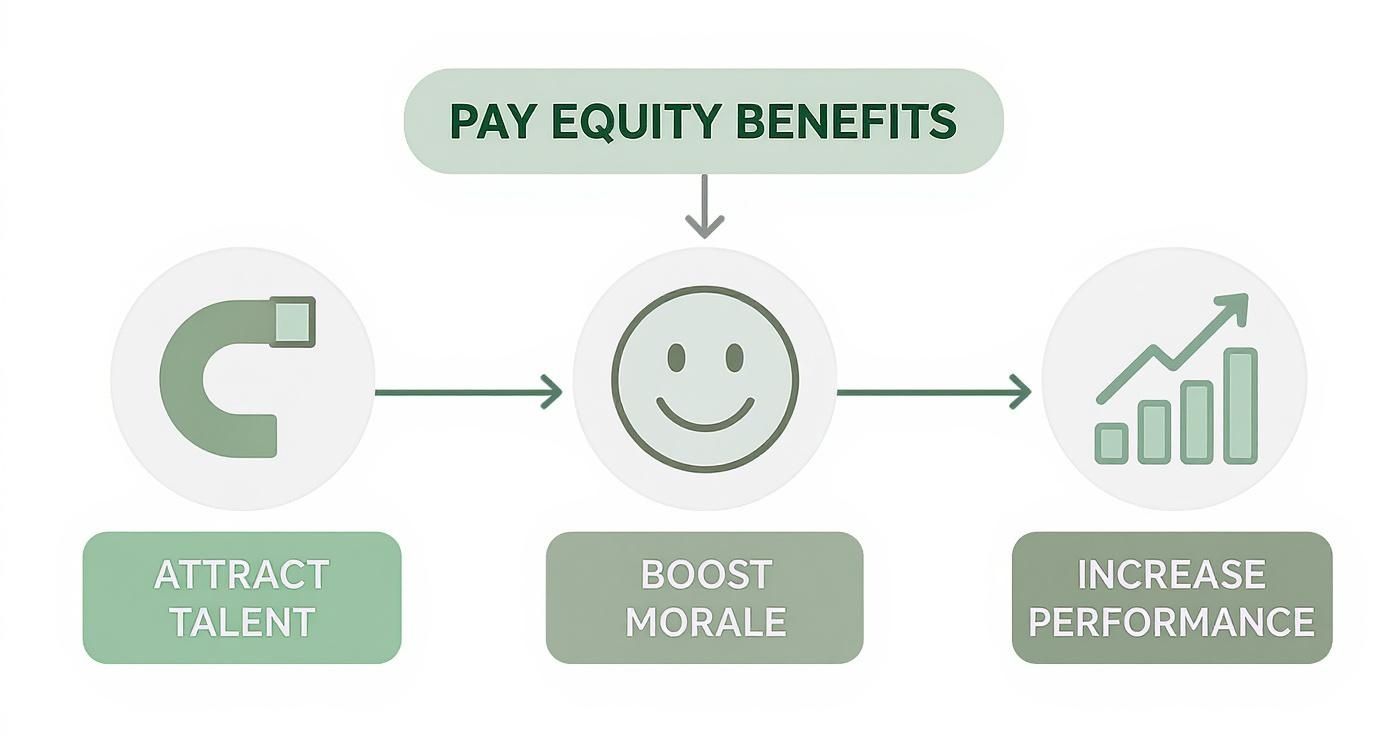
As you can see, these aren't just one-off benefits. They feed into each other, creating a powerful cycle that strengthens your entire organization.
Stage 1: Group Comparable Jobs
First things first, you need to group jobs that are truly comparable in value to the company. This is where the concept of "comparable worth" really comes to life. We’re not just comparing one Marketing Manager to another; we're looking at different roles that require a similar level of contribution, even if the day-to-day tasks look nothing alike.
To do this right, you need a consistent yardstick. Evaluate every role against the same core criteria:
- Skill: What level of expertise, education, and hands-on experience does the job demand?
- Effort: How much mental and physical energy is required to succeed?
- Responsibility: How much accountability does the person have for projects, budgets, or other people?
- Working Conditions: What is the physical environment like, and are there any inherent risks?
For example, you might find that a Senior Content Strategist and a Lead Product Designer land in the same group. Their jobs are different, but both demand high-level creative skills, intense strategic effort, and significant responsibility for critical business outcomes.
Stage 2: Collect the Right Compensation Data
Once your job groups are set, it's time to gather the data. And I mean all of it. The goal here is to get a complete picture of not just what people are paid, but why they're paid that amount.
You’ll need to pull a few key data points for every single employee in the groups you're analyzing:
- Total Compensation: This isn't just base salary. Include bonuses, commissions, stock options—every component of their pay package.
- Job-Related Information: Their official job title, department, and the job group you just assigned them to.
- Demographic Data: You'll need gender, race, and ethnicity to spot potential patterns across protected classes.
- Legitimate Business Factors: These are the neutral, job-related reasons that can legitimately explain pay differences. Think of things like:
- Time with the company (tenure)
- Relevant experience from previous jobs
- Geographic location (cost of living adjustments)
- Recent performance ratings
- Educational background
Be meticulous here. Bad data leads to bad conclusions. Take the time to clean up your information and make sure it’s complete, because the quality of your analysis depends entirely on the quality of your input.
Stage 3: Analyze the Data for Pay Gaps
Now for the fun part: running the numbers. This is where you shift from data collection to statistical analysis. The gold standard for a pay equity audit is a technique called multiple regression analysis.
It sounds complicated, but the concept is straightforward. This powerful statistical model lets you measure the impact of something like gender or race on pay after you’ve already accounted for all the legitimate business reasons for pay differences.
Imagine the analysis model first explains pay based on valid factors like experience, performance, and location. If there’s still a statistically significant pay gap between men and women after controlling for all those things, that remaining gap is considered "unexplained." And that's a huge red flag for a systemic issue.
The whole point of regression analysis is to isolate pay disparities that cannot be justified by legitimate, job-related factors. It’s how you separate an explainable pay variation from a potential inequity.
When you get the results, a "statistically significant" gap is one you need to pay attention to. It means the difference is very unlikely to be a random fluke and needs a much closer look.
Stage 4: Remediate and Make Adjustments
Finding unexplained pay gaps in your analysis means it's time to take action. The final and most critical step is making targeted salary adjustments to bring affected employees in line with their peers.
This isn’t about giving everyone a blanket raise. Remediation has to be a precise, data-driven process. You're surgically closing the specific gaps your audit uncovered. It's absolutely essential to document these adjustments clearly, explaining exactly why the change was made. To ensure all your compensation changes are legally sound, using a comprehensive contract review checklist can be a huge help during this process.
But don't stop there. After you've made the immediate fixes, you have to investigate the root causes. Are your hiring negotiations creating gaps from day one? Is your promotion process unintentionally biased? Digging in and fixing the source of the problem is the only way to make sure these inequities don’t creep back in. For more on this, check out our guide on how to assess fair market value to get your starting offers right from the start.
Building a Sustainable Fair Compensation Strategy
Fixing pay gaps with a one-time audit is a great start, but it's not a long-term solution. Think of it like bailing water out of a leaky boat. You've handled the immediate problem, but if you don't patch the hole, you'll be bailing forever. To achieve real, lasting pay equity, you have to build fairness directly into the way your company operates.
This means shifting from a reactive mindset—fixing problems as they pop up—to a proactive one where you prevent them from happening in the first place. A truly sustainable fair compensation strategy ensures every single pay decision, from a new hire’s offer to an annual raise, is rooted in objective, equitable principles right from the get-go.
Standardize Your Salary Structures
If you do one thing to prevent pay inequity, this should be it: take the guesswork out of compensation. The most powerful way to do that is by creating a formal pay structure built on standardized salary bands for every role.
A salary band simply defines the minimum, midpoint, and maximum pay for a job or level. This framework acts as a clear, consistent guardrail for every pay decision, replacing subjective feelings with a data-driven process. It's what ensures two people with similar skills and responsibilities get paid within the same range, regardless of how well they negotiated or who their manager is.
When pay ranges are clearly defined and consistently applied, it becomes much harder for unconscious bias to influence compensation. This structure is the foundation of a proactive pay equity strategy.
To build this, you'll want to group similar jobs into levels based on their impact and responsibility. Then, use reliable market data to set competitive and fair pay ranges for each level. If you're not sure where to start, our guide offers a great walkthrough on how to determine salary ranges that balance market rates with internal fairness.
Create Transparent Career Pathways
Pay gaps don't just happen on day one. They often grow silently over the years through unequal opportunities for advancement. When the path to promotion is a mystery, it's easy for a system to emerge where some people get ahead faster than others for reasons that have nothing to do with their performance.
Transparent career pathways fix this by mapping out exactly what it takes to get to the next level. It clearly answers the questions every ambitious employee has:
- What specific skills do I need to move from Marketing Specialist to Senior Marketing Specialist?
- What projects should I take on to be considered for a Manager role?
- How is "high performance" actually defined and measured for my job?
Making this information open and available to everyone empowers employees to drive their own growth. Just as importantly, it holds managers accountable for making promotion decisions based on consistent, objective criteria, which helps level the playing field for everyone.
Train Managers to Mitigate Bias
Your managers are on the front lines of nearly every compensation decision. They’re the ones conducting performance reviews, recommending promotions, and approving raises. Even the most well-intentioned manager has unconscious biases that can subtly influence these critical moments, slowly widening pay gaps over time.
This is why regular training isn't just a nice-to-have; it's absolutely essential. Effective training should give your managers the tools to spot and challenge their own biases, especially in key areas like:
- Performance Reviews: Training them to focus on objective results and specific behaviors, not on subjective personality traits.
- Salary Negotiations: Giving them firm guidelines on how to work within the established salary bands and avoid getting swayed by an applicant's previous salary.
- Promotion Decisions: Making sure they evaluate every candidate against the same clear, pre-defined criteria.
This kind of training turns your managers from potential risks into your biggest champions for fairness. A proactive approach, built on the components below, is how you build a culture where fair pay is simply how you do business.
Key Components of a Fair Compensation Framework
This table outlines the essential elements needed to build a sustainable and equitable compensation strategy, moving from reactive audits to proactive fairness.
| Component | Objective | Key Actions |
|---|---|---|
| Formal Pay Structure | Ensure consistency and objectivity in all pay decisions. | Develop standardized salary bands for all roles using reliable market data. |
| Transparent Career Paths | Provide equal opportunity for advancement and growth. | Clearly define the skills, competencies, and milestones for promotion at each level. |
| Manager Training | Mitigate unconscious bias at key decision points. | Conduct regular training on performance reviews, hiring, and promotion processes. |
| Regular Audits | Proactively identify and correct emerging pay discrepancies. | Schedule annual or biennial pay equity analyses to monitor the health of the system. |
| Open Communication | Build trust and empower employees with information. | Share the company's compensation philosophy and explain how pay decisions are made. |
By weaving these practices into your company's DNA, you build a system where the question of what is pay equity is not just an abstract concept, but a lived reality for every single employee.
Common Questions About Pay Equity
As companies start to get serious about pay equity, a few common questions always seem to pop up. Moving from the idea of fairness to putting it into practice can feel tricky, but getting clear on these key points is the first step toward building a strategy that actually works.
Let’s walk through some of the most frequent questions we hear from leaders and HR pros when they begin to peel back the layers of their own pay practices.
Why Not Just Give Everyone the Same Percentage Raise?
This is a classic. On the surface, giving every single employee the same 3% raise seems like the fairest thing you could do. It's equal, right?
But in reality, this approach often makes existing pay gaps worse.
Imagine a male employee makes $100,000 and his female counterpart in a similar role makes $90,000 because of a historical gap. A flat 3% raise gives him an extra $3,000, but she only gets $2,700. The gap between them just widened from $10,000 to $10,300. While the percentage was the same, the dollar amounts weren't, and the inequity grew.
A uniform percentage increase applies the same multiplier to an unequal starting point. This method essentially bakes in historical disparities, guaranteeing that those who started behind will fall even further behind over time.
The only way to fix these kinds of systemic gaps is with targeted, data-driven adjustments. This means using the findings from a pay equity audit to give specific, calculated raises to the employees who are paid less than their peers without a good business reason. It’s a surgical approach, not a blanket one, designed to bring people up to the fair pay level where they should have been all along.
How Often Should We Conduct a Pay Equity Audit?
A pay equity audit is definitely not a "one-and-done" item on your checklist. Your company is constantly changing—people get hired, promoted, change roles, and leave. Every one of these moments is a chance for a new pay gap to creep in, even with the best intentions.
The accepted best practice is to run a full, comprehensive pay equity audit at least once a year. An annual check-up is frequent enough to spot and fix new issues before they become ingrained problems. It also lines up perfectly with the yearly compensation cycle, so you can bake any necessary adjustments right into your merit and bonus planning.
That said, some events should trigger an immediate, off-cycle review. You’ll want to run an analysis sooner if your company goes through:
- A merger or acquisition: When you smash two different pay structures and cultures together, inequities are almost guaranteed to surface.
- Rapid growth or hiring sprees: Onboarding tons of new people quickly makes it easy for inconsistencies in starting offers to slip through the cracks.
- A major reorganization: When you redefine roles and reporting structures, you're changing the "comparable worth" of jobs, which calls for a fresh look.
Think of it this way: the annual audit is your deep clean, but ongoing monitoring is how you keep things tidy day-to-day.
Does Pay Transparency Mean Sharing Everyone’s Salary?
This is probably the single biggest myth about pay transparency, and it’s one that causes a lot of unnecessary anxiety. When leaders hear "pay transparency," they often picture a nightmare scenario: a spreadsheet with every employee's name and exact salary posted on the company intranet.
While a few companies have experimented with that level of radical openness, it is absolutely not the norm or the goal.
The real point of pay transparency is to pull back the curtain on the process—the "how" and "why" behind pay decisions. It's about making sure your system for determining pay is clear, logical, and applied consistently to everyone.
Pay transparency really exists on a spectrum. In practice, it often looks like this:
- Posting Salary Ranges on Job Descriptions: This is already the law in many places. It sets clear expectations right from the start.
- Sharing Internal Salary Bands: Letting employees see the established pay range for their job level, so they understand their earning potential now and in future roles.
- Having a Clear Compensation Philosophy: Openly explaining what factors you use to set pay—like market data, experience, performance, and internal equity.
Ultimately, this is all about building trust. When people understand the system and see that it’s fair, they worry less about what the person in the next cubicle is making and focus more on their own growth. It answers the crucial question: "Am I being paid fairly according to the rules?"
Ready to build a compensation strategy that attracts and retains top marketing talent? At SalaryGuide, we provide the marketing-specific salary data and career tools you need to ensure your pay practices are competitive and fair. Explore our solutions and gain confidence in your compensation decisions.
