Digital marketing skills for your resume: examples that show impact
Published by SalaryGuide, with recruiter insight from our sister company, Search for Hire.
A marketing resume should not read like a software inventory.
Listing “SEO, Google Ads, social media, analytics, email” tells a hiring manager what words you know. It does not show what you can actually do.
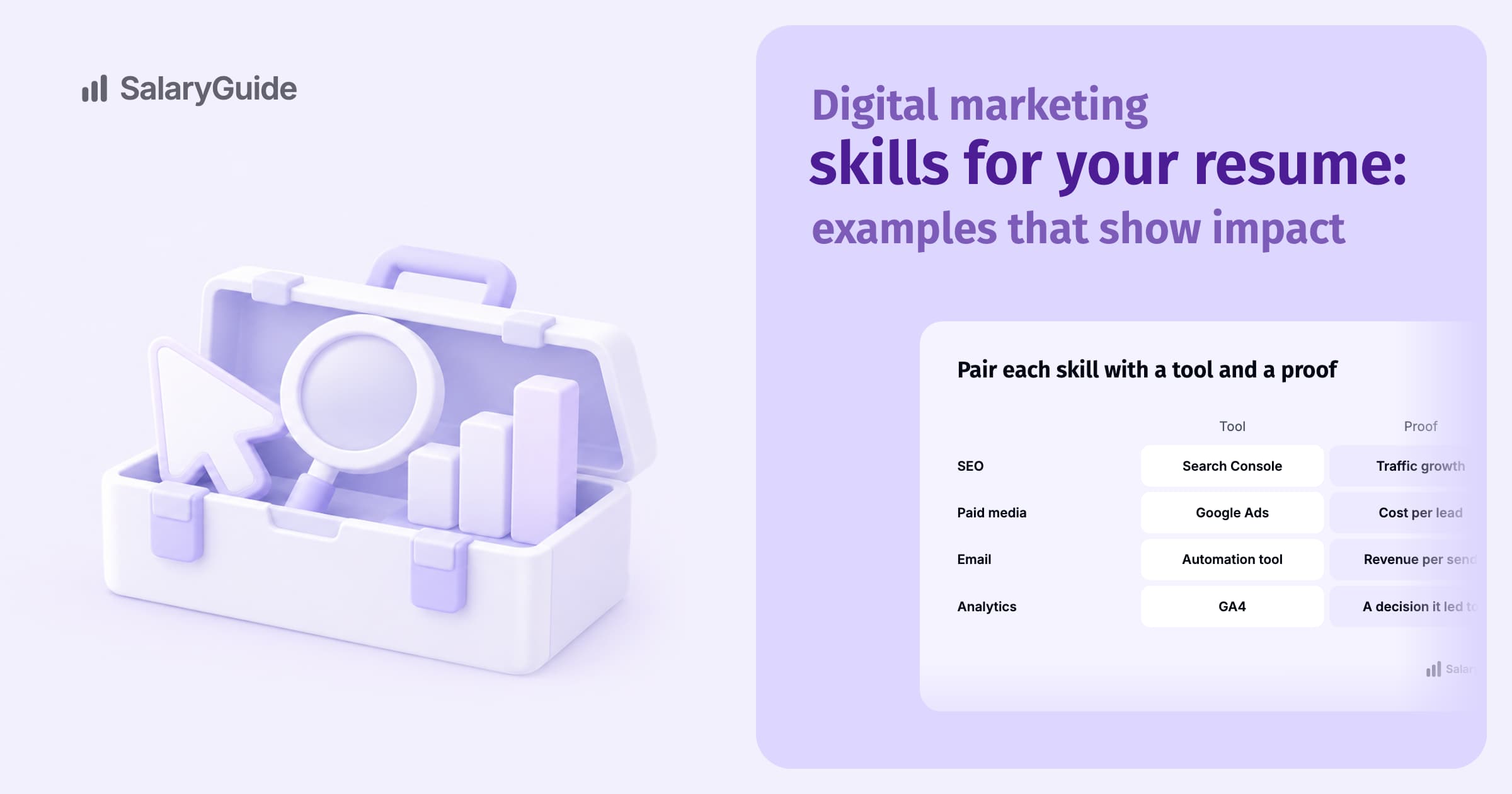
The stronger approach is to connect each skill to evidence: what you worked on, what you owned and what changed.
For the wider resume structure, use How to Write a Marketing Resume. This page focuses specifically on expressing digital marketing skills credibly.
Start with the job, not a generic skills list
Read the job description and identify the capabilities that appear central to the role.
Group them into:
- channel skills;
- analytics and measurement;
- tools and platforms;
- commercial skills;
- communication and collaboration.
Then choose the skills you can actually support with evidence.
Do not add a platform simply because it appears in the job description if you have never used it.
SEO
Weak:
SEO, keyword research, on-page optimization
Stronger:
Researched search demand and optimized landing-page content for a product category, improving non-brand organic visibility and supporting the content plan.
Useful evidence can include:
- keyword research;
- technical audits;
- content briefs;
- internal linking;
- on-page optimization;
- reporting;
- measurable traffic or ranking change where defensible.
If SEO is the career direction you want to develop, the SEO specialist career guide can help you identify the broader skill set employers expect.
Paid search and PPC
Weak:
Google Ads
Stronger:
Managed paid-search campaigns across branded and non-brand terms, monitoring spend, conversion quality and search-query performance to improve campaign efficiency.
If you have numbers you can defend, add scale or outcome:
- monthly spend;
- leads generated;
- CPA change;
- ROAS;
- conversion-rate improvement.
Do not claim sole ownership of results produced by a wider team unless that was genuinely your role.
Paid social
Show more than platform familiarity.
Useful evidence may include:
- audience strategy;
- creative testing;
- budget allocation;
- campaign setup;
- lead quality;
- conversion tracking;
- reporting and optimization.
Example:
Built and optimized paid-social tests across three audience segments, using creative and conversion data to reallocate spend toward the strongest-performing combinations.
Content marketing
Weak:
Content creation
Stronger:
Planned and produced content around defined audience problems, coordinating briefs, SEO requirements and distribution across organic search, email and social.
Depending on your experience, show:
- research;
- strategy;
- briefs;
- editing;
- distribution;
- performance analysis;
- conversion or pipeline contribution.
Social media
Avoid reducing social media to posting.
Evidence may include:
- channel strategy;
- content planning;
- community management;
- creator partnerships;
- social listening;
- paid amplification;
- reporting.
Example:
Managed the monthly content calendar across LinkedIn and Instagram, coordinating creative production and reporting on reach, engagement and traffic to inform the next content cycle.
Email and lifecycle marketing
Useful evidence includes:
- campaign planning;
- segmentation;
- lifecycle journeys;
- lead nurture;
- testing;
- deliverability awareness;
- conversion analysis.
Example:
Built segmented onboarding emails for new users and tested message sequence and timing against activation behavior.
CRM and marketing automation
Do not simply list HubSpot, Salesforce or another platform.
Explain how you used the system.
Examples:
- lead routing;
- campaign tracking;
- lifecycle stages;
- segmentation;
- workflow automation;
- reporting;
- database hygiene;
- sales handoff.
Example:
Built CRM workflows to route inbound leads by segment and standardized campaign fields so Marketing and Sales could report from the same definitions.
Analytics and reporting
A strong analytics bullet shows the decision that came from the data.
Weak:
Google Analytics, dashboards, reporting
Stronger:
Analyzed acquisition and conversion data to identify a high-traffic landing page with weak conversion, then worked with the web team on a revised page and measurement plan.
Useful skills might include:
- GA4;
- spreadsheets;
- dashboards;
- SQL where relevant;
- experimentation;
- funnel analysis;
- attribution;
- forecasting.
Conversion rate optimization and experimentation
If you have experimentation experience, describe:
- hypothesis;
- page or journey tested;
- success metric;
- result;
- next decision.
Example:
Designed landing-page tests around form length and proof points, using conversion rate and lead-quality feedback to choose the next iteration.
Marketing technology
Tool knowledge matters most when it supports a process.
Instead of:
MarTech: HubSpot, GA4, Looker Studio, WordPress, Zapier
show where appropriate:
Connected campaign, CRM and website reporting across HubSpot, GA4 and Looker Studio to reduce manual weekly reporting.
Do not force every tool into achievement bullets. A concise tools section can still be useful once the main experience section proves how you work.
Commercial and cross-functional skills
Digital marketing roles increasingly require skills that do not belong to one channel.
Examples include:
- prioritization;
- budget management;
- forecasting;
- stakeholder management;
- sales alignment;
- customer research;
- briefing creative teams;
- working with developers;
- vendor or agency management.
These are often better demonstrated through experience bullets than placed in a generic “soft skills” list.
Use evidence that matches your career stage
Student or graduate
Evidence can come from:
- university projects;
- student societies;
- volunteer work;
- personal websites;
- freelance projects;
- internships.
Use the dedicated marketing resume with no experience guide for structure and examples.
Early-career marketer
Show ownership of specific tasks, channels and projects. Add scale where you can do so accurately.
Manager
Shift the emphasis toward decisions, prioritization, budget, team coordination and business outcomes.
Senior leader
The resume should increasingly show portfolio decisions, organizational influence, commercial impact and team development rather than a long list of platforms.
A useful formula for marketing resume bullets
Try:
Action + scope + decision or method + evidence
Examples:
Audited 120 high-intent landing pages and prioritized technical and content changes with the SEO and engineering teams, improving coverage of key product topics.
Managed a six-figure annual paid-media budget across search and social, reallocating spend based on marginal acquisition cost and lead quality.
Built a lifecycle reporting dashboard that combined campaign and CRM data, giving Sales and Marketing one weekly view of qualified pipeline.
Use numbers only when they are real and you can explain them.
Where should skills appear on the resume?
Use three places:
- Experience bullets: the strongest proof.
- Projects or portfolio: especially useful earlier in your career.
- Skills/tools section: a concise scan-friendly summary.
Do not rely on the skills section to carry the whole application.
Final skills checklist
Before sending the resume, ask:
- Does every important skill match the role I am targeting?
- Can I explain how I used each skill?
- Have I shown evidence rather than only labels?
- Are important tools attached to real work where possible?
- Are metrics accurate and defensible?
- Have I removed skills I could not discuss confidently in an interview?
If you need more evidence rather than better wording, use the 90-day digital marketing learning roadmap or build a practical marketing portfolio.
A strong skills section helps the reader scan. Strong experience bullets prove the skill is real.