SEO Specialist Job Requirements Your Guide to Getting Hired

At its heart, the job of an SEO specialist is a fascinating mix of technical know-how, sharp content strategy, data-driven analysis, and clear communication. Think of them as the architect of a website's online visibility, carefully designing every page so it’s not only found by search engines but also resonates with real people. This role goes way beyond just stuffing keywords into a page; it's about crafting a smooth, intuitive journey from a search query all the way to a conversion.
What an SEO Specialist Actually Does

An SEO specialist is like a translator between a website and a search engine. Their main job is to structure and optimize a site’s content so that search engines like Google can perfectly understand and index it, ultimately showing it to the right people at the right time. They don't just organize information; they dig deep to figure out what users are searching for and then strategically place the website’s content to meet that need head-on.
This work is a constant blend of art and science. The "science" is all the technical stuff—improving site speed, fixing crawl errors, and making sure the website's architecture is sound. The "art" is where human insight comes in: understanding the nuances of user intent, working with content creators to make something truly compelling, and building genuine relationships to earn high-quality backlinks.
Four Pillars of SEO Expertise
The responsibilities of an SEO specialist really boil down to four foundational pillars. While each pillar represents a unique set of skills, they are all deeply connected. True success in SEO comes from mastering all four, as they work together to drive organic growth and hit business targets.
An effective SEO specialist moves beyond surface-level tactics. They combine deep keyword research, thorough technical audits, and quality link building with continuous performance analysis. This is how you turn raw data into real, measurable gains in traffic and leads.
Because the digital marketing world is always in motion, the demands of the job are constantly evolving. Today, employers expect any serious candidate to have a firm grasp of both on-page and off-page SEO. On top of that, strong analytical skills are a must-have, as specialists need to interpret data to refine strategies and then clearly communicate their plans and results to the rest of the team.
One of the most crucial tasks they handle is performing comprehensive website audits to pinpoint exactly where the opportunities for improvement lie.
To give you a clearer picture, we can group the core competencies into a simple framework.
Core Competencies for an SEO Specialist
This table breaks down the four key areas of expertise and the main responsibilities that fall under each one.
| Skill Category | Key Responsibilities and Requirements |
|---|---|
| Technical SEO | Conducting site audits, improving page speed, ensuring mobile-friendliness, and implementing schema markup. |
| Content & Strategy | Performing keyword research, planning content calendars, optimizing on-page elements, and aligning content with user intent. |
| Analytics & Reporting | Tracking organic traffic, monitoring keyword rankings, analyzing user behavior, and creating performance reports. |
| Soft Skills | Communicating complex ideas, collaborating with cross-functional teams, adapting to algorithm changes, and problem-solving. |
As you can see, the role is incredibly multifaceted, requiring someone who can think both creatively and analytically to navigate the complexities of search.
The Technical and Analytical Skillset

If your SEO strategy is the road map, then your technical skills are the engine that actually gets you to your destination. This is where theory meets practice. An SEO specialist has to roll up their sleeves and apply a specific set of hard skills to get a website ranking higher.
These aren't just nice-to-haves; they are the absolute bedrock of a career in SEO.
Think of it like this: A website is a massive library. Your job is to make sure every single book (or webpage) is properly cataloged, easy for people to find, and sitting on the right shelf. If you don't handle this foundational work, even the most brilliant content will just gather dust, totally invisible to both search engines and your audience.
This is the core of the seo specialist job requirements. It all comes down to knowing which levers to pull to make a site more attractive to Google's crawlers while also making it genuinely useful for people.
Mastering On-Page and Off-Page Optimization
The first layer of hands-on expertise is a solid grasp of on-page and off-page SEO. These two sides of the same coin work together to build a website's authority and relevance in the eyes of search engines.
On-page SEO covers everything you have direct control over on your website. We're talking about crafting title tags that are impossible not to click, writing meta descriptions that pull people in, and structuring your content with a logical flow of headers (H1s, H2s, etc.). It also means optimizing your images with descriptive alt text and building a smart internal linking structure that guides visitors and search bots seamlessly through your site.
On the flip side, off-page SEO involves all the actions you take outside of your website to boost your rankings. The biggest piece of this puzzle is link building—getting other reputable sites to link back to yours. Every one of those backlinks is like a vote of confidence, signaling to Google that your content is valuable and trustworthy.
Here’s what that looks like in the real world:
- Keyword Research: This is ground zero for any SEO effort. It’s not just about finding popular terms; it’s about understanding the intent behind the search. A true pro knows how to conduct keyword research like an expert to uncover the hidden gems.
- Content Optimization: You’ll work closely with writers to make sure blog posts, landing pages, and product descriptions are all perfectly aligned with target keywords and what the user is actually looking for.
- Link Building Outreach: This involves finding relevant websites and running smart outreach campaigns to earn those powerful backlinks that move the needle on your site's authority.
Diving Deep into Technical Site Health
Beyond just the content, a great SEO specialist is also a bit of a website mechanic. You have to be able to pop the hood, diagnose what's wrong, and fix the technical issues that hold a site back. Technical SEO is all about making sure a website is fast, secure, and a breeze for search engines to crawl and index.
A slow or broken site is a deal-breaker for both users and Google. In fact, just a one-second delay in page load time can cause a 7% reduction in conversions. That’s real money lost, which is why technical skills are non-negotiable.
Key technical responsibilities you'll own:
- Improving Site Speed: This means compressing images, minifying code, and using browser caching to make pages load in a snap.
- Ensuring Mobile-Friendliness: Over half of all web traffic now comes from mobile devices, so a responsive, mobile-first design isn't optional.
- Implementing Schema Markup: You'll add structured data to help search engines understand your content on a deeper level, which can lead to getting those eye-catching rich snippets in the search results.
- Managing Crawlability and Indexability: This involves using tools like your
robots.txtfile and XML sitemaps to give search engine bots a clear map of your site.
The best SEO specialists don’t just know what technical issues to fix; they understand why those fixes matter for user experience and the business’s bottom line. They connect a technical flaw, like a slow page, to a business problem, like lost revenue.
Turning Data into Action with Analytics
Finally, a top-tier SEO specialist has to be a data geek at heart. It’s not about staring at pretty dashboards; it's about digging into the numbers to find the story they're telling. The data helps you diagnose problems, spot trends, and uncover huge opportunities for growth.
Tools like Google Analytics 4 (GA4) and Google Search Console are your mission control. They give you the raw data on organic traffic, keyword rankings, click-through rates, and how people are behaving on your site. Being able to navigate these platforms and pull out real, actionable insights is what separates the pros from the amateurs.
From this data, an SEO specialist can see that Organic Search is the top-performing channel, signaling that their current strategies are effective and should be scaled. To expand your capabilities further, check out our guide on essential marketing skills to learn for career growth.
Getting Your Hands Dirty: The Modern SEO Toolkit
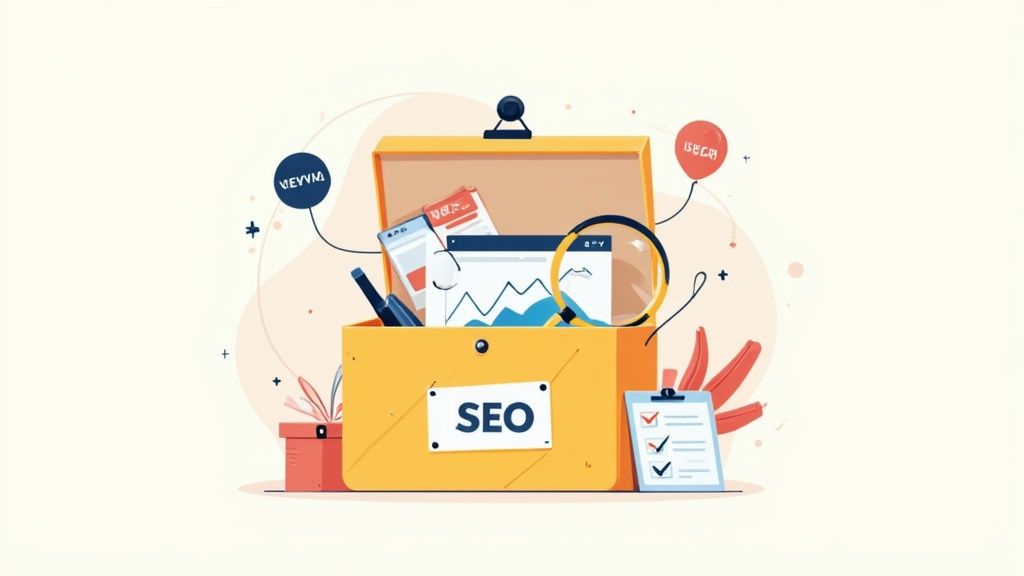
Let's be real: an SEO specialist is only as good as the tools they wield. Think of it like a master mechanic—they need more than just a single wrench to do the job right. In our world, a whole suite of specialized software is required to diagnose website issues, build winning strategies, and prove our work is actually working. Knowing your way around this digital toolbox is a non-negotiable part of the SEO specialist job requirements.
These platforms are far more than just fancy add-ons; they are the command center for any serious SEO campaign. They're where we get the hard data for keyword research, spy on competitors, run technical audits, and manage backlinks. Without them, you’re basically just guessing, and guesswork doesn't get you to the top of Google.
All-In-One SEO Platforms
These are the Swiss Army knives of the SEO world. They pack a massive range of features into one place, covering nearly everything you need to run a campaign, from the initial brainstorming sessions to tracking results month after month. For most of us, they're where we spend a good chunk of our day.
The two giants in this space are undoubtedly Semrush and Ahrefs. These platforms are treasure troves of data. You can uncover keyword search volumes, see a competitor's entire backlink profile, find gaps in your content strategy, and keep a close eye on your rankings over time.
A classic move is to plug a competitor's domain into one of these tools to see their top-performing pages. By analyzing what content earns them the most traffic and links, you can figure out their secret sauce and then create something even better to win over a piece of their audience.
This dashboard from Ahrefs gives you a quick, at-a-glance view of a site's overall SEO health.
It highlights key metrics like Domain Rating (DR), the number of websites linking to you, and estimated organic traffic, making it easy to spot trends and potential issues right away.
Specialized Technical SEO Tools
While the all-in-one platforms are fantastic, sometimes you need to pop the hood and get a closer look at the engine. That’s where specialized technical tools, like crawlers and log file analyzers, come in. They’re the magnifying glass and the fine-toothed comb in your toolkit, built for deep, surgical analysis.
The undisputed champion here is Screaming Frog SEO Spider. It’s a desktop program that crawls a website exactly like a search engine would, following every link and inspecting every page. It’s brilliant for uncovering technical gremlins that could be holding a site back.
With a crawler like Screaming Frog, you can tackle critical tasks:
- Find Broken Links: Hunt down every last 404 error that frustrates users and wastes Google's time.
- Analyze Page Titles and Meta Data: Instantly see which pages have missing, duplicate, or clunky meta tags across an entire site.
- Generate XML Sitemaps: Create a perfect roadmap for search engines to ensure they don't miss any important pages.
- Audit Redirects: Make sure all your 301 and 302 redirects are set up correctly so you don't lose valuable link equity.
The Rise of AI and Automation in SEO
The tool landscape isn't static; it’s evolving fast, and AI is at the forefront of that change. Skills like AI-assisted content creation and sophisticated data analysis are popping up more and more in job descriptions. In fact, our research found that mentions of AI-related skills in SEO job listings grew by 21% over the past year. This shows a clear shift toward smarter, more automated workflows in our field. You can learn more about how AI is shaping the industry and see the full research behind these job trends.
Soft Skills That Define Elite SEO Professionals
Technical SEO knowledge will get you in the door, but it won't make you a top performer. What really separates a good SEO specialist from a great one? It almost always comes down to soft skills—the human element that transforms a solid strategy into a game-changing business win.
These are the skills that build bridges between departments, solve complex mysteries, and keep you sane in an industry that’s always in flux.
Think of it like being a detective. Your SEO tools and audits are your clues, but it's your critical thinking that connects the dots. Imagine a site's rankings suddenly tank, but there are no obvious technical red flags. This is where the real work begins.
You have to start asking deeper questions. Did a competitor just roll out a massive new content hub? Did a small UI change completely torpedo user engagement? Maybe a quiet algorithm update just changed the rules of the game for your niche. Without sharp problem-solving skills, you're just a data reporter, not a strategist who can uncover the root cause.
The Art of Communication and Collaboration
Being the smartest SEO in the room is useless if you can't get anyone to listen. SEO is a team sport, not a solo mission. You’re constantly working with developers, content writers, product managers, and C-suite executives—and they all speak different professional languages.
Your ability to translate a complex technical issue—like crawl budget waste from faceted navigation—into a clear business case for a developer is a superpower. It’s the skill that moves recommendations from a spreadsheet into a live production environment.
Solid communication is absolutely crucial for:
- Educating Stakeholders: You have to explain why a seemingly minor tweak to the site's URL structure is vital for long-term organic growth.
- Building Consensus: It’s on you to get content and design teams aligned on creating pages that are beautiful for users and perfect for search engines.
- Reporting on Impact: You need to present performance data in a way that resonates with leadership, clearly connecting your SEO wins to revenue and business goals.
Adaptability in an Ever-Changing Field
The only thing you can count on in SEO is change. Google pushes out thousands of updates to its algorithm every single year. The tactic that was gold six months ago might be completely useless today. This reality makes adaptability one of the most vital seo specialist job requirements.
A top-tier SEO professional doesn't just react to these shifts; they see them coming. They have an insatiable curiosity, are always learning, and aren't afraid to test new ideas. When a core update rocks the SERPs, they don't panic. They dig into the data, see what the industry experts are saying, and calmly adjust their strategy.
This kind of resilience and forward-thinking is what separates a short-term plan from a sustainable, long-term strategy built to last.
Mapping Your SEO Career Path
https://www.youtube.com/embed/THn_CsWq3J8
The title "SEO Specialist" isn't a single, fixed role. It's more like a career ladder, where your responsibilities, strategic input, and of course, your paycheck, grow as you gain real-world experience. Getting a handle on this progression is the first step in charting your own course from an entry-level doer to a strategic leader.
Think of it like moving up in a professional kitchen. A junior cook meticulously follows the recipes. The sous chef starts to refine those recipes and manages their own section of the line. The head chef? They're the one designing the entire menu, shaping the restaurant's identity. Each level builds on the last, demanding more skill, foresight, and a much bigger sense of ownership.
Junior SEO Specialist: Laying The Foundation
A Junior SEO Specialist is all about execution. With 0-2 years of experience, your world revolves around learning the ropes and getting your hands dirty with the fundamental tasks that make an SEO campaign tick. The main goal is to support the team by putting strategies (developed by more senior folks) into action.
The day-to-day is very hands-on and task-driven, and you'll be building the essential groundwork that bigger wins are built upon.
Your core responsibilities will look something like this:
- Keyword Research: Helping to uncover keyword opportunities and putting together target lists.
- On-Page Optimization: Making direct changes to title tags, meta descriptions, and header tags.
- Basic Reporting: Pulling raw data from tools like Google Analytics to create initial performance reports.
- Link Building Support: Assisting with outreach campaigns and keeping track of newly acquired backlinks.
At this stage, you're focused on the "how" and "what" of SEO, not necessarily the strategic "why." You’re building the muscle memory you'll need for the rest of your career.
Mid-Level SEO Specialist: Taking Strategic Ownership
As a Mid-Level SEO Specialist, typically with 2-5 years of experience, you start to shift from pure execution to genuine strategic involvement. You're not just implementing tasks anymore; you're starting to own entire campaigns and have a real say in the overall strategy. You're the one in the data, figuring out what’s working and what isn’t, and making informed recommendations to steer the ship.
This is the most common role you'll find out in the wild. In fact, mid-level positions make up a whopping 59% of all SEO job listings, making it a crucial and highly sought-after stage in your career. For a closer look at what you can expect to earn here, our detailed breakdown of SEO salaries offers some great benchmarks.
At the mid-level, you are no longer just following a recipe; you are starting to create your own. You're expected to diagnose why a campaign is underperforming and propose a data-backed solution to fix it.
Your duties will expand to include:
- Campaign Management: Overseeing specific SEO projects from kickoff to completion.
- Content Strategy: Working alongside content teams to plan and optimize new articles and landing pages.
- Technical Audits: Firing up tools like Screaming Frog to run site crawls, spot technical issues, and prioritize fixes.
- Deeper Analytics: Going beyond simple reports to analyze trends, connect the dots, and deliver actionable insights.
Senior SEO Specialist: Becoming A Visionary Leader
The Senior SEO Specialist or SEO Manager operates at a much higher strategic altitude, usually with 5+ years of experience under their belt. This role is far less about the daily to-do list and much more about owning the entire organic search channel. They are responsible for setting the long-term vision, mentoring junior team members, and ensuring SEO goals are perfectly aligned with the company's bottom line.
A senior specialist is expected to have a deep understanding of the competitive landscape, anticipate Google's next move, and clearly communicate the business impact of SEO to the C-suite. They think in terms of market share, revenue, and ROI. This jump in responsibility comes with a significant pay bump, as a growing 12% of senior SEO roles now command salaries over $100,000.
The soft skills—like communication, critical thinking, and adaptability—are what truly set senior professionals apart.
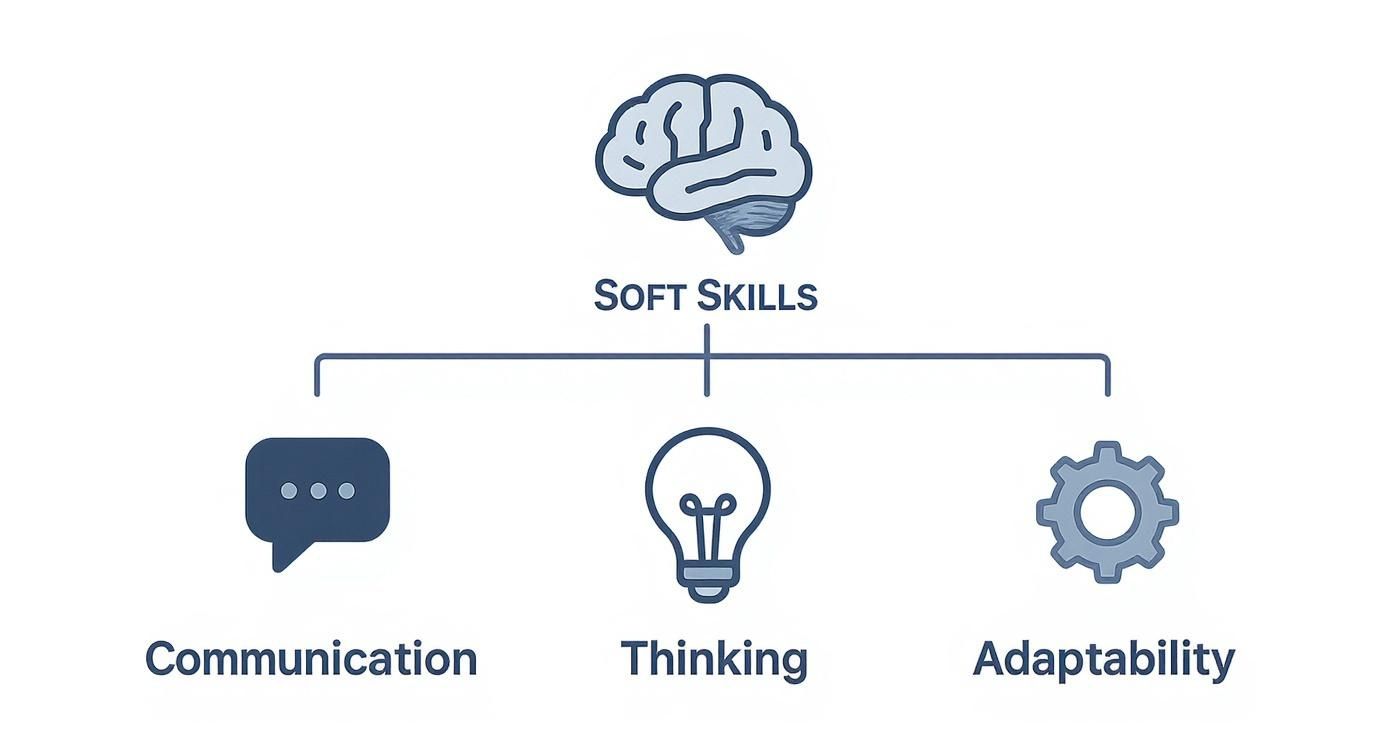
While your technical skills get you in the door, it's these high-level soft skills that ultimately allow a senior specialist to lead teams effectively and drive massive business growth.
SEO Specialist Career Progression
To put it all together, here’s a quick overview of how the requirements, responsibilities, and salary expectations evolve as you advance in your SEO career.
| Career Level | Typical Experience | Key Responsibilities | Average Salary Range (US) |
|---|---|---|---|
| Junior SEO Specialist | 0-2 Years | Task execution, keyword research, on-page implementation, basic reporting. | $45,000 - $65,000 |
| Mid-Level SEO Specialist | 2-5 Years | Campaign management, content strategy, technical audits, in-depth analysis. | $65,000 - $90,000 |
| Senior SEO Specialist/Manager | 5+ Years | Long-term strategy, team leadership, budget management, C-suite reporting. | $90,000 - $130,000+ |
This table provides a clear roadmap, showing that as you take on more strategic responsibility and demonstrate a greater impact on business goals, your compensation and role will grow accordingly. It's a journey from learning the rules to rewriting them.
How to Build Your SEO Experience and Credentials
Knowing the theory behind SEO is a great start, but getting hired comes down to proving you can actually do the job. The best way to stand out in a crowded field is by building a track record of hands-on experience and tangible credentials. It’s what shows a hiring manager you’re not just knowledgeable—you can deliver real results.
And the field is definitely growing. Between January 2016 and January 2023, global searches for “SEO jobs” shot up by a staggering 311%. In that same window, searches for “SEO courses” exploded by 654%. This tells us one thing loud and clear: more people are trying to break into SEO, making it more important than ever to prove your skills.
Formal Education vs. Practical Certifications
Do you need a marketing degree to get into SEO? Honestly, not really. While a formal education can lay a good groundwork, many of the most talented SEOs I’ve met are self-taught or transitioned from completely different careers.
These days, practical certifications from industry-recognized platforms often carry more weight. They’re a clear signal to employers that you know how to use the specific tools of the trade.
To beef up your resume, look into credentials from trusted sources:
- Google Skillshop: Getting certified in Google Analytics and Google Ads is non-negotiable. It proves you can understand and work with data, which is at the heart of SEO.
- HubSpot Academy: They offer a fantastic range of free courses that cover everything from inbound marketing and content strategy to core SEO principles.
- Semrush Academy: These courses dive deep into their powerful toolkit, showing you can handle advanced keyword research and tear apart a competitor's strategy.
Gaining Hands-On Experience
Certificates are great, but they're no substitute for a portfolio packed with successful projects. Real-world experience is the ultimate credential, and you don’t need to wait for a full-time job to start getting it. This is where the theoretical stuff you learned finally clicks into place.
The most compelling resume isn't just a list of skills; it's a collection of stories. Each project you complete, whether for yourself or a client, becomes a case study that proves your ability to drive organic growth.
The best way to start is by creating your own proof of work. Fire up a personal blog about a niche you love—this is your laboratory to experiment with content, keywords, and on-page optimization. You could also offer your SEO services to local small businesses, helping them with their local listings or running a basic technical audit.
This kind of practical application doesn't just sharpen your skills; it gives you measurable results and success stories to talk about in interviews. Learning how to build a marketing portfolio is the final, crucial step to package up all that great work and present it effectively.
Your Top Questions About SEO Jobs, Answered
When you’re trying to break into SEO or climb the ladder, a few big questions always seem to pop up. It’s easy to get conflicting advice, so let's cut through the noise and get you some straight answers.
Do I Really Need a College Degree for an SEO Job?
Short answer: Nope. While a degree in marketing or communications looks nice on a resume, it's almost never a dealbreaker. I've worked with incredible SEOs who came from backgrounds in history, teaching, and even hospitality.
What hiring managers really care about is what you can do. Can you get results? That’s the golden question. A portfolio is your best friend here. Show them a personal blog you ranked, a freelance project where you boosted traffic, or even a detailed case study of a site you optimized.
Real-world results will always speak louder than a diploma. Proving you can rank a page is far more impressive than listing a relevant college course.
How Much Coding Do I Actually Need to Know?
You definitely don't need to be a developer, so don't sweat it. But you absolutely need to speak their language. A solid grasp of basic HTML and CSS is non-negotiable for any serious SEO specialist.
Think of it like this:
- HTML: This is your key to understanding and tweaking the core building blocks of a page—things like title tags, headers (H1s, H2s), and meta descriptions.
- CSS: Knowing the basics helps you understand how a site is styled, which can flag issues with user experience or even slow load times.
- JavaScript: You don’t need to write it, but you should understand how it works. Knowing how dynamic content gets rendered is crucial for troubleshooting why Google might not be seeing certain parts of a page.
This foundational tech literacy is a cornerstone of modern SEO specialist job requirements. It’s what separates the pros from the amateurs.
What’s the Real Deal with SEO Salaries?
Money talk. SEO salaries can be all over the map, depending heavily on your experience, where you live, and whether you're at an agency, in-house, or flying solo as a freelancer. The good news is, the growth potential is fantastic.
Typically, someone just starting out can expect to land in the $45,000 to $65,000 range. Once you have a few years under your belt and can prove your worth, that number climbs to $65,000 to $90,000. For senior-level pros and managers steering the ship, salaries often shoot well past the $100,000 mark.
Your income potential is tied directly to the value you bring. The better you get at connecting your SEO work to real business growth—more traffic, more leads, more sales—the more you'll earn. It’s as simple as that.
At SalaryGuide, we pull back the curtain on compensation so you can negotiate with confidence. Explore real salary data and find your next opportunity on SalaryGuide.com.
