How to Improve Marketing ROI and Prove Your Value
If you want to improve your marketing ROI, there's a simple, non-negotiable rule you have to live by: you can't improve what you don't accurately measure. This is about moving past vanity metrics and building a bulletproof tracking system that ties every marketing dollar you spend to a real business outcome.
Building a Foundation for Accurate ROI Measurement
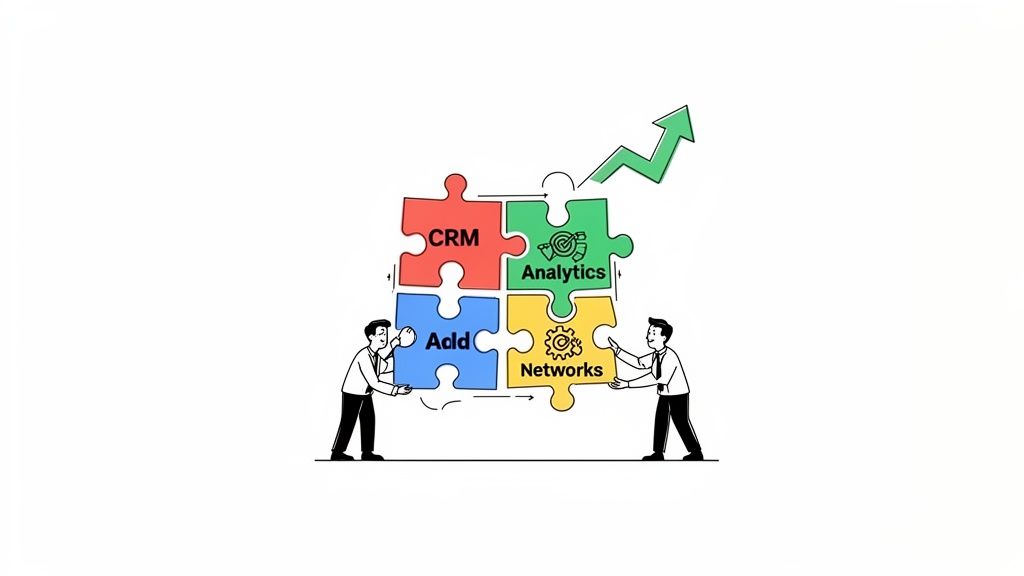
You wouldn't build a house on a shaky foundation, right? The same goes for your marketing strategy. Before you can start shifting budgets or tweaking campaigns with any real confidence, you need a single source of truth for all your data. This means getting your key platforms—your CRM, your analytics tools, your ad networks—to actually talk to each other.
Without that unified view, you're flying blind. You’re just guessing which of your efforts are actually driving growth and which are just noise.
The big goal here is to finally break free from the limitations of last-click attribution. That old model gives 100% of the credit to whatever a customer did right before converting, which is simple but dangerously misleading. It almost always undervalues the hard work you do at the top of the funnel to build brand and trust.
Think about it: a potential customer might read three of your blog posts and see a LinkedIn ad over a few weeks before they finally type your name into Google and click a search ad to buy. Last-click gives all the glory to that search ad, completely ignoring the entire journey that made it possible.
This is the basic flow for getting your measurement system in order.
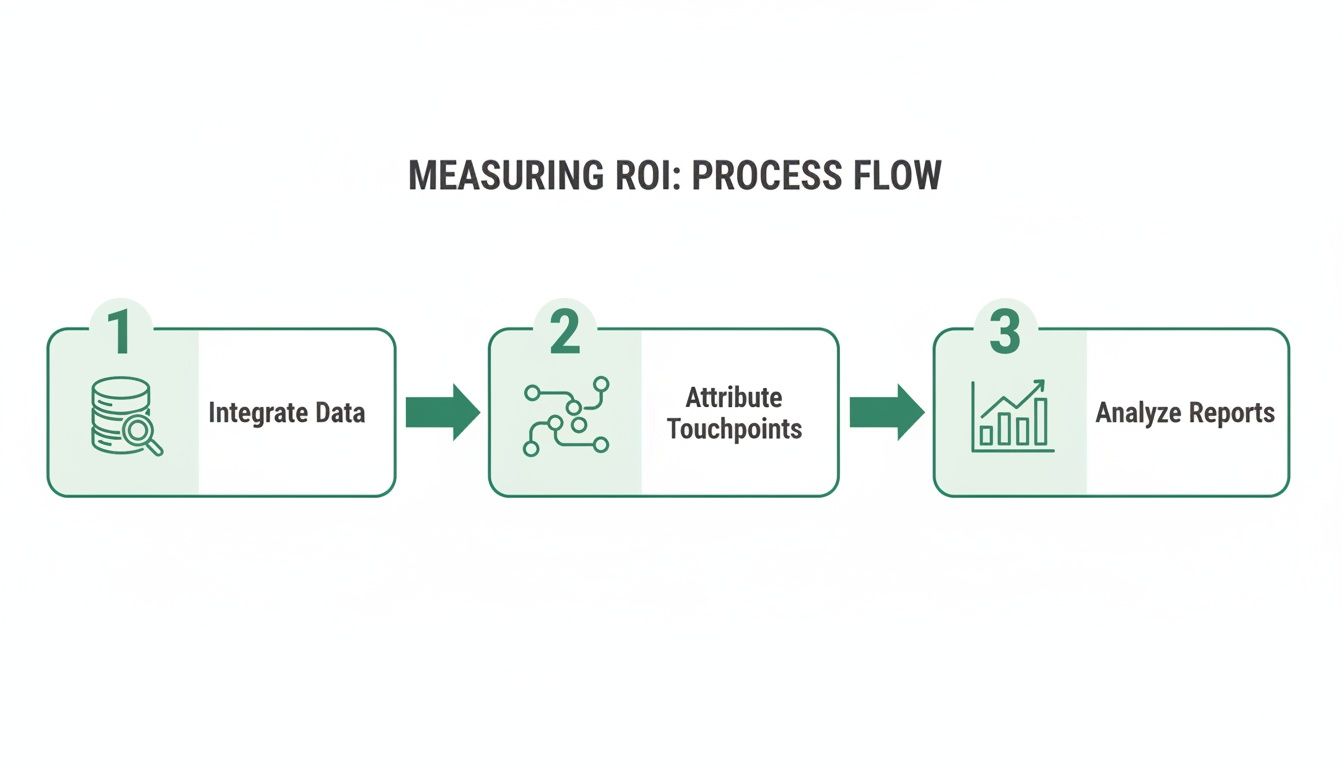
As you can see, you can't get to the analysis part until you’ve integrated your data and figured out how to assign credit to your touchpoints.
Why Multi-Touch Attribution Is Non-Negotiable
This is where multi-touch attribution comes in. It’s the solution. This approach intelligently distributes credit across the many touchpoints in a customer's journey, giving you a much more realistic picture of what's actually working. Once you see which channels assist in conversions, you can finally justify those long-term investments in content marketing, SEO, and social media.
In fact, switching to data-driven attribution models can boost marketing ROI by 15-20%. When companies ditch last-click, they often discover the hidden value of top-funnel content that was previously ignored. It's no wonder that historically, only 36% of marketing leaders could accurately measure ROI, even though 83% said it was a top priority. That disconnect leads directly to wasted budget.
The core challenge isn't a lack of data; it's a lack of connection. When your analytics platform, ad accounts, and sales CRM operate in silos, the customer's journey is fractured. You see isolated events, not the complete story that led to a sale.
Creating Your Single Source of Truth
To get started, map out your entire martech stack. Pinpoint where customer data is being collected at every single stage of the funnel. The whole point is to make sure data flows seamlessly between all these systems. A great, practical first step is to get religious about using UTM parameters consistently across every campaign. This is ground zero for tracking sources effectively in your analytics.
Next, you absolutely have to integrate your CRM with your marketing platforms. This connection is what links your marketing spend directly to sales outcomes. Once it's done, you can answer the questions that really matter:
- Which ad campaign generated the most qualified leads this quarter?
- What's the average lifetime value of customers who come from organic search?
- How many touchpoints does an enterprise customer typically have before they sign a contract?
I’ve seen a lot of different attribution models in my time, and choosing the right one depends heavily on your business model and sales cycle.
Comparing Attribution Models for Modern Marketers
This table breaks down the most common attribution models to help you understand where they shine and where they fall short.
| Attribution Model | How It Works | Best For | Potential Pitfall |
|---|---|---|---|
| Last-Click | 100% of credit goes to the final touchpoint before conversion. | Short sales cycles, direct-response campaigns. | Ignores all top-of-funnel and mid-funnel marketing efforts. |
| First-Click | 100% of credit goes to the very first touchpoint a user interacts with. | Brands focused on demand generation and awareness. | Undervalues channels that close deals and nurture leads. |
| Linear | Credit is split evenly across all touchpoints in the journey. | Giving all channels some recognition as part of the process. | Treats all touchpoints as equally important, which is rarely true. |
| Time Decay | Touchpoints closer to the conversion get more credit. | Longer B2B sales cycles where recent interactions are key. | Can still undervalue initial awareness-building touchpoints. |
| Data-Driven | Uses machine learning to assign credit based on actual impact. | Mature marketing teams with high data volume. | Can be a "black box" and requires significant conversion data. |
Ultimately, moving to any multi-touch model is a massive step up from the default last-click view that most platforms provide.
A critical first step in this entire process is setting up a clear methodology. You can get a solid primer by exploring frameworks for measuring content marketing ROI. This foundational work sets the stage for every optimization you’ll make down the road.
Once you have reliable, integrated data, you can stop making reactive adjustments and start making proactive, strategic decisions. This is also where you can find major efficiencies. You can learn more about how to streamline your processes with marketing workflow automation.
Benchmarking Performance and Setting Realistic Goals
Now that you have reliable tracking in place, you can finally get an honest look at your marketing performance. This is your "before" photo—the critical snapshot that makes every improvement you make from here on out both measurable and meaningful. You have to know where you stand today to prove the value of your optimizations tomorrow.
The first move is a deep dive into your existing channels. Pull all that data into one place and start crunching the numbers that actually define the health of your marketing engine. We’re not talking about vanity metrics like impressions or clicks; we're talking about unit economics.
The two metrics that matter most are your Customer Acquisition Cost (CAC) and Customer Lifetime Value (LTV). Everything else flows from these.
Calculating Your Core ROI Metrics
Your CAC is simply what it costs you, on average, to win a new customer from a specific channel. To get this number, just divide your total channel spend (don't forget tools and relevant salaries!) by the number of new customers you got from that channel over a certain period.
On the other side of the coin, LTV represents the total revenue you can reasonably expect from a single customer during their entire relationship with your business. The calculation can get complicated, but a straightforward version is (Average Purchase Value) x (Average Purchase Frequency) x (Average Customer Lifespan).
A healthy LTV:CAC ratio is generally considered to be 3:1 or higher. If you're at 1:1, you’re just breaking even. Anything less, and you're actively losing money on each new customer. This ratio is the clearest signal of your marketing efficiency and the foundation for improving your ROI.
One of the biggest mistakes I see is marketers calculating a single, blended CAC for the whole business. The real insights come from breaking this down by channel. Your CAC from paid search might be $150, while a customer from an organic blog post costs just $30. That's where you find the gold.
Identifying Your Winners and Losers
Once you have a clear CAC and LTV for each channel, the picture becomes incredibly clear. Your winners and losers will practically jump off the page. I always recommend mapping this out in a simple table.
| Marketing Channel | Total Spend (Q1) | New Customers | CAC | LTV | LTV:CAC Ratio |
|---|---|---|---|---|---|
| Google Ads | $15,000 | 100 | $150 | $400 | 2.7:1 |
| SEO/Content | $8,000 | 250 | $32 | $550 | 17:1 |
| LinkedIn Ads | $12,000 | 40 | $300 | $1,200 | 4:1 |
| Facebook Ads | $10,000 | 200 | $50 | $100 | 2:1 |
Looking at this, it's a no-brainer. SEO and LinkedIn Ads are knocking it out of the park. Meanwhile, Facebook Ads are barely washing their own face and need some serious attention—or a budget cut. This kind of data-driven view strips emotion and "gut feelings" out of your strategic planning.
Setting Goals That Are Actually Based on Data
With this baseline firmly established, you can finally set goals that are both realistic and achievable. Forget vague targets like "increase ROI." It's time to get specific.
- Objective 1: Cut our Facebook Ads CAC from $50 down to $35 this quarter by testing new creative and lookalike audiences.
- Objective 2: Boost new customers from SEO by 20% by building out our highest-performing content clusters.
- Objective 3: Hold the 4:1 LTV:CAC ratio on LinkedIn Ads steady while we try to scale the spend by 15%.
These aren't just goals; they're a battle plan. They are specific, measurable, and directly tied to improving your bottom line. This initial benchmark gives you a clear starting line, transforming your marketing from a collection of random tactics into a focused, growth-driving machine.
Finding the Right Channel Mix for Sustainable Growth
After benchmarking your performance, you can clearly see which channels are your heavy hitters and which ones are just draining your budget. But improving marketing ROI isn't as simple as cutting the losers and pouring more money into the winners. The real goal is to strike a balance between short-term wins and long-term, sustainable growth.
It’s easy to fall into the trap of dumping every available dollar into performance channels like paid search advertising. The instant gratification is addictive—you spend money today and see leads or sales roll in tomorrow. The problem is, this approach often leads to a plateau. Your growth becomes entirely dependent on ad spend, and you're not building any real brand equity.
Sustainable growth demands a more thoughtful approach. It’s about building a marketing engine that doesn't just capture existing demand but actively creates new demand for the future.
The Myth of Brand vs. Performance
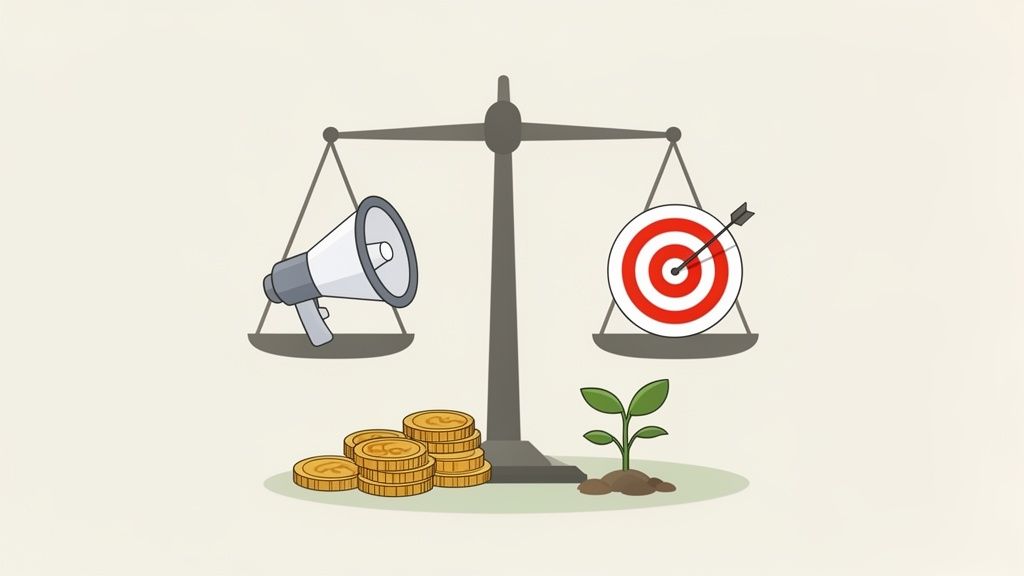
The classic marketing debate pits brand against performance, but the most successful strategies don't treat them as enemies. Think of them as two essential parts of a single, powerful engine. Performance marketing is your accelerator; it drives immediate action. Brand marketing is your fuel tank; it ensures you have a loyal audience to draw from for years to come.
For example, a B2B company might run highly targeted LinkedIn ads to drive demo requests (performance). At the same time, they could publish an in-depth industry report that cements their reputation as a thought leader (brand). The ads deliver immediate leads, but that report builds trust and attracts organic traffic long after the ad campaigns end.
A purely performance-driven strategy is like constantly harvesting without ever planting new seeds. Eventually, you run out of crops. A blended strategy ensures you're always cultivating future demand while reaping the benefits of today's opportunities.
This isn't just a gut feeling; the data backs it up. Research shows that allocating 50-60% of your budget to brand-building and 40-50% to performance tactics can unlock a hidden 50% in your marketing ROI. This is a game-changer for teams over-indexed on paid search. Just look at Domino’s—their overall ROI jumped by 45% after they started running brand awareness campaigns on YouTube alongside their performance ads. Other studies confirm that even a tiny 1% lift in brand awareness can drive significant sales growth, both now and in the future. You can dig into more of this research on Google's hub for unlocking hidden marketing ROI.
Auditing and Rebalancing Your Budget
So, how do you find this balance? Start by auditing where your money is actually going. You need to categorize every single dollar into either a "brand" or "performance" bucket.
Performance Marketing: This is anything with a direct, measurable conversion goal. Think paid search campaigns, retargeting ads, and bottom-of-funnel email promotions.
Brand Marketing: These are your top-of-funnel activities designed to build awareness, trust, and affinity. This includes organic social media, SEO-driven content, public relations, and community building.
Once you have this breakdown, compare it to that ideal 60/40 brand-to-performance split. Are you lopsided? Most companies I've worked with are shocked to find just how dramatically they're under-investing in their brand.
A Practical Reallocation Scenario
Let's walk through an example. Imagine a SaaS company spending 90% of its $50,000 monthly budget on Google Ads and just 10% on content. Their ROI is okay, but growth has flatlined and their cost-per-acquisition is slowly creeping up. They're stuck on the performance treadmill.
To get off it and build a foundation for long-term ROI, they could reallocate their budget like this:
| Current Allocation (90/10 Split) | Proposed Allocation (60/40 Split) |
|---|---|
| Google Ads: $45,000 (90%) | Google Ads & LinkedIn Ads: $30,000 (60%) |
| Content Creation: $5,000 (10%) | Content & Distribution: $20,000 (40%) |
This isn't just about moving numbers around in a spreadsheet. It's a fundamental shift in their growth strategy.
With the new budget, they can now:
- Maintain Performance: Keep a strong presence on high-intent channels like Google Ads.
- Build the Brand: Seriously invest in creating pillar content, case studies, and webinars that attract their ideal audience organically.
- Create Synergy: Use that new content to fuel their social media channels and email newsletters, creating a cohesive brand experience that nurtures leads over time.
This rebalancing act creates a much more resilient marketing ecosystem. You reduce your dependency on any single channel and build a moat of brand loyalty that competitors can't just buy their way through. It's a strategic move away from simply renting traffic to actually earning an audience—and that's the ultimate path to sustainable, high-ROI growth.
Finding Your Wins: How to Run High-Impact Experiments
Alright, you've got your benchmarks and you've shuffled the budget around. Now for the fun part. Improving your marketing ROI isn't about finding a single silver bullet; it's a constant process of discovery. You have to be willing to roll up your sleeves and test your way to better returns.
This is where we move from educated guesses to a disciplined system of learning. We're going to design small, controlled tests around the three main levers you can pull: your creative, your audience targeting, and how you bid. It's the small, consistent wins from these experiments that compound over time and really move the needle on your overall marketing efficiency.
Every good experiment I've ever run started with a clear, testable question, not just a random idea.
Designing Experiments That Actually Teach You Something
A solid hypothesis is everything. It's a simple statement spelling out what you're changing, who it's for, and what you expect to happen. Without one, you’re just throwing spaghetti at the wall.
A great hypothesis usually follows this framework: "If we [make this specific change], then [this specific audience] will [do this expected thing] because [this is our reasoning]."
Let's look at a real-world example:
- A weak idea: "Let's try a new headline for our Google Ads." (This tells you nothing.)
- A strong hypothesis: "If we change our Google Ads headline to focus on '24/7 Support' instead of 'Affordable Pricing,' then marketing managers searching for our solution will click through at a higher rate because our customer interviews show support is their biggest pain point."
See the difference? This structure forces you to justify why you think a change will work, which is where the real learning happens.
Your marketing data can tell you what is happening. A well-designed experiment is the only way to prove why it's happening. It turns correlation into causation and gives you a repeatable playbook for success.
Testing Your Creative and Messaging
Your ad copy, images, and CTAs are the easiest and often most impactful things you can test. I've seen tiny tweaks here lead to massive swings in click-through and conversion rates.
My advice? Start with your highest-traffic ads that have the lowest performance. They represent the biggest opportunity for a quick win.
Here are a few ideas to get you started:
- Headlines: Pit a benefit-driven headline ("Save 10 Hours a Week") against a feature-driven one ("Advanced Automation Tools").
- Images and Video: Test a clean product shot against a lifestyle photo showing a happy customer. For video, try a snappy 15-second cut against a more detailed 30-second version.
- Call-to-Action (CTA): Simply changing "Learn More" to "Get Your Free Demo" can completely change the intent and quality of the leads you get.
I once worked with a SaaS company that saw a 30% drop in their cost-per-lead overnight. The only thing they did was A/B test their landing page headline to better match the ad that brought the visitor. That simple alignment made the user experience feel seamless and instantly boosted their campaign ROI.
Optimizing Your Audience and Bidding
Beyond the creative, you need to experiment with who you're showing your ads to and how you're paying to reach them. This is where you can uncover some serious efficiency gains.
Who Are You Talking To? Platforms like LinkedIn or Facebook have incredibly powerful targeting tools. Don't just set them and forget them.
- Lookalike Audiences: Are you building lookalikes from all your recent converters? Try testing an audience built from only your top 1% of customers by LTV. The quality can be night and day.
- Interest vs. Job Title: On LinkedIn, for example, you could test an audience of users with the job title "Marketing Director" against an audience of users in the "Digital Marketing" interest group.
- Exclusion Lists: This is key. Keep refining your audience by excluding irrelevant job titles, industries, or demographics to stop wasting money.
How Are You Paying? Most ad platforms now push automated bidding strategies, and for good reason—they can work wonders for your ROI when used correctly.
| Bidding Strategy | What It Does | Best For |
|---|---|---|
| Manual CPC | You set the maximum bid for each click. | Maximum control, but very time-consuming. |
| Maximize Conversions | The platform automatically sets bids to get the most conversions within your budget. | Campaigns with enough conversion data to learn from. |
| Target CPA | You set a target cost-per-acquisition, and the platform adjusts bids to hit it. | Stabilizing lead costs and locking in your ROI. |
The best way to test this is to duplicate an existing campaign and change only the bidding strategy. Let it run for at least two to four weeks to give the algorithm enough data to work with. The results will almost always point you toward a clear path for getting more conversions for the same (or even less) ad spend. This iterative process is how you take your ROI from good to great.
Improving Your Funnel and Scaling What Works
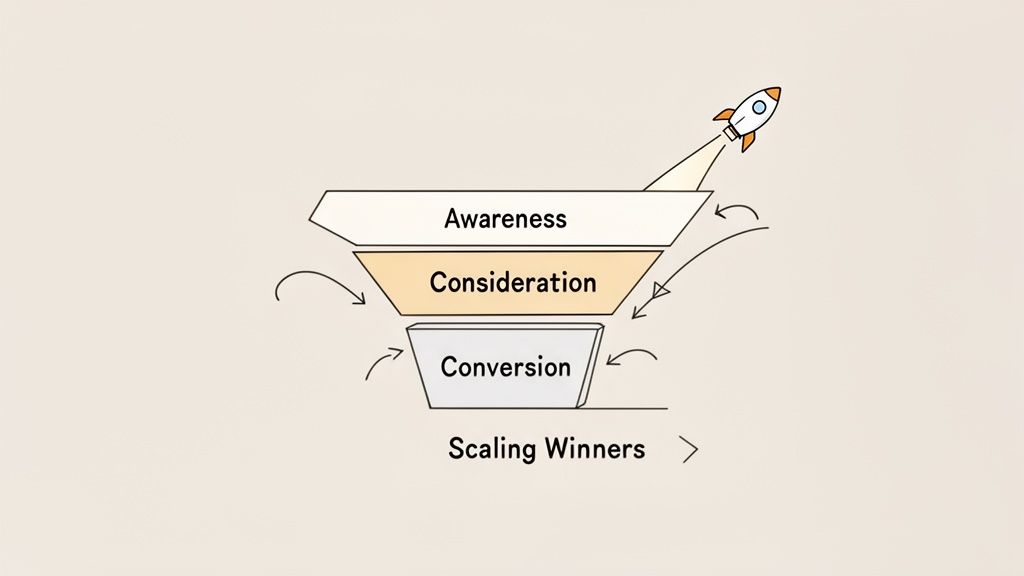
Getting traffic to your site is a hard-won victory, but it's really only half the battle. If those visitors don't convert, your marketing ROI will always be stuck in first gear. This is where the focus shifts from acquisition to optimization—turning the funnel you already have into a powerful growth engine.
Once you’ve identified what’s working from your experiments, the real magic begins. By sharpening every step of the customer journey, from the landing page to the final thank you, you can dramatically increase the value of every single visitor. Then, and only then, is it time to scale.
From Leaky Bucket to Well-Oiled Machine
Think of your conversion funnel like a plumbing system. If it’s full of leaks—confusing messaging, a clunky checkout, slow-loading pages—you'll lose valuable leads no matter how much traffic you pour in at the top. Fixing those leaks is the entire point of conversion rate optimization (CRO).
Start by walking through your own funnel like you’re a brand-new customer. Seriously, try to buy something or sign up. Where does it feel clunky? What questions pop into your head? Even tiny improvements here can have an outsized impact. For instance, one study found that better user experiences and AI-powered tools could shorten customer journeys by over 30%, getting people to convert faster.
So many marketers get obsessed with pouring more traffic into the top of the funnel. The biggest ROI gains are almost always hiding in the funnel you already have. Fixing a conversion issue is cheaper than buying more ads, and the results last forever.
Good CRO isn’t about massive, expensive redesigns. It's about small, targeted tweaks backed by data. Here are a few high-impact areas to look at first:
- Landing Page Congruence: Does the headline on your landing page perfectly match the ad someone just clicked? Any disconnect here is a surefire way to make them hit the back button.
- Simplify Your Forms: Do you really need to ask for a prospect's phone number and company size on the very first touchpoint? Every field you can cut from a form is likely to boost your completion rate.
- Social Proof and Trust Signals: Sprinkle in testimonials, customer logos, and security badges right next to your "Buy Now" or "Sign Up" buttons. These little signals build a ton of confidence at that critical moment of decision.
Scaling the Winners Strategically
After you've plugged the leaks in your funnel and have some validated experiments, you’ve finally earned the right to scale. This isn't about blindly cranking up your budget across the board. It's a calculated move to pour fuel on the fire you've already started.
Go back to that channel performance analysis you did earlier. Your data will point directly to the campaigns, audiences, and creative that are delivering the best LTV:CAC ratio. These are your golden geese.
Scaling is more than just upping the daily ad spend. To see how this fits into a broader strategy, check out our guide on what revenue marketing is and how it all connects to driving predictable, scalable growth.
A Practical Framework for Reallocating Your Budget
Let's say your experiments proved that a LinkedIn ad campaign targeting "Marketing Directors" with a specific case study video is absolutely crushing it, delivering a 5:1 LTV:CAC ratio. Meanwhile, your general brand awareness campaign on Facebook is barely breaking even with a 1.5:1 ratio.
Here’s how you’d strategically shift your budget:
- Cut the Underperformers: Don’t hesitate. Pause or drastically cut the budget for that low-performing Facebook campaign. You aren't abandoning the channel forever, just stopping the financial bleed from an inefficient tactic.
- Feed the Winner: Start incrementally increasing the daily spend on your high-performing LinkedIn campaign by 15-20% at a time. Keep a close eye on your CPA and lead quality to make sure performance holds as you scale up.
- Clone Your Success: Don't just add more money; expand the winning formula. Create a new lookalike audience based on the "Marketing Directors" who already converted. Test that winning case study video on other B2B-friendly platforms. See if the magic is repeatable.
- Automate and Systematize: Once a strategy is proven and scaled, let the machines take over. Use platform tools like Performance Max or automated bidding rules to manage it efficiently. This lets the algorithm optimize for conversions 24/7, freeing you up to go find the next big win.
Following this methodical process ensures that your ROI improvements aren't just a one-time fluke. It turns optimization from a project into a process—a sustainable cycle of testing, learning, and scaling that constantly pushes your returns higher.
Answering Your Top Questions About Marketing ROI
Even with a solid framework in hand, getting into the weeds of marketing return on investment always brings up a few tricky questions. This is where the theory meets reality. We’ve compiled answers to the most common hurdles and points of confusion that come up in the field. Think of this as your go-to reference when you're trying to make sense of the numbers.
What Is a Good Marketing ROI?
This is the million-dollar question, and the only honest answer is: it depends. There’s no universal "good" ROI. The right number for your business is completely contextual and shifts based on your industry, business model, and especially your profit margins.
As a general rule of thumb, many marketers aim for a 5:1 ratio—that’s $5 in revenue for every $1 spent. Anything hitting 10:1 is typically considered exceptional. But context is everything. A SaaS company with fat margins might be thrilled with a 4:1 return, while a low-margin ecommerce store might need that 10:1 ratio just to stay profitable.
Ultimately, the most important benchmark is your own past performance. The real goal is to consistently improve upon your baseline.
How Do I Calculate ROI for Long-Term Plays Like SEO?
Measuring the return on channels like SEO or content marketing can feel like trying to nail Jell-O to a wall. The results aren't immediate. A blog post you publish today might not rank or drive meaningful traffic for six months, but it could continue delivering value for years with almost no additional cost.
The trick is to shift your focus to its long-term impact on core business metrics. Here’s how you can do it:
- Attribute Conversions: Use your analytics to see how many leads or sales come from organic search traffic landing on your content.
- Estimate Traffic Value: A great way to frame this is to calculate what that same volume of traffic would have cost you if you’d paid for it through Google Ads.
- Track Assisted Conversions: Don't forget to look at customer journeys where your organic content was a touchpoint, even if it wasn't the final click that led to the sale.
It requires patience, for sure. But the ROI on these channels often dwarfs paid media over the long haul because you're building a lasting asset, not just renting an audience.
Many marketers grapple with demonstrating value, and finding effective strategies that actually work to improve marketing ROI is a common challenge. For long-term channels, the solution is shifting the conversation from immediate returns to the cumulative value of the marketing assets you are building.
Should I Stop Using a Channel with Negative ROI?
Hold on a second. Before you hit the kill switch, you have to figure out why the ROI is in the red. A poor return is often just a symptom of a deeper problem, and cutting the channel might mean you're walking away from a massive opportunity.
Ask these questions first:
- Is it a top-of-funnel channel? A channel built for brand awareness might look terrible on a last-click ROI report, but it could be doing the heavy lifting to assist conversions down the line. Check your multi-touch attribution model.
- Have we really optimized it? Is the channel itself the problem, or is it bad creative, sloppy targeting, or a clunky landing page experience? Be honest.
- Does it reach a unique audience? Sometimes, a "poorly performing" channel is the only realistic way to get in front of a niche, high-value customer segment.
If you’ve tested everything, optimized until you're blue in the face, and the channel still isn’t performing or helping other channels, then it's time to reallocate that budget.
At SalaryGuide, we believe that understanding your value—and proving it—is the key to a successful marketing career. Our platform provides the salary insights, career tools, and relevant job opportunities to help you take the next step with confidence. Explore real marketing salaries and find your next role on SalaryGuide.
