What Is Paid Search Advertising The Ultimate Guide for Marketers
Paid search advertising is pretty straightforward at its core: you pay to place your ads on search engine results pages. You've probably heard it called pay-per-click (PPC), which gets right to the point—you only shell out cash when someone actually clicks your ad. This makes it an incredibly direct way to get in front of people who are actively searching for what you sell.
The Foundations of Paid Search Advertising
Think of it like this: search engines are a massive, bustling marketplace, and millions of people are walking through every minute, shouting out exactly what they're looking for. Paid search lets you set up a stall right at the main entrance, perfectly positioned to catch the eye of your ideal customer. It all runs on a lightning-fast auction system where you bid on specific keywords to show your ads to the right people at the right time.
This isn't just about throwing an ad onto a page. It's about tapping directly into a user's intent at the very moment they express it. When someone types "best running shoes for trails" into Google, an auction happens in the blink of an eye. Companies are all bidding for that top ad spot, but it's not just about who pays the most. The winner is the one with the most relevant ad and landing page experience.
Why Paid Search Matters for Marketers
For any serious marketing pro today, getting a handle on paid search is a must. It delivers traffic and visibility almost instantly, which is a huge advantage over the slow-and-steady build of organic SEO. You can see a direct, measurable impact on the bottom line. It's no wonder it's become the biggest piece of the digital ad pie, pulling in nearly 40% of global ad spend. In 2024 alone, companies poured $190.5 billion into search ads, and that number is only going up.
Success in paid search boils down to a few key ingredients working in harmony:
- Keywords: These are the search terms you're bidding on—the language your customers use.
- Ad Copy: The actual text of your ad. It has to be compelling enough to earn the click.
- Bidding: Your strategy for how much you're willing to pay for each click.
- Quality Score: This is Google's (or Bing's) report card on your ads, keywords, and landing pages. A good score can actually lower your costs.
To get the full picture, it helps to understand how paid search fits into the larger world of What Is Search Engine Marketing, which covers both the paid and organic sides of search. A career in paid media is not just in high demand; it's also a great way to build a lucrative skillset. You can see how these skills stack up by checking out the typical https://salaryguide.com/blog/seo-specialist-job-requirements and compensation ranges.
Paid search advertising is the art and science of intercepting demand. You're not creating desire; you're meeting it head-on with a solution, which is why it converts so effectively.
Here’s a quick breakdown of the core concepts to get you started.
Paid Search Advertising at a Glance
This table provides a quick summary of the fundamental concepts of paid search advertising, breaking down its key components for easy understanding.
| Component | What It Is | Why It Matters for Marketers |
|---|---|---|
| Keywords | The specific words or phrases users type into search engines that you bid on. | This is the foundation of targeting, connecting your ad directly to a user's stated need or question. |
| Ad Auction | A real-time auction that determines which ads are shown and in what order. | Winning auctions means gaining visibility at the top of search results, putting your brand front and center. |
| Ad Rank | A formula (Max Bid x Quality Score) that determines your ad's position. | It proves that a higher budget isn't everything; relevance and quality can lower costs and improve placement. |
| Pay-Per-Click (PPC) | The model where you pay the search engine only when a user clicks your ad. | This creates a direct link between your ad spend and user engagement, ensuring your budget is spent on interested traffic. |
Understanding these four pillars is the first step toward building and managing successful campaigns that deliver real business results.
How the Paid Search Auction Really Works
Every time someone types a query into a search engine, a lightning-fast auction takes place behind the scenes. Forget stuffy auction houses with gavels; this is a complex, automated battle that decides which ads appear, and in what order, all in the blink of an eye. To really get paid search, you have to understand how this digital marketplace functions.
It all starts with the searcher's intent, captured in their search query. That query is the starting gun, triggering an auction among every advertiser bidding on keywords related to it. It’s a classic misconception that the advertiser willing to pay the most automatically wins the top spot. While budget certainly matters, the system is fundamentally designed to reward relevance.
This simple flow breaks down what happens every single time an ad is served.
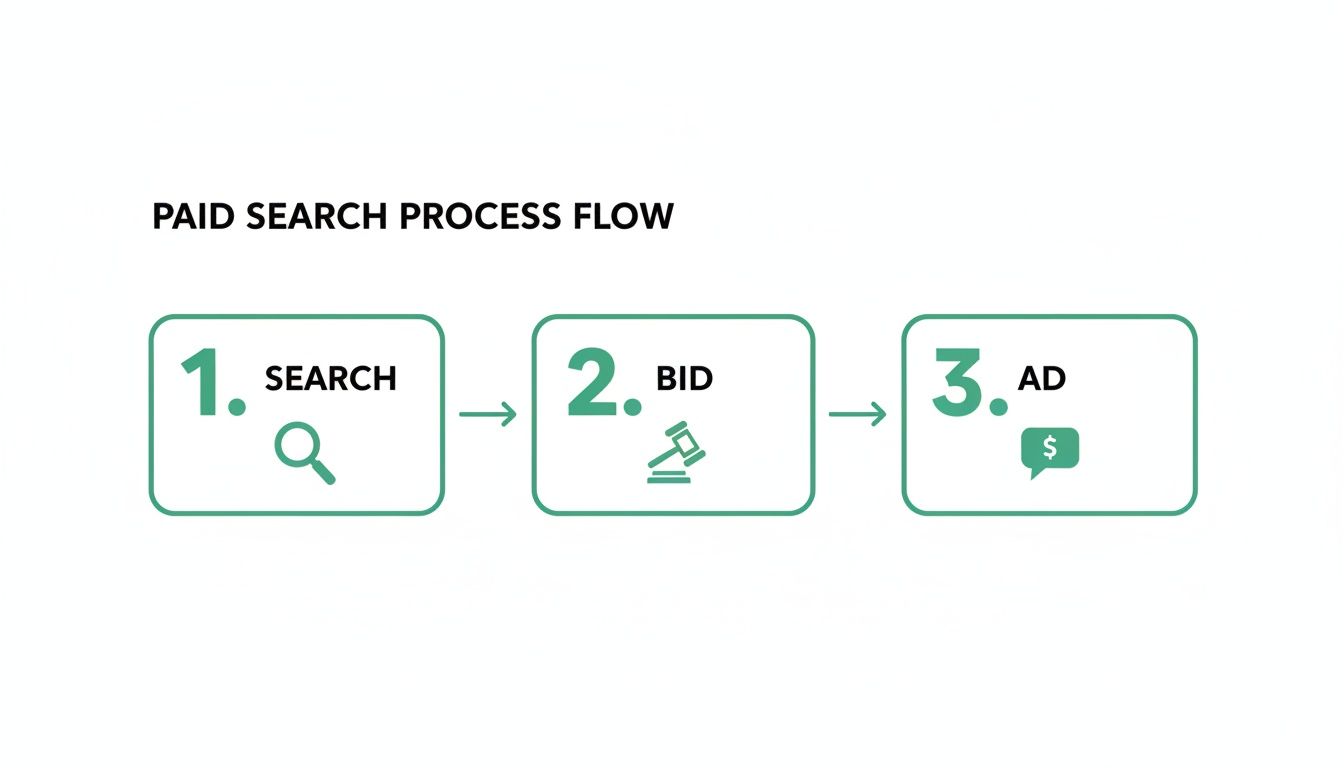
As you can see, the user's search kicks off the bidding contest, which instantly determines the final ad placement. This entire process unfolds in milliseconds.
The Role of Keywords and Match Types
Keywords are the absolute backbone of any paid search campaign. Think of them as the bridge connecting what a person is searching for with the ads you've created. Picking the right keywords is half the battle; the other half is controlling how closely a search has to match your keyword to trigger your ad. This is where keyword match types come in.
You'll work with three main match types:
- Broad Match: This gives the search engine the most leeway. Your ad can appear for searches related to your keyword, including synonyms, misspellings, and related concepts. If you bid on women's hats, your ad might show up for "buy ladies hats" or even "winter headwear for women."
- Phrase Match: This option gives you a nice balance of reach and control. Your ad shows for searches that include the meaning of your keyword. Words can appear before or after your phrase, but the core intent must be the same. For example, "running shoes" could match searches like "best shoes for running" or "buy running shoes online."
- Exact Match: This is your most restrictive, laser-focused option. Your ad will only show for searches that share the exact same meaning or intent as your keyword. For instance,
[men's formal shoes]would match a search for "formal shoes for men" but not "men's boots."
Getting your match type strategy right is crucial for managing your budget. Broad match can pull in a ton of traffic, but you risk paying for irrelevant clicks. Exact match delivers highly relevant traffic, but you might miss out on a wider audience.
Decoding Ad Rank and Quality Score
So, if the highest bidder doesn't always win, what actually determines who gets the top ad spot? The answer is Ad Rank, a score that search engines calculate to decide your ad's position.
Ad Rank isn't just about your bid. It's a calculation that multiplies your maximum bid by your Quality Score, proving that relevance is just as valuable as cash.
The formula is pretty simple:
Ad Rank = Maximum Cost-Per-Click (CPC) Bid x Quality Score
Your Maximum CPC Bid is the most you're willing to pay for a single click. But the real secret weapon here is your Quality Score. This is a diagnostic score from 1 to 10 that estimates the quality of your ads, keywords, and landing page. A high Quality Score can land you a better ad position for a lower cost.
Search engines like Google calculate Quality Score using three main ingredients:
- Expected Click-Through Rate (CTR): How likely is someone to click your ad when it's shown?
- Ad Relevance: Does your ad copy make sense for the keyword it's tied to?
- Landing Page Experience: Once someone clicks, does the page they land on deliver? Is it relevant, trustworthy, and easy to use?
At the end of the day, a high Quality Score tells the search engine that you're providing a great experience for its users. This focus on user satisfaction is precisely why an advertiser with a killer Quality Score can outrank a competitor with a much bigger budget.
Exploring the Major Paid Search Platforms
When people hear "paid search," their minds usually jump straight to Google. And while Google is the undisputed giant, a truly savvy marketer knows that putting all your eggs in one basket is a risky play. Looking beyond the biggest name on the block lets you tap into different audiences, often with less competition and at a lower cost.
Let's take a look at the main players you need to know.
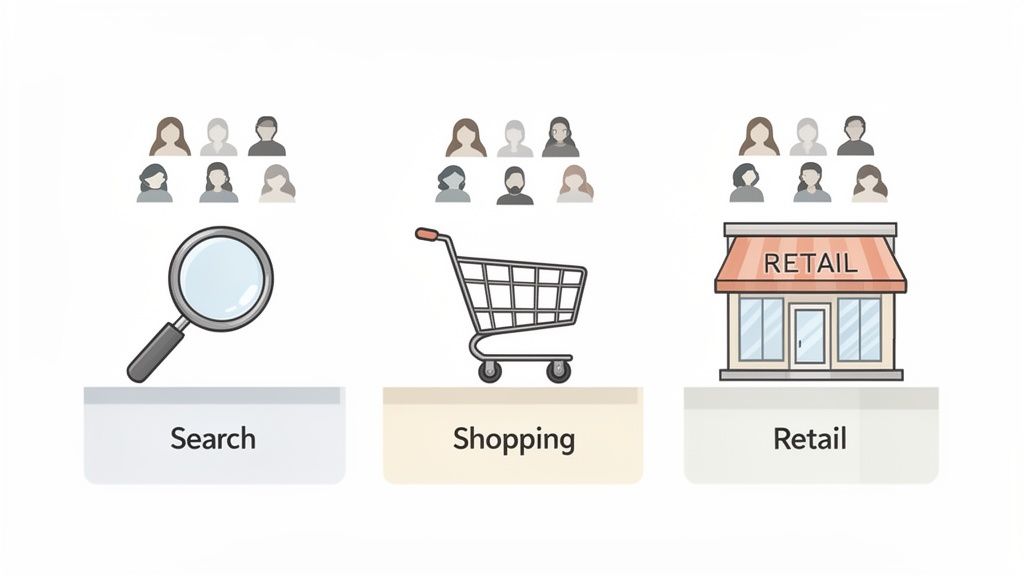
Each platform has its own unique flavor and strengths. The right mix for you will always come down to your specific business goals, what you're selling, and who you're trying to sell it to.
The Undisputed Leader: Google Ads
You can't talk about paid search without starting with Google Ads. It's the titan of the industry, and for one simple reason: volume. Processing over 3.5 billion searches every single day, its reach is simply staggering. For the vast majority of businesses, Google Ads isn't just an option; it's the foundation of their entire paid search strategy.
What makes it so powerful is its incredible versatility. Google has built a sophisticated suite of tools and campaign types to help you hit just about any marketing goal you can dream up.
- Search Campaigns: This is the bread and butter of paid search. Classic text ads that pop up on the results page, perfectly positioned to capture people who are actively searching for what you offer.
- Shopping Campaigns: An absolute game-changer for e-commerce. These are the visual ads showing your product image, price, and brand right in the search results. They create a frictionless path from search to purchase.
- Performance Max: This is Google’s AI-driven, "all-in-one" campaign. You give it your goals, and it automates ad creation and delivery across all of Google's properties—Search, YouTube, Display, Gmail, you name it—to hunt down conversions wherever they might be hiding.
Of course, with great power comes great competition. Bidding on popular keywords can get pricey, but the sheer size of the audience and the depth of its targeting tools make Google Ads an essential part of the toolkit.
The Strategic Alternative: Microsoft Advertising
Too many marketers sleep on Microsoft Advertising (which you might remember as Bing Ads). That's a mistake. This platform is a powerful, strategic tool that gets your ads onto the Microsoft Search Network, covering Bing, Yahoo, and AOL.
While it doesn't have Google's massive market share, Microsoft Advertising has some serious advantages. For starters, its audience often skews a bit older and tends to have more disposable income—a goldmine for businesses with higher-priced products or services.
The secret weapon of Microsoft Advertising is its potential for a higher ROI. It's common for advertisers to see lower competition, which means a lower average cost-per-click (CPC) and, ultimately, a more efficient cost-per-acquisition (CPA).
Think of it this way: Microsoft Advertising isn't just a "smaller Google." It's your ticket to a different, highly qualified audience that your competitors are likely ignoring.
Specialized Platforms for Niche Goals
Beyond the big two search engines, a new breed of platform has emerged, built for very specific user intents—especially when it comes to shopping.
Amazon Advertising is a non-negotiable for any brand that sells on Amazon. It lets you run sponsored product ads right inside Amazon's own search results, catching shoppers at the absolute peak of their buying intent. Think about it: when someone searches on Amazon, they're not just kicking tires. They have their wallet out, ready to buy.
By getting to know the strengths of each platform, you can build a paid media strategy that's far more resilient and profitable. Diversifying your ad spend doesn't just expand your reach; it also protects your business from the inevitable performance swings that happen on any single channel.
Mastering Your Campaign Strategy and Budget
Getting a paid search campaign off the ground is one thing, but making it truly successful? That’s where real strategy comes in. This is the point where you move beyond the technical nuts and bolts and start connecting your advertising budget to actual business goals. A solid strategy is what turns a simple ad spend into a predictable, revenue-driving machine.
It all starts by thinking past keywords. While keywords are the bedrock of any search campaign, the real magic happens when you layer on other targeting options. It’s not enough to have the right message; you have to get that message in front of the right person, in the right place, at precisely the right moment.
Layering Your Targeting for Precision
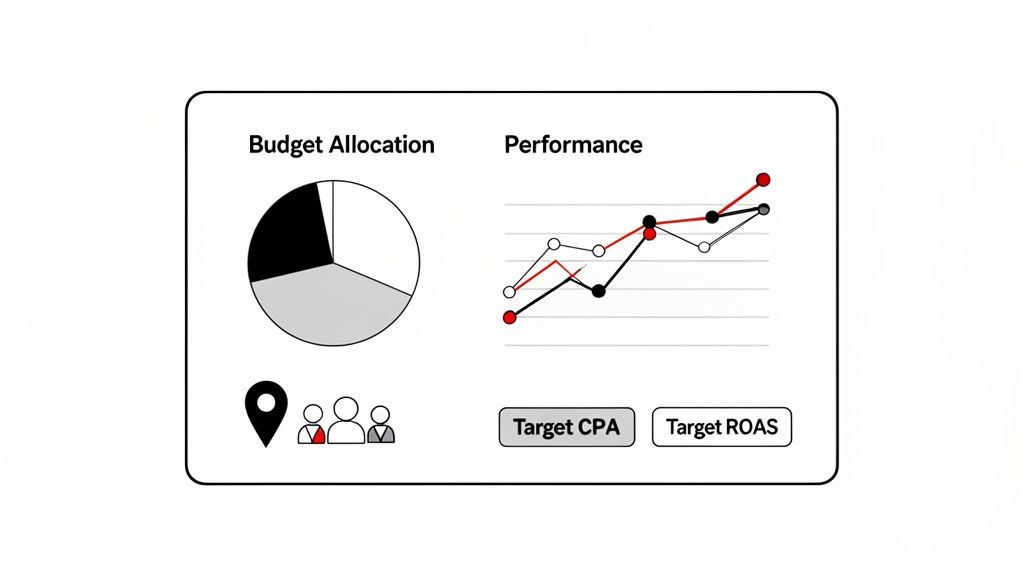
Think of targeting layers as a series of filters. Each one helps you sift through the massive online audience until you’re left with a small, highly motivated group of ideal customers. By combining these filters, you make sure every dollar you spend is aimed at the people most likely to convert.
- Geographic Targeting: This is a no-brainer for both local and global businesses. A neighborhood plumber can target ads to a specific zip code, while a big e-commerce brand can focus its budget on countries where it sees the most sales.
- Demographic Targeting: Platforms like Google Ads let you zero in on specific age ranges, genders, parental status, and even household income brackets. This helps you tailor your ad copy and creative to resonate with a particular group.
- Audience Targeting: This is where you can get really sophisticated. You can target people based on their recent online behavior and interests. This includes powerful tactics like remarketing (showing ads to users who've already visited your website) or targeting in-market segments (people actively researching products just like yours).
When you stack these options, you create a laser-focused campaign. Imagine a luxury travel agency targeting users in a high-income demographic, located in a major city, who are also in the market for "5-star European vacations." That level of precision is exactly what makes paid search so incredibly effective.
Choosing the Right Bidding Strategy
Once you know who you're targeting, you have to decide how you're going to pay for their clicks. Your bidding strategy is what tells the platform how to spend your money in the ad auction, and it needs to be perfectly aligned with your campaign's main objective.
It really boils down to a choice between hands-on control and automated efficiency.
With Manual Bidding, you have complete control. You set the absolute maximum you're willing to pay for a click on each and every keyword. This is a great approach when you're just starting a campaign and need to get a feel for costs without letting an algorithm run wild with your budget.
But as your campaigns grow, automated bidding strategies become your best friend. They use machine learning to optimize your bids for specific goals, which saves a ton of time and often leads to better results.
The real power of paid search emerges when your ads convert intent into action. An often-cited statistic highlights that users clicking on paid search ads are 50% more likely to purchase than visitors from organic links, making it a highly efficient channel for turning searchers into customers.
To make the right choice, you first need to understand what each automated strategy is built to do.
Choosing the Right Bidding Strategy
This table breaks down some of the most common automated bidding strategies available in platforms like Google Ads and Microsoft Advertising. Matching your campaign goal to the right strategy is one of the most important decisions you'll make.
| Bidding Strategy | Primary Goal | Best For |
|---|---|---|
| Maximize Clicks | Drive as much traffic as possible within a set budget. | Brand awareness campaigns or when you need to gather initial traffic data quickly. |
| Target CPA (Cost-Per-Acquisition) | Generate conversions at a specific average cost per conversion. | Lead generation or e-commerce campaigns with a clear, defined cost-per-lead goal. |
| Target ROAS (Return On Ad Spend) | Achieve a specific return for every dollar spent on advertising. | E-commerce businesses focused on profitability, where conversion values vary. |
| Enhanced CPC (eCPC) | Automatically adjusts manual bids up or down based on conversion likelihood. | Marketers who want more control than full automation but still want some algorithmic help. |
Ultimately, your choice here is critical. A campaign designed to generate leads for a sales team will almost certainly perform best using Target CPA. On the other hand, an online retailer with thousands of products will get more value from Target ROAS to ensure profitability.
Getting this right ensures your budget is working as hard as possible to achieve your goals. It's a fundamental part of mastering the essential marketing skills to learn for a successful career in digital advertising.
Navigating Your Paid Search Career Path
Getting good at paid search advertising isn't just another line on your resume—it's a direct ticket to a high-demand marketing career. The skill to turn an ad budget into real, measurable revenue is gold for any business, making paid search pros some of the most valuable players in any industry.
It's a field with a clear, rewarding career path for anyone who enjoys mixing sharp analysis with creative problem-solving. Your journey will likely start with hands-on campaign work and grow into high-level strategy and leadership. Understanding this path helps you see what skills to focus on, what you're worth in the market, and how to plan your next move.
The Typical Paid Search Career Trajectory
The career ladder in paid search is pretty well-defined. You start with the tactical, day-to-day stuff and gradually move toward big-picture strategy. Each step up demands a deeper understanding of the business's goals and a broader skill set that goes way beyond just knowing your way around an ad platform.
Here’s the path many successful professionals take:
PPC Specialist (Entry-Level): This is where it all begins. As a specialist, you live inside the ad accounts. Your days are filled with keyword research, writing ad copy that gets clicks, building out new campaigns, and tweaking bids to hit performance targets. The main goal is solid execution and hitting key metrics like click-through rate (CTR) and cost-per-acquisition (CPA).
Paid Search Manager (Mid-Level): Once you’ve mastered the fundamentals, you're ready for a manager role. Here, your responsibilities get bigger. You’re now in charge of allocating budgets across different campaigns, running A/B tests to find what works, and digging deeper into the performance data. You start thinking more strategically, connecting campaign results to the company's bottom line and explaining what it all means to stakeholders.
Senior PPC Strategist or Director of Paid Media (Senior-Level): At this stage, your focus is almost entirely on high-level strategy and leadership. A director isn't just looking at search ads; they're overseeing the entire paid media ecosystem, which might include social, display, and video. You’re setting the vision, managing a team of specialists, controlling multi-million dollar budgets, and making sure the whole program delivers a stellar return on investment (ROI).
Core Skills and Responsibilities at Each Level
As you climb the ladder, your toolbox of skills needs to grow. While you’ll always need to know the platforms inside and out, things like strategic thinking and leadership become way more important.
PPC Specialist
- Skills: Strong analytical mind, fluency in Google Ads and Microsoft Advertising, a hawk-eye for detail, and serious Excel/Google Sheets skills.
- Responsibilities: Daily campaign checks, expanding keyword lists, writing and testing ad copy, and pulling basic performance reports.
Paid Search Manager
- Skills: Advanced data analysis, budget forecasting, a good grasp of conversion rate optimization (CRO), and the ability to clearly communicate insights from the data.
- Responsibilities: Crafting campaign strategies, managing budgets, setting up complex tests, and mentoring junior members of the team.
Director of Paid Media
- Skills: Team leadership, cross-channel media planning, P&L management, and polished presentation skills for the C-suite.
- Responsibilities: Defining the vision for the whole paid media department, fighting for budget, forecasting performance, and weaving paid search into other channels like SEO and content marketing.
The most valuable paid search professionals are those who can translate campaign data into a compelling business story. They don't just report on what happened; they explain why it happened and prescribe a clear, data-backed plan for what to do next.
This knack for connecting the dots between daily tasks and long-term business wins is what truly separates a good practitioner from a great leader. The further you go, the less it's about pulling the levers yourself and the more it's about designing the entire machine. To get a better sense of how these roles fit into the wider world of marketing, take a look at a typical digital marketing career path.
What's Next? The Future of Paid Search
If there's one constant in paid search, it's change. The ground is always shifting beneath our feet. To stay effective, you have to look past this quarter's results and get a real sense of where the industry is heading. The next big leaps are already happening, and they're all about smarter automation and a whole new approach to user privacy.
This isn't just about new features; it's a fundamental change in how we work. We're moving from a world of manual tweaks and reactive adjustments to one that demands proactive, high-level strategy. The relationship is no longer just marketer and platform, but marketer and machine.
AI is in the Driver's Seat
Let’s be clear: artificial intelligence isn't some far-off concept anymore. It’s the engine running the show. The ad platforms are pushing everyone toward automated, goal-based campaign types like Performance Max for a reason. In this new setup, our job is to provide the strategic direction—the creative assets, the audience signals, the business goals—and then let the algorithms figure out the nitty-gritty of bidding and ad placement.
This means we're shifting from being keyword micromanagers to strategic conductors. Success now depends on feeding the AI high-quality data and trusting it to uncover conversion paths we'd probably miss on our own. It frees up our time to focus on what really matters: crafting better landing pages, developing knockout creative, and thinking about the big picture, rather than getting lost in the weeds of daily bid changes.
The future of paid search isn't about replacing marketers. It's about making them more valuable. Automation takes care of the tactical legwork, which lets us focus on the strategic insights and creative thinking that machines just can't do.
Getting Serious About Privacy
The entire digital advertising world is being rebuilt as third-party cookies are phased out. For years, we've leaned on cookies for essential tasks like tracking and remarketing. Their departure forces us to find new, more privacy-friendly ways to measure what's working.
The new playbook is all about first-party data (the information you collect directly from your audience) and platform tools like enhanced conversions and consent mode. The focus is shifting to building real relationships with customers and using aggregated, anonymous data to gauge campaign performance. It definitely requires a more sophisticated approach to attribution, but it's how we'll prove ROI in a world that respects user privacy.
The New Frontiers of Search
Beyond the big shifts in AI and privacy, a few other exciting developments are changing how people find things online and how we can connect with them.
Retail Media Networks: This is a huge one. Retailers like Amazon, Walmart, and Instacart have become advertising powerhouses. These networks let you place ads right on their sites and apps, getting your product in front of people with their credit cards out, ready to buy.
Voice and Visual Search: People are talking to their devices and searching with their cameras more than ever. Think about Siri, Alexa, and Google Lens. This changes everything for keyword strategy; we have to start thinking in terms of natural, conversational questions and make sure our product images are optimized for visual recognition.
Mobile is Everything: The pivot to mobile isn't coming; it's already happened. Budgets have followed eyeballs, with over 70% of digital ad spend now aimed at mobile devices. It makes sense, too—clicks happen twice as often on mobile as they do on desktop. You can see just how much this has changed things by looking at how global advertising spending reflects this shift.
Got Questions? We've Got Answers
What’s the Real Difference Between Paid Search and SEO?
Think of it this way: Paid search (PPC) is like renting a billboard in the best spot in town. You pay for the placement, and you get immediate visibility and traffic. It’s perfect for launching a new product, running a promotion, or just getting quick feedback on what resonates with customers.
SEO, on the other hand, is like building your own flagship store in that same prime location. It takes time, effort, and a solid foundation to earn your spot, but once you're there, you have a long-term asset that brings in organic traffic without paying for every visitor. The smartest marketers don’t choose one or the other—they use both. PPC gives you that instant impact, while SEO builds your brand's lasting authority.
How Much Should I Actually Budget for a Paid Search Campaign?
This is the million-dollar question, but there's no single magic number. Your budget really comes down to your industry, how competitive your keywords are, and what you’re trying to achieve.
For a small business just dipping its toes in the water, a starting budget of $500–$1,500 per month is a realistic place to begin gathering meaningful data. The key is not to spend big right away. Instead, start small with a focused set of high-intent keywords, prove you can get a positive return on investment, and then confidently scale up from there.
Is Paid Search Still Worth It With So Much Competition?
Absolutely, and here's why: Its power comes from meeting your customers at the exact moment they're actively looking for a solution. They're literally telling you what they want.
Today, winning at paid search isn't just about outspending your competitors. It's about outsmarting them. Success comes from surgically precise targeting, ad copy that truly connects with the user's problem, and a landing page experience that makes it incredibly easy for them to take the next step.
The core of a modern paid search advertising strategy isn't just winning auctions. It's about winning the right auctions for the right users with a message that truly resonates.
At SalaryGuide, we provide the tools and insights to help you build a successful marketing career. Explore real job postings and get the salary data you need to grow with confidence. Find your next role on SalaryGuide.
