Lifecycle Marketing Manager Salary: Guide (2026)

If you're looking up "Lifecycle Marketing Manager salary," you're probably in one of a few specific situations right now. Maybe you've got an interview coming up and you need to know what number to put on the table. Maybe you just got an offer and you're trying to figure out if it's low, fair, or genuinely good. Or maybe you've been in the role for a while and your pay just feels off, even though your title sounds right.
We built this guide to help with all of that. Not with one misleading "average" that flattens a complex market into a single number, but with real ranges, current job-posted figures, and a practical framework you can use to figure out exactly where you belong in the band.
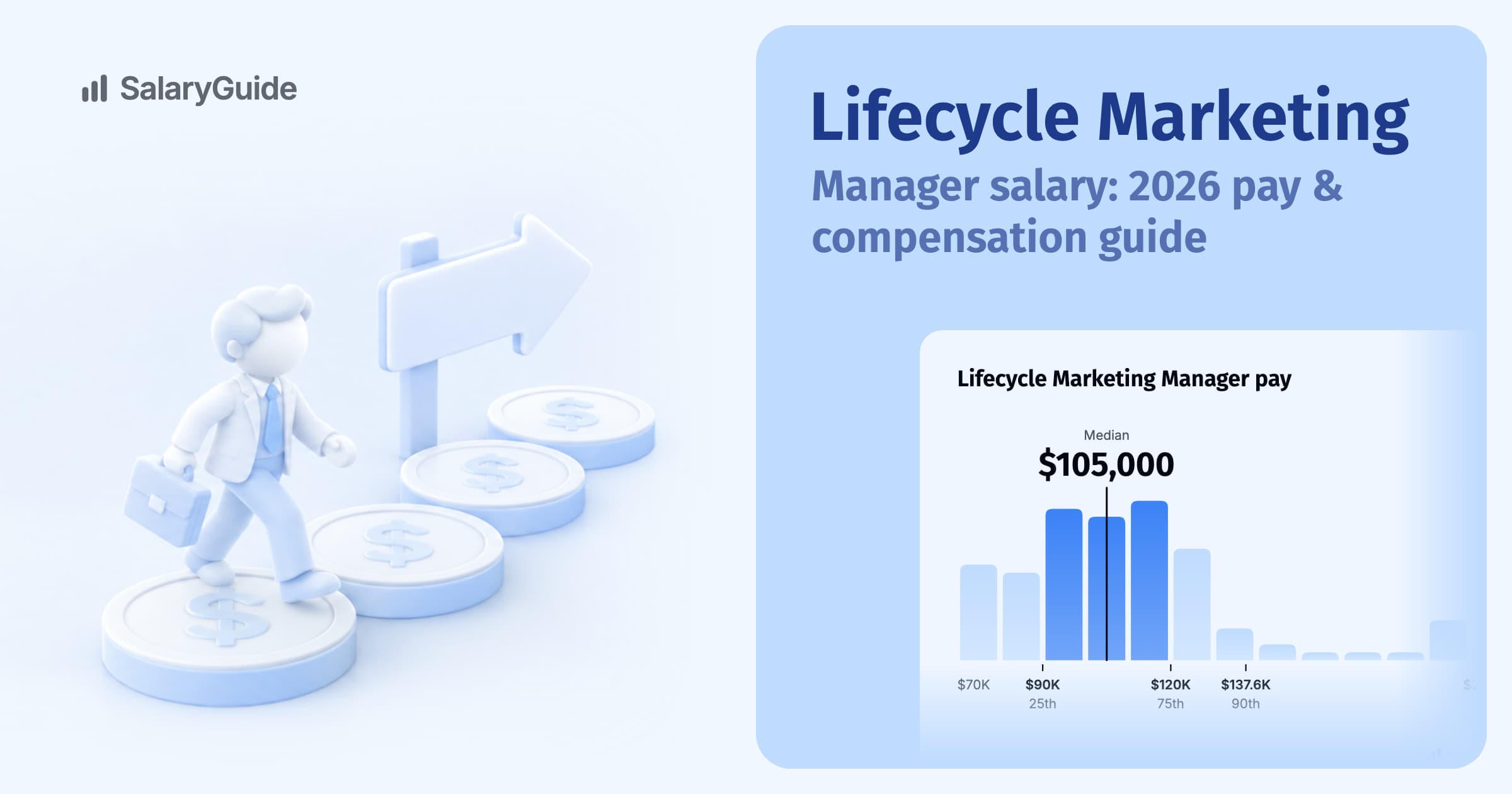
The short version: In the US, lifecycle marketing manager total pay typically falls between $85,786 and $144,451 (25th to 75th percentile), with an average of $110,678 based on March 2026 data. But the real range is much wider than that once you account for scope, location, and company tier. We'll break down exactly why below. You can explore lifecycle marketing salary data on SalaryGuide to see current figures from real job postings and verified submissions.

What Does a Lifecycle Marketing Manager Actually Do?
Before diving into numbers, it helps to understand what this role actually involves, because the scope of what you own is the single biggest driver of where you land in the salary band.
Lifecycle marketing is the practice of moving a customer through time. Not getting one click. Building a system that turns first-time visitors into signups, signups into activated users, activated users into retained customers, retained customers into expanding accounts, churned users into win-backs, and happy customers into referrals. This is essentially revenue marketing in its most systematic form.
Most lifecycle managers own some combination of these channels and responsibilities:
Email marketing (newsletters, onboarding sequences, triggered campaigns)
SMS and push notifications
In-app messaging
Audience segmentation and personalization
Experimentation (A/B tests, holdouts, incremental lift measurement)
Marketing automation tooling (Braze, Iterable, Salesforce Marketing Cloud, HubSpot, Klaviyo, Customer.io, Marketo, and others)

And here's the critical pay insight almost every salary page misses:
Title is a weak signal. Scope is the pay driver.
Two people can both hold the title "Lifecycle Marketing Manager" and have completely different jobs. Person A runs weekly newsletters and a few automated flows in a single tool. Person B owns activation and retention strategy across multiple channels, runs experiments, partners with data and product teams, and is accountable to LTV and revenue. Understanding the full range of marketing manager responsibilities and duties helps clarify what separates executional roles from strategic ones.
Same title. Different "closeness to money."
That gap often shows up as a six-figure difference in total compensation. You can see this play out clearly if you browse lifecycle marketing jobs on SalaryGuide and filter by experience level. The range within "manager" alone is striking.
Keep that in mind as you read through the salary data below. Every number makes more sense once you understand that scope, not title, determines pay.
Lifecycle Marketing Manager Salary Benchmarks for 2026
You'll see different numbers depending on where you look. That's not because one source is wrong. It's because they're measuring different things: base pay vs total comp, job postings vs employee-reported data, different sample sizes. The current datasets, alongside SalaryGuide's verified submissions, show these figures right now:
| Source | Key Figure | Range | Notes |
|---|---|---|---|
| Industry data (March 2026) | $110,678 avg | $85,786 - $144,451 (25th-75th) | 90th percentile: $182,204. Based on 241 salaries |
| Job-posted data (March 2026) | $86,300 median | $70,500 - $108,800 (25th-75th) | Skews toward job-posted base pay |
| Compensation research (Feb 2026) | $119,302 | N/A | Directional anchor, not exact title match |
| Aggregated data (Jan 2026) | $119,091 avg total | N/A | Notes higher pay in markets like San Jose |
Why do these numbers look so different?
Job-posted pay data tends to skew toward base salary. Many postings exclude bonus and equity entirely, so the median naturally looks lower. Employee-reported data incorporates additional compensation like bonuses and stock. Other research falls somewhere between. This is a universal challenge in compensation analysis.
No single dataset tells the full story. That's not a flaw. It's just how compensation data works. The sources are measuring different slices of reality.
A practical way to reconcile these sources: if you're interviewing for a typical US in-house lifecycle marketing manager role, treat roughly $85K to $145K as the "common" total pay band and $150K+ as the high-scope or high-paying-company zone. When you see a number that feels surprisingly low, it's often base-only. When it feels surprisingly high, it usually includes equity and bonus at a well-funded company. You can use SalaryGuide's salary benchmarking methodology to understand how these figures are assembled and what they actually represent.

SalaryGuide is built exclusively for marketing professionals — the platform aggregates salary submissions, job postings, and verified data specifically for this field, which is why figures from our platform are used as a primary benchmark throughout this guide.

How Location Affects Lifecycle Marketing Manager Pay
Location still moves pay significantly, even in a remote-heavy world. That's because many companies price roles using geographic tiers. Understanding the cost of living adjustment behind these tiers helps explain why two people doing the same job at the same company earn different amounts.

Lifecycle Marketing Manager Salary in New York City
Current estimates for NYC:
Average: $117,217
Typical range: $90,053 to $154,362
90th percentile: $196,204
NYC's premium reflects both cost of living and the city's density of financial services, media, and DTC subscription companies. All of these industries rely heavily on lifecycle and retention marketing to drive revenue.
Lifecycle Marketing Manager Salary in San Francisco
Current estimates for SF:
Average: $142,481
Typical range: $112,503 to $182,788
90th percentile: $227,042
Based on 48 salaries
San Francisco consistently pays a premium, partly because of cost of living and partly because the Bay Area has a dense concentration of high-growth SaaS and FinTech companies where lifecycle roles carry significant revenue responsibility. Performance marketing and lifecycle roles in this market are often bundled together, expanding scope and pay.
Does Remote Work Actually Erase the Location Pay Gap?
Many remote-first companies still use geo bands. One listing for a Senior Lifecycle Marketing Manager at Calendly explicitly shows tiered pay by location:
| Tier | Salary Range |
|---|---|
| Tier 1 (high-cost markets) | $168,300 - $227,700 |
| Tier 2 | $154,275 - $208,725 |
| Tier 3 (lower-cost markets) | $140,250 - $189,750 |
That single example explains a huge chunk of salary confusion. Two remote employees can do the same job, at the same company, and earn different pay because the company chose location-tiered compensation. If you want Tier 1 pay, you typically need to negotiate like you're benchmarking against Tier 1, with evidence. Our guide on how to assess fair market value walks through exactly how to build that case.
Remote Lifecycle Marketing Manager Salary Data
SalaryGuide's remote job feed for lifecycle marketing shows some useful benchmarks based on 154 remote jobs with published salary data:
Median posted salary: $125,000
Mid level (2-4 years): $99,000 (9 roles)
Senior level (4-8 years): $130,000 (65 roles)
Manager (4-8 years): $135,000 (46 roles)
Director/executive (8+ years): $95,000 (34 roles)
A note on that director number: it looks low relative to many director postings. That can happen when titles are inconsistently labeled in postings, the sample includes companies with "director" titles that aren't true executive scope, or higher-paying director roles simply don't publish ranges. Treat that figure as directional and cross-check using our lifecycle marketing salary page for current verified data.
Lifecycle Marketing Manager Salary by Seniority Level
Understanding how pay changes across career levels helps you plan your trajectory. The data for each rung on the ladder breaks down below. For a comprehensive view of how the full digital marketing career path unfolds financially, see our dedicated career roadmap.
Lifecycle Marketing Manager (Mid-Level)
This is the core band most people search for.
Industry data (March 2026): average $110,678, typical range $85,786 to $144,451, 90th percentile $182,204
Compensation research (Feb 2026): $119,302
For context, explore lifecycle marketing jobs on SalaryGuide where you can filter by experience level to see what companies are currently posting.
Senior Lifecycle Marketing Manager Salary
Current senior-level data (48 salaries):
Median total pay: $119,000
Total pay range: $92,000 to $158,000
But current postings tell a more dramatic story. A SalaryGuide-tracked posting for a Senior Lifecycle Marketing Manager at Stripe lists $136,000 to $245,000. A posting for the same title at Figure shows $104,000 to $130,000, plus a 25% annual bonus target and RSUs.
Two "Senior Lifecycle Marketing Manager" postings. One starts at $136K and goes to $245K. The other starts at $104K. Company tier, scope, and equity philosophy all stack on top of each other. That's not a range anomaly, it's the market being honest.
Director of Lifecycle Marketing Salary
Current director-level data (19 salaries):
Median total pay: $130,000
Total pay range: $103,000 to $167,000
Compensation research shows the average Director of Lifecycle Marketing salary at $196,193, which is notably higher, likely reflecting a broader definition or different sample composition.
And current postings reinforce how wide this band really is. SalaryGuide lists a Director of Lifecycle Marketing at ClickUp (representing the high-growth SaaS tier) and a Director of Lifecycle Marketing at Everyday Health (representing the media publisher tier). Two very different salary bands under the same title.
"Director" isn't one market. It's multiple markets hiding under one title. If you're thinking about making that jump, our guide on how to become a marketing director covers what the transition actually requires.
Real Job Postings: What the Market Is Actually Paying Right Now
If you want to know what the market is paying right now, job postings with public ranges are the closest thing to a live feed. Several examples visible in SalaryGuide's job data in early 2026:
| Company | Title | Location | Posted Range |
|---|---|---|---|
| 90min | Lifecycle Marketing Manager | Remote, New York | $95,000 - $110,000 |
| Robinhood | Lifecycle Marketing Manager | Hybrid, Clearwater, FL | $86,000 - $130,000 |
| Imprint | Lifecycle Marketing Manager | On-site, NY and SF | $150,000 - $180,000 |
| Datavant | Growth and Lifecycle Marketing Manager | Remote | $96,000 - $120,000 |
| monday.com | Lifecycle Marketing Manager | NYC-based | $85,000 - $110,000 base + bonus/equity |
| Figure | Senior Lifecycle Marketing Manager | Remote | $104,000 - $130,000 + 25% bonus + RSUs |
If you only read one section of this article, read this:
The same title can be a $95K job or a $180K job. And the reason is almost never "negotiation skill." The reason is usually one (or more) of these:
-> The higher-paying role owns more of the revenue lifecycle (activation + retention + expansion, not just newsletters)
-> The higher-paying role operates in a higher LTV business (FinTech, B2B SaaS, enterprise subscriptions)
-> The higher-paying role is at a higher-paying company tier
-> The higher-paying role includes equity and bonus that aren't visible when you compare base salaries alone

Negotiation still matters. But you can't negotiate yourself into a different company's compensation philosophy. The biggest salary jumps come from choosing the right type of role, not just asking for more money in the wrong one. Our highest-paying marketing jobs guide shows which functions consistently command premium pay across company types.
Total Compensation vs. Base Salary: What the Numbers Are Really Telling You
This is where a lot of people miscalculate their market value.
Base salary is your fixed cash, paid in paychecks. It's the number most people think of when they hear "salary." But for lifecycle marketing managers at well-funded companies, base is often only part of the picture. Understanding how to calculate total compensation is essential before comparing any two offers.
Bonus typically runs 5% to 25% of base depending on company and level. Some companies call it a "performance bonus," others call it a "target bonus," and some don't offer one at all. That range alone can mean a $10K-$30K swing on a $120K base. For a deeper breakdown of how variable pay structures work, see our guide on what is variable compensation.
Equity adds another layer of complexity:
RSUs (at public companies) can be a meaningful chunk of annual comp. They have a clear dollar value because the stock trades publicly.
Stock options (at startups) can be worth a lot, or effectively zero, depending on the company's outcome. Pricing them requires a realistic probability lens, not the company's optimistic scenario.
Understanding equity compensation (what RSUs are worth, how vesting schedules work, and how to evaluate options at different company stages) is one of the highest-value skills a lifecycle marketer can develop.

Take Figure as an example. A Senior Lifecycle Marketing Manager posting there shows $104,000 to $130,000 in base, but also includes a 25% annual bonus target and RSUs. That means total comp at the top end could be significantly higher than $130K. Comparing that role to a "base-only" posting at $110K is not apples to apples.
When you compare offers, compare expected annual cash first (base + realistic bonus). Then separately evaluate equity with a sober probability lens. Mixing them all into one number without context is how people make bad career decisions.
Knowing your OTE in marketing (what your on-target earnings look like when all components are factored in) lets you negotiate the full package, not just base.
What Actually Drives Lifecycle Marketing Pay: The Scope Score Framework
A practical framework that turns "why is this range so wide" into something you can actually use.
Give yourself 1 point for each of these you truly own:
You own multiple lifecycle stages (not just newsletters or one stage)
You own multiple channels (email + SMS + push + in-app, not just one)
You run experimentation (holdouts, incrementality testing, not just A/B subject lines)
You can work with data (events, funnels, cohorts, basic SQL helps)
You own a revenue KPI (activation rate, retention, expansion, LTV)
You influence product (you shape lifecycle triggers, onboarding, messaging surfaces)
You manage stakeholders or a team (real cross-functional marketing leadership)
Now interpret your score:
| Score | What It Means | Typical Pay Zone |
|---|---|---|
| 0-2 points | Closer to an executional channel role | Lower half of the band |
| 3-5 points | Core lifecycle manager market | Middle of the band ($85K-$145K) |
| 6-7 points | "Growth lifecycle" territory | Upper band, often $150K+ |

This is why you'll see Growth + Lifecycle titles posting huge ranges like $125,000 to $225,000 at certain companies. The role may flex from "senior executor" to "owner of the growth loop," and the pay range reflects that difference in scope. Growth marketing salaries sit at the top of the marketing pay scale precisely because of this expanded scope.
Your scope score isn't just a self-assessment exercise. It's the language you should use in salary negotiations. When you can articulate exactly what you own and how it connects to revenue, you stop being "a marketer asking for more money" and start being someone who can demonstrate their impact in business terms. This connects directly to understanding how to measure marketing performance in ways your stakeholders care about.
How to Set Your Lifecycle Marketing Manager Salary Target
A step-by-step method that doesn't rely on vibes.
Step 1: Anchor to a real market band
If you're in the US, start with the lifecycle marketing salary data on SalaryGuide as your baseline: 25th percentile at $85,786, 75th percentile at $144,451. That's your "common market" band for the title.
Step 2: Adjust for location
If you're in a top-paying market like San Francisco, the band shifts up materially (average $142,481, typical range $112,503 to $182,788). NYC also sits above the national average at $117,217. Use our job market trends dashboard to see live data on median posted salaries by market.

Step 3: Adjust for company tier
Use postings as reality checks. A role at a mid-market media company at $95,000 to $110,000 tells you what that band looks like. A FinTech role at $150,000 to $180,000 tells you what the premium tier can reach. SalaryGuide's company intelligence pages are useful for understanding what individual companies typically pay. Look up the specific companies you're targeting to see how their pay compares to market.
Step 4: Add scope premium
If your scope score is high (multi-channel, experimentation, revenue ownership), you can justify pushing toward the top of the 75th percentile band, or into the next level band (senior), depending on how the company levels roles. Our guide on what a competitive salary actually means can help you frame this conversation. Understanding how to determine salary ranges for your specific combination of scope, location, and company type is a skill worth developing.
Step 5: Convert to a confident ask
Instead of asking for "a raise," ask for a range backed by data:
"Based on current market benchmarks for lifecycle roles and the scope of this position, I'm targeting total compensation in the range of X to Y. If we can get to Z, I'm ready to move forward."
Where X is your reasonable floor, Y is your ambitious but defensible top, and Z is the number that makes you say yes quickly. Our salary negotiation script guide gives you exact language that works, including how to handle common pushback from recruiters and hiring managers. If the first offer is low, our guide on how to negotiate salary after a lowball offer covers exactly how to respond without damaging the relationship.
How to Increase Your Lifecycle Marketing Manager Salary
Most people try to grow their pay by "getting better at email." That works, but it's the slow path. The fast path is to become the person who can own systems, not campaigns. Our list of highest-paying marketing jobs consistently shows that systems-level scope beats channel expertise on compensation.

Learn the Lifecycle Metrics That Drive Pay
Lifecycle marketing is paid well when you can tie your work to metrics that matter. Think:
-> Activation rate: what percentage of signups actually do the thing that makes them stick
-> Retention cohorts: how your month-1 users look 3, 6, 12 months later
-> Repeat purchase rate: for e-commerce and subscription models
-> Expansion revenue: are your customers growing with the product
-> Churn reduction: what's the incremental value of keeping someone one more month
-> LTV: the number everything else flows into
If you can walk into a room and say, "Here's the cohort drop-off, here's the trigger we need, here's the expected lift, here's how we'll measure incrementality," you stop being a marketer. You become a revenue operator. And revenue operators get paid more. Understanding how to improve marketing ROI and articulating it in financial terms is the skill that removes the pay ceiling. This is what differentiates a growth marketing role from a standard lifecycle one.
Get Stronger with Marketing Automation Tools and Data
You don't need to be a data engineer. But you do need to understand events and attributes, know how segmentation actually works under the hood, avoid garbage data inputs, and collaborate with data and product teams without getting lost in the conversation.
Lifecycle managers who can self-serve analysis and build journeys without constant engineering support often get pulled into higher-paying "growth lifecycle" scope, because they're removing bottlenecks instead of creating them. This is one of the core marketing skills to learn if you want to position yourself for the upper salary band.
Move into CRM and Marketing Automation Roles
This is one of the clearest pay premiums inside marketing, because CRM and marketing automation sit at the intersection of customer data, systems architecture, automation logic, and measurable outcomes.
SalaryGuide's verified salary submissions show marketing automation roles as notably high: an in-house median of $163,000 based on 12 submissions (last updated Feb 20, 2026). That's not "lifecycle manager pay." That's "MarTech systems owner" pay, and it's accessible if you invest in the right skills. CRM roles follow a similar premium curve. Check the salary page for current benchmarks by experience level.
Target Industries with High Customer Lifetime Value
A rough mental model:
If one retained customer is worth $50, lifecycle marketing is often treated as "nice to have."
If one retained customer is worth $5,000, lifecycle marketing is treated as a growth engine.
That's why FinTech, B2B SaaS, subscription products, and marketplaces consistently pay more for lifecycle scope. The math simply works differently when retention and expansion directly impact revenue at scale. If you're considering making an industry move, understanding your average salary increase when changing jobs can help you calibrate whether the jump is worth it financially.
How SalaryGuide Helps Lifecycle Marketing Managers Know Their Worth
We built SalaryGuide specifically for marketing professionals because generic salary sites treat all marketing roles the same. They lump lifecycle managers in with content marketers and brand managers, which makes the data nearly useless for benchmarking.
The platform helps you get to the right number faster in a few specific ways:
Lifecycle Marketing Salary Data gives you salary data grounded in what companies are currently publishing, not what they paid three years ago. You can see the median posted salary, breakdowns by experience level, and actual job listings with ranges attached.
CRM Salary Benchmarks cover adjacent paths that often overlap heavily with lifecycle roles, especially at the senior level where CRM strategy and lifecycle strategy merge.
Marketing Automation Salary Data shows the "systems premium" we talked about earlier. If you're considering a move into automation-heavy roles, this gives you the numbers to back up that decision.
Email Marketing Salary Data provides context for the email-heavy lifecycle roles, which dominate the lower-to-mid part of the pay band.
Marketing Job Market Trends provide broader context like median posted salary across marketing, salary transparency rates, and remote job share. These are useful for framing your negotiation conversations.
Marketing Career Path Roadmap is for readers trying to decide between lifecycle, growth, product marketing, and ops. Understanding where each path leads (financially and in terms of scope) makes career planning a lot more concrete.
And if you want hands-on support, SalaryGuide Pro offers step-by-step negotiation playbooks, exact scripts that recruiters respond to, deep salary benchmarks, a private community of marketers sharing real negotiation wins, and weekly live coaching sessions. It's built for marketers who are serious about closing the gap between what they earn and what they're worth.
Global Lifecycle Marketing Manager Salary Snapshot
If you're reading this from outside the US, here's a brief look at international data. Keep in mind that sample sizes tend to be smaller and job scopes differ more across markets, so treat these as directional.

Lifecycle Marketing Manager Salary in India
Recent salary data (5 salaries):
Average: Rs 20,00,015 per year
Typical range: Rs 13,33,014 to Rs 32,00,016
India's lifecycle marketing scene is growing rapidly, especially in SaaS companies serving global markets. Roles there often demand the same toolkit (marketing automation, segmentation, CRM) but at a fraction of the US compensation.
Lifecycle Marketing Manager Salary in Australia
One company-specific estimate: Lifecycle Marketing Manager at Governance Institute of Australia at A$130K to A$140K per year (refreshed Dec 2025).
Use global numbers carefully. Sample sizes can be small, and job scopes differ significantly across markets. They're most useful as a rough starting point for local benchmarking. If you work across markets, pay transparency laws by state is a useful read for understanding how posting requirements vary and where you can find reliable salary data. For a broader view of what marketing professionals earn globally, see our dedicated benchmark piece.
Frequently Asked Questions About Lifecycle Marketing Manager Salary
What is the average lifecycle marketing manager salary in 2026?
In the US, current March 2026 data puts the average at $110,678, with a typical range of $85,786 to $144,451 (25th to 75th percentile). Top earners reach $182,204 at the 90th percentile. But "average" can be misleading here because scope, location, and company tier create enormous variation within the same title. For current data, visit the lifecycle marketing salary page on SalaryGuide.
How does experience affect lifecycle marketing manager pay?
Experience matters, but not the way most people think. The bigger factor is what you own. Based on SalaryGuide's remote job data:
Mid-level roles (2-4 years) post around $99,000
Senior roles (4-8 years) post around $130,000
Manager roles (4-8 years) post around $135,000
The jump from mid to senior is less about years and more about moving from executing campaigns to owning strategy across channels. Our guide on how to get promoted covers what that transition actually requires.
What skills command the highest lifecycle marketing manager salary?
The highest-paying lifecycle roles go to people who combine channel expertise with business impact. Specifically: multi-channel strategy (email + SMS + push + in-app), experimentation and incrementality testing, data fluency (SQL, cohort analysis, event tracking), revenue KPI ownership (activation, retention, LTV), and cross-functional leadership. SalaryGuide's data shows that marketing automation roles, which sit at the intersection of these skills, carry a median of $163,000 in-house. See our list of marketing skills to learn if you want to build toward those premium roles.
How do lifecycle marketing manager salaries differ by industry?
Industries with high customer lifetime value pay more for lifecycle roles. FinTech, B2B SaaS, enterprise subscriptions, and marketplaces consistently sit at the top of the range. That's because when one retained customer is worth $5,000+, lifecycle marketing becomes a direct revenue lever, not a support function. The Imprint posting at $150,000-$180,000 (FinTech) vs the 90min posting at $95,000-$110,000 (media) illustrates this clearly. You can browse lifecycle marketing job listings on SalaryGuide filtered by industry to see the spread firsthand.
How do location and cost of living impact lifecycle marketing salaries?
Location still drives meaningful pay differences. San Francisco averages $142,481 for this role, compared to $117,217 in NYC and $110,678 nationally. Even remote roles often use location tiers. Calendly, for example, explicitly publishes three pay tiers for the same remote role, with up to a $87,000 spread between Tier 1 and Tier 3. Our explainer on what cost of living adjustment means for salary negotiations is worth reading if you're based outside major metro areas.
Are remote lifecycle marketing manager roles paid less than in-office roles?
Not automatically. SalaryGuide's remote lifecycle postings show a median posted salary of $125,000 overall, with the manager slice at $135,000. That's competitive with (and sometimes above) in-office medians. The catch is that many remote roles still use location-based pay bands, so "remote" alone isn't the pay determinant. Where you live still matters at companies that use geo tiers. Check our live job market stats to see the current remote vs in-office salary spread across marketing roles.
How should I negotiate if the offer includes bonus and equity?
Don't negotiate a single number. Negotiate the package. Break it into three components:
Base salary: your fixed cash floor
Bonus target: ask what percentage and whether it's guaranteed or performance-based
Equity: type, amount, vesting schedule, and current valuation for RSUs
A mid-range base ($104K-$130K) turns into much higher total comp once the 25% bonus target and RSUs are included. Always compare offers on an expected annual cash basis first, then evaluate equity separately. Our salary negotiation script and our guide to how to negotiate a marketing salary walk through this package-first framework in detail.
What bonuses and benefits are typical for lifecycle marketing managers?
Bonuses typically range from 5% to 25% of base salary, depending on company stage and your level. Early-stage startups might skip bonuses entirely in favor of equity. Enterprise companies tend to have structured bonus programs tied to company and individual performance. Beyond cash comp, look for equity (RSUs or options), professional development budgets, remote work flexibility, and health benefits. At senior levels, signing bonuses are also common when companies need to bridge a gap between your current comp and their offer. For a complete breakdown of package components, see our guide on what is a total compensation package.
What does the career progression look like for a lifecycle marketing manager?
The typical path runs from Lifecycle Marketing Manager to Senior Lifecycle Marketing Manager to Director of Lifecycle Marketing. At each level, pay bands widen significantly. Manager roles sit in the $85K-$145K range, while directors can reach $155,000 to $241,000 at well-paying companies. The fastest path to higher pay isn't always moving "up" though. Sometimes a lateral move into a growth lifecycle role or marketing automation at a high-LTV company pays more than a promotion at a lower-paying one. Check our marketing career path roadmap to see how different marketing trajectories compare financially.
How do agency vs in-house lifecycle marketing salaries compare?
In-house roles consistently pay more than agency roles for lifecycle marketing. SalaryGuide's broader marketing data shows in-house salaries running roughly 46% higher than agency equivalents for comparable roles. Agency lifecycle roles tend to focus on client-facing execution across multiple accounts, while in-house roles typically carry deeper strategic ownership and revenue accountability, which drives the pay premium. If you're currently at an agency and want to maximize earnings, an in-house move is one of the most reliable salary jumps you can make. Our dedicated guide on agency vs in-house marketing salary digs into exactly how much each move is worth by role type.
Markets shift, titles change, and lifecycle scope continues to expand. The safest way to use this guide is to anchor to a credible percentile range (not just an average), cross-check with real postings from the last few weeks, and price yourself by scope, not title.
If you want to stop guessing and start benchmarking with real data, explore lifecycle marketing salary data on SalaryGuide. We track compensation across marketing roles with breakdowns by experience, location, and company type, so you can walk into your next conversation knowing exactly what the market says you're worth.