Agency vs In-House Marketing Salary 2026 Comparison

2/10/2026
Cover image

People don't search "agency vs in-house marketing salary" out of curiosity. They search it because they're about to make a move:

"Am I underpaid at my agency?"

"If I go in-house, what's my real raise?"

"Is the pay cut worth it for the learning?"

"What roles actually get a big bump when switching?"

This guide answers those questions with current 2026 data, plus the first-principles reason this compensation gap keeps showing up year after year.


Do In-House Marketing Jobs Pay More Than Agency Jobs?

In 2026, in-house marketing roles usually pay more than agency roles. Especially in performance-heavy specialties like SEO, paid search, paid media, growth marketing, and marketing operations.

Two hard signals back this up, updated today:

Job market signal (posted salaries): Across the marketing job postings we track at SalaryGuide, the median posted salary is $123k for in-house positions vs $95k for agency positions. That's roughly a +29% premium for going in-house. Check our trends dashboard for real-time market data.

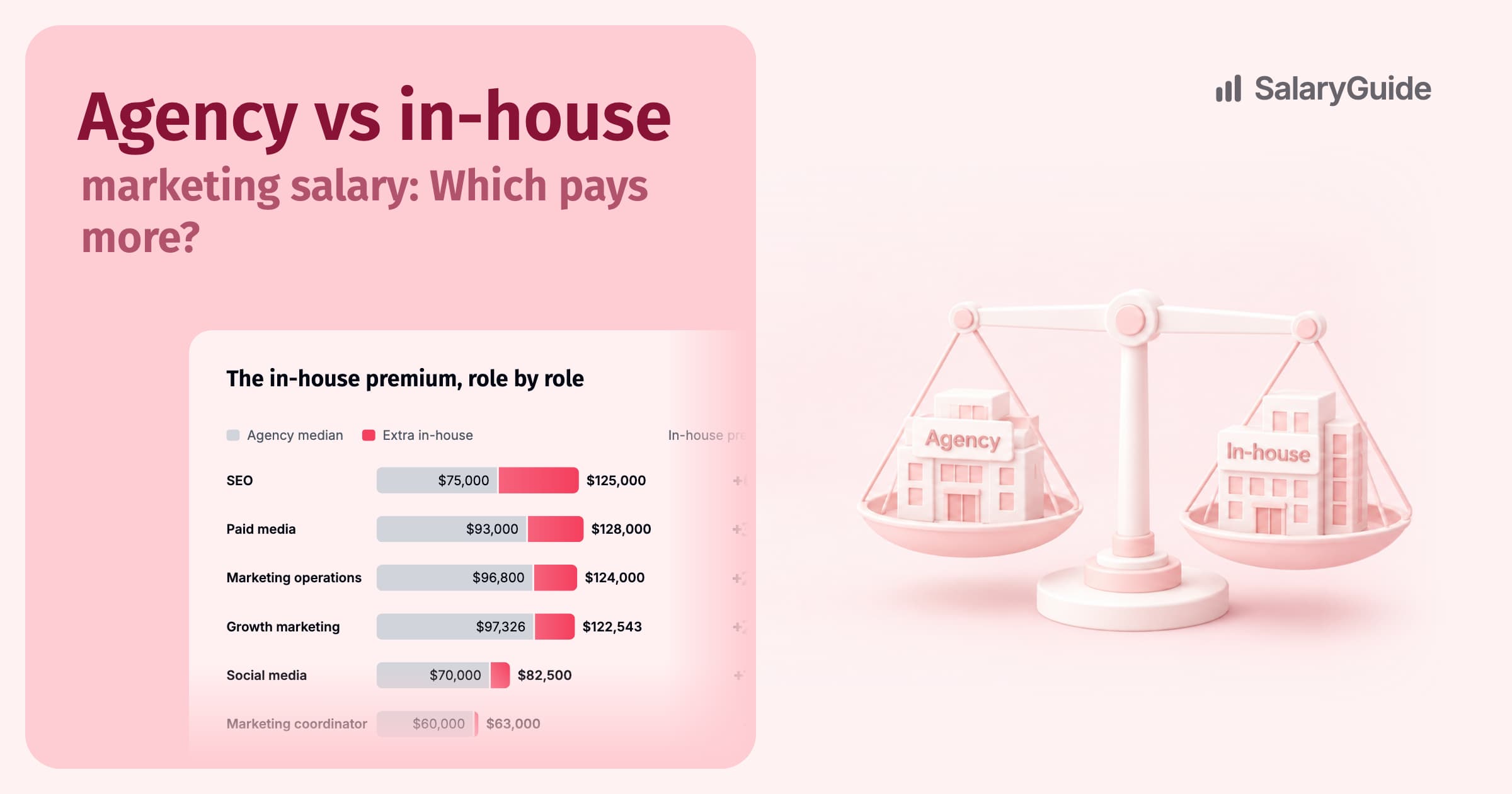
Compensation signal (verified salary submissions): When we look at verified salary data broken down by specific marketing roles on SalaryGuide, in-house median base salary is typically ~20-30% higher across common specialties, with some massive outliers (SEO being a standout at +67%).

But that "usually" matters. There are real exceptions where agencies can beat in-house offers, and we'll cover exactly when that happens.

SalaryGuide trends dashboard showing 34,330 jobs, $110,500 median salary, in-house vs agency split, and daily job trends


What's the Difference Between Agency and In-House Marketing?

In-house marketing means you work for a company marketing its own product or service. Your work directly impacts that company's revenue, retention, margin, or brand equity. You own outcomes for one business.

Agency marketing means you work at a services firm marketing clients' businesses. Your time is packaged and sold (retainer, project-based, hourly, performance fee structures). You juggle multiple clients and deliverables.

Borderline cases that confuse the comparison:

"In-house agency" creative teams (internal studios inside a company) behave like in-house for compensation purposes.

Consultancies specializing in martech, analytics, or growth can pay like in-house or like agencies depending on their pricing power and business model.

Holding-company agencies (big networks) vary wildly by region and hierarchy level, making apples-to-apples salary comparisons difficult.


Agency vs In-House Marketing Salary by Role (2026)

Below is median base salary by role, split agency vs in-house. This data comes from SalaryGuide's role pages, last updated February 9, 2026. Each role shows how many verified submissions back the numbers.

Agency vs In-House Median Salary (Selected Marketing Roles)

SalaryGuide SEO salary page showing $87,500 median with range breakdown, experience chart, and agency vs in-house data

Agency vs In-House Median Salary (Selected Marketing Roles)

Role (SalaryGuide Category) Agency Median Salary In-House Median Salary In-House Premium
SEO $75,000 $125,000 +67%
Paid Media $93,000 $128,000 +38%
Paid Search $86,500 $116,775 +35%
Marketing Operations $96,800 $124,000 +28%
Public Relations $71,200 $90,600 +27%
Growth Marketing $97,326 $122,543 +26%
Social Media Manager $70,000 $82,500 +18%
General Marketing $70,000 $80,000 +14%
Marketing Specialist $65,000 $70,000 +8%
Marketing Coordinator $60,000 $63,000 +5%
Paid Social $93,500 $95,000 +2%
Product Marketing $120,000 $121,400 +1%

Sources: SalaryGuide role pages (each shows "last updated: Feb 9, 2026" and verified submission counts)

What These Numbers Really Mean for Your Career

1. The gap is tiny in early-career generalist titles

Coordinator and specialist roles show +5% to +8% differences.

That's why obsessing over "agency vs in-house" at 1-2 years into your marketing career can be a trap. Your skill acceleration matters way more than a $3-5k base salary swing at this stage.

2. The gap explodes in roles tied to revenue and leverage

SEO (+67%), paid search (+35%), paid media (+38%), growth marketing (+26%), marketing operations (+28%).

These are roles where an in-house team can justify higher compensation because the upside isn't capped by billable hours. If you own the SEO strategy for a $500M company, the value you create isn't constrained by what the agency can bill.

3. Some specialties are basically at parity

Paid social is almost equal (+2%). Product marketing is basically equal (+1%), which makes sense because "product marketing" is mostly an in-house organizational function anyway.


Why Agency Pay Is Lower Than In-House Pay

If you only remember one thing from this guide, make it this:

Agencies are priced by time. In-house is priced by impact.

Side-by-side comparison of agency time-based pricing model vs in-house impact-based compensation model showing why pay differs

Agency Economics

Your salary has an invisible ceiling: what the agency can bill for your time, minus overhead, bench time, and profit margin.

Here's a simplified model to see why this creates pay compression:

You bill at $150/hour. You're 70% utilized (billable vs bench time). You work ~1,900 hours/year which equals ~1,330 billable hours. Revenue "created" comes out to about $199,500/year.

Now back out:

  • Account management and sales costs

  • Tools and software subscriptions

  • Leadership overhead

  • Non-billable work (internal meetings, training, pitches)

  • Profit margin (typically 15-25%)

Suddenly a $120k+ base starts to look difficult unless the agency has elite pricing power or runs lean on overhead.

In-House Economics

In-house compensation is justified through a completely different lens:

"This person controls $X in ad spend"

"This person drives $Y in pipeline or direct revenue"

"This person reduces churn by Z%"

"This person saves $A in agency fees by bringing work in-house"

"This person builds a growth loop we can scale without linear headcount"

That's why roles like SEO, paid media, growth marketing, and operations tend to jump when you go in-house. Impact scales faster than hours worked. If you build an SEO strategy that drives $5M in organic revenue, your comp isn't constrained by what you could bill per hour.


What Do Industry Salary Reports Say About Agency vs In-House?

Industry salary report data showing 78% specialization premium, agency raise decline from 7.7% to 4.5%, and in-house marketing manager median of $169,840

Even outside SalaryGuide's data, you see the same macro pattern: compensation is increasingly a premium for specialized skills, and agency budgets tighten when client demand softens.

Industry research projects average year-over-year pay gains of +1.5% across marketing and creative roles, with higher pressure in digital marketing roles (+2.4%) and certain analytics-heavy roles (+3.3%). Notably, research reports that 78% of hiring leaders pay more for candidates with specialized skills, explicitly calling out digital strategy, AI/ML integration, automation, and analytics expertise.

Agency-side research shows tightening: raises averaged 7.7% in 2023 but expected raises were muted at 4.5% in 2024. Reports note that non-salary compensation (bonuses and profit sharing) declined as sales stagnated and layoffs increased across agencies.

U.S. Bureau of Labor Statistics (May 2024 wage data): Marketing managers have a median annual wage of $161,030, with higher medians in "management of companies and enterprises" ($169,840) and other in-house-heavy industries.

None of these are perfect "agency vs in-house" apples-to-apples splits, but they triangulate the same story: Specialization is the lever that unlocks higher pay, and budget structure differs dramatically by employer type.


When Do Agencies Pay More Than In-House Jobs?

Agency work can beat in-house compensation when pricing power and performance leverage flip the traditional math.

Here are the main scenarios:

1) Boutique Agencies with Real Pricing Power

If an agency is:

  • Niche-focused (one thing, done insanely well)

  • Sells outcomes, not hours (or has high effective rates)

  • Has long retainers with low churn

  • Doesn't run on junior-heavy leverage models

They can pay like a top in-house team. Think specialized growth agencies, technical SEO consultancies, or performance creative shops with proven ROI track records.

2) Performance-Comp Heavy Roles

Some agencies (especially in paid media and growth) pay meaningful upside beyond base:

  • Profit share tied to agency performance

  • Aggressive bonuses tied to client revenue growth

  • Commissions on retained accounts or expansions

If that upside is real and consistent (ask what percentage of people actually receive it), agency total comp can outrun a "safe" in-house base salary.

3) Senior Agency Leadership

Director and VP-level roles in agencies can be lucrative if the agency is healthy:

  • Revenue ownership and book-of-business responsibility

  • Client relationship equity

  • Sometimes actual equity compensation (rare but possible in smaller agencies)

4) Geographic and Cost-of-Living Distortions

In-house roles in low-cost markets often compress salaries. Agencies that sell into high-cost markets (coastal tech hubs) can sometimes pay "exported" wages to remote talent, creating an arbitrage opportunity. Understanding cost of living adjustments is critical here.


Should You Choose Agency or In-House Marketing?

This is the decision framework we wish everyone used before making a move.

Choose in-house if you want:

Higher expected base pay (especially mid to senior levels). SalaryGuide data confirms the 20-30% premium across most specialties.

Equity upside (startups and public companies routinely offer RSUs or stock options).

Deeper ownership (one funnel, one product, real accountability for outcomes).

Less client volatility (usually more stable, though not immune to layoffs).

Choose agency if you want:

Faster reps (exposure to many accounts, industries, and marketing challenges).

Compressed learning curve (especially valuable early in your marketing career).

Specialization-by-fire (SEO, paid media, and CRO professionals often level up faster in agencies).

Network and deal flow (clients become your future employers and references).

The Based Take

Agency is often the best "skill accelerator." In-house is often the best "income compounding machine."

The cheat code? Do both in sequence. Get fast reps and portfolio pieces at an agency for 2-4 years, then take that specialized expertise in-house for the compensation bump and equity upside.


What You Give Up When Switching Between Agency and In-House

When you move between agency and in-house, you often trade one invisible asset for another:

Agency to in-house: You trade breadth for depth. You go from touching 10 accounts lightly to owning one funnel completely.

In-house to agency: You trade ownership for velocity. You give up deep strategic control for exposure to rapid iteration and diverse problems.

So don't just compare salary numbers. Compare:

Split-screen comparison showing agency marketing path (breadth, velocity, diverse clients) versus in-house path (depth, ownership, strategic control)

  • Learning rate (how fast you're acquiring valuable skills)

  • Brand and case studies (what you can show in your next interview)

  • Scope (budget owned, channel owned, team size)

  • Manager quality (this matters more than people admit)

  • Promotion velocity (how fast can you move up?)

Money follows leverage. Leverage follows scope plus skills. If you focus on those, the compensation catches up.


How to Negotiate Agency vs In-House Marketing Salaries

Side-by-side comparison infographic showing negotiation strategies for in-house vs agency marketing roles with key questions and scripts

If You're Negotiating an In-House Role

Your job is to tie compensation to impact, not tasks.

Questions to ask:

What's the funnel metric you care about most this quarter?

What budget will I own (or influence)?

What does "great" look like in 90 days? (See our 90-day review guide)

What to say:

"Based on market benchmarks for this role, in-house medians are around $X for this specialty. I'm aiming for $Y given my track record and the scope here."

"If the base can't move, let's talk about bonus structure and equity bands."

If You're Negotiating an Agency Role

Your job is to force clarity on workload economics and upside structures.

Questions to ask:

What's the utilization target (billable hours expectation)?

What's the expectation for after-hours client work?

Is there a bonus or profit share? What percentage of staff actually receives it?

How are raises handled (timing and typical percentage)?

Research context is relevant here: agency compensation can tighten when sales slow, and expected raises can drop significantly. You want transparency upfront.

What to say:

"I'm happy to be performance-accountable. I want the comp structure to reflect that accountability."

"If the base is fixed, I want clear upside tied to retained revenue, account expansions, or performance outcomes."


How to Research Your Exact Agency vs In-House Salary Range

Three-step visual workflow showing how to research exact salary ranges using SalaryGuide's platform

Generic averages are how people stay underpaid. Here's the workflow we recommend:

Step 1: Start with your role category (paid media, SEO, growth, etc.) on SalaryGuide and check the agency vs in-house split for your specific specialty.

Step 2: Sanity-check the market direction with our trends dashboard (posted salary medians, mix of in-house vs agency jobs, remote work share, salary transparency rate).

Step 3: Dial it in by location and seniority level on SalaryGuide's salary pages. Each page is built from job postings plus verified salary submissions, so you're seeing real market data, not estimates.

Our Methodology (Full Transparency)

We aggregate salary data from three sources: job postings, user submissions, and public sources. Learn more about SalaryGuide.

We only use submissions from the last 12 months and run a multi-step verification process with outlier removal to ensure data quality.

That's how we maintain accuracy across 15,000+ verified salary submissions and 100,000+ marketing jobs tracked.


Common Questions About Agency vs In-House Salaries

Split comparison showing when in-house marketing pays more vs when agency roles can beat corporate offers

Is in-house always higher?

No. It's higher on average, but there are real exceptions:

Elite boutique agencies with pricing power can beat corporate offers

Agencies with profit-share or performance upside can win on total comp

Small in-house teams (especially non-tech) can underpay badly

Use role-specific medians on SalaryGuide, not ideology.

Why is SEO such a huge gap?

Because in-house SEO often sits closer to:

  • Revenue forecasting and pipeline modeling

  • Technical architecture and product decisions

  • Product-led growth loops

  • Content strategy at scale

Agencies often sell SEO as a packaged service with margin constraints built in. The result: in-house SEO roles can command significantly higher pay (+67% median).

Why is paid social basically equal?

Paid social is execution-heavy and widely adopted across both agency and in-house settings. Agencies have to pay competitively to staff it, and in-house teams sometimes hire it at mixed seniority levels. Net effect: parity in the median (+2%).

What if I'm early-career?

The pay gap is smaller at coordinator and specialist levels (+5% to +8%). At this stage, focus on:

Then monetize that skill stack later with a strategic move (often in-house).

What about total comp (bonus and equity)?

That's where things get interesting:

In-house (especially tech companies) is more likely to add equity (RSUs, stock options)

Agencies are more likely to promise bonus or profit share, but it's uneven across the industry

Always ask: "What percentage of people at my level actually receive the bonus?" Research shows agency bonuses can be inconsistent when sales slow down.


Where This Data Comes From (Updated 2026)

SalaryGuide role salary pages (agency vs in-house splits; verified submission counts): Last updated February 9, 2026 on the pages used in this guide.

SalaryGuide trends dashboard (job posting medians; in-house vs agency job mix; transparency rate; remote work share): Last updated February 9, 2026.

U.S. Bureau of Labor Statistics (Occupational Outlook Handbook): Wage data referenced is May 2024; page shows industry medians and overall medians (accessed February 9, 2026).

Industry compensation trends (+1.5% avg; 78% pay premium for specialized skills), accessed February 9, 2026, show consistent patterns.

Research on agency-side compensation dynamics (raises, remote/hybrid policies, bonus trends) published 2024, survey conducted November-December 2023, provides context for agency compensation tightening.


Ready to Know Your Worth?

If you want to stop guessing and start negotiating with actual data, check out SalaryGuide's salary tools. We break down compensation by role, experience, location, and company type so you can see exactly where you stand.

Confident marketing professional stepping forward with rising salary charts and career growth symbolism in vibrant editorial illustration style

And if you're serious about leveling up your negotiation game, SalaryGuide Pro gives you step-by-step playbooks, exact scripts, live coaching, and a private community of marketers who've successfully negotiated $10k+ raises. (We even teach you how to turn a "no" into a "yes" without burning bridges.)

Want us to build a "choose your path" interactive tool where you pick your role, level, location, and agency/in-house preference to get a personalized negotiation target and script? We've got the data for it. Let us know.