What Is Pay Compression and How to Fix It
Pay compression is the invisible squeeze that happens when the salary gap between your new hires and your seasoned veterans shrinks to almost nothing. It’s a frustrating situation where newcomers, fresh to the company, are earning nearly the same as employees who have been loyal for years.
This creates a financial traffic jam, leaving little room to reward the very people who have the most experience and institutional knowledge.
Why Pay Compression is Such a Problem

At its heart, pay compression silently chips away at the value of loyalty. It happens when companies have to offer aggressively high starting salaries to compete for new talent, while the pay for their existing, long-term staff inches up at a snail's pace—if at all.
For example, a company might bring in a new accountant at $60,000 just to stay competitive in the hiring market. The problem? Their current accountants, who have been with the company for years, might only be making $62,000. That tiny difference sends a powerful message that tenure isn't valued, which is a fast track to resentment and disengagement.
A Real-World Marketing Example
Let's look at a common scenario on a marketing team. Maria, a Senior Content Strategist, has been with the company for five years and currently earns $85,000. The market is hot, so to attract a promising new graduate, the company hires David, a Junior Content Specialist, at a starting salary of $81,000.
Suddenly, Maria, with all her experience, leadership, and deep brand knowledge, is earning only 5% more than a new hire she's now expected to train. This is pay compression in action. It's an unintentional but clear signal that loyalty doesn't seem to pay off. These kinds of issues are exactly why more companies are exploring clearer compensation strategies and pay transparency.
This isn't just a hypothetical problem; it’s a reality playing out in offices everywhere, directly harming team morale and motivation.
To make sure we're on the same page, let's break down the core components of pay compression. The table below gives a quick snapshot of what's really going on.
Pay Compression At a Glance
| Concept | What It Means | Primary Impact |
|---|---|---|
| The Squeeze | The salary gap between new and tenured staff becomes minimal or non-existent. | Devalues experience and loyalty. |
| Who It Affects | Primarily mid to long-tenured employees and their direct managers. | Leads to lower morale and higher turnover. |
| The Cause | Rapidly rising market rates for new talent outpace internal salary increases. | Creates feelings of inequity and unfairness. |
Understanding these basics is the first step. When experienced employees feel undervalued, they start looking elsewhere, and that's a problem no company can afford to ignore.
The Three Main Causes of Pay Compression

Pay compression doesn't just happen overnight. It sneaks into an organization through a combination of market pressures, internal policies, and sometimes, plain old neglect. Getting a handle on these root causes is the first real step toward fixing the problem for good.
While every company's situation is different, the issue usually boils down to three main drivers that slowly squeeze the salary gaps between your seasoned veterans and brand-new hires. These can work alone or team up, creating a perfect storm for salary imbalances that can tank morale and send your best people running for the door.
Let's break down each one.
1. Rapid External Market Movement
The most frequent culprit is a hot job market. When demand for a certain skill suddenly explodes, the starting salaries needed to attract fresh talent can jump dramatically. To stay in the game, companies have to make competitive offers to new hires. The problem? They often forget to adjust the pay for the loyal employees already doing that same job.
A perfect real-world example is the recent surge in demand for SEO specialists with AI expertise. A marketing agency might realize they need to offer $90,000 to a new specialist just to get them in the door. But their existing SEO pros, hired two years ago, might only be making $92,000 after a couple of standard annual raises. That tiny gap hardly recognizes two years of experience, loyalty, and company knowledge.
2. Flawed Internal Promotion Practices
How a company handles promotions is another huge piece of the puzzle. It’s common for an internal promotion to come with a standard, percentage-based raise—maybe 5% to 10% over the employee's current salary. On paper, that seems fair. But it falls apart if that bump doesn’t actually align with what the market is paying for the new, more senior position.
Picture this: a Content Manager making $80,000 gets promoted to Senior Content Manager. A 10% raise bumps her up to $88,000. Great, right? Not so fast. The company is also hiring externally for that same Senior role and quickly discovers the market rate is closer to $95,000. Now, your internally promoted star is doing the exact same job for $7,000 less than a new hire would. You've accidentally penalized her for her loyalty. This is why it's so critical to understand how to assess fair market value for every single role, not just the ones you're hiring for.
3. Salary Freezes and Minimal Raises
Finally, long periods of pay stagnation can do serious damage. When the economy gets rocky, many businesses hit pause on raises or only offer tiny cost-of-living adjustments to get by. While these moves might be necessary for survival, they have a long tail.
An employee’s pay might creep up by only 1-2% a year for several years, while the external market rate for their job leaps by 15-20% in that same timeframe.
This slow-drip approach to internal raises creates a massive chasm between what your people earn and what the market says they're worth. Research backs this up, showing that typical annual merit budgets hovering around 3% simply can’t keep pace with the aggressive starting offers required to attract new talent. It's the classic story of why a ten-year veteran often finds out they're being paid significantly less than the new person sitting at the next desk.
Spotting the Warning Signs of Pay Compression

Pay compression doesn't announce its arrival. It creeps in quietly, often growing in the shadows and slowly chipping away at morale long before anyone mentions it in an exit interview. If you want to get ahead of it, you have to know what to look for.
The good news is that the signs are there if you're willing to do a little digging. Think of it like being a detective for your own company's pay structure. You’ll need to look for clues in both the hard data and the subtle shifts in your team's mood. Both are critical for seeing the full picture.
Quantitative Clues in Your HR Data
Your HR and payroll data is ground zero for finding objective evidence of pay compression. These are the numbers that can confirm your suspicions and show you exactly where the salary gaps are shrinking.
Here are a few of the biggest red flags to hunt for in your systems:
- Low Compa-Ratios for Tenured Staff: The compa-ratio is a compensation pro’s best friend. It’s simply an employee's salary divided by the midpoint of their assigned pay range. When you see that your veterans—folks with five or more years under their belt—have compa-ratios consistently below 1.0, while new hires are coming in right at that midpoint or even higher, you’ve found the smoking gun for pay compression.
- Overlapping Salary Bands: Take a look at the salary ranges for different levels within the same job family. Does the maximum salary for a junior-level role bleed into the minimum for the next level up? If there’s a significant overlap, you have a structural issue that makes giving meaningful promotional raises almost impossible.
- High Turnover Among Mid-Tenure Employees: Pay close attention to who is leaving. Are you losing your best people with 3-7 years of experience? This is the group that feels the sting of compression the most. They’ve been around long enough to see new hires get paid more, and they’re experienced enough to easily find a better offer elsewhere. A spike in turnover here is a massive warning sign.
Qualitative Signs from Your Team
The numbers tell one part of the story, but the human side tells the rest. These qualitative signs—the things you hear and feel in the office—are just as important. They often bubble up long before the data paints a clear picture of a widespread problem.
Pay compression isn't just a data problem; it's a people problem. When employees feel their loyalty and experience aren't being valued financially, the frustration will always find a way to the surface.
Keep your ear to the ground for these more subtle clues:
- Increased Complaints About Pay Fairness: If you notice more grumbling about pay, especially right after a new person joins the team, don’t dismiss it as random chatter.
- Managers Struggle to Justify Pay: A manager who can’t confidently explain why a loyal, long-term employee’s salary is fair compared to a newcomer’s is a clear signal that something is off.
- Morale Drops After New Hires Arrive: Do you notice a dip in engagement or a more cynical tone after a new teammate is onboarded? That’s often a direct reaction from a team that perceives an injustice in pay.
The Real Business Impact of Unchecked Pay Compression
Think of pay compression as a slow leak in your company’s foundation. It might seem like a small thing at first, but left alone, it can cause some serious, expensive structural damage. This isn't just a "morale problem"—when pay compression goes unchecked, it systematically chips away at your bottom line.
The most immediate and painful hit comes from increased employee turnover. Who are the first to feel that squeeze? Your most valuable, tenured team members. These are the people with deep institutional knowledge, the ones you count on to perform at the highest level. They're also the most attractive candidates for competitors who are more than happy to pay them what they're worth on the open market.
When those veterans walk out the door, the costs explode. You’re not just losing their salary; you’re losing their expertise, their mentorship, and the stability they bring to the team. Then comes the financial gut punch of recruiting, hiring, and training their replacement, a process that can easily cost 1.5 to 2 times their annual salary for every single departure.
The Slow Drain on Productivity and Engagement
For every person who leaves, you can bet there are a few more who stay behind, feeling completely demoralized. Imagine being a seasoned pro and finding out the new hire is making almost the same as you. It’s a motivation killer. Why would anyone go the extra mile when their loyalty and experience aren’t being valued?
That feeling of being treated unfairly leads directly to a drop in productivity. Disengaged employees aren't the ones innovating or collaborating. They're not staying late to finish a project; they're doing the bare minimum. This "quiet quitting" can poison a team's culture, dragging a high-performing department down to one that just punches the clock.
This isn’t a new problem. History shows us that pay compression spikes during labor shortages when companies scramble for new talent. As data from multiple industries reveals, this trend is a major driver of retention issues, with impacted employees reporting lower engagement and a higher likelihood of job hunting. You can dig into more of these compensation trends on Payscale.com.
The real danger of pay compression is that it systematically devalues your most proven assets—your experienced employees. The financial impact isn't just in the cost to replace them, but in the lost productivity of those who stay.
Legal Risks and Brand Damage
Finally, ignoring pay compression can land you in some serious hot water, both legally and reputationally. While compression itself isn't always illegal, it can easily mask or even create discriminatory pay gaps that affect protected groups, like women or older workers. If an audit ever reveals that your pay compression issues disproportionately impact a specific demographic, you could be facing some very costly discrimination lawsuits.
Even the perception of unfairness can do a number on your employer brand. We live in an era of growing pay transparency, and stories of unfair pay practices travel fast. Once you get a reputation for not paying fairly, attracting top talent becomes exponentially harder. Fixing a damaged reputation can be a long, expensive road—far more costly than making the right salary adjustments in the first place.
A Step-By-Step Guide To Fixing Pay Compression
Pinpointing pay compression is the first hurdle, but the real work is in creating a clear, methodical plan to fix it. This isn't about making a few quick salary bumps and calling it a day. It's about rebuilding trust and implementing a fair system that actually values experience.
Think of it like renovating a house with a shaky foundation. You wouldn’t just slap some paint over the cracks in the wall; you’d get in there and reinforce the base to prevent the problem from coming back. Tackling pay compression requires that same systematic approach to ensure your compensation structure is stable and fair for the long haul.
Step 1: Conduct A Comprehensive Pay Audit
Before you can change a thing, you need a complete picture of what's going on inside your own walls. This means digging deeper than just looking at a list of salaries. A proper pay audit involves slicing your salary data in a few different ways to uncover those hidden inequities.
Your audit should examine employee pay based on:
- Role and Level: Compare salaries for everyone doing similar jobs at the same career level.
- Tenure: Look for those tell-tale signs where long-serving employees are earning only slightly more (or sometimes even less) than recent hires in the same role.
- Performance: Cross-reference pay with performance reviews. Are your top contributors actually being rewarded like top contributors?
This deep dive is what helps you zero in on exactly where pay compression is hitting your team the hardest.
To help organize your findings, you can use a simple table to track key data points for each employee.
Pay Compression Audit Template
| Employee ID | Role | Tenure (Years) | Current Salary | Market Rate (Midpoint) | Compa-Ratio | Compression Risk (Low/Med/High) |
|---|---|---|---|---|---|---|
| 1001 | Sr. Marketing Manager | 5 | $95,000 | $110,000 | 0.86 | High |
| 1002 | Jr. Marketing Manager | 1 | $92,000 | $90,000 | 1.02 | Low |
| 1003 | Graphic Designer | 4 | $72,000 | $80,000 | 0.90 | Medium |
| 1004 | Content Strategist | 6 | $88,000 | $105,000 | 0.84 | High |
This kind of structured data makes it much easier to spot the outliers and prioritize your next steps.
Step 2: Benchmark Against External Market Data
Once you have your internal house in order, it's time to look outside. Your compensation strategy can't exist in a bubble. Using reliable, up-to-date market data is non-negotiable if you want your salary bands to be both competitive and fair.
This is where platforms like SalaryGuide become so powerful. By benchmarking your roles against real-time market rates, you can see exactly how far your internal pay has drifted from reality. This data-driven approach removes the guesswork and gives you the objective proof you need to justify salary adjustments. For a deeper dive, check out our article on how to determine salary ranges for your team.
Step 3: Identify Impacted Employees And Roles
With your internal audit and external benchmarks in hand, you can now create a targeted list of the people and positions hit hardest by compression. These are usually your high-performing, mid-tenure folks whose salaries have stagnated while the market for their skills raced ahead.
Don't just look for the most obvious cases. Pay close attention to roles where you've recently hired new talent at the top of the market. This is one of the most common triggers for creating compression issues among your existing team.
Step 4: Develop A Remediation Plan And Budget
Now for the action plan. It's time to develop a strategy for making targeted salary adjustments to bring your underpaid employees in line with their peers and the market. Your plan needs to outline the specific dollar increases for each person and, crucially, calculate the total budget required to make it happen.
Failing to address this is where the real costs start to pile up.
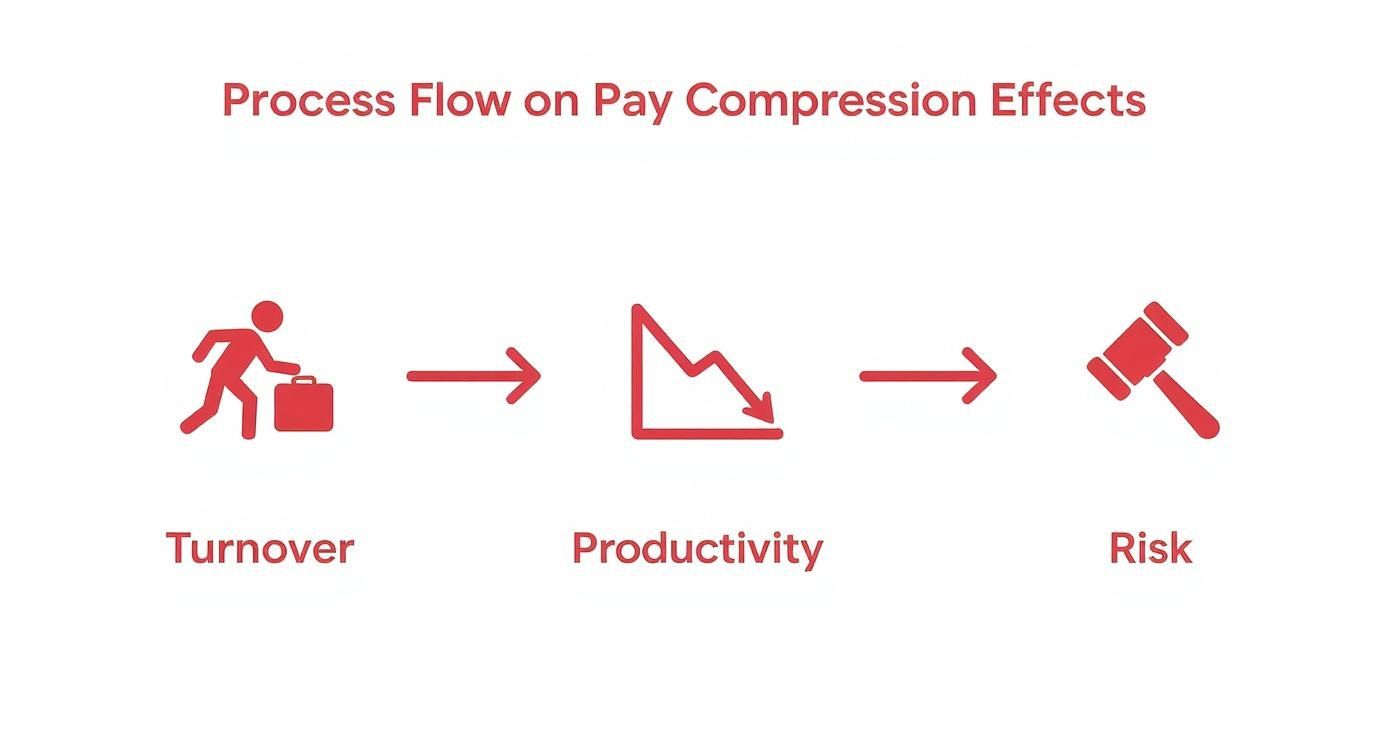
As you can see, leaving compression unchecked creates a nasty cycle of higher turnover, lower productivity, and increased business risk. It’s a problem that only gets more expensive over time.
Step 5: Revise Your Internal Compensation Policies
Finally, and this is the most important step for long-term health, you have to fix the systems that caused the mess in the first place. Otherwise, you'll be right back here in a year or two.
Your revised internal policies should include:
- Clearer promotional increase guidelines that truly reflect the market rate for the new role, not just a small percentage bump on the old salary.
- A regular cadence for market reviews (annually, at a minimum) to ensure your salary bands stay current.
- Defined career paths that show employees a clear route for how their compensation can grow as they gain experience and skills.
Taking proactive steps, like those found in a good guide to workforce planning, is essential for building and maintaining a fair pay structure that prevents compression from creeping back in.
Your Top Pay Compression Questions, Answered
Even with a solid plan in hand, tackling pay compression for the first time usually brings up a few tricky questions. It's a complicated issue with a lot of interconnected parts, and getting the details right is what separates a quick fix from a lasting solution.
Let’s walk through some of the most common questions that pop up for leaders and HR pros as they start untangling salary imbalances. Getting clear on these points will help you move forward with confidence and get your whole team on the same page.
How Often Should We Run a Pay Compression Analysis?
You should absolutely make a full pay compression analysis a standard part of your annual compensation review. No exceptions. This regular check-up lets you spot problems before they grow into serious retention headaches.
But honestly, waiting a full year can sometimes be too long.
- In fast-paced fields like marketing or tech, the market can shift dramatically in six months. A bi-annual review is a much smarter move.
- When inflation is high, salary benchmarks get stale fast. You’ll need to run checks more frequently just to keep up.
- Anytime you’re hiring for a hot, in-demand role, do a quick spot-check. You need to know if that competitive offer you're about to make will throw your existing team's pay structure out of whack.
What’s the Difference Between Pay Compression and Pay Equity?
This is a big one. People often use these terms interchangeably, but they are two very different problems. If you mix them up, you’ll end up solving the wrong issue.
Pay equity is about fair pay for similar work. It means ensuring that people in the same or similar roles are paid equally, without any bias based on gender, race, or other protected classes. It's a matter of fairness and legal compliance.
Pay compression, on the other hand, is all about the shrinking gap between the pay of experienced employees and new hires. You could have perfect pay equity—for instance, all your Senior Content Marketers are paid the exact same, regardless of background—but still have a massive compression problem if they're only making 5% more than the Junior Content Marketer you just hired.
Can We Really Fix Pay Compression Without Giving Everyone a Raise?
Let's be direct: fixing existing pay compression will almost certainly require spending money. You can’t solve a problem caused by underpayment without actually adjusting salaries for the people who have fallen behind. Trying to fix compression with a $0 budget just isn't realistic.
However, the solution isn't just about handing out raises and calling it a day. The most durable fixes come from improving the system that created the problem in the first place. These non-monetary strategies are what will prevent you from being in the same situation again next year:
- Rethink your salary bands. Make sure there's meaningful separation and progression between job levels.
- Update your promotion policies. A promotion should come with a raise that reflects the market rate for the new role, not just a small bump on the old salary.
- Be more transparent. You don't have to share everyone's exact salary, but you should be open about your overall compensation philosophy and how you make decisions.
So yes, targeted raises are the immediate cure. But fixing your internal processes is the long-term cure.
Ready to build a compensation strategy that attracts and retains top marketing talent? At SalaryGuide, we provide the real-time salary data and tools you need to diagnose and fix pay compression, ensuring your team feels valued and fairly compensated. Explore our platform today.
