what is salary benchmarking: A practical guide to fair pay

12/7/2025
Cover image

Salary benchmarking is how you figure out what a job is really worth on the open market. It's the process of comparing your company's salary for a specific role against what other companies are paying for similar positions.

Think of it like getting a property appraisal before you buy or sell a house. You wouldn’t just guess the price; you’d look at what similar homes in the neighborhood have sold for. Salary benchmarking does the same thing for compensation, making sure your offers are competitive, fair, and smart.

What is Salary Benchmarking and Why Does It Matter?

An illustration of a balanced scale comparing property documents and a house being inspected.

At its heart, salary benchmarking pulls compensation decisions out of the realm of gut feelings and into the world of hard data. It's a structured way for a company to hold its internal pay scales up against the mirror of the external job market. This isn't about simply matching a single competitor's offer—it's about truly understanding the entire compensation landscape for a role, including base pay, bonuses, and equity.

This has become a non-negotiable part of modern HR. As talent pools become more global and competitive, having accurate data is crucial. Companies across major markets like the United States, Canada, and the UK rely on this process to set their salary budgets year after year. For a deeper dive, WorldatWork's Salary Budget Survey shows just how widespread this practice is.

This table breaks down the key elements of salary benchmarking, giving you a quick reference for the concepts we'll explore throughout the guide.

Core Components of Salary Benchmarking at a Glance

Component What It Is Why It's Important
Market Data Salary information collected from reliable third-party sources. Provides an objective, external view of compensation for specific roles, industries, and locations.
Job Matching The process of comparing your internal job descriptions to similar roles in the market data. Ensures you're comparing apples to apples. A "Marketing Manager" at one company can be very different from another.
Pay Bands The minimum, midpoint, and maximum salary range for a specific job or job level. Creates a structured and equitable framework for pay decisions, allowing for growth and performance-based raises.
Total Compensation The complete package of pay, including base salary, bonuses, commissions, and equity. Gives a holistic view of a role's value, which is critical for attracting and retaining top talent in competitive fields.

Understanding these pieces is the first step toward building a compensation strategy that actually works.

The Strategic Edge of Getting Pay Right

Without this data, a company is flying blind. You could be overpaying for some positions, which drains your budget, or underpaying for others, which is a surefire way to lose your best people to the competition. Proper benchmarking brings clarity and confidence to every compensation decision.

The benefits go way beyond just setting a salary for a new hire. A solid benchmarking strategy helps you:

  • Attract Top Talent: In a hot job market, a competitive offer is your best recruiting tool. It signals to candidates that you’re serious and that you value the skills they bring to the table.
  • Keep Your Best People: When your current team feels they're paid fairly, they're more likely to be engaged, motivated, and loyal. This is your best defense against costly turnover.
  • Build a Fair Workplace: Benchmarking is key to creating internal equity. It helps you spot and fix unfair pay gaps between people doing similar work, which builds trust and a healthier culture.
  • Budget with Confidence: When you know the market rate for every role, you can plan your hiring, promotion, and annual raise budgets with far greater accuracy.

By basing compensation on real market data, you shift the conversation. It's no longer about, "What do we feel this job is worth?" Instead, it becomes, "What is the market paying for this combination of skills and responsibilities?"

Ultimately, salary benchmarking isn't just a task; it's the foundation of a much larger compensation analysis. It’s the essential first step that informs everything that follows, from designing your pay bands to structuring job offers and managing raises. In today's world, it's not a luxury—it's a necessity for any business that wants to grow and succeed.

Unpacking the Methods of Salary Benchmarking

Salary benchmarking isn't a one-and-done task. It's more like a detective's investigation, where you piece together different clues to build a clear picture. Each method gives you a different angle, and when you combine them, you get a solid understanding of the compensation landscape.

The whole process starts with the data. Without good data, you’re just guessing. Companies usually pull from two main types of sources, and each has its pros and cons.

Sourcing Your Compensation Data

First, you have free public data. This is the stuff you find from government sources like the Bureau of Labor Statistics or aggregated from big job boards. It’s easy to get and can give you a ballpark figure, which is a decent starting point. The problem is, it lacks detail. It might give you an average salary for a "Marketing Manager" in Chicago, but it won’t distinguish between one at a 10-person startup and one at a Fortune 500 giant.

For real precision, you need proprietary data from paid salary surveys. These are detailed reports from specialized firms that gather compensation info directly from companies. This data is verified, anonymized, and organized, giving you a much sharper view of what businesses of a specific size, in a particular industry and location, are actually paying. This is the gold standard.

Choosing the right data is the most critical first step. Relying on outdated or overly broad information is like using a blurry map to navigate a new city—you might head in the right general direction, but you’re likely to get lost.

Once your data is sorted, the next challenge is making sure you’re comparing apples to apples.

The Art of Accurate Job Matching

One of the most common pitfalls is matching roles by title alone. A "Content Strategist" at a small agency wears a lot of different hats compared to a "Content Strategist" at a global enterprise. This is where job matching comes in, and it's absolutely crucial.

Instead of just looking at the title, effective job matching dives deeper into what the role actually entails:

  • Core Responsibilities: What does this person do day-to-day? What are they accountable for?
  • Required Skills and Experience: What specific expertise, education, and years in the trenches are needed to succeed?
  • Scope and Impact: Are they managing a team? A budget? How much does their work influence the company's bottom line?
  • Company Context: Industry, company size, and annual revenue all heavily influence what a role is worth.

By focusing on these practical elements, you can be confident you're making a fair comparison. This is how you truly assess the fair market value for every unique position in your company.

Understanding Percentiles and Pay Bands

With matched jobs and solid data, you can start making sense of the numbers. This is where percentiles become your best friend. Instead of just fixating on an "average" salary, percentiles slice the market data into segments, giving you a much richer story.

  • 25th Percentile: Think of this as the lower end of the market range. Companies might aim here for entry-level positions or roles in less competitive locations.
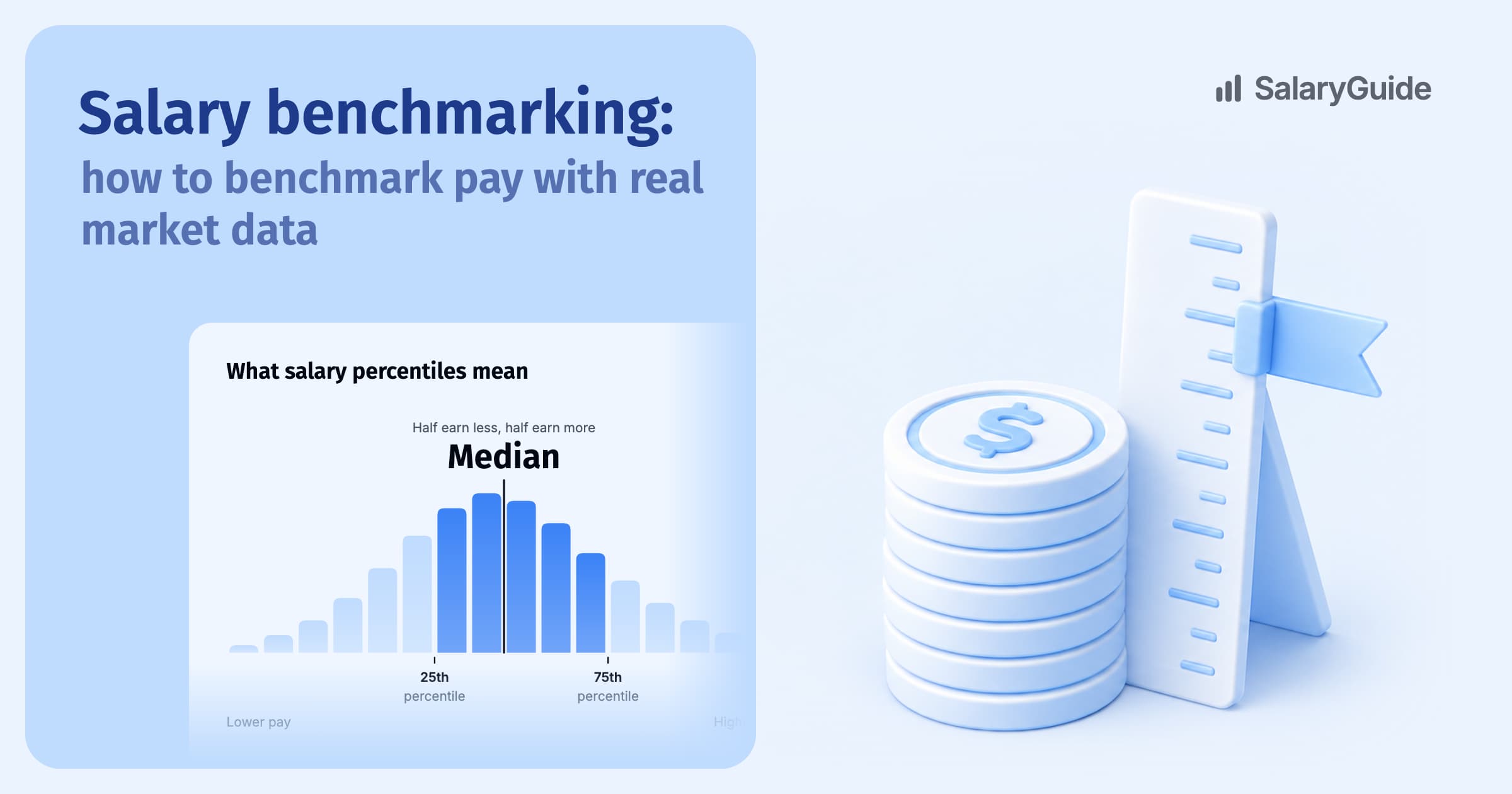
  • 50th Percentile (The Median): This is the dead center of the market. Exactly half of companies pay less, and half pay more. It's the most common target for setting a competitive salary.
  • 75th Percentile: Now we're at the high end. A company might target this to snag elite talent in a fiercely competitive space.

These percentiles are the building blocks you use to create pay bands. A pay band establishes a clear salary range with a minimum, a midpoint (often tied to the 50th percentile), and a maximum. It gives you a structured way to manage compensation while still having flexibility.

Moving Beyond Base Salary to Total Compensation

Here's a mistake I see all the time: focusing only on base pay. In today's market, especially in competitive fields like marketing, the best talent is looking at the whole picture.

Adopting a total compensation mindset is a game-changer. It gives you a complete, competitive view by accounting for every piece of financial value an employee receives, not just their take-home pay.

This bigger picture includes:

  • Bonuses and Commissions: Performance-based incentives that can dramatically boost annual earnings.
  • Equity: Stock options or grants are a huge deal, particularly at startups and high-growth companies.
  • Benefits: Don't forget the real-dollar value of health insurance, retirement plans, and other valuable perks.

When you benchmark total compensation, you get a genuine sense of where you stand. It helps you build offers that aren't just fair, but truly compelling—the kind that attract and keep the people you need to win.

Your Step-by-Step Salary Benchmarking Playbook

Knowing the theory is one thing, but putting it into practice is a whole different ball game. This playbook is designed to give you actionable steps, whether you're an employer building a compensation strategy from the ground up or a professional trying to figure out your market worth.

While each side of the table has different goals, the path to a solid, data-backed conclusion looks surprisingly similar.

For companies, this is all about creating a pay structure that’s fair, competitive, and won't break the bank. For individuals, it's about arming yourself with the right data to confidently ask for what you're worth. Let's walk through it from both perspectives.

A Benchmarking Guide for Employers

A structured approach is your best defense against inconsistency and bias. It takes compensation out of the realm of subjective guesswork and turns it into a strategic business function. The real goal is to build a framework that you can easily manage, justify, and tweak as the market inevitably shifts.

This simple flow shows you the core stages, starting with raw data and ending with real pay analysis.

A three-step diagram illustrating the salary benchmarking process: collect data, match job, analyze pay.

As you can see, a successful project moves logically from gathering market intelligence to matching your internal roles, and finally, analyzing the numbers to create a strategy.

Here’s how to do it, step-by-step:

  1. Define and Document Every Role: You can't compare your jobs to the market if you don't know exactly what they entail. Go beyond simple titles. Create detailed job descriptions that spell out core responsibilities, necessary skills, and how the role impacts the business.

  2. Select Reliable Data Sources: This is a make-or-break decision. You'll want to layer your sources—use public data for a general lay of the land, but lean on high-quality, specialized data (like SalaryGuide's marketing-focused insights) for real precision. The more unique the role, the more specific your data needs to be.

  3. Conduct Rigorous Job Matching: Here's where art meets science. You need to compare your internal job descriptions to the benchmark roles in your data sources. Don't get hung up on titles. Your aim is to match 80% or more of the responsibilities and qualifications to make sure it's a true apples-to-apples comparison.

  4. Analyze the Data and Establish Your Pay Philosophy: Now, it's time to look at the percentiles. This is where you decide where you want to stand. Are you aiming to pay at the 50th percentile (the market median), or do you want to be a market leader and target the 75th percentile to snag top talent? This single choice is the foundation of your entire compensation philosophy.

  5. Develop Your Salary Ranges: With your target percentile set as the midpoint, you can now build out your pay bands. These ranges give your hiring managers guardrails and create much-needed transparency for your team. For a complete walkthrough of the nuts and bolts, check out our guide on how to determine salary ranges.

Following these steps gives you a system that isn't just fair—it's defensible. When an employee asks why they're paid what they are, you can point to a clear, data-driven process instead of shrugging.

A Benchmarking Guide for Professionals

As an employee or a job candidate, getting a handle on salary benchmarking is a superpower. It allows you to negotiate with confidence and take control of your career path. The goal is simple: build an undeniable, data-driven case for the compensation you deserve.

This process lets you walk into any salary talk with facts, not just feelings.

  1. Objectively Audit Your Skills and Experience: First, take a hard look at yourself. Create a detailed inventory of your accomplishments, key responsibilities, and any specialized skills you bring to the table. Put numbers to your impact wherever you can (e.g., "managed a $500,000 ad budget," or "grew organic traffic by 30% in one year").

  2. Research Relevant Market Data: Head to reliable platforms and find salary data for roles that truly match your profile. Pay close attention to your specific industry and location. And remember to filter for companies of a similar size and stage to the one you're interested in.

  3. Benchmark Your "Total Compensation": Don't make the mistake of only looking at base salary. You need to research typical bonus structures, stock options or equity, and benefits packages for your kind of role. This big-picture view is the only way to evaluate an offer accurately.

  4. Prepare Your Narrative: Once you have the data, craft a clear story. Your job is to connect the dots between your unique skills, your proven achievements, and the market value you've uncovered. You're not just throwing out a number; you're showing them exactly why you're worth it.

Whether you're an HR leader architecting a new pay structure or a marketing pro gearing up for your annual review, this playbook gives you a clear path forward. It grounds the entire conversation in objective data, which almost always leads to fairer outcomes for everyone involved.

Salary Benchmarking in the Real World

Theory is one thing, but seeing salary benchmarking in practice is where it really clicks. Let’s walk through a real-world scenario to see how all these concepts come together. We'll start by looking over the shoulder of a mid-sized tech company building a pay range, then switch seats to see how a candidate uses the same data to their advantage.

This two-sided view shows how good data doesn't just benefit one party—it creates a more transparent and fair process for everyone at the hiring table.

A split image displays pay range documents on a desk and a person with a magnifying glass.

The Employer Perspective: Building a Pay Range

Let's say a B2B SaaS company is hiring a Senior Digital Marketing Manager. Their first move isn’t to guess a salary; it’s to perform a careful job match. They look past the title and define the real-world responsibilities: managing a $1M annual ad budget, leading a team of three, and being the main driver for lead generation.

With that clear picture, the HR team digs into market data. They blend insights from a few reliable sources, making sure to filter by industry (SaaS), company size (150-250 employees), and location (a major tech hub). This level of detail is what separates a good benchmark from a wild guess.

Here’s what the salary percentiles for this exact role look like:

  • 25th Percentile: $95,000 base salary
  • 50th Percentile (Median): $115,000 base salary
  • 75th Percentile: $135,000 base salary

But they don’t stop at the base pay. They know that total compensation is what really matters, so they factor in the typical 15% performance bonus. The company's goal is to be competitive, so they decide to target the market median (50th percentile) as the midpoint for their new pay band.

This process transforms an abstract question—"What should we pay?"—into a structured, data-driven decision. The company now has a defensible pay range that aligns with its budget and talent strategy.

The Candidate Perspective: Negotiating an Offer

Now, let's flip the script. A candidate named Alex is in the running for that same Senior Digital Marketing Manager job. Before even hopping on the first call, Alex is doing their own homework on platforms like SalaryGuide, pulling real-world data for similar marketing roles in the tech space.

Alex’s research and a quick self-audit tell them their skills and experience are top-tier, aligning squarely with the 75th percentile. They have a decade of experience, a proven track record of crushing lead targets, and deep expertise with the company’s specific martech stack.

The company comes in with an offer of $118,000—a solid number, slightly above their median target. But Alex is armed with data. They confidently present a counteroffer, not by just asking for more money, but by articulating their value. They connect their past achievements directly to the market data, building a clear case for why their compensation should be closer to the 75th percentile.

This evidence-based approach turns a potentially awkward negotiation into a professional conversation about fair market value. The company, impressed by the thoughtful approach and recognizing Alex’s high-caliber qualifications, revises the offer to $130,000 plus the performance bonus. Everyone wins.

A Deeper Look at the Numbers

To make this crystal clear, let's look at a sample benchmark table. This is the kind of data both the company and Alex would have used to understand the complete compensation landscape for a Senior Digital Marketing Manager.

Sample Salary Benchmark for a Senior Digital Marketing Manager

Metric 25th Percentile 50th Percentile (Median) 75th Percentile
Base Salary $95,000 $115,000 $135,000
Typical Bonus $14,250 $17,250 $20,250
Total Compensation $109,250 $132,250 $155,250

This table shows why looking only at base salary is a mistake. The total compensation figures give a much more accurate picture of earning potential and help both sides make more informed decisions.

Why This Matters for Specialized Roles

This kind of detailed analysis is even more crucial for niche or emerging roles. As technology creates new specialties in areas like AI governance, privacy, and data science, finding accurate pay data becomes a huge competitive advantage. For example, sector-specific data shows that global average total compensation for privacy and cybersecurity roles hovers around $200,000, with some leadership positions commanding much more. You can discover more insights about these specialized salary trends and see how companies use benchmarking to compete for top-tier talent.

Ultimately, whether you're building a pay band or negotiating your next offer, the principle is the same: good data takes the guesswork out of the equation. It empowers everyone to make decisions that are fair, competitive, and firmly grounded in market reality.

Avoiding Common Pitfalls and Legal Risks

Scales of justice balancing a document with a checklist against a warning sign, with a gavel.

While salary benchmarking gives you a roadmap for fair pay, it's a journey filled with potential wrong turns. One of the most common blunders is leaning on old, irrelevant data. A salary survey from three years ago? That's a historical document, not a strategic tool for today’s fast-moving market.

Another classic mistake is poor job matching. You can’t compare a "Marketing Manager" at a 50-person startup to someone with the same title at a global corporation. The scope, budget, and responsibilities are worlds apart, making a direct salary comparison totally misleading.

Navigating Common Benchmarking Mistakes

To keep your strategy sound, you have to actively sidestep a few common errors. Each one can inject bias, skew your pay bands, and chip away at the trust you’re trying to build. Falling into these traps wastes time and can lead to losing great people or simply overpaying.

Here are the biggest pitfalls to watch out for:

  • Using a Single Data Source: Relying on one survey or platform gives you a narrow, and likely biased, view. Always cross-reference multiple reliable sources to get a more balanced and accurate picture.
  • Ignoring Company Context: You have to filter data by your company's size, industry, and revenue. A role's value is directly tied to the environment it exists in.
  • Focusing Only on Base Salary: As we've covered, top talent looks at the whole package. If you only benchmark base pay, you’re leaving yourself wide open to competitors with better bonuses, equity, or benefits.
  • Treating It as a One-Time Project: The market is constantly shifting, so your compensation strategy needs to move with it. Benchmarking isn't a "set it and forget it" task—it's an ongoing process.

The goal of salary benchmarking isn't just to find a number. It's to understand the context behind that number. Without context, data is just noise.

The Growing Importance of Legal Compliance

Beyond strategic errors, the legal side of compensation is getting more and more complicated. A wave of pay transparency laws is sweeping across the globe, fundamentally changing how companies must talk about salaries. What used to be good practice is now a legal requirement in many places.

Think of proper salary benchmarking as your first line of defense. A well-documented, data-driven process shows you have a clear, objective reason for your pay decisions. This is crucial for defending against pay discrimination claims and ensuring you’re paying people equitably, regardless of gender, race, or age.

To make sure your benchmarking practices are up to snuff, it’s always smart to consult resources on broader employment law considerations.

This data-backed approach also shapes financial planning. Planned salary increases worldwide are heavily influenced by benchmarking data. For example, recent reports show average planned raises in the United States hovering around 3.5%, while a market like Brazil is looking at 5.8% increases due to different economic pressures. European salary budgets are all over the map, with increases ranging from 2% to over 7%, reflecting the unique economic realities of each country.

The Strategic Value of Accurate Benchmarking

Think of salary benchmarking as more than just a box to check. It's a continuous, strategic process that, when done right, becomes the engine for long-term business stability and success. When you stop guessing what a role is worth and start using real data, you're doing much more than figuring out a salary for a new hire.

This commitment to data turns compensation from a simple administrative task into one of your most powerful strategic tools. It helps you make smarter financial moves, build a more stable team, and cultivate a culture where people genuinely feel their work is valued.

From Reactive to Proactive Business Strategy

Investing in accurate, consistent benchmarking completely changes how you manage talent. Instead of scrambling to replace people who leave or struggling to fill open positions, you start building an environment that attracts top performers—and, crucially, makes them want to stick around.

This proactive approach gives you a few major advantages:

  • Builds a Culture of Trust: When salaries are tied to objective market data, it creates a sense of fairness and transparency. People are far more likely to trust that their pay is equitable, which is a massive boost for morale and engagement.
  • Attracts and Retains Top Talent: In a competitive job market, a data-backed compensation plan is your secret weapon. It helps you make compelling offers and prevents you from losing your best employees to competitors willing to pay more.
  • Enables Confident Budgeting: Knowing the going market rate for every single role makes financial planning incredibly precise. You can budget for new hires, promotions, and annual raises without any of those costly surprises down the line.
  • Ensures Legal and Ethical Compliance: A well-documented benchmarking process is your best defense against pay discrimination claims. It gives you a clear, objective rationale for your pay structure, promoting fairness across the board.

For business owners, getting this right is also key to making smart decisions about optimizing director compensation between salary and dividends.

The bottom line is this: shifting from an arbitrary pay model to a data-driven one is one of the smartest investments you can make for your company's future. It’s the foundation of any competitive and equitable workplace.

Your Top Salary Benchmarking Questions, Answered

Once you get the basics down, the real-world questions start to surface. Let's tackle some of the most common ones that come up when putting salary benchmarking into practice.

How Often Should We Be Doing This?

Think of it this way: for most of your team, a deep dive once a year is probably enough. An annual review keeps you in sync with the market without constantly shaking things up.

But some roles are hotter than others. Think about your performance marketers or anyone deep in marketing AI. For those fast-moving, high-demand positions, you really need to check in more often. A review every six months is a smart move to make sure you're not falling behind and losing key people.

The big takeaway is that salary benchmarking isn't a "set it and forget it" task. It's an ongoing process. The market is always moving, so your compensation strategy needs to keep pace.

Can I Just Trust Free Salary Calculators Online?

Those free online tools can give you a quick, thirty-thousand-foot view, but that's about it. They're useful for a ballpark figure, but don't bet the farm on them when you're making a serious offer.

The problem is they miss all the nuance. They rarely account for the critical details that actually determine what a job is worth, like:

  • Company Size: A 20-person startup and a Fortune 500 company are playing in completely different leagues when it comes to pay.
  • Industry Niche: The salary for a B2B SaaS marketer looks very different from one in CPG or e-commerce.
  • Specialized Skills: Knowing your way around a specific martech stack like HubSpot or Marketo can add a serious premium to a salary.

Free tools just can't get that specific, and that’s where you need to be for a truly accurate benchmark.

What’s the Deal with Remote Work and Salaries?

The shift to remote work has thrown a major curveball into compensation. The biggest question companies now have to answer is whether to adjust pay based on where an employee lives.

Three main approaches have shaken out:

  1. Geographic Pay: You adjust salaries up or down based on the local cost of living and labor market where your employee logs in from.
  2. National Rate: You pay one rate for the role, period. It doesn't matter if your content marketer is in San Francisco or St. Louis.
  3. Hybrid Model: This is a middle-ground approach, maybe with a few broad regional tiers (like West Coast, Central, East Coast) instead of city-by-city adjustments.

Deciding which path to take is one of the most defining parts of a modern compensation strategy. It says a lot about your budget, your talent pool, and the kind of culture you want to build.


Ready to move beyond guesswork and access real, marketing-focused salary data? SalaryGuide provides the specialized insights and tools you need to benchmark with precision, build fair pay structures, and attract top marketing talent. Explore SalaryGuide's tools today.