What is compensation analysis? A Guide to Fair Pay and Business Growth
Ever wondered if you're paying your team enough—or too much? That’s where compensation analysis comes in. It’s a thorough review of how you pay your people, making sure your salary structure is both competitive in the job market and fair within your own walls.
Think of it less as a simple administrative task and more as a strategic health checkup for your company's most valuable asset: its people.
What Is Compensation Analysis Really About

Imagine you're the captain of a ship. To get to your destination, you need to navigate two things constantly: the open sea and the inner workings of your own vessel.
The open sea represents the external job market. You have to keep an eye on the weather, the currents, and where other ships are headed. This is market benchmarking—seeing what other companies are paying for similar roles to ensure you can attract the best talent without getting left behind.
At the same time, you have to manage your own ship. Is the cargo balanced? Is the crew being treated fairly? This is internal equity. It's about ensuring people in similar roles, with similar skills and responsibilities, are paid fairly relative to one another. If one part of the ship is overloaded while another is neglected, you risk mutiny—or in business terms, high turnover and low morale. We dive deep into this crucial piece of the puzzle in our complete guide on what is pay equity.
A successful compensation analysis is a dynamic balancing act. It prevents you from overpaying in one area while underpaying—and losing—critical talent in another, creating a sustainable financial and cultural foundation.
The Strategic Value of Analysis
Ultimately, compensation analysis is a core business function. It directly impacts your ability to hire, retain, and motivate the people who bring your company's vision to life. To really get it right, you have to look beyond just the base salary. There are many other factors to consider, like understanding the true cost of salary for consultants, which folds in benefits, taxes, and other employer contributions.
This process gives you solid, data-driven answers to some of the toughest questions you face as a leader:
- Are our salaries competitive enough to attract top-tier marketers?
- Are there hidden pay gaps in our organization that create legal risks or kill morale?
- Is our pay structure actually aligned with our company's financial goals and core values?
To highlight why this matters, a recent survey revealed a fascinating paradox: while 65% of firms predicted revenue growth, base compensation in some key professional markets actually declined. This shows you can't just look at one piece of data. A proper analysis forces you to weigh your own business performance against what's happening in the broader market to make smart, sustainable decisions.
A well-executed compensation analysis serves several key business objectives. The table below breaks down its primary goals and the direct impact they have on the organization.
Core Goals of Compensation Analysis at a Glance
| Objective | Business Impact |
|---|---|
| Attract Top Talent | Positions the company as a competitive employer, making it easier to hire skilled candidates. |
| Retain Key Employees | Reduces turnover by ensuring current employees feel valued and fairly compensated. |
| Ensure Internal Equity | Boosts morale and minimizes internal conflicts by creating fair and transparent pay structures. |
| Manage Labor Costs | Prevents overspending on salaries, helping to maintain a healthy budget and financial stability. |
| Mitigate Legal Risk | Helps identify and correct pay disparities, ensuring compliance with pay equity laws. |
| Align with Business Goals | Connects compensation directly to performance and company objectives, driving desired outcomes. |
In short, a thorough compensation analysis is your roadmap for building a motivated, stable, and high-performing team while keeping your financial house in order.
The Five Pillars of a Strong Compensation Strategy
A solid compensation strategy isn’t just about picking a number for a salary. It's a carefully constructed system built on five core pillars. Each one supports the others, and together they create a framework that’s competitive, fair, and built to last.
Think of it like building a house. You can't just throw up some walls and call it a day. You need a solid foundation, a sturdy frame, and functional systems all working together. Let's walk through the blueprint for a compensation plan that actually works.
1. Market Benchmarking: What's Happening Out There?
First up is market benchmarking. This is all about looking outside your own four walls to see what the competition is doing. You’re systematically researching and comparing your company's pay practices against the broader job market.
It's just like selling a house. You wouldn't just guess at a price; you'd look at "comps"—what similar homes in your area have recently sold for. Market benchmarking is the exact same idea, but for jobs. You dig into salary data to figure out the going rate for a specific role, in your industry, in your city. This is how you make sure your offers are competitive enough to land the talent you want.
2. Internal Equity: What's Happening in Here?
While benchmarking looks outward, our second pillar, internal equity, turns the focus inward. This is the crucial work of making sure your people are paid fairly in relation to one another inside your own company.
It means jobs with similar responsibilities, skill demands, and impact should be compensated in a similar way, no matter who is in the role. Nothing crushes morale faster than a new hire coming in at a much higher salary than a long-time, high-performing employee doing the same job. Getting internal equity right is absolutely essential for keeping your best people and building a culture of trust.
A truly effective compensation strategy strikes a delicate balance between external competitiveness and internal equity. Paying the market rate gets people in the door, but ensuring internal fairness is what keeps them engaged and motivated for the long haul.
3. Pay Structure: The Architectural Framework
The third pillar is building a formal pay structure. This is the architecture that organizes all your compensation practices into a logical, easy-to-manage system. It’s what holds the whole thing together.
A pay structure usually consists of two key components:
- Job Grades: Jobs of similar value and complexity are grouped together.
- Salary Ranges: Each job grade gets a defined minimum, midpoint, and maximum salary.
This framework takes the guesswork out of pay decisions, from new hire offers to promotions and raises. Instead of subjective calls, you have a consistent and transparent process. For example, a "Marketing Manager I" and a "Marketing Manager II" would land in different grades with distinct salary ranges that clearly reflect their different levels of responsibility.
4. Total Compensation: The Full Picture
Base salary is just one chapter of the story. The fourth pillar, total compensation, looks at the entire value proposition you offer an employee. It’s the sum of all the financial rewards and benefits you provide.
Looking at the whole package is critical because it reflects the true investment you're making in your team. A full total compensation review includes:
- Base Salary: The fixed, predictable pay an employee receives.
- Variable Pay: Performance-based rewards like bonuses, commissions, or profit-sharing.
- Benefits: The dollar value of health insurance, retirement plans (like a 401k match), and paid time off.
- Equity: Stock options or grants that give employees a direct stake in the company's success.
A company with a slightly lower base salary but fantastic benefits and a generous bonus plan might actually have the more attractive offer. You can’t know unless you look at everything.
5. Job Evaluation: The Foundation of It All
Finally, our fifth pillar is job evaluation. This is the foundational process of figuring out the relative worth of different jobs within your organization. It’s how you decide which roles belong in which pay grade to begin with.
Job evaluation is a systematic method for assessing roles based on objective criteria, like:
- The skills and qualifications required
- The complexity of the work
- The scope of responsibility
- The role's overall impact on the business
By using a consistent system—like a point-factor method where jobs are scored across different categories—you can create a clear, logical hierarchy. This is what ensures that a Senior Director is valued (and paid) more than a Junior Coordinator, all based on defensible criteria. This process is the bedrock of internal equity and provides the logic that supports your entire pay structure.
How to Conduct Your Compensation Analysis
Alright, you understand what a compensation analysis is and why it matters. Now for the fun part: actually doing one. Moving from theory to practice can feel like a huge leap, but if you break it down into manageable steps, it's a completely achievable process. This is your playbook for getting it done right.
Think of it like a health check-up for your company's pay strategy. You start with a question (Are we paying our people fairly and competitively?), gather the vital signs (data), analyze the results, and create a treatment plan. A structured approach is the only way to get results you can stand behind.
The whole process really boils down to balancing three core ideas: what the market is paying, whether your internal pay is fair, and if your overall structure makes sense.
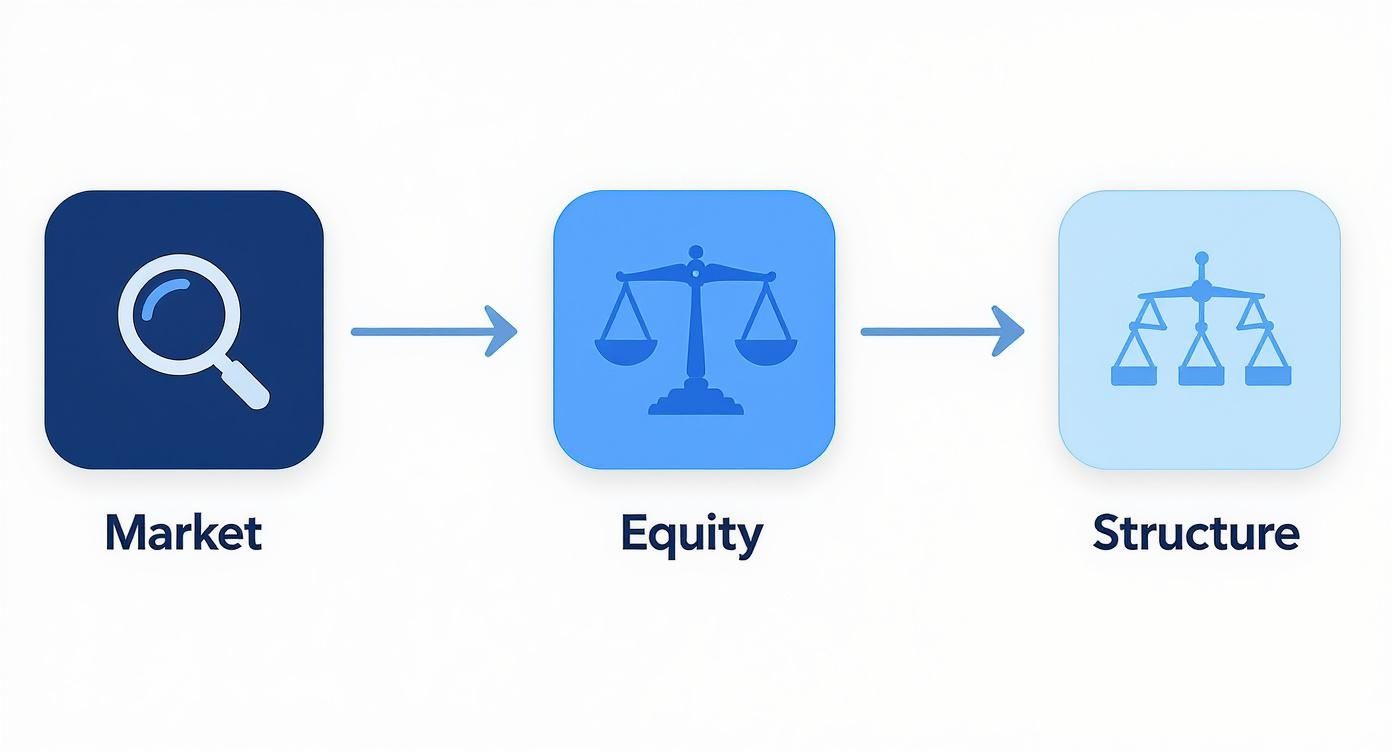
Starting with market data, then checking it against internal equity, and finally building a solid structure ensures your compensation plan is both smart and sustainable.
Step 1: Define Your Scope and Objectives
Before you even think about opening a spreadsheet, you need to know why you're doing this. What's the goal? Without a clear objective, you'll just be swimming in data with no direction.
Start by asking a few pointed questions:
- Are we trying to figure out why we're losing good people in the engineering department?
- Do we need to get our numbers straight to justify costs for an upcoming funding round?
- Is our main goal to get ahead of new pay transparency laws and ensure we're compliant?
Your answers will shape everything that follows, from the data you need to the people you pull in. You'll definitely want HR, finance leads, and department heads in the room—they have the on-the-ground context you can't get from a report.
Step 2: Gather Your Internal Data
With your goals locked in, it’s time to look inward. You need a complete, honest picture of what you're currently paying everyone. Your HR and payroll systems are your best friends here.
Pull together a detailed report that includes:
- Employee Basics: Job title, department, location, hire date, and any relevant demographic data for the equity piece of your analysis.
- Pay Details: The nitty-gritty of base salary, bonus structures and actual payouts, commission plans, and any equity grants.
- Performance Info: Recent performance review scores or ratings, if you have them.
Accuracy is everything at this stage. Garbage in, garbage out. If your data is messy or incomplete, your entire analysis will be built on a shaky foundation. Double-check your numbers.
Step 3: Collect External Market Data
Now, it’s time to see what the rest of the world is doing. This is where you find out if your pay is truly competitive. And no, pulling salary numbers from a few random job postings just won't cut it.
You need reliable, high-quality salary surveys from reputable sources. Make sure the data is relevant to your industry, company size, and location. The real work here is matching your internal jobs to the survey jobs based on actual responsibilities, not just titles. A "Product Marketing Manager" at a 50-person startup is a completely different job than one at a 5,000-person corporation.
One of the most common missteps is using the wrong data for your talent market. If you're a tech company in Austin, you can't benchmark your salaries against a national average that includes rural Kansas.
Step 4: Analyze the Data and Identify Gaps
This is where the magic happens. With your internal and external data laid out side-by-side, you can finally start connecting the dots and spotting the problems. The goal is simple: see where you stand against the market and find any pay gaps inside your own walls.
Here’s what you’ll be doing:
- Calculate Compa-Ratios: This is a quick way to see how an employee's salary compares to the market midpoint for their role. A compa-ratio of 1.0 means they're paid exactly at the market rate.
- Run a Regression Analysis: This sounds intimidating, but it's a powerful statistical tool that helps you spot pay gaps tied to things like gender or ethnicity while accounting for legitimate factors like experience or performance.
- Visualize Your Findings: Don't just stare at spreadsheets. Create charts and graphs that clearly show which roles are underpaid, overpaid, or right on the money. This makes it much easier to explain your findings to leadership.
This analysis will shine a bright light on your problem areas—whether it's specific roles that are way off market or systemic equity issues that need to be fixed, fast.
Step 5: Develop and Implement Your Action Plan
Data is just data until you do something with it. The final, most important step is to build a concrete action plan. This is where you figure out how to determine salary ranges that are both competitive and fair. Your plan needs to spell out specific salary adjustments, updates to your pay bands, and a clear communication strategy.
Of course, any plan needs a budget. A recent analysis of nearly 17 million employees showed that while a market like India projected the highest salary increases, the overall rate of increase was slowing down. Meanwhile, the UK actually saw a contraction. Knowing these larger trends helps you build a realistic budget for your own adjustments.
Don't forget communication. You have to be ready to explain the "why" behind any changes. Transparency builds trust, even when you have to deliver news people don't want to hear. Be prepared to walk your team through the process, the data, and the reasoning for the final decisions.
Finding the Right Tools and Data Sources
A compensation analysis is only as good as the data you feed it. Using outdated or irrelevant numbers is like trying to navigate a new city with an old map—you’ll probably end up lost. To make sure your decisions are fair, competitive, and defensible, you need to start with credible, relevant information.
The first step is understanding what’s out there. Data sources generally fall into two main buckets: free public data and paid private surveys. Each has its pros and cons, and the right choice really boils down to your budget, your industry, and how precise you need to be.
Free vs. Paid Data Sources
If you're just getting started or working with a tight budget, free data sources are a fantastic place to begin. Government agencies offer a treasure trove of reliable information that can serve as a solid foundation for your analysis.
Government Labor Statistics: Agencies like the U.S. Bureau of Labor Statistics (BLS) provide mountains of salary data across countless industries and regions. It’s impartial and extensive, which makes it a trustworthy starting point.
Public Job Postings: This isn't exactly a scientific method, but browsing salary ranges on job boards for roles similar to yours can give you a real-time pulse on what the market is offering.
But when you need to get really specific, paid salary surveys are usually the way to go. These are put together by specialized firms that gather detailed compensation data directly from other companies. This gives you a much more granular view, letting you slice the data by company size, specific tech stacks, or niche industries—details you’ll never find in public data.
Think of it this way: free government data gives you a reliable, wide-angle photo of the entire market. Paid surveys provide the high-resolution, close-up shots you need to see the fine details critical for setting competitive pay.
Choosing the Right Tools for the Job
Once you have the data, you need a way to manage and make sense of it all. Your toolkit should match your company's complexity. A small startup doesn’t need a massive software platform, but a global enterprise would be drowning in spreadsheets without one.
For smaller businesses, a well-organized spreadsheet can often do the trick. You can use it to track internal employee data, plug in your market benchmarks, and calculate key metrics like compa-ratios. It’s cost-effective and flexible enough for a straightforward analysis.
As you grow, though, spreadsheets become clunky and dangerously prone to error. That’s when dedicated compensation management software becomes a lifesaver. These platforms are built to automate data collection, simplify analysis, and manage complex pay structures. Our guide to the best compensation management software is a great resource for exploring options. You can also explore specialized tools like an HR simplified SaaS platform to manage your data.
To help you decide what’s best for your organization’s needs, let’s break down the different data sources.
Comparison of Compensation Data Sources
| Data Source Type | Pros | Cons | Best For |
|---|---|---|---|
| Government Data | Free, highly reliable, and comprehensive national/regional data. | Often lacks role specificity and can lag behind fast-moving markets. | Small businesses or establishing a foundational market baseline. |
| Paid Salary Surveys | Highly detailed, industry-specific, and timely data. | Can be expensive and may require participation to access. | Mid-to-large companies needing precise, competitive benchmarks. |
| Crowdsourced Data | Free or low-cost, offers real-time insights from employees. | Data is self-reported and can be inconsistent or inaccurate. | Quick pulse checks and supplementing other, more reliable sources. |
Ultimately, the smartest strategy often involves a mix of sources. You can start with free data to get a general lay of the land, then strategically invest in paid surveys for your most critical roles. This blended approach ensures your compensation analysis is both powerful and precise.
Avoiding Common Compensation Analysis Mistakes
A rushed or poorly planned compensation analysis can do more harm than good, quickly eroding team morale and trust. Even seasoned pros can fall into a few common traps that can completely derail the process. Knowing what these pitfalls are ahead of time is half the battle.
Think of it like performing delicate surgery. You need the right tools and a steady hand. One slip-up, like using a contaminated instrument, can cause serious complications down the line. The whole point is to make your company healthier, not create new problems.
Relying on Outdated Market Data
One of the most common and costly mistakes is leaning on old salary data. The job market isn't a fixed point in time; it's constantly shifting, especially in fast-paced fields like marketing. Setting pay for a Growth Marketing Manager using last year's survey is like trying to navigate with an old map—you're bound to get lost.
This misstep usually leads to one of two bad outcomes:
- Underpaying: Your offers fall flat, and you lose out on great candidates. Even worse, your current team starts to feel undervalued.
- Overpaying: You anchor your salary bands to inflated numbers from a hot market that has since cooled off, putting a needless strain on your budget.
The fix? Always use the most current data you can get your hands on, and never rely on just one source. It's best to triangulate your numbers by comparing government data with fresh, industry-specific surveys to get a clear, real-time snapshot of the market.
Ignoring Internal Equity for Market Rates
Chasing market rates without a second thought is another classic blunder. While staying competitive is crucial for hiring, ignoring how salaries stack up internally is a recipe for disaster. This often happens when a company scrambles to match an outside offer for a new hire but forgets to check how that shiny new salary compares to what loyal, high-performing employees in the same role are making.
Just imagine your senior designer, who's been with you for five years, finding out a new hire with less experience is making $10,000 more than them. The hit to morale, trust, and loyalty is instant and can be incredibly damaging.
A smart compensation strategy has to strike a balance between the pull of the external market and the need for internal fairness. If you let one completely outweigh the other, you're setting yourself up for instability.
Overlooking the Total Compensation Package
Focusing only on base salary is like judging a book by its cover—you're missing the whole story. A proper compensation analysis looks at the entire rewards package: bonuses, benefits, equity, perks, the works. A lot of companies make the mistake of benchmarking only base pay, which gives them a skewed view of where they actually stand.
For instance, your base salary might be 5% below the market average, but you might offer a fantastic 401(k) match and top-tier health insurance that adds a ton of value. If you're only looking at the salary number, you'll think you're underpaying and might make expensive adjustments you don't actually need to. Always add up the full value you're bringing to the table.
Communicating Changes Poorly
Finally, you can have the most fair, accurate, and data-driven analysis in the world, but if you communicate the results badly, it can all fall apart. Simply dropping an email about new salary bands without any context is a surefire way to stir up anxiety and mistrust.
Transparency is your best friend here. When you're rolling out changes, you have to be ready to:
- Explain the "why" behind the whole process.
- Give a brief overview of the steps you took.
- Arm your managers with the right information and talking points to handle tough questions.
People need to see that the process was fair and thoughtful, not just a random decision made behind closed doors. A good communication plan is every bit as critical as the analysis itself.
Putting Your Compensation Plan into Action
The hardest part of a compensation analysis isn't the number crunching—it's turning those data-driven insights into reality. A brilliant plan that just sits in a spreadsheet is worthless. This final step is all about securing buy-in, communicating with care, and managing the human side of change.

Successfully launching your new strategy involves far more than just updating pay bands. It requires a thoughtful approach to communication and change management. How you roll out the plan is every bit as critical as the analysis itself if you want to build trust and see positive results.
Building the Business Case for Change
Before you can adjust a single salary, you need to get your leadership team on board. Your analysis gives you the data, but you have to translate it into a compelling business case. It's crucial to frame your findings around strategic goals, not just numbers on a page.
Your presentation to leadership should clearly connect the dots:
- The Problem: Start by showing where you’re losing talent due to uncompetitive pay or where morale is suffering because of internal inequities.
- The Solution: Present your proposed new pay structures and salary bands as the direct answer to those problems.
- The Impact: Detail the expected ROI, like lower employee turnover, better hiring success rates, and reduced legal risks.
- The Cost: Lay out a clear, transparent budget for the required salary adjustments. No surprises.
Getting executive buy-in isn't just about getting a signature; it's about turning them into champions of the new plan. When leadership truly understands and supports the 'why,' the entire rollout process becomes dramatically smoother.
Communicating with Transparency and Empathy
Once you have leadership’s support, the spotlight turns to your employees. This is where the rubber meets the road. Poor communication can completely undermine the best-laid plans, creating a swirl of anxiety and mistrust. Your goal is to be open about the process and empathetic to everyone's concerns.
This is more important than ever. Recent analysis shows a major gap between pay adjustments and inflation, which is taking a toll on team morale. A global survey highlighted that a staggering 53% of employees received no salary increase in the last year. Of those who did, 47% were given raises that fell short of inflation. The same study uncovered a massive transparency problem, with 65% of respondents reporting little to no clarity on how compensation decisions are made. You can learn more about compensation trends and analysis to see just how powerful transparency can be in building trust.
When rolling out changes, prepare your managers first. They are your front line. Arm them with talking points, FAQs, and the context they need to handle tough one-on-one conversations. They must be able to explain the rationale behind individual pay adjustments with confidence and clarity.
By managing the implementation with genuine care, you reinforce that the compensation analysis was a fair, data-driven effort designed to support everyone in the organization.
Compensation Analysis: Your Questions Answered
Diving into compensation analysis always kicks up a few questions. Let's tackle some of the most common ones that pop up when companies start building smarter, fairer pay structures.
How Often Should We Run a Compensation Analysis?
For a full-blown, deep-dive analysis, the general rule of thumb is every one to two years. This schedule keeps your overall pay strategy in sync with the market and your own internal company goals.
That said, you shouldn't just set it and forget it. I always advise clients to do a lighter "pulse check" at least once a year. This is more of a quick health check-up, focusing on your most critical roles or any positions where you know the market is moving fast. In fields like marketing or tech, where talent demand shifts on a dime, you might even need to do these check-ins more often.
Can a Small Business Really Do a Compensation Analysis?
Yes, absolutely. You don't need a massive HR department or a huge budget to do this effectively. It's all about being scrappy and smart.
For a small business, the key is resourcefulness. You can still get great results if you:
- Tap into free, high-quality data from sources like the Bureau of Labor Statistics.
- Use affordable salary tools or even just a well-organized spreadsheet.
- Concentrate your efforts on a handful of key benchmark jobs instead of trying to analyze every single role.
This targeted approach helps you make sure your most important salaries are competitive without breaking the bank.
What’s the Difference Between Internal Equity and External Competitiveness?
I like to explain this as looking in two different directions.
External competitiveness is about looking outside your company walls. You’re comparing your pay scales to what other companies in your industry and region are paying for similar jobs. This answers the big question: "Are we paying enough to attract the people we want to hire?"
Internal equity, on the other hand, is about looking inward. It’s all about fairness within your own team. Are you paying people fairly compared to their colleagues, based on their skills, responsibilities, and contributions? This answers a different, but equally important, question: "Are we paying our current team in a way that feels fair and motivating?"
The magic happens when you strike the right balance between the two. You have to be competitive enough to get great talent through the door, but you also need to be equitable enough to keep them happy and engaged once they're on the team.
What Do I Do If an Employee Is Paid Above Our New Salary Range?
This is a classic problem, and we call these employees "red-circled." Handling this requires a delicate touch. You need a plan to bring their pay back in line with your structure over time, but you can't just cut their salary—that's a recipe for a disengaged, or former, employee.
Here are a few proven strategies:
- Freeze their base pay: Their salary stays put until the market range catches up to them through your company's annual pay increases.
- Shift to lump-sum bonuses: Instead of a base pay raise, you can reward great performance with a one-time bonus. This recognizes their contribution without making the long-term pay issue worse.
- Look for a promotion: Is there an opportunity to move them into a more senior role that better aligns with their current pay level? This can be a win-win.
Ready to bring clarity to your marketing compensation strategy? SalaryGuide provides the real-time salary data and insights you need to build a competitive and equitable pay plan. Explore our platform to benchmark roles and attract top marketing talent with confidence.
