Marketing: marketing manager responsibilities and duties for 2026 success

The role of a marketing manager boils down to one thing: driving business growth through smart, well-executed marketing. They're the strategic heart of the marketing department, responsible for everything from high-level planning to the nitty-gritty of campaign execution. Think of them as the bridge between the company's big-picture goals and the creative and analytical work that makes those goals a reality.
What Does a Marketing Manager Actually Do?

A great analogy for a marketing manager is the conductor of an orchestra. They might not play every single instrument, but their job is to make sure every section—SEO, paid ads, content, social media—is perfectly in sync. They unite all these moving parts to create a single, powerful strategy aimed at hitting a clear business target, whether that's boosting revenue or capturing more market share.
At its core, this role is about translation and direction. A marketing manager takes the high-level vision from leadership and translates it into a concrete, actionable marketing plan. Then, they guide their team to bring that plan to life.
Blending Strategy with Execution
It’s easy to think marketing managers just "run campaigns," but that barely scratches the surface. Their work is a constant loop of planning, doing, and analyzing. They live at the intersection of the C-suite's strategic vision and the marketing team's day-to-day tasks.
A huge part of their job is building and guiding these strategies. For example, knowing how to build and implement a modern B2B demand generation strategy is a critical skill for growth. This strategic oversight ensures every piece of content, every ad dollar, and every team member's effort is pulling in the same direction toward measurable results.
A marketing manager’s value isn’t just in launching campaigns, but in understanding which campaigns to launch, why they matter to the business, and how to prove their impact with data.
While the specifics can change from company to company, a marketing manager's duties always revolve around a few core pillars. These are the foundational areas where they spend most of their time and energy.
Core Pillars of Marketing Manager Responsibilities
| Pillar | Key Focus Areas |
|---|---|
| Strategic Planning | Defining marketing goals, identifying target audiences, and creating the overall marketing roadmap. |
| Team Leadership | Managing and mentoring specialists (e.g., content creators, advertisers), fostering a high-performing and collaborative team environment. |
| Budget Management | Allocating the marketing budget effectively and tracking spending to ensure a strong return on investment (ROI). |
| Performance Analysis | Using analytics to monitor campaign performance, interpret data, and make data-driven decisions to optimize future marketing efforts. |
This blend of strategic, financial, and people-management responsibilities makes the role incredibly dynamic and essential. It's no surprise that skilled marketing leaders are in high demand. In fact, employment for marketing managers is projected to grow 6 percent between 2024 and 2034, which is faster than the average for all occupations.
How the Marketing Manager Role Is Evolving
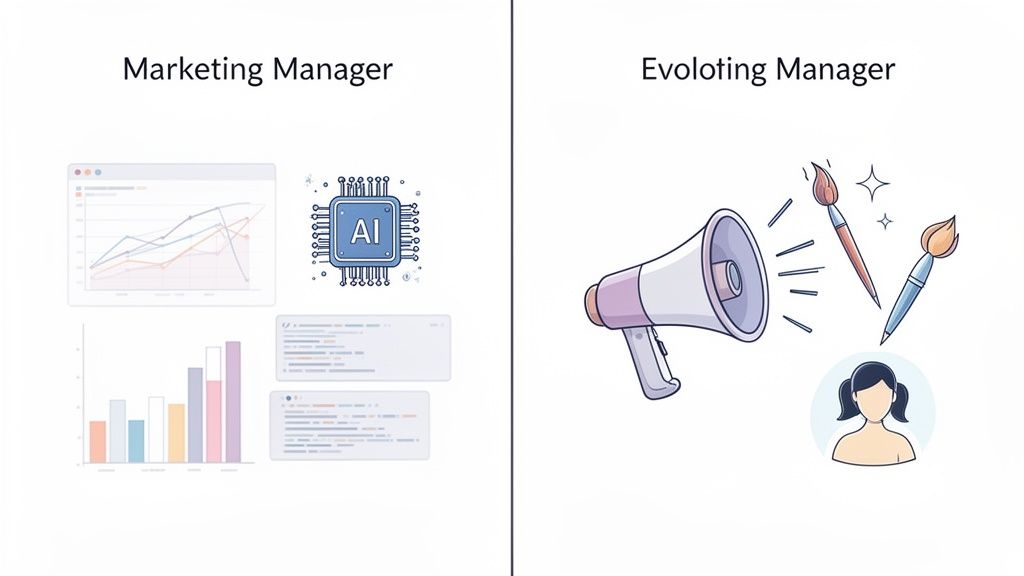
The classic job description for a marketing manager is gathering dust. What used to be a role centered on clever campaigns and managing the brand's voice has morphed into something far more technical and results-oriented. The marketing manager responsibilities and duties we know are being rewritten before our eyes.
Think of the old-school manager as a theater director, focused purely on the performance—the ads, the copy, the visuals. The modern manager is more like a film producer. They're still obsessed with the creative elements, but they're equally consumed by the budget, distribution, and, most critically, the box office returns. Success isn't just about applause anymore; it's measured in dollars and cents.
This shift turns the marketing manager from a cost center focused on activities to a profit center judged on outcomes. The conversation has moved from "How many clicks did we get?" to "How did this campaign impact our sales pipeline and customer lifetime value?"
The Rise of the T-Shaped Marketer
Today's best marketing leaders are expected to be experts in multiple disciplines. They’re part data scientist, part customer psychologist, and part tech guru, blending deep expertise in one area with a solid understanding of many others. This is the "T-shaped" skillset, and it’s no longer optional.
- Data Scientist: A modern manager has to be comfortable getting their hands dirty in analytics, translating complex data into clear insights to forecast trends and make smarter decisions.
- Customer Psychologist: Their work is rooted in a deep empathy for the customer—understanding their motivations, their pain points, and what it takes to build a marketing journey that truly resonates.
- Technologist: They need to navigate a complex marketing technology (MarTech) stack, from CRMs and automation platforms to sophisticated analytics and AI tools.
This combination of skills is a direct response to how customers buy things today. A manager needs to see the whole picture: how a customer finds the brand on social media, what content they engage with on the website, and what finally convinces them to make a purchase, all while tracking and improving every single touchpoint. You can get a better sense of what employers are looking for by exploring the current digital marketing job requirements.
The modern marketing manager doesn't just manage campaigns; they orchestrate entire customer experiences. Their influence extends beyond the marketing department, shaping product development, sales strategy, and the overall voice of the business.
This evolution shows a clear pivot toward data-backed, strategic thinking. Companies are prioritizing tangible business impact—leads, revenue, and customer retention—over vanity metrics. The period between 2026 and 2027 will be a turning point, as managers will be expected to have fully integrated AI and predictive analytics into their daily workflow.
Technology and AI as Core Competencies
Not that long ago, knowing your way around a few MarTech platforms was a nice bonus on a resume. Now, it's table stakes. The ability to choose, implement, and get the most out of a suite of marketing tools is a non-negotiable part of the job.
This technological fluency now extends directly into artificial intelligence. AI isn't some far-off concept anymore; it's a practical tool being used for everything from personalizing content and optimizing ad spend to predicting which leads are most likely to close.
A marketing manager who can’t use AI tools is like a carpenter trying to build a house without power tools. Sure, they might get the job done eventually, but they'll be slower, less efficient, and ultimately left behind.
From Campaign Manager to Business Strategist
The single biggest change is the marketing manager's growing strategic influence. By owning the customer data and having a pulse on market trends, they've become the undeniable voice of the customer inside the company.
This unique vantage point allows them to provide critical feedback that shapes decisions across the entire business.
- Product Development: Marketing insights can steer the creation of new features or products that customers actually want.
- Sales Enablement: They equip the sales team with the right messaging and materials to close deals more effectively.
- Executive Strategy: They translate market data into strategic recommendations for leadership, directly impacting the company’s growth.
This expanded scope means the responsibilities of a marketing manager are more demanding, but they're also more rewarding. They aren't just promoting a product anymore—they are helping build a better, smarter business from the ground up.
A Practical Look at Daily and Weekly Tasks
To really get what a marketing manager does, you have to look past the high-level strategy and get into the operational rhythm of the role. What’s on their plate on a random Tuesday morning or a Friday afternoon? The job is a constant juggling act between proactive planning and reactive problem-solving, forcing you to switch mental gears on a dime.
Think of a marketing manager as an air traffic controller for all your campaigns. They need a bird's-eye view of everything—every project in the air, its speed, its destination, and any chance of a collision. Their daily and weekly to-dos are the essential checks and course corrections that keep everything running smoothly and on time.
The Daily Pulse Check
The start of each day is all about getting a quick, clear picture of performance and priorities. It's less about long-term roadmaps and more about making tactical tweaks and getting the team on the same page. A marketing manager’s morning is usually a rapid-fire review of the most critical, fast-moving parts of their strategy.
These are the tasks that keep the marketing department's engine running, making sure the team is focused, informed, and never blocked.
- Leading a Team Huddle: A quick 15-minute stand-up meeting is non-negotiable. It’s for covering the day's top priorities, flagging any immediate roadblocks, and making sure everyone knows what they’re doing. This isn’t a deep strategy session; it’s a fast check-in to build momentum for the day.
- Analyzing Real-Time Dashboards: First thing, you're checking the KPIs from live campaigns. That could mean glancing at the ad spend on a PPC campaign in Google Ads, monitoring social media chatter, or seeing how a new landing page is converting.
- Providing Creative Feedback: The creative pipeline never stops. You'll be reviewing and approving assets from the team, like new ad copy, a blog post draft, or the design for an email newsletter. This feedback has to be sharp, constructive, and totally aligned with the campaign's goals.
- Responding to Urgent Issues: Something always comes up. It could be a sudden drop in website traffic, a negative social media comment that needs a careful response, or a technical glitch with a marketing tool.
The daily grind for a marketing manager is really about managing momentum. Your job is to clear the path for your team, make quick, data-informed calls, and keep the marketing engine firing on all cylinders.
The Weekly Strategic Rhythm
As the week unfolds, the focus starts to pull back from the immediate tasks to a wider, more strategic view. Weekly responsibilities are about spotting patterns, syncing up with other departments, and planning what’s just around the corner. This is where the manager connects all the daily execution back to the bigger picture.
These tasks make sure the week's work actually moved the needle and set the team up for success next week.
- Diving into Performance Reports: This means going deeper than the daily dashboards to analyze weekly trends. For instance, a manager might compare this week's lead generation numbers to last week's or dig into which blog posts drove the most sign-ups.
- Aligning with the Sales Team: You absolutely have to meet with sales leadership to talk about lead quality. This feedback loop is crucial for making sure marketing isn't just generating noise but is actually helping the sales team close deals.
- Planning Upcoming Sprints: It’s time to map out the content calendar, campaign launches, or promotional pushes for the next one to two weeks. This involves assigning out tasks, setting deadlines, and making sure the right people and budget are in place.
- One-on-One Team Meetings: Connecting with individual team members is key. These meetings are for discussing their progress, offering mentorship, and supporting their career growth. Solid leadership is a massive part of the marketing manager responsibilities and duties.
The work environment itself can vary a lot. Marketing manager roles can be in a traditional office or fully remote, just like many modern jobs. No matter the location, the role is demanding, packed with fast-moving campaigns and constant deadlines that can definitely create stress. Travel is also pretty common, as managers often need to meet with vendors, attend trade shows, and connect with customers in person.
These weekly routines are what turn a potentially chaotic list of tasks into a predictable, manageable process. For anyone looking to make these activities more efficient, learning about marketing workflow automation is a great next step toward building smarter systems.
Understanding How Success Is Measured
A marketing manager's job isn't just about launching clever campaigns; it's about proving those efforts actually moved the needle. Success comes down to connecting marketing activities directly to business results. At the end of the day, they need a solid answer when leadership asks the big question: "What did we get for the money we spent?"
To get that answer, a good manager lives and breathes Key Performance Indicators (KPIs). Think of KPIs as the vital signs of your marketing health. A single metric might not tell you much, but when you look at them together, they paint a clear picture of how marketing is driving growth and guiding customers from their first click to the final purchase.
This story is almost always told through the marketing funnel, which gives us a simple, powerful framework for measuring what works at each stage of the journey.
The graphic below breaks down how a manager's focus shifts from high-level strategy down to the daily details.
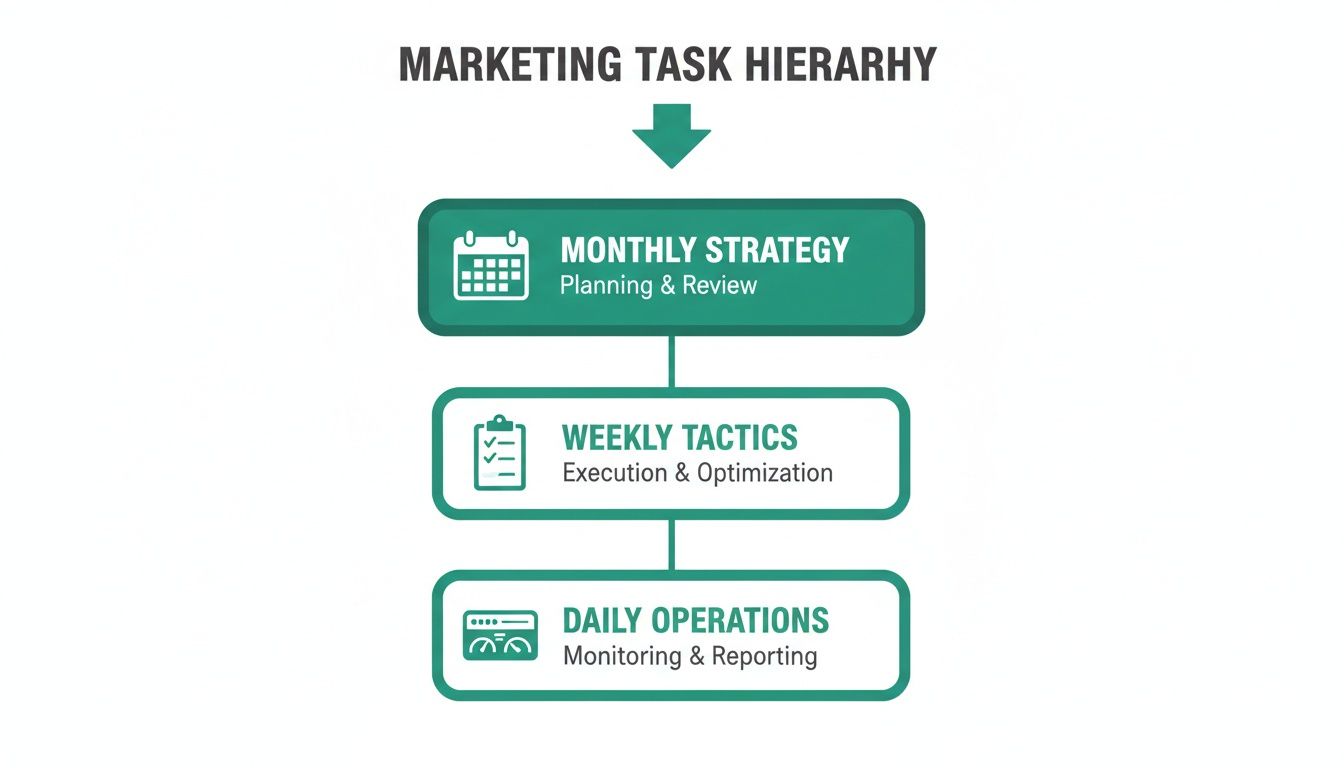
You can see how big-picture strategic planning (monthly) cascades into specific tactics (weekly) and then into real-time performance tracking (daily). It’s a constant cycle of planning, doing, and measuring.
To really get a handle on a marketing manager's world, it helps to see which KPIs they obsess over at each stage of the customer journey. Each set of metrics answers a different, critical question about the business.
Marketing Manager KPIs by Funnel Stage
| Funnel Stage | Example KPIs | Business Question It Answers |
|---|---|---|
| Top of Funnel (Awareness) | Website Traffic, Social Media Reach, Brand Mentions, Impression Share | "Are we reaching the right people and building brand recognition?" |
| Middle of Funnel (Consideration) | Lead Conversion Rate, MQLs, Email Open/Click-Through Rates, Content Downloads | "Are we successfully turning casual visitors into interested leads?" |
| Bottom of Funnel (Conversion) | Customer Acquisition Cost (CAC), ROAS, Customer Lifetime Value (CLV), Sales Qualified Leads (SQLs) | "Are our marketing efforts directly generating revenue and providing a positive return?" |
These KPIs aren't just for show; they are the tools a manager uses to diagnose problems, spot opportunities, and justify their budget. Let's break them down.
Top-of-Funnel Metrics: Getting on the Radar
The top of the funnel is all about casting a wide, but smart, net. The goal is simple: attract as many relevant people as you can into your brand's orbit. A marketing manager isn’t just making noise for the sake of it; they're trying to pull in the right crowd.
Success here is all about growing your visibility and initial engagement.
- Website Traffic: This is your digital footfall. How many people are showing up to your online storefront? A steady increase in unique visitors is a great sign that your awareness campaigns are hitting the mark.
- Social Media Reach & Engagement: It's one thing for people to see your content, but it's another for them to interact. Likes, shares, and comments show that your message is resonating.
- Brand Mentions: This is the digital equivalent of word-of-mouth. Tracking how often your brand is mentioned online gives you a real-time pulse on public awareness and sentiment.
Mid-Funnel Metrics: From Looker to Lead
Once you've got an audience, the next job is to turn that attention into genuine interest. The middle of the funnel is where casual browsers raise their hands and say, "Tell me more." The manager’s role is to make that step irresistible and easy.
At this point, the focus shifts from broad reach to qualified engagement.
The real skill in mid-funnel marketing is sorting the curious onlookers from the serious potential buyers. It’s all about quality over sheer quantity, so the sales team gets leads that are actually worth chasing.
Key metrics here include the Lead Conversion Rate—the percentage of visitors who take a specific action, like filling out a form—and Marketing Qualified Leads (MQLs), which are leads that marketing has identified as being ready for a sales conversation.
Bottom-of-Funnel Metrics: Proving the Payoff
This is where the rubber meets the road. The bottom of the funnel is all about actions that generate revenue and prove a clear return on the marketing investment. These are the numbers the C-suite cares about most, and they are at the core of a marketing manager's duties.
- Customer Acquisition Cost (CAC): Simply put, how much does it cost in sales and marketing to win one new customer? A huge part of the job is finding ways to drive this number down.
- Return on Ad Spend (ROAS): For every dollar you put into advertising, how many dollars did you get back in revenue? A high ROAS means your ad campaigns are efficient and profitable.
- Customer Lifetime Value (CLV): This metric looks at the big picture, predicting the total amount of revenue a single customer will generate over their entire relationship with your company.
A huge piece of this puzzle is knowing how to calculate marketing ROI accurately. This is how you prove your department’s value. Ultimately, a great manager uses this data not just to report on what happened, but to make smarter bets on what to do next. To go even deeper, check out our guide on how to measure marketing performance.
Translating Your Skills into a Standout Resume
Think of your resume not as a history of past jobs, but as a marketing campaign for your career. Its one and only job is to sell you as the best candidate for a marketing manager role. The single biggest pitfall I see is people simply listing their old duties.
A hiring manager already knows what a marketing specialist does. They're not looking for a job description; they're looking for proof that you can think and act like a leader who gets results. This means you have to shift your mindset from "what I did" to "what I accomplished." It’s a subtle but powerful change that makes the difference between a resume that gets tossed and one that lands you the interview.
From Task-Doer to Impact-Driver
Let's get practical about how to make this happen. A weak bullet point is a passive statement about a task you performed. A strong one, on the other hand, tells a short, compelling story about your impact, backed up by cold, hard data.
For example, "Managed social media accounts" is a dead-end statement. It tells the reader nothing about your skill, strategy, or the outcome of your work. It's forgettable filler.
But what if we rephrased it?
- Before: Managed social media content and campaigns.
- After: Drove a 45% increase in qualified leads from social channels by implementing a new data-informed content strategy, contributing to $250K in sales pipeline.
See the difference? The "After" version is a powerhouse. It proves you didn't just post updates; you built a strategy, analyzed data, generated real leads, and directly impacted the company's bottom line. In one sentence, you've shown strategic thinking, analytical skills, and a clear focus on business goals.
Quantify Everything You Can
Numbers are your best friend on a resume. They cut straight through the fluff and offer concrete proof of your value. Your mission is to find a metric for every single accomplishment you list.
And don't panic if you don't have access to the final, exact revenue figures for every project. There are plenty of other ways to quantify your work.
- Efficiency Gains: Did you make a process faster or smoother? "Reduced campaign launch time by 30% by creating a new project management workflow."
- Growth Metrics: How did you expand an audience or channel? "Grew the email subscriber list from 10,000 to 25,000 in one year through targeted lead magnet campaigns."
- Cost Savings: Were you able to make the budget stretch further? "Decreased customer acquisition cost (CAC) by 15% by optimizing ad spend allocation based on performance data."
Your resume should read like a highlight reel of your greatest business wins. Each bullet point is a mini-case study proving you are ready to handle the financial and strategic responsibilities of a manager.
Frame Your Skills for a Leadership Role
To make the leap from specialist to manager, your resume needs to speak the language of leadership. This means shining a spotlight on any experience where you took on strategic planning, mentored a teammate, or worked across different departments—even if you didn't have the official title.
Think back to projects where you took the lead, guided a junior colleague, or presented a new idea to stakeholders. Those are the stories that show you're ready for more responsibility.
Let's look at another transformation.
- Before: Wrote blog posts for the company website.
- After: Led the content strategy that increased organic search traffic by 70% year-over-year, resulting in the blog becoming the #1 source of inbound leads for the sales team.
The second version completely reframes a specialist task (writing) as a leadership achievement (strategy and results). It shows you're not just a writer; you're a strategist who understands how marketing activities connect to the bigger business picture. When you consistently frame your experience this way, you're not just asking for a new job—you're proving you're ready for it.
How Your Responsibilities Shape Your Paycheck
Let’s get one thing straight: not all marketing manager roles are created equal. And neither are their salaries. The single biggest factor that will move the needle on your earning potential is the specific set of responsibilities you own.
Think of it this way: a manager running a ten-person team with a multi-million dollar budget in B2B tech is playing a completely different game than someone managing two specialists for a local retail shop. The scope of your work—from the size of your team and budget to the strategic weight of your projects—directly impacts your compensation. This is precisely why getting a firm grip on the full spectrum of marketing manager duties is so crucial for your career.
Key Factors That Drive Your Salary
A few core elements really determine where a role lands on the salary spectrum. If you can prove you’re a pro in high-stakes areas like large-scale budget management, owning a P&L, or leading complex projects that span multiple departments, you’re setting yourself up for a much higher paycheck.
- Team Size and Leadership Scope: It's simple, really. Managing a larger, more diverse team demands more sophisticated leadership and operational chops, and that commands a higher salary.
- Budget Ownership: The more marketing dollars you control, the greater your financial responsibility. A manager overseeing a $5 million budget has a much bigger impact on the business's bottom line than one managing $50,000, and their pay will reflect that.
- Industry and Company Size: Let's be realistic, some industries just pay more. High-growth sectors like SaaS or fintech often have deeper pockets than others. In the same vein, large enterprise companies typically have higher pay bands than small businesses or startups.
Your salary isn't just an arbitrary number. It’s a direct reflection of the level of trust and responsibility the company is placing in your hands. The more you can show you can handle complexity and deliver measurable results, the more leverage you'll have at the negotiating table.
To really know your worth, you need to step away from guesswork and look at real, transparent compensation data. This is what arms you with the confidence to walk into a salary negotiation backed by the facts of the market.
For example, take a look at the data from SalaryGuide below. It shows real-time salary information for marketing roles, which you can filter by location and seniority.
This kind of data gives you a tangible benchmark. It lets you see exactly how different responsibilities in different markets translate into actual salary ranges. By using tools like this, you can make sure your pay truly reflects the strategic value and complexity of your work.
Common Questions About the Marketing Manager Role
As you start to map out a career as a marketing manager, a few questions always seem to pop up. Let's tackle some of the most common ones to give you a clearer picture of what the job really entails day-to-day.
What Is the Biggest Difference Between a Marketing Manager and a Digital Marketing Manager?
The real difference comes down to scope. I like to think of a Marketing Manager as the general contractor building a house. They're responsible for the entire project, from the digital foundation (like SEO and PPC) to the physical structure (events, print ads, and PR). Their job is to make sure every single piece works together under one cohesive strategy.
A Digital Marketing Manager, on the other hand, is more of a specialist—like the master electrician. They are laser-focused on the online world. While their work definitely overlaps with a generalist marketing manager (especially in tech-first companies), the "Marketing Manager" title usually means you're holding the purse strings for a bigger, more diverse budget and taking a 10,000-foot view of all marketing, both online and off.
What Are the Most Critical Soft Skills for a Successful Marketing Manager?
Your technical marketing chops will get you in the door, but it’s the soft skills that will make you truly successful. The non-negotiables are communication, leadership, and adaptability. You simply can't thrive without them.
A great manager has to be able to sell their strategic vision to their team and to the C-suite, inspire everyone from creative designers to data analysts, and have the guts to pivot quickly when the data or the market tells them to.
Rock-solid project management skills are also a must-have for keeping multiple campaigns and deadlines from going off the rails. Just as important is being able to manage expectations with stakeholders across the company. This is what separates a good manager from a great one—the ability to navigate organizational politics and get everyone pulling in the same direction.
How Can I Transition into a Manager Role from a Specialist Position?
Moving from a hands-on specialist role (like an SEO expert or content writer) into management is a big leap. It requires a conscious shift from focusing on doing the work to focusing on directing the work. The trick is to start acting like a leader long before you have the title.
You can start by actively looking for opportunities to:
- Lead a cross-functional project. This forces you to learn how to work with and influence people from different teams.
- Mentor a junior team member. It’s a fantastic way to prove you have what it takes to guide and develop people.
- Translate your work into business impact. Always frame your results in terms of revenue, leads, or customer acquisition cost—not just channel-specific vanity metrics.
When you consistently show that you get the bigger picture and understand how your expertise drives the bottom line, you're making an undeniable case that you’re ready for the full scope of a marketing manager's responsibilities.
Ready to find your next marketing role? SalaryGuide gives you access to thousands of real, recently posted marketing jobs directly from company career sites, with no recruiter spam. Explore open roles on SalaryGuide and find your perfect fit.
