How to Negotiate a Marketing Salary in 2026?
When you search "how to negotiate a marketing salary," you're not looking for vague confidence tips. You want specific numbers you can defend, exact words to say when a recruiter asks about your salary expectations, and a way to turn your campaign metrics into actual dollars. You're trying to avoid getting lowballed in a world where "marketing manager" can mean five completely different jobs with wildly different pay bands.
The stakes are real. Marketing professionals who skip salary negotiation typically leave 10-20% on the table, and that gap compounds over your entire career. We're talking hundreds of thousands of dollars over a decade.
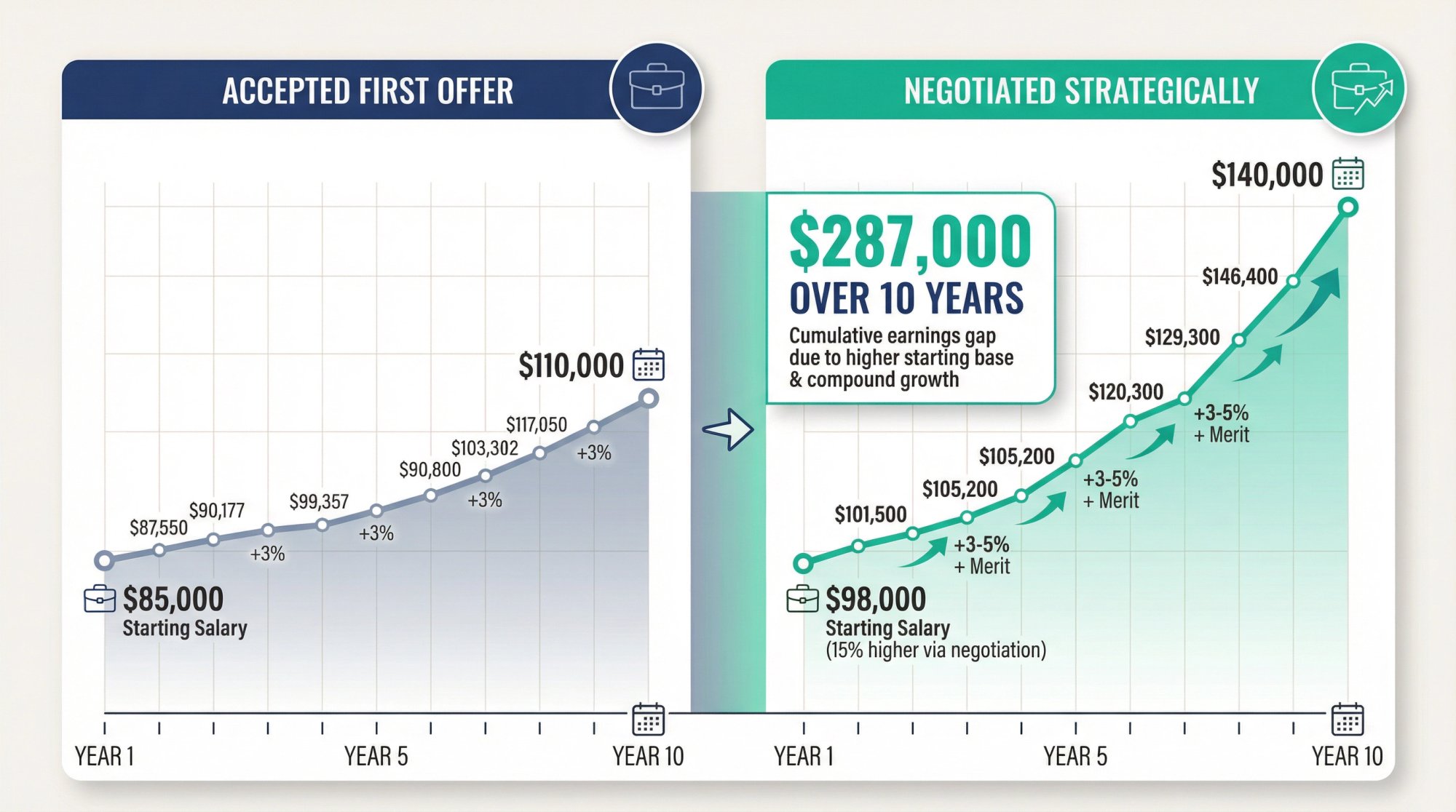
Here's what success actually looks like: you walk away with a compensation package you can explain in one sentence, you feel respected, and you don't spend the next year resentful because you accepted the first number thrown your way.
What Is the Current Marketing Job Market in 2026?
Before we get into tactics, you need to know what the current market actually looks like (not what you think it looks like based on outdated salary data from 2022).
SalaryGuide's live U.S. marketing job market view shows these numbers right now:
| Metric | Current Data |
|---|---|
| Marketing jobs posted (last 30 days) | 34,330 |
| Companies hiring | 17,291 |
| Median posted salary | $110,500 |
| Remote roles | 22% |
| Salary transparency rate | 41% of jobs post pay ranges |
| In-house vs. agency split | 86% in-house / 14% agency |
That last point is critical. The median posted salary for in-house marketing roles is $123,000 versus $95,000 for agency positions. Moving from agency to in-house is often the cleanest "salary unlock" a marketer can make, and it's the kind of context shift that changes your entire negotiation baseline.
What Is Salary Negotiation Really About?
Salary negotiation isn't about convincing someone you "deserve" more money. It's simpler than that:
You're trying to land at the top of a budget band
They're trying to land you at the bottom of that same band
Both of you are trying to do it without creating regret on either side
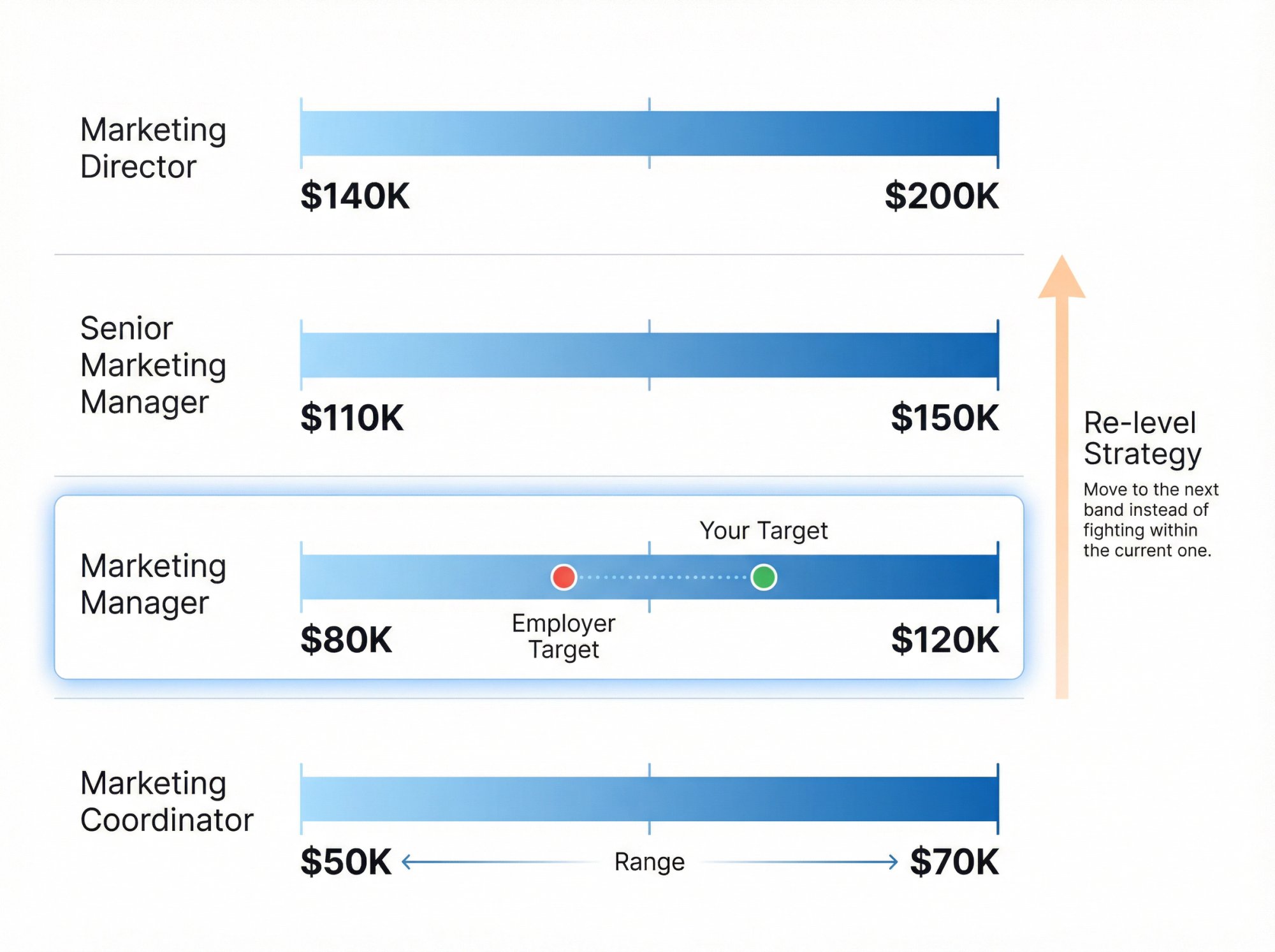
Most companies have a compensation band for each level. The negotiation usually determines where you land inside it, or whether they bump you up or down a level. That's why the smartest negotiation move is often "re-level the role" rather than fighting over $7,000 in base salary.
And yes, negotiating is completely normal. Employers expect it. (Also, it's rarely offer-killing unless you act weird about it.)
How to Negotiate Marketing Salary: 6-Step Framework
What Should You Think About Beyond Base Salary?
Your job is to negotiate a package, not a single number.
Total comp buckets you can negotiate:
Base salary
Bonus (target percentage, payout rules, frequency)
Equity compensation (vesting schedule, strike price, refresh grants, acceleration clauses)
Sign-on bonus, relocation package, retention bonus
Title and level (this changes the entire band)
Work setup (fully remote, hybrid split, travel expectations, home office stipend)
Budget authority (tools budget, ad spend, contractor hiring, conference attendance)
Time (extra PTO days, 4-day work weeks, start date flexibility, sabbaticals)
Review timeline (guaranteed comp review after 6 months with clear success criteria)
Sometimes base salary is capped, but bonus structure is flexible. Sometimes the title can be bumped, which moves you into a higher band entirely. Always ask about the full package, not just one line item.
How to Find Your Real Market Salary Range
You need three numbers before you walk into any negotiation:
| Number | What It Means |
|---|---|
| Floor | The lowest you'll accept without hating your life |
| Target | What you actually want (and can justify) |
| Anchor | A defensible high number to use in your counter |
Where to find grounded data:
Posted salary ranges (when listed in the job description)
SalaryGuide's role-specific pages broken down by seniority, geography, and agency vs. in-house
Recruiter intel from your network
Current job postings (not 3-year-old anonymous submissions)
Marketing reality: Titles are messy. "Manager" might be an individual contributor. "Head of Growth" might be a 2-person startup. So you need to benchmark by scope, not just title:
Budget size (annual ad spend, tools budget, team budget)
Channels you're responsible for (paid, organic, lifecycle, product)
Impact metrics (revenue driven, pipeline, retention, cost savings)
Complexity (data infrastructure, experimentation velocity, tooling sophistication)
Seniority expectations (pure strategy vs. hands-on execution)
Industry research consistently shows this exact issue: marketing lacks standard salary grades and job titles are inconsistent, which makes benchmarking harder. You need to anchor on scope and outcomes, not titles alone.
How to Prove Your Value in Marketing Terms
This is where most marketers completely mess up. They list tasks, not outcomes.
Your value proof should answer:
What business metric actually moved?
By how much? (Percentages and absolute numbers)
How confident are we it was incremental? (Not just correlated)
What did it cost to get that result? (Efficiency matters)
What would it cost to replace you or buy that skill externally?
How to Translate Marketing Work Into Business Value
Use this to convert "marketing work" into language that finance and executives actually care about:
→ Paid Media / Performance:
Metrics you moved: ROAS, CAC, LTV:CAC ratio, pipeline contribution, attributed revenue
Translate it: "I reduced CAC by 18% while maintaining volume, which increased contribution margin and freed $40k/month for growth experiments"
Metrics you moved: Organic revenue, signups, MQLs, pipeline, keyword rankings, conversion rate
Translate it: "I grew organic signups 40% year-over-year and reduced reliance on paid channels, creating a compounding acquisition channel that doesn't reset every month"
→ Lifecycle / Email / Retention:
Metrics you moved: Activation rate, retention, churn, expansion revenue, revenue per user
Translate it: "I increased activation by 12 points and reduced early churn, which is effectively revenue without acquisition spend. That improvement is worth $X in annual recurring revenue"
Metrics you moved: Win rate, feature adoption, pricing outcomes, launch performance, sales cycle length
Translate it: "I improved win rate by 6 points by tightening positioning and enablement. That's direct sales efficiency, and sales efficiency is money"
→ Marketing Ops / Analytics:
Metrics you moved: Attribution accuracy, automation coverage, reporting time saved, data quality, experiment velocity
Translate it: "I cut weekly reporting from 6 hours to 1 hour and improved attribution accuracy, which means we stopped spending blind and made faster decisions"
Critical insight: Finance teams don't care about "engagement" or "impressions." They care about revenue, margin, and efficiency. Translate everything into those terms.
What Is a Reasonable Counteroffer Amount?
Don't counter with a number you can't justify with a straight face.
Recent hiring manager surveys found most are comfortable with 10% to 25% above an initial offer, with 15% to 20% appearing most common. Bigger asks can backfire unless you have exceptionally strong justification.
That doesn't mean you can't ask for more than 25%. It means: if you're going outside that comfort zone, you need a stronger story. You need:
A competing offer at that level
Rare specialized skills they desperately need
Bigger scope than what was described in the interview
Market data showing the original offer is below median for the role
Without one of those, asking for 40% more makes you look unrealistic, not confident.
When Should You Negotiate Your Marketing Salary?
Best timing: After they want you, before you sign. Right after you receive the offer.
Goal of your first response: Buy time and set up a real conversation. Don't accept immediately (even if you're thrilled), and don't counter over email with a single number.
Your first move:
"Thanks for the offer! I'm excited about the role and the team. I'd like to take 24-48 hours to review the full package carefully. Can we schedule a quick call tomorrow to walk through it and discuss a couple questions I have?"
This gives you time to prepare, shows you're thoughtful (not reactive), and sets up a live conversation where nuance and tone matter.
How to Get Your Negotiation Agreement in Writing
You haven't actually negotiated until the agreed-upon terms are in the offer letter (or addendum) with all the key comp points spelled out.
Don't accept a verbal "yeah, we can do that" without documentation. Things get forgotten. People leave. Budgets change. Get it in writing, even if it's just an email confirmation from the hiring manager saying "Confirmed: $X base, $Y target bonus, Senior Manager title, review after 6 months."
What Are Current Marketing Salary Benchmarks?
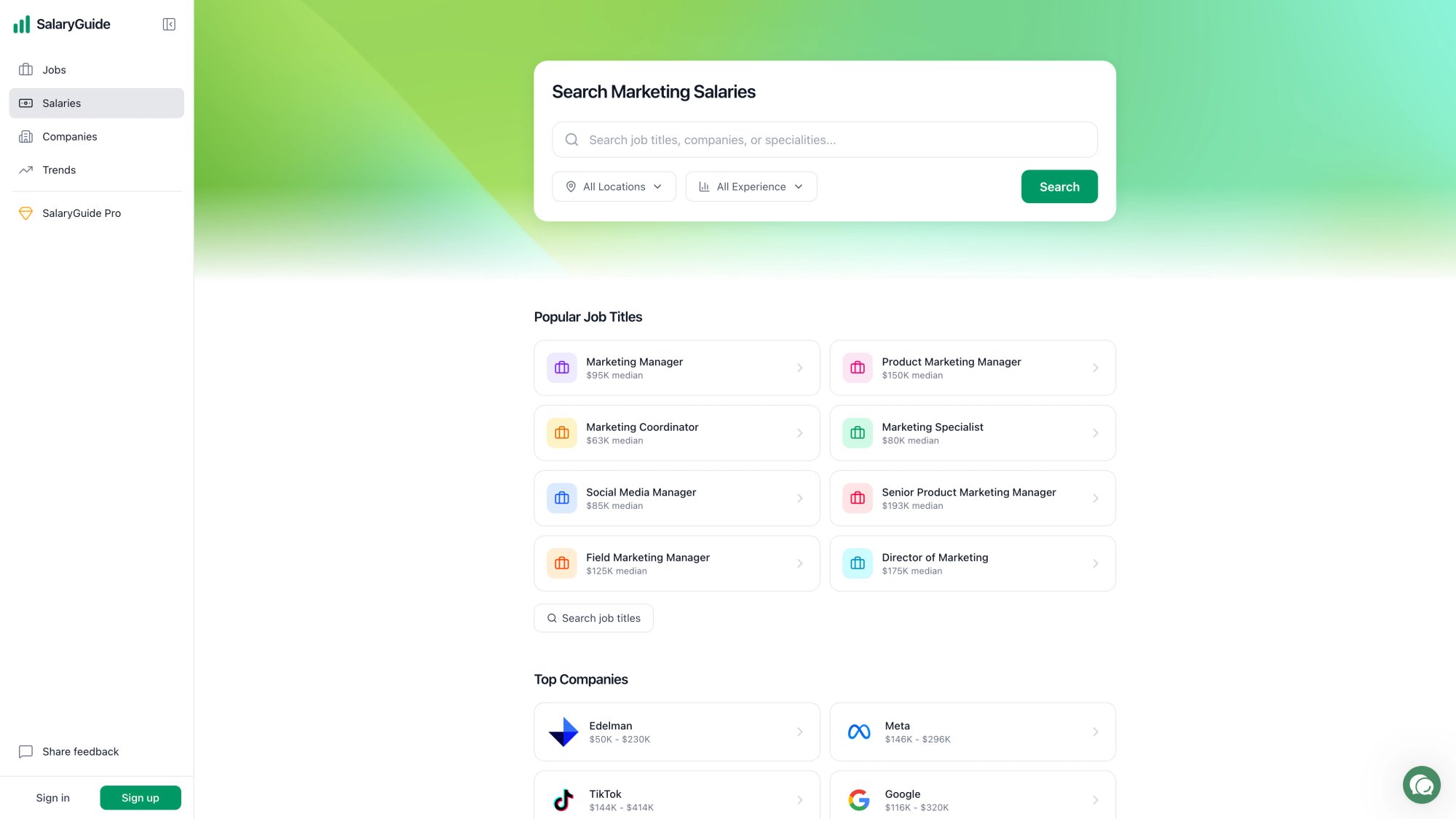
SalaryGuide's role pages show a pattern that's absolute negotiation gold for marketers: in-house consistently pays more than agency for multiple specialties. These numbers were updated February 9, 2026:
| Role | Median Salary | In-House Premium |
|---|---|---|
| Paid Media | $95,000 | +38% higher than agency |
| SEO | $100,000 | +17% higher than agency |
| Content Marketing | $105,000 | +29% higher than agency |
| Product Marketing | $195,000 | N/A (not typically agency) |
Use this two ways:
If you're moving from agency to in-house, don't negotiate like you're taking a small step. Your market context fundamentally changed. You should be targeting the in-house median, not a 10% bump from your agency salary.
If you're a hiring manager pulling candidates from agencies, your agency-calibrated comp expectations may be anchoring you way too low.
What Should You Say During Salary Negotiation?
What to Say When Asked About Salary Expectations
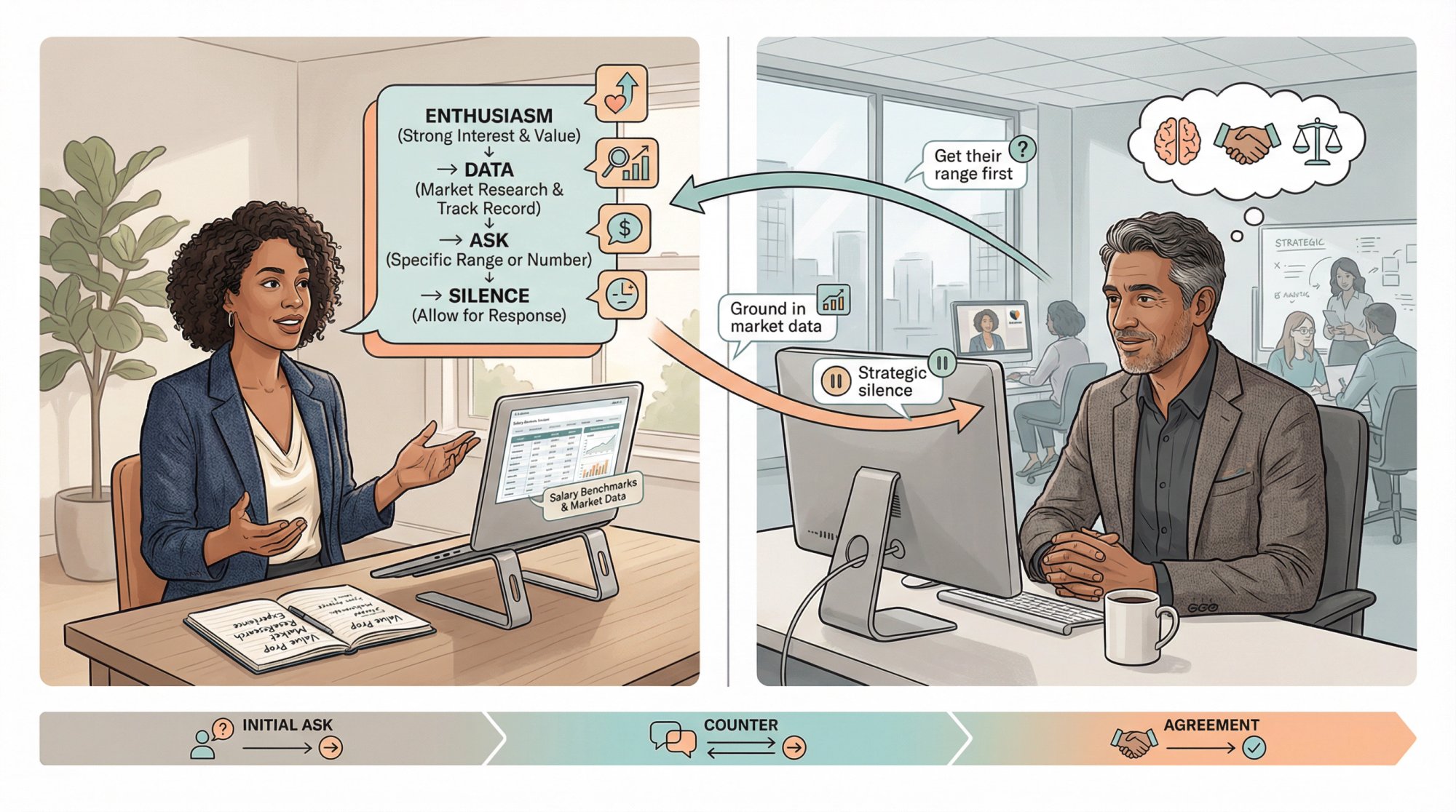
Goal: Avoid anchoring yourself too early. Try to get their range first. Keep it collaborative.
Option A (best when transparency laws apply or ranges might exist):
"I'm flexible on the exact number depending on scope, level, and total comp structure. Could you share the budgeted range for this role so we're aligned before we go deep into the process?"
Option B (if they refuse to share first):
"Totally understand. Based on what I'm seeing in the market for roles like this and the scope we discussed, I'm targeting a total comp in the range of X to Y. If that's in the right ballpark, I'd love to keep moving forward."
Option C (if you absolutely must give one number):
"If we're talking about a role with [this scope], I'd be aiming for around X. But I'd rather confirm the level and full responsibilities first so we don't anchor off incomplete information."
How to Request Time to Review an Offer
"Thanks so much for the offer. I'm genuinely excited about the role and working with the team. I'd like to take 24-48 hours to review the full package carefully. Can we schedule a quick call tomorrow to walk through it together and talk through a couple questions?"
What to Say When Making a Counteroffer
Structure: Enthusiasm → Data → Ask → Silence
"I'm really excited about this opportunity and I want to make this work. I did a thorough market check for this role's scope and level, and I'm consistently seeing compensation closer to [anchor number]. Based on my track record driving [specific results], I'm looking for [target number]. Is there flexibility to get the base to [specific number]?"
Then stop talking. The silence is doing work for you.
How to Negotiate When Base Salary Is Capped
"I appreciate the offer. If base salary is capped at the current level, could we look at a sign-on bonus to bridge the gap, or adjust the title and level to match the scope of the role? I'd rather solve this as a package than get stuck on one line item."
What to Say If They Claim No Negotiation
"I understand the base might be fixed. If that's the case, can we discuss a written compensation review after 6 months tied to specific performance goals? I'd like a clear path to getting to market rate if I hit the outcomes we're discussing."
How to Negotiate Your Job Level and Title
"Based on the scope we discussed, especially owning [budget size / team / strategic decisions], this feels closer to a [Senior / Lead / Director] role than the current leveling suggests. Can we calibrate the level so the compensation matches the actual responsibilities?"
How to Ask for a Raise as a Marketing Professional
What Size Raise Can You Realistically Get?
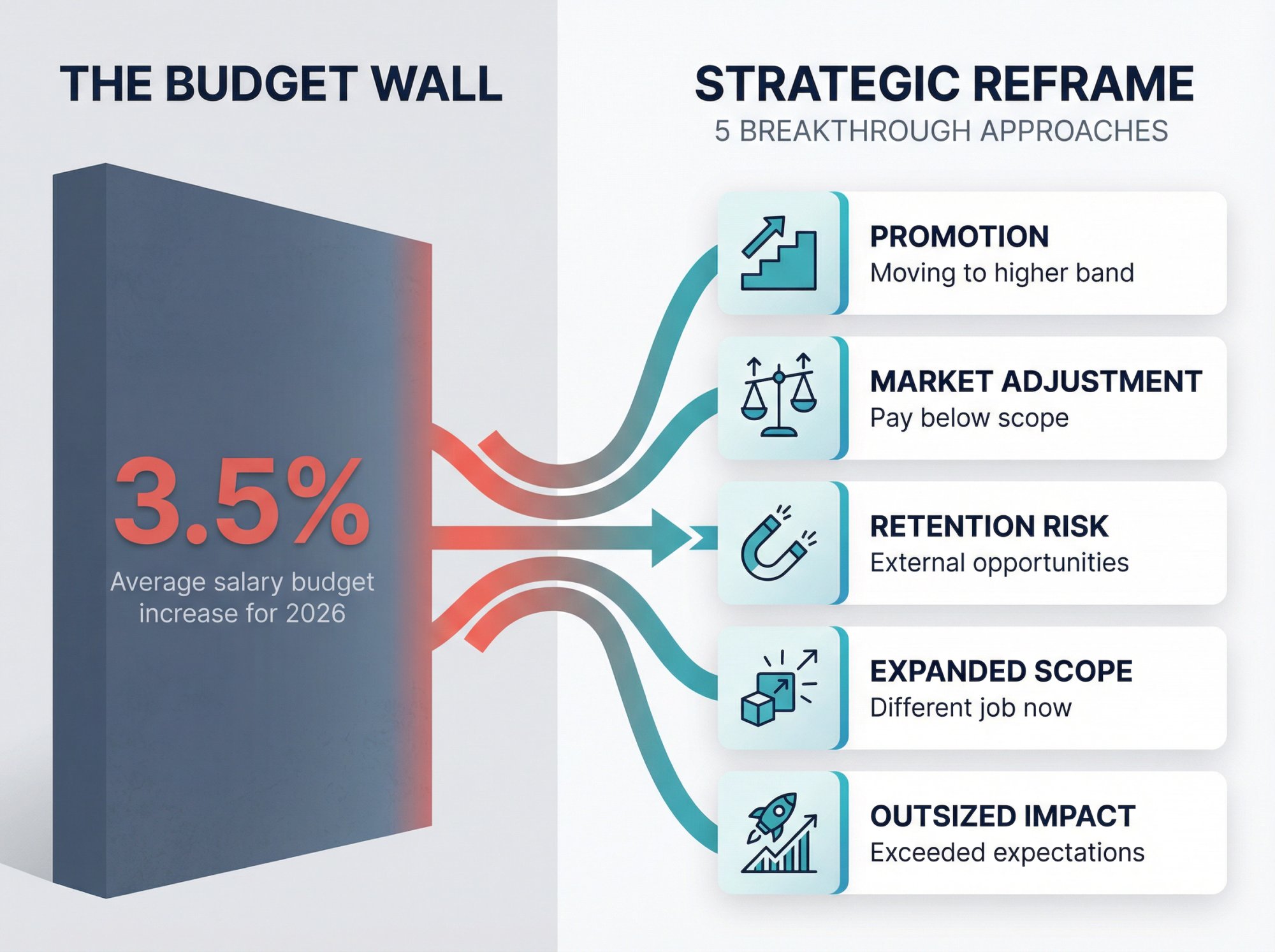
Recent salary budget surveys (based on 1,551 organizations surveyed in May-June 2025) show U.S. employers planned 3.5% salary budget increases for 2026.
Translation: if you walk into a raise conversation asking for a raise with no compelling story, you'll hit an immediate budget wall.
So you need to frame your ask as one of these:
Promotion or level change (moving to a higher band)
Market adjustment (your pay has fallen below market for your scope)
Retention risk (you have external pull or competing opportunities)
Expanded scope (you're doing a different job than when you were hired)
Measurable outsized impact (you delivered results that far exceeded expectations)
How to Structure Your Raise Conversation
Use this structure for your raise conversation:
Here's what I shipped (3-5 concrete outcomes with metrics)
Here's what changed (before/after on key business metrics)
Here's why it matters (tie it to revenue, margin, efficiency, or risk reduction)
Here's what I'm asking for (specific number + why it's fair based on market and scope)
Here's my plan for the next 90 days (so it feels like an investment, not a reward)
Pro tip: Time your raise conversation strategically. Don't ask right after the company missed quarterly targets or announced layoffs. Do ask when you've just shipped a major win or when performance reviews are happening.
How Often Do People Actually Negotiate Salary?
Two recent data points worth knowing:
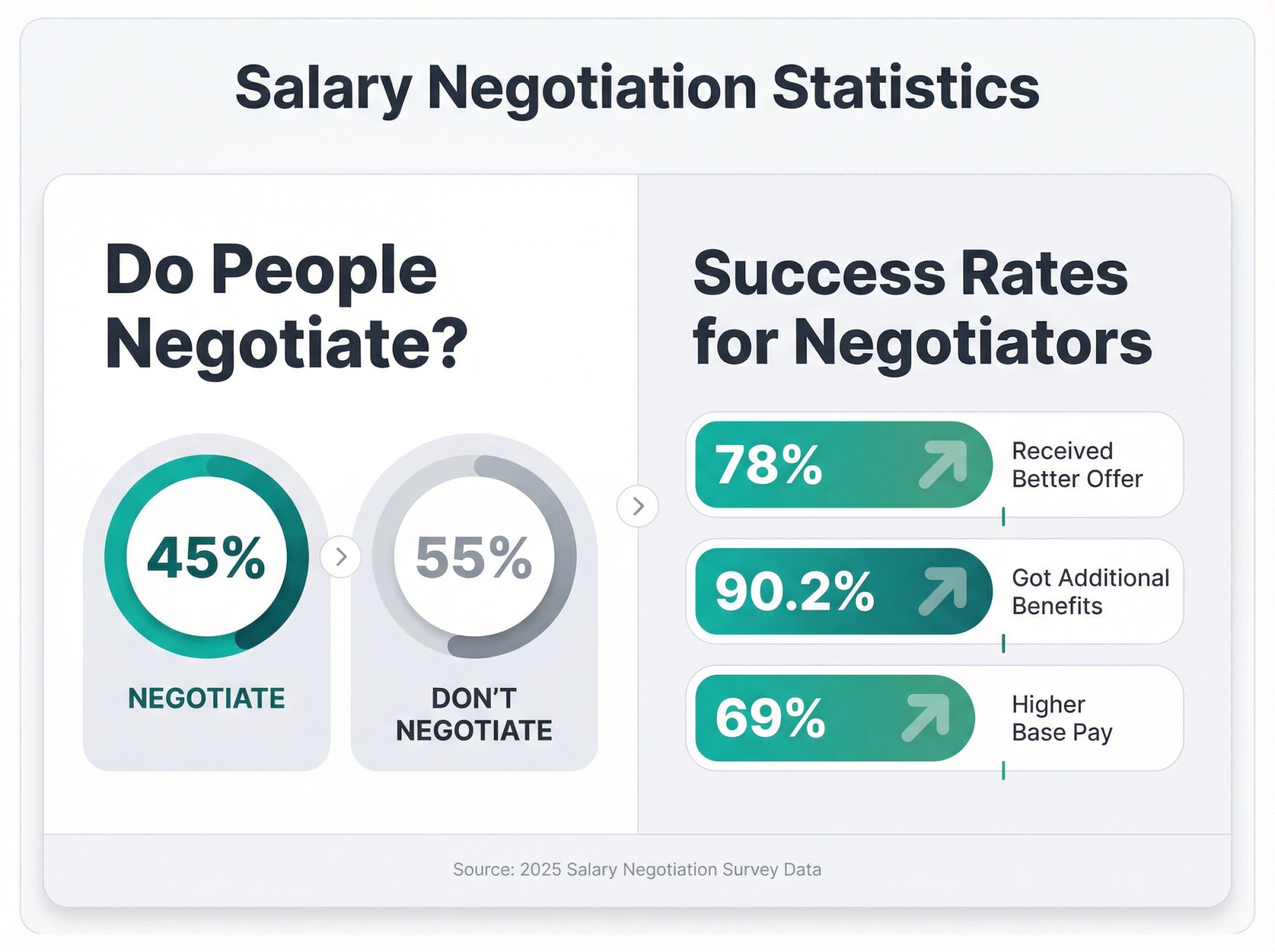
Recent research reports (April 2025) show that 45% of workers negotiate salary while 55% don't. Among those who did negotiate, 78% received a better offer.
The numbers are striking. Additional survey data shows only 30.4% negotiated their offer in Q4 2025, but among those who did, 90.2% received some additional benefit, and 69% got better base pay.
Takeaway: Negotiating isn't magic, but skipping it is basically choosing to leave money (or perks) on the table.
How Do Salary Transparency Laws Affect Negotiation?
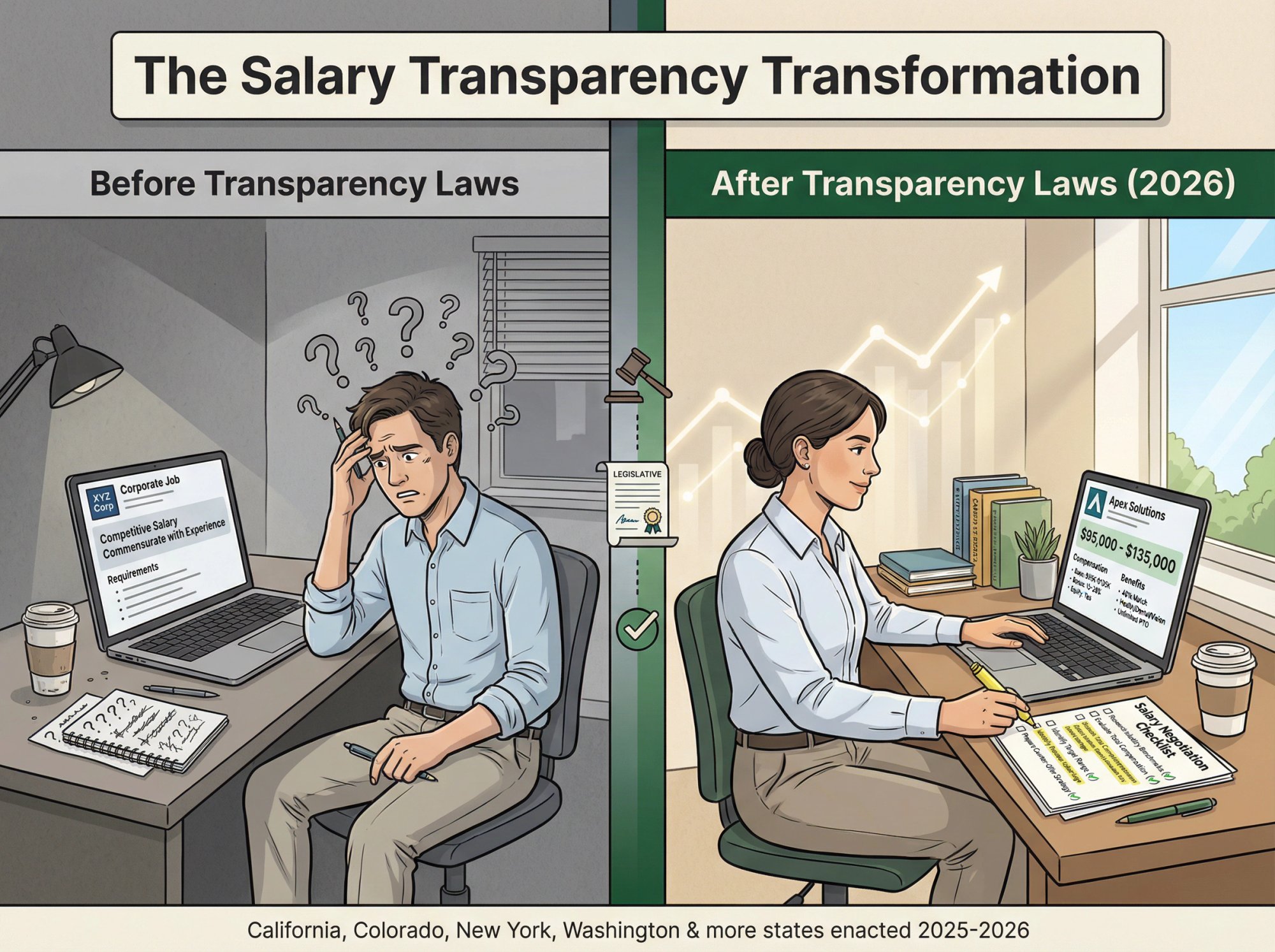
Pay ranges showing up in job postings isn't a trend anymore. It's becoming law in more states.
A January 21, 2026 legal compliance piece notes that more states joined pay transparency requirements in 2025, with ongoing expansion at state and local levels. It also highlights California changes effective January 1, 2026 aimed at preventing overly broad pay ranges (like "$80k-$200k" which tells you nothing useful).
Compliance guides break pay transparency laws into tiers: posting ranges proactively, providing ranges on request, and salary history restrictions.
How this helps you as a candidate:
If a range is posted, you can negotiate within it (aim near the top if you're a strong fit)
If it's not posted but the law requires disclosure on request, you can ask for the budgeted range early in the process
If they push for your current salary in states with salary history bans, you can redirect: "I prefer to focus on the value I'll bring to this role and the market rate, rather than what I've been paid historically"
(I'm not giving legal advice here. Laws vary by location. But the direction is clear: more transparency, more leverage for prepared candidates.)
What Marketing Salary Negotiation Mistakes Should You Avoid?
Why You Should Negotiate as a Marketing Specialist
Specialized skills command premium pay. Recent marketing and creative trends reports found 78% of marketing leaders typically offer higher salaries to candidates with specialized skills. Research specifically calls out digital strategy, AI/ML, automation, and analytics as high-value specializations.
If you have deep expertise in performance marketing attribution, marketing data pipelines, or lifecycle automation, you're not a "marketing generalist." You should be negotiating like a specialist with rare skills.
Why You Should Never Give Your Salary First
The first number becomes the mental "center" for the entire negotiation. If you throw out a low number in the first phone screen because you're worried about seeming greedy, you just negotiated against yourself. You set a ceiling that's hard to move past.
Always try to get them to share their range first. If you absolutely must share a number early, make it your target (not your floor), and frame it as flexible based on scope and level.
Why Emotional Arguments Don't Work in Salary Negotiation
"I need more money because my rent went up" is a weak argument. It's personal, and it makes the company feel like they're solving your life problem rather than paying market rate for value.
"Based on scope, market data, and the outcomes I've delivered, here's the package that makes sense" is a strong argument. It's about fairness, value, and market reality.
What to Negotiate Beyond Base Salary
Sometimes base salary is genuinely capped (rigid bands, tight budgets, equity constraints). But bonus target, equity grant size, sign-on bonus, PTO, and review timeline often have more flexibility.
Also, negotiating title and level can move you into a completely different band, which changes everything downstream.
Why Marketing Impact Proof Matters in Negotiation
Marketing has a reputation for being "hard to measure." Your detailed proof of business impact is the antidote to that perception. Walk in with before/after metrics, efficiency gains, revenue contribution, and cost savings. Make it impossible for them to wave you off as "just a marketer."
How Can SalaryGuide Help You Negotiate Better?
If you're a marketing professional trying to figure out whether your current pay is competitive (or what to ask for in your next role), platforms like SalaryGuide were built specifically for this.
Here's how to use it in your negotiation prep:
1. Start with SalaryGuide's trends dashboard to calibrate the current market. You'll see posted median pay, remote share, salary transparency rate, and in-house vs. agency splits based on real-time job posting data.
2. Use role-specific salary pages to benchmark your exact specialty. Whether you're in paid media, SEO, content marketing, product marketing, or retention, you can see median comp broken down by experience level and geography. You'll also see that critical in-house vs. agency gap we talked about earlier, which can completely change your negotiating baseline.
3. Leverage the in-house vs. agency data as a negotiation lever when switching environments. If you're moving from a $75k agency role to an in-house position, you shouldn't be asking for $82k. You should be targeting the in-house median for your role, which might be $110k. That's not greed. That's market reality.
4. If you want deeper support, SalaryGuide Pro offers step-by-step negotiation playbooks, exact scripts recruiters respond to, live Q&A sessions with experts, and a private community of marketers sharing real negotiation wins. It's $99/month (founding rate) and runs inside a Skool community with weekly coaching calls.
But even without a paid tool, the core principle remains the same: you need accurate, current, role-specific data before you walk into any negotiation. Generic averages from 2023 aren't good enough.
Frequently Asked Questions About Marketing Salary Negotiation
Should You Negotiate Salary in a Weak Job Market?
Yes, but negotiate like an adult: use data, be realistic about your ask, and have alternatives. Surveys from Q1 and Q4 2025 show negotiation rates and outcomes do fluctuate with market conditions, but negotiating thoughtfully can still pay off even when hiring slows down. What changes in a tough market is how much you can push, not whether you should push at all.
What Should You Do If They Say This Is Their Final Offer?
Ask a clarifying question: "Is base salary capped, or is the full package capped?" Then pivot to other levers:
Sign-on bonus or relocation package
Higher bonus target percentage
Equity grant (or larger equity grant)
Earlier compensation review (6 months instead of 12)
Title or level calibration (which might unlock a different band)
Sometimes "we can't move on base" actually means "we have flexibility everywhere else."
How to Negotiate When Salary Ranges Are Already Posted
Pick a target near the top of the range only if you can defend "top-of-range value" with rare skills, proven outcomes, or bigger scope than described. Otherwise, aim for the upper-middle of the range and trade for non-base items like bonus structure, equity, or review timing.
Can You Negotiate After Already Accepting an Offer?
Technically yes, but it's awkward and risky. You lose almost all leverage once you've said yes. The time to negotiate is between receiving the offer and accepting it, not after you've already committed. If you realized you made a mistake by accepting too quickly, you can try (especially if something material changed), but expect it to be uncomfortable.
Can You Negotiate Without a Competing Offer?
Absolutely. Competing offers give you leverage, but they're not required. You can negotiate based on:
Market data showing the offer is below median
Scope being broader than initially described
Your proven track record of delivering results
Specialized skills they need
You don't need a competing offer to ask for fair market value.
Should You Share Your Current Salary If Asked?
In states with salary history bans, you can (and should) decline. In other states, you're legally allowed to deflect with: "I'd prefer to focus on the value I'll bring to this role and the market rate for the position, rather than what I've been paid historically." If they push hard, you can share your total comp (not just base), which is usually higher and gives you a better anchor.
How Do You Know If Your Counteroffer Is Reasonable?
Run it through this reality check:
Is it within 10-25% of their initial offer? (That's the typical comfort zone.)
Can you justify it with market data, scope, or proven outcomes?
Does it match the market median (or higher) for your role and seniority?
Would you feel confident explaining it out loud to the hiring manager?
If you can answer yes to all of those, your counter is reasonable.
What If They Withdraw the Offer Because You Negotiated?
This is extremely rare if you negotiate respectfully and professionally. Companies expect negotiation. What can blow up an offer is:
Acting entitled or aggressive
Making unrealistic demands with no justification
Being dishonest (lying about competing offers, for example)
Negotiating poorly after you've already accepted
If a company rescinds an offer purely because you asked a reasonable question about compensation, you probably dodged a bullet. That's a red flag about how they treat employees.
Final Mindset (The One Line to Remember)

You're not begging for more money. You're showing them the price of getting outcomes.
If you've reduced CAC by 20%, built a compounding organic channel, or improved win rates, you're not asking for a favor. You're pricing value. And if you can't defend your number with data and outcomes, you're not negotiating. You're guessing.
Walk in prepared. Know your numbers. Use real market data. Practice your scripts out loud so they don't sound rehearsed. And remember: the negotiation starts the moment they want to hire you, not the moment you want the job.
Good luck.
