The Ultimate Salary Negotiation Script (2026)

You searched for "salary negotiation script" because you don't need a pep talk. You need the exact words to say.
This is that guide. You'll get copy/paste templates for every scenario (email, phone, recruiter screen, counteroffer, raise request), a simple framework to pick your numbers, and the specific phrases that turn "I want more money" into "This is the market rate for this value."
If you're a marketing professional, you'll also get scripts for the stuff we actually care about but often forget to negotiate: bonus structure, tool budgets, title scope, and remote flexibility.
Let's make sure you don't leave money on the table.

How to Succeed at Salary Negotiation
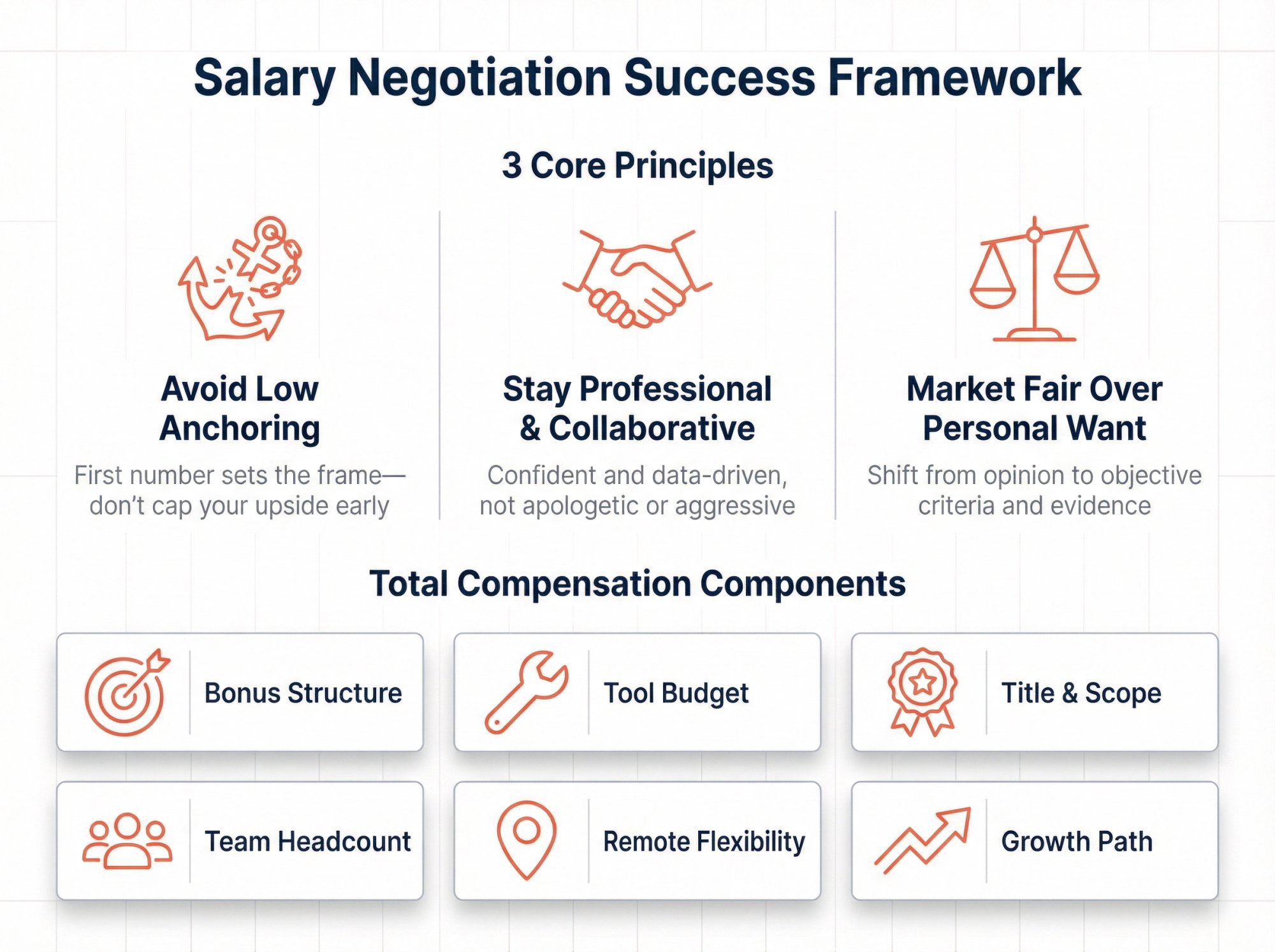
You're trying to do three things at once, and they're all critical.
Don't get anchored low.
The first number sets the frame for everything that follows. If you throw out a low anchor early, you've capped your upside before you even start negotiating. Understanding how to answer salary expectations strategically is crucial to avoiding this trap.
Sound professional and collaborative.
You want to come across as confident and data-driven, not apologetic or aggressive. The goal is "let's solve this together," not "I demand."
Turn "I want more" into "This is market fair."
The difference between a successful negotiation and an awkward one is objective criteria. When you can say "for this scope and market, $X is the fair price," you've shifted from opinion to evidence.
This is where salary benchmarking becomes your most powerful tool.
What to Negotiate Besides Base Salary
Here's what most career advice misses. If you're in marketing, your actual earning power comes from a bundle of factors that change how the next 2-3 years look:
→ Bonus structure: Is it discretionary or formula-based? What metrics do you control? Understanding performance-based compensation helps you evaluate the true value of variable pay.
→ Tool budget: Can you actually run experiments, or are you stuck with whatever's already licensed?
→ Title and scope: Does your title match what you're actually doing? (Title affects your next job's salary.)
→ Team headcount: Are you managing people? That's a different pay band.
→ Remote/hybrid flexibility: Location affects cost of living and quality of life.
→ Growth path: What's the next level, and what does it take to get there? Learning how to get promoted should be part of your negotiation strategy.
Most people focus only on base salary and walk away from the negotiation leaving real value on the table. When you understand what is a total compensation package, you can negotiate holistically.
How to Prepare Your Negotiation Numbers (10 Minutes)
The scripts in this guide work best when you've already done 10 minutes of homework. You need three numbers before you start:
| Number | What It Is |
|---|---|
| Target | What you'd feel good accepting |
| Stretch | What you'll ask for (your opening anchor) |
| Walk-away | The minimum you'll accept (or you pass on the offer) |
Step 1: How to Find Your Market Rate
Don't negotiate based on vibes. Use actual percentile data so your ask has teeth.
Understanding how to assess fair market value gives you confidence in your numbers.
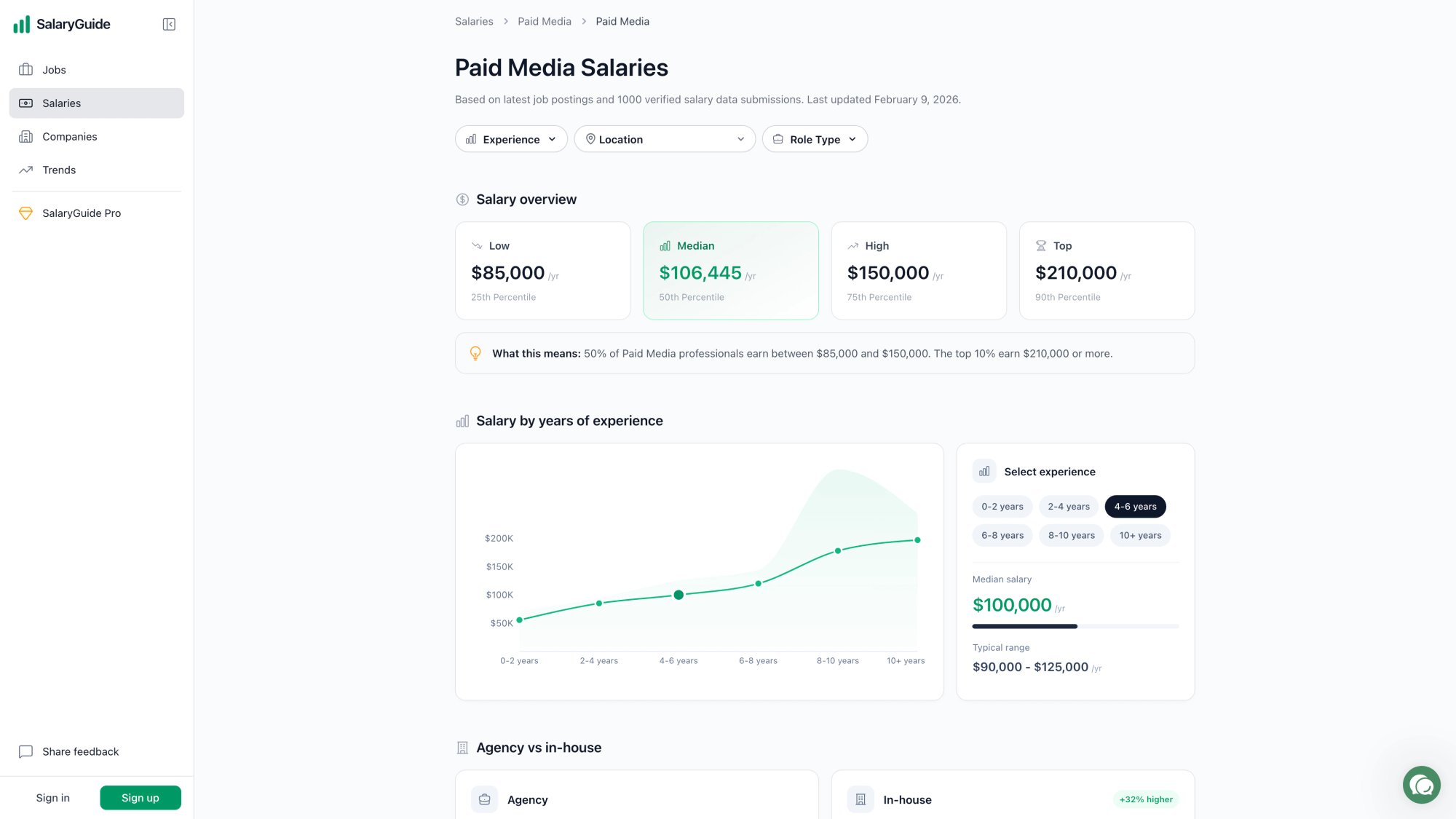
SalaryGuide's salary pages show percentiles with a "last updated" stamp. That's your external objective criteria. Here's an example (just to show you the method):
Chief Revenue Officer (CRO) salary data (as of February 9, 2026):
| Metric | Amount |
|---|---|
| Median total comp | $111,000 |
| 25th-75th percentile | $100,500-$121,500 |
| 90th percentile | $127,800 |
You're not "asking for more." You're aligning to a known distribution. That small shift in framing changes the entire conversation.
Step 2: Why Marketing Salaries Vary by Work Type and Seniority
Reality #1: In-house vs agency is basically a different market
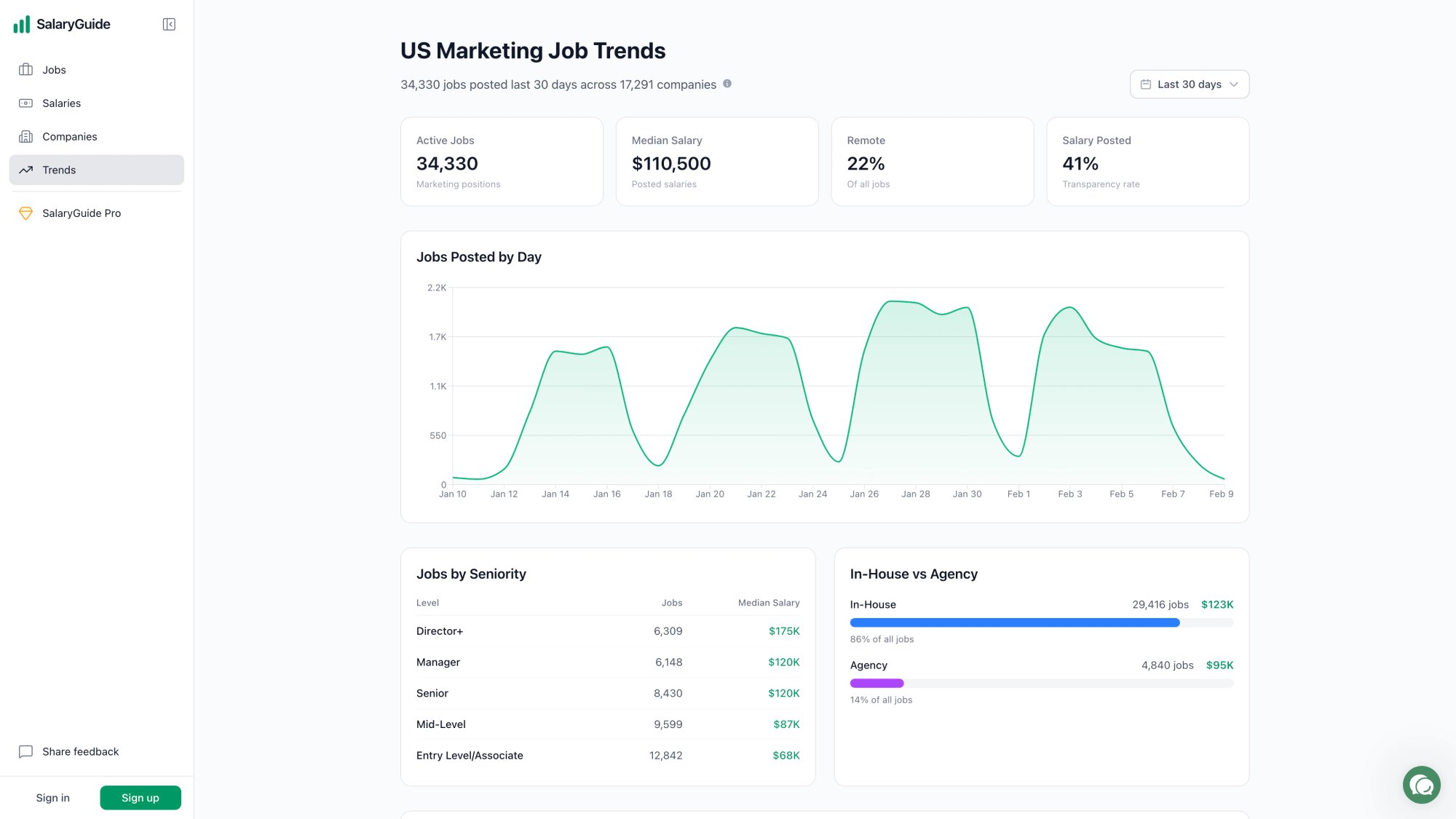
According to SalaryGuide's live trends dashboard (last 30 days of data), in-house roles dominate the job market and pay significantly higher:
| Work Type | Median Salary | Share of Market |
|---|---|---|
| In-house | $123,000 | 86% of listings |
| Agency | $95,000 | 14% of listings |
That's a 29% pay premium for in-house work.
If you're moving from agency to in-house, your market value just jumped. Your script should price that transition, not just your years of experience.
Check how much do marketers earn to understand the full pay landscape.
Reality #2: Seniority bands are real bands (and titles matter less than scope)
Same trends dashboard breaks down median posted salary by actual seniority level:
| Level | Median Salary |
|---|---|
| Director+ | $175,000 |
| Manager | $120,000 |
| Senior | $120,000 |
| Mid-level | $87,000 |
| Entry/Associate | $68,000 |
If you're applying for a "Senior" role but actually doing "Manager" work (budget ownership, people management, strategy), your negotiation script should explicitly price the scope, not just match the title.
Understanding how to become a marketing director helps you understand what director-level compensation looks like.
Step 3: How Pay Transparency Affects Your Negotiation Strategy
Pay transparency is rising, but it's nowhere near universal yet. Learning what is pay transparency helps you understand how the laws affect your negotiation strategy.
SalaryGuide's marketing dataset shows 41% of marketing jobs posted salary ranges in the last 30 days. Research shows salary transparency rates are increasing across the market.
Translation: You still need scripts for "what's the budgeted range?" because a huge chunk of postings keep it hidden.
Why Salary Negotiation Feels Easier With This Framework

Negotiation is just price discovery under uncertainty.
The employer is trying to buy your time and skill at the lowest defensible price. You're trying to sell at the highest defensible price. Both sides are operating with incomplete information.
The winning move is to shift the conversation from:
"I want $X"
To:
"For this scope and market, $X is the fair price. How do we make it work?"
That's why every script in this guide follows the same structure:
Enthusiasm (you're excited about the role)
Objective criteria (here's the data)
Specific ask (here's the number or the question)
Silence or next step (let them respond, or ask what's possible)
When you use this structure, negotiation stops feeling like conflict and starts feeling like collaborative problem-solving.
Salary Negotiation Scripts You Can Copy and Paste
"What Are Your Salary Expectations?" (Recruiter Screen)
Goal: Don't anchor yourself low. Get their range. Keep the process moving.
Script (best default):
Totally fair question. I'm still mapping the scope and success metrics for the role, so I don't want to anchor us prematurely.

Can you share the budgeted range for this position? If we're aligned, I'm confident we can make the numbers work.
If they refuse and demand a number (use a range anchored high):
Based on market data for similar roles and the scope we've discussed, I'm targeting a base in the $X to $Y range, depending on total comp and the exact responsibilities.

What range are you working with on your side?
If the job posting already includes a range (use it to justify "top of band"):
I saw the role is posted at $A-$B. Given my experience in [specific outcomes], I'd be targeting the top end of that range.

If we're aligned there, I'm excited to move forward.
Why this works: It's calm, it signals competence, and it makes the recruiter solve the puzzle with you instead of against you. Learn more strategies in how to answer salary expectations.
How to Handle Application Forms That Force a Number
Goal: Don't self-lowball inside an ATS filter.
Rules of thumb:
| Situation | What to Enter |
|---|---|
| If you can type text | "open to discussion" or "market rate" |
| If it forces a number | Enter your stretch, not your target |
| If posting includes a range | Enter the top of the posted range |
Then use your next human conversation to reset the context with the recruiter script above.
How to Buy Time Without Sounding Uncertain (After Getting the Offer)
Goal: Lock in that you're excited, then get 24-48 hours to review everything.
Email script:
Subject: Thank you - excited about the offer

Hi [Name],

Thank you for sending this over. I'm genuinely excited about the role and the team.

Can I take until [day/time] to review the full offer details? I want to look at everything thoughtfully (base, bonus, benefits, equity if applicable) and come back with any questions.

Thanks again,
[Your Name]
This is normal. You're not playing games. You're doing due diligence. Any reasonable employer expects this.
Understanding how to calculate total compensation helps you evaluate the full offer.
How to Counteroffer via Email (Short and Data-Backed)
Goal: Make a specific ask backed by market data and impact, while staying collaborative.

Template:
Subject: Offer details - quick question on base

Hi [Name],

I'm excited about the offer and I'd love to make this work.

After reviewing the role scope and benchmarking market data for similar positions, I was hoping we could adjust the base salary to $X.

My reasoning is simple:

- Scope: [1 line: what you're owning that drives revenue/cost/risk]

- Track record: [1 line: a metric win that matches the role]

- Market: roles with this scope are typically priced closer to $X

Is there flexibility to get to $X? If base is constrained, I'm open to discussing a sign-on bonus, bonus target, or equity to close the gap.

Thanks,
[Your Name]
How to pick $X (fast):
| Situation | Typical Ask |
|---|---|
| Strong offer (already top 25th percentile) | 5-10% increase |
| Mid-band offer | 10-15% to reach top of band |
| Below-market offer | 15-25% to align with market |
If you used SalaryGuide percentiles, your "market" line becomes immediately credible. See counter offer letter examples for more templates.
How to Counteroffer on the Phone (What to Say and When to Stop Talking)
This is the most "real" version because tone and timing matter.
Opening:
First, thank you - I'm excited about the offer and I like the team a lot.

I reviewed everything, and I had one thing I wanted to discuss: base salary.
State the ask + why (keep it tight):
Based on the scope and market data for comparable roles, I'm looking for $X base.

I'm confident I can deliver [outcome] because I've already done [proof].
Then shut up. Let them talk.
The silence is doing work. Don't fill it. Let them respond.
If They Say: "We Don't Have Budget"
Response:
Got it. What flexibility do we have elsewhere to bridge the gap?

For example: sign-on bonus, bonus target, equity, or a compensation review at 3-6 months tied to specific goals.
Understanding what is variable compensation helps you propose creative alternatives.
If They Say: "That's the Top of the Range"
Response:
Thanks - that's helpful.

If that's truly the cap on base, could we:

1) Confirm what performance would look like at 6 months, and

2) Add a written review checkpoint with a compensation adjustment if I hit those targets?

Alternatively, can we explore a sign-on to make year one whole?
If They Say: "We Need an Answer Today"
Response:
I understand timing matters. I want to be respectful of that.


Can we do this: I'll confirm by [time tomorrow] after I've reviewed the full package once more. I want to make a decision I can fully commit to.
If they're legit, they'll usually give you the time. If they won't, that's a signal about how they operate.

How to Negotiate What Marketers Actually Forget
How to Negotiate Bonus Structure
Script:
Can we clarify the bonus plan and what levers I control?

Specifically:

- What's the target bonus %

- What are the metrics (pipeline, revenue, ROAS, retention, etc.)

- Who signs off

- What's the historical payout rate

If the base can't move, I'd love to explore increasing the target bonus or adding a sign-on.
Learn more about what is commission-based pay to understand variable compensation structures.
How to Negotiate Title and Scope
Script:
Based on the scope we discussed - [team size/budget/strategy ownership] - I believe the title should reflect that level.

Would you be open to adjusting the title to [X], to match the responsibilities and market leveling?
Remember: Your title today determines your market value for your next job. Don't undersell your scope.
Understanding marketing manager responsibilities and duties helps you articulate the scope correctly.
How to Negotiate Tool Budget
Script:
To hit the targets we discussed, I'll need the right tooling.

Can we confirm:

- The monthly tool budget I can control

- Whether I can choose vendors (within reason)

- What approval looks like for new tools

If there's no formal budget, can we add a quarterly allowance for tooling + experimentation?
How to Negotiate Remote Work and Location Pay
Pay transparency laws increasingly force employers to disclose ranges, and remote jobs often come with location-based pay zones. Remote roles may need to comply with transparency requirements across multiple states, and employers often disclose different ranges for different locations.
Script:
I'm aligned on the role. For the location piece, can we confirm which pay band applies to me and whether that changes if I relocate?

I just want to make sure we're aligned long-term.
Understanding what is cost of living adjustment helps you evaluate location-based pay fairly.
How to Answer "What Are You Currently Earning?"
Two things can be true at once:
You want to stay professional
You don't want your past salary used to cap your future
Also, in many places, this question is getting legally restricted.
In the EU, pay transparency regulations require that employers must disclose the starting salary or range (in the posting or before the interview) and are prevented from asking about pay history.
In the US, pay transparency rules are expanding, but laws vary significantly by state and city (and they're changing fast). Check pay transparency laws by state for the latest regulations.
Script:
I prefer to keep my current compensation private.

I'm focused on the market rate for this role and the scope we've discussed. Based on my research, I'm targeting $X-$Y for this position.
How to Ask for a Raise (Internal Negotiation Script)

Internal raises are harder because you don't have "new hire" leverage. You have to sell it like an investment memo.
Use this three-part structure (which SalaryGuide's raise guide emphasizes):
What changed (scope expansion)
What you delivered (measurable outcomes tied to revenue/cost/risk)
What the market pays for that scope
Understanding what is merit increase and typical promotion salary increase percentage helps you set realistic expectations.
How to Request the Raise Meeting
Hey [Manager Name] - can we book 30 minutes next week to discuss my role scope, performance, and growth path?

I'd like to walk through what I've delivered this cycle and align on next steps (including compensation).

What time works?
What to Say in the Raise Meeting
I want to talk about aligning my compensation with the scope of my role.

Since [time], my scope expanded to include:

- [scope change]

- [scope change]

Results:

- [metric win tied to revenue/cost/risk]

- [metric win]

Based on market benchmarks for this scope, I'm looking to move my base to $X.

How do we make that happen, and what's the timeline?
Check asking for a raise for more strategies.
If They Can't Adjust Base Right Now
I understand budgets can be tight.

Can we define the exact milestones I need to hit, and set a specific date (e.g., 90 days) to revisit with a compensation adjustment if I deliver?
This turns a "no" into a "yes, if."
How to Handle Common Negotiation Objections
Use these when you get pushback.
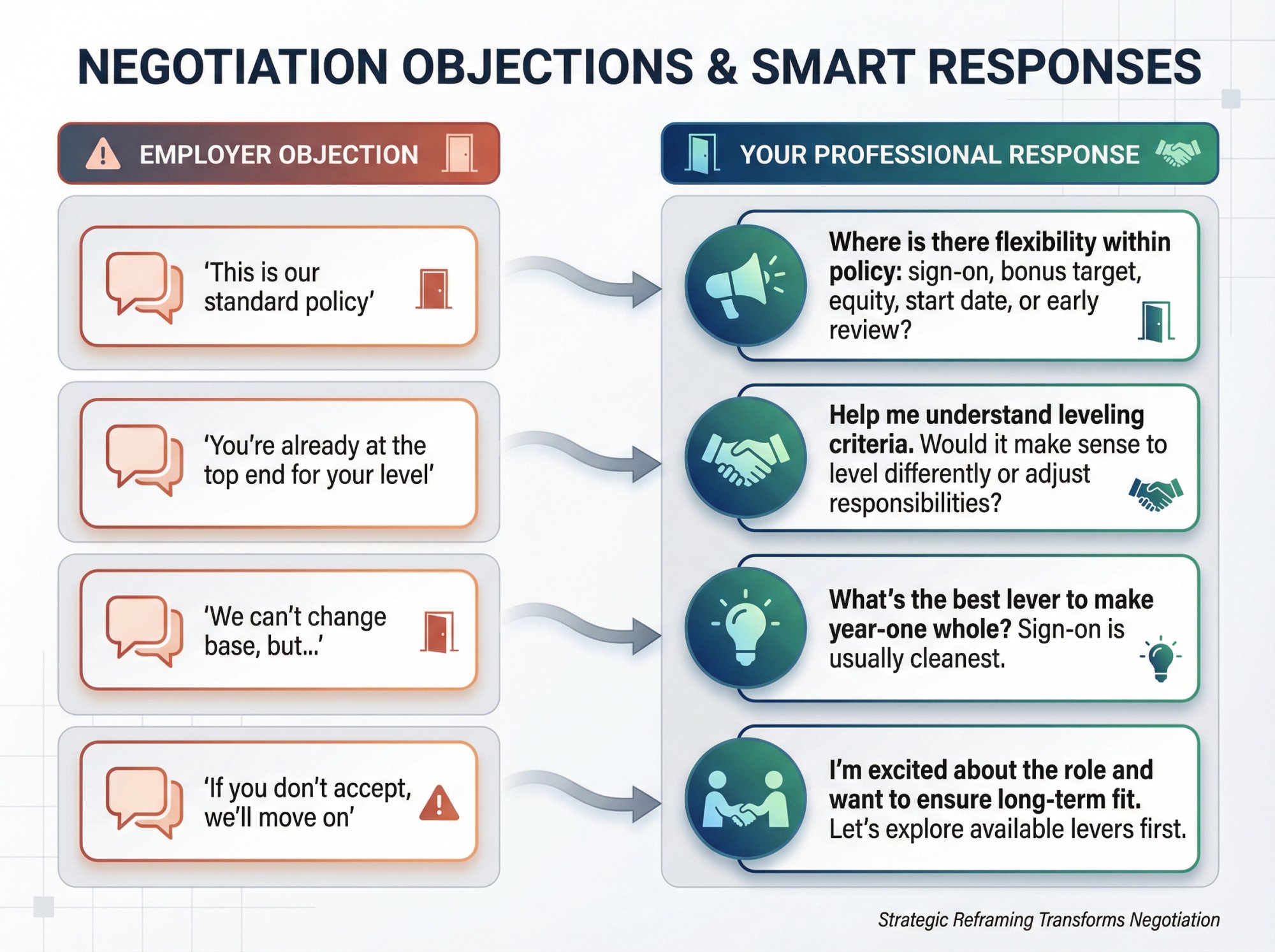
| Objection | Your Response |
|---|---|
| "This is our standard policy" | Totally understand. Where is there flexibility within the policy: base within band, sign-on, bonus target, equity, start date, or an early review? |
| "You're already at the top end for your level" | Help me understand the leveling criteria. Based on my scope, would it make sense to level the role differently, or adjust responsibilities to match the current band? |
| "We can't change base, but..." | OK. What's the best lever to make year-one compensation whole? Sign-on is usually the cleanest. What would that look like? |
| "If you don't accept, we'll move on" | I respect that. I'm excited about the role, and I want to be confident this is the right long-term fit. If we can't close the gap, I understand, but I'd like to be sure we explored the available levers first. |
Understanding compensation philosophy examples helps you work within company frameworks.
Learn about what is retention bonus and what is equity compensation as alternative compensation levers.
How to Prove Your Value (Lines You Can Steal)
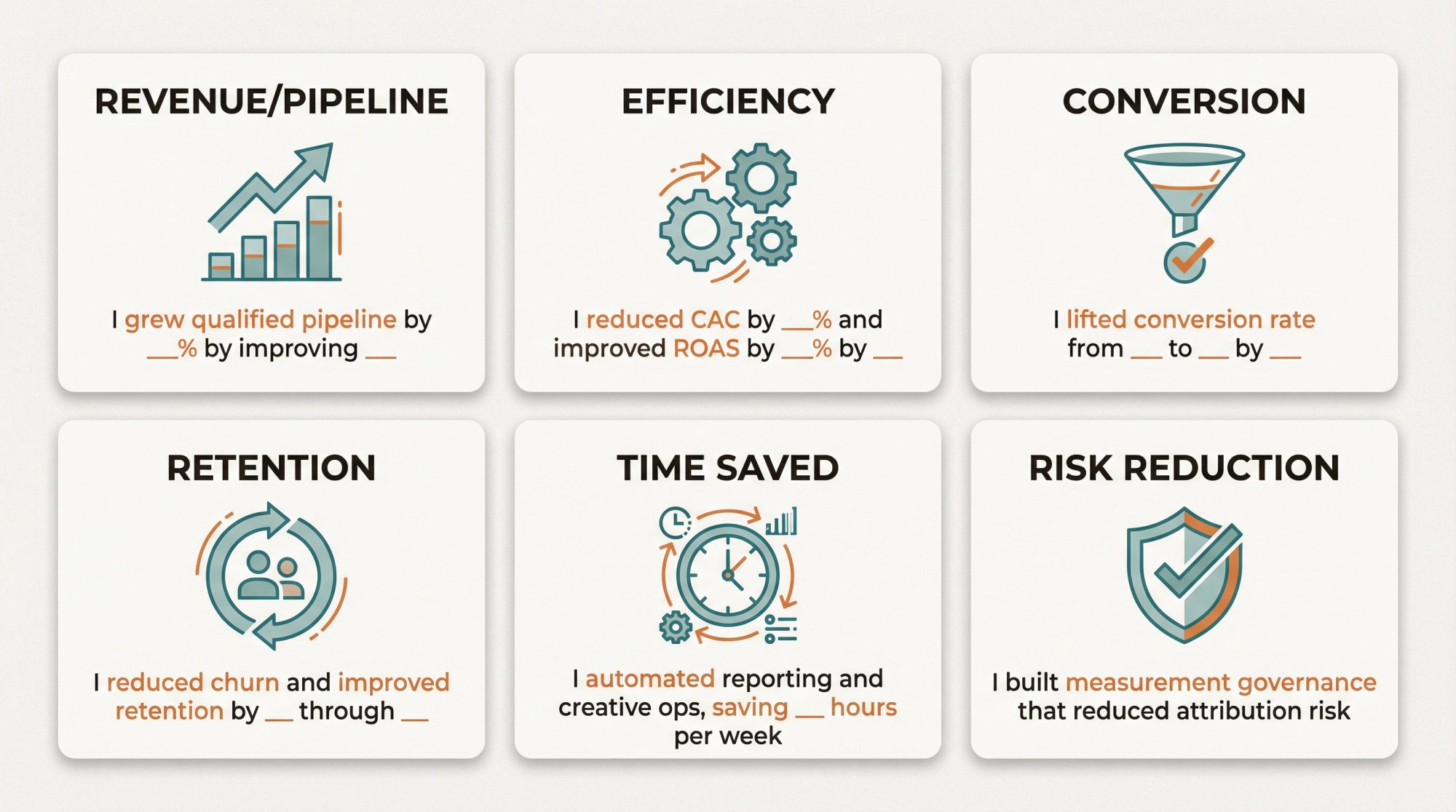
Your negotiation shifts from awkward to easy when you can point to business outcomes.
Here are plug-and-play proof angles for marketing roles. Pick the ones that match what you've actually done:
→ Revenue/Pipeline:
"I grew qualified pipeline by __% by improving __."
→ Efficiency:
"I reduced CAC by __% and improved ROAS by __% by __."
→ Conversion:
"I lifted conversion rate from __ to __ by __."
→ Retention:
"I reduced churn and improved retention by __ through __."
→ Time Saved:
"I automated reporting and creative ops, saving __ hours per week."
→ Risk Reduction:
"I built measurement governance that reduced attribution risk."
Then tie it directly to the role's goals. Show them you've already done the thing they're hiring you to do.
Understanding how to measure marketing performance helps you frame your wins in business terms.
How Pay Transparency Is Changing Negotiation in 2026
How to Use Posted Salary Ranges in Your Negotiation
Pay transparency legislation is evolving rapidly:
Salary ranges in job ads are the core requirement in most transparency laws
Ranges must reflect a "good faith" expectation (you can't post "$50k-$500k" and call it transparent)
Remote postings can trigger multiple states' requirements
Some jurisdictions now require benefits descriptions too
What that means for your scripts:
If a range is posted, negotiate within the range unless you're clearly being leveled wrong. If the range is huge ($80k-$150k), ask what level they're hiring at and what profile maps to the top end. If the role is remote, ask which location band applies to you.
Check pay transparency laws by state to understand the specific requirements in your region.
How EU Pay Transparency Laws Affect Your Negotiation
EU pay transparency policies state that employers must disclose the starting salary or pay range (in the posting or before the interview) and are prevented from asking about pay history.
Also, according to a French government explainer, the directive must be transposed by June 7, 2026.
What that means for you:
You can push for the range early without sounding "money-first." It's literally where EU policy is heading.
Understanding what is pay equity helps you frame these conversations within the broader transparency movement.
One-Page Negotiation Cheat Sheet
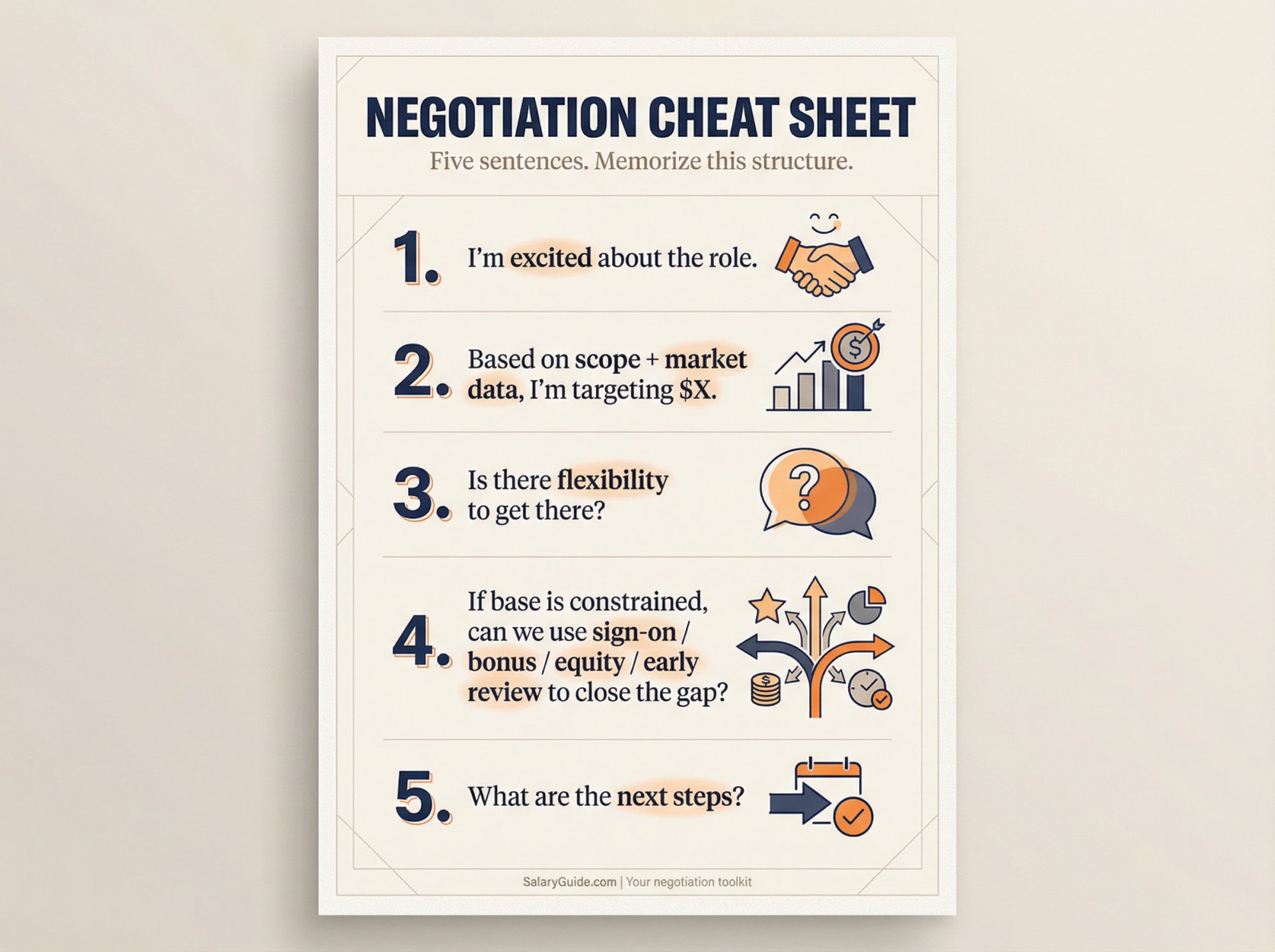
1) I'm excited about the role.

2) Based on scope + market data, I'm targeting $X.

3) Is there flexibility to get there?

4) If base is constrained, can we use sign-on / bonus / equity / early review to close the gap?

5) What are the next steps?
That's it. Five sentences. If you memorize nothing else, memorize this structure.
Frequently Asked Questions
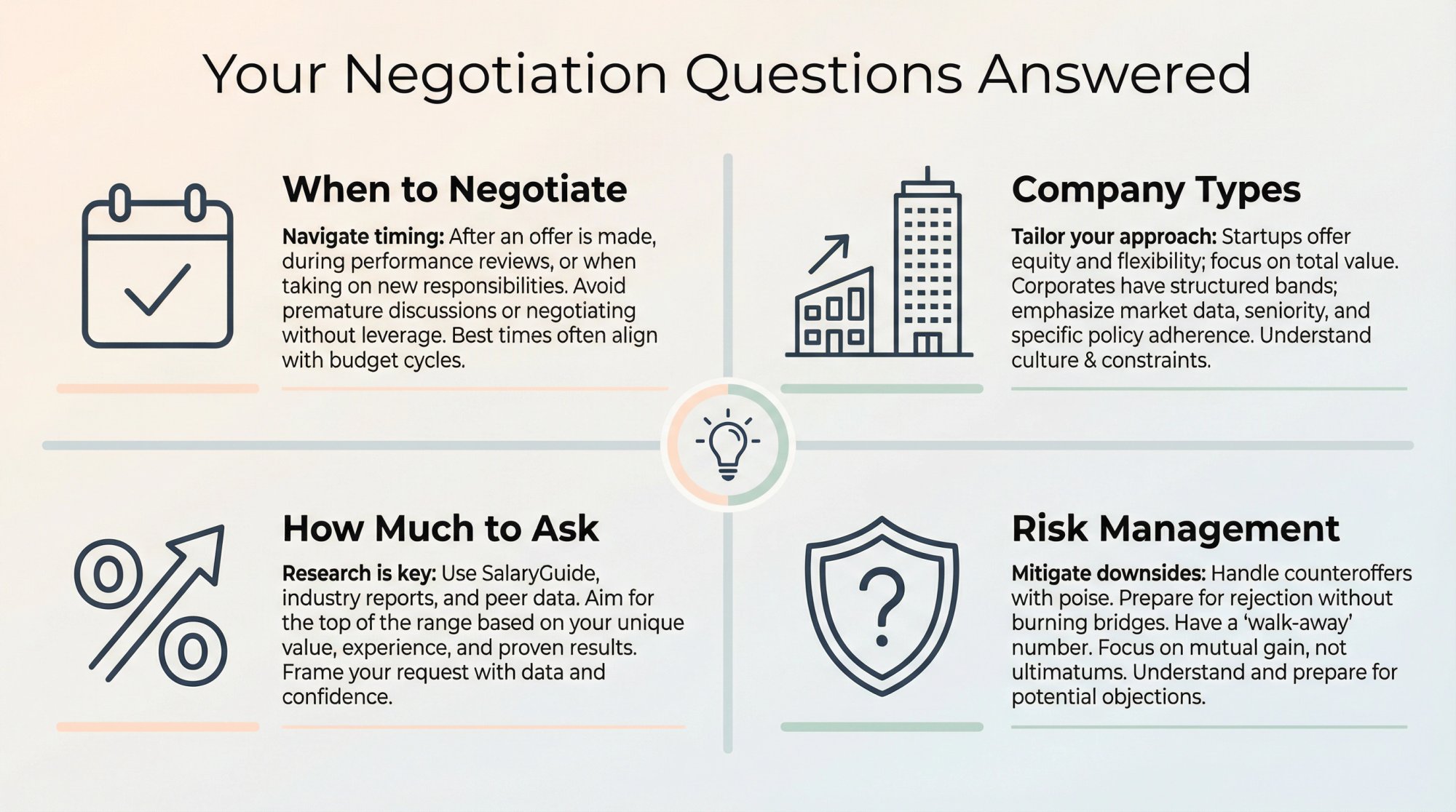
When Should I Negotiate vs. Just Accept the Offer?
You should negotiate almost always, even if the offer feels fair. Most employers expect negotiation and build buffer into their initial offer. If you don't ask, you're leaving that buffer on the table (and signaling you might not know your market value).
The only time to skip negotiation is if:
You're in financial distress and can't risk losing the offer
The offer is already at the verified top of market for your scope (not just "feels good")
You've been explicitly told "this is our final offer" with context that makes it credible
Otherwise, negotiate. Even a small 5-10% increase compounds over your career.
Understanding average salary increase when changing jobs helps set realistic benchmarks.
How Do Startup vs. Enterprise Negotiations Differ?
Startups:
Often have less cash flexibility but more equity to offer
Title inflation is common (you might be "Director" at a 15-person company)
Focus negotiations on: equity %, vesting schedule, acceleration clauses, role scope
Ask about runway and funding status (your equity is worth $0 if they run out of money)
Enterprise:
More rigid salary bands and approval processes
Less equity upside, but more cash and benefits flexibility
Focus negotiations on: bonus target, sign-on, benefits, remote flexibility, promotion timeline
Use their posted ranges and leveling frameworks as leverage
Script adjustment for startups:
I understand cash might be constrained at this stage. Can we structure more of the package as equity with a strong vesting schedule and acceleration clause?
Learn more about what is equity compensation to evaluate startup offers properly.
How Much Can I Ask For Without Sounding Greedy?
There's no universal rule, but here are the ranges that usually work:
| Situation | Typical Ask |
|---|---|
| Strong offer (already top 25th percentile) | 5-10% increase |
| Mid-band offer | 10-15% to reach top of band |
| Below-market offer | 15-25% to align with market |
The key is justification. If you can show market data supporting your ask, you're not being greedy. You're being informed.
Also: asking for 20% more doesn't make you sound greedy if you're currently underpaid by 20%. Frame it as market correction, not personal preference.
Understanding what is a competitive salary helps you benchmark effectively.
Should I Negotiate If I'm Desperate for a Job?
This is tough, and the honest answer is: it depends on your risk tolerance.
If you're truly desperate (can't make rent, no savings buffer), accepting a slightly below-market offer might be the right move. But even then, you can still negotiate lightly:
I'm excited about the role and ready to move forward. Just want to confirm - is there any flexibility on [sign-on bonus / start date / early review]?
That's a soft ask that signals you know your worth without risking the offer.
Most people feel desperate even when they have more runway than they think. If you can survive 2-3 more months, negotiate properly. Don't anchor yourself into a below-market salary that'll cost you tens of thousands over the next few years.
What If They Rescind the Offer After I Negotiate?
This almost never happens if you negotiate professionally. Employers expect negotiation. It's a normal part of hiring.
The only scenarios where an offer gets rescinded:
You were wildly unrealistic (asked for 2x market with no justification)
You were unprofessional (aggressive, entitled tone)
The company is broke or disorganized (and you dodged a bullet)
If you follow the scripts in this guide (enthusiasm + data + specific ask + flexibility), you're not at risk. Any company that rescinds an offer over a reasonable, professional negotiation is showing you exactly what it'd be like to work there.
How Do I Practice These Scripts Before the Real Conversation?

Method 1: Record yourself
Read the script out loud and record it on your phone. Play it back. Does it sound natural? Or rehearsed? Adjust pacing and tone until it sounds like you.
Method 2: Role-play with a friend
Have someone play the recruiter/hiring manager. Run through the script and their likely objections. This is the best prep because you'll hear the words coming out of your mouth in real time.
Method 3: Write it out first
If it's an email negotiation, draft it, walk away for an hour, then re-read it. Is it clear? Collaborative? Backed by data? Then send it.
Pro tip: Don't memorize word-for-word. Memorize the structure (enthusiasm + data + ask + flexibility). Then let your natural voice fill in the details.
Understanding how to prepare for interview helps you build these practice habits.
What's Different About Entry-Level vs. Senior Negotiations?
Entry-level negotiation:
Your leverage is potential, not proven track record
Focus on: learning opportunities, mentorship, growth path, tool access
Salary negotiation is softer (you have less market data to lean on)
Don't be afraid to ask for 5-10% more, but expect less flexibility
Check best entry-level marketing jobs to understand the entry-level landscape.
Senior/leadership negotiation:
Your leverage is outcomes you've already delivered
Focus on: base, bonus structure, equity, title, team size, budget authority
Salary negotiation is harder (you have clear market comps and scope to justify it)
Expect 10-20% negotiation ranges to be realistic
Script adjustment for entry-level:
I know I'm early in my career, but I've already delivered [specific outcome]. Based on that, and the scope of this role, I was hoping we could adjust to $X. Is there flexibility there?
Understanding digital marketing career path helps you plan long-term progression.
Can I Negotiate After I've Already Accepted an Offer?
Technically, yes. Realistically, it's much harder.
Once you've accepted, you've signaled the offer was acceptable. The employer has moved on mentally (and often communicated your acceptance internally). Reopening negotiation at that point can damage trust.
If you must renegotiate post-acceptance:
Only do it if:
Something material changed (you discovered the role scope is different than discussed)
You received a competing offer you're considering
The employer misrepresented something significant
Script for post-acceptance renegotiation:
Hi [Name] - I know I've already accepted, and I apologize for revisiting this. After further reflection [or: after receiving a competing offer], I realize I need to discuss [compensation / scope / title] to move forward confidently. Can we talk?
Better approach: Don't accept until you've negotiated. Use the "buy time" script to give yourself 24-48 hours to think and research before accepting.
See how to accept a job offer for proper acceptance etiquette.
How Do I Know If I'm Being Leveled Correctly?
Compare your actual responsibilities to the stated level. Here's a quick framework:
| You're Likely | If You... |
|---|---|
| Under-leveled | Manage people but have an IC title, own a P&L but aren't called "manager," set strategy but are labeled "coordinator" |
| Correctly leveled | Your responsibilities match the typical scope for your title at similar companies |
| Over-leveled | Your title is inflated relative to actual scope (common at startups) |
How to check:
Look at SalaryGuide's salary pages for your role
Compare the responsibilities description to what you actually do
Check LinkedIn profiles of people with your title at comparable companies
If you're under-leveled, use this script:
Based on the scope we discussed - [budget size, team size, strategic ownership] - this role maps to a [higher level] at most companies. Can we align the title to reflect that scope?
Understanding how to become a marketing director helps you understand what director-level scope entails.
How Does SalaryGuide Help With Salary Negotiation?
SalaryGuide is built specifically for marketing professionals who need real salary data to negotiate confidently. Here's how it helps:
1. Salary percentile data
Every salary page shows 25th, 50th, 75th, and 90th percentiles with a "last updated" stamp. That's your external objective criteria for any negotiation. Instead of saying "I want more," you say "market data shows $X for this scope."
2. Live market trends
The trends dashboard shows real-time data on salary posting rates, in-house vs. agency splits, remote vs. hybrid breakdowns, and median salaries by seniority. This helps you understand context (is now a good time to ask for 20%? What's the market doing?).
3. Negotiation playbooks and community
SalaryGuide Pro is a paid community that includes step-by-step negotiation systems, exact scripts, live offer reviews, and weekly coaching calls. If you're in the middle of a negotiation and need real-time help, that's where you go.

4. Career intelligence tools
SalaryGuide's tools include AI-powered LinkedIn optimization, job board with salary transparency, and company intelligence pages. These help you prepare for negotiations by understanding employer comp philosophy and growth trajectory.
Bottom line: SalaryGuide turns negotiation from a guessing game into a data-backed process. You show up with market percentiles, not just hopes.
Want More?
If you're serious about maximizing your earning power, SalaryGuide is built for exactly this. Check out the salary data, explore career tools, browse the jobs board, research companies, or join the community for ongoing support.
You've got the scripts. Now go get paid what you're worth.
