How to Accept a Job Offer with Confidence

That moment you get a job offer is fantastic—a real rush of excitement. But before you pop the champagne, take a breath. The real work of accepting a job offer starts right now, with a clear-headed look at what's actually on the table.
It’s about more than just the salary. You need to dig into the entire package to make sure this move truly lines up with your career goals and what you need financially.
Evaluating Your Offer Before You Say Yes
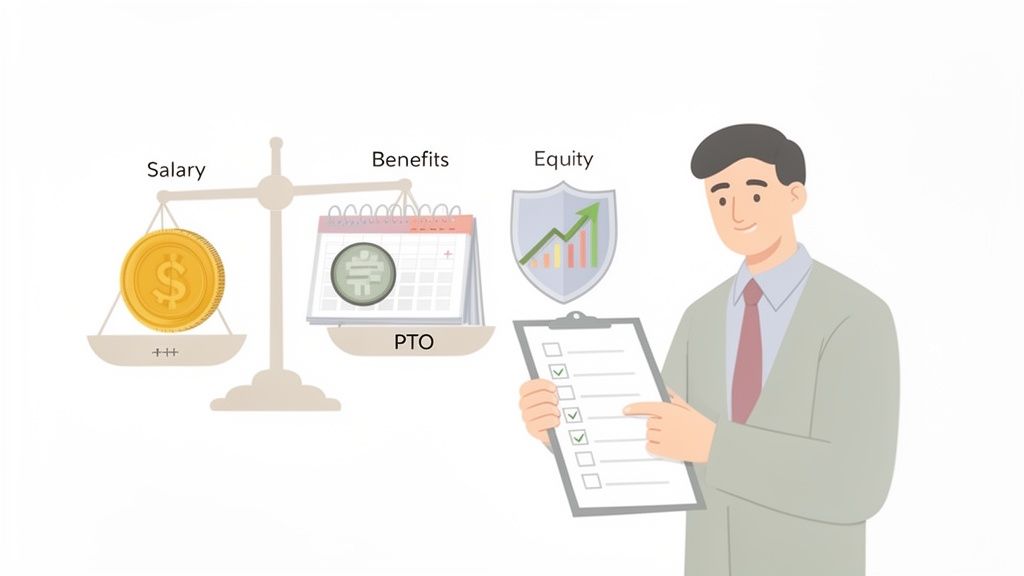
It’s easy to get fixated on the base salary. I’ve seen it happen time and time again. But that number is just one part of the story. To get the full picture, you have to look at the total compensation package.
Think of it this way: a role with a slightly lower base salary might actually be a better financial move if it comes with a hefty signing bonus, guaranteed annual performance bonuses, or significant stock options in a company you believe in. You're not just taking a job; you're making a financial decision. Understanding all the components is key, and you can get a deeper dive into what makes up a total compensation package here: https://salaryguide.com/blog/what-is-total-compensation-package.
Beyond the Paycheck
Once you’ve dissected the direct compensation, the next layer is the benefits package. This is where the hidden value often lies, and a strong benefits plan can be worth thousands of dollars a year.
Don’t just skim this part. Look closely for:
- Real-world Health Coverage: What are the actual costs for medical, dental, and vision? A high-deductible plan can eat into your paycheck faster than you think.
- Time to Recharge (PTO): How many vacation, sick, and personal days do you get? A generous PTO policy is a non-negotiable for avoiding burnout.
- Retirement Savings: A 401(k) is standard, but the company match is what really matters. That’s free money you don't want to leave on the table.
- Investment in You: Does the company offer a budget for courses, certifications, or conferences? This shows they’re serious about helping you grow.
These aren’t just perks; they directly impact your financial health and overall happiness at work.
To keep everything straight, especially if you're comparing multiple offers, a simple checklist can be a lifesaver. It forces you to look at each component side-by-side instead of just focusing on the salary.
Job Offer Evaluation Checklist
| Component | What to Look For | My Notes/Value |
|---|---|---|
| Base Salary | Is it in line with market rates for your role and experience? Does it meet your personal financial needs? | |
| Bonus Structure | Is there a signing bonus? Is the performance bonus guaranteed or discretionary? What's the target percentage? | |
| Equity/Stock Options | What's the vesting schedule? What's the strike price? What is the potential value? | |
| Health Insurance | What are the monthly premiums, deductibles, and co-pays for medical, dental, and vision? | |
| Retirement Plan | Does the company offer a 401(k) or similar plan? What is the company match percentage? | |
| Paid Time Off (PTO) | How many vacation, sick, and personal days are offered? Are holidays included? | |
| Professional Development | Is there a budget for training, certifications, or attending industry conferences? | |
| Remote/Hybrid Policy | What are the specific expectations for in-office vs. remote work? Is there a stipend for home office setup? | |
| Company Culture | Based on your interviews, does the team environment feel collaborative, supportive, and aligned with your values? | |
| Career Growth | What does the path for advancement look like from this role? Are there clear opportunities to learn and take on more? |
Using a structured approach like this ensures you're making a decision based on the complete picture, not just one exciting number.
Cultural Fit and Growth Potential
Finally, think about the things that aren't written in the offer letter. Does the company's mission actually excite you? Did you get a good vibe from the people you'd be working with? What are the real expectations for work-life balance? These intangible factors often determine whether you'll be happy in a role long-term.
It's a candidate's market in many industries, and people are being much more selective. Recent data shows that the average offer acceptance rate for American professionals is 79%, which means more than one in five people are turning down good offers. This is especially true in competitive fields like tech, where a poor candidate experience or a misaligned package can be a deal-breaker.
Before you give your final answer, make sure you understand every clause in the contract. For complex agreements, some people are even turning to tools that provide an initial AI contract review to flag any unusual terms. The goal is to walk in on your first day with confidence, knowing you've made a well-informed choice.
The Art of Confident Negotiation
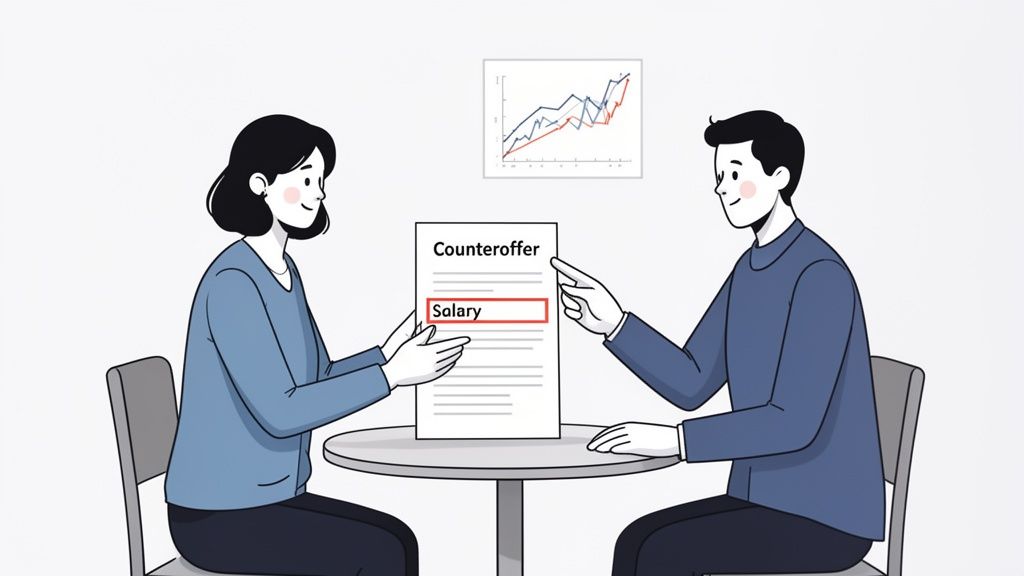
Let's get one thing straight: negotiation isn't a battle. It’s a standard, professional conversation about your value. A lot of people feel anxious about it, worried they'll come across as greedy or even lose the offer altogether. But the truth is, a thoughtful, well-researched negotiation shows you're a confident professional who understands business.
Think of the first offer as the opening bid. Companies almost always have a salary range for every role, and they rarely start at the top. If you don’t negotiate, you could be leaving a serious amount of money on the table over the course of your career.
Building Your Case With Data
Successful negotiation is all about preparation, not aggression. Your counteroffer shouldn't be based on what you want to earn, but on what the market says you're worth. Before you even pick up the phone, it’s time to do some homework.
Start by digging into salary benchmarks for your role, location, and level of experience. Reliable data takes this from an emotional request to a straightforward business discussion.
With that market data in hand, you need to articulate what makes you the right person for the job. What specific skills and accomplishments justify a better compensation package?
- Quantify your wins: Did you boost qualified leads by 30% in your last role? Did you deliver a project 15% under budget?
- Showcase rare skills: Do you hold a niche certification or have deep expertise in a high-demand software?
- Align with their goals: Explain how your past successes will directly help them solve their current challenges.
This groundwork gives you a firm foundation to stand on. It helps you clearly communicate your value and makes the entire process smoother. If you need a bit more guidance, you can learn more about how to answer salary expectations which is a key part of these conversations.
Structuring Your Counter-Offer
When you present your counter, it needs to be a complete proposal, not just a demand for a higher salary. Look at the entire offer and figure out what matters most to you.
Key Insight: Don’t just focus on the base salary. Perks like a signing bonus, an earlier performance review, a flexible work arrangement, or even a better job title can often be negotiated.
For instance, a startup might be tight on cash for a base salary but could be generous with equity. On the other hand, a big corporation might have strict salary bands but could easily approve a substantial budget for your professional development. You have to read the room and tailor your request.
Always start the conversation by expressing your excitement for the role. This sets a positive, collaborative tone. Frame your counter as a way to get to a package that makes you feel motivated and ready to hit the ground running.
You might say something like: “I am so excited about this opportunity to join as the new Digital Marketing Manager. Based on my research for similar roles in the area and my experience driving X results, I was anticipating a salary closer to [Your Target Number]. Is there any flexibility to discuss this?”
This keeps the door open for a productive conversation. By being prepared, professional, and respectful, you can confidently secure an offer that truly reflects what you bring to the table.
Making It Official: From Verbal "Yes" to Written Agreement
So, you've done the hard work of evaluating the offer, maybe even negotiated a few key points, and now you're ready to say "yes." This is a big moment, and how you handle it sets the tone for your entire relationship with your new employer. It’s a two-part dance: the enthusiastic verbal acceptance followed by the official written confirmation.
First comes the phone call. This is your chance to connect with the hiring manager or recruiter on a personal level. Hearing the excitement in your voice builds an immediate sense of rapport and assures them they made the right choice. It’s a simple gesture, but it lets them know you're genuinely on board, so they can stop considering other candidates and start planning for your arrival.
But a phone call alone isn't enough. You absolutely need to follow it up in writing.
Putting Your Acceptance on Paper
Your written acceptance—almost always an email—is what makes it official. Think of it as the formal handshake that locks everything in. This isn't just a formality; it's a critical document that prevents any misunderstandings by putting the agreed-upon terms down in black and white. It creates a clear record for both you and your new company.
Keep your acceptance email professional, concise, and positive. You just need to hit a few key points:
- A simple, clear subject line. Something like "Job Offer Acceptance - [Your Name]" is perfect. No need to get creative here.
- Start with thanks. Kick things off by thanking them for the opportunity and expressing your excitement to get started.
- The formal acceptance. State clearly that you are accepting the [Job Title] position.
- Confirm the details. Briefly restate the core terms you've agreed on, like your salary, start date, and any other make-or-break items you discussed.
- Look ahead. End by asking about any paperwork or next steps you need to handle before day one.
This approach leaves no room for error and ensures everyone is on the same page.
What a Good Acceptance Email Looks Like
Here’s a real-world example of how to pull this all together. It’s straightforward, confirms the essentials, and keeps the tone upbeat and professional.
Subject: Job Offer Acceptance - Maya Chen
Dear [Hiring Manager's Name],
I'm thrilled to formally accept the offer for the Digital Marketing Manager position at [Company Name]. I can't wait to join the team and start contributing to your upcoming projects.
As we discussed, I am accepting the position with a starting salary of [$XX,XXX] per year, and my first day will be [Your Start Date].
Please let me know what I need to do next regarding paperwork or onboarding. I'm looking forward to working with you and everyone on the team.
Thank you again for this fantastic opportunity.
Best regards,
Maya Chen
That’s it. A simple, professional message like this solidifies your new role and shows you mean business from the get-go. With some entry-level jobs pulling in 180 applicants a piece, getting this final step right is more important than ever. You’ve successfully made it through a tough process, and this final communication is your victory lap. If you're curious, you can find more eye-opening job market statistics that show just how competitive things are out there.
Handling Counter-Offers and Multiple Opportunities
The final stretch of a job search can feel like a high-stakes chess match. Just when you think you've crossed the finish line, a surprise counter-offer from your current boss lands in your lap, or you find yourself trying to decide between two great opportunities.
These are definitely good problems to have, but they require a clear head and a solid strategy to make sure you're choosing the best path for your career long-term.
The Temptation of the Counter-Offer
When your current company pulls out a counter-offer, it’s easy to feel flattered. The familiarity is comfortable, the pay bump feels like validation, and it saves you the stress of starting somewhere new.
But you have to ask yourself the hard question: why now? Why did it take your resignation for them to suddenly recognize your value? The core issues that prompted you to look for a new job in the first place—whether it was a dead-end role, a difficult culture, or just plain boredom—rarely vanish just because your paycheck gets bigger.
A counter-offer is often a quick fix for the symptom (you leaving) but almost never addresses the root cause (why you were unhappy). Statistics consistently show that a huge chunk of employees who accept a counter-offer are back on the job market within 12 months.
To get some clarity, it helps to weigh the pros and cons objectively. We've created a simple decision matrix below to help you compare the critical factors side-by-side. You can also explore an in-depth guide on evaluating a job offer versus a counter-offer to really dig into the details.
Counter-Offer vs. New Offer Decision Matrix
| Factor | Accepting Counter-Offer | Accepting New Offer |
|---|---|---|
| Trust | May be damaged. Your loyalty will now be questioned. | Clean slate. You're seen as an enthusiastic new team member. |
| Root Issues | The reasons you wanted to leave probably still exist. | Opportunity to solve the problems you were facing (e.g., new challenges, better culture). |
| Future Promotions | You were a "flight risk." You might be overlooked for key roles. | Path for growth is often clearer and part of the reason you accepted. |
| Team Dynamics | Can become awkward with colleagues who know you tried to leave. | Fresh start with a new team and professional relationships. |
| Compensation | Is the raise just an advance on your next review? | Salary and benefits were negotiated upfront based on current market value. |
Ultimately, a counter-offer can sometimes be the right move, but go into it with your eyes wide open. More often than not, you're just delaying the inevitable.
Juggling Multiple Job Offers
Getting more than one offer is a fantastic validation of your skills. The trick is to handle the situation with professionalism and respect for everyone involved. You're not just comparing salaries; you're comparing cultures, growth potential, and how each role fits into your life.
This flowchart maps out the process, from getting that first verbal "yes" to signing on the dotted line.
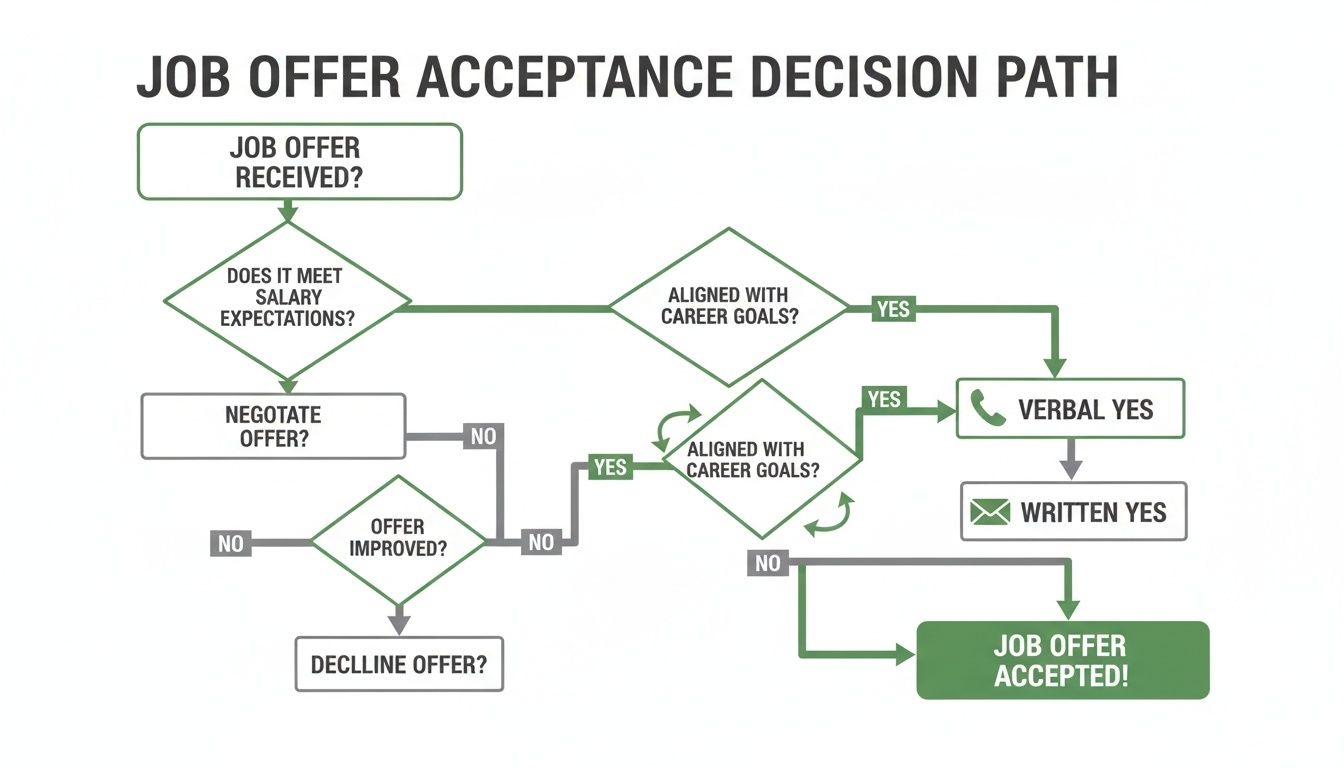
As you can see, a verbal agreement is a great start, but nothing is truly final until that formal, written offer is in your hands confirming every last detail.
You can sometimes use one offer to get a better package from your top choice, but you have to play your cards right. Transparency and politeness are key.
- Be clear about your timeline. Let your preferred company know you have another offer on the table and when you need to make a decision.
- Reiterate your interest. Make it obvious they are your first choice and that you're excited about the possibility of joining their team.
- Be specific, but not demanding. If another company offered more, it's okay to say so. Try something like, "I have another offer for $95,000, but I'm genuinely more excited about the work your team is doing. Is there any flexibility to bring your offer closer to that number?"
Think about all the work it took to get here. In 2025, job seekers are firing off anywhere from 32 to over 200 applications on average. With employers getting flooded with around 180 applicants for every opening, landing even one offer is a major accomplishment. This reality makes it crucial to handle these hard-won opportunities with care, ensuring you secure the best future for yourself without burning any bridges along the way.
Planning Your Professional Transition
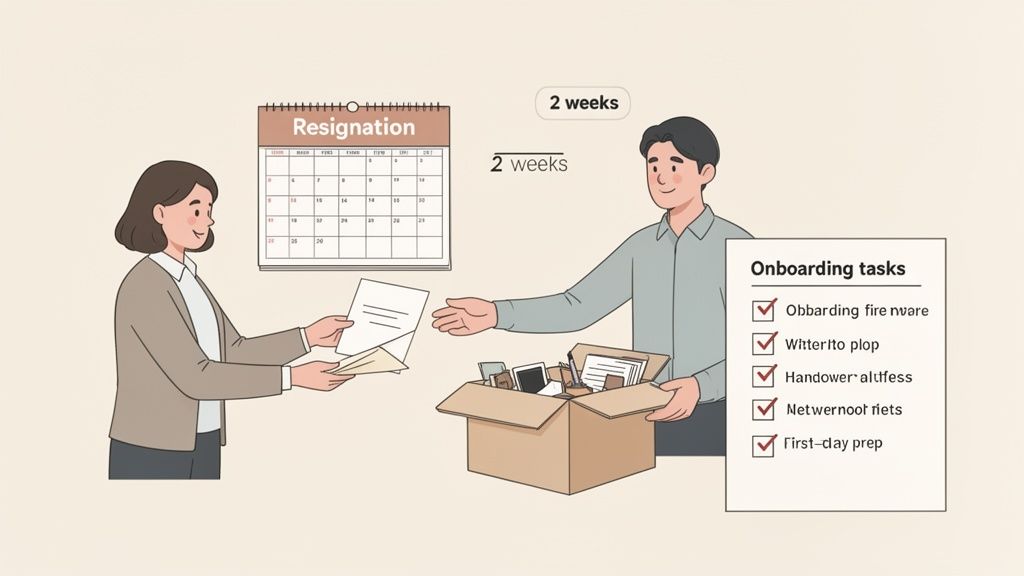
Once you’ve officially accepted that fantastic new job, your focus needs to pivot. It’s time to manage a graceful exit from your current role. Leaving on a high note is crucial for preserving the professional relationships you've worked so hard to build.
This whole process kicks off with your resignation, and there's a right way to do it. Always start by telling your direct manager first, either in person or over a video call if you're remote. This simple act of respect allows you to control the narrative and avoids them hearing the news through the grapevine. After that conversation, you'll follow up with a formal resignation letter.
Resigning Gracefully From Your Current Role
Knowing how to write a resignation letter is an essential skill for maintaining a good relationship with your soon-to-be-former employer. The good news? It doesn't need to be a long, drawn-out document. Keep it simple.
Your letter should be professional and to the point. Make sure it includes these three things:
- A clear statement that you are resigning.
- Your final day of employment (the effective date).
- A brief, genuine thank you for the opportunity.
This isn't the time to air grievances or get into the nitty-gritty of why you're leaving. A resignation letter is just a formal record of your departure, not a place to burn bridges.
Pro Tip: Your professional network is one of your most valuable career assets. Always keep your resignation positive and forward-looking to maintain those connections. How you leave a job is often remembered just as much as how you performed in it.
Navigating Your Final Two Weeks
Think of your two-week notice period as the final sprint. This is your last chance to really show your professionalism and leave a lasting positive impression. The goal is to make the handover as smooth as possible for your team and whoever steps into your shoes.
Spend some time creating a transition plan. Outline your main responsibilities and give a status update on all your current projects. It's also incredibly helpful to document key processes, share important contacts, and organize any necessary login information to make the knowledge transfer seamless.
Be proactive in training colleagues who will be covering your duties. By being organized and genuinely helpful during your last couple of weeks, you solidify your reputation as a reliable and considerate professional. This final act of goodwill ensures you depart on the best possible terms, ready to start your new chapter with a clean slate.
Answering Those Lingering Questions About Job Offers
You’ve made it through the interviews, and the offer is on the table. Fantastic! But even after you've weighed the pros and cons, a few tricky, last-minute questions can pop up. Let's walk through some of the most common scenarios people face at this final hurdle.
How Long Do I Have to Decide?
There's no universal rule here, but you can generally expect a company to want an answer within 24 to 72 hours. From their perspective, they need to keep the hiring process moving if you decide to pass.
That said, this is a huge decision for you, and it's completely okay to ask for a bit more time. Making a rushed choice is a recipe for regret. A reasonable employer gets that.
If you need a few extra days, try saying something like this:
"Thank you so much for the offer! I'm really excited about this opportunity. To make sure I give this the full consideration it deserves, would it be possible to have until Friday to get back to you with a final decision?"
Most companies will grant this. They'd rather have a candidate who is 100% sure and committed than someone who felt cornered into a quick "yes."
Am I Risking the Offer if I Try to Negotiate?
This is a big fear for a lot of people, but here's the reality: it is incredibly rare for a company to pull an offer just because you tried to negotiate. As long as you handle it professionally and your request is grounded in reality, you're fine. For many roles, negotiation is simply part of the game—it's expected.
Think of it this way: any company that would yank an offer over a polite, well-researched negotiation discussion is showing you a pretty serious red flag about their culture. The real risk isn't in negotiating; it's in how you do it. The key is to stay positive, reiterate how much you want the role, and frame your counter as a conversation, not a demand.
What if I Only Have a Verbal Offer?
A verbal offer is a great start, but it’s not the finish line. Until you have that offer in writing, nothing is official. This is a hard-and-fast rule you shouldn't bend. The written offer letter is what protects both you and the company by laying out all the important terms in black and white.
After you get that exciting phone call, send a follow-up email pretty quickly. Thank them for the call and politely ask for the formal, written document.
Here’s a simple way to phrase it:
- Subject: Following up on our conversation
- Body: "Thank you again for the offer to join the team as [Job Title]. I'm thrilled about the possibility. When you have a moment, could you please send over the formal offer letter with the complete compensation and benefits details?"
This is just a gentle, professional nudge to get the paperwork rolling. It ensures you have all the details documented before you make your final move.
Is It Okay to Accept an Offer and Then Back Out?
This is a tough one. In the industry, this is known as reneging, and you should avoid it at all costs. When you accept a job, you're giving your word. Backing out after saying "yes" can seriously tarnish your professional reputation.
Think about the fallout: you could burn bridges with the company, the hiring manager, and any recruiters involved. You never know when you'll cross paths with these people again. Before you accept, be as sure as you possibly can that it's the right move. If you're holding out for an offer from your dream company, it's far better to ask for an extension on your current offer than to accept it just to have a safety net.
Ready to find a marketing role that’s truly worth accepting? SalaryGuide sources real, recently posted jobs directly from company career sites, cutting through the noise of recruiters and third-party boards. Find your next opportunity and get the compensation data you need at https://salaryguide.com.
