Navigating a Job Offer Counter Offer
That counteroffer from your current boss can feel like a huge compliment. But before you get too flattered, it's important to pull back the curtain and see what's really going on.
More often than not, that sudden pay bump is a quick fix for their problem, not a long-term solution for your career.
The Real Reasons You Got a Counteroffer
When your current company scrambles to keep you, it’s almost never just about your amazing talent. It's a business calculation, plain and simple. Understanding their motives is your first step toward making a smart, unemotional decision.
The biggest driver is usually just logistics. It's far cheaper and easier for them to give you a raise than it is to go through the headache of recruiting, interviewing, and training someone new. Think about it—the hiring process is a massive time and money sink, and your empty chair could throw a major project completely off track.
What's Really Motivating Your Employer?
A counteroffer is a defensive move to keep things stable. Your manager is likely worried about a few things:
- Project Disruption: Losing you right now could mean missing a critical deadline or derailing a key initiative.
- Team Morale: They know that when one person leaves, others start updating their own resumes. Your departure could trigger a chain reaction.
- Hiring Headaches: The cost and effort to find your replacement are significant, and it’s a distraction they’d rather avoid.
Honestly, it’s a reactive measure. Companies often use counteroffers as part of their strategies to reduce employee turnover because it solves an immediate pain point for them.
Let this sink in: The company that was perfectly fine underpaying you yesterday suddenly found the budget to pay you market value today. This isn't about a newfound appreciation for your worth. It's about their convenience.
The Uncomfortable Truth
While more money is always nice, it almost never solves the real problems that made you want to leave in the first place.
Were you bored? Was the culture toxic? Did you feel stuck with no path for growth? A bigger paycheck is just a temporary distraction from those deeper issues.
The data backs this up. While nearly 40% of UK employers handed out counteroffers last year, the results aren't great. A staggering 80% of employees who accept a counteroffer end up leaving within six months anyway. More money just can't fix a broken situation. You can dig into the data behind counteroffer outcomes to see for yourself.
This really highlights the core issue: the reasons you started looking for a new job will still be there long after the glow of a salary increase wears off.
How to Properly Evaluate Both Offers
When you’re holding a new job offer and your current employer slides a counteroffer across the table, it’s easy to get sidetracked. The flattery, the bump in pay—it can cloud your judgment. But making the right call means stepping back and evaluating both opportunities with a cool head, focusing on what truly aligns with your long-term career goals.
This decision is about more than just a short-term financial win. You need to get to the heart of why you started looking for a new role in the first place.
This flowchart is a great mental model for walking through the key questions you should be asking yourself—and what your employer's motivations might be.
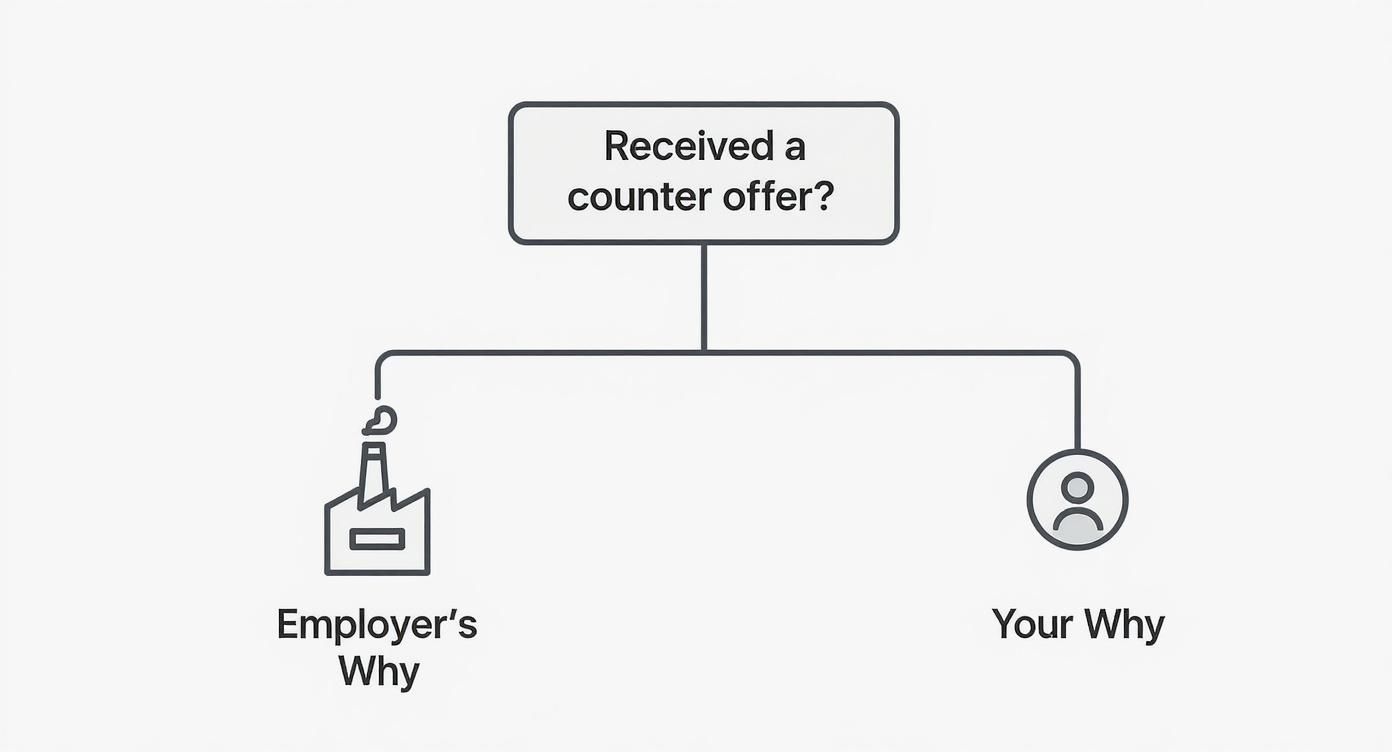
As you can see, the real test is whether the counteroffer actually solves the core problems that pushed you to start your job search. Most of the time, it doesn't.
Look Beyond the Base Salary
First things first: don't get fixated on the base salary. A bigger paycheck from your current job can feel like a victory, but it's often a smokescreen for a weaker overall package compared to the new offer. You have to look at the whole picture.
This means doing a proper total compensation analysis. You need to put a dollar value on everything, from bonuses to benefits. We have a detailed guide that walks you through exactly how to calculate total compensation so you can compare apples to apples.
Make sure you're comparing these critical financial components for both offers:
- Base Salary: The starting number. Simple enough.
- Performance Bonuses: Are they guaranteed or discretionary? Ask about the company's historical payout track record. A "potential" bonus isn't the same as cash in hand.
- Health Insurance: This is a big one. Compare the monthly premiums, deductibles, and out-of-pocket maximums. A plan with lower premiums could easily save you thousands each year.
- Retirement Contributions: What's the 401(k) match? A more generous match from one company is literally free money you'd be leaving on the table.
- Equity or Stock Options: Especially in a growing company, this can be a massive factor in your long-term wealth. Don't underestimate its potential.
Assign Value to the Intangibles
Once you've done the math, it's time to weigh the things you can't put a price on. These are the factors that determine whether you're happy and engaged day-to-day or counting down the minutes until Friday.
Things like company culture are a huge deal—they influence more than half of all job decisions. While familiarity (69%) and job security (56%) are strong reasons people consider staying, a counteroffer rarely fixes the underlying issues. Think about it: if your manager was the problem, or if you had no path for growth, is a pay raise really going to change that?
Take a moment and remember exactly why you started interviewing. If it was because of a toxic work environment, a lack of new challenges, or burnout from a poor work-life balance, more money is just a band-aid on a much deeper wound.
Build Your Decision Matrix
To strip the emotion out of this decision, I always recommend building a simple decision matrix. It’s a straightforward tool that forces you to compare the offers based on what you value most, not just what looks best on paper at first glance.
You're essentially creating a personalized scorecard. Let's walk through how to create one.
New Job Offer vs. Counter Offer Decision Matrix
Start by listing all the factors that are important to you in a job. Then, score both the new offer and the counteroffer for each factor. Finally, assign a "priority" score to each factor to weigh what matters most to you. This is where you get brutally honest with yourself.
Here's an example of what that might look like:
| Factor | New Job Offer | Current Role Counter Offer | Your Priority (1-5) |
|---|---|---|---|
| Total Compensation | 4 | 5 | 5 |
| Career Growth Path | 5 | 2 | 5 |
| Work-Life Balance | 4 | 2 | 4 |
| Company Culture | 4 | 3 | 4 |
| Learning Opportunities | 5 | 3 | 3 |
| Relationship with Manager | 3 | 2 | 5 |
Once your table is filled out, you can get a clearer, data-backed view of the situation. By scoring and weighing each element, you'll see which opportunity truly aligns with your career ambitions and personal needs, helping you make a confident choice that you won't regret six months down the line.
The Hidden Risks of Accepting a Counter Offer
Getting a counteroffer can feel like a huge win. Your current company wants you, you get more money, and you don't have to deal with the stress of starting somewhere new. It seems like the safest choice, but from my experience, what feels like a short-term victory is often loaded with risks that can stall your career.
The moment you hand in your notice, the dynamic with your employer changes for good. Even with a fatter paycheck, you’re now the one who was ready to leave. That simple fact can create ripple effects you might not see coming.
Your Loyalty Will Be Questioned
Once you’ve shown you’re willing to walk, you're marked. Your manager and the leadership team now know you were actively looking for a way out. This can create an invisible wall of distrust that’s hard to break down.
Put yourself in their shoes for a second. When a critical, high-profile project comes up, who are they going to give it to? The person who has always been all-in, or the one they had to pay extra just to keep them from leaving?
This shift in perception can quietly sabotage your career:
- Promotions: You might get passed over for that next step up in favor of someone they see as more committed to the company's future.
- Key Assignments: The most exciting, resume-building projects could start going to colleagues who feel like a "safer" bet.
- Insider Status: You may find yourself out of the loop on important decisions, subtly pushed to the sidelines.
Your relationship with your direct manager can also become strained. What used to feel like a partnership might now feel purely transactional. The trust that makes a great working relationship has been cracked, and that’s incredibly difficult to repair.
You’ve essentially put all your cards on the table. You revealed you were unhappy enough to leave, and your employer now knows it. When the next round of budget cuts or restructuring happens, whose name do you think will be at the top of the list?
The Original Problems Rarely Disappear
Let's be real—money probably wasn't the only reason you started job hunting. While compensation always matters, most people leave for deeper reasons.
Was it a toxic culture? A dead-end role with no room to grow? A manager you just couldn't click with? A bigger salary is a great distraction, but it doesn't fix those underlying problems.
A few months after you accept the counteroffer, the shine of that raise will wear off. You’ll find yourself right back where you started, facing the same frustrations that made you update your resume in the first place. All you've done is hit the snooze button on a problem that needs a real solution.
The Data Shows a Clear Pattern
This isn't just a gut feeling; the stats on counteroffers paint a pretty stark picture. While data shows around 55% of employees accept a counteroffer, their long-term loyalty is another story.
A stunning 60% of those who accept end up leaving within 12 months anyway. Even more telling, 45% are gone in just six months. This really hammers home that a counteroffer is often just a Band-Aid for both sides. You can discover more insights about counter offer statistics to see just how common this cycle is.
These numbers are a clear warning that accepting is usually a short-sighted move. The reasons you wanted to leave almost always resurface, putting you right back on the job market before you know it.
The hard truth is that a counteroffer is rarely about your value—it’s about your employer’s convenience. They’re trying to avoid the immediate headache and cost of replacing you. They aren’t suddenly fixing the systemic issues that pushed you away.
By saying yes, you risk trading a fresh start and a real opportunity for a temporary pay bump in a role you were already done with. You're choosing familiar discomfort over the potential for genuine, long-term career satisfaction.
How to Communicate Your Decision with Professionalism
You’ve weighed the pros and cons and made your choice. Now comes the delicate part: communicating that decision. How you handle this final conversation, whether you're staying or going, says a lot about your professionalism and can impact your reputation for years to come. The goal is to be clear, firm, and appreciative, leaving no room for ambiguity while keeping relationships intact.
This isn't just about what you say, but how you say it. Getting this moment right requires a bit of grace and confidence. In fact, mastering communication skills is often the key to not just navigating these talks, but also ensuring you walk away with your professional network stronger than before.
Turning Down the Counter Offer with Grace
If you've decided the new opportunity is the right move, your first step is to tell your current manager directly and respectfully. This is a conversation best had face-to-face, or at the very least, over a video call. An email should only serve as the formal follow-up.
Before you walk into that meeting, get your thoughts straight. This isn't another round of negotiations; it’s a final announcement. Your script should be simple: express genuine gratitude for your time there and for the offer, but be unwavering in your decision to leave.
Here’s a simple script you can adapt:
"Thank you so much for putting this counter offer together. I've given it a lot of thought, and I sincerely appreciate it, as well as everything I've learned here. After careful consideration, I've decided to accept the other position. It’s a move I'm making for my long-term career growth, and I feel it’s the right next step for me. I am 100% committed to making the next two weeks as smooth as possible for the team."
See how that works? It’s appreciative, professional, and final. It avoids getting bogged down in the details of the offer and pivots to the future—both yours and the company's transition.
What to Do If They Keep Pushing
It happens. Some managers might take the news personally or try to pressure you into changing your mind. The key is to stay cool and professional. Don't let yourself get pulled into an argument or feel like you owe them a lengthy defense of your choice.
If the conversation gets tense, you can gently steer it back on track.
- Acknowledge their position: "I hear you, and I really do appreciate your passion for the team."
- Reiterate your decision firmly: "That said, I have already committed to the other role, and my decision is final."
- Shift the focus to the handover: "I want to use my remaining time to set the team up for success. What are the highest priorities for me to focus on during the transition?"
This approach shows you respect their perspective but reinforces that your mind is made up. You’re maintaining control and keeping it professional.
Putting Your Final Decision in Writing
After you've had the conversation, it's time to send your formal resignation email. This is the official record of your decision and your last day, so it needs to be crystal clear. Keep the tone positive and forward-looking.
If you're looking for different ways to phrase your resignation, you can find some excellent templates in these counter offer letter examples that fit all sorts of situations.
A Go-To Email Template for Declining a Counter Offer:
Subject: Resignation - [Your Name]
Dear [Manager's Name],
Please accept this email as my formal resignation from the [Your Job Title] position at [Company Name]. My final day of employment will be [Your Last Day].
Thank you again for the counter offer. I've genuinely valued my time here and I'm grateful for all the opportunities and experience I've gained working with you and the team.
I have made a firm decision to accept another role that I believe aligns best with my long-term career goals. I am fully committed to ensuring a smooth and organized handover during my final two weeks. Please let me know how I can best support the transition.
I wish you and everyone at [Company Name] all the best.
Sincerely,
[Your Name]
How to Professionally Accept a Counter Offer
Deciding to stay is the less common path, but if it's the right one for you, clarity is just as critical. The absolute first step is to get the new terms—salary, title, responsibilities, everything—in writing in an updated offer letter. Do not make a move until you have that document in hand.
Once you have the official offer from your current employer, you owe the other company an immediate and professional response. Don't leave them hanging. Call the hiring manager or recruiter to let them know your decision personally, then follow up with a polite email. Thank them for their time and their generous offer, but state clearly that you've decided to remain in your current role. It's a small industry, and handling this with respect will preserve your reputation.
Using a Counter Offer to Negotiate
You’ve got a counteroffer from your current company. Now for the tricky part: can you—and should you—use it to get a better deal from the new company you’re actually excited about? It’s a delicate dance, for sure. But when you handle it with a bit of finesse, you can often turn that counteroffer into a significantly better package.

This isn't about playing games or making threats. Think of your current employer's job offer counter offer as a new piece of market data. It’s hard proof that your skillset is valued at a specific, higher price point. That’s a powerful piece of information to bring to the table.
Framing the Conversation Correctly
How you deliver this message is everything. You absolutely have to frame this conversation as a transparent discussion, not an ultimatum. The tone should be collaborative and positive, never demanding.
You're essentially sharing new information that helps both of you land on the most accurate and competitive compensation. The goal is to show you’re still thrilled about the new role while subtly demonstrating your increased market value.
This takes confidence. You have to know what you’re worth and be ready for any outcome, because while many people pull this off, there's always a chance the company could react poorly.
Scripts for a Delicate Negotiation
This is a conversation best had over the phone or video call. So much nuance gets lost in email. Once you’ve talked, you can send a quick, polite email to recap what you discussed.
Here are a couple of ways you can open that conversation.
Scenario 1: The Collaborative Approach
"Thank you again for this offer—I’m genuinely excited about the opportunity to join the team. In the interest of full transparency, my current employer presented a significant counteroffer. While the reasons I'm leaving haven't changed, this new information does give me a much clearer picture of my current market value. I am still very keen on this role, and I'm hoping we can find a way to bridge that gap."
This script immediately positions you as a partner. It reinforces your interest while framing the counteroffer as objective market data, not a demand.
Scenario 2: The Direct but Respectful Approach
"I'm calling because I've received a counteroffer that is substantially higher than what we discussed. My strong preference is to join your team, as I see a much better long-term fit here. Given this new information, would you be open to revisiting the compensation package?"
This approach gets straight to the point but keeps the tone respectful and professional. It clearly states your preference for their company, which is key.
Understanding the Potential Risks
Let’s be honest: this move isn't risk-free. You need to walk in with your eyes open to the potential downsides.
- They could rescind the offer. It’s the worst-case scenario, but it happens. Some companies have a strict no-negotiation policy or might see your move as a red flag, causing them to pull the offer.
- You could damage the relationship. Even if they match it, the hiring manager might now see you as someone only motivated by money. This could start your new working relationship on a shaky foundation.
- They could just say no. The company might simply stand firm on their original offer. At that point, the ball is back in your court, and you have to be prepared to either accept their original terms or walk away.
For a deeper dive, our guide on how to counter a job offer has more detailed scripts and strategies. Ultimately, this is a power move for professionals who are confident in their value and ready for a complex—but potentially rewarding—negotiation.
Your Top Counteroffer Questions, Answered
Let's be honest, even with a perfect game plan, getting a counteroffer can throw you for a loop. It's a high-stakes, often emotional conversation. Here’s how to handle some of the most common curveballs that come up, so you can navigate the situation with confidence.
Think of this as your practical field guide for those tricky, in-the-moment scenarios.
What if My Boss Gets Emotional or Angry?
It happens. You deliver your well-rehearsed resignation, and instead of a handshake, you get a guilt trip, frustration, or even anger. When this happens, your only job is to stay professional and composed. You do not need to defend your decision or get pulled into an argument.
The best tactic is to gently steer the conversation back to the logistics of your departure. Acknowledge their feelings, but stand your ground.
Here's a script that works: "I really do understand your passion for the team, and I'm grateful for everything I've learned here. My decision is final, though, and it's based on my long-term career goals. I'd love to spend the rest of our time focusing on how I can make the transition as smooth as possible over the next two weeks."
This response is a masterclass in de-escalation. It shows respect for their perspective but firmly closes the door on any further negotiation.
Is It Ever a Good Idea to Accept a Counteroffer?
I get this question a lot, and my answer is almost always a hard no. But there are very, very rare exceptions. Accepting a counter might make sense only if your single, sole reason for leaving was that you were dramatically underpaid, and everything else about the job—the culture, your boss, the work—is fantastic.
Even then, you have to be brutally honest with yourself. Before you even think about saying yes, you need to be certain that:
- The root problems that made you look for another job are actually fixed.
- Your loyalty won't be secretly questioned every time a tough project comes up.
- Any promises about future roles or responsibilities are put down in writing.
Don't forget the cold, hard data: studies have shown that 80% of people who accept a counteroffer are gone within six months anyway. Proceed with extreme caution.
How Long Should I Take to Decide?
Time is not on your side here. The company that just hired you is eagerly waiting for your "yes," and your current employer needs to figure out their next move. Taking too long to decide looks indecisive and can damage your reputation with both sides.
You have a 24 to 48-hour window, max. This is the professional standard. It shows you’re thoughtful but decisive. When you receive the counter, thank your manager, and give them a clear timeline. Something as simple as, "Thank you, I appreciate this. I'll give it some thought and get back to you with my final decision by the end of the day tomorrow," works perfectly.
At SalaryGuide, we arm marketing professionals with the data and insights needed to ace these kinds of career-defining moments. When you know your worth, you can make your next move with total confidence. See what you're really worth at https://salaryguide.com.
