Copywriter vs content writer: the difference in work and pay
Published by SalaryGuide, with recruiter insight from our sister company, Search for Hire.
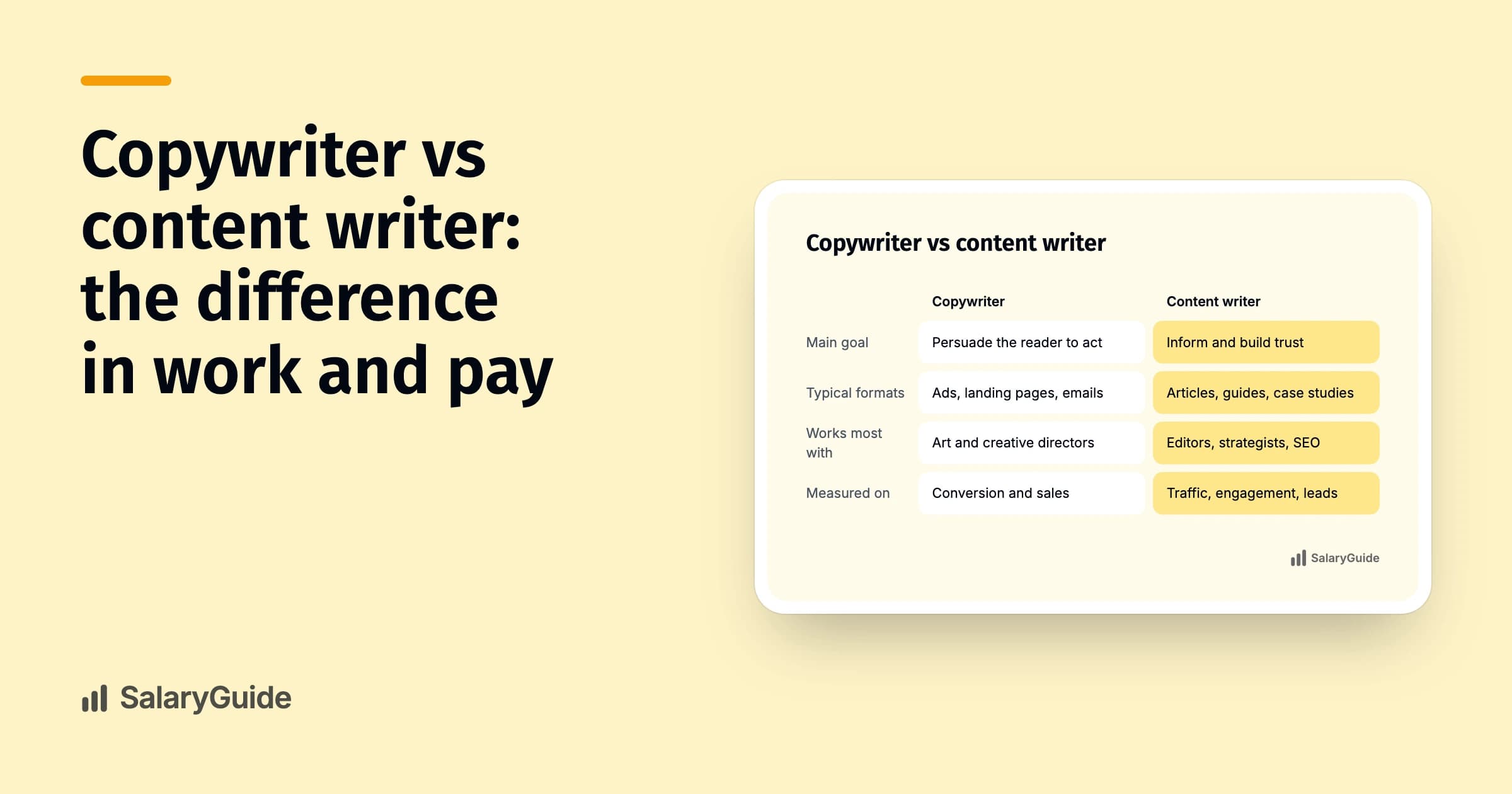
A copywriter writes to get someone to act: click, sign up, buy or remember a brand. A content writer writes to help someone understand: how a product works, how to solve a problem or why a topic matters. Both write for marketing, and many writers do both, but the goals lead to different days, different skills and different careers.
Take one product. The copywriter writes the landing page headline, the ad and the email that announces it. The content writer writes the guide that explains how to choose the right product of that kind, the case study and the help article a customer reads after buying.
Copywriter vs content writer at a glance
| Copywriter | Content writer | |
|---|---|---|
| Main goal | Persuade the reader to act | Inform, educate and build trust |
| Typical formats | Ads, landing pages, emails, product pages, taglines, campaign concepts | Articles, guides, case studies, newsletters, reports, help content |
| Typical length | A few words to a few hundred | Several hundred to several thousand words |
| Works most with | Art directors, creative directors, product and growth teams | Editors, content strategists, SEO specialists, subject experts |
| Measured on | Conversion, click-through, sales, brand recall | Organic traffic, engagement, subscribers, leads from content |
| Research | Customer motivations, objections and the competition | The subject itself, through sources and expert interviews |
What a copywriter does
Copywriters compress. They take everything a product does and find the one idea that will make a particular reader care, then express it in as few words as possible. A copywriter’s week might include headline options for a campaign, an email sequence for a product launch, new copy for a pricing page, and a test of two versions of a sign-up page.
At agencies, copywriters usually work in pairs with an art director, developing campaign ideas together and presenting them to clients. In-house, copywriters often cover more channels for one brand, from the website and product interface to sales materials and ads.
Good copywriters are judged on ideas and results. A clever line that does not change behavior is not considered a success.
What a content writer does
Content writers expand. They take a question a reader has and answer it completely, clearly and accurately, in a way that also builds trust in the brand. A content writer’s week might include researching and writing a long guide, interviewing a customer for a case study, updating older articles that have lost search traffic and editing a newsletter.
Content writers usually work from a content plan set by a Content Strategist or content marketing manager, which decides which topics matter and why. Many also work closely with SEO specialists, because a large share of content is meant to be found through search.
Good content writers are judged on usefulness: whether readers find the content, stay with it, trust it and come back.
Skills that overlap and skills that differ
Both roles need:
- clear, correct writing and the discipline to cut;
- a strong sense of the reader;
- the ability to take feedback and turn a draft around quickly;
- comfort working in a brand’s voice.
Copywriting rewards concepting, persuasion, writing short and testing variations. Content writing rewards research, structure across long pieces, explaining complex ideas simply, interviewing experts and understanding how search works.
How the pay compares
In SalaryGuide’s US data as of October 14, 2026, the median Copywriter earns $75,000 in total compensation across 199 submissions, and the median Content Writer earns $70,000 across 36 submissions. The content writer sample is small, so treat that $5,000 gap as a rough guide. For copywriter pay by level, agency or in-house and experience, see our full guide to Copywriter salary.
Career paths
The two roles lead to different places:
- Copywriters usually move to Senior Copywriter, then Associate Creative Director or Copy Lead, and on to Creative Director or Head of Copy.
- Content writers usually move to Senior Content Writer or Editor, then into content strategy, managing editor or Content Marketing Manager roles.
The copywriting path leads toward creative leadership, where you own ideas and creative teams. The content path leads toward content and marketing leadership, where you own a content program and what it achieves. For how both fit into the wider marketing ladder, see the marketing career path roadmap.
Which one fits you?
Copywriting may suit you better if you:
- love finding the one line that makes an idea click;
- enjoy brainstorming and working in a creative team;
- like seeing results quickly, such as a test that lifts sign-ups.
Content writing may suit you better if you:
- enjoy research and explaining things properly;
- prefer longer, structured pieces to short bursts of copy;
- like building an audience over months through useful work.
In small companies, one person often does both. A combined role is a good way to find out which side you prefer.
Moving from one to the other
From content writing to copywriting: build short-form samples, such as ads, landing pages and email subject lines, and try to get one into a test so you can show the result. Study the copy of brands you admire and rewrite pieces in their style.
From copywriting to content writing: write two or three long, well-researched pieces that answer real questions, including one based on an interview with an expert. Learn the basics of search, such as how people phrase questions and how a page is structured to answer them.
Open copywriting and content jobs
As of October 14, 2026, SalaryGuide lists 1,805 open copywriting jobs in the US. Many ads mix the two roles, so read the list of outputs: ads and landing pages point to copywriting, while articles, guides and case studies point to content writing.
What hiring managers look for
For copywriting roles, hiring managers want to see ideas and range in your portfolio and will often set a short writing test with headlines and body copy. For content roles, they look for research, structure and accuracy, and may ask you to outline or write a short article on a topic you do not know well. In both cases, explaining your choices is as important as the writing itself.
FAQs
What is the difference between a copywriter and a content writer?
A copywriter writes to persuade people to act, through ads, landing pages and emails. A content writer writes to inform and build trust, through articles, guides and case studies. Copywriters are usually measured on conversion and content writers on traffic, engagement and leads from content.
Who earns more, a copywriter or a content writer?
In SalaryGuide’s data as of October 14, 2026, the median Copywriter earns $75,000 and the median Content Writer earns $70,000. The content writer sample is small, so the gap should be treated as a rough guide.
Can a content writer become a copywriter?
Yes. Build a portfolio of short-form samples such as ads, landing pages and emails, and try to get one into a test so you can show the result. Many writers move between the two roles, especially in smaller companies.
Is SEO writing copywriting or content writing?
SEO writing is usually content writing, because it focuses on answering searchers’ questions in depth. Copywriters also write for search, such as page titles and product pages, but long-form SEO articles are normally a content writer’s job.
What career path does a content writer have?
Content writers often move into senior writing or editing roles, then into content strategy, managing editor or content marketing manager roles, where they own a content program and its results.


