How to read a pay range like a recruiter
Published by SalaryGuide, with recruiter insight from our sister company, Search for Hire.
TL;DR
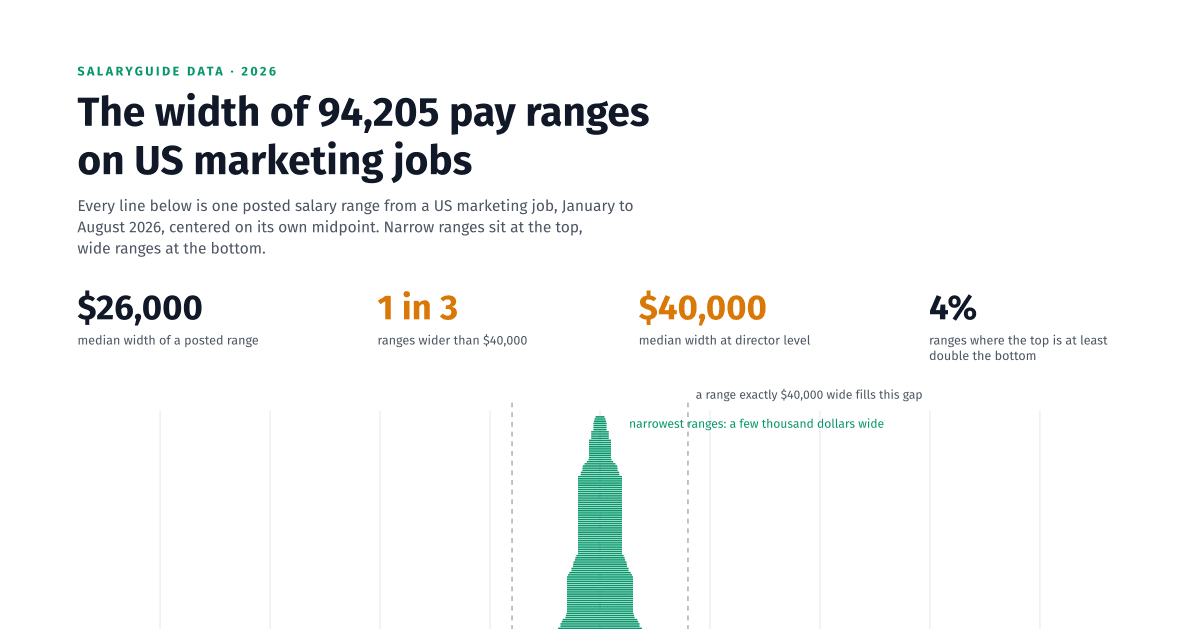
About half of US marketing job ads print a pay range, and most candidates skim past it. Our study of 94,205 posted ranges found the median is $26,000 wide and the typical posting reads $98,500 to $124,500. This piece covers what each number in the range means on the hiring side, and how to use it in your next offer conversation.
Where the numbers come from
Every statistic in this piece is from our published study of 94,205 posted pay ranges on US marketing jobs, “Why are salary ranges so wide?” (August 2026). Nothing new is measured here. This piece explains how to use those numbers.
The three numbers inside every range
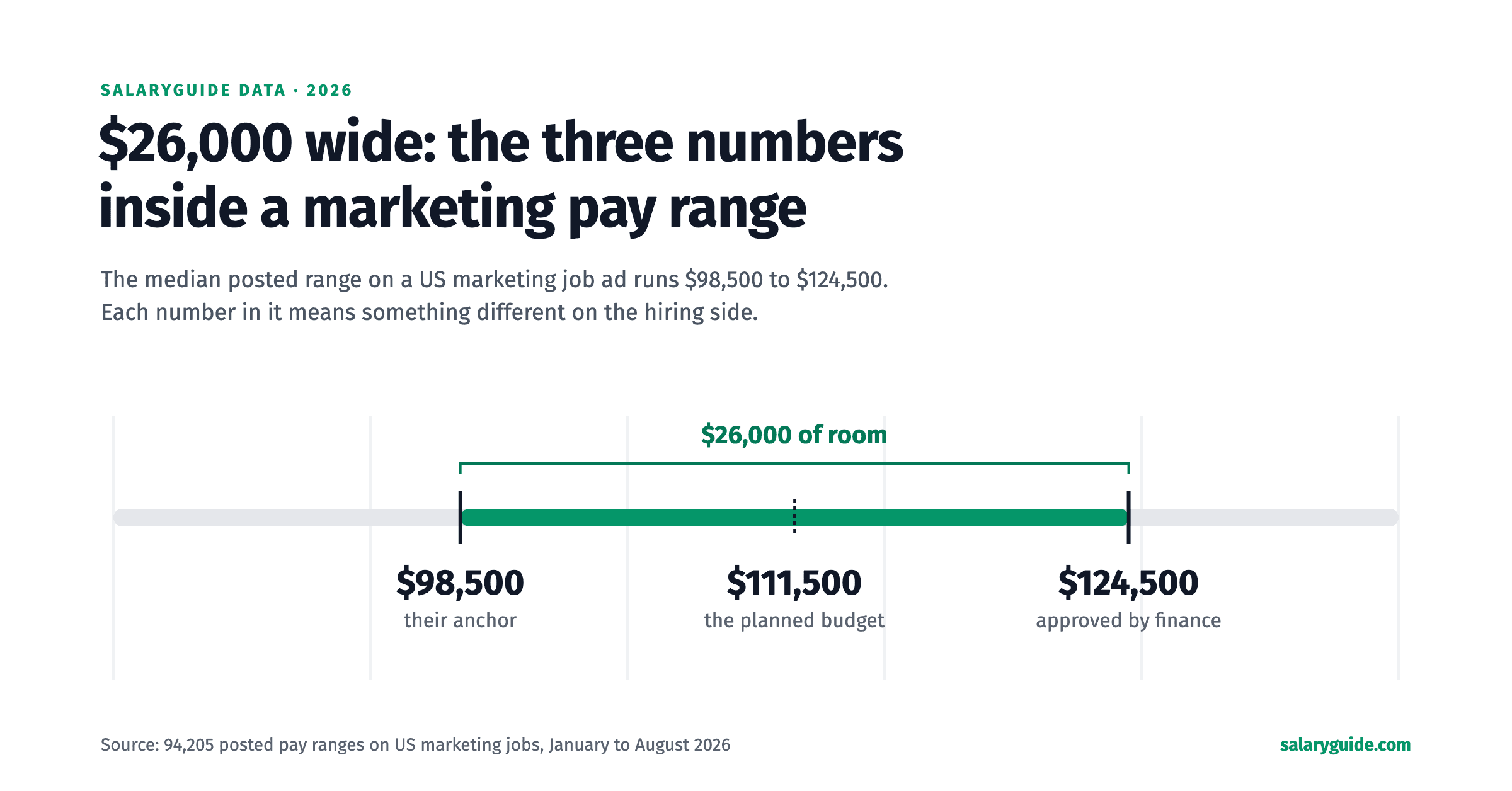
A recruiter reads a posted range in three parts:
The bottom is the number they hope you accept. Offers default here when a candidate never pushes.
The midpoint is roughly where the budget was planned, and internal comp bands are usually built around it.
The top is what finance already signed off for a strong candidate. No company prints a ceiling it refuses to pay.
Most candidates never take that last part on board. Every dollar in the range has already been approved, so asking for the top of it does not surprise anyone on the hiring side.
The typical range holds $26,000 of room
The median posted range on a US marketing job is $26,000 wide, sitting on a median midpoint of $111,500. A typical posting reads roughly $98,500 to $124,500.
Run the math on your own next offer. The difference between signing at the bottom and landing near the top of a typical posting is $26,000 a year, for every year you hold the job. Raises and bonuses are usually calculated as a percentage of base, and your next employer will anchor on this number too, so the gap keeps compounding.
When the range is wider than $40,000
One in three marketing ranges is wider than that. Past that width, the range stops carrying information. The employer usually has not decided the level of the hire, and the same ad is shopping for a strong manager and a light director at once.
One question settles it: “Which level was this range approved for?” It is a routine question for a recruiter, and one that candidates rarely think to ask. The answer tells you which half of the range you are negotiating in, before you say a single number.
The recruiter read
The play for your next offer
- 1.
Benchmark before you anchor. The printed range shows one company’s budget. Your market value comes from the wider data, so pull your number by role and city first, then compare the two.
- 2.
Anchor above the midpoint, with the evidence attached. Offers default to the bottom half, and the top half goes to candidates who make the case in numbers.
- 3.
If the range is wider than $40,000, ask which level it was approved for. It is a normal question, and the answer changes what you should ask for.
- 4.
Say the words out loud before the call. Knowing your anchor and saying it under pressure are different skills. Rehearse the conversation before the real one.
Most marketers wing the range conversation and leave $8K to $15K on the table.
SalaryGuide is marketing-only comp data plus a voice agent that runs your actual negotiation before you walk in.
Data: SalaryGuide pay range study, 94,205 posted ranges on US marketing jobs. Recruiter context: Search for Hire, the specialist marketing recruitment firm and SalaryGuide’s sister company.
Journalists and publishers are welcome to reuse the chart with attribution and a link back to this page.
FAQs
What does the bottom of a salary range mean?
It is the number the employer hopes you accept, and offers default to it when a candidate never pushes. The approved budget runs to the top of the range, so the bottom is an opening position.
What is the midpoint of a salary range?
The midpoint is roughly where the budget for the role was planned, and internal pay bands are usually built around it. On a typical US marketing posting it sits at $111,500. Offers move out of the bottom half when a candidate anchors above the midpoint with evidence a hiring manager can repeat to finance.
Should I ask for the top of the salary range?
You can. The top is a number finance already approved for a strong candidate, so asking for it does not surprise anyone on the hiring side. Bring evidence a hiring manager can repeat to finance, such as pipeline you sourced or a ROAS you held while spend doubled.
How wide is a normal salary range on a marketing job?
The median posted range on a US marketing job is $26,000 wide, so a typical ad reads $98,500 to $124,500. One in three ranges is wider than $40,000. Past that width, the employer usually has not decided the level of the hire.
What should I ask when the salary range is very wide?
Ask which level the range was approved for. It is a normal question to put to a recruiter, and few candidates ask it. The answer tells you which half of the range you are negotiating in before you name a number.