The $26,000 shrug: what 94,205 pay ranges on marketing jobs actually tell you
Published by SalaryGuide, with recruiter insight from our sister company, Search for Hire.
TL;DR
Pay transparency won the law and lost the plot. We analyzed every US marketing job posting SalaryGuide collected in 2026 with a usable salary range, 94,205 unique ranges from 25,950 companies. The median range is $26,000 wide. One in three is wider than $40,000, which is the point where our recruitment team treats a range as no information. At director level it is one in two. The widest range of the year ran from $70,000 to $1,000,000, on a paid media role. Employers are complying with transparency, and quietly pricing in room to win the negotiation anyway.
Key findings
| Result | Number |
|---|---|
| Unique posted ranges analyzed | 94,205 |
| Median width of a posted range | $26,000 |
| Median midpoint | $111,500 |
| Ranges wider than $40,000 | 32.8% |
| Director-level ranges wider than $40,000 | 48% |
| Ranges where the ceiling is at least double the floor | 4% |
| Widest range found | $70,000 to $1,000,000 |
Research methodology
This report is based on US marketing job postings collected between January 1 and August 10, 2026:
- All data was collected and processed by SalaryGuide.com's job pipeline: 344,588 marketing postings, of which 159,661 carried a usable annual base range in US dollars.
- Identical company, title, and range combinations were counted once, leaving 94,205 unique ranges from 25,950 companies.
- Base salary only. Bonus, equity, and commission are excluded. Hourly, weekly, monthly, and non-dollar postings are excluded.
- Seniority labels come from the job titles themselves.
- Qualitative insight comes from the specialist recruitment team at Search for Hire, who manage active marketing hiring briefs year round.
Introduction
Pay transparency was supposed to end the guessing game. State laws now push a salary range onto most US job postings, and most large employers post one range everywhere rather than run two versions of every ad.
Yet the law only says a range must appear. It says almost nothing about how wide that range can be.
Here's the reality we found in our own data:
- The median posted range on a US marketing job is $26,000 wide.
- One posting in three carries a range wider than $40,000, the point where our recruitment team stops treating it as information.
- At director level, that share climbs to nearly one in two.
At Search for Hire, our sister recruitment company, the team reads hundreds of these ranges on live hiring briefs and negotiates marketing offers every week. They watch candidates anchor decisions on numbers that were never commitments in the first place. So we measured the one property of a pay range that nobody regulates: its width.
Finding 1: the middle of the market is a $26,000 shrug
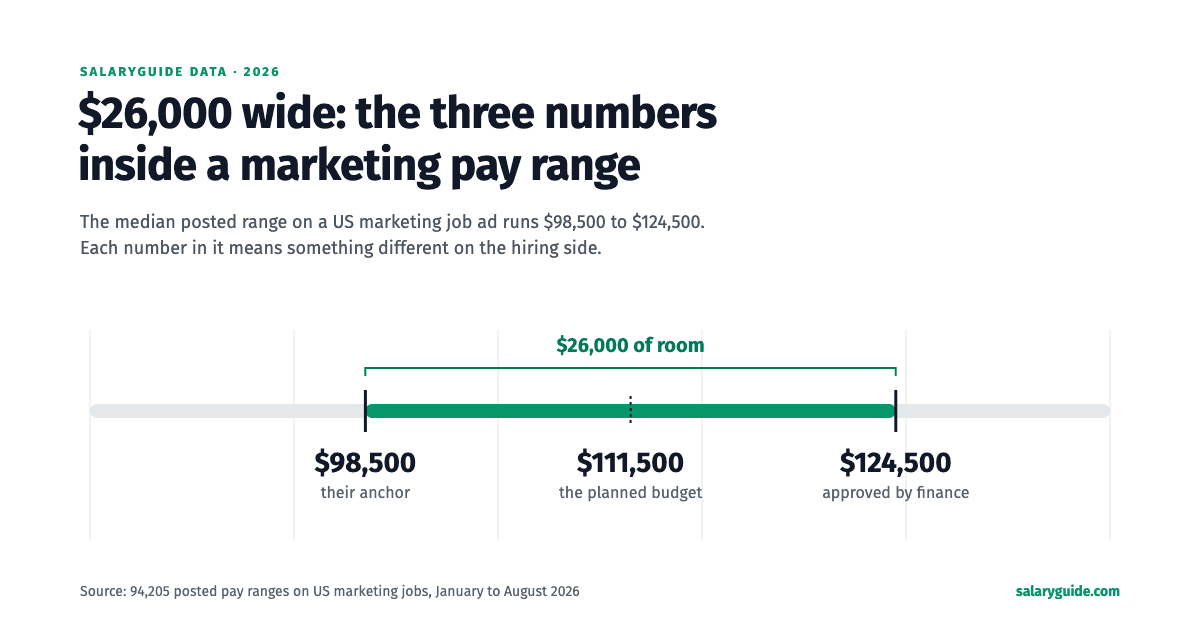
The median posted range is $26,000 wide, on a median midpoint of $111,500.
A typical posting in our set reads somewhere between $98,500 and $124,500. That is workable. You can prepare for a salary conversation inside a window like that.
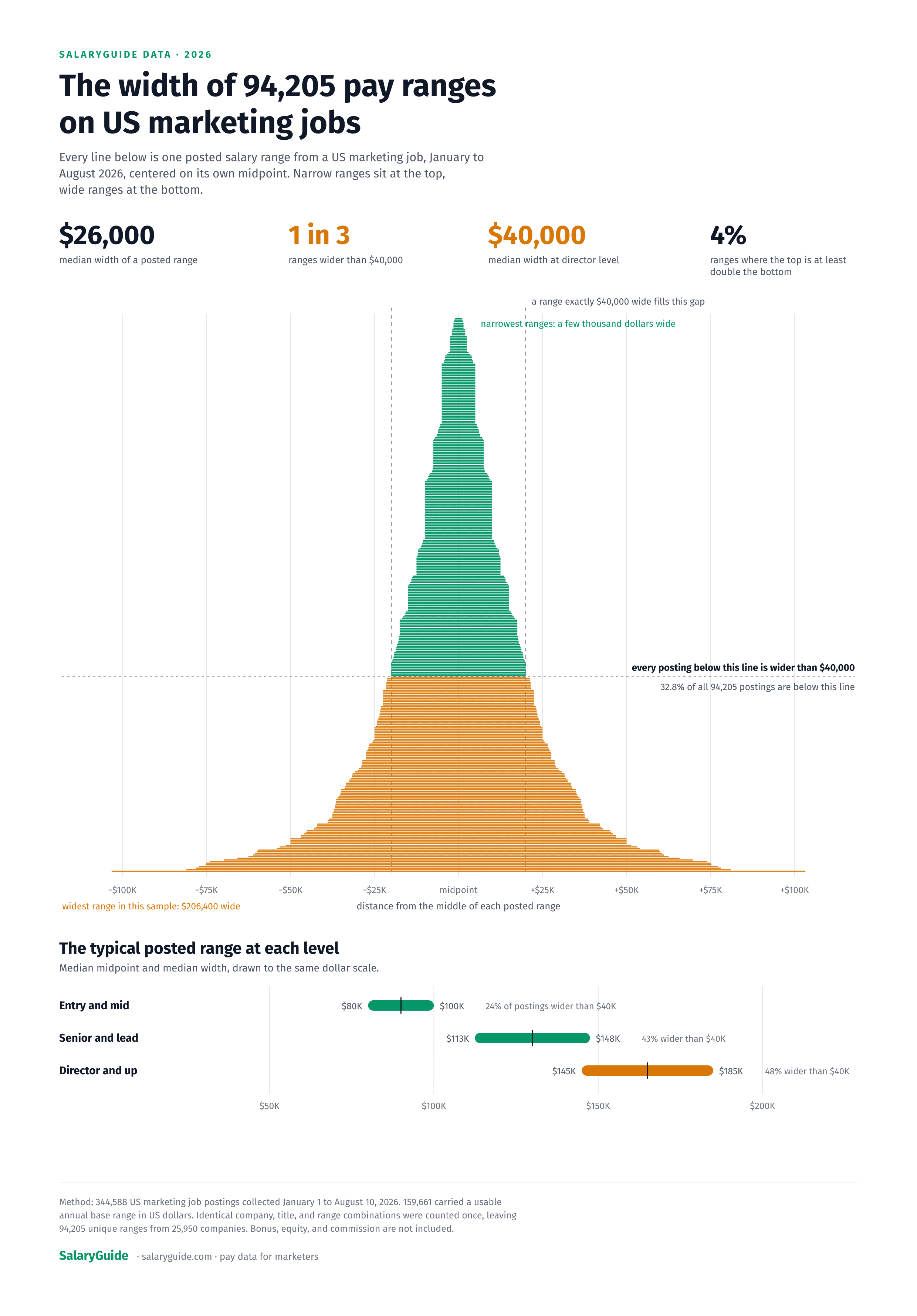
The quartiles tell a messier story. A quarter of all ranges are narrower than $15,000, and those employers clearly know their budget. Another quarter are wider than $50,000, and one posting in ten is wider than $81,400.
Our recruitment team draws the line at $40,000. Past that width, a range no longer narrows anything down for the candidate, and in live placement work it gets treated as no information. By that bar, 32.8% of US marketing postings this year published a range too wide to plan around.
“When I see a role advertised with a 60K-wide salary range, my honest reaction is that the brief isn’t finished. It’s not something I’d take on for Search for Hire, and not because the role isn’t real. A range that wide tells me the client hasn’t done the work to pin down who they’re actually hiring. It’s fishing. You cast the widest net you can and hope the right person swims into it. All that width does is create noise and waste everyone’s time.
Candidates already know the band they sit in, and it’s tight, usually a 15K spread at most. So a 60K range doesn’t pull in more of the right people. It pulls in a mismatched pool. Someone at the bottom and someone at the top of that band are two completely different hires, with different experience, different expectations, and different reasons for moving.
The fix is simple. Nail the budget down first. Build the actual avatar of the person you want, then do the research on what it genuinely costs to hire someone like that in today’s market. Let the data set the number. From there you advertise a real, honest range, 15 to 20K at the very most, and you keep the ceiling flexible internally. If someone lands at the top of that band and makes a strong case for more, you’ve got room to push. That’s a targeted search. A 60K range isn’t a search, it’s a guess.”
Josh Peacock, Search for Hire
Finding 2: seniority buys you fog
Median range width doubles between entry level and director level.
| Level | Typical posted range | Median width | Wider than $40K |
|---|---|---|---|
| Entry and mid (54,992 postings) | $80,000 to $100,000 | $20,000 | 24% |
| Senior and lead (18,208) | $112,500 to $147,500 | $35,000 | 43% |
| Director and up (21,005) | $145,000 to $185,000 | $40,000 | 48% |
Typical posted range = median midpoint for the level, plus and minus half the median width.
The pattern is consistent across the whole dataset. The more a role pays, the less its posting commits to, and at director level nearly half of all postings sit past the point our recruiters call useless.
“While the biggest ranges happen more often at the director level, this is due to a number of different factors. When people reach this stage of their career, there’s much more than just a base salary that affects the raw compensation package. A lot of people at the director or VP level will have equity options, profit-sharing schemes, and large bonus incentives as well. Therefore, companies go for a wider base range so that they don’t exclude themselves from the market and different compensation structures that are unique to each company.
However, this can lead to more competitiveness within the market, as candidates who are trying to break into the director level will be applying, as well as candidates who are already at that level and seeking a new opportunity. This is where we see a breakdown in the hiring process, as they can’t weed out who is the right fit. As they’re inundated with applications, systems start to break. Candidates don’t hear back, and the company’s reputation slowly diminishes without their knowledge.”
Daris Benallal, Senior Recruiter, Search for Hire
Key insights for candidates:
- If you are interviewing at director level, expect the posted range to be a $40,000 window. That is now the normal amount of fog, and it means the real budget conversation happens in the room.
- A wide range on a senior posting usually means the role can be leveled up or down after interviews. Ask early which level they are actually hiring for.
- The narrower the range, the more the employer has already decided. Narrow ranges are faster processes and shorter negotiations.
Finding 3: the double-tops, and who posts honestly
4% of postings have a ceiling at least double the floor.
A range like that usually means one of two things. Either several levels were folded into one opening, or on-target earnings were entered as base salary. It is worth asking which one it is before you anchor on any part of it.
The widest range we found all year was a paid media role posted at $70,000 to $1,000,000. That posting is fully compliant with every transparency law in America. It is also a shrug in dollars.
The honest end of the market looks very different:
| Title | Postings | Typical range | Median width |
|---|---|---|---|
| Marketing manager | 1,107 | $80,000 to $100,000 | $18,600 |
| Marketing coordinator | 674 | $55,000 to $65,000 | $10,000 |
| Product marketing manager | 623 | $119,000 to $150,000 | $30,000 |
| Social media manager | 493 | $75,000 to $95,000 | $15,000 |
| Marketing specialist | 491 | $62,400 to $80,000 | $13,700 |
Coordinator postings come closest to a straight answer, with a typical span of $10,000 on a $60,000 job. Product marketing sits at the foggy end of the common titles, with a median $30,000 span and one posting in three past the $40,000 mark. The closer a title sits to revenue and leadership, the wider the span gets.
Finding 4: remote work and the calendar change almost nothing
Remote-tagged postings run a $27,000 median width against $26,000 for everything else.
You might expect remote roles to carry wider ranges, since one posting can price for many cities at once. In practice the difference is $1,000, which is close to nothing.
The calendar barely moved either. January's median width was $30,000 and July's was $25,000. Wide ranges are a design choice, and in 2026 the design is stable.
The 2026 pay range playbook: how to act on this data
For marketers in a job search
Treat any range wider than $40,000 as an invitation to name a number first, and decline it. Anchor from market data for your role and your city instead.
Use the posted range for one job only: checking the ceiling. If the top of the range sits below market for your role, that budget conversation is already over, and your evening is better spent on a different application.
And when the top is double the bottom, ask the recruiter what the last person in the seat actually earned in month three. The answer will tell you more than the posting did.
For employers writing job postings
The honest end of the market already proved that narrow ranges work. Coordinator roles post $10,000 spans and they fill.
A tight range signals you know your budget, and it filters out candidates you were never going to afford, which saves interview hours on both sides. If your range needs to be $60,000 wide to cover the role, you are hiring for two different jobs, and the cleaner move is to post two.
Conclusion
Transparency laws changed what job postings show. They did not change what employers commit to. A third of US marketing postings this year carry a range too wide to mean anything, and the share grows with every step up the ladder.
None of this means wide ranges are a trap. Most of the time they are an employer keeping options open. It does mean the posted number is the start of your research, and it should never be the end of it.
You have spent years building your marketing career. Don't walk into the one conversation that prices it with less information than the other side. Look up what your role actually pays, and bring your own number to the table.
Use this data
Journalists and publishers are welcome to use the chart and the numbers in this study with attribution and a link back to this page. For media questions or custom cuts of the data, contact us at hello@salaryguide.com.
FAQs
What is the typical salary range on a US marketing job posting?
The median posted range in 2026 is $26,000 wide, sitting on a median midpoint of $111,500. A typical posting reads roughly $98,500 to $124,500.
Why do companies post such wide salary ranges?
Width buys the employer options. The role can be leveled up or down after interviews, and the final offer can land low in the range without breaking any promise. At director level, wide bases also cover different compensation structures, since equity and bonus mixes differ by company.
Is a wide salary range a red flag?
Usually it is optionality rather than a warning sign. Treat any range wider than $40,000 as no information. It tells you the employer kept their options open, and it tells you nothing about what they will pay you.
Do remote jobs post wider ranges?
Barely. Remote-tagged postings run a $27,000 median width against $26,000 for everything else, even though remote roles could justify wider geographic pricing.
How should I respond to a wide range in an interview?
Avoid naming a number first. Anchor from market data for your role and city, and use their range only to check whether the ceiling clears your target.
What was the widest range in the study?
A paid media role posted at $70,000 to $1,000,000. The ceiling is 14 times the floor, and the posting is fully compliant with US transparency laws.