What Is the Average Content Marketing Manager Salary?
Across the United States, the typical content marketing manager salary lands somewhere between $77,858 and $87,207 per year. Of course, that’s just the middle ground.
If you’re just starting out, you might see offers around $59,000. But for seasoned pros with a track record of success, it’s not uncommon to see salaries climb well past $115,000. These numbers provide a great starting point, but they don't tell the whole story.
Your Quick Guide to Content Marketing Manager Salaries
Figuring out what you should be paid as a Content Marketing Manager is a lot like putting together a puzzle. Your final salary isn't just one number; it’s a picture formed by several key pieces—your years of experience, where you live, and the industry you work in all matter. This guide will walk you through each of these factors to give you a clear, practical understanding of what you can earn.
We'll begin with the most straightforward factor: experience. This will give you a solid baseline, whether you're stepping into your first manager role or you're a veteran strategist looking to make your next move.
Benchmarking Salary by Experience
In content marketing, your career is all about building value over time, and your paycheck should absolutely reflect that. As you grow, your role naturally evolves from hands-on execution to high-level strategic planning, and that's where the real salary growth happens.
Early on, you're focused on writing, editing, and getting campaigns out the door. A few years in, you’re the one building the content engine, managing a team, and proving its impact on the bottom line.
Recent data from sources like ZipRecruiter and Built In shows this trend clearly. For those with 0-2 years of experience, starting salaries typically fall between $48,533 and $59,518. It’s a field where expertise is genuinely rewarded.
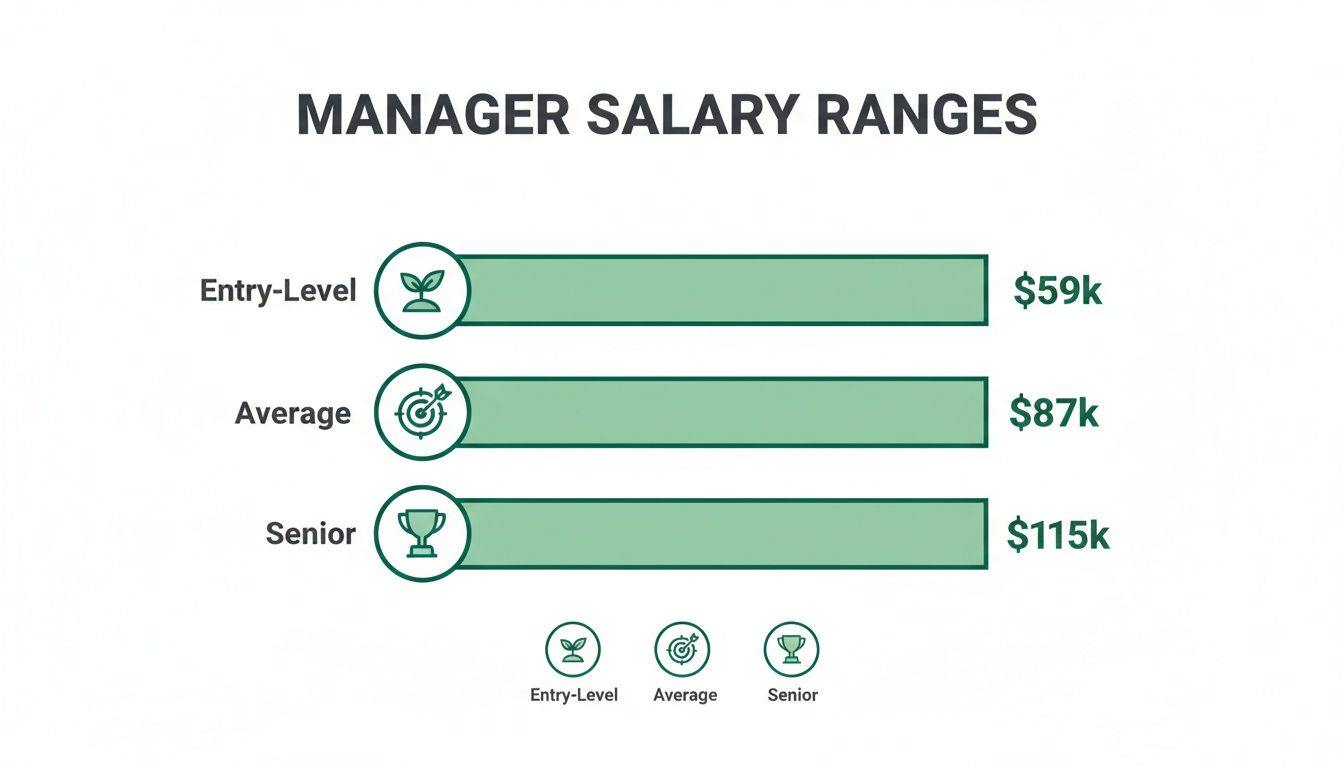
The numbers show that senior-level managers with over six years under their belt command an average of $115,723, with the highest earners pushing past $142,781. That's a significant jump, and it shows just how much companies are willing to pay for strategic leadership and proven results.
To give you a clearer picture, here's a simple breakdown of what to expect at each stage.
Content Marketing Manager Salary by Experience Level
This table summarizes the typical base pay and total compensation you can anticipate as you advance in your career.
| Experience Level | Average Base Salary Range | Potential Total Compensation |
|---|---|---|
| Entry-Level (0-2 Years) | $55,000 – $70,000 | Up to $75,000 |
| Mid-Level (3-5 Years) | $75,000 – $95,000 | Up to $105,000 |
| Senior-Level (6+ Years) | $100,000 – $125,000+ | $130,000+ |
Remember, your total compensation is more than just your base salary. It often includes performance bonuses, profit-sharing, or stock options that can add a significant amount to your annual earnings. Don't forget to look at the whole picture when you're evaluating an offer.
Experience is just one variable, though. For a wider view of pay across the marketing field, check out our complete guide on how much do marketers earn.
How Experience Shapes Your Earning Potential
Think of your career path like leveling up in a video game. Every campaign you ship, every new skill you master, and every leadership challenge you tackle unlocks the next stage—and, usually, a bigger paycheck. For a Content Marketing Manager, experience isn't just about years on the job; it's a direct measure of the value you deliver.
As you grow, your role naturally shifts from being a tactical doer to a strategic leader, and your salary should absolutely follow that arc. This progression is probably the single biggest factor influencing a content marketing manager salary.
When you're just starting out, you’re deep in the trenches—writing, editing, and managing the day-to-day content calendar. Your value is in producing high-quality work and keeping the content machine humming. But as you rack up a few years, your perspective widens. You start moving from just creating the content to architecting the entire strategy behind it. This is where the real value—and the serious salary jumps—begin.

From Execution to Ownership
In your first couple of years, success is all about output. Did you hit publish on the blog posts? Did the social media campaign launch on schedule? The focus is on doing.
After three to five years, though, the conversation changes. The questions pivot from "what did you create?" to "what results did you drive?" This is the mid-level turning point where you begin to own outcomes, not just tasks.
At this stage, your role likely expands to include:
- Team Management: You're now guiding junior writers, editors, and specialists, which means your impact is amplified through the work of others.
- Budget Oversight: You might be trusted with a slice of the marketing budget, making key decisions on where to invest for the best return.
- Performance Analytics: You're expected to dig deeper than surface-level metrics and connect content performance directly to business goals like lead generation and sales pipeline.
This leap into ownership is what separates a Manager from a Senior Manager and justifies a bigger paycheck. You're no longer just a line item in the budget; you're a revenue driver.
The Senior-Level Strategic Leap
Once you've got six or more years under your belt, you're playing an entirely different game. Senior Content Marketing Managers and Directors are the strategic minds shaping a company's entire brand narrative and its position in the market.
Your value is no longer in the content you create, but in the strategic vision you provide. You’re not just managing a blog; you're building a brand's authority in its market.
At this level, you have to think like a business owner. Your days are filled with high-level planning, collaborating with sales and product teams, and confidently presenting your strategy's ROI to the C-suite. You're responsible for the entire content ecosystem and how it contributes to the company's bottom line.
Quantifying the Experience Premium
This evolution from tactical work to strategic leadership has a direct and clear impact on your earning power. The data backs it up: experience is king. A professional with less than a year of experience might see a total compensation around $48,533. An early-career manager with one to four years sees that jump to $69,364.
But the most significant leaps happen as you become more senior. Base salaries for those with six-plus years often start around $115,723 and can climb as high as $142,781. You can dig into more of this data in this comprehensive pay analysis.
Ultimately, your experience is your most valuable negotiating asset. If you understand how your role is meant to evolve, you can start building the skills for the next level now—and make a rock-solid case for a salary that truly reflects your growing impact.
Why Your Location Determines Your Paycheck
Just like a house in Beverly Hills costs more than one in rural Ohio, a content marketing manager salary is deeply tied to geography. Where you clock in—whether it's a buzzing tech hub or your quiet home office—is one of the single biggest factors in your earning potential. The local cost of living and the sheer concentration of high-paying companies in an area create massive swings in what you can expect to earn.
Think of it this way: a company in San Francisco or New York City has to offer a higher salary. They're competing for talent who need to afford some of the country's most expensive housing and everyday goods. This economic reality creates a built-in premium for roles in major metro areas. The talent isn't necessarily more skilled; the market simply demands they be paid more to live there.
The High-Cost Hub Premium
Certain cities are magnets for top-tier companies, especially in tech and finance. This cluster of opportunity drives up competition for skilled people, and like clockwork, salaries follow suit.
For a Content Marketing Manager, this means an offer in a city like San Francisco will almost always look more impressive on paper than an identical role based in a smaller town. It's not just about the price of a gallon of milk; it's about the density of high-revenue businesses all fighting over the same limited pool of experts.
- San Francisco Bay Area: Often leads the pack, with salaries that can run 20-30% higher than the national average.
- New York City: A titan of media, finance, and tech that commands salaries rivaling those on the West Coast.
- Boston and Seattle: Home to booming tech and biotech scenes that create intense demand for sharp marketing talent, pushing wages up.
Of course, there’s a catch. That bigger paycheck in a major hub is often gobbled up by significantly higher living expenses, from rent and taxes to a simple lunch out. The net financial gain can sometimes be smaller than you'd think.
The Global Salary Divide
This location effect isn't just a U.S. thing; it’s a global reality. A Content Marketing Manager in the United States will almost always earn more than their counterparts in Europe or Latin America, even after converting the currency.
Let’s look at some real-world numbers to see how stark the difference can be.
Global Salary Comparison for Content Marketing Managers
Here's a snapshot of what you can expect to see in different parts of the world. All figures are converted to USD to give you an apples-to-apples comparison.
| Region / Country | Average Annual Salary Range (USD) |
|---|---|
| United States | $77,858 – $113,276 |
| United Kingdom | $57,000 – $88,000 |
| Latin America | $24,600 – $44,000 |
The numbers speak for themselves. This significant global pay gap is a major reason why many U.S. companies are now tapping into remote talent from other regions. As you can see from the data, which you can explore further in the 2025 Digital Marketing Salary Guide, it's a win-win. They can offer a highly competitive salary for a specific country that still represents a major cost saving for the business.
This trend is changing the game for job seekers and employers, blurring the old lines between local and global pay scales.
Navigating the Remote Work Frontier
The explosion of remote work has tossed a fascinating wrench into the old location-based pay models. Companies everywhere are wrestling with a huge question: do we pay for the location of the employee or the value of the role?
Right now, three main approaches are taking shape:
- Location-Based Pay: The traditional model, adapted for remote work. Companies adjust your salary based on your local cost of living. A manager in Boise, Idaho, would earn less than their colleague in Los Angeles for doing the exact same job.
- Location-Agnostic Pay: A progressive approach where a single salary band is set for a role, no matter where the employee logs in from. This philosophy pays for skill and impact, not geography.
- Hybrid Approach: A middle-ground solution. Some companies create regional pay tiers (e.g., Tier 1 for major hubs, Tier 2 for mid-sized cities) to find a balance between fairness and market realities.
Figuring out a company's philosophy on remote pay is now a crucial step in your job search. It directly affects your negotiation leverage and long-term earnings, so don't be shy about asking how they handle it during the interview process. Your physical address—or lack of one—is a bigger piece of the salary puzzle than ever before.
Skills That Command a Higher Salary
Let's be blunt: not all skills are valued equally. In content marketing, strong writing and project management are just the price of entry. To really move the needle on your paycheck, you need to master the high-impact skills that directly tie your work to the company's bottom line.
Think of it this way: your skillset is an investment portfolio. While the basics are your safe, steady bonds, the skills we're about to cover are the high-growth stocks. They're the ones that deliver the biggest returns. Companies are more than willing to pay top dollar for managers who can prove their worth with hard data, not just beautiful prose.

Mastering SEO for Business Impact
A deep, practical understanding of SEO is probably the most valuable weapon in a Content Marketing Manager's arsenal. It's the difference between creating content and creating content that actually gets found. Without it, the most brilliant article is like a billboard in the desert.
We're talking about more than just basic keyword research. The managers pulling in the highest salaries can confidently navigate technical SEO, architect a powerful link-building strategy, and dissect search intent like a detective. They don't just get content to rank; they build organic traffic machines that consistently generate leads and revenue. That ability to directly fuel the sales pipeline is why advanced SEO skill is non-negotiable for top-tier roles.
Data Analytics and ROI Reporting
The C-suite speaks one language: numbers. To earn a seat at the table (and the salary that comes with it), you have to be fluent. The ability to track, analyze, and report on the return on investment (ROI) of your content is what separates a creative from a strategic business leader. This is a massive factor in any content marketing manager salary.
This means getting your hands dirty in tools like Google Analytics, SEMrush, or HubSpot to connect the dots between your content and real business results.
- Lead Generation: Can you prove how many qualified leads that new ebook generated?
- Sales Influence: Can you use attribution models to show how your blog posts helped close a six-figure deal?
- Customer Lifetime Value: Can you demonstrate that your onboarding content reduces customer churn?
When you can confidently walk into a meeting and say, "Our content strategy last quarter generated $500,000 in new sales pipeline," you've just made yourself indispensable.
The Rise of AI and Automation
Artificial intelligence is already reshaping how content gets made. Managers who aren't just aware of AI but are actively integrating it into their workflows have a serious advantage. This isn't about letting robots write your blog posts; it's about augmenting your team's creativity and supercharging their efficiency.
An AI-driven strategy means using technology for complex content ideation, testing hundreds of headlines in minutes, and automating distribution. This frees your team up to focus on the big-picture thinking and creative work that humans do best, dramatically increasing their overall impact.
Getting comfortable with AI content tools and marketing automation platforms signals that you're focused on scalability and the future. To go deeper, you can explore more essential marketing skills to learn in our comprehensive guide.
Advanced Multimedia Production Skills
Text is no longer the undisputed king. It’s a key player in a much larger court that includes video, audio, and interactive content. As platforms like YouTube, TikTok, and podcasts command more and more attention, skills in multimedia production have become incredibly valuable. A manager who can confidently lead a multimedia content strategy is a huge get for any company.
This means you can:
- Develop a Video Strategy: Go beyond one-off videos to create entire series that align with brand goals.
- Manage Production: Oversee the entire process—from scripting and shooting to editing—whether you're working with an in-house team or freelance crews.
- Launch a Podcast: Build and grow a brand podcast from the ground up to establish authority and connect with your audience.
These skills enable a company to create the kind of diverse, engaging content that modern audiences demand. By investing your time here, you’re not just getting better at your job—you’re building an undeniable case for a bigger paycheck.
Getting Paid What You're Worth: Your Guide to Salary Negotiation and Career Growth
Knowing the average content marketing manager salary is one thing. Actually getting that number on your paycheck? That requires a plan. Think of this as your roadmap for turning market data into more money in the bank, covering both immediate negotiations and smart, long-term career moves.
This isn't about awkward confrontations or making demands. It’s about building a solid business case for yourself. You're a valuable asset, and it's time to prove it with data. Let's walk through how to prepare for that conversation and what to do next.
Step 1: Do Your Homework and Find Your Number
Before you even think about scheduling a meeting, you need to do your research. Walking in unprepared is like launching a campaign without knowing your audience—it’s just not going to work. The goal here is to anchor your salary request in hard data, not just a feeling that you deserve more.
Start by digging into salary benchmarking tools and reputable industry reports to find a realistic salary band for your role. Make sure you filter for the key variables: your experience level, where you're located (or the company's policy on remote pay), the industry you're in, and the specialized skills you bring to the job. This research gives you a credible, confident starting point.
Step 2: Create a Brag Sheet That Proves Your Value
With market data in hand, it’s time to build an undeniable case for your individual impact. This is where a "brag sheet" becomes your secret weapon. It's a running list of your accomplishments, but with one crucial rule: every single point has to be tied to a measurable business result.
Your boss doesn't need to hear that you "managed the company blog." They need to understand the value of that work. Frame every achievement using a simple formula: What I Did > The Resulting Metric > The Business Impact.
Let's look at the difference:
Weak: "Wrote SEO-focused blog posts."
Strong: "I overhauled our blog's SEO strategy, which drove a 45% lift in organic traffic in six months and contributed to $75,000 in new pipeline revenue."
Weak: "Launched a new webinar series."
Strong: "I developed and launched a three-part webinar series that generated 1,200 MQLs and directly influenced $150,000 in closed deals."
See the shift? You’re no longer talking about tasks; you're talking about tangible value. You're framing the conversation around their bottom line, not just your own.
Remember, the strongest negotiation tactic is irrefutable proof of your ROI. When you can connect your daily tasks to revenue, you're no longer just a cost center—you're a growth engine.
Step 3: Master the Salary Conversation
You've got your research. You've got your brag sheet. Now you're ready to actually have the conversation. Confidence is everything, whether you're negotiating a new job offer or asking for a raise in your current role. For a great breakdown of specific tactics, check out this guide on How to Negotiate a Salary Increase.
When it's time to talk, stay calm and professional. Start by reaffirming your commitment to the company's goals. Then, walk your manager through the highlights from your brag sheet, clearly connecting your wins to the team's success. Finally, state your desired salary range—the one you backed up with all that market research. For more specific scripts and tips, our article on asking for a raise is a fantastic resource.
Planning Your Long-Term Career and Salary Growth
Securing a raise is a great short-term win, but real wealth is built through strategic career planning. Don't just think about your next pay bump; think about your next role. For content marketers, a few career paths are especially rewarding.
A very common—and lucrative—move is to specialize in the B2B tech sector, especially in fast-growing areas like SaaS, fintech, or cybersecurity. These industries tend to have high margins and can easily trace a direct line from great content to big-ticket sales. As a result, they're often willing to pay top dollar for content leaders who can deliver.
Beyond just switching industries, focus on building the skills that get you into leadership. A typical career ladder might look something like this:
- Content Marketing Manager: Owning strategy and execution.
- Senior Manager / Head of Content: Leading a small team, managing a budget, and reporting up.
- Director of Content: Setting the high-level vision for the entire brand's story.
- VP of Marketing: Overseeing all marketing functions, where content is a major pillar of a much broader strategy.
Each step up that ladder requires you to move from doing the work to leading the people who do the work. Start looking for chances now to mentor junior colleagues, manage complex projects that involve other teams, and present your team's results to executives. These are the things that build the foundation for your next big career leap—and the salary that comes with it.
Common Questions About Content Marketing Salaries
Alright, we’ve covered a lot of ground—from salary benchmarks to negotiation tactics. But chances are, you still have a few specific questions bubbling up. This is where we get down to brass tacks.
Think of this as the final, practical piece of the puzzle. We’ll tackle the most common questions we hear from content marketers, turning all that data you just learned into confident, real-world action.
What Is the Typical Career Path for a Content Marketing Manager?
Most people don't just land in a Content Marketing Manager role. The journey almost always begins with your hands on the keyboard, deep in the creative trenches. You’ll likely start out as a Content Creator, Copywriter, or Content Specialist, focused purely on producing great work—be it blog posts, social media updates, or video scripts.
The move to Content Marketing Manager is the first real pivot from creating to strategizing. This is where you graduate from simply writing to owning the editorial calendar, digging into performance analytics, and maybe even guiding a junior writer or two.
From there, the path gets more strategic as you climb:
- Senior Content Marketing Manager: You’re now managing a bigger team, controlling a serious budget, and you're the one on the hook for proving the ROI of your team’s efforts.
- Director of Content or Head of Content: At this level, you’re the storyteller-in-chief. You’re not just managing a blog; you’re setting the brand’s entire narrative and ensuring it aligns with the company’s biggest goals.
- VP of Marketing: For many, the ultimate goal is a seat at the executive table. Here, content becomes a critical pillar of a much broader strategy to drive company growth, and you’re the one leading the charge across all marketing functions.
How Does Industry Type Affect Salary?
Your industry plays a huge role in your paycheck. Let's be blunt: not all companies see content marketing the same way, and their salary ranges make that crystal clear.
As a general rule, B2B (business-to-business) roles tend to pay more than B2C (business-to-consumer). This is especially true when you get into highly technical or high-growth industries.
Think of it this way: In B2B tech, a single, well-researched whitepaper can directly influence a multi-million dollar software contract. That direct line between your content and a massive revenue number makes your role incredibly valuable and justifies a much higher salary.
Hot sectors like SaaS (Software as a Service), fintech, and cybersecurity are famous for paying top dollar. These fields have complex products and long sales cycles where educational, trust-building content isn’t just a "nice-to-have"—it's an absolute necessity for closing a deal. A great content marketer here is a translator, making complex ideas accessible and building the business case for a product.
What Education Do I Need to Maximize My Salary?
While a bachelor’s degree in Marketing, Communications, or Journalism is a great foundation, it's rarely the thing that gets you a top-tier salary. In this field, what you can do and what you've done will always trump where you went to college.
If you want to maximize your earning potential, pour your energy into gaining specialized, in-demand skills. Your goal is to get certifications that directly tie to business growth.
Some of the most valuable credentials you can earn are in:
- Advanced SEO Certifications: Nothing screams "valuable" like proving you can bring in free, high-intent traffic from Google.
- Google Analytics and Data Analysis: Senior roles demand that you measure your impact. Being able to speak the language of data and analytics is non-negotiable.
- Marketing Automation Platforms: Expertise in tools like HubSpot, Marketo, or Pardot shows you get the bigger picture—how content actually fuels the entire lead-gen engine.
At the end of the day, a portfolio bursting with campaigns that drove real, measurable results will always be more persuasive than a diploma.
How Do I Justify a Raise During My Performance Review?
Walking into a review and asking for a raise without proof is basically just making a wish. To get what you want, you need to build a rock-solid business case that frames your value in dollars and cents, not just "hard work."
Never go into that meeting cold. Spend the weeks beforehand building your "brag sheet," a document that quantifies everything you’ve accomplished over the last year.
Your mission is to connect your daily tasks to tangible business outcomes:
- Lead Generation: "My blog series on X directly generated 350 marketing qualified leads last quarter."
- Organic Traffic Growth: "The SEO strategy I implemented led to a 40% year-over-year increase in organic traffic."
- Conversion Rate Improvement: "By rewriting the copy on our key landing pages, we lifted the conversion rate from 2% to 4.5%."
- Sales Enablement: "The new case studies I created have been used by the sales team to help close over $200,000 in new deals."
When you present your wins in the language of revenue and growth, the entire conversation shifts. You’re no longer just asking for more money—you’re proving you're a profitable investment for the company.
Ready to find what you're worth? SalaryGuide provides real-time marketing salary data and live job postings sourced directly from company career pages. Use our tools to benchmark your compensation, discover your next career move, and negotiate with confidence. Explore real marketing salaries and jobs on SalaryGuide.
