What does a Communications Manager do? Role, salary and career path
Published by SalaryGuide, with recruiter insight from our sister company, Search for Hire.
A Communications Manager decides what an organization says, who hears it first, which channel carries it and who has to approve it. That covers the email every employee reads about a reorganization, the statement a journalist receives, the talking points a CEO uses on stage and the holding line when something goes wrong.
It is also one of the most common roles in the field. As of October 14, 2026, SalaryGuide lists 8,919 open communications jobs in the US.
What does a Communications Manager do?
Most Communications Manager jobs combine some of these five areas:
- Internal communications: company-wide announcements, intranet news, town hall agendas, manager briefing packs and change messages such as a new policy or a restructure.
- Media and external relations: press releases, pitches to reporters, interview preparation and keeping spokespeople on message. In larger companies a separate PR team may own this.
- Executive communications: speeches, CEO notes to staff, conference talks and posts written for senior leaders.
- Issues and crisis response: holding statements, question-and-answer documents and an approval route that is agreed before a story breaks.
- Messaging and measurement: the core narrative everyone else borrows, plus reporting on coverage, reach and whether people actually understood the message.
Which of these you own depends on where the role reports. When communications sits inside marketing, the job leans toward launches and external messaging. When it reports to HR or the CEO’s office, internal and executive work usually takes up most of the week.
Communications Manager vs PR Manager vs Marketing Manager
The three titles overlap, and job ads use them loosely. The clearest difference is the audience each role is judged on.
| Role | Main audience | Typical output | How success is judged |
|---|---|---|---|
| Communications Manager | Employees, media, leaders and the public | Announcements, narratives, statements, executive content | Understanding, trust and accurate coverage |
| PR Manager | Journalists and the outlets they write for | Pitches, releases, media briefings | Quality of coverage and share of voice |
| Marketing Manager | Buyers and prospects | Campaigns, content and offers | Leads, pipeline and revenue |
If media work is the part you enjoy most, PR Manager vs PR Specialist explains how that path splits by seniority. If you lean toward campaigns and revenue, compare the role with Marketing Manager responsibilities.
What the work looks like in a real week
A typical week for a Communications Manager at a mid-sized company might run like this:
- Monday: agree the message for a product announcement with marketing, legal and the product lead.
- Tuesday: draft the CEO’s all-hands talking points and the follow-up note managers will send their teams.
- Wednesday: offer an exclusive to two trade reporters and brief the spokesperson.
- Thursday: a customer complaint spreads on social media. You write a holding statement, route it through legal and the executive team, and agree who answers press questions.
- Friday: check intranet readership and the pulse survey question about the restructure, then adjust next week’s plan.
The pattern repeats. Most of the job is getting the right people to agree on the right words quickly, then getting those words to each audience in the right order. Employees should rarely learn company news from a journalist.
Skills and tools
Skills hiring managers test
- Writing for different audiences. A board update, a note to frontline staff and a press statement about the same news need three different versions.
- News judgment. Knowing which story a reporter will care about, and which internal change will worry people.
- Calm process under pressure. Who approves, in what order, and what you say while you wait.
- Stakeholder management. Legal, HR, finance and executives all want a say, often on the same afternoon.
- Measurement beyond open rates. Coverage quality, message pull-through and survey results show whether communication worked.
Tools you will meet
- Media databases and monitoring tools such as Cision, Muck Rack and Meltwater.
- Internal channels such as Slack, Microsoft Teams, SharePoint or a dedicated employee app like Staffbase.
- Email tools for employee newsletters and leader messages.
- A house style guide, often based on AP style in the US.
Employers rarely hire for a specific tool. They hire for writing and judgment, and expect you to learn their channels within your first few weeks.
Communications Manager salary
SalaryGuide does not yet have enough exact-title submissions for Communications Managers to publish a reliable title page. The closest benchmark is the broader communications salary category, which covers coordinators through communications leaders. As of October 14, 2026 it is based on 5,754 salaries.
| Benchmark | Total compensation |
|---|---|
| 25th percentile | $70,000 |
| Median | $93,000 |
| 75th percentile | $138,000 |
| 90th percentile | $187,000 |
Source: SalaryGuide communications salary data, 5,754 salaries, as of October 14, 2026. Total compensation includes base salary, bonus and equity.
How pay grows with experience
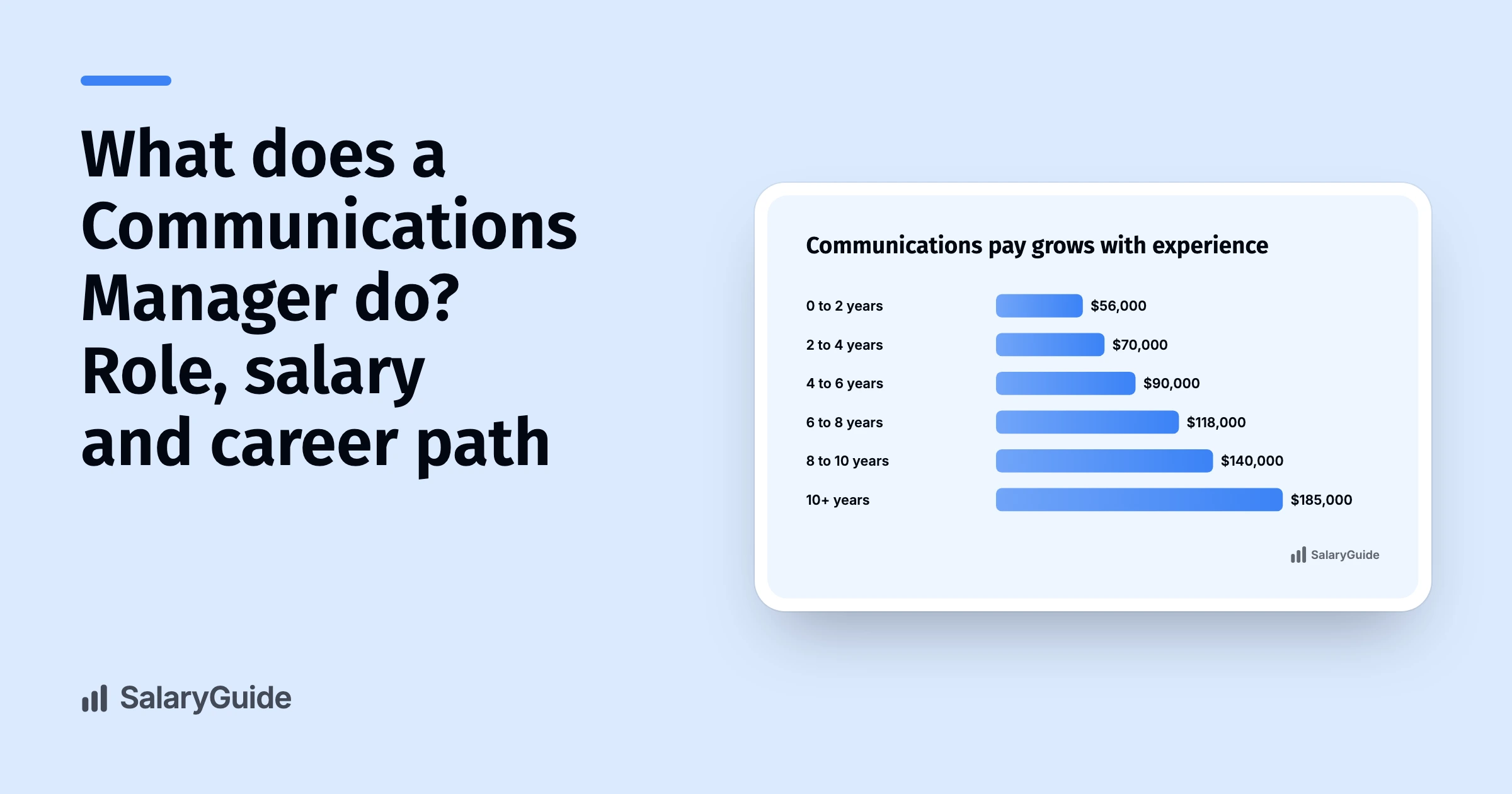
| Experience | Median total compensation | Submissions |
|---|---|---|
| 0 to 2 years | $56,000 | 289 |
| 2 to 4 years | $70,000 | 1,574 |
| 4 to 6 years | $90,000 | 1,445 |
| 6 to 8 years | $118,000 | 759 |
| 8 to 10 years | $140,000 | 547 |
| 10+ years | $185,000 | 1,002 |
Between 4 and 8 years of experience, the median rises from $90,000 to $118,000. The biggest steps in the data come after year 6. That is often the point where the job shifts from producing communications for others to owning them for a leader, a business unit or a crisis.
Specialism changes the number
| Category | Median total compensation | Submissions |
|---|---|---|
| Communications | $93,000 | 5,754 |
| Internal communications | $122,000 | 80 |
| Corporate communications | $161,000 | 288 |
Internal and corporate communications medians sit well above the broad category because those samples lean toward senior, in-house roles that advise executives. Read them as a sign of where the money is, not as a starting salary.
In-house, agency and remote
In-house communications roles have a median of $93,000 across 5,311 submissions. Agency roles come in at $104,000, but from a much smaller sample of 416. Remote roles show the highest median of the three work arrangements at $103,000, against $98,000 for hybrid and $88,000 for on-site. The remote sample is the smallest of the three at 681 submissions, so treat that gap with care.
Communications Manager career path
A common ladder looks like this:
- Communications Coordinator or Assistant: drafting, scheduling, monitoring coverage and keeping the content calendar.
- Communications Specialist: owns a channel or program and writes most of the copy.
- Communications Manager: owns plans, approvals and a set of senior stakeholders.
- Senior Manager or Director of Communications: sets strategy for a function or region, leads a team and advises executives.
- VP of Communications or Chief Communications Officer: owns the company’s reputation and sits close to the CEO.
People arrive from several directions: local or trade journalism, PR agencies, HR and internal communications, or marketing writing roles. Writers who prefer building content systems to managing announcements often move toward content strategy instead. For where communications sits next to other marketing paths, see the marketing career path roadmap.
How to become a Communications Manager
- Build a portfolio with range. Include a news release, an internal change announcement, a short executive speech and a crisis holding statement. Use sample companies and label them as samples.
- Get approval experience. Volunteer to run a cross-team announcement end to end, including legal or HR sign-off.
- Learn the media side. Build a media list for one industry beat and pitch a real story, even a small one.
- Show that you measure. Bring one example where you checked whether people understood a message, not just whether they opened it.
- Start as a specialist if you need to. Owning one channel well is the most common route into a manager role.
Then compare live roles. Job ads are the best guide to scope, because two Communications Manager roles can differ more than two different titles.
What hiring managers look for
Communications hiring managers usually read your writing before anything else, and a timed writing test is common: a short announcement or a statement about a difficult situation. They look for clear language, the right tone for each audience and good instincts about approvals. Expect to be asked who you would involve before a message goes out, and what you would do if legal and the CEO want different wording.
FAQs
What does a Communications Manager do day to day?
They plan and write announcements, brief leaders and spokespeople, coordinate approvals with legal and HR, handle media questions and report on whether messages landed. The balance between internal, media and executive work depends on where the role reports.
Is a Communications Manager the same as a PR Manager?
Not quite. A PR Manager focuses on journalists and media coverage. A Communications Manager usually covers a wider set of audiences, including employees and executives, and PR is often one part of the job.
How much does a Communications Manager earn in the US?
SalaryGuide’s communications category, the closest benchmark, has a median total compensation of $93,000 as of October 14, 2026, with the middle half of submissions between $70,000 and $138,000. Professionals with 4 to 8 years of experience have medians between $90,000 and $118,000.
What qualifications do Communications Managers need?
Many have degrees in communications, journalism, English or marketing, but employers weigh writing samples and experience more heavily than the degree subject. A portfolio that shows internal, media and crisis writing is the strongest evidence.
What comes after Communications Manager?
The usual next steps are Senior Communications Manager and Director of Communications, then VP of Communications or Chief Communications Officer. Some people move sideways into corporate affairs, public affairs or executive communications.


