Event Marketing Manager salary and career path
Published by SalaryGuide, with recruiter insight from our sister company, Search for Hire.
Event Marketing Managers plan the conferences, trade shows, roadshows, dinners and virtual events a company uses to meet customers, and they answer for what those events produce. In SalaryGuide’s US data, the median Event Marketing Manager earns $102,000 in total compensation.
That is well above the median for event marketing as a whole, which is $83,500. The difference is mostly about level: the broad category includes coordinators and assistants, while the manager title is usually given to people who own budgets, contracts and results.
Event Marketing Manager salary in the US
As of October 14, 2026, SalaryGuide’s Event Marketing Manager salary page is based on 58 salaries.
| Benchmark | Total compensation |
|---|---|
| 25th percentile | $88,000 |
| Median | $102,000 |
| 75th percentile | $128,750 |
| 90th percentile | $156,200 |
Source: SalaryGuide Event Marketing Manager salary data, 58 salaries, as of October 14, 2026. Total compensation includes base salary, bonus and equity.
Almost all of these submissions come from in-house roles (52 of 58), where the in-house median is $103,000. Event roles at agencies and production companies are too few in the title sample to compare.
For people with the exact title, pay rises from a median of $80,000 at 2 to 4 years of experience (12 submissions) to $101,000 at 4 to 6 years (19 submissions) and $122,500 at 6 to 8 years (16 submissions).
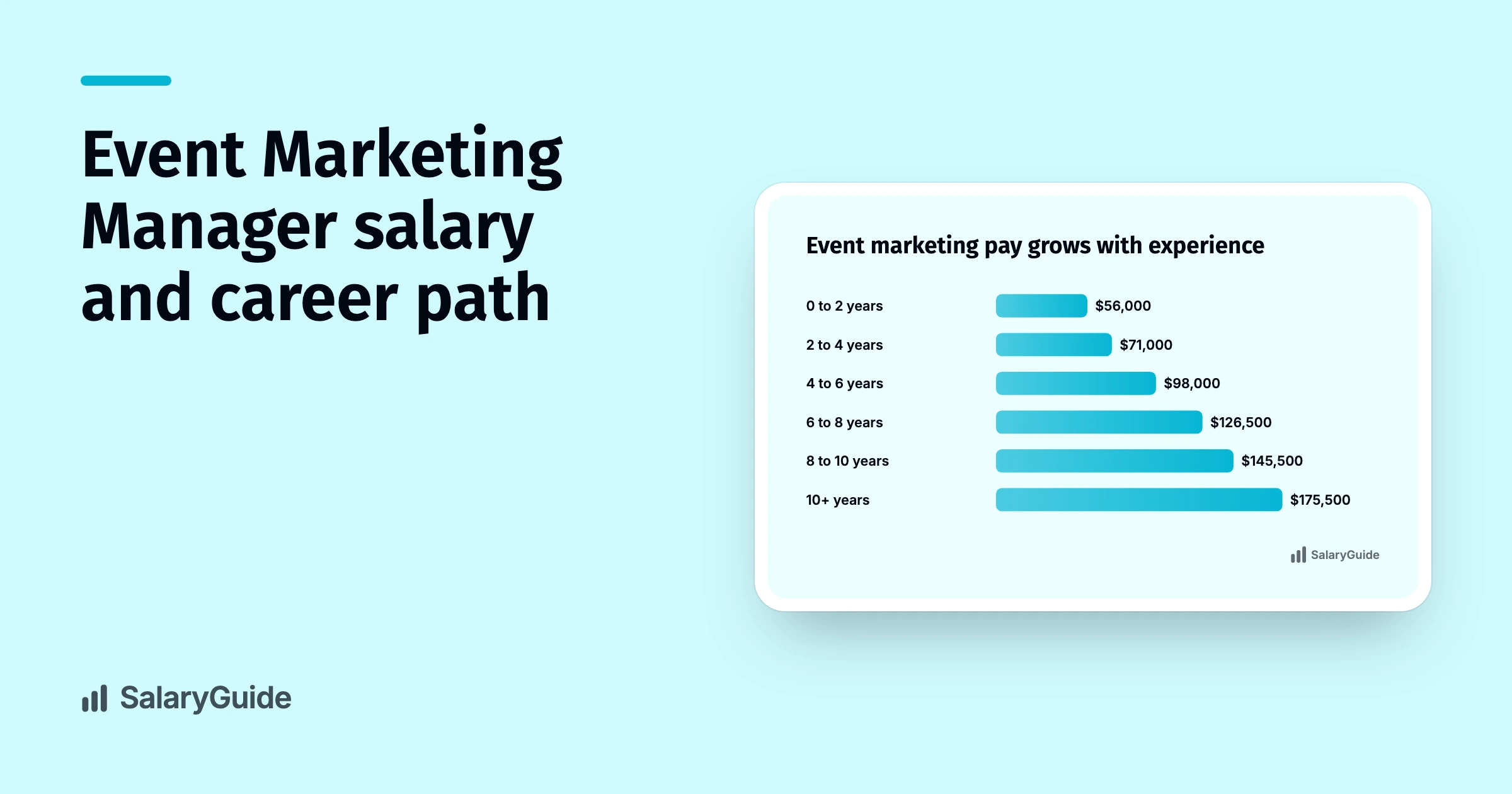
How event marketing pay grows with experience
The broader event marketing salary category covers every level, from event coordinator to head of events, across 1,322 submissions.
| Experience | Median total compensation | Submissions |
|---|---|---|
| 0 to 2 years | $56,000 | 173 |
| 2 to 4 years | $71,000 | 452 |
| 4 to 6 years | $98,000 | 287 |
| 6 to 8 years | $126,500 | 148 |
| 8 to 10 years | $145,500 | 90 |
| 10+ years | $175,500 | 108 |
Source: SalaryGuide event marketing salary data by years of experience, as of October 14, 2026.
The biggest step comes between the 2 to 4 and 4 to 6 year bands, a rise of $27,000. It is often the point where people move from coordinating events that someone else planned to owning a program of their own.
Why on-site event roles show lower pay
Event work feels like the most on-site job in marketing, yet in the event marketing category the on-site median is the lowest of the three work arrangements:
| Work arrangement | Median total compensation | Submissions |
|---|---|---|
| Remote | $98,000 | 261 |
| Hybrid | $86,000 | 364 |
| On-site | $73,000 | 630 |
The data does not show the cause, but the mix of jobs is a possible reason. On-site roles are more likely to include venue, hospitality and event production positions. Remote and hybrid roles are more often program management jobs, where the team travels to each event but plans it from home. The gap probably says more about the type of employer than about where you sit.
What an Event Marketing Manager owns
- The event portfolio. Choosing which events to run or attend, from the company’s own user conference to trade shows, regional roadshows, executive dinners and webinars, and how much to spend on each.
- Budget and contracts. Venues, hotels, catering, AV, booth builders and travel. This is where a lot of money is saved or lost.
- Attendee marketing. Invitations, registration pages, partner promotion and reminders that turn sign-ups into people in the room.
- The run of show. Agendas, speakers, staffing plans and the minute-by-minute schedule on the day.
- Follow-up with sales. Making sure every useful conversation reaches the CRM quickly and that sales teams follow up while it still matters.
Common tools include event management platforms such as Cvent, Bizzabo and Splash, webinar platforms such as ON24 or Zoom Webinars, badge scanning apps and the company’s CRM, usually Salesforce or HubSpot.
Contract and budget skills that raise pay
The skills that separate higher-paid event marketers are often the least glamorous. Venue and hotel contracts carry real financial risk, and an Event Marketing Manager who reads them well protects the budget:
- Food and beverage minimums: the amount you commit to spend with the venue, whether or not people turn up.
- Room block attrition: what you owe if attendees book fewer hotel rooms than you reserved.
- Cancellation and force majeure clauses: who pays if the event moves or cannot happen.
- Exhibitor rules and union labor: at large convention centers, which services must be bought from approved suppliers.
Hiring managers for senior event roles often ask about a contract you negotiated or a budget you brought in under plan. Concrete answers, with numbers you are allowed to share, carry a lot of weight.
How Event Marketing Managers prove results
Events are expensive, so many companies judge them on business outcomes rather than attendance alone. Typical measures include:
- Pipeline sourced: new sales opportunities that started at the event.
- Pipeline influenced: existing opportunities where the buyer attended.
- Meetings booked: especially for trade shows and executive dinners.
- Cost per meeting or per opportunity: the event’s total cost divided by what it produced.
- Attendee satisfaction: usually a short post-event survey.
To report this well, you need the event set up as a campaign in the CRM before invitations go out, and an agreed process for logging leads afterward. Event Marketing Managers who build that discipline tend to earn more trust, and more budget, than those who report only attendance.
Event Marketing Manager career path
A common path is Event Coordinator, then Event Marketing Specialist, Event Marketing Manager, Senior Event Marketing Manager or Head of Events, and Director of Events or Experiential Marketing.
Many people move sideways as well. Event marketing pairs naturally with regional sales support, which is the core of field marketing, and our guide to field marketing vs event marketing explains how the two roles differ. Others move toward brand roles, where experiences are one part of a larger plan. Brand Manager salary shows how that path pays.
How to get into event marketing
Event marketing is one of the more accessible ways into the field. Hospitality, venue, catering and agency coordinator experience all transfer, because the logistics are the same. To make the switch:
- volunteer to run logistics for an industry meetup, conference or nonprofit event;
- learn one event platform and one CRM well enough to set up registration and track attendees;
- keep a simple record of the budget, attendance and outcomes of every event you work on.
Our guide on how to get into marketing with no experience covers applications and portfolios in more detail.
Open event marketing jobs
As of October 14, 2026, SalaryGuide lists 2,398 open event marketing jobs in the US. Check each ad for the size of the event program, the travel expected and whether you will own the budget, because those details separate a coordinator role from a manager role more reliably than the title does. For event marketing pay next to other marketing roles, see how much marketers earn.
What hiring managers look for
Event hiring managers want proof that you can deliver under pressure and still think about results. Expect questions about an event that went wrong on the day and what you did, how you chose which events to drop from a calendar, and how you measured whether an event was worth its cost. Bringing one real budget and one real results summary to the interview is often more persuasive than a long list of events.
FAQs
How much does an Event Marketing Manager make in the US?
SalaryGuide’s median for Event Marketing Managers is $102,000 in total compensation, based on 58 salaries as of October 14, 2026. The middle half earns between $88,000 and $128,750.
Why is event marketing pay so wide?
The event marketing category includes everyone from event assistants to heads of events. Its median is $83,500, but the median rises from $56,000 for people with under 2 years of experience to $175,500 for those with 10 or more years.
Do event marketers have to travel?
Most do, especially during conference and trade show seasons. The amount varies widely by company, so check the travel expectation in each job ad before you apply.
What tools do Event Marketing Managers use?
Event management platforms such as Cvent, Bizzabo and Splash, webinar platforms such as ON24 or Zoom Webinars, badge scanning apps and a CRM such as Salesforce or HubSpot are the most common.
Is event marketing a good career?
It can be. The work is varied and visible, the skills transfer to field marketing, brand and partnerships, and pay rises steeply with experience. The main tradeoffs are travel and intense periods around major events.