Performance marketing vs growth marketing: roles and pay
Published by SalaryGuide, with recruiter insight from our sister company, Search for Hire.
Performance marketing and growth marketing are often used as if they mean the same thing, and many job ads mix them up. They overlap, but they answer different questions.
Performance marketing asks: how do we get the most customers from our advertising budget? Growth marketing asks: where in the whole customer journey is growth being lost, and what experiment would fix it? A performance marketer works mostly in paid channels. A growth marketer works across acquisition, the product experience, retention and referrals.
Performance marketing vs growth marketing at a glance
| Performance marketing | Growth marketing | |
|---|---|---|
| Main focus | Paid acquisition that can be measured | Growth across the whole customer journey |
| Typical channels | Search, paid social, display, affiliates, app install ads | Paid channels plus onboarding, email, product features, pricing and referrals |
| Key measures | Cost per acquisition, return on ad spend, conversion rate | Activation, retention, customer lifetime value, payback period |
| Works most with | Creative, analytics, media platforms and agencies | Product, engineering, data and lifecycle teams |
| Typical output | Campaigns, budget shifts, creative and landing page tests | Experiments across the funnel, from sign-up flows to referral programs |
What performance marketers do
Performance marketers spend money to buy measurable results, such as a sign-up, a purchase or a qualified lead. Their week usually involves:
- setting and moving budgets across channels such as Google Ads, Meta, TikTok and LinkedIn;
- managing bids and targeting;
- testing creative and landing pages;
- watching cost per acquisition and return on ad spend daily;
- checking whether platform-reported results hold up against the company’s own data.
The best performance marketers are commercially sharp. They know what a customer is worth, how much they can afford to pay to acquire one, and when to stop spending on a channel that looks good in its own dashboard but does not deliver. Our guide to Paid Media Manager salary covers the multi-channel version of this job in detail.
What growth marketers do
Growth marketers look for the biggest leak in the customer journey and run experiments to fix it. A common way to think about the journey is the AARRR framework: acquisition, activation, retention, referral and revenue.
A growth marketer’s experiments might include:
- a shorter sign-up flow to get more visitors to create an account;
- a new onboarding email sequence to help new users reach their first success faster;
- a referral program that rewards customers for inviting others;
- a pricing page test to move more customers to an annual plan;
- a win-back campaign for customers who stopped using the product.
Growth marketing is most common in software and consumer apps, where the product itself can be changed and measured quickly. Growth marketers spend a lot of time with product managers, engineers and data analysts, because many of the best growth ideas involve the product, not just marketing channels.
Where the two roles overlap
- Both are data-driven. Each relies on testing, measurement and honest analysis.
- Both care about acquisition. Paid channels are often a large part of a growth team’s work.
- Both need to understand unit economics. Knowing what a customer is worth and what they cost is central to both.
In many companies, performance marketers sit inside a growth team. In others, a job titled Growth Marketing Manager is really a performance marketing role focused on paid acquisition. Read the responsibilities in the ad to see which one you are looking at.
Performance marketing pay
As of October 14, 2026, SalaryGuide’s performance marketing category is based on 853 salaries.
| Benchmark | Total compensation |
|---|---|
| 25th percentile | $85,000 |
| Median | $109,000 |
| 75th percentile | $149,000 |
| 90th percentile | $188,000 |
| Experience | Median total compensation | Submissions |
|---|---|---|
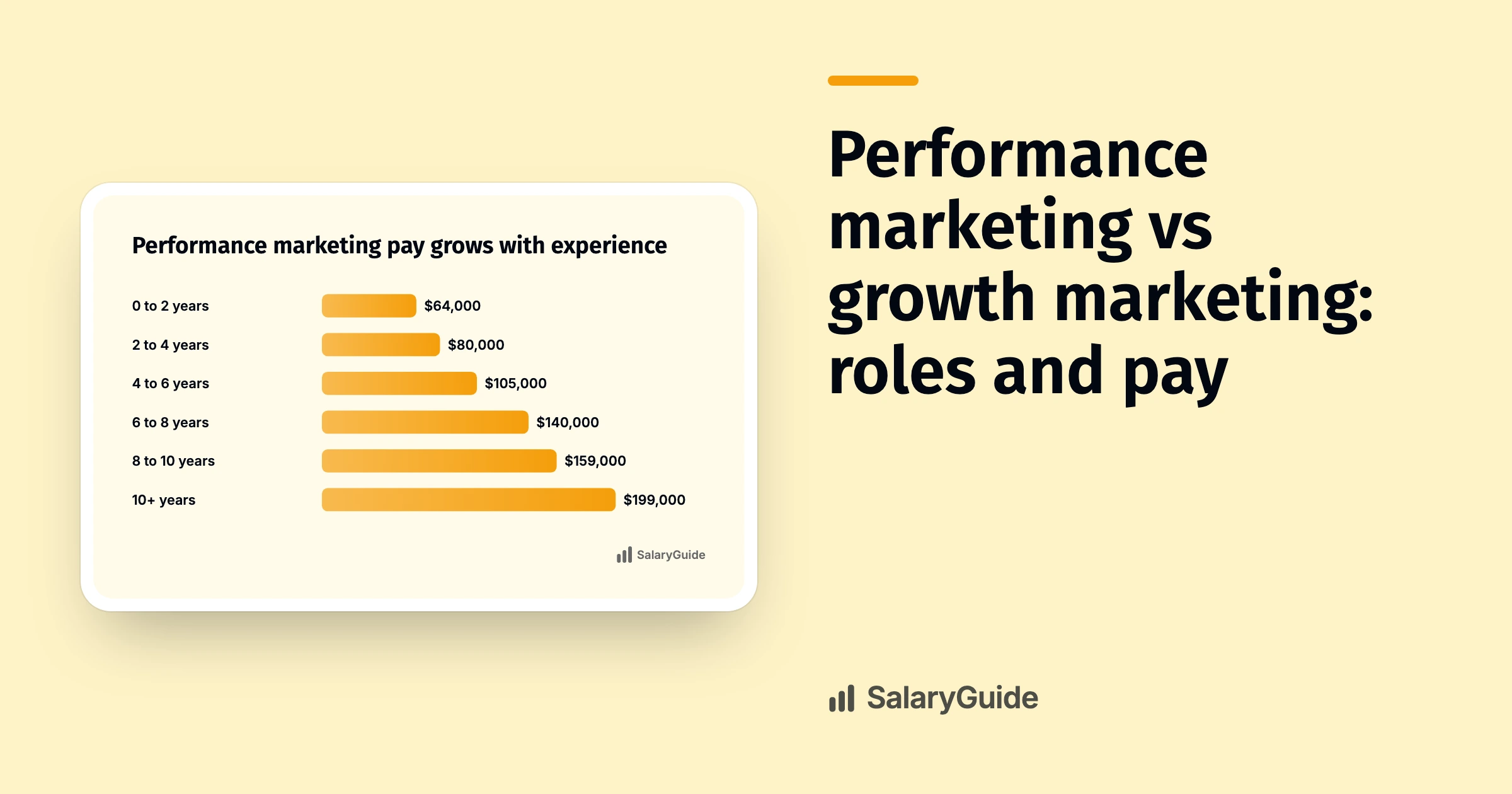
| 0 to 2 years | $64,000 | 25 |
| 2 to 4 years | $80,000 | 218 |
| 4 to 6 years | $105,000 | 251 |
| 6 to 8 years | $140,000 | 156 |
| 8 to 10 years | $159,000 | 87 |
| 10+ years | $199,000 | 111 |
Source: SalaryGuide performance marketing salary data, 853 salaries, as of October 14, 2026. Total compensation includes base salary, bonus and equity.
In-house performance marketers have a median of $111,000 (689 submissions), against $95,000 at agencies (135 submissions).
For growth marketing pay, including the exact Growth Marketing Manager title by experience and work arrangement, see our full guide to Growth Marketing Manager salary.
Which one fits you?
Performance marketing may suit you better if you:
- enjoy working in ad platforms and seeing results change daily;
- like making fast budget decisions with clear numbers;
- want deep expertise in a set of channels.
Growth marketing may suit you better if you:
- enjoy finding problems across the whole customer journey;
- like working with product, engineering and data teams;
- are comfortable with experiments where many ideas fail before one works.
Moving from performance to growth marketing
Performance marketing is one of the most common routes into growth. To make the move:
- Look past the click. Follow the customers your campaigns bring in through sign-up, activation and their first months, and find where they drop off.
- Run one experiment outside paid media. An onboarding email, a landing page change or a referral offer gives you evidence of full-funnel work.
- Learn the product data. Get comfortable with product analytics tools and basic SQL.
- Talk in lifetime value and payback, not just cost per acquisition.
Our guide to how to measure marketing performance covers the measures both roles rely on, and when each one can mislead.
Open performance marketing jobs
As of October 14, 2026, SalaryGuide lists 1,015 open performance marketing jobs in the US. Check whether each role owns budget across several channels, works on the product experience or focuses on one channel. Those details tell you more than the title. For marketing pay across roles, see how much marketers earn.
What hiring managers look for
Performance marketing hiring managers usually ask you to walk through an account: the budget, the targets, what you changed and what happened. Growth hiring managers usually ask about an experiment: your hypothesis, how you tested it, what the result was and what you did next, including experiments that failed. In both cases, they want to see that you read data honestly and make decisions with it.
FAQs
What is the difference between performance marketing and growth marketing?
Performance marketing focuses on paid acquisition that can be measured, such as search and social ads, and is judged on cost per acquisition and return on ad spend. Growth marketing looks at the whole customer journey, including activation, retention and referrals, and runs experiments across marketing and the product.
Is growth marketing the same as performance marketing?
No, though they overlap. Many growth teams include performance marketers, and some jobs titled Growth Marketing Manager are focused mainly on paid acquisition. Read the responsibilities to see which kind of role it is.
How much do performance marketers earn?
SalaryGuide’s performance marketing category has a median total compensation of $109,000 across 853 submissions as of October 14, 2026. Pay grows from a median of $80,000 at 2 to 4 years of experience to $199,000 at 10 or more years.
What is the AARRR framework?
AARRR stands for acquisition, activation, retention, referral and revenue. Growth marketers use it to break the customer journey into stages and find where the most customers are lost.
Can a performance marketer become a growth marketer?
Yes, and it is one of the most common routes. Follow your customers beyond the first click, run at least one experiment outside paid media, learn product analytics and talk about results in terms of lifetime value and payback.