What is programmatic advertising? A Beginner's Guide to Ad Buying
Programmatic advertising is really just using software to buy and sell digital advertising. Instead of people haggling over prices and placements on the phone or over email, complex algorithms do all the work in the blink of an eye. The result is a much faster, smarter, and more efficient way to get ads in front of the right people.
A Simple Guide to Programmatic Advertising
Think of it like a high-speed stock exchange, but for ads. As soon as you click on a website, an auction for the ad space on that page begins and ends before the content even finishes loading. Advertisers bid on that single impression—the chance to show their ad to you specifically—based on what the data says about your interests and habits.
This move away from manual, relationship-based ad buying has completely reshaped the industry. To really get a handle on it, it’s helpful to understand What Is Programmatic Advertising? at its core. This automated approach isn't just about being fast; it’s about being incredibly precise. Marketers can now zero in on audiences using detailed criteria like:
- Demographics: Targeting based on age, gender, or location.
- Interests: Reaching people based on their hobbies, browsing history, and what they've bought in the past.
- Behaviors: Showing ads to users based on actions they’ve previously taken on a site or in an app.
Key Players in the Programmatic Ecosystem
This whole automated world depends on a few key technologies that talk to each other. Each piece has a specific job, but they all work together to connect advertisers who need to buy ad space with publishers who have space to sell. Getting to know these components is the first step in building a solid programmatic strategy.
Here’s a quick rundown of the essential players and what they do.
Key Players in the Programmatic Ecosystem
| Component | What It Does |
|---|---|
| Demand-Side Platform (DSP) | This is the advertiser's tool. It lets them manage ad campaigns and buy inventory from tons of different sources all in one place. |
| Supply-Side Platform (SSP) | This is the publisher's tool. It helps website owners and app developers manage, sell, and get the most money for their ad space. |
| Ad Exchange | The marketplace in the middle. It’s a huge digital auction house where SSPs and DSPs connect to buy and sell ad inventory. |
| Data Management Platform (DMP) | This is the "brain" that collects and organizes audience data from all over, making ad targeting much sharper and more effective. |
Each of these platforms plays a vital role in making sure the right ad gets to the right person at the right price, all in a fraction of a second.
The sheer size of this market is hard to overstate. The global programmatic advertising industry is expected to rocket from US$273.7 billion in 2026 to a mind-boggling US$975.1 billion by 2033. This explosive growth is fueled by trillions of ad auctions happening every day, with mobile ads accounting for over 63% of the total volume. You can dig into the latest programmatic advertising market trends on persistencemarketresearch.com to see the full picture.
How the Programmatic Bidding Process Unfolds
Ever wonder how that oddly specific ad for hiking boots shows up right after you were browsing travel blogs? It's not magic. It's a lightning-fast auction that happens behind the scenes every single time you load a webpage. The entire thing is over in less time than it takes you to blink.
It all kicks off the moment you navigate to a website. As the page materializes on your screen, the publisher's site sends out a flare signal: "Visitor here! Ad space available!" This signal isn't just a simple alert; it carries a small, anonymous data packet about you—things like your general location, the type of content you read, and maybe even that you're a fan of the outdoors.
This is where the machinery kicks into high gear. The publisher uses a Supply-Side Platform (SSP), which acts like an auctioneer for their ad space. The SSP bundles that visitor data into a formal "bid request" and shoots it over to an Ad Exchange, the sprawling digital marketplace where ad inventory is bought and sold.
The Real-Time Auction Begins
The Ad Exchange is a busy place. It immediately blasts that bid request out to hundreds, sometimes thousands, of Demand-Side Platforms (DSPs). Think of a DSP as a brand's personal shopping assistant, armed with a budget and a crystal-clear picture of its ideal customer. The brand has already told its DSP exactly who it wants to reach and the maximum price it’s willing to pay to get their attention.
Each DSP receiving the request makes a snap judgment, analyzing the data in a fraction of a second. "Does this user fit our target profile?" If the answer is yes, the DSP calculates how much that ad impression is worth to its client and fires back a bid. This whole whirlwind of bidding and counter-bidding is what we call Real-Time Bidding (RTB).
At its core, programmatic is just this incredibly fast, automated auction. Dozens or even hundreds of advertisers are all competing for that single ad spot on your screen, and it all happens in a flash. It's a high-speed battle of algorithms where the highest bidder wins the chance to show you their ad.
This diagram breaks down the flow from a human-led strategy to the final, automated ad delivery.
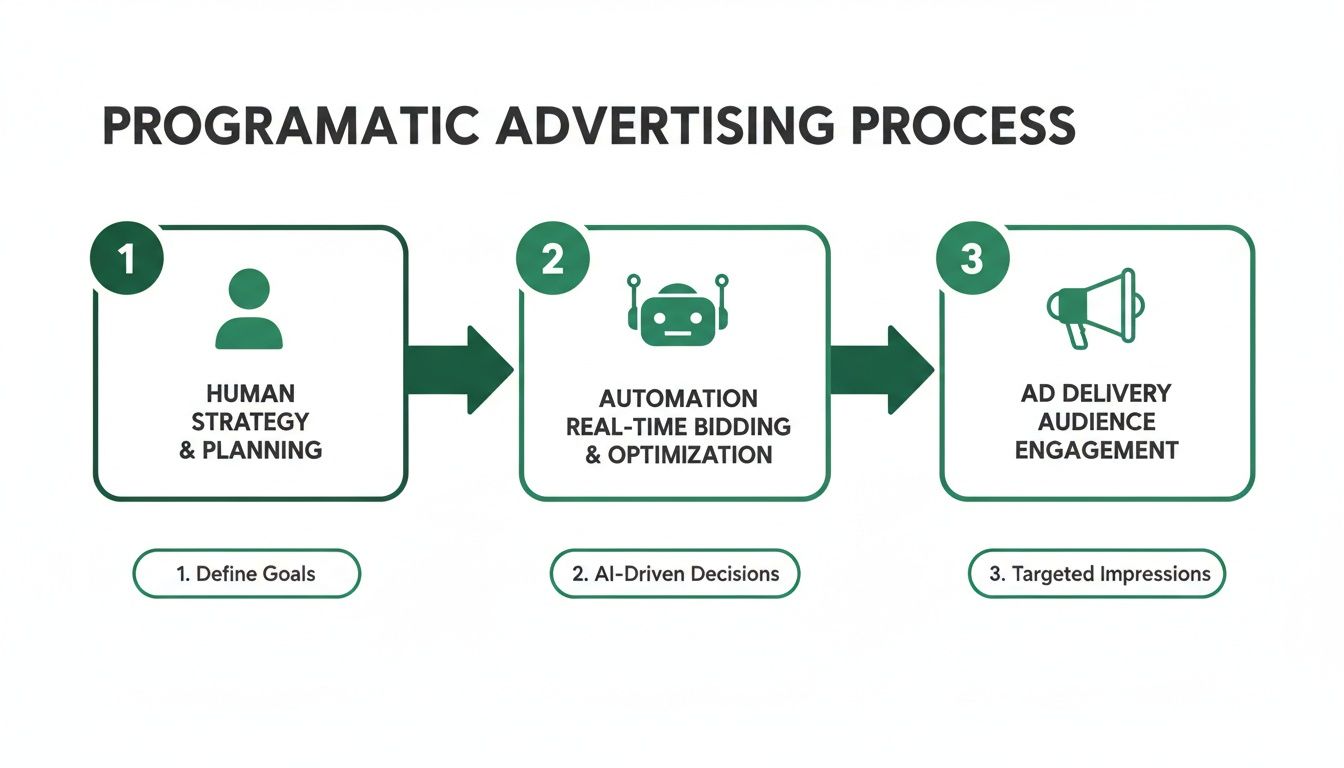
It shows how technology executes the specific goals set by marketing teams to place a perfectly targeted ad.
The Winning Bid and Ad Delivery
Back at the ad exchange, all the bids are in. The exchange quickly identifies the highest bidder and declares a winner. It sends a notification back to the winning DSP, which instantly serves up the ad creative—the actual image or video ad. By the time the webpage has finished loading, the winning ad is sitting there, waiting for you.
If this sounds familiar, it's because the underlying concept is a lot like paid search advertising, where businesses bid on keywords to show up in search results. Both systems use automated bidding to spend money efficiently and get in front of the right people. If you're curious about that, you can dive deeper in our guide on what is paid search advertising.
Comparing the Different Programmatic Deal Types
Programmatic advertising isn't a one-size-fits-all solution. Think of it like a menu of options, each tailored to different campaign goals. Whether you're chasing massive reach, trying to lock down a spot on a premium website, or something in between, there’s a deal type designed for the job.
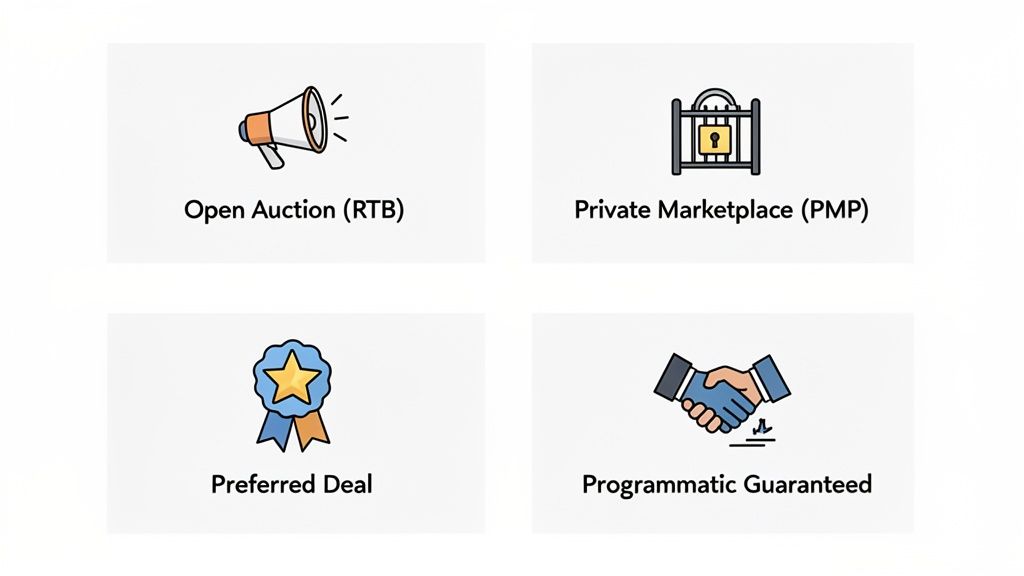
Getting a handle on these different approaches is the first step toward building a strategy that actually works. Each one strikes a unique balance between control, access to ad space, and what you’ll pay. Let’s break down the four main ways you can buy.
H3: Open Auction (RTB)
This is programmatic advertising in its purest, most well-known form. The Open Auction, powered by Real-Time Bidding (RTB), is exactly what it sounds like: a massive, public marketplace where publishers make their ad inventory available to any and all advertisers.
It’s a wide-open, competitive free-for-all. The upside? Unmatched scale and the potential for very low CPMs. This makes it a go-to for campaigns focused on getting as many eyeballs as possible without breaking the bank.
H3: Private Marketplace (PMP)
A Private Marketplace (PMP) is the velvet-rope version of the open auction. It's an invite-only affair where a publisher or a group of publishers offers premium inventory to a hand-picked list of advertisers.
You still bid in real-time, but you’re competing against a much smaller, more exclusive pool of buyers. This gives you better transparency and brand safety, since you have a much clearer idea of where your ads are running. It's a fantastic middle ground for advertisers who want more control than the open auction offers.
A simple analogy: The Open Auction is like a huge public flea market where anyone can set up a stall. A Private Marketplace is more like a curated, members-only art fair.
H3: Preferred Deals
With a Preferred Deal, you get a "first look" at a publisher's ad inventory before it ever hits the auction floor. The advertiser and publisher agree on a fixed price (a set CPM) ahead of time.
There’s no bidding and no obligation. The advertiser gets the first right of refusal—they can inspect the impression (looking at the user data, context, etc.) and decide whether to buy it at the pre-negotiated price. If they pass, the impression then moves on to the private or open auctions. This is great for securing reliable access to specific inventory you value.
H3: Programmatic Guaranteed
Finally, Programmatic Guaranteed (or Programmatic Direct) brings the certainty of old-school media buying into the automated world. Here, the advertiser and publisher negotiate directly to buy and sell a guaranteed number of impressions at a fixed price.
The inventory is reserved specifically for that advertiser. It’s the most controlled and predictable of all the deal types, making it perfect for big-brand campaigns where you absolutely need to secure placement on specific, high-value sites.
To help you decide which approach fits your campaign, this table breaks down the key differences at a glance.
Programmatic Deal Types Compared
| Deal Type | Inventory Access | Pricing Model | Best For |
|---|---|---|---|
| Open Auction | Public and open to all advertisers | Real-time auction (RTB) | Maximizing reach and broad targeting |
| Private Marketplace (PMP) | Invite-only to select advertisers | Real-time auction (RTB) | Accessing premium inventory with more control |
| Preferred Deal | Priority access to inventory | Fixed price, non-guaranteed | Securing specific ad placements before the open auction |
| Programmatic Guaranteed | Reserved and guaranteed inventory | Fixed price, guaranteed volume | High-impact campaigns requiring predictable delivery |
Choosing the right deal type comes down to your priorities. Are you focused on efficiency and scale, or are brand safety and premium placement your main concerns? By aligning the deal type with your campaign's core objectives, you ensure your budget is spent wisely.
The Real Benefits and Challenges You Will Face
Programmatic advertising brings some serious firepower to a marketing strategy. Its biggest selling point is unmatched efficiency and scale. Think about it: you can reach enormous audiences across thousands of websites and apps, all managed from a single dashboard. This automation wipes out the countless hours you’d otherwise spend on manual negotiations and ad placements.
But it’s not just about blanketing the internet. The real magic is in the hyper-specific audience targeting. By crunching huge amounts of data, you can connect with people based on their actual interests, online habits, and demographics with pinpoint accuracy. This means your ad budget goes toward the individuals who are most likely to care about what you're offering, making every dollar work harder.
Understanding the Trade-Offs
Of course, this powerful, automated world isn't perfect. One of the biggest headaches for brands is brand safety. If you're not careful, your ads can pop up next to inappropriate or controversial content, which can do a number on your company's reputation. To avoid this, you have to be diligent with whitelists, blacklists, and verification partners to keep your brand in safe territory.
Another major problem is ad fraud. This is where bots and other shady tactics create fake impressions and clicks, eating up your budget with zero results. The industry is constantly battling this, but it’s a persistent threat that requires sharp monitoring and good fraud detection tools.
Navigating the programmatic space means accepting a trade-off. You gain incredible efficiency and targeting power, but you must actively manage the risks of ad fraud and brand safety to ensure your campaigns deliver real value.
Finally, you have to account for the "ad tech tax." A slice of every dollar you spend gets absorbed by the platforms that make the whole thing work—the DSPs, SSPs, and ad exchanges. Knowing this hidden cost exists is crucial for figuring out if your campaigns are truly profitable. Since programmatic is all about efficiency, knowing your numbers is non-negotiable. A great place to start is by understanding your what is ROAS in digital marketing to see if your ad spend is actually paying off.
Even with these hurdles, confidence in programmatic is solid. It's projected to account for roughly 90% of all display ad budgets by 2026. And with 84% of marketers reporting better results year-over-year, it's clear this is a mature and effective channel when you know what you're doing. You can discover more insights about these programmatic advertising trends on basis.com. In the end, success comes down to balancing the good with the bad. For a closer look at what to track, check out our guide on how to measure marketing performance.
Key Skills That Boost Your Programmatic Career
So, you understand the basics of programmatic advertising. That's a great start. But to truly build a career in this space, you need to cultivate a unique mix of skills that sets you apart. The best in the business are part data scientist, part creative strategist, and part tech wizard, all rolled into one.
This isn't just about learning another marketing channel; it's about becoming a high-value expert who can turn data into dollars. Demand for people who really get programmatic consistently outstrips the supply, opening up some incredible career paths for those who put in the work.
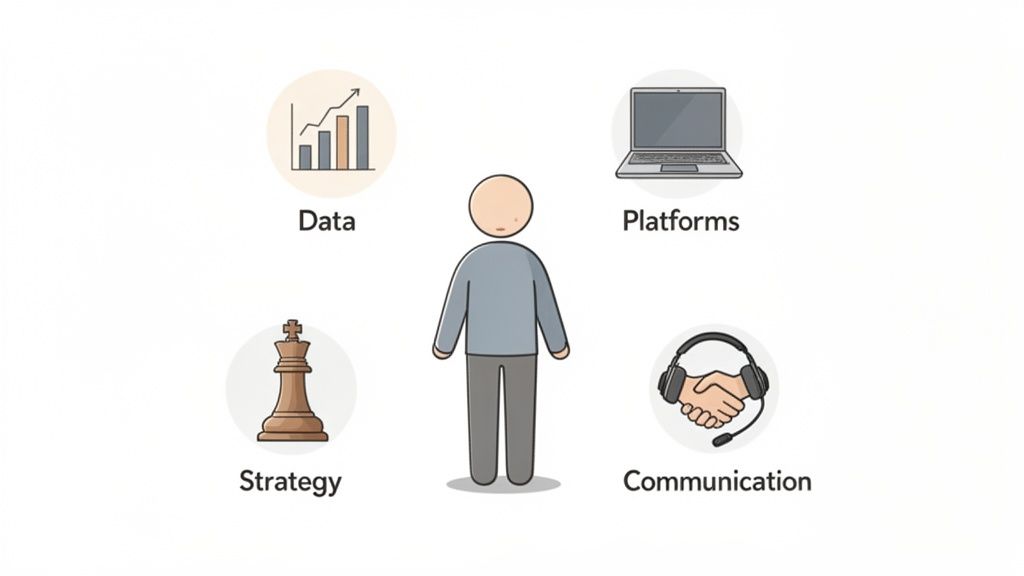
The Analyst Mindset
At its core, programmatic advertising is a numbers game. Your success lives and dies by your ability to get into the weeds of performance data, spot trends that others miss, and make smart, calculated decisions. Gut feelings are great, but data wins.
Here’s what that looks like in practice:
- Data Interpretation: You need to glance at a dashboard full of acronyms—CPM, CPC, CPA—and instantly see the story. Is the campaign healthy? Are we overpaying? Where’s the opportunity?
- Problem-Solving: When performance suddenly tanks (and it will), you have to be the detective. Is it the ad creative? The audience targeting? A faulty pixel? Your job is to find the culprit and fix it fast.
- A/B Testing and Optimization: The best campaigns are never "set it and forget it." A true analyst is always running controlled tests with different ads, landing pages, and audience segments to squeeze every last drop of performance out of the budget.
The Strategic Thinker
Being a data whiz is only half the battle. Programmatic experts also have to see the forest for the trees. A campaign doesn't exist in a silo; it has to connect real business goals with specific audience behaviors through a well-crafted plan.
A great programmatic specialist doesn't just buy ads; they build a strategic framework. They decide which deal types to use, how to allocate the budget across the marketing funnel, and how to measure success against overarching business goals.
You’re the one who has to translate a client's request—"we need more sales"—into a tangible programmatic strategy that actually delivers.
The Platform Expert
Finally, you have to know the tools inside and out. All the strategy and analysis in the world won't do you any good if you can't actually build and run the campaign in a Demand-Side Platform (DSP). This is where the rubber meets the road.
Becoming a true platform expert means:
- Technical Proficiency: Developing deep, hands-on experience with the major players, like Google's Display & Video 360 (DV360), The Trade Desk, or Amazon DSP.
- Campaign Management: Getting comfortable with the day-to-day grind of setting up campaigns, managing budgets, troubleshooting tracking pixels, and putting out fires.
These three pillars—analysis, strategy, and technical skill—are what separate the amateurs from the pros. If you're a marketer looking to level up, check out the various marketing skills to learn on SalaryGuide to build a truly in-demand profile. Nailing this combination is what leads to bigger paychecks and better leadership roles in this exciting field.
What to Expect in the Future of Programmatic
The world of programmatic advertising moves at a dizzying speed. What worked last year might be obsolete next year, so staying ahead means looking at the big shifts on the horizon. This isn't just about tweaking current campaigns; it's about getting ready for new tech, new channels, and new consumer expectations.
One of the biggest earthquakes hitting the industry is the slow death of the third-party cookie. For years, cookies were the backbone of tracking and targeting, but that era is ending. This change is forcing everyone to get smarter and more creative with privacy-friendly alternatives.
The future isn't about finding a one-to-one replacement for the cookie. Instead, it’s about building a more transparent advertising ecosystem using contextual targeting, first-party data, and privacy-preserving technologies to connect with audiences in a respectful and effective way.
New Frontiers for Programmatic Buying
While display ads on websites are still a huge part of the picture, programmatic is breaking out of its original container and expanding into some really exciting new areas. These new channels give advertisers fresh ways to reach people in different moments of their day.
Here are the key growth areas to watch:
- Connected TV (CTV): As more people ditch traditional cable for streaming, programmatic CTV is booming. It brings the precision of digital targeting right into the living room, mixing the broad reach of TV with the data-driven smarts of online advertising.
- Digital Out-of-Home (DOOH): Think of those digital billboards you see in cities or airports. They're now part of the programmatic ecosystem. This allows for incredibly dynamic ads that can be triggered by real-time data, like changing the creative based on the weather or local foot traffic.
- Digital Audio: The explosion in podcasts and music streaming has opened up a massive opportunity. Programmatic audio lets you reach listeners when they're fully engaged but screen-free—like during a commute, at the gym, or while cooking.
The Rise of AI and Predictive Targeting
Artificial intelligence is becoming much more than just a tool for automating bids. The next wave is all about predictive targeting. AI algorithms are now sophisticated enough to sift through mountains of data and identify audiences that are likely to convert, even before they’ve shown any obvious buying signals. It’s a shift from reacting to user behavior to proactively anticipating it.
This constant innovation and expansion is why worldwide ad spending is on track to blow past $1 trillion for the first time by 2026. With programmatic driving more than four-fifths of all digital ad investment, it’s clear this is the engine powering the future of media buying. You can dig into more global ad spend projections on dentsu.com.
Frequently Asked Questions About Programmatic
As you get more familiar with programmatic advertising, a few questions always seem to come up. Let's tackle some of the most common ones to clear up any confusion and solidify your understanding.
Is Programmatic Advertising the Same as RTB?
This is a classic point of confusion, but the answer is no, not exactly. They are, however, very closely linked.
Think of programmatic advertising as the entire car—the whole automated system for buying and selling digital ads. Real-Time Bidding (RTB) is just the engine, a powerful and popular method for powering that car, specifically through an open auction model.
But programmatic advertising isn't only about open auctions. It also includes other ways to buy ads automatically, such as:
- Private Marketplaces (PMPs)
- Preferred Deals
- Programmatic Guaranteed
So, while RTB is a massive component of programmatic, it’s just one piece of a much bigger puzzle. The term "programmatic" covers all automated ad buying, auction-based or not.
What Are the Most Popular Programmatic Platforms?
On the advertiser side—the "buy-side"—a few major Demand-Side Platforms (DSPs) lead the pack. You'll constantly hear about Google's Display & Video 360 (DV360), The Trade Desk, and Amazon DSP. These platforms are the command centers for brands looking to manage their campaigns and buy ad inventory across the internet.
For publishers on the "sell-side," the most common Supply-Side Platforms (SSPs) are Google Ad Manager, Magnite, and Xandr. These are the tools that website owners and app developers use to sell their ad space efficiently and for the highest price.
Can Small Businesses Use Programmatic Advertising?
Absolutely. It might sound like something reserved for big brands with massive budgets, but programmatic has become much more accessible over the years.
In fact, many platforms that small businesses already know and love, like Google Ads and Meta (Facebook/Instagram), run on programmatic principles. They automate the ad buying and targeting process, letting businesses of any size tap into the power of this technology without a huge upfront investment.
The trick is to start smart. Define your campaign goals, know exactly who you're trying to reach, and set a budget you can comfortably track and measure.
Ready to advance your marketing career? At SalaryGuide, we connect you with real marketing roles directly from company career sites, cutting through the noise of recruiters and job boards. Explore marketing salaries and find your next opportunity on salaryguide.com.
