What Is Account Based Marketing A Guide to B2B Success
Account-based marketing, or ABM, is a powerful B2B strategy that gets your marketing and sales teams working together to go after a handpicked list of high-value companies. Think of these companies not just as leads, but as entire markets of one. It completely flips the script on traditional marketing, focusing on deep, personalized engagement rather than casting a wide net for leads.
The Strategic Shift to Account Based Marketing
Let's use a classic analogy. Traditional marketing is like fishing with a giant net. You cast it wide, hoping to catch a few good fish along with a lot of smaller ones you have to throw back.
So, what is account based marketing? It’s more like spear fishing. You identify the biggest, most valuable fish in the pond and go after them directly with a custom-made spear. This approach turns the old marketing funnel upside down. Instead of trying to attract thousands of anonymous website visitors to hopefully convert a few, ABM starts by identifying the exact customers you want to win and focuses every bit of effort on making that happen.
This isn't just a passing fad; it's a fundamental change from a lead-focused mindset to an account-focused one. Account-based marketing has seen a massive surge in adoption, with a staggering 94% of marketers now using it in some capacity. It signals a major move away from the old "spray-and-pray" methods toward highly targeted strategies that produce real, measurable business results.
From Volume to Value
The core principle behind ABM is both simple and incredibly effective. Rather than generating a massive volume of individual leads that your sales team has to painstakingly sift through, you start by identifying the companies that are the best fit for your business.
This ensures that every marketing dollar and every sales call is aimed squarely at prospects with the highest potential to drive revenue. A crucial first step here, just as with any B2B strategy, is defining your Ideal Customer Profile. Getting this right from the start prevents wasted effort and creates a much smoother path to closing deals.
This targeted strategy brings a few huge advantages to the table:
- Reduces Wasted Effort: Your sales and marketing teams concentrate their energy only on accounts that have a genuine chance of becoming top-tier customers.
- Improves Customer Experience: Prospects get communication that’s incredibly relevant and speaks directly to their unique challenges, not just generic sales pitches.
- Aligns Sales and Marketing: Both teams are on the same page, targeting the same companies with the same goals. This alignment is a cornerstone of what's known as revenue marketing. You can learn more in our guide on what is revenue marketing.
ABM is a strategic B2B marketing approach that concentrates sales and marketing resources on a clearly defined set of target accounts and deploys personalized campaigns designed to resonate with each account.
By treating each target company as its own unique market, you can build much stronger relationships with the key decision-makers, which helps move deals forward much more quickly.
ABM vs Traditional Marketing At a Glance
To really understand the difference, it helps to see the two approaches side-by-side. The table below breaks down the core philosophical and tactical differences.
| Aspect | Traditional Marketing (The Net) | Account Based Marketing (The Spear) |
|---|---|---|
| Primary Goal | Generate a high volume of individual leads. | Win specific, high-value target accounts. |
| Targeting | Broad; focuses on industries or personas. | Hyper-focused; targets named companies. |
| Funnel | Starts wide at the top (attract), narrows at the bottom (close). | Starts narrow (identify), expands within the account. |
| Sales & Marketing | Often operate in separate silos; marketing hands off leads. | Fully aligned; work as a single team from the start. |
| Key Metric | Cost Per Lead (CPL), Marketing Qualified Leads (MQLs). | Account Engagement, Pipeline Velocity, Deal Size. |
| Communication | One-to-many; generic messaging for a large audience. | One-to-one or one-to-few; highly personalized. |
As you can see, the difference isn't just in the tactics—it's a complete shift in strategy, from a game of numbers to a game of precision and value.
The Three Pillars of a Winning ABM Strategy
A strong account-based marketing strategy isn't built on guesswork. It's a structured approach that rests on three core pillars. Think of them as the foundation, framework, and finishing touches of your entire go-to-market motion. Each one builds on the last, creating a repeatable process for finding, engaging, and ultimately winning your most valuable accounts.
By breaking down the process into these components, any marketing team can move from the abstract idea of ABM to a concrete, actionable plan. This framework ensures you're always focusing your energy and budget where they’ll make the biggest difference.
Pillar 1: Identify and Select High-Value Accounts
First things first: you have to know who you’re going after. This is the most critical pillar because everything else depends on it. We're not talking about broad-stroke personas here; this is about hand-picking the specific companies that have the highest revenue potential for your business.
The whole process kicks off with a rock-solid Ideal Customer Profile (ICP). Your ICP is a super-detailed definition of your perfect customer, built on firmographics (like industry, company size, and annual revenue) and technographics (the specific tech stack they use). A well-defined ICP gets your sales and marketing teams perfectly aligned on what a "great" account actually looks like.
Once you have that ICP locked in, you can start building your target account list. This usually involves a few key steps:
- Scoring and Prioritization: Rank potential accounts based on how well they fit your ICP and other buying signals, like a recent funding round or key executive hires.
- Intent Data Analysis: Use third-party data to see which of these companies are actively researching solutions like yours right now. This helps you zero in on accounts that are already in a buying cycle.
- Sales Collaboration: This is a non-negotiable. Sit down with your sales team to review and refine the list. Their on-the-ground intel is pure gold.
Getting this first pillar right is like aiming your spear before you throw it. It prevents a ton of wasted effort down the line.
Pillar 2: Engage and Personalize at Scale
With your target list in hand, it's time to engage. This is where you move beyond generic, one-size-fits-all messaging and start delivering content and experiences that speak directly to each account's unique challenges. The goal is simple: make your brand impossible for them to ignore because you’re so incredibly relevant.
This is the fundamental shift from traditional marketing's wide-net approach to ABM's targeted spear.
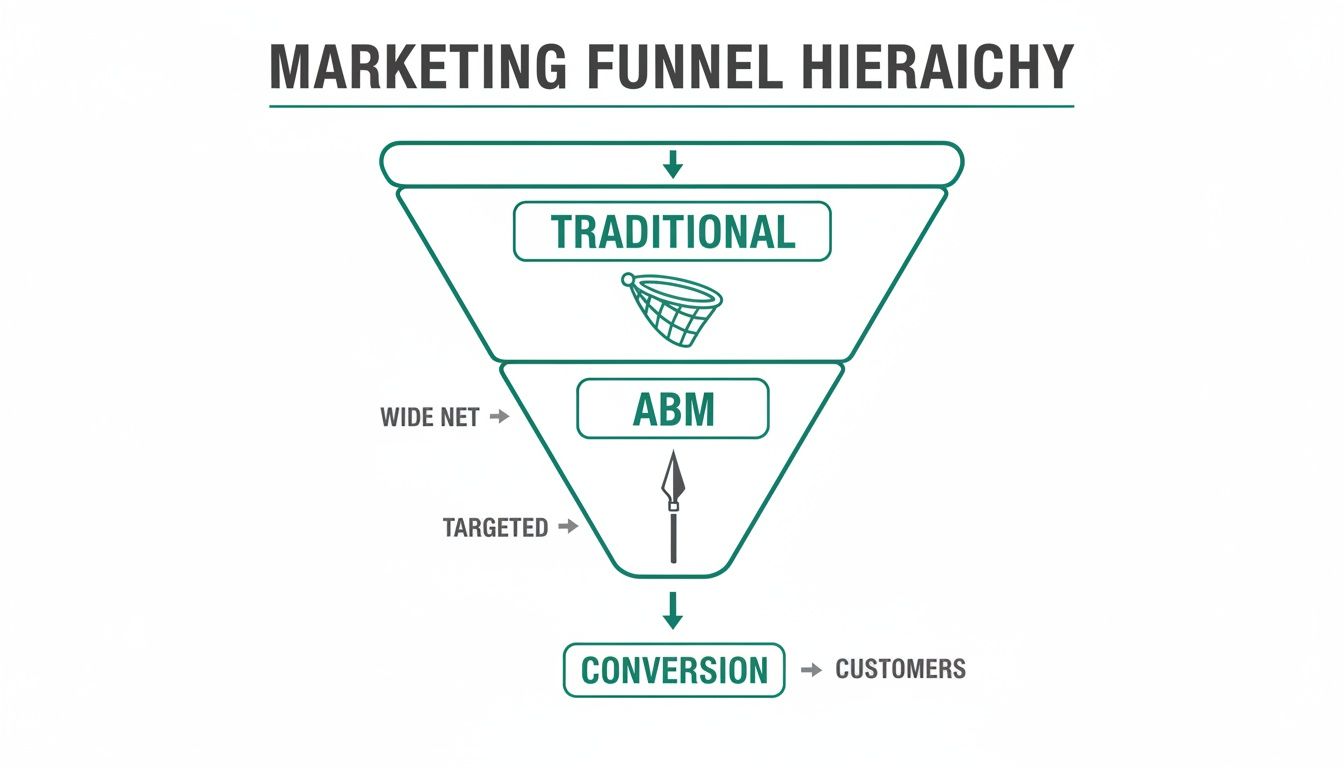
As the visual shows, ABM flips the old funnel on its head. You start with a small, focused group of accounts and then work to deepen your engagement within them.
Truly effective engagement requires a coordinated, multi-channel game plan. You can’t just send one email and hope for the best. Instead, you orchestrate a series of touchpoints across different channels, including things like:
- Targeted Digital Advertising: Running ad campaigns on platforms like LinkedIn that are shown only to employees at your target companies.
- Personalized Email Nurturing: Crafting email sequences that reference an account's industry, specific pain points, or even key people on their team.
- Custom Content and Landing Pages: Building out resources like case studies, whitepapers, or website pages tailored for a single high-value account or a small cluster of similar ones.
The heart of ABM engagement is relevance. You’re not just blasting a message; you’re starting a genuine conversation by showing you’ve done your homework and understand their world.
Pillar 3: Measure and Optimize for Impact
The final pillar is all about measuring what matters and constantly optimizing your approach. ABM is not a "set it and forget it" play. It demands continuous monitoring based on data that actually ties back to business impact. This means your old-school marketing metrics, like total lead volume or cost-per-lead, just won't cut it anymore.
Instead, you need to track account-centric KPIs that show real progress within your target list. These metrics give you a clear, honest picture of whether your efforts are moving the needle. Key performance indicators for ABM include:
- Account Engagement Score: A blended score that tracks how much an entire account is interacting with your brand across every channel.
- Pipeline Velocity: How quickly your target accounts are moving through the sales cycle, from first touch to a closed deal.
- Target Account Pipeline Coverage: The percentage of your total sales pipeline that is made up of your hand-picked target accounts.
By focusing on these numbers, you can directly prove marketing's contribution to revenue and make smart, data-driven decisions to fine-tune your campaigns. This constant feedback loop is what ensures your ABM program keeps getting better and delivering a massive return on your investment.
Why ABM Delivers Higher ROI and Larger Deals
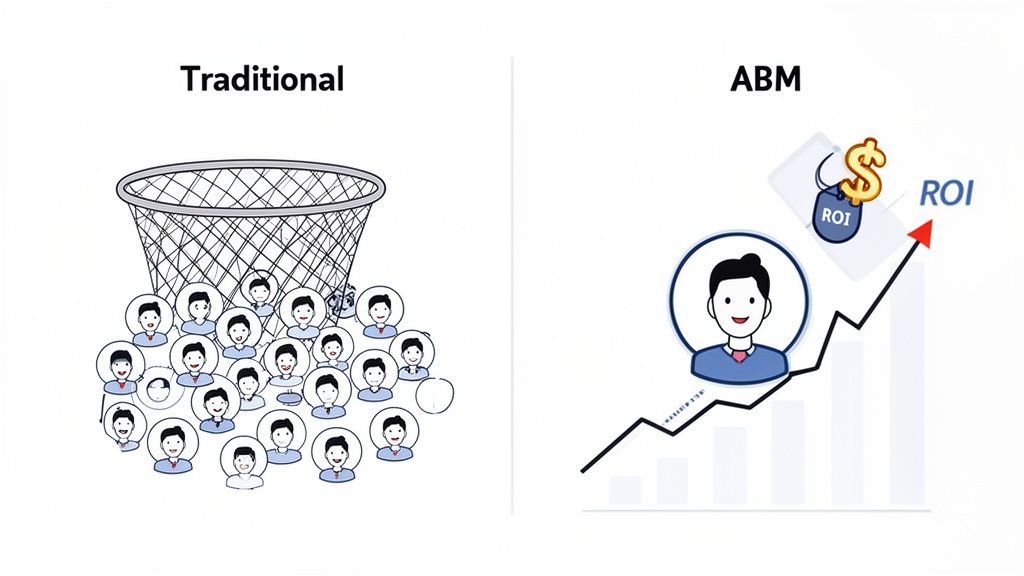
Account-based marketing isn't just another buzzword; it’s a completely different way of thinking about revenue. It’s about shifting from a wide-net, volume-based game to a high-precision, value-driven strategy. The logic is beautifully simple: stop spending money, time, and creative energy on leads that go nowhere. Instead, focus all your firepower on the accounts that can truly move the needle.
This intense focus is exactly why ABM produces such impressive returns. Rather than stretching your budget thin trying to reach thousands of potential prospects, every single dollar is put to work building real relationships with companies that fit your ideal customer profile perfectly. When you allocate resources this strategically, better results are almost inevitable.
Driving Efficiency Through Sales and Marketing Alignment
One of the biggest, yet often overlooked, financial wins from ABM comes from finally fixing the age-old disconnect between sales and marketing. In the old model, marketing generates a pile of leads and tosses them over the fence, leaving sales to dig for gold. This isn't just inefficient; it's a huge waste of everyone's time.
ABM gets rid of that entire problem.
When sales and marketing sit down and agree on a target account list from the very beginning, they stop being two separate departments and start acting like one cohesive revenue team. This tight partnership means marketing's campaigns are warming up the exact people that salespeople want to talk to. The result? A sales cycle that's faster and smoother for everyone involved.
Instead of making cold calls, your sales reps follow up with genuinely engaged accounts that have already seen and interacted with content made just for them. This teamwork creates a powerful ripple effect:
- Higher Win Rates: Your teams are only working on the opportunities with the highest chance of closing.
- Reduced Customer Acquisition Costs: You stop burning cash on leads that were never going to buy.
- Accelerated Sales Cycles: Prospects are already familiar with your brand and value proposition before sales even reaches out.
"The ultimate benefit of ABM is its impact on the bottom line. By treating each target account as a market of one, you create hyper-relevant experiences that command attention and build trust, directly leading to more closed-won revenue."
Securing Larger Deals with Deeper Engagement
ABM isn’t just about being more efficient—it’s about landing bigger fish. Because the entire strategy revolves around deep research and personalization, you're not just solving one person's problem; you're addressing the major business challenges of the entire organization. This lets you frame your solution as a critical strategic partner, not just another piece of software.
By engaging multiple decision-makers across the company with messaging that speaks directly to their role and concerns, you build widespread support. This deep penetration into an account often uncovers larger, more complex needs you would have never found with a traditional, lead-focused approach.
The numbers back this up. Industry benchmarks show ABM can deliver 21-50% higher returns than traditional marketing. More telling, 58% of marketers report larger deal sizes from their ABM efforts—often 91% bigger on average. For any business leader, these figures point to a clear, repeatable path to revenue growth. You can dive deeper into the revenue impact of ABM at Intent Amplify.
This is precisely why real ABM expertise has become such a valuable skill for marketers looking to make a bigger impact and advance their careers.
Building Your High-Performance ABM Team
A great account-based marketing strategy isn't something you just buy off a shelf. It's built, piece by piece, by a dedicated, cross-functional team that thinks and acts as one. ABM has a funny way of erasing the old, rigid lines between departments, demanding a level of teamwork that many companies just aren't set up for yet.
Putting this team together is a real investment in specific skills and, more importantly, in a culture where sales and marketing aren't just "aligned"—they're completely intertwined. Every person plays a distinct role, but they're all working together to identify, engage, and ultimately win over your most important accounts.
The Core Roles of an ABM Unit
While the exact team structure can change depending on your company, a truly effective ABM program almost always runs on a few key positions. Think of these people as the engine of your entire ABM machine, each bringing a unique talent to the table for the shared goal of growing account-level revenue.
Here are the essential players you need to have on your roster:
- The ABM Strategist (The Architect): This is the person steering the ship. They're the mastermind who develops the entire game plan, works with sales leadership to define the Ideal Customer Profile (ICP), and meticulously selects the target account list.
- The Content Personalization Specialist (The Storyteller): This role is all about creating the hyper-relevant, "wow, they get us" messaging that makes ABM so effective. They take existing content and tailor it, or build entirely new pieces—from custom landing pages to industry-specific reports—that speak directly to the challenges of each specific account.
- The Sales Development Representative (SDR) (The Catalyst): In an ABM world, the SDR is so much more than a cold caller. They become a strategic partner who uses the insights and personalized content from marketing to spark meaningful conversations with the right people at the right companies. Their job is to turn that initial engagement into a real, qualified meeting.
These roles are the foundation of a solid team. To get a better sense of how they fit into the bigger picture, it can be helpful to explore different marketing department organizational structures.
Essential Skills and Responsibilities
To really thrive in an ABM role, you need more than just the classic marketing or sales chops. It calls for a special kind of professional who is part data analyst, part creative thinker, and part master relationship-builder. Getting this mix right is crucial, whether you're hiring new talent or helping your current team members grow into these roles.
Let's dig into what each person actually does day-to-day and the skills they need to knock it out of the park.
Key Roles in an Account Based Marketing Team
Here’s a quick breakdown of who does what on a modern ABM team, covering their main duties and the skills that are absolutely non-negotiable for success.
| ABM Role | Primary Responsibilities | Essential Skills |
|---|---|---|
| ABM Strategist | - Defines the ABM strategy and target account list. - Manages the ABM technology stack. - Measures program performance and ROI. |
- Strong data analysis and interpretation. - Deep understanding of sales cycles. - Project management and leadership. |
| Content Specialist | - Creates and customizes content for specific accounts. - Manages a library of personalized assets. - Works with designers on bespoke visuals. |
- Exceptional writing and storytelling. - Strong empathy for customer pain points. - Familiarity with personalization tools. |
| SDR | - Executes personalized outreach sequences. - Nurtures relationships with multiple stakeholders. - Gathers account intelligence for the team. |
- Consultative selling and active listening. - Resilience and persistence. - Excellent cross-functional communication. |
This table is a great starting point for mapping out the talent you need to bring on board or develop internally to make your ABM program a success.
Fostering Seamless Sales and Marketing Collaboration
At the end of the day, the single biggest predictor of ABM success has nothing to do with technology or budget. It's the quality of the relationship between your sales and marketing teams. Without genuine, open collaboration, even the most brilliant strategy is destined to fail.
The cornerstone of any successful ABM initiative is communication. It's not about marketing handing off leads to sales; it's about both teams co-owning the account journey from the very first touchpoint to the final signature.
This kind of partnership doesn't happen by accident. You have to build it intentionally with clear processes for planning and communication.
- Weekly Alignment Meetings: Sales and marketing need a regular, scheduled time to get in a room together. This is where they review account progress, dissect engagement signals, and decide on the next moves for each target.
- Shared Goals and KPIs: Both teams must be judged by the same metrics. Success should be measured by shared outcomes like the amount of pipeline generated from target accounts and, of course, the revenue closed from that list.
- Integrated Technology: Your CRM and marketing automation platforms can't live in separate worlds. They need to be tightly connected to give both sales and marketing a single, shared view of every touchpoint and conversation happening within an account.
When you achieve this level of integration, your ABM team stops being just a group of individuals and becomes a powerful, unified revenue engine for the business.
Measuring Success with ABM-Specific KPIs
In traditional marketing, we're often obsessed with volume. How many leads came in this week? What was our cost-per-lead? But when you make the jump to account-based marketing, those old yardsticks don't just fall short—they can be downright misleading.
Success in ABM demands a completely different way of thinking. You're no longer counting individual leads. Instead, you're tracking the health, progress, and engagement of entire accounts. The focus shifts from top-of-funnel activity to real business impact. The question isn't "How many MQLs did we get?" but "How deeply are we connecting with our target accounts, and are they moving forward?"
Moving Beyond Vanity Metrics
The key performance indicators (KPIs) for ABM give you a clear, holistic view of how your efforts are influencing the accounts that matter most. These aren't just numbers to fill a dashboard; they’re direct signals of account penetration, sales cycle acceleration, and ultimately, revenue.
Here are the essential KPIs you should be tracking:
- Account Engagement Score: Think of this as a unified "interest score" for an entire company, not just one person. It combines all the touchpoints from multiple people within the account—website visits, content downloads, event attendance, email opens—into a single, powerful metric that tells you how hot an account really is.
- Target Account Pipeline Coverage: This one answers a simple but critical question: what percentage of our sales pipeline is made up of our hand-picked target accounts? When this number is high, it’s a clear sign your ABM strategy is generating the right kind of opportunities.
- Pipeline Velocity: How fast are target accounts moving from that first touch to a closed deal? ABM is built to shorten sales cycles by getting everyone on the same page sooner. Tracking velocity proves your personalized approach is actually accelerating revenue.
When you zero in on these indicators, you can more effectively measure marketing performance and show its direct contribution to the bottom line.
Key Metrics for Your ABM Dashboard
Building a dashboard that brings these KPIs to life is crucial for communicating success. Your goal is to tell the story of an account's journey, showing how it progresses from a name on a list to a genuine opportunity.
The best ABM measurement frameworks don't just track what marketing did. They show what happened within the target account as a direct result of those marketing activities.
The proof is in the numbers. Time and again, data shows that this focused approach pays off. Teams using ABM see 38% higher win rates and a 60% lift in deal size from their account-based advertising.
This kind of precision is why roughly 20% of targeted accounts turn into qualified opportunities—a massive jump from the 1-2% you might see with broader demand generation tactics. And it gets even better: companies with a well-defined Ideal Customer Profile (ICP) report 68% higher account win rates, which really drives home how important smart account selection is. You can find more ABM performance statistics on WebFX.com.
At the end of the day, measuring what is account based marketing is all about tracking influence, engagement, and revenue—not just leads.
Launching Your First ABM Pilot Program
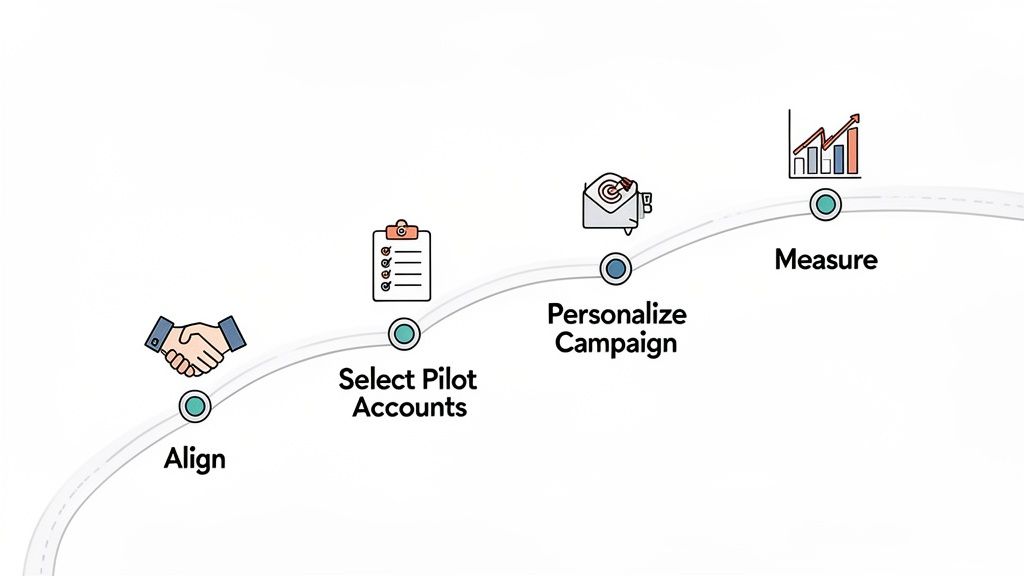
Diving into account-based marketing doesn’t mean you have to rip up your current playbook and start from scratch. The smartest way to get started is with a small, focused pilot program. Think of it as a test flight—it's your chance to prove the concept works, learn what resonates, and build momentum before you ask for a bigger budget.
A good pilot program is all about minimizing risk while gathering maximum insight. Your goal is to show leadership what ABM can really do, but without demanding a huge investment upfront. You'll focus on a handful of hand-picked accounts to create a powerful internal case study that makes a compelling argument for expansion.
Step 1: Achieve True Sales and Marketing Alignment
Before you write a single email or design an ad, you have to get sales and marketing in the same room, reading from the same script. This is the absolute foundation of your pilot. Without it, the whole thing falls apart.
This isn't just another meeting. It's a working session focused on critical questions:
- What does a "high-value" account really look like to both of us?
- What specific business outcomes are we trying to drive with this pilot?
- How will we work together on outreach, and what’s our feedback loop?
The outcome should be a pact. Both teams have to agree on the target list, the messaging, and the KPIs. This shared ownership is what makes it a genuine ABM effort, not just another marketing campaign that sales might ignore.
Step 2: Select Your Pilot Accounts Carefully
Now that your teams are aligned, it's time to pick your targets. For a pilot, less is always more. You want to select a small, manageable list of 5 to 10 accounts. This is the sweet spot—it lets you provide a truly personal touch without completely swamping your team.
Your pilot list should be a strategic mix. You'll want a few "dream" accounts that are a perfect fit for your ideal customer profile (ICP). It's also smart to include one or two existing customers where you see a clear opportunity for a big upsell or cross-sell. The key is picking accounts where you have a legitimate shot at making an impact and can gather clean, undeniable data.
Step 3: Develop a Simple Personalized Campaign
Your first ABM campaign doesn't need to be some elaborate, multi-channel masterpiece. The real aim here is to orchestrate a simple, coordinated experience that proves the power of personalization. It’s all about having a few different channels working together.
For example, a solid, streamlined pilot campaign could look something like this:
- Targeted Ads: Run a hyper-specific ad campaign on LinkedIn that shows relevant content only to the key players at your target companies.
- Personalized Email Outreach: Write a short email sequence that speaks directly to the target’s industry, maybe mentioning their recent company news or a challenge you know they're facing. As you build this out, ensuring your messages actually land in their inbox is crucial. A good email deliverability guide can be a lifesaver here.
- Sales Follow-Up: Make sure your sales reps have all the engagement data from your marketing touches. That way, their calls and emails are timely, relevant, and warm.
The magic of an ABM pilot is in the coordination. It's not about doing more; it's about making sure every touchpoint—from an ad impression to a sales call—is connected and relevant to the account.
Step 4: Establish Baseline Metrics to Measure Success
Finally, you can’t prove success if you don’t know what you're measuring against. Before you launch anything, establish your baseline. What are the current engagement levels within these target accounts (if any)? How long is your typical sales cycle? What's your average deal size?
Your pilot's performance will be judged against this starting point. After a defined period—a quarter is usually a good timeframe—you can analyze the results and tell a clear, data-backed story. Did engagement spike in your pilot accounts? Did you book meetings with senior decision-makers you couldn’t reach before? This narrative is your best weapon for getting the buy-in you need to scale up your ABM program.
Got Questions About ABM? We've Got Answers.
When marketers first start digging into account-based marketing, a few key questions always seem to pop up. Let's tackle some of the most common ones head-on—the practical stuff around cost, company size, and how ABM is really any different from just doing marketing well.
Getting these fundamentals straight can help clear up any confusion and show you a more direct path to getting started.
Is ABM Only for Huge Enterprise Companies?
Absolutely not. While ABM got its reputation from big companies targeting other massive companies, its core ideas work for any B2B business where a single customer is worth a lot over their lifetime. You don't need a massive budget or a giant team to see real results.
For smaller or mid-market companies, a scaled-down approach often called "ABM Lite" can be a game-changer. It’s all about focusing your energy on a short, carefully chosen list of high-potential accounts and running a simple, personalized campaign. The guiding principle is quality over quantity, which is smart business at any size.
What's the Real Cost to Start an ABM Program?
This is the classic "it depends" answer, which can be frustrating, but it's true. The cost of ABM can swing wildly. You could dip your toes in the water with a small pilot program, using the team you already have and some low-cost tools for basic ad targeting and personalization.
The smartest way to begin is to start small. Run a focused pilot program, prove it delivers a return, and then use those wins to get the budget you need to scale up.
On the other end, you have full-blown programs with dedicated ABM platforms like 6sense or Demandbase, hefty ad budgets, and a team of specialists. That’s a serious investment. The great thing about ABM is its scalability—you can start at a level that fits your budget today and expand as you prove its value.
How Is ABM Really Different from Just Good Marketing?
This is a great question because it cuts right to the chase. The biggest difference is where you start.
Think of it like this:
- Traditional Marketing casts a wide net. It focuses on generating a high volume of individual leads, which then have to be sorted, scored, and qualified before sales ever sees them.
- Account-Based Marketing flips that model on its head. It starts by hand-picking a list of high-value target accounts first. Only then does it launch highly targeted marketing campaigns aimed squarely at the key people inside those specific companies.
It’s a complete reversal of the typical marketing funnel. Instead of marketing to everyone and hoping the right people respond, ABM dedicates all of its resources to pre-qualified, best-fit customers from day one. No more wasted effort.
Ready to advance your marketing career with the skills that matter? At SalaryGuide, we provide the latest job postings, salary insights, and career tools to help marketers like you understand your value and find your next great role.
