How to Write a Professional Resume for Marketing Success
Your resume is more than just a piece of paper—it's the most important ad you'll ever create for your personal brand. To write a professional resume that actually gets you noticed, you have to treat it like a meticulously planned marketing campaign. That means backing up your claims with hard numbers, weaving in the right keywords, and making your value crystal clear from the first glance.
Your Resume Is Your First Marketing Campaign
Think of your resume as a high-stakes, direct-response ad. Its one and only job? To land you an interview. Hiring managers spend an average of just seven seconds on that initial scan, so you have to make an immediate impact. There's no time for a slow build-up.
Your resume needs to scream "I'm the right person for this job!" It's part compelling story, part data-driven case study of your career. A truly "professional" resume in today's market is a balancing act—it needs the creative flair of a marketer but also the rigid structure that can satisfy the Applicant Tracking Systems (ATS) that screen it first.
This guide will walk you through exactly how to write a resume that impresses both the bots and the humans. The old "one-size-fits-all" resume is dead. Customizing your resume for each application is how you cut through the noise in a flooded job market. We'll get into why clarity, measurable results, and smart keyword use are your three most powerful tools.
Why Every Single Detail Matters
The margin for error is razor-thin. Research from Zety shows that resumes between 475 and 600 words are a staggering 43% more likely to be considered for a role. And get this: nearly 80% of resumes are tossed out simply because of a typo or grammatical mistake.
That tells you everything you need to know. Every word, every bullet point, and every formatting choice has to earn its place. Your job is to make it ridiculously easy for a busy recruiter to spot your value in those few precious seconds.
What A Modern Professional Resume Looks Like
Today’s resume is a living document that highlights your achievements, not just your day-to-day duties. It’s a critical piece of your professional toolkit, but it doesn't work in a vacuum. A great resume outlines your impact, but you can take it a step further by learning how to build a marketing portfolio to show, not just tell, what you can do.
And since your resume is your opening pitch, you need to ensure your online presence is just as polished. It's well worth your time to focus on optimizing your LinkedIn profile to attract recruiters, which acts as the digital, expanded version of your resume.
Your resume should answer one fundamental question for the employer: "How will this person make our business more successful?" Every section should contribute to a clear and compelling answer.
To help you get started, let's look at the key building blocks. The table below breaks down the essential parts of a modern professional resume, what they're for, and how you, as a marketer, can make each one shine.
Essential Components of a Modern Professional Resume
| Section | Purpose | Key Focus for Marketers |
|---|---|---|
| Contact Info & Links | Makes it easy for recruiters to get in touch and see your work. | Include your LinkedIn profile and a link to your online portfolio or personal website. |
| Professional Summary | A 2-3 sentence "elevator pitch" that hooks the reader. | Tailor it to the job description, highlighting your top 2-3 achievements and core skills. |
| Work Experience | Details your career history and accomplishments. | Use action verbs and quantify results with metrics (e.g., "Increased lead gen by 35%"). |
| Skills | A scannable list of your technical and soft skills. | Feature marketing-specific tools (e.g., HubSpot, Google Analytics) and sought-after soft skills. |
| Education & Certs | Shows your foundational knowledge and ongoing learning. | List relevant degrees and any industry certifications (e.g., Google Ads, SEMrush). |
Each of these sections plays a vital role in building a narrative that convinces a hiring manager you're worth talking to. We'll break down how to perfect each one.
Choosing Your Resume Format for Readability
Before a single bullet point gets a chance to shine, your resume's format has to pull its weight. A confusing layout or the wrong structure can make a hiring manager toss your resume aside without a second thought. The goal here is simple: make your resume dead easy to scan, so your best stuff jumps right off the page.
Picking a format isn't just about aesthetics; it's a strategic move that hinges on your career story. A marketer with a clear, upward climb in SEO needs a different layout than someone pivoting from PR into a growth marketing role. Your format is the frame that holds your professional picture.
The Three Core Resume Formats
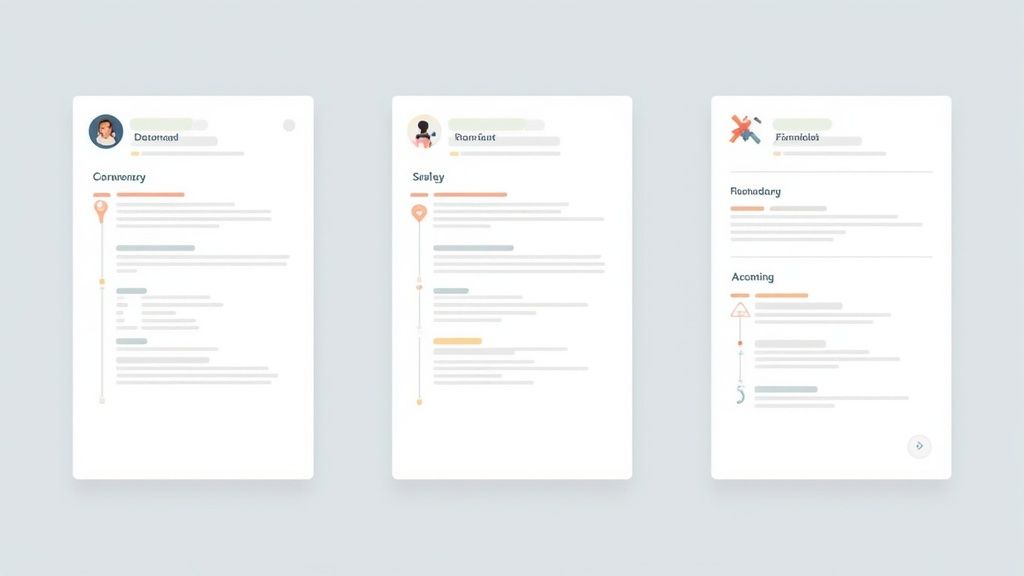
Let's break down the main options. Each one tells your story in a slightly different way, and knowing which one to use is half the battle.
Chronological: This is the old standby for a reason. It lists your jobs from most recent to oldest. It’s perfect if you have a solid career path and want to show a clear, logical progression in your field. Most recruiters expect and prefer this format.
Functional: This one is all about your skills, pushing your actual work history to the background. It's sometimes used by career changers or freelancers with a patchwork of projects. A word of caution, though: many recruiters are immediately skeptical of this format because it can look like you're hiding something.
Combination (Hybrid): This format gives you the best of both worlds. It kicks off with a powerful summary of your skills and qualifications right at the top, then follows with a more streamlined chronological work history. You get to showcase your top skills first while still giving recruiters the timeline they want to see.
Selecting the Right Format for Your Marketing Career
For almost every marketer, the choice will boil down to the chronological or combination format. It's all about picking the one that best frames your experience.
If you have a strong, consistent work history with clear promotions, the chronological resume is your best friend. A content marketer who went from Content Specialist to Content Manager to Head of Content? That's a story this format tells beautifully. It screams progression.
On the other hand, the combination resume is a game-changer for marketers who are switching things up. If you're a paid media pro trying to break into SEO, this format is for you. It lets you lead with transferable skills like keyword research, data analysis, and A/B testing, proving your value for the new role right away.
A well-chosen resume format acts like a visual guide, directing the recruiter's attention exactly where you want it to go. It makes your most compelling qualifications impossible to miss during that critical seven-second scan.
Designing for Scannability and Professionalism
Once you've picked your format, you need to think about the design. Your resume has to look clean, professional, and be ridiculously easy to read. Cluttered pages, weird fonts, and massive text blocks are resume killers.
Here are the non-negotiables for a clean design:
Font Choice: Don't get fancy. Stick to classics like Calibri, Arial, Garamond, or Georgia. They’re easy on the eyes and, just as importantly, play nice with the Applicant Tracking Systems (ATS) that will likely read your resume first.
Font Size: Keep your body text between 10.5 and 12 points. Your name can be bigger, maybe 18-22 points, and section headings should stand out at around 13-15 points in bold. This creates a natural hierarchy that guides the eye.
White Space: Let your content breathe! Use margins of at least 0.7 inches and leave plenty of space between sections. White space makes the document feel less intimidating and helps the important information pop.
Consistency: This is huge. If you bold one job title, you have to bold them all. Use the same date format throughout. Little inconsistencies look sloppy and can be a major red flag for a detail-oriented marketing job.
Nailing these fundamentals of format and design creates a resume that not only looks good but works hard for you.
Turning Responsibilities into Compelling Results
Your experience section is the heart of your resume, but it’s also where most marketers get it wrong. It's so easy to fall into the trap of creating a laundry list of job duties—a collection of "responsible for" statements that only tell a recruiter what you did, not how well you did it.
If you want to write a resume that actually lands interviews, you have to shift your thinking. Stop listing responsibilities and start showcasing results. Your goal is to turn your experience section into a highlight reel of your career wins.
The Power of Quantified Achievements
Let's be blunt: numbers tell a better story than words alone. They give your claims context, prove your impact, and paint a clear picture for a hiring manager of what you could do for their team.
Put yourself in their shoes. Which of these two candidates gets the callback?
- Candidate A: "Managed social media accounts for the company."
- Candidate B: "Grew organic Instagram followers by 200% to 50k in 6 months by launching a targeted content series."
It’s not even a contest. Candidate B immediately communicates their value. Those numbers aren't just details; they're solid proof of performance. This is the single biggest difference between a good resume and a great one.
Here’s a great example of what this looks like in practice, grabbing a recruiter's attention instantly.
See how your eye is drawn straight to the bolded numbers and specific outcomes? That’s what you’re aiming for. It makes your value clear in seconds.
A Simple Formula for Powerful Bullet Points
Crafting these achievement-driven statements isn't as intimidating as it sounds. I've used a simple formula for years that helps structure every bullet point for maximum impact.
Action Verb + What You Did + The Quantifiable Result
Let’s break that down:
- Start with a strong action verb. Ditch the passive words like "Managed" or "Responsible for." Instead, lead with dynamic verbs like "Launched," "Optimized," "Increased," "Negotiated," or "Redesigned."
- Briefly describe the project or task. This gives just enough context. What did you actually work on?
- End with the quantifiable result. This is the "so what?" of your statement. How did your work move the needle for the company? Think in percentages, dollar amounts, time saved, or any other hard number you can find.
This structure forces you to connect your day-to-day work to real business outcomes—which is exactly what employers are looking for.
You're Instantly in the Top 10%
Here’s a little secret: very few people actually do this. An analysis of 18 million resumes found that only about 10% of job seekers include measurable results. That number drops to a shocking 5% for entry-level candidates.
Employers are starved for this kind of proof. A simple statement like, "Managed a 10-person team that reduced errors by 15%," is infinitely more powerful than just, "Managed a team." You can dig into more stats like this by exploring the full research on resume trends from MyPerfectResume.
By simply adding metrics to your accomplishments, you automatically place yourself in the top tier of applicants. It’s a relatively small effort that gives you a massive competitive advantage.
Role-Specific Examples for Marketers
I know what you're thinking—"What if my role isn't all about numbers?" The truth is, every marketing role, from creative to analytical, drives business goals that can be measured. You just have to know where to look.
For the Paid Media Specialist:
- Before: Ran Google Ads campaigns.
- After: Managed a $500k annual Google Ads budget, optimizing campaigns to increase ROAS by 35% year-over-year.
For the SEO Manager:
- Before: Responsible for blog content and technical SEO.
- After: Drove a 75% increase in organic traffic in 12 months by executing a comprehensive content strategy and resolving over 200 technical SEO issues.
For the Content Marketing Manager:
- Before: Wrote blog posts and created ebooks.
- After: Developed and executed a content strategy that generated 1,500+ MQLs in Q4, contributing to $250k in new pipeline revenue.
For the Growth Marketer:
- Before: Handled user acquisition and A/B testing.
- After: Launched a new user onboarding flow that improved activation rates by 22% and reduced churn by 12% within the first 60 days.
Even roles that feel less data-heavy, like a marketing coordinator, have plenty of opportunities to quantify impact. If you need some ideas, check out our detailed marketing coordinator job description for inspiration. By focusing on your achievements, you transform your resume from a boring work history into a powerful business case for why you’re the one they need to hire.
Optimizing Your Resume to Beat the Bots
https://www.youtube.com/embed/DksA_vF84JA
Before your resume ever lands in front of a hiring manager, it faces its first—and arguably most important—challenge: the Applicant Tracking System (ATS). These automated systems act as the gatekeepers for the vast majority of companies today, scanning every application for specific keywords and the right format.
Think of the ATS as a very literal-minded robot. It couldn't care less about your fancy graphics, creative columns, or designer fonts. Its sole purpose is to parse your resume for data, check if you’re a match for the job description, and pass the promising candidates along. If it can't read your file, it gets tossed into the digital void, regardless of how perfect you are for the role.
This means the structure of your resume is just as critical as the words you use. I’ve seen countless talented marketers get rejected at this initial stage simply because of avoidable formatting mistakes. To build a resume that gets past the bots and wows the humans, simplicity is your secret weapon.
Decoding the Job Description for Keywords
The key to passing the ATS test is hidden in plain sight: the job description. It’s basically a cheat sheet that tells you exactly what the hiring manager wants to see. Your job is to mirror that language naturally throughout your resume.
Start by dissecting the job description and pulling out the essential skills, tools, and qualifications. Don’t just skim for the obvious stuff; pay close attention to how they phrase responsibilities and what outcomes they value.
- Hard Skills: List all the specific software and platforms they mention. Think HubSpot, Google Analytics, Semrush, or Salesforce.
- Soft Skills: Pinpoint the desired traits like "strategic planning," "cross-functional collaboration," or "data-driven decision making."
- Action Verbs: Take note of the verbs they use to describe the role, such as "develop," "analyze," "manage," and "optimize."
Once you have this list, start weaving these keywords into your professional summary, your bullet points under each role, and your skills section. The goal is to make it feel authentic, not like you’re just stuffing your resume with buzzwords.
ATS Formatting Do's and Don'ts
The formatting choices you make can either help or hurt your chances. To ensure your resume is easy for the software to read, it’s best to stick to a clean, straightforward layout. This quick table breaks down what works and what doesn't.
| Do | Don't |
|---|---|
| Use standard fonts like Arial, Calibri, or Garamond. | Use custom, script, or decorative fonts. |
| Use standard section headings like "Experience" or "Education." | Get creative with section titles ("My Journey"). |
| Put your contact info in the main body of the resume. | Place critical information in the header or footer. |
| Use a single-column layout for easy reading. | Use tables, text boxes, or multi-column layouts. |
| Save your final resume as a .docx or .pdf file. | Include images, charts, graphs, or logos. |
Following these simple rules is your best insurance policy against an ATS rejection. If the software can't parse your contact info or work history, you’re basically invisible to the recruiter.
Common Formatting Mistakes that Wreck Your Chances
An ATS can get tripped up by surprisingly simple design elements. If you want to make sure your resume is machine-readable, you have to steer clear of the common formatting traps that get so many applications filtered out.
The biggest offenders? Things like tables and columns, which might look organized to us but often get scrambled into nonsense by an ATS. The same goes for headers and footers; some systems just skip them entirely, so always keep your contact details in the main body of the document.
The process below shows the simple but powerful formula for writing achievement-focused bullet points—which is the perfect place to integrate those keywords you found.
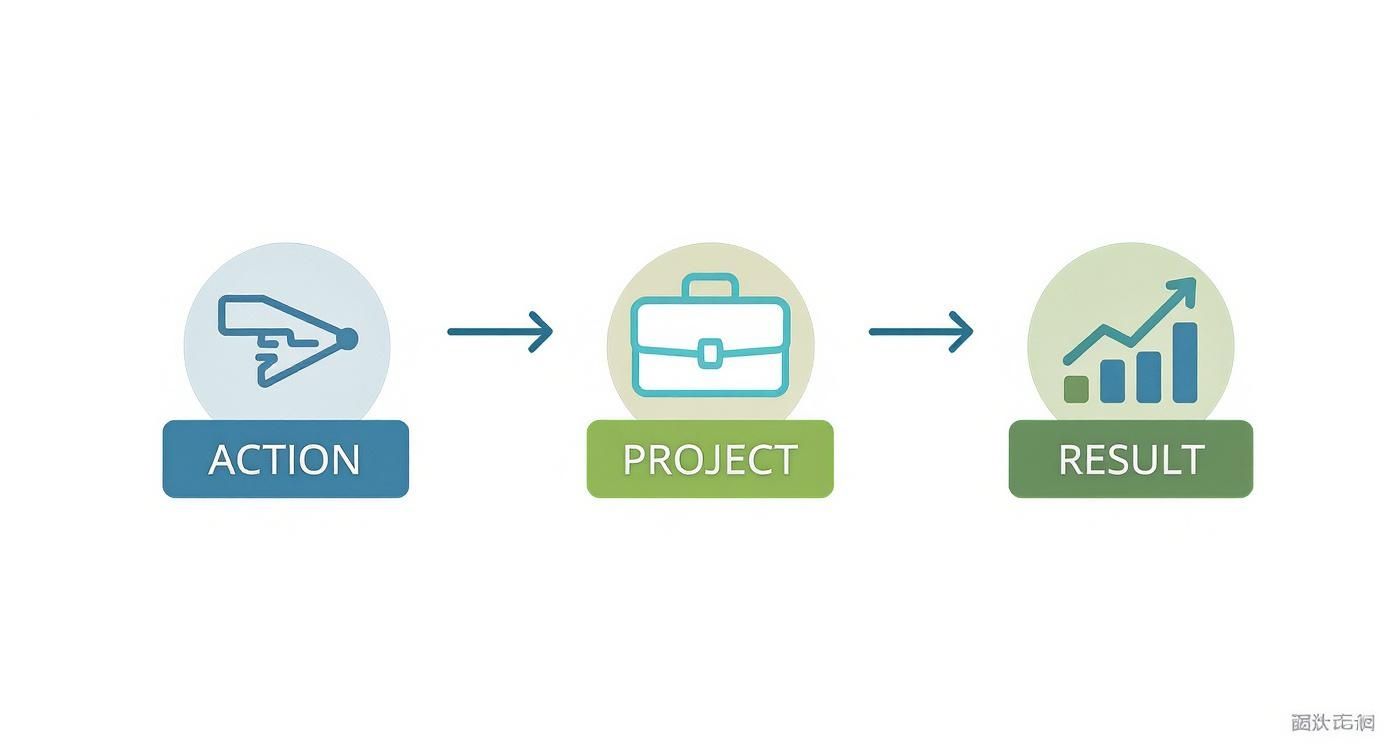
This workflow is a great reminder: start with a strong action, explain what you did, and always end with a measurable result. For a deeper dive, this comprehensive ATS resume checker guide is a fantastic resource.
As AI becomes more ingrained in hiring, this is only getting more important. New data shows that 31% of recruiters are looking to increase their use of AI. In fact, 40% already say it helps them find qualified candidates more efficiently. This means your resume has to be crystal clear, showcasing your skills and results in a way that an algorithm can easily understand and validate. Knowing how to write for these systems gives you a massive advantage.
The One-Two Punch: Nailing Your Summary and Skills
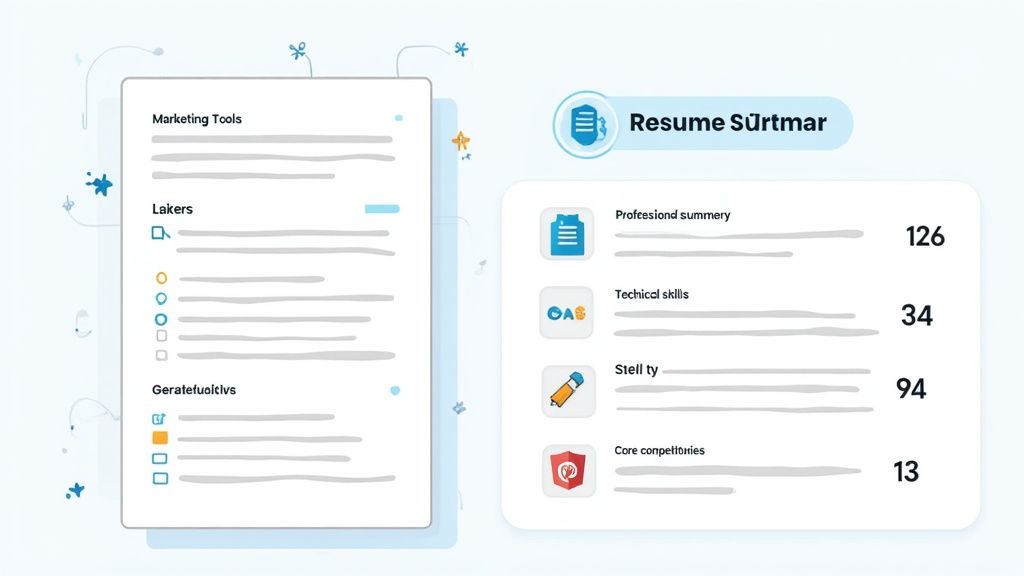
Think of the top third of your resume as prime real estate. You get a few precious seconds—six, to be exact—to grab a recruiter's attention. This is where you land your first, and most important, impression. A compelling Professional Summary paired with a laser-focused Skills section is your best bet to hook them immediately and make them want to read more.
This opening combo is your highlight reel. It screams, "I know exactly what you're looking for, and I've got it." The summary is your elevator pitch, and the skills section is the scannable proof that you can walk the walk.
Writing a Summary That Sells
Forget the outdated "Objective" statement that talks about what you want. Your summary is a confident, 3-4 line declaration of the value you deliver to an employer. For any marketer with a bit of experience under their belt, this is non-negotiable.
A great summary quickly answers three key questions:
- Who are you? (e.g., "Data-driven SEO Manager," "Creative Content Strategist")
- What's your specialty? (e.g., "...with over 8 years of experience scaling B2B SaaS startups...")
- What’s your headline achievement? (e.g., "...proven to drive organic growth, culminating in a 150% increase in MQLs.")
If you're changing careers or fresh out of college, a Resume Objective might actually be a better fit. It pivots the focus to your drive and transferable skills, showing your enthusiasm for breaking into a new field.
My Go-To Tip: Always write your professional summary last. Once you've gone through your work history and pulled out all those fantastic, number-backed achievements, it’s a thousand times easier to cherry-pick the most impressive highlights for your intro.
Curate Your Skills for Maximum Impact
Your skills section isn't a brain dump of every tool you've ever touched. It’s a carefully curated showcase designed to mirror the job description and make it ridiculously easy for a recruiter to see you're a match.
I always tell marketers to break their skills into logical categories. It just makes the section so much more scannable and shows you have an organized, strategic mind.
- Marketing Tools: Be specific. List the platforms you know inside and out, like HubSpot, Google Analytics, Semrush, Marketo, or Salesforce.
- Technical Skills: Include any tech abilities that give you an edge. For us, this often means things like basic HTML/CSS, SQL for digging into data, or knowing your way around WordPress.
- Core Competencies: This is where your bread-and-butter marketing abilities go. Think SEO Strategy, Paid Media Management, Content Marketing, Conversion Rate Optimization, or A/B Testing.
Show, Don't Just Tell, Your Soft Skills
Hard skills will get your resume past the bots, but soft skills are what land you the job. It's no surprise that 91% of recruiters say they value seeing them listed. The biggest mistake people make, though, is falling back on clichés. I've heard from hiring managers that seeing "team player" or "good communicator" is an instant turn-off.
Instead of just listing a soft skill, weave it into the fabric of your experience bullets.
Don't just write "Communication." Instead, describe an achievement: "Presented quarterly marketing performance reports and strategic recommendations to executive leadership, securing buy-in for a 15% budget increase."
To get a better sense of what's currently in high demand, it's worth checking out these essential marketing skills to learn for career growth. By categorizing your skills and backing them up with real-world proof, you give recruiters a powerful, at-a-glance confirmation that you're the real deal.
Don't Sabotage Yourself: The Final Polish
You’ve spent hours writing, tweaking, and quantifying your marketing wins. It's tempting to fire off that application and call it a day, but this final check is where so many good resumes go to die. One tiny typo or an awkward sentence can make a hiring manager question your attention to detail—and in marketing, that's a cardinal sin.
Here's a trick I swear by: read your resume out loud. Seriously. It forces you to slow down and catch the clunky phrases and grammatical slip-ups your brain automatically corrects on screen. If it sounds weird when you say it, it will definitely read weird to someone else.
Get a Fresh Pair of Eyes
Your next step is to run it through a grammar checker. A tool like Grammarly is great for catching those sneaky errors you might miss. But don't rely on technology alone. The single most valuable thing you can do is have another human being read it.
Find a trusted colleague, a mentor, or even a friend who's a good writer. After you’ve stared at the same document for hours, you develop blind spots. They’ll see the typo you’ve read 50 times or point out a bullet that just doesn’t make sense. That outside perspective is gold.
The biggest mistake I see? Sending the same generic resume everywhere. We all know it's a numbers game, but tailoring your resume to the job description can boost your chances of getting an interview by over 50%. A generic application screams, "I'm not that interested."
Career-Killing Mistakes to Avoid
Beyond basic proofreading, there are a few classic blunders that can immediately get your application tossed, especially for a marketing role. Before you hit that "submit" button, do one last sweep for these common missteps.
- Your College Email Address: If your email is anything other than a variation of your name (like
jane.doe@email.com), it’s time for an update. An address likepartyanimal2006@email.cominstantly torpedoes your credibility. - Listing Duties Instead of Results: We've hit this hard, but it’s worth repeating because it's that important. Don't just say you "Wrote blog posts." Frame it as an achievement: "Authored a blog series that drove a 45% increase in organic traffic in six months."
- Ignoring the Job Description: Your resume isn't a static document. If you’re not customizing it with keywords and skills from the specific job post, you're practically guaranteeing an ATS will filter you out. Every single application deserves a tailored resume. No exceptions.
A Few Common Resume Questions, Answered
Even with a solid plan, a few tricky questions always seem to pop up when you're in the thick of resume writing. Let's clear up some of the most common ones I hear from marketers.
One Page or Two?
This is the classic debate, isn't it? For almost everyone in marketing with under 10-15 years of relevant experience, stick to one page. It's the industry standard for a reason.
A one-page limit forces you to be disciplined. It makes you cut the fluff and ensure every single line earns its spot by showcasing your biggest wins.
Now, if you're a seasoned executive with a long, impressive history of major projects that are directly on point for the role you want, a second page can work. But that page has to be packed with value, not just a list of jobs from a decade ago.
What If I Don't Have Any "Real" Marketing Experience?
Breaking into marketing is all about reframing your existing skills. Don't use a standard chronological resume; it will only highlight what you haven't done. Instead, a combination or functional format is your best friend here. It lets you lead with your transferable skills.
Say you're coming from a sales background. You already get the customer mindset and know what it takes to persuade someone. You just need to translate that for a marketing hiring manager.
- Instead of this: "Handled email outreach to sales accounts."
- Try this: "Exceeded quarterly sales targets by 25% by developing personalized email outreach sequences for key accounts."
See the difference? You're connecting your past actions to marketing outcomes. You should also add a "Marketing Projects" or "Certifications" section. This is where you can show off any relevant courses, freelance work, or even personal projects that prove you're serious about this career change.
The goal is to connect the dots for the recruiter. Don't make them guess how your sales or customer service experience applies. Show them, with metrics, that you already have the foundation for marketing success.
Should I Put a Photo on My Resume?
In the U.S. and Canada, the answer is a hard no. Don't do it.
Including a photo can open the door to unconscious bias, and most companies have policies designed to prevent exactly that. On a more practical level, photos and other graphics can totally scramble an Applicant Tracking System (ATS), meaning your resume might get tossed out before a person ever lays eyes on it.
Keep your resume clean and professional. Your headshot belongs on your LinkedIn profile—that's what it's there for.
Ready to take the next step in your career? At SalaryGuide, we provide the data, tools, and insights marketing professionals need to understand their worth and find their next great opportunity. Explore real salary data and top marketing jobs at https://salaryguide.com.
