How to Get Marketing Experience: Practical Steps to Build Your Portfolio
So, how do you get marketing experience without a job? It's the classic chicken-and-egg problem that trips up so many people starting their careers. The good news is you don't have to wait for someone to hire you to start building a killer portfolio.
The secret is to create your own opportunities. You can gain real, valuable experience by starting a personal project, freelancing for a local business, volunteering your skills for a cause you care about, or landing a structured internship. The most important part? Generating measurable results you can proudly showcase.
Escaping the Entry-Level Experience Trap
It's a frustrating paradox, isn't it? You need experience to get hired, but you can't get experience without being hired. We're going to move past that tired old problem. The truth is, "experience" isn't just a formal job title on a resume—it's about proving you can create and measure tangible impact.
Today's sharpest new marketers are building impressive resumes without ever waiting for permission. They're proactively finding ways to apply marketing principles to real-world scenarios and, crucially, documenting the outcomes. This proactive approach immediately sets you apart, turning you from a candidate who has simply learned about marketing into one who has actively done it.
This shift in mindset is what separates the successful candidates from everyone else. You’re not just a job seeker; you're an experience creator. And you don’t need a huge budget or a big-name client to get started. All you need is a little initiative and a plan to track your results.
Four Proven Paths to Marketing Experience
To help you figure out where to begin, let's break down the four most effective ways to build your marketing resume from scratch. Each path offers its own unique set of benefits and challenges, so you can pick the one that aligns best with your goals and current situation.
The most valuable thing you can do for yourself is to unapologetically create your own experience. An employer is far more impressed by someone who started a project and failed than someone who never started at all.
This table compares these four common starting points.
| Method | Key Benefit | Best For Developing | Potential Challenge |
|---|---|---|---|
| Internships | Structured learning and mentorship | Corporate communication, teamwork | Highly competitive, may be unpaid |
| Freelancing | Earning income while you learn | Client management, ROI reporting | Finding and securing the first clients |
| Volunteering | Gaining experience for a good cause | Campaign execution, community management | Limited resources and smaller budgets |
| Personal Projects | Complete creative and strategic control | SEO, content creation, brand building | Requires strong self-discipline |
Whether you want the structure of an internship or the creative freedom of a personal project, the key is to just start. Each path will teach you invaluable lessons that no textbook ever could.
Securing Internships and Your First Marketing Role
Getting out of the classroom and into a real marketing role is a massive leap. Whether it's an internship or your first full-time gig, it takes more than just firing off a standard application. You need to show that you're proactive and have potential, even if your resume isn't packed with previous jobs.
The trick is to reframe the experience you do have. Think about academic projects, volunteer work, or that side-hustle blog you've been running. A hiring manager often cares more about seeing your initiative than a perfectly polished but empty resume.
Translating Potential into Experience
Your resume and cover letter are your first impression—make them count. Don't just list your tasks; talk about your impact. Did you run the social media for a campus club? Don't just say that. Show them you increased engagement by 15% or grew the follower count. That’s the language marketers speak.
Deciding between a structured role and something more flexible can be tough. This chart breaks it down to help you figure out what's right for you right now.
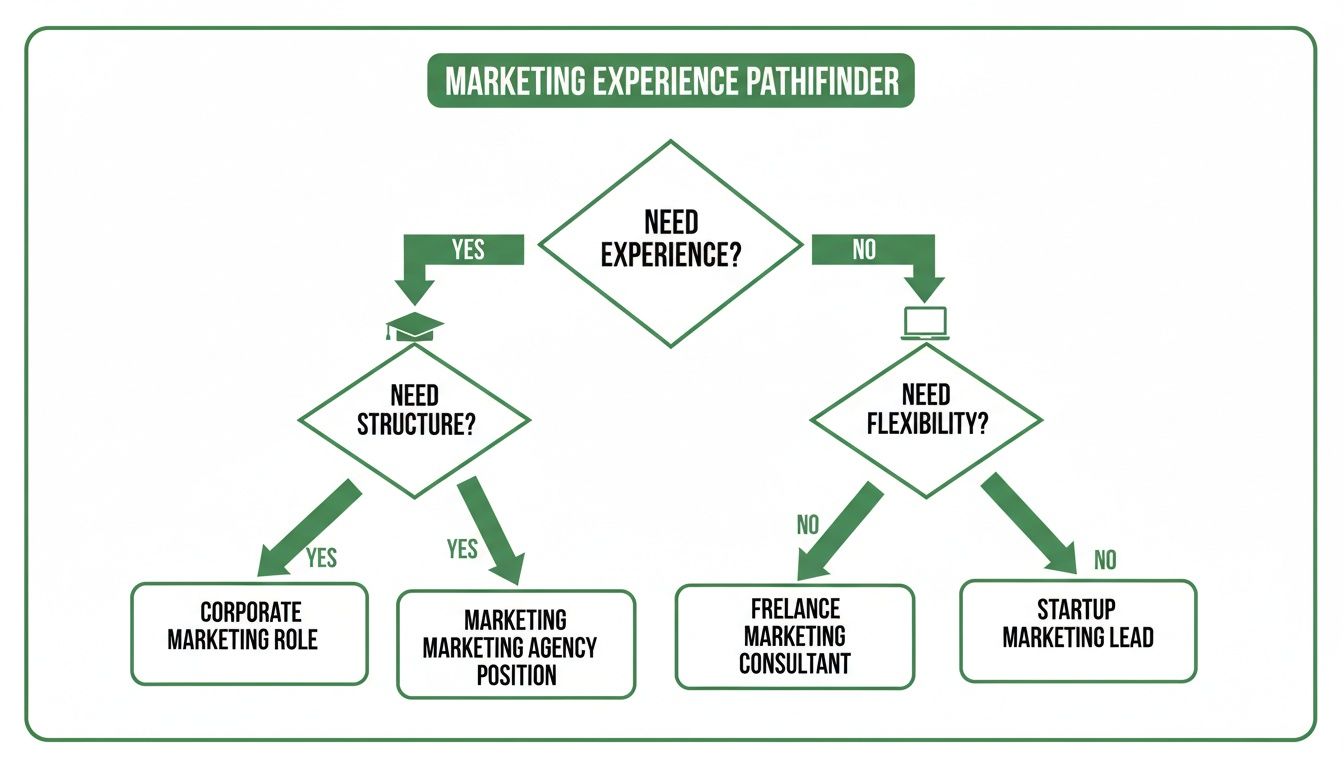
As you can see, both paths are completely valid ways to get your foot in the door. It really just depends on your personal situation and what you need to grow. For a lot of people just starting out, an internship provides the structure and mentorship that can really kickstart a career.
These formal roles are a direct pipeline into high-demand areas. Think about it: 53% of shoppers now find products through social media. An internship can give you hands-on experience in this critical channel. With most marketing teams juggling an average of 10 different channels, a structured role is one of the best ways to get a broad, real-world education you just can't find anywhere else.
Your goal isn't just to get the interview, but to control the narrative. Frame every experience, no matter how small, as a deliberate step toward becoming a marketer. This shows foresight and commitment.
Standing Out in a Crowded Field
Let's be honest, it's a competitive market. Simply applying for jobs isn't enough. You have to be actively building connections. This guide on how to grow your network on LinkedIn is a great place to start learning how to find those hidden opportunities.
Once you land an interview, it’s all about preparation. You’ll need to connect the dots for the interviewer, showing exactly how your past projects and skills line up with what their company needs. For some practical help, we’ve put together a guide on the most common marketing internship interview questions.
To cut through the noise, use platforms like SalaryGuide that pull openings directly from company websites. This saves you from sifting through old or irrelevant posts on third-party job boards and helps you focus your energy on real, active roles that are a good match for your skills.
Don't Wait for Permission—Create Your Own Experience
Here's a tough truth: waiting for a company to give you marketing experience is a losing game. The most powerful thing you can do right now is to stop waiting and start creating it yourself.
Forget the idea that you need a prestigious client or a formal job title. Real marketing experience begins with small, proactive projects that get real, measurable results. This is how you move from theory to practice. A hiring manager will always be more impressed by the candidate who took a tiny $50 ad budget for a local pizza shop and turned it into five new customers than someone with a perfect GPA and zero proof they can actually do the work.

Find That First Project
Your first project doesn't have to be glamorous. It just has to be real. The goal is to find a low-stakes opportunity where you can apply a specific marketing skill and, most importantly, track the outcome. Think locally. Start small.
- Help out a non-profit. Most charities and community organizations run on fumes. They would kill for someone to manage their social media or write a simple monthly newsletter.
- Approach a local business. Know a coffee shop, boutique, or contractor with a weak online presence? Offer to run a week-long social media ad campaign for them. Keep the budget tiny and the goal simple.
- Tap into your network. Does your aunt have an Etsy shop? Does your friend’s band have a new album? These are perfect, low-pressure environments to test your skills.
Offering your skills for free or taking on a small freelance gig is how you build your first case studies. You can find some great small business marketing tips to guide you. Just make sure you get permission upfront to track the results and share them in your portfolio.
Zero in on High-Impact Skills
When you're creating your own projects, focus on skills that spit out hard data. Digital advertising is a perfect place to start because it’s all about clear, undeniable metrics.
Freelance PPC gigs are goldmines for this. A staggering 93% of marketers consider PPC effective, and with an average 3.17% click-through rate for search ads, you can quickly generate numbers that prove you know what you’re doing. You can dig into more stats like this from platforms like Salesforce to see where the demand is.
The experience of being an entrepreneur, even on a tiny scale, is incredibly valuable to employers. Starting a project and failing looks better on a resume than never starting at all. It shows initiative, grit, and a bias for action.
Track Everything, Build Your Case Studies
Your number one goal here is to collect proof. For every single project, no matter how small, you need to be obsessive about tracking the right metrics. This is what turns "I helped a friend with their Instagram" into a powerful case study for your portfolio.
Example Metrics to Track for Your Projects:
- Google Ads Campaign: You'll want to track click-through rate (CTR), cost per click (CPC), conversions (like form fills or sales), and return on ad spend (ROAS).
- Social Media Management: Keep an eye on follower growth, engagement rate (likes, comments, shares), and especially website clicks originating from social media.
- Email Newsletter: The key numbers are open rate, click-through rate, and unsubscribe rate.
For each project, write down the challenge, the specific actions you took, and the results you achieved. This process is everything. If you're wondering how to frame this on your resume, our guide on how to write a professional resume can show you how to feature these achievements effectively.
Turning Certifications into Real-World Case Studies
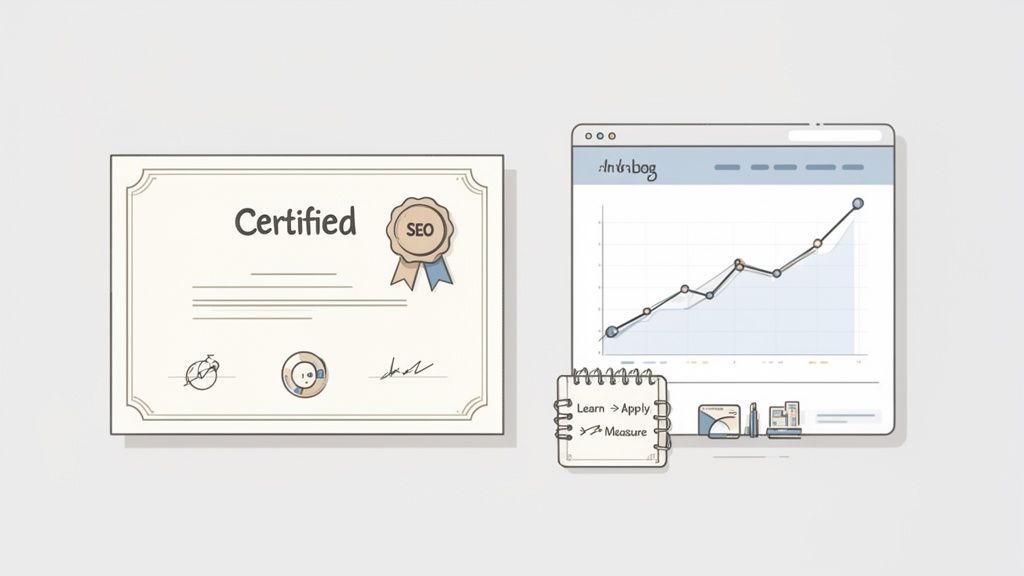
Let’s be honest: online courses and certifications are a great start, but they aren't a substitute for real experience. Their true power is unlocked the moment you apply that newfound knowledge to a project you can actually put your hands on. This is how you bridge the gap between theory and execution—and turn a simple line on your resume into a compelling story you can tell an interviewer.
Think of that Google Analytics or HubSpot credential not as the finish line, but as the starting pistol. The second you pass that final exam, you should be looking for a way to put those skills to the test. This is what separates a passive learner from an active doer in the eyes of a hiring manager.
From Learning to Doing
So, you just finished a comprehensive SEO certification. Don't just slap it onto your LinkedIn profile and call it a day. It’s time to get your hands dirty.
- Launch a Niche Blog: Pick something you’re passionate about—vintage video games, sustainable gardening, urban hiking, anything. The goal isn't to become the next big influencer; it's to create a living, breathing case study.
- Document Everything: From your keyword research to your on-page SEO tweaks, keep a record. Install Google Analytics (the tool you just learned about!) and start tracking your organic traffic from day one.
- Report the Results: In a few months, you’ll have a story to tell. A simple, one-page case study that says, "Grew organic traffic from 0 to 500 monthly visitors in 90 days using these specific strategies," is incredibly powerful.
This shows initiative, strategic thinking, and—most importantly—an ability to deliver measurable results. That’s the definition of experience.
Build Your Project Hub
You need a place to show off all this great work. A simple personal website or online portfolio is non-negotiable. It doesn’t need to be fancy; a clean, one-page site built on a user-friendly platform does the trick. This becomes the central hub where you can showcase your self-initiated projects and case studies.
By creating your own projects, you shift the narrative from "I learned how to do this" to "Here’s how I did this, and here are the results." This simple change is what makes your experience undeniable to employers.
Volunteering is another fantastic way to apply your new skills. Nonprofits are almost always in need of marketing help but are often running on a shoestring budget. Offer to manage a social media campaign or create a short-form video series for a local animal shelter. With 73% of global users researching products and services on social media, your skills are incredibly valuable.
This kind of hands-on work allows you to apply what you learned in a course to solve real-world problems and generate real results for your portfolio. You can discover more insights about global marketing trends and see how they create new opportunities for aspiring marketers.
Making Sure the Right People See Your Work
Gaining that initial marketing experience is a huge win, but it’s only half the battle. If your impressive results are just sitting in a folder on your computer, they aren't working for you. The next critical step is getting your accomplishments in front of the right people—the recruiters, hiring managers, and senior marketers who can open doors.
This is where building a personal brand and networking smartly comes into play. It's what turns you from another resume in the pile into a marketer they remember. Forget thinking of your online profiles as static documents; they are living, breathing showcases for your skills and, most importantly, your impact.
Turn Your LinkedIn Into a Magnet for Opportunity
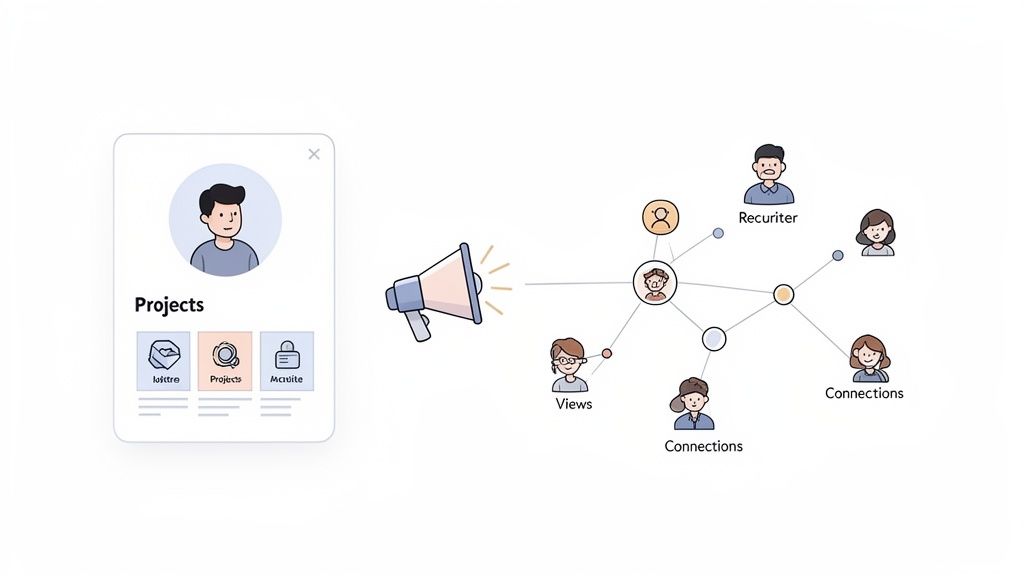
For most recruiters, your LinkedIn profile is your first impression. It needs to tell a quick, compelling story about who you are, what you can do, and the results you've already delivered.
First up, your headline. Ditch the generic "Student" or "Marketing Enthusiast." Instead, pack it with value. Think: "Aspiring SEO Specialist | Grew Blog Traffic by 200% | Google Analytics Certified." Right away, you're communicating a specific interest, a hard number, and a relevant skill.
Next, make the "Featured" section your best friend. This is prime real estate. Pin your portfolio, a detailed case study you wrote, or a blog post that breaks down a project's success. You want to make it ridiculously easy for a hiring manager to see tangible proof of your abilities in seconds.
Get Loud About Your Wins (In a Smart Way)
Don't be shy—if you got results, you need to talk about them. The single best way to build a personal brand is to create content around your hands-on experience. It’s a powerful way to show, not just tell, what you know.
Here are a few simple ways to start sharing your journey:
- Write a short LinkedIn post. Break down a specific challenge from a project and what you learned. Something like, "Learned a ton running my first Google Ads campaign for a local cafe. By focusing on hyper-local targeting, we hit a 4.5% CTR with just a $50 budget. Here’s the key takeaway..."
- Craft a simple one-page case study. Use a free tool like Canva to create a PDF outlining the project goal, your specific actions, and the quantifiable results.
- Jump into conversations. Join marketing groups on LinkedIn or follow industry discussions on X (formerly Twitter). Share what you're learning and ask thoughtful questions.
The goal isn't just to list your skills on a resume; it's to publicly demonstrate them. When a recruiter sees you actively discussing marketing strategies and sharing real-world results, you instantly stand out from the crowd of passive applicants.
Build Relationships, Not Just a Rolodex
Networking often gets a bad rap, but it’s not about mindlessly spamming connection requests. It's about building genuine, two-way relationships with people in your field.
Start by following marketing leaders and companies you genuinely admire. Engage with their content thoughtfully. A comment like, "This is a great point about user intent. I saw a similar trend when I was analyzing keyword data for X project..." is infinitely more valuable than a simple "Great post!"
When you do send a connection request, always add a personalized note. It can be as simple as mentioning a post of theirs you found helpful or a shared interest you noticed. That tiny bit of effort shows you're a real person who's serious about making a meaningful connection. This approach will help you build a network that provides advice, mentorship, and maybe even your next job lead.
And if you want to get even better at framing your wins, our guide on how to measure marketing performance can give you the language to articulate your impact more effectively.
5. Finding Your First Role with SalaryGuide
Alright, you’ve put in the work. You’ve built a portfolio packed with projects that show real, measurable results. Now it’s time to turn all that hustle into an actual paycheck. This is the moment you stop just creating experience and start putting it to work for you.
When you're just starting out, sifting through massive job boards can feel overwhelming. That's where a tool like SalaryGuide comes in handy. It's designed to help you bypass the clutter of third-party sites and connect directly with companies that are hiring.
Your main goal is to find roles where you can hit the ground running with the skills you just developed. Zero in on searches for titles like "Marketing Coordinator," "Digital Marketing Intern," or "Junior SEO Specialist"—roles that explicitly ask for things you've already done, like content creation, social media management, or SEO.
Match Your Portfolio to What They’re Asking For
Think of every job description you read as a treasure map. When a company says they need someone with experience running Google Ads, your map points straight to the case study in your portfolio where you did exactly that.
Don't just say you have the skill. In your cover letter or interview, you can say, "I saw you're looking for someone to manage your ad campaigns. In my recent freelance project for a local bakery, I managed a $500 budget and increased their click-through rate by 15% in one month." That’s how you connect the dots for the hiring manager.
This is also where knowing your worth is crucial. SalaryGuide provides real-time compensation data, so before you even hit "apply," you can see what the market rate is for that specific role in your city. Arming yourself with this data gives you a massive advantage when it's time to talk about salary.
By aligning your proven projects with the exact needs listed in a job description, you transform from a candidate who says they can do the work into one who has already proven it.
This focused strategy is your best bet. Find the right roles, back up your application with hard evidence from your portfolio, and walk into salary negotiations with confidence. It's the most direct path to landing that first marketing job and making sure you're paid fairly from day one.
Your Top Questions About Getting Marketing Experience, Answered
Starting out in marketing always brings up a ton of questions. Let's be honest, it can feel a bit like you're trying to solve a puzzle with half the pieces missing.
Getting straight, practical answers is the key to moving forward with a solid plan. Here’s my take on a few of the questions I hear most often from aspiring marketers.
What Should I Charge for My First Freelance Gig?
This is a classic chicken-and-egg problem. For that very first project, your real payment isn't cash—it's credibility.
Think about offering your services pro bono to a non-profit you admire or at a seriously reduced rate for a local small business. Your goal isn't to make a killing, it's to walk away with a fantastic testimonial and a concrete, measurable case study you can put in your portfolio.
Once you have that first win under your belt, you've got leverage. At that point, you can start looking at what other entry-level freelance marketers are charging. A good starting point is often in the $25-$40 per hour range, but now you can back up your rate with proven results, not just promises.
What's the Single Most In-Demand Skill for a New Marketer?
If I had to pick one thing, it would be anything that generates hard data.
Skills like running digital ads (think Google Ads or social media campaigns), mastering SEO, or building an email marketing funnel are pure gold. Why? Because they all produce clear, undeniable metrics—click-through rates, conversion numbers, organic traffic growth, you name it.
For someone just starting out, being able to say "I increased their website traffic by 20%" is infinitely more powerful than saying "I'm a creative thinker." Pick one of these data-driven areas and build a small, focused project to showcase your abilities.
Does a Personal Blog Actually Count as Real Experience?
Absolutely. As long as you treat it like a business, a personal blog is one of the best case studies you can create. It demonstrates initiative, strategic thinking, and practical skills that employers desperately want to see.
A personal blog can be one of your strongest portfolio pieces, but there's a catch: you have to treat it like a business, not a diary.
This means you need to be able to show exactly how you grew an audience, boosted engagement, or got your articles to rank for specific keywords. Get cozy with a tool like Google Analytics and track everything meticulously. Be ready to talk about your content strategy, what worked, what failed miserably, and what you learned from it. That's what turns a hobby into a professional asset.
Ready to turn that hard-won experience into a paycheck? SalaryGuide pulls the best entry-level and internship marketing roles directly from company career pages, so you can skip the endless searching and get right to applying. Find your first marketing role on SalaryGuide.
