How to Become a Marketing Analyst Your Complete Career Guide
So, you want to become a marketing analyst? It's a fantastic career choice that sits right at the intersection of data, strategy, and creativity. Getting there requires the right mix of education, hands-on technical skills, and a portfolio that proves you can do the job. You'll need to get comfortable with data tools like SQL and Tableau, really understand core marketing principles, and, most importantly, learn how to turn a spreadsheet full of numbers into a clear, actionable business strategy.
Your Roadmap to a Marketing Analyst Career

Breaking into a new field can feel daunting, but the path to becoming a marketing analyst is more straightforward than it seems. This guide is designed to be your roadmap, walking you through each stage from building foundational knowledge to landing your first role. We’ll cover what skills to learn, how to showcase them, and how to navigate the job search with confidence.
At its heart, a marketing analyst is a data-driven storyteller. You’re the one who digs into the data to answer the big "why" questions. Why did that ad campaign crush its goals while another one flopped? Who are our most loyal customers, and what do they have in common? What trends are emerging that we need to jump on? Your insights directly influence major business decisions, making the role incredibly valuable and rewarding.
The Growing Demand for Data Storytellers
The need for sharp marketing analysts isn't just steady—it's exploding. Companies are swimming in data and desperately need people who can make sense of it all and translate it into profitable action. This has created a really strong job market for anyone who can blend analytical skills with strategic thinking.
The numbers back this up. The U.S. Bureau of Labor Statistics projects that jobs for market research analysts will grow by 7 percent between 2024 and 2034, much faster than the average for other professions. That translates to about 87,200 job openings popping up each year for the next decade. You can dig into the full projections for market research analysts on the BLS website.
The best marketing analysts don't just report numbers; they build a narrative. They connect data points to create a clear story that guides marketing strategy and drives tangible business results.
What This Guide Will Cover
Think of this as your personal playbook. We’re cutting through the fluff and focusing on the practical, real-world steps you need to take to launch your career.
Here’s a quick peek at what we'll unpack:
- Building Your Foundation: We’ll dive into the essential education, skills, and tools you absolutely need to know, from SQL and Python to Tableau and Google Analytics.
- Crafting a Standout Portfolio: I’ll show you how to create projects that genuinely showcase your skills and grab a hiring manager's attention, even if you’re starting from scratch.
- Nailing the Job Search: Get practical tips for writing a resume that gets noticed, acing your interviews, and confidently tackling those tricky technical and case-study questions.
- Understanding Your Value: We'll benchmark salaries and map out what your career progression could look like, from your first entry-level role to a senior leadership position.
Building Your Foundational Skills and Education
Landing a role as a marketing analyst means you need to be a bit of a hybrid professional—someone who speaks both the language of marketing and the language of data. While a specific degree can give you a leg up, what hiring managers are really looking for is proof you can dig into the numbers and surface the insights that drive smart business decisions.
Think of yourself as a storyteller whose primary sources are spreadsheets and databases. Your job is to translate raw data into a clear, compelling narrative about what’s working, what isn’t, and where the opportunities lie. This requires a specific set of tools and skills, blending technical know-how with sharp communication.
The Educational Groundwork
Most people break into this field with a bachelor's degree. You'll see successful analysts coming from all sorts of backgrounds—marketing, business, statistics, economics, and even psychology. What these fields have in common is that they teach you to think critically about consumer behavior and market trends, which is the heart of the job.
But the degree itself is just the starting point. These days, what you know often matters more than where you learned it.
For those looking to climb the ladder quickly, an advanced degree can be a serious accelerator. A master's in a field like data science, business analytics, or information technology is a huge plus, especially for senior or highly specialized roles. It’s an investment, but it often pays off with higher salaries and access to more leadership opportunities down the road.
Mastering Your Toolkit: The Essential Skills
To get hired, you need a solid foundation of technical skills. These are the non-negotiable, hands-on abilities you'll use every single day to wrangle data and find meaningful patterns.
Here is a breakdown of the core skills—both technical and soft—that every aspiring marketing analyst needs to focus on.
Essential Skills for a Marketing Analyst
| Skill Category | Specific Skills & Tools | Real-World Application Example |
|---|---|---|
| Data Extraction | SQL | Writing a query to pull a list of customers from the last 6 months who purchased a specific product after clicking a social media ad. |
| Data Visualization | Tableau, Power BI, Looker Studio | Creating an interactive dashboard that shows campaign ROI, click-through rates, and conversion funnels for the marketing team's weekly meeting. |
| Spreadsheet Mastery | Advanced Excel & Google Sheets (Pivot Tables, VLOOKUPs) | Quickly cleaning a messy data export from an ad platform and using pivot tables to summarize performance by demographic before a deeper dive. |
| Web Analytics | Google Analytics, Adobe Analytics | Analyzing user behavior on a new landing page to identify where visitors are dropping off in the conversion process. |
| Communication | Data Storytelling, Presentation Skills | Presenting findings to stakeholders, translating complex data into a clear story: "Our Q3 campaign drove a 15% lift in leads among our target demographic because of X." |
| Critical Thinking | Problem-Solving, Business Acumen | Questioning a sudden spike in website traffic to determine if it's from a successful PR mention or a bot attack, rather than just reporting the numbers. |
These skills work together. You'll use SQL to get the data, clean it up in Excel, visualize it in Tableau, and then use your communication skills to explain what it all means to your team.
Key Takeaway: Your technical skills are your entry ticket. Without a solid foundation in SQL and a data visualization tool, it’s nearly impossible to perform the core functions of a marketing analyst role.
It’s Not Just About the Numbers
While technical chops get you in the door, your soft skills are what will make you a truly valuable member of the team. It’s one thing to find an insight; it’s another thing entirely to convince a VP of Marketing to change their strategy based on your findings.
This is where the art of the job comes in.
Storytelling with Data: Don't just show charts and tables. Build a narrative. Explain the context, walk your audience through your discovery process, and end with a clear, actionable recommendation.
Critical Thinking: A good analyst is naturally curious and a little skeptical. You have to constantly ask "why?" Is this trend a real signal or just random noise? What other factors could be at play here? This is how you move from simply reporting data to providing genuine insight.
The industry is also moving fast. Getting comfortable with emerging AI data analysis techniques can really set you apart from other candidates.
For a more detailed breakdown, our guide on marketing analyst job requirements dives deeper into what today's companies are looking for. When you combine strong technical skills with sharp business intuition, you stop being just a data cruncher and become a strategic partner.
Crafting a Portfolio That Gets You Hired

You’ve put in the work to learn the skills, but now you face the classic paradox: you need experience to get a job, but you need a job to get experience. This is where a killer portfolio comes in. It’s your single best tool for proving you can do the work before you even get in the door.
A great portfolio isn't just a gallery of pretty charts. It's a collection of stories that show a hiring manager you can use data to solve real business problems. Each project needs a clear beginning (the problem), a middle (your analysis), and an end (your recommendation). This is how you prove you're not just a technician but a genuine strategic thinker.
Sourcing Projects and Finding Your Data
So, where do you find these projects? The good news is you don't need access to a company's confidential data to build something impressive. Public datasets are an absolute goldmine for aspiring analysts.
Here are a few ideas to get you started today:
- Analyze E-commerce Customer Behavior: Grab a public e-commerce dataset from a site like Kaggle. Dive in and perform a customer segmentation analysis, figure out which products sell best by region, or even build a simple model to predict customer lifetime value. This shows you can tackle core business questions.
- Build a Campaign Performance Dashboard: Find a sample marketing campaign dataset and bring it to life. Use a tool like Tableau or Power BI to create an interactive dashboard that visualizes KPIs like click-through rates, conversion rates, and cost per acquisition.
- Conduct an SEO Competitor Analysis: Pick two competing websites and use free tools to analyze their keyword rankings and backlink profiles. Package your findings into a report that highlights what’s working for them and where the opportunities are.
The key is to choose projects that look and feel like the actual work a marketing analyst does every day. That makes your skills instantly recognizable and valuable to an employer.
Pro Tip: Don't just show off the final, polished result. Document your entire process. Show your initial hypothesis, explain how you cleaned the data, include your SQL queries, and justify why you chose one visualization over another. Your thought process is often more valuable to a hiring manager than the final chart.
Structuring Your Portfolio for Maximum Impact
Presentation is everything. A hiring manager might only spend a couple of minutes looking at your portfolio, so it has to be sharp, professional, and easy to follow. Treat every project like a mini-case study.
For each project, make sure you clearly lay out these four parts:
- The Business Problem: Start with the "why." What question were you trying to answer? For example, "A subscription service needed to understand what was causing customers to cancel."
- Your Process and Tools Used: Give a quick rundown of your methodology. Mention the specific tools you used, like, "I extracted and cleaned the data with SQL, ran the analysis in Python using the Pandas library, and built the final visualizations in Tableau."
- The Analysis and Key Findings: This is the heart of your project. Show your key visuals and explain what the data told you. For instance, "The analysis revealed that customers who skipped the onboarding email series were 45% more likely to churn in their first month."
- Your Recommendations: This is the most crucial step. What should the business do with your insights? "Based on this finding, I recommended creating an automated follow-up campaign to re-engage users who don't open the initial onboarding emails."
Showcasing Your Work and Building Your Brand
Once your projects are ready, they need a home. A clean personal website or a well-organized GitHub profile are both fantastic options. I’m a big fan of GitHub because it lets recruiters peek under the hood and see your actual code, which speaks volumes about your technical chops.
Your portfolio is just one piece of the puzzle. It’s also incredibly important to build your personal brand on LinkedIn to stand out from the crowd. Share your projects, write short posts about what you learned, and start conversations with other people in the analytics space. This kind of activity shows you’re passionate and proactive.
To take it one step further, consider writing a short blog post for each project. This lets you guide the reader through your analysis in a more narrative style, which is a fantastic way to showcase your communication skills. For more great ideas, check out our in-depth guide on how to build a marketing portfolio that gets results.
Finding the Right Role and Acing the Interview
Alright, you've built up your skills and have a portfolio that shows what you can do. Now for the exciting part: turning all that hard work into a paycheck. Landing a marketing analyst job is less about blindly firing off applications and more about a smart, targeted approach. Think of yourself as the solution to a company's marketing puzzles—your job is to make that crystal clear.
Your resume is the very first impression you'll make. It’s got about six seconds to convince a recruiter you’re worth a closer look, so it needs to be sharp. Forget generic descriptions of your duties; we're talking about pure, unadulterated impact.
Crafting a Resume That Gets Noticed
Recruiters and the software they use are scanning for two things: relevant keywords and measurable results. Your entire resume should be engineered to deliver on both.
- Show the Numbers: Don't just say you "analyzed campaign data." That's expected. Instead, say something like, "Used SQL to analyze campaign performance, uncovering a 15% dip in a key demographic. My recommendation led to a strategy shift that boosted ROI by 10%." Numbers don't lie.
- Speak Their Language: Pull up the job description and circle the key terms. Are they asking for "customer segmentation," "A/B testing," or "Tableau dashboards"? Make sure those exact phrases appear in your own experience section.
- Flaunt Your Tech Stack: Give your tools their own dedicated section. List out everything you're comfortable with: SQL, Python, Tableau, Power BI, Google Analytics, Adobe Analytics, you name it.
Your resume is a marketing asset for "Brand You." Its only objective is to land you the interview.
A great resume doesn’t just list responsibilities. It proves your value by connecting your analytical work to real business wins—like more revenue, better customer engagement, or lower costs.
What to Expect in the Interview Process
The marketing analyst interview isn't just one conversation. It’s usually a multi-stage gauntlet designed to test your technical chops, your business sense, and how you tackle problems on the fly. You'll likely face behavioral questions, a technical screen, and some kind of case study.
The absolute best thing you can do is prepare. Re-read your own portfolio projects. Be ready to talk through the entire process—where you got stuck, the "aha!" moment when you found an insight, and what you’d do differently now.
The Technical Screening
This is where they check if you can actually do the work. They need to know you have the foundational skills down cold.
- SQL Challenges: You might find yourself at a whiteboard or in a shared doc, asked to write a query from scratch. Brush up on your
JOINs(for combining data),GROUP BY(for summarizing it), andCASEstatements (for adding some logic). - Stats and Probability: They’ll likely ask about A/B testing, what statistical significance really means (p-values!), and how you define key metrics. They want to see you understand the why behind the math, not just that you can plug numbers into a calculator.
A common technical question: "You've just run an A/B test on a new website headline. How would you know if your results are statistically significant?"
A killer answer here goes beyond a simple definition. You'd talk about setting up a null hypothesis, choosing a significance level (usually 0.05), and then using a p-value to determine whether you have enough evidence to say one headline truly performed better than the other.
The Case Study: Your Time to Shine
This is often the most important part of the interview. The case study is where you show them how you think. They’ll give you a vague business problem and ask you to talk them through your solution.
A classic case study: "We just launched a new social media ad campaign. Walk me through how you'd measure its success and calculate the ROI."
Resist the urge to just list a bunch of metrics. Instead, use a structured approach to show them you’re a methodical thinker.
- Ask Clarifying Questions: "Before I dive in, can you tell me the main goal of this campaign? Were we going for brand awareness, generating leads, or driving direct sales?" This immediately shows you're strategic.
- Define Your Metrics: "Okay, since the goal was lead generation, I’d focus on Cost Per Lead (CPL), the Conversion Rate from lead to paying customer, and the total number of qualified leads."
- Identify Your Data Sources: "To get this, I'd pull ad spend data directly from the platform's ad manager, track website conversions with Google Analytics, and link it to customer lifetime value from our CRM."
- Explain the Analysis: "For ROI, I'd calculate the total revenue from the new customers we acquired, subtract the campaign's ad spend, and then divide that number by the ad spend."
- Offer Deeper Insights: "Beyond just the top-line ROI, I'd also want to segment the results. I'd look at which ad creative, audience segment, or time of day performed best. That's the information we can use to make our next campaign even better."
Walking them through a framework like this proves you can handle ambiguity and think like a business partner, not just a data cruncher. You're showing them exactly how you'll add value from day one.
Understanding Your Earning Potential and Career Growth
You've built your skills and created a portfolio that proves what you can do. Now, it's time to talk about the rewarding part: your salary and career path. Knowing your market value is crucial. It’s not just about negotiating a better starting salary; it’s about making smart career moves for the long haul.
A career in marketing analytics offers a very clear and promising growth trajectory, with plenty of opportunities to boost your income and make a bigger impact over time.
What to Expect in Terms of Salary
The pay for marketing analysts is solid, and it gets better with experience. While the average base salary hovers around $64,371, that’s just a starting point. Fresh out of the gate with less than a year of experience, you might see total compensation around $57,963.
But here's where it gets interesting. If you specialize in data-heavy marketing analysis, your earning potential jumps significantly. It's not uncommon to see salaries hitting $95,000 a year in the U.S. for those with the right skills. You can dig into more salary details on PayScale.
Don't forget that where you live matters—a lot. Major business and tech hubs almost always pay more to account for the higher cost of living and fierce competition for talent. Keep an eye on cities like Charlotte, North Carolina (averaging $96,495), and Houston, Texas (at $85,950), which are becoming hotspots for well-paid analyst roles.
Mapping Your Career Trajectory
Think of the marketing analyst role as a launchpad. It’s the perfect foundation for moving into more senior and strategic positions. Your career won't be static; as you master your craft, new doors will open, leading to more responsibility and, of course, better pay.
A typical career path might look something like this:
- Junior/Entry-Level Marketing Analyst: This is where you cut your teeth. You'll spend your days pulling data, building reports, and running initial analyses, usually under the wing of more senior team members.
- Marketing Analyst/Senior Marketing Analyst: After a few years, you'll start owning projects from beginning to end. You'll be the one presenting findings to stakeholders and might even start mentoring the new junior analysts.
- Marketing Analytics Manager: This is your first real step into leadership. You'll be managing a team of analysts, defining the analytical strategy for marketing campaigns, and working directly with department heads on major business goals.
- Director of Marketing Analytics/Data Science: At this senior level, you’re a key strategic leader. You’re responsible for the entire analytics function, often integrating advanced techniques like machine learning, and your insights will directly influence company-wide decisions.
The jump from an individual analyst to a manager is a big one. Your focus shifts from doing the hands-on data work yourself to empowering your team, setting the right priorities, and making sure their analysis drives real, measurable results for the business.
Of course, the path isn't always a straight line up the ladder. Many seasoned analysts find their skills are in high demand in related fields and decide to pivot. Your expertise translates perfectly to roles like:
- Data Scientist: Diving deeper into predictive modeling and machine learning.
- Product Analyst: Using data to inform how products are built and improved.
- Business Intelligence (BI) Analyst: Specializing in creating the dashboards and reporting systems that the whole company relies on.
The job search itself is a journey, from polishing your resume to landing that great offer.
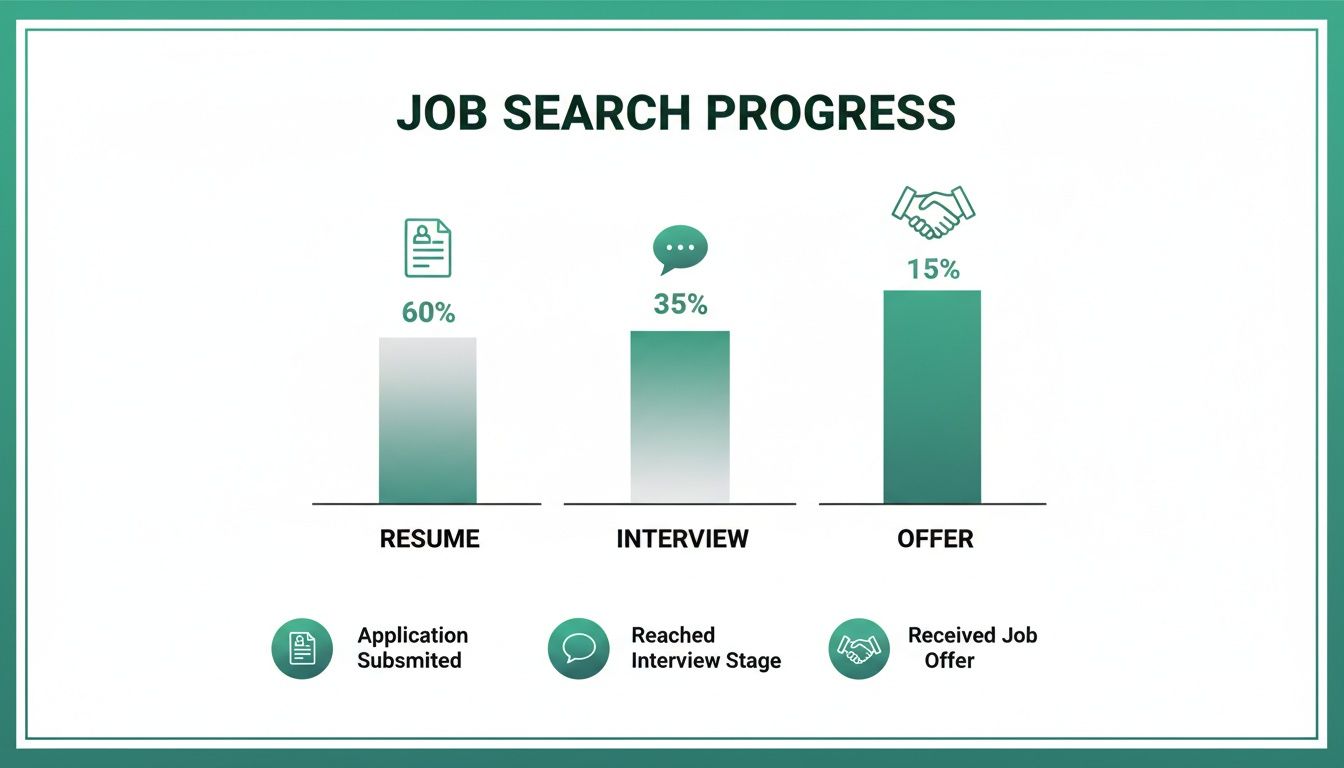
Each step, from the first application to the final handshake, is a chance to move your career forward and unlock that next salary level.
How to Maximize Your Salary
This part is simple: your skills directly dictate your salary. The fastest way to increase your value is to master the technologies that companies are desperate for.
An analyst who is comfortable with Python and can build predictive models will always command a higher salary than someone who sticks to Excel and Google Analytics. In this field, continuous learning isn't just a good idea—it's essential for financial growth.
Here’s a look at how that growth translates into real numbers as you gain experience.
Marketing Analyst Salary Progression by Experience
| Experience Level (Years) | Median Annual Base Salary |
|---|---|
| 0-1 Years | $59,000 |
| 1-4 Years | $67,000 |
| 5-9 Years | $78,000 |
| 10-19 Years | $85,000 |
As you can see, sticking with it pays off. The most significant salary bumps often come with moves into leadership. If management is on your radar, you can learn more about the earning potential in our Marketing Analytics Manager salary guide.
Ultimately, the people who earn the most are the ones who can draw a straight line from their data analysis to revenue growth. Show a company you can make them money, and you’ll become an indispensable—and well-compensated—asset.
Common Questions on the Marketing Analyst Path
As you start piecing together your career plan, you're bound to have some questions. It's only natural. Let's tackle some of the most common ones I hear from aspiring analysts to clear things up so you can move forward.
Do I Really Need a Master's Degree?
Honestly, not usually. For most entry-level and mid-level roles, a bachelor's degree in marketing, business, stats, or something similar is all you need to get your foot in the door. What really lands you the job is having solid, demonstrable skills and a portfolio that proves you can do the work.
But a master's degree can be a serious career booster down the line. If you have your sights set on a leadership role or a highly specialized quantitative position, a master's in data science or business analytics can definitely give you an edge. Think of it as an express lane to higher-level strategy and a bigger paycheck.
My take: A bachelor's gets you in the game. Real-world experience and a great portfolio win you the job. A master's helps you climb the ladder faster later on.
What Does a Marketing Analyst Actually Do All Day?
No two days are ever quite the same, which is part of the fun. It’s a constant blend of deep, focused analysis and team collaboration.
Your morning might be "heads-down" time. You could be writing SQL queries to pull fresh data from last night's email campaign or digging through dashboards in Tableau or Power BI to see how key metrics are tracking. The first part of the day is often about finding the story in the numbers—spotting an anomaly or a trend that needs a closer look.
Afternoons often shift toward communication and strategy. You might find yourself:
- Huddling with the marketing team to go over A/B test results and decide what to try next.
- Building a set of visualizations to explain a new customer segment for an upcoming launch.
- Presenting your analysis to stakeholders, turning all those complex numbers into a clear, compelling story that helps them make a smart business decision.
It's a balancing act, for sure. You're constantly switching between being a data detective and a strategic storyteller.
How Do I Get Experience if I Don't Have a Job Yet?
This is the classic chicken-and-egg problem, but it’s easier to solve than you think. You just have to create your own experience. The goal is to build a portfolio of projects that show you can handle the exact tasks you’d be doing in a full-time role.
Here are a few practical ways to get started:
- Find Freelance Gigs: Check out platforms like Upwork or Fiverr. There are always small businesses looking for help analyzing customer surveys or setting up their Google Analytics.
- Use Public Datasets: Kaggle is a goldmine. It’s packed with free datasets on everything from e-commerce sales to social media engagement. Grab a dataset, define a business problem, and solve it.
- Help Out a Nonprofit: Many nonprofits have tons of data but lack the resources to analyze it. Offer to help them understand their donor patterns or measure the impact of their programs.
Is Being a Marketing Analyst a Stressful Job?
It can be, but it's usually the good kind of pressure. The stress typically comes from a few places. You’ll have tight deadlines, especially when a big campaign is about to go live or leadership needs an urgent report.
It can also be challenging to explain complex data to people who aren't numbers-oriented. Translating the concept of statistical significance to a creative director takes real skill and patience. And since your analysis informs big decisions, you feel the weight of your recommendations. When the data tells you the company needs to change course, you have to be ready to stand by your findings.
But that's also what makes it so rewarding. There's nothing like seeing your insights lead to a campaign that smashes its goals. That feeling of making a real impact more than makes up for the stressful moments.
Ready to put your skills to the test? SalaryGuide provides a curated, no-fluff job board with real roles sourced directly from company websites. Explore marketing analyst opportunities and get the salary data you need to make your next move.
