Resume: resume no work experience college student that lands interviews
When you're a college student trying to build a resume with no formal work experience, the game isn't about what you haven't done. It's about showcasing the incredible potential you already have. Your task is to shift the spotlight from a traditional job history to the wealth of projects, coursework, and skills that prove you’re ready to contribute from day one.
Why That Empty Experience Section Is Actually an Opportunity
Staring at a blank "Work Experience" section can feel intimidating, but I want you to see it differently. It’s not a roadblock; it’s a clean slate. In today's job market, smart companies aren't just hiring people for the jobs they've had. They're looking for potential, a willingness to learn, and raw talent.
Honestly, having no formal job history isn't the deal-breaker many students think it is. This is your chance to build a powerful narrative around your unique strengths.
Your mission is to craft a resume that tells a compelling story about what you can do, rather than just listing what you've been paid to do. This means strategically highlighting what you have in spades:
- Relevant academic knowledge from your major and specialized classes.
- Real-world skills you've developed through hands-on projects and personal initiatives.
- A fresh perspective that isn't tied down by old industry habits.
- Essential soft skills like teamwork, problem-solving, and communication, which you use every day in your studies.
Sidestepping the Underemployment Trap
Getting this right is more critical than ever. The reality is that the job market can be tough for new graduates. A staggering 52% of the Class of 2023 ended up in jobs that don't even require a degree just a year after graduating. That's a huge problem.
Think about this: a college grad in a field-appropriate job earns about 88% more than someone with only a high school diploma. But an underemployed grad? They only make about 25% more. You can learn more about the graduate job market landscape to see the full picture. A strong resume is your first and best defense against this "scarring effect," helping you land a role that truly matches your education and ambition.
Your resume isn't a history report of past jobs. It's an advertisement for your future potential. As a student, your product is a potent mix of your skills, knowledge, and drive.
Shifting the Hiring Manager's Focus
Put yourself in the shoes of a hiring manager for a moment. When they get a resume from a college student, they aren't expecting to see a decade of corporate experience. It's just not realistic. What they are looking for is evidence that you're a quick learner, a creative problem-solver, and someone who can make a real contribution to their team.
Your resume needs to guide their eyes away from the absence of paid work and toward the presence of valuable experiences.
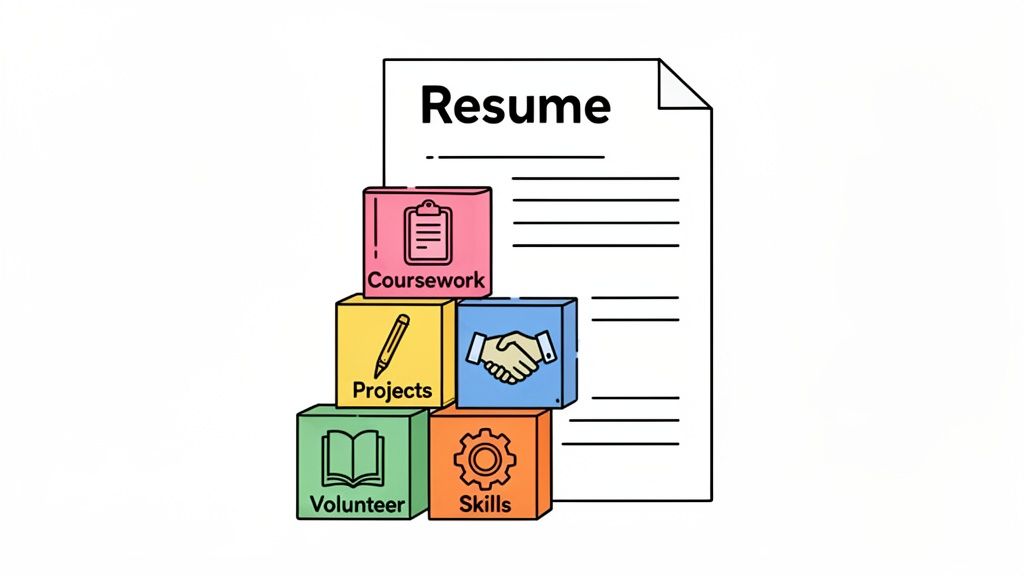
Those experiences—that tough group project, the leadership role you took in a volunteer group, or that complex data analysis assignment you aced—are the real building blocks of your professional story. When you frame them correctly, you show you have the very skills they're trying to find. The goal is to make them think, "This person has the raw talent and initiative we need. We can teach them the rest." That simple shift in perspective is how you turn an empty experience section into your biggest advantage.
Building a Resume That Gets Noticed—Even Without a "Work History"
When you're a student, the "Work Experience" section on a resume template can feel like a big, empty space staring back at you. The trick isn't to worry about what you don't have, but to reframe what you do have. Forget the traditional resume format for a moment. We're going to build a document that highlights your skills and potential, showing a hiring manager exactly what you can bring to the table.
Let’s dive into the core sections that will make your resume feel anything but empty.
Make Your Education Section Work for You
Your education is your most recent and relevant experience, so it belongs right at the top of your resume, just under your contact info. But don't just list your school, degree, and graduation date. That's a missed opportunity.
This is your first chance to connect your academic background directly to the job you want. You can do this by adding a "Relevant Coursework" subsection. This simple addition is a game-changer because it immediately signals to a recruiter that you have the foundational knowledge they're looking for.
For instance, instead of just listing a class title, describe what you actually did:
- Consumer Behavior: Dove into consumer decision-making models and analyzed market segmentation strategies for B2C brands.
- Digital Marketing Analytics: Gained hands-on experience using Google Analytics to track campaign performance and interpret user engagement data.
- Public Relations Strategy: Crafted comprehensive communication plans and press materials for mock brand campaigns, learning to manage brand voice and messaging.
See the difference? You’ve turned a simple list into a showcase of your skills and knowledge.
Pro Tip: Your education section isn't just a formality. It's prime real estate. Use it to prove you already have specialized knowledge that's directly applicable to the role you're targeting.
Turn Your Projects into Proof
Your academic and personal projects are your secret weapon. They are the closest thing you have to professional work, and they are incredibly valuable for demonstrating your abilities. This is where you show you can take theory from the classroom and apply it to solve real problems. Give these projects their own dedicated section.
Think about that big final paper, a group presentation that went really well, or even a personal website you built. For each one, use a few bullet points to break down your role, what you did, and what happened as a result.
Here's how you could frame a marketing project:
- Integrated Marketing Campaign: Local Coffee Shop
- Drove the project by conducting market research, using surveys and competitive analysis to pinpoint target audiences and find a unique brand position.
- Developed a multi-channel content strategy, creating sample social media posts and blog outlines aimed at increasing foot traffic by an estimated 15%.
- Pitched the final campaign to a panel of marketing professors, earning top marks for strategic thinking and creative execution.
This transforms a school assignment into a mini-case study of your marketing chops. If you have several projects like this, you might even consider creating a simple online portfolio to show them off. In fact, learning how to build a marketing portfolio can be a fantastic way to display your work in more detail.
Don't Overlook Volunteer and Leadership Roles
Any experience where you took on responsibility, worked with a team, or managed tasks is resume-worthy. Whether you were volunteering for a local non-profit, holding a leadership role in a campus club, or organizing a student event, you were building critical soft skills that all employers look for.
Treat these experiences just like you would a paid job. Focus on your actions and the results you helped deliver.
For example:
Campus Event Coordinator, University Marketing Club
- Spearheaded the promotion for a guest speaker event, which resulted in a 40% increase in student attendance over previous club events.
- Managed logistics by collaborating with a five-person team to handle everything from venue booking and speaker travel to creating and distributing promotional flyers.
This shows initiative, teamwork, and organization—all skills that translate directly to any professional setting. Remember, a skill is a skill, whether you were paid for it or not.
By building your resume around these pillars—Education, Projects, and Leadership—you create a powerful story that proves your value, no formal job title required. This is exactly how you make a resume stand out when you're just starting out.
Translating Academic Skills into Employer Language
Let's be honest—recruiters aren't just looking for a degree. They're trained to spot specific skills and competencies, and they do it fast. With an average of just 7.4 seconds spent on each resume, you have a tiny window to prove your worth.
Your biggest challenge, which is also your greatest opportunity, is bridging the gap between your academic life and the professional world. You’ve already built an impressive toolkit through your classes and projects; now, it’s all about learning how to talk about it in a way that makes a hiring manager sit up and take notice.
Showcase Your Hard and Soft Skills
When you're building a resume with no formal work experience, the skills section becomes your most valuable real estate. This is where you prove you have both the technical know-how (hard skills) and the essential interpersonal qualities (soft skills) to excel.
Hard skills are the specific, teachable abilities you've picked up. Think about the software, tools, and methodologies you’ve actually used.
- Marketing Analytics: Don't just list "Google Analytics." A much better approach is, "Experience using Google Analytics to track user behavior and analyze campaign KPIs."
- Content Creation: "Writing" is too vague. Try something like, "Proficient in SEO content writing, including keyword research and on-page optimization techniques."
- Data Analysis: Instead of a generic "Excel," specify your capabilities: "Analyzed market research data using Python (Pandas, Matplotlib) to create compelling data visualizations."
Soft skills, on the other hand, are all about how you work. They're trickier to demonstrate on paper but are often the deciding factor for employers.
A great resume shows, it doesn't just tell. Instead of listing "Teamwork," describe a project where you successfully collaborated. Instead of claiming "Problem-Solving," detail a specific challenge you overcame.
Connect What You've Done to What They Need
The game has changed for new graduates. Companies today want to see tangible proof of your abilities, not just a list of courses. Knowing the essential resume skills employers are actively hunting for can make all the difference.
It’s all about practical application. Recent studies show that nearly 90% of employers are looking for evidence of problem-solving skills on resumes. This is followed closely by teamwork (80%), written communication (over 70%), and a demonstrated work ethic.
Your job is to frame your classroom experiences in this exact language. It’s a simple but powerful shift in perspective.
- Instead of this: "Wrote a research paper."
- Try this: "Conducted in-depth research and authored a 20-page analytical paper on emerging market trends, demonstrating strong written communication and critical thinking."
See the difference? The second example transforms a basic academic task into a compelling showcase of professional competence.
A Practical Guide to Translating Your Experience
Let's look at how to reframe common college activities into resume-ready bullet points that will actually catch a recruiter’s eye. This is all about translating your accomplishments into the skills that marketing employers are looking for.
Translating College Experiences into In-Demand Marketing Skills
| College Experience | In-Demand Marketing Skill | Example Resume Bullet Point |
|---|---|---|
| Leading a study group | Leadership & Communication | Orchestrated weekly review sessions for a 10-person study group, clarifying complex concepts and improving collective understanding of course material. |
| Analyzing a case study | Critical Thinking & Analysis | Deconstructed a complex business case study, identified key challenges, and proposed a data-supported solution, showcasing analytical and problem-solving abilities. |
| Presenting in class | Public Speaking & Persuasion | Developed and delivered a persuasive 15-minute presentation on social media strategy, effectively communicating key insights to an audience of 30+ students and faculty. |
| Volunteering for an event | Project Management & Teamwork | Contributed to the successful execution of a campus-wide charity event by coordinating volunteer schedules and managing on-site logistics with a team of five. |
Each of these examples is built around action and impact. They lead with strong verbs and provide meaningful context, making it easy for a hiring manager to visualize your potential.
By learning to speak their language, you turn your academic background from a simple list of classes into powerful proof of your professional readiness. This is exactly how you build a resume that gets results, even without a single line in the "Work Experience" section.
Writing Bullet Points That Get You Noticed
The bullet points under each section—projects, volunteer work, coursework—are really the heart and soul of your resume. This is your chance to go beyond just listing things you’ve done and start proving what you can do. Let’s be honest, vague statements are the fastest way to land your resume in the ‘no’ pile, especially when you don't have formal work experience to lean on.
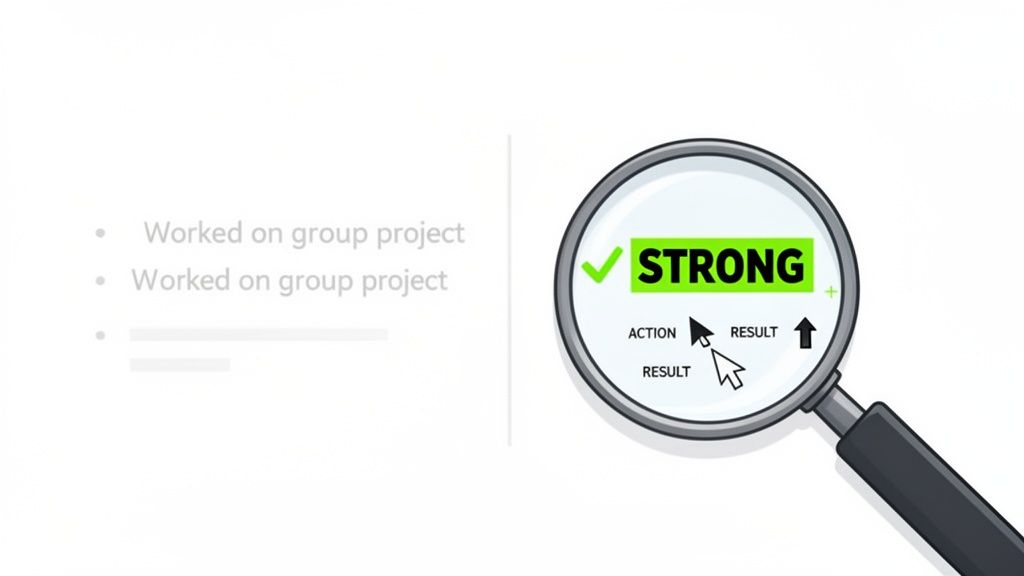
Phrases like "Worked on a group project" or "Responsible for social media" are resume killers. They tell a recruiter next to nothing. To really grab their attention, you need to frame every bullet point as a powerful, results-oriented statement that puts your skills on full display. It's all about showing your impact, not just your participation.
The Action Plus Project Plus Result Formula
I’ve found the most effective way to write a killer bullet point is to use a simple but incredibly powerful formula: Action + Project + Result. This little framework forces you to be specific and, most importantly, to focus on the outcome of your efforts.
Here’s how it breaks down:
- Action: Kick off every bullet with a strong, dynamic action verb.
- Project: Briefly explain the task or project you were involved in to give some context.
- Result: This is the key—quantify the outcome or explain the positive result of your work.
Let’s see this in action by transforming a typical student experience.
- Weak Bullet: "Worked on a group project about Gen Z consumers."
- Strong Bullet: "Spearheaded market research for a semester-long project on Gen Z consumer habits, delivering a 15-page report that earned an A grade and was used as a model for future classes."
See the difference? The second example is so much more compelling. It uses punchy verbs ("Spearheaded," "delivering"), gives specifics, and shows a clear, positive result.
Think of your resume as a collection of evidence. Each bullet point is a piece of proof that you can solve problems, deliver results, and be a valuable part of a team.
Quantify Everything You Can
Numbers are your absolute best friend on a resume. Why? Because they provide concrete proof of your accomplishments and are incredibly easy for a busy recruiter to scan and digest. Even if you don't have traditional business metrics to work with, you can almost always find a way to add numbers to your experiences.
Start thinking about:
- Scale: How many people were in your project group? How many students attended the event you helped promote? How large was the dataset you analyzed?
- Frequency: How often did you do something? Did you publish a blog post every week or manage a social media account daily?
- Impact: Did your work contribute to a specific grade? Did you help increase event attendance by a certain percentage? Did you find a way to reduce the time it took to finish a task?
For example, "Managed the club's Instagram account" becomes "Grew the club's Instagram following by 25% over one semester by implementing a consistent content schedule and engaging with followers." Much better, right?
Lead with Powerful Action Verbs
The very first word of your bullet point sets the tone. Swapping out passive phrases like "Responsible for" with strong action verbs will instantly make your resume feel more professional and dynamic. If you want to dive deeper into this, you can learn more about how to write a professional resume that truly stands out.
To give you a head start, I've put together a table of some of my favorite action verbs, broken down by the type of skill they demonstrate.
Powerful Action Verbs for Your Marketing Resume
| Analytical Verbs | Creative Verbs | Leadership Verbs | Communication Verbs |
|---|---|---|---|
| Analyzed | Conceptualized | Coordinated | Articulated |
| Assessed | Designed | Delegated | Authored |
| Calculated | Developed | Guided | Briefed |
| Evaluated | Devised | Headed | Corresponded |
| Forecasted | Established | Inspired | Drafted |
| Interpreted | Fashioned | Mentored | Edited |
| Measured | Formulated | Orchestrated | Persuaded |
| Researched | Originated | Oversaw | Presented |
| Synthesized | Produced | Spearheaded | Publicized |
| Tracked | Prototyped | Supervised | Reported |
By consistently applying the Action + Project + Result formula, finding ways to quantify your achievements, and always leading with a powerful verb, you can turn a simple list of academic and extracurricular activities into a compelling story about your potential. This approach ensures your resume gets the serious consideration it deserves, even without a formal work history.
Formatting Your Resume for Humans and Robots
Alright, you've done the heavy lifting. You’ve dug through your academic life and pulled out some fantastic, professional-sounding achievements. But here's a hard truth: even the most amazing content can fall flat if your resume is a cluttered mess or gets kicked out by a robot before a real person even lays eyes on it.
This last part is all about presentation. We need to make sure your resume can impress both a time-crunched hiring manager and the automated systems they use.
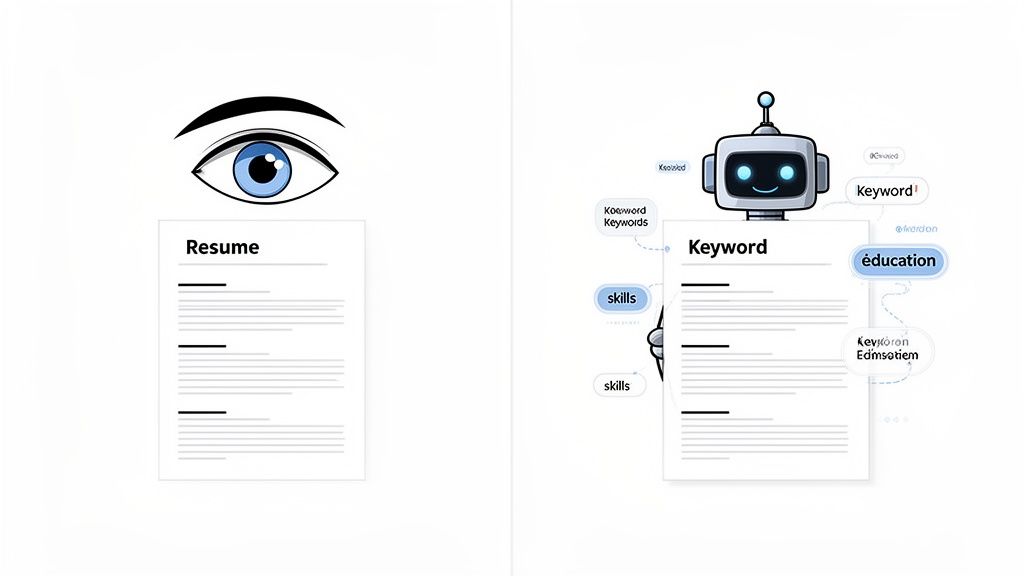
It’s a bit of a balancing act. You need a design that's clean and easy for a human to scan in about six seconds. At the same time, it has to be structured in a way that’s friendly to Applicant Tracking Systems (ATS). These are the gatekeeper programs that over 98% of Fortune 500 companies use to sift through applications.
Think of it this way: first, you have to get past the robot. Then, you get to wow the human.
Designing for Human Eyes
Before a hiring manager reads a single word, they’re already forming an opinion based on your resume’s layout. A document that looks cluttered or confusing immediately signals a lack of attention to detail—not a great first impression. The goal is a clean, professional look that’s incredibly easy to scan.
Keep your formatting simple and consistent. This is not the time to get fancy with wild graphics or unusual fonts that just distract from what really matters: your skills and potential.
Here are a few simple rules I always tell people to follow:
- Font Choice: Stick to the classics. You can’t go wrong with fonts like Calibri, Arial, Garamond, or Georgia. Keep your main text between 10-12 points.
- White Space is Your Friend: Set your margins somewhere between 0.5 and 1 inch all around. This breathing room makes the page feel less intimidating and much easier to read.
- Stay Consistent: Make sure all your headings, dates, and bullet points look the same throughout the entire document. Consistency is key to a professional look.
For a resume for a college student with no work experience, one page is the gold standard. It forces you to be ruthless about what you include, which is something recruiters definitely appreciate.
How to Beat the Robots (ATS Optimization)
Now for the bots. An ATS is basically a keyword-matching machine. It scans your resume for specific terms and formatting to decide if you’re a potential fit. If your resume isn't built for it, you could be a perfect candidate and still get filtered out automatically.
To get past the ATS, you have to think like software. It craves simplicity and clarity, not complex designs.
Here’s how to make your resume robot-proof:
- Use Standard Headings: Don't get cute with your section titles. Stick to universally understood headings like "Education," "Projects," "Skills," and "Volunteer Experience." An ATS might not recognize "My Creative Adventures."
- Ditch the Fancy Stuff: Avoid tables, columns, images, and anything in the header or footer. These elements can scramble the parsing software, causing it to read your information wrong or just skip it entirely.
- Speak Their Language (Keywords): Read the job description like you're studying for a final. Pull out the key skills and qualifications they mention. Now, weave those exact phrases naturally into your bullet points and skills section. If they want "social media marketing," make sure you have "social media marketing" on your resume.
- Save It Right: Unless they ask for something else, always submit your resume as a PDF or .docx file. These are the most common and compatible formats for ATS.
My Favorite Sanity Check: Before you hit submit, copy everything from your resume and paste it into a plain text editor like Notepad. If it turns into a jumbled mess, that's a huge red flag that an ATS will struggle to read it.
By getting both the human and the robot on your side, you drastically improve your chances of moving from the "applied" pile to the "interview" list. And that's the whole point, right?
Common Questions from Students Building Their First Resume
Trying to write your first resume as a college student with no work experience can feel like a puzzle. It’s completely normal to have a ton of questions pop up. Let's tackle some of the most common ones I hear from students so you can build your resume with confidence.
How Long Should My Resume Be?
One page. That's it.
For a student or recent grad, a single page is the gold standard. Recruiters are busy, and this constraint forces you to be ruthless about what’s truly important. It’s your highlight reel, not your life story.
If you’re tempted to spill onto a second page, take another look. It often signals to a hiring manager that you're filling space with fluff. Keep it punchy, powerful, and focused on what makes you a great candidate.
Should I Include My GPA on My Resume?
This one's a classic. My rule of thumb is to include your GPA only if it’s a 3.5 or higher. A great GPA signals a strong work ethic and a knack for learning—two things every employer wants, especially when you don't have a long work history.
What if it's below a 3.5? Just leave it off. Seriously. Let your projects, skills, and coursework do the heavy lifting. You can also get strategic and list your GPA in your major if it’s much stronger than your overall cumulative GPA.
Key Takeaway: Think of your resume as your personal marketing brochure. You’re highlighting your best features. If your GPA is a major selling point, show it off. If not, shine the spotlight on your other strengths.
What if I Genuinely Have No Relevant Experience?
I hear this a lot, and the answer is simple: go make your own experience. You don't need to wait for someone to hire you to start building skills. In fact, the initiative you take to create something from scratch can be more impressive than any class project.
Here are a few ideas to get you started:
- Launch a personal project. Build a simple website and learn the basics of SEO. Start a blog about something you're passionate about. Offer to run the social media accounts for a campus club you're in.
- Volunteer with purpose. Find a local nonprofit that needs help and offer to manage their email newsletter or create content for their Instagram. Even a few hours a week makes a difference.
- Hunt for freelance gigs. There are plenty of platforms where you can find small, entry-level projects. This gives you tangible results and real-world examples to talk about.
Once you've added these experiences, you'll want to make sure the entire document tells a compelling story. For a deeper dive, check out these excellent tips on how to write a resume that will actually get a recruiter's attention.
And after that amazing resume lands you a call, the real fun begins. Get yourself ready with our guide on how to prepare for an interview.
At SalaryGuide, we're committed to helping you launch your marketing career with confidence. Explore real, recently posted marketing roles and get the salary insights you need to understand your value from day one. Start your journey at https://salaryguide.com.
