A Practical Guide on How to Learn Digital Marketing
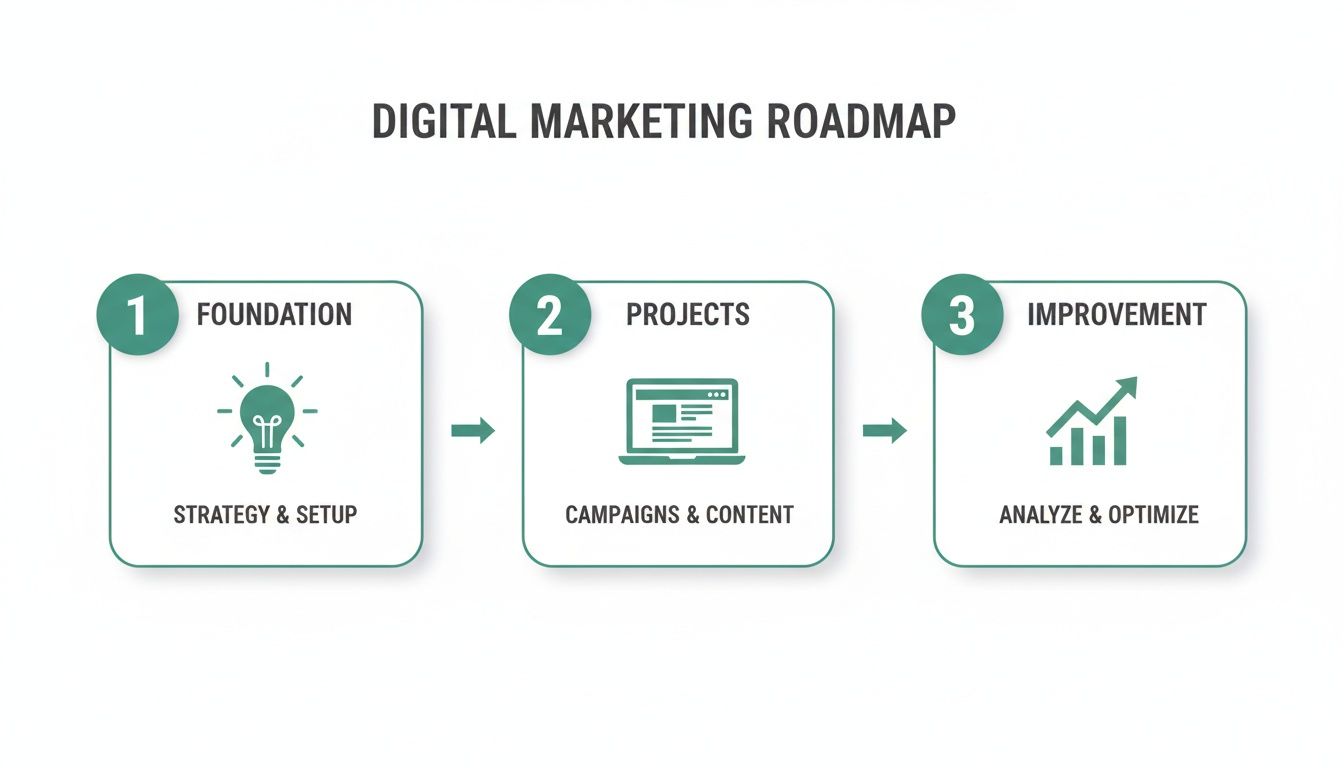
So, how do you actually learn digital marketing? It’s a process I break down into three key phases: building a solid foundation, applying what you've learned through hands-on projects, and then committing to continuous improvement fueled by real data. Following this path is the difference between just knowing stuff and developing real, career-ready skills.
Your Digital Marketing Learning Roadmap
Let's be honest, starting in digital marketing feels like being dropped into a massive city with no map. You've got SEO over here, social media over there, a hundred different tools blinking at you, and trends changing what seems like every week. Trying to learn it all at once is a recipe for burnout.
The real goal, especially at the beginning, is to build a strong foundational knowledge that you can build on later, no matter which specialty you end up loving.
This means you need to understand the "why" before you get bogged down in the "how." Before you start fiddling with Google Ads campaigns or obsessing over blog post keywords, you have to get a handle on the core principles that make everything else work.
Start With the Customer Journey
Every single thing we do in marketing—every social post, every email, every ad—has a purpose. And that purpose is to move someone along their journey from being a total stranger to becoming a happy customer.
Think of it in these three simple stages:
- Awareness: This is the "hello!" moment. How do people even find out you exist? This is where content marketing, social media, and top-of-funnel ads do the heavy lifting.
- Consideration: Okay, they know who you are. Now they're weighing their options. This is where your SEO efforts, detailed product pages, and helpful email sequences become crucial for building trust.
- Conversion: This is the finish line. What finally gets them to click "buy" or "sign up"? This stage is all about persuasive ad copy, crystal-clear calls-to-action, and landing pages that make it easy to say yes.
Understanding this framework gives you a high-level map for everything else you'll learn.
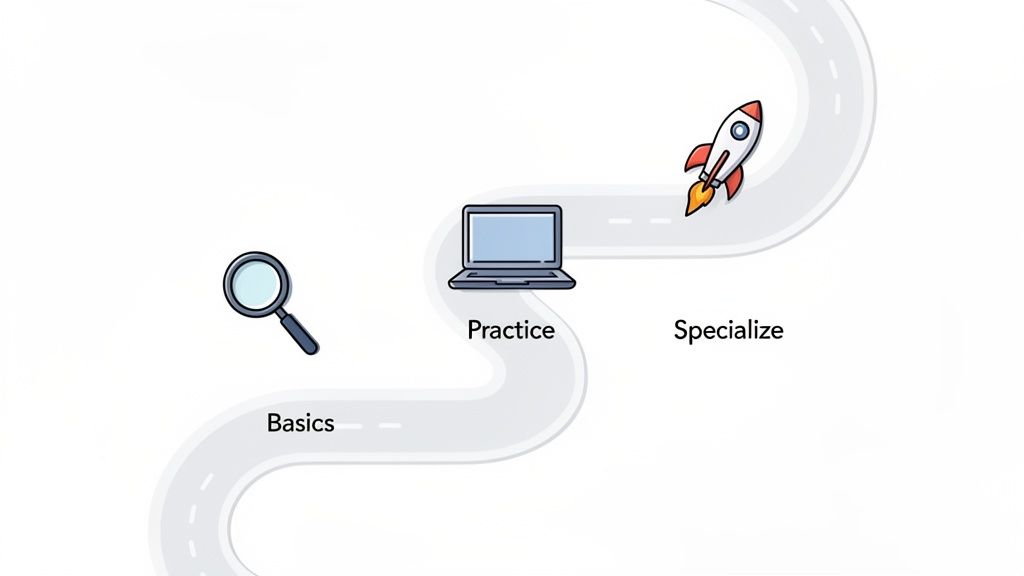
As you can see, real mastery isn't a straight line. It’s a cycle of learning, doing, and getting a little bit better each time.
The Core Pillars of Digital Marketing
To really grasp the foundation, you need to know the main disciplines that make up the world of digital marketing. Here's a quick look at the essential pillars, the tools of the trade, and how we measure success in each.
| Discipline | Essential Tools | Primary Success Metric |
|---|---|---|
| SEO (Search Engine Optimization) | Google Search Console, Ahrefs, SEMrush | Organic Traffic & Keyword Rankings |
| Paid Media (PPC/SEM) | Google Ads, Facebook Ads Manager | Return on Ad Spend (ROAS) & Cost Per Acquisition (CPA) |
| Content Marketing | WordPress, Google Docs, Grammarly | Engagement, Time on Page, & Lead Generation |
| Email Marketing | Mailchimp, ConvertKit | Open Rate, Click-Through Rate (CTR), & Conversions |
| Analytics | Google Analytics 4 | Website Traffic, Conversion Rate, & User Behavior |
| CRO (Conversion Rate Optimization) | Hotjar, Google Optimize | Conversion Rate Lift |
Getting familiar with these areas is your first major step. You don't need to be an expert in all of them, but you need to know what they are and how they fit together.
A Practical Framework For Your First 90 Days
Instead of just passively watching tutorials, structure your first three months around a simple loop: Learn, Apply, Measure. You can definitely accelerate your progress with dedicated Google Ads training courses for specific skills, but this broader framework will keep you focused.
Pick one core area to start. Let's say it's content marketing. Spend a couple of weeks just absorbing the fundamentals from trusted sources—industry blogs, free certification courses, and solid YouTube channels.
The fastest way to make a new skill stick is to use it immediately. Reading about SEO is one thing. Actually optimizing a blog post and seeing it climb in the rankings is a whole different ballgame.
Once you have a decent grasp of the theory, immediately start a small, low-stakes project. This is non-negotiable.
Launch a simple WordPress blog about a hobby you love. Start a niche Instagram account. Run a tiny ad campaign with a $50 budget. The point isn’t to strike gold overnight; it's to create your own personal sandbox where you can experiment, break things, and learn without pressure.
This hands-on experience is what builds real confidence and gives you something to show a hiring manager. Finally, use free tools like Google Analytics and Google Search Console to see what happened. What worked? What bombed? And most importantly, why? That feedback loop is where the real learning happens.
Building Foundational Skills in SEO and Content
If paid media is the gas pedal, consider SEO and content marketing the engine. This is the bedrock of sustainable, long-term growth. It's what works behind the scenes, bringing the right people to your website month after month, long after a paid campaign has ended. To get real results, you have to move beyond generic advice.
When you're just starting out, it's smart to focus on the channels that pack the biggest punch. For 49% of marketers, organic search delivers the best return on investment, hands down. And with the SEO industry expected to become a $106.9 billion market by 2025, it’s a skill worth mastering.
Think about it: 93% of all online experiences start with a search engine. Getting this right can completely change a business's trajectory.
Uncovering User Intent with Keyword Research
The very first step in a solid SEO plan is figuring out what people are actually searching for. This is about more than just finding keywords with high search volume. You have to get inside the user's head and understand their intent. Are they trying to buy something? Learn how to do a task? Compare their options?
A great way to practice this is to put yourself in the customer’s shoes. Let's say you need new running shoes. Your journey might start with a broad search like "best running shoes." As you dig deeper, you might search for something more specific, like "Brooks Ghost 15 vs Hoka Clifton 9" or "running shoes for overpronation."
Each of these queries represents a different type of intent:
- Informational Keywords: The user has a question ("how to start running"). Your content needs to be the best, most comprehensive answer.
- Navigational Keywords: The user wants to find a specific site ("Nike website"). There's not much to optimize for here besides your own brand name.
- Commercial Keywords: The user is researching and comparing products ("best trail running shoes"). This is the perfect place for reviews, buying guides, and detailed comparisons.
- Transactional Keywords: The user is ready to pull out their wallet ("buy Brooks Ghost 15 size 10"). Your product pages need to be perfectly optimized to capture this sale.
By creating content that targets keywords across this entire spectrum, you build an ecosystem that helps people at every single stage of their journey.
Mastering On-Page and Off-Page SEO
Once you know which keywords to target, it's time to optimize your website. This is where the two pillars of SEO come into play: on-page and off-page.
On-Page SEO is everything you do on your website to improve its ranking. This includes the nitty-gritty details like:
- Title Tags & Meta Descriptions: Writing compelling headlines and short descriptions that make people want to click on your result in Google.
- Content Structure: Using clear headings (H1, H2, H3) to organize your content. This makes it easier for both people and search engines to understand what your page is about.
- Internal Linking: Linking to other relevant pages on your own website. This helps spread authority and guides users to more useful content.
Off-Page SEO, on the other hand, is all about actions taken outside of your website. The biggest piece of this puzzle is link building—getting other reputable websites to link to yours. Every link from a quality site acts like a vote of confidence, signaling to Google that your content is trustworthy and valuable.
A classic rookie mistake is pouring all your energy into creating content but having zero plan to promote it. I've seen it a hundred times. Great content that nobody ever sees is just a well-written diary entry. Off-page SEO is how you get your work in front of the right eyeballs.
Your First SEO Mini-Project
Theory is one thing, but you learn SEO by doing. Here's a simple, hands-on project to get you started:
- Launch a Simple Blog: Use a platform like WordPress or Squarespace to start a small blog. Pick a niche you're actually interested in—whether it's vintage cameras, homebrewing, or urban gardening.
- Do Some Keyword Research: Use free tools like Google Keyword Planner or the free version of Ahrefs to find five informational keywords in your niche that don't have a ton of competition.
- Write and Optimize Five Articles: Create one blog post for each of your target keywords. Really focus on your title tags, meta descriptions, and internal links between the articles.
- Set Up Google Search Console: This free tool from Google is non-negotiable. Submit your sitemap and start watching the Performance report to see what queries are actually bringing people to your site. This is your direct feedback loop.
Completing a small project like this gives you invaluable, real-world experience. And if you find yourself really enjoying this side of marketing, learning more about how to become an SEO specialist is a great next step. This is how you turn textbook knowledge into a skill that gets you hired.
Mastering Paid Media and Social Channels
If SEO and content are the reliable engine for long-term growth, then paid media is the nitrous boost. It's how you get immediate traction, laser-target specific groups of people, and collect a ton of data, fast. Getting a handle on paid advertising and social media is a non-negotiable step toward becoming a truly versatile digital marketer.
This is where you shift from earning attention to buying it. The two giants you absolutely need to know are Google Ads and Meta Ads (which covers Facebook and Instagram). Mastering these platforms is all about learning to turn a set budget into tangible results, whether that's more website traffic, new leads, or actual sales.
Your First Paid Advertising Campaign
Jumping into paid ads can feel like walking into a casino for the first time. You’re spending real money, and the dashboards are an explosion of metrics, settings, and acronyms. The secret? Start small. Stay focused. Know exactly what you want to achieve before you spend a single dollar.
Let's break down what it takes to get your first campaign off the ground.
- Define Your Objective: What's the goal here? "Get more traffic" is too vague. Are you trying to get email sign-ups for your blog's newsletter? Push downloads for a free PDF guide? Make a sale? Your objective is the North Star that guides every other decision.
- Target Your Audience: This is where paid media's magic really happens. You can zero in on people based on their demographics, what they're interested in, how they behave online, and even major life events. On Facebook, for instance, you could target people aged 25-40 who are interested in "trail running" and live within 25 miles of a national park. That's power.
- Set a Budget: Begin with a small budget you’re completely comfortable losing. Seriously. Think of it as tuition. A daily budget of just $5-$10 is perfect for your first run. The goal isn't to strike it rich; it's to learn the ropes and see what works.
- Write Ad Copy: Your ad copy has to cut through the noise. It needs to speak directly to your audience's problems or desires in a way that feels personal. Keep it clear, punchy, and make sure it has a strong call-to-action (CTA) like "Learn More," "Download Now," or "Shop the Collection."
This screenshot from the Meta Ads platform shows you that first crucial step: choosing your campaign's objective.
Picking the right objective here—like "Leads" or "Sales"—is critical because it tells the platform’s algorithm exactly what kind of user action to optimize for.
The Power of Social Media and Influencer Marketing
Beyond running direct ads, social media is your space to build a real community. It’s where you can let your brand’s personality shine, engage directly with customers, and build lasting loyalty. But there's another powerful tool in the social media toolbox: influencer marketing.
This isn't just about paying a celebrity to post a picture with your product anymore. Today, it’s a sophisticated strategy that can drive incredible results. The industry exploded from $1.7 billion in 2016 to a massive $16.4 billion in 2022 and is on track to hit $30 billion by 2025. On average, brands are seeing a $6.50 return for every $1 spent. If you're curious, you can dig into more digital marketing industry statistics.
When you're just starting, don't even think about the mega-influencers. Your goldmine is with micro-influencers—creators who have between 10,000 and 50,000 followers. Their engagement rates are often through the roof, and their connection with their audience is so authentic that a recommendation feels like it’s coming from a trusted friend.
Working with a few well-chosen micro-influencers is a surprisingly affordable way to introduce your product or content to a passionate, niche audience. It’s a brilliant move for building both your portfolio and your brand's credibility.
Your Paid Media Mini-Project
Alright, time to get your hands dirty. This project is designed to give you firsthand experience running a campaign from start to finish.
- Set Your Goal and Budget: Let's use the blog you created in the SEO section. Decide on a simple, measurable goal: get 10 new newsletter subscribers. Now, set aside a small test budget of $50 to $100.
- Pick Your Platform: Choose either Google Ads (great for capturing people actively searching for something) or Meta Ads (perfect for targeting based on interests and demographics).
- Build Your Campaign: Create a simple ad with a great image or short video and some snappy copy. Make sure you have a clean, simple landing page on your blog where people can easily sign up.
- Launch and Track: Let your campaign run for about 5-7 days. Check in on the ads manager daily to watch your key metrics. Specifically, keep an eye on:
- Click-Through Rate (CTR): What percentage of people who saw your ad actually clicked it?
- Cost Per Click (CPC): How much are you paying every time someone clicks?
- Conversion Rate: Of the people who clicked, what percentage actually signed up?
The point of this project isn't to make a fortune. It’s to demystify the process, get comfortable with the metrics, and build the confidence to manage a real ad budget. This is the experience that separates someone who has read about paid media from someone who has done it.
Using Data Analytics for Smarter Decisions
Marketing without data is just expensive guesswork. This is the point in your journey where you stop just doing marketing and start understanding its actual impact.
Honestly, mastering analytics is what separates a junior marketer who just executes tasks from a senior strategist who drives real business growth. It's a skill set that employers are desperate for.
The whole point is learning to read the story your data is telling you. Every website visit, click, and purchase leaves a digital footprint. Your job is to follow these footprints to understand what people are doing, figure out what’s working, and—just as importantly—fix what isn’t. This is how you stop throwing spaghetti at the wall and start making smart, data-backed decisions.
Navigating Google Analytics 4
Your command center for all of this will be Google Analytics 4 (GA4). It’s the industry standard for measuring web traffic and user engagement. Getting comfortable with it is simply non-negotiable.
GA4 can look intimidating at first, I get it. But you really only need to master a few key reports to unlock some incredibly powerful insights.
Start by getting cozy with these core areas:
- Traffic Acquisition Report: This is your 30,000-foot view. It shows you exactly where your website visitors are coming from—organic search, paid ads, social media, you name it. This report answers the crucial question: "Which of my channels are actually pulling their weight?"
- Engagement Reports: These reports tell you what people do once they land on your site. You can see the most popular pages, how long people stick around, and the specific actions they take. A high bounce rate on a key landing page? That's a huge red flag that your ad and your page content aren't aligned.
- Conversion Reports: This is where the money is. Here, you track the actions that truly matter to the business, like a form submission, a newsletter signup, or a purchase. By setting up conversion events, you can draw a straight line from your marketing efforts to real business results.
The goal isn't to memorize every metric. It’s to learn how to ask good questions and then find the answers in the data. For instance, if your Traffic Acquisition report shows Instagram is sending tons of traffic but your Conversion report shows zero sales from that channel, you’ve just uncovered a clear problem that needs solving. For a more structured approach, our guide on how to measure marketing performance is a great next step.
The Principles of Conversion Rate Optimization
Once you can spot problems with analytics, the next step is learning how to fix them methodically. Welcome to the world of Conversion Rate Optimization (CRO).
CRO is a systematic process for improving your website to get more visitors to take the action you want them to take. It's less about wild guesses and more about scientific testing.
The core idea behind CRO is simple but powerful: you don't actually know what will work until you test it. What you think is a brilliant design change might actually tank your conversions. Data, not your opinion, has to win the argument every single time.
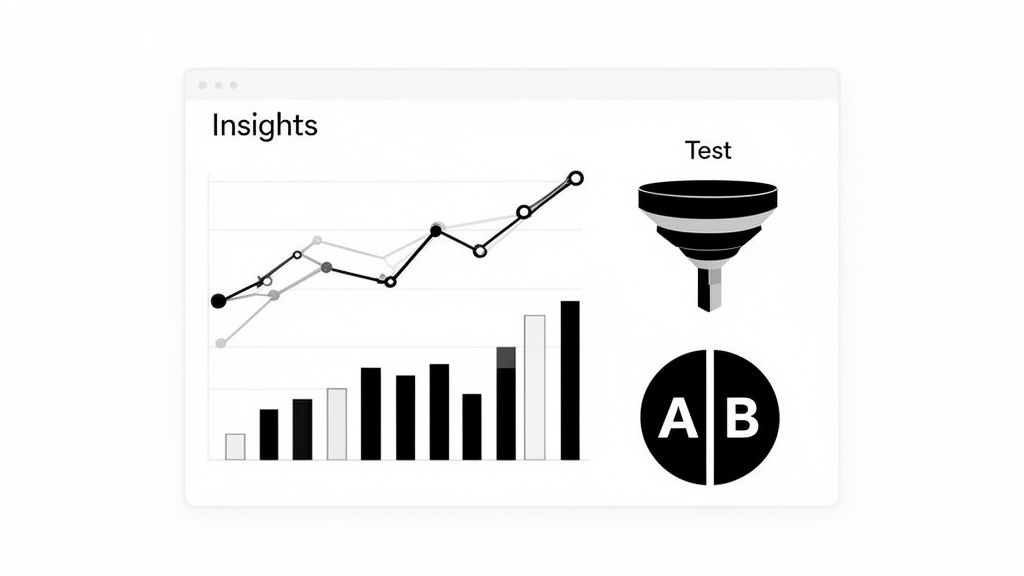
The process is a simple loop: you find a problem in your data, form a hypothesis on how to fix it, run an experiment to test your idea, and analyze the results to see if you were right.
Running Your First A/B Test
The most common way to run a CRO experiment is with an A/B test, sometimes called a split test. You create two versions of a webpage: the original "control" (Version A) and a variation with one specific change (Version B). Then, you show each version to a different slice of your audience to see which one performs better.
Let's walk through a real-world scenario.
Imagine your analytics show that your "Request a Demo" landing page has a terrible conversion rate. Plenty of people visit, but almost no one fills out the form.
- Form a Hypothesis: You notice the call-to-action button is a bland gray that just blends into the background. Your hypothesis is: "Changing the button color from gray to a high-contrast orange will make it more visible and lead to more form submissions."
- Run the Test: Using a tool like Google Optimize or a similar platform, you set up the test. Version A is the original page (gray button). Version B is the exact same page, but with an orange button. The tool will automatically show Version A to 50% of visitors and Version B to the other 50%.
- Analyze the Results: After letting the test run long enough to get a statistically significant result, you check the data. If Version B (the orange button) resulted in a 20% increase in demo requests, your hypothesis was correct. You can now confidently roll that change out to 100% of your audience.
This disciplined approach removes ego from marketing and turns it into a process of continuous, measurable improvement. Master this, and you'll have one of the most valuable skills in the entire digital marketing field.
Building Your Digital Marketing Career Path
Alright, you’ve been putting in the work and learning the ropes. But knowing SEO is one thing; actually getting paid to be an SEO Manager is a whole different ballgame. This is where we bridge that gap—turning your new knowledge and projects into a real paycheck and a career you can build on.
It all starts with positioning yourself correctly in the job market. You need to know which credentials hiring managers actually care about, how to show off your hands-on experience, and what career paths are genuinely open to you right now.
Choosing Certifications That Actually Matter
Let's be clear: not all digital marketing certifications are created equal. Some are essential resume-builders that signal you’ve got the fundamentals down, while others are just digital wallpaper. Your time is valuable, so focus on the ones tied directly to the industry’s most-used platforms.
These are the certifications that consistently catch a recruiter's eye:
- Google Ads Certifications: Covering Search, Display, Video, and Shopping ads, these are non-negotiable if you're serious about paid media. They prove you know your way around the world's biggest advertising platform.
- Google Analytics Individual Qualification (GAIQ): This is your proof that you can navigate GA4, make sense of the data, and create reports that mean something. It’s a core skill for almost any marketing role.
- HubSpot Content Marketing Certification: HubSpot offers a ton of great, free courses. Their content marketing certification is especially well-regarded because its curriculum is practical and focused on the inbound methodology that drives modern marketing.
These credentials tell employers you have a verified understanding of the tools they rely on every single day.
Mapping Your Career and Salary Expectations
Your career in digital marketing can branch off in countless directions. Most people start in a generalist role and then specialize as they figure out what they enjoy and excel at. Understanding this natural progression helps you set realistic goals for your job titles and your salary.
To give you a clearer picture, I've broken down the typical career path and what you can expect to earn at each stage.
Digital Marketing Career Path and Salary Benchmarks
This table outlines the common roles you'll encounter, the skills needed to land them, and the salary ranges you can realistically target as you grow.
| Role Level | Common Titles | Key Skills | Typical Salary Range |
|---|---|---|---|
| Entry-Level | Digital Marketing Coordinator, Marketing Assistant | Social media scheduling, basic reporting, content updates | $45,000 - $65,000 |
| Specialist | SEO Specialist, PPC Analyst, Content Marketer | Keyword research, campaign management, blog writing, data analysis | $60,000 - $85,000 |
| Manager | Digital Marketing Manager, SEO Manager | Strategy development, team leadership, budget management | $80,000 - $120,000+ |
| Director/Head | Head of Growth, Director of Digital Marketing | P&L responsibility, cross-functional leadership, market strategy | $120,000 - $180,000+ |
Of course, these numbers can shift based on your location, industry, and the size of the company, but they provide a solid benchmark. The key takeaway is simple: your earning potential grows in lockstep with your specialized expertise and strategic responsibilities. Mapping out a personal https://salaryguide.com/blog/how-to-create-a-career-development-plan is a great way to stay on track.
Expert Tip: The fastest way to level up your career and salary is to become a T-shaped marketer. This means you have broad, functional knowledge across many disciplines (the top of the "T") but deep, undeniable expertise in one or two specific areas (the vertical stem).
Building a Portfolio That Gets You Hired
Your resume lists your skills, but your portfolio proves them.
Trust me, for a hiring manager, seeing the actual results of your mini-projects is infinitely more compelling than reading another bulleted list. This is where all that hands-on work you’ve been doing really shines.
Set up a simple, clean website to serve as your professional portfolio. For each mini-project you completed (like your blog or that small ad campaign), create a short and sweet case study.
Here’s a simple structure that works every time:
- The Challenge: Kick things off by explaining the goal. (e.g., "The objective was to increase organic traffic for a new blog in the competitive homebrewing niche.")
- The Process: Walk them through the steps you took. Be specific. Mention the tools you used, your keyword research process, or the ad targeting strategy you developed.
- The Results: This is the most important part. Show the outcome with hard data and visuals. Use screenshots from Google Analytics, Google Ads, or Search Console. Quantify everything. "Increased organic clicks by 150% in 60 days" hits a lot harder than "improved SEO."
This portfolio will quickly become the centerpiece of your job applications and the main talking point in your interviews.
Acing the Interview
Once you land an interview, your portfolio has already done most of the heavy lifting. The conversation naturally shifts from "Do you know how to do this?" to "Tell me about the time you did this."
Be ready to walk through your projects in detail. Talk about your thought process, what went wrong along the way, and what you learned from your mistakes. This shows critical thinking and resilience—two traits every single hiring manager is desperate to find.
As you get your materials together, it’s also smart to learn how to optimize your resume to pass Applicant Tracking Systems, since a robot is often the first gatekeeper you need to impress.
By combining respected certifications with a results-driven portfolio and a clear vision for your career, you stop being someone who is just learning digital marketing and become a professional who’s ready to deliver value from day one.
Answering Your Biggest Questions About Getting Started in Digital Marketing
As you get ready to dive in, a few questions are probably rattling around in your head. Everyone starting out has them. How long will this take? Do I really need a degree? What if I mess up? Let’s clear the air and tackle those questions head-on.
How Long Until I Can Actually Get a Job?
This is the big one, right? The honest, no-fluff answer is that it really depends on how much you put into it.
If you can consistently carve out 10-15 hours a week and stick to a solid plan that mixes learning with doing, you could realistically be ready for an entry-level role in about six to nine months.
But here's the catch: it's not about passively watching videos. A hiring manager would much rather see a candidate who spent six months building a blog, tinkering with a small Google Ads budget, and actually analyzing the results than someone who has just watched tutorials for two years.
The goal isn't just to know digital marketing; it's to build a body of work. Your personal projects are your resume before you have a resume. They prove you have initiative and practical skills—and that often speaks louder than years of purely academic study.
Is a Formal Degree a Must-Have?
Absolutely not. While a marketing degree certainly doesn't hurt, the digital marketing world is driven by skills, not diplomas. What you can do matters infinitely more to a hiring manager than where you went to college.
Your portfolio, a few key certifications from respected names like Google or HubSpot, and the ability to confidently explain your projects will be what lands you the job. This field changes so fast that a degree from four years ago is often less valuable than up-to-the-minute, practical knowledge. It's one of the best things about building a career in this industry—it's a true meritocracy.
What are the Biggest Mistakes Beginners Make?
I've seen a lot of aspiring marketers stumble over the same few hurdles. If you can sidestep these, you’ll be way ahead of the pack.
- Learning without doing. This is the number one trap. Just consuming content is the fastest way to forget it. You have to get your hands dirty and actually build things—a website, a campaign, an email sequence. That's how the knowledge sticks.
- Avoiding the numbers. It’s tempting to focus only on the creative side, but marketing without data is just expensive guesswork. Make Google Analytics your best friend from day one. Seriously.
- Trying to master everything at once. Don’t boil the ocean. You can't become an expert in SEO, paid ads, content, and email marketing all at the same time. Get a broad understanding of how it all connects, then pick one or two areas that really click with you and go deep. This "T-shaped marketer" model is exactly what employers are looking for.
Which Specialization Has the Best Career Prospects?
Every core discipline has a solid career path, but if you're looking for what's in red-hot demand, skills in data analysis, performance marketing (PPC), and marketing automation are at the top of the list. Any role that can draw a straight line between its work and company revenue—like a PPC Manager or a Growth Marketer—tends to have fantastic long-term potential.
That said, the "best" path is always the one you're genuinely excited about. If you love the puzzle of user psychology and enjoy writing, you can build an incredibly rewarding and lucrative career in SEO and content marketing. The most successful people in this field are the ones who are endlessly curious about their niche. Find where your passion overlaps with what the market needs, and you've found your sweet spot.
Ready to see what's out there? SalaryGuide has real, verified marketing jobs with transparent salary data to help you understand your worth and find the right fit. Explore marketing roles on SalaryGuide.
