Best marketing job boards: where to find marketing jobs
Published by SalaryGuide, with recruiter insight from our sister company, Search for Hire.
Last reviewed: 12 October 2026
No single job board contains every worthwhile marketing role. The strongest search usually combines one broad platform, one or two specialist sources and direct company research.
This guide compares useful places to find marketing jobs and explains when each one is most valuable.
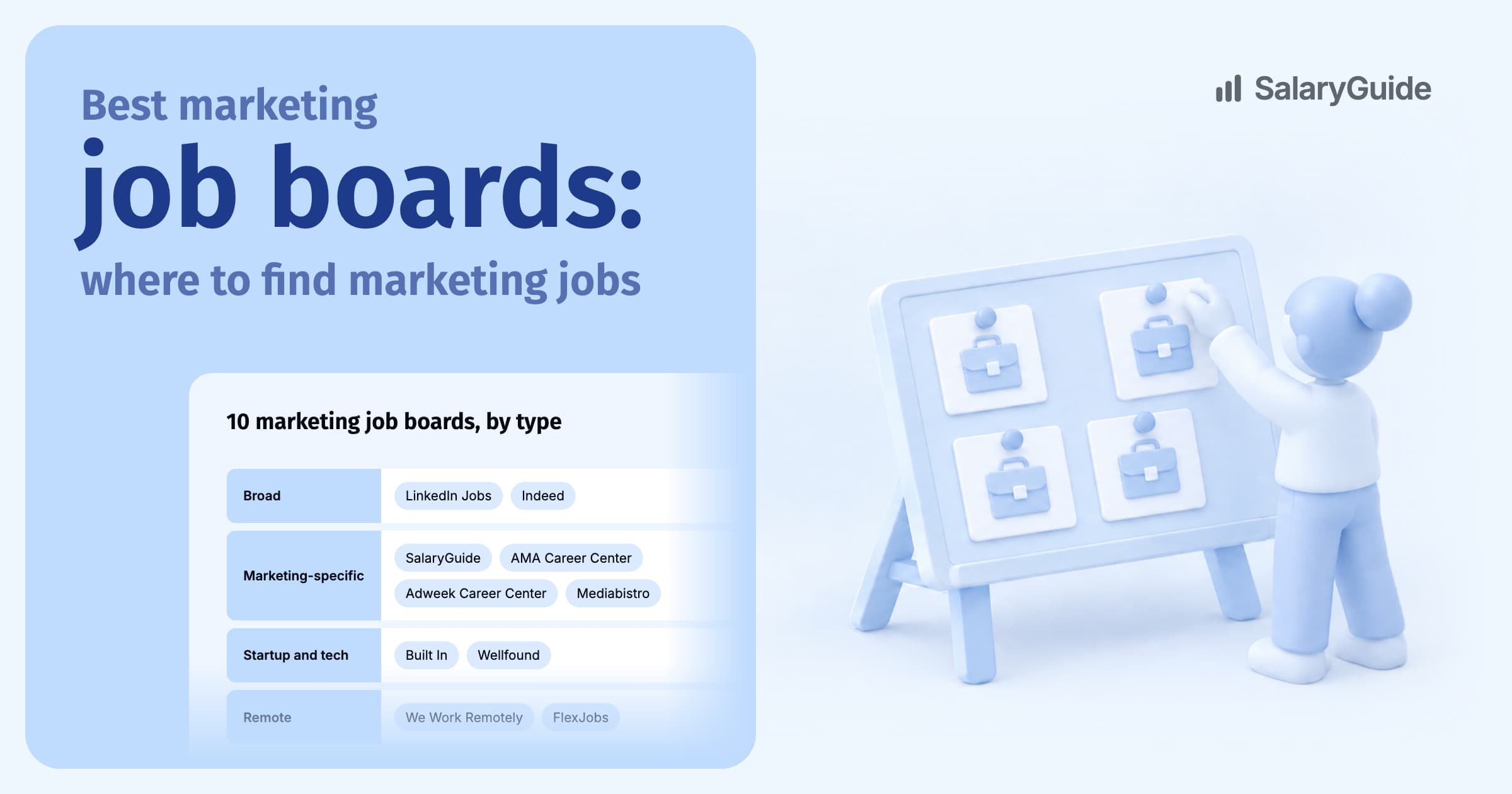
Quick comparison
| Job board | Best for | Main strength |
|---|---|---|
| SalaryGuide | Marketing-specific job discovery | Marketing roles alongside salary and career intelligence |
| LinkedIn Jobs | Broad professional search | Large employer coverage and strong company context |
| Indeed | Broad market coverage | High volume across company sizes and locations |
| Built In | Tech and digital companies | Strong technology-company focus |
| Wellfound | Startups and growth companies | Startup roles and compensation visibility on many listings |
| AMA Career Center | Marketing-specific professional roles | Marketing association audience |
| Adweek Career Center | Advertising, brand and creative roles | Industry-specific opportunities |
| Mediabistro | Media, content and creative roles | Media and communications focus |
| We Work Remotely | Remote-first roles | Remote opportunity discovery |
| FlexJobs | Flexible and remote work | Curated flexible-work focus |
1. SalaryGuide
SalaryGuide Jobs is the natural starting point when you want marketing-specific opportunities rather than a general job database.
Use it when you want to move directly between:
- role discovery;
- salary research;
- company research;
- related career content.
That makes it particularly useful when you are still comparing job titles or trying to understand whether two similar-looking roles actually sit at different levels.
2. LinkedIn Jobs
LinkedIn Jobs is useful for broad professional searches and for understanding the people and companies behind a vacancy.
Its biggest advantage is context. Before applying, you can often review the company page, employees, hiring team and recent activity without leaving the platform.
Use it for:
- broad role searches;
- company alerts;
- networking-led job discovery;
- tracking employers you already know.
Do not assume that every role on LinkedIn is unique. The same vacancy may appear on several boards.
3. Indeed
Indeed remains useful when you want breadth across employers, locations and seniority levels.
It can be particularly helpful for:
- local searches;
- coordinator and specialist roles;
- smaller employers that may not have sophisticated recruiting channels;
- comparing job-title language across a large market.
Because broad boards can surface a lot of noise, use precise titles, locations and exclusions rather than searching only for “marketing.”
4. Built In
Built In is especially useful for marketing roles in technology and digitally focused companies.
Use it if you are targeting areas such as:
- SaaS;
- fintech;
- adtech;
- ecommerce;
- product marketing;
- growth marketing;
- lifecycle marketing;
- marketing operations.
It is less useful if your target market is mainly traditional local employers outside the technology ecosystem.
5. Wellfound
Wellfound is particularly useful for startup and growth-company roles.
It can help when you are comfortable with jobs where scope is broad and responsibilities may change quickly.
Pay attention to:
- company stage;
- team size;
- equity language;
- whether the role is genuinely strategic or simply combines several jobs under one title.
Startup titles can vary widely, so compare responsibilities rather than relying on the title alone.
6. AMA Career Center
The American Marketing Association job listings can be useful for marketing-specific professional and academic opportunities.
It is a narrower source than LinkedIn or Indeed, which is exactly why it can be worth checking alongside them.
7. Adweek Career Center
The Adweek Career Center is useful for advertising, creative, brand, media and related marketing roles.
It can be a better fit than a broad board when your target career sits close to agencies, advertising, creative leadership or media.
8. Mediabistro
Mediabistro is worth checking for content, media, communications, publishing and creative roles.
Candidates targeting content marketing, editorial, social, communications or media-adjacent careers may find it more relevant than someone focused on marketing analytics or performance marketing.
9. We Work Remotely
We Work Remotely focuses on remote jobs.
Use it when remote work is a genuine requirement, but still verify:
- permitted countries or states;
- time-zone requirements;
- employment versus contractor status;
- salary currency;
- travel expectations.
“Remote” does not always mean “work from anywhere.”
10. FlexJobs
FlexJobs focuses on remote, hybrid and flexible work opportunities.
It can be useful if flexibility is a core search criterion rather than an optional benefit.
As with any paid or curated service, decide whether the additional filtering and curation is valuable for your particular search before subscribing.
Specialist marketing job boards
Specialist communities can be useful for narrow functions such as SEO, PPC, growth, lifecycle or product marketing.
The advantage is relevance. The disadvantage is volume.
Use specialist boards as an additional channel rather than your only search source.
How to build a stronger job-search system
The goal is not to open ten job boards every morning.
Use a repeatable system.
Choose one broad board
For example, LinkedIn or Indeed.
Choose one marketing-specific source
For example, SalaryGuide.
Add one specialist source
Choose this based on your function, industry or remote-work preference.
Build a target-company list
Some strong opportunities are discovered directly through employer career pages or professional networks.
Keep a list of companies you would genuinely consider and check them periodically.
Track applications
At minimum, record:
- company;
- role;
- source;
- application date;
- salary range if published;
- interview stage;
- follow-up date;
- outcome.
This prevents duplicate applications and helps you understand which channels actually produce interviews.
Search by responsibilities, not only titles
Marketing titles are inconsistent.
A “Growth Manager” at one company may resemble a “Performance Marketing Manager” elsewhere. A “Content Strategist” may sit inside Brand, SEO, Product Marketing or Customer Marketing.
Search combinations of:
- job title;
- core channel;
- seniority;
- industry;
- location;
- tools;
- responsibilities.
If you are still deciding which roles to target, start with Marketing Career Path or Best Entry-Level Marketing Jobs.
What to do once you find the right role
Do not treat finding the vacancy as the finish line.
Before applying:
- compare the role against your actual skills;
- tailor your resume to the responsibilities that matter;
- prepare relevant work examples;
- research the company;
- record the published salary range if available.
Then use the marketing interview preparation checklist if you progress to interview.
The best job board is the one that repeatedly surfaces roles you would actually take. Use broad reach for coverage, specialist sources for relevance and a simple tracking process so your search becomes more deliberate over time.