Average Salary of Marketing Major: Earnings by Career Stage
So, what’s the real bottom line when you walk across that stage with a marketing degree?
The number you'll see thrown around a lot is an average salary of around $67,990 per year for marketing majors in the U.S. But let’s be clear: that figure is just a national benchmark. It's a useful starting point, but your actual paycheck will swing pretty dramatically based on your job, the industry you're in, and where you put down roots.
What a Marketing Degree Is Actually Worth
Think of your marketing degree less like a fixed price tag and more like a key that unlocks a whole showroom of cars. The degree itself gets you in the door, but your final value—and salary—depends on the model you choose (your job title), the engine you pick (your specialized skills), and even the city you drive it in (your location). That average number doesn't capture the full story of your earning potential.
At its core, your degree gives you a launchpad. It teaches you the fundamentals of consumer psychology, brand strategy, and effective communication—skills that are incredibly valuable in just about any business. Where the real salary differences kick in is when you start to specialize.
For example, a Social Media Coordinator, a common entry-level role, is going to start in a different ballpark than a Digital Marketing Specialist. One is focused on managing a brand's public voice, while the other is often directly tied to driving measurable revenue through data-driven campaigns. That difference in impact is reflected in the paycheck right from day one.
Marketing Major Salary Potential at a Glance
The idea of a single "average salary" for a marketing major can be misleading because the field is just so broad. To give you a clearer picture, here’s a look at how salaries tend to progress as you move through different stages of a marketing career.
The table below breaks down typical salary ranges from entry-level positions all the way up to executive leadership.
| Career Stage | Typical Role Examples | Average Salary Range (US) |
|---|---|---|
| Entry-Level | Marketing Assistant, Social Media Coordinator, SEO Analyst | $50,000 – $75,000 |
| Mid-Level | Digital Marketing Manager, Content Strategist, Brand Manager | $75,000 – $110,000 |
| Senior-Level | Senior Marketing Manager, Director of Marketing, Head of Growth | $110,000 – $160,000+ |
| Executive | Chief Marketing Officer (CMO), VP of Marketing | $160,000 – $250,000+ |
As you can see, the potential for growth is significant. Your career choices and the skills you build are the most powerful levers you have for climbing this ladder.
The Spectrum of Marketing Salaries
The data really highlights this diversity. While broad aggregations show U.S. bachelor's degree holders in marketing earning a median of about $67,990, a closer look at specific job titles tells a much more detailed story.
Marketing assistants might start out around $55,000, but a digital specialist can pull in anywhere from $70,000 to $90,000 right away. If you jump into a high-growth area like product marketing, you could see even higher starting numbers—assistants in that field average closer to $86,000. If you want to dive deeper into how different roles impact these figures, Coursera.org has some great insights.
This wide range drives home a critical point: your career path directly shapes your financial future.
Why Your First Job Title Matters
That first job you land out of college does more than just get your foot in the door; it sets the trajectory for your future earnings. Choosing a path with clear growth potential and in-demand skills can put you on the fast track.
Think about these common starting points for marketing grads:
- Creative & Communications Roles: This is your classic Content Creator or Public Relations Assistant, focusing on brand storytelling and public perception.
- Data & Analytics Roles: Jobs like SEO Analyst or PPC Specialist live and breathe performance metrics. They are all about driving and measuring results.
- Strategic & Product Roles: Positions like Marketing Coordinator or Assistant Product Marketing Manager get into market research, campaign strategy, and positioning a product for success.
Each of these paths offers a different set of opportunities and salary ceilings. That makes your first move out of college a truly pivotal step in defining where you'll be five or ten years down the road.
Mapping Your Earnings Across Common Marketing Roles
A marketing degree is your ticket to a huge and incredibly varied professional world. Think of it like a passport—it gets you in the door, but you still have to decide where you want to go. The path you choose will have a massive impact on your career and, of course, your earning potential. The average salary for a marketing major isn't one number; it's a whole spectrum of possibilities shaped by what you specialize in.
Getting a handle on these different avenues is key. Some roles are deeply creative, all about brand voice and visual storytelling. Others are intensely analytical, driven by data, performance metrics, and a direct line to the company's revenue. It's no surprise that roles where you can clearly show a return on investment (ROI) tend to pay more.
Let's break down some of the most common specializations.
This chart gives you a bird's-eye view of the typical salary hierarchy inside a marketing department, from your first job out of college all the way up to senior leadership.
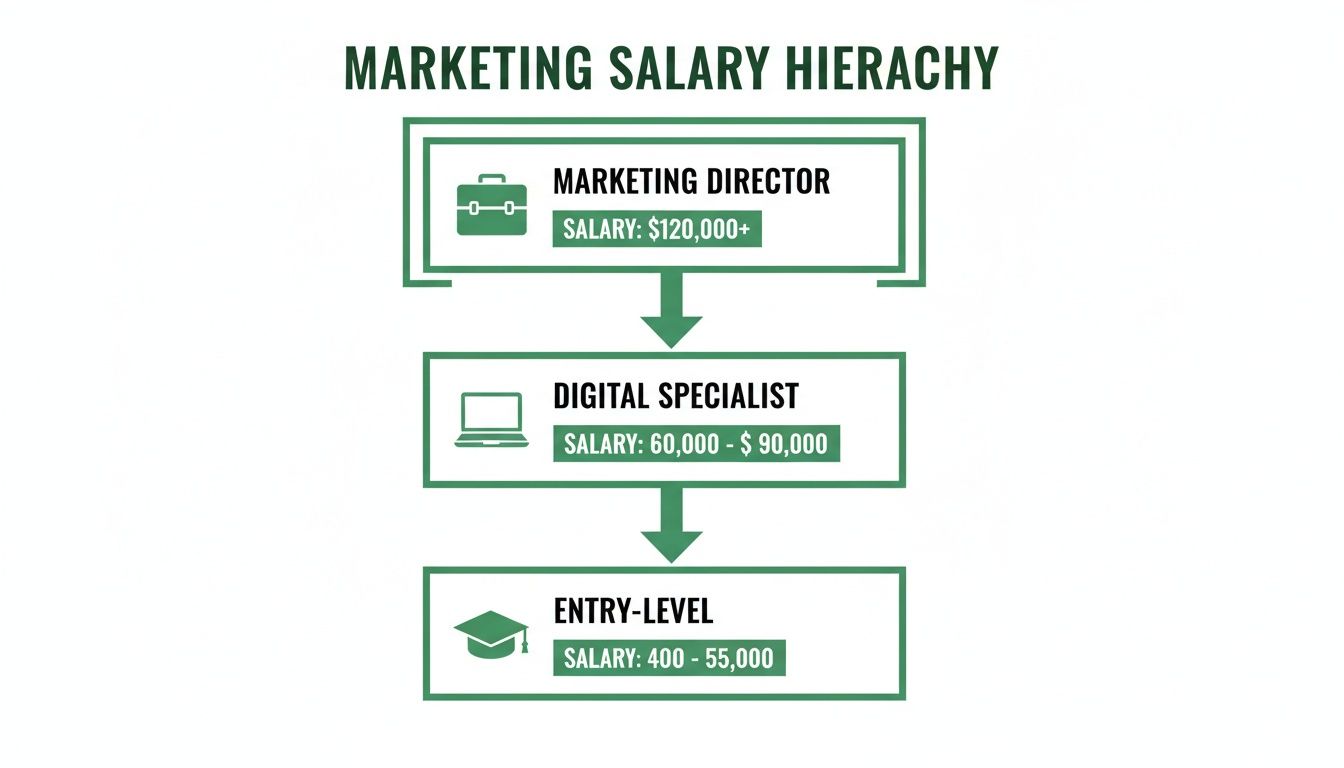
As you can see, the pay jumps are significant as you climb the ladder, gain experience, and take on more strategic responsibilities.
Digital Marketing Specialists
This is the engine room of any modern marketing team. Digital marketing specialists are the pros who navigate the online world, using all sorts of channels to attract, engage, and convert customers. Their work is highly measurable, which makes it much easier to prove their value to the company's bottom line.
These jobs demand a mix of analytical smarts and creative execution. One day you might be managing a complex ad budget, and the next you're brainstorming a viral social media campaign. Because of its direct link to generating leads and sales, this specialization is always in high demand.
Common roles and their typical salary ranges include:
- SEO Specialist: Focused on getting a website to show up in search engine results. Entry-level salaries usually fall between $55,000 and $70,000, with seasoned specialists earning over $90,000.
- PPC/SEM Analyst: Manages paid ad campaigns on platforms like Google Ads. You can expect to start in the $60,000 to $75,000 range, with the potential to hit six figures once you become an expert.
- Marketing Automation Specialist: Works with platforms like HubSpot or Marketo to nurture leads through automated campaigns. This more technical role often starts around $65,000 and can climb past $100,000 pretty quickly.
Content and Communications Professionals
If digital marketing is the engine, then content is the fuel that makes it run. The professionals in this space are the storytellers. They're responsible for crafting the messages that build a brand's identity and forge a real connection with its audience. Their work builds trust, educates customers, and positions the company as an expert in its field.
While people sometimes think of these as the "creative" roles, modern content jobs are incredibly data-informed. Success isn't just about beautiful prose; it's measured by engagement metrics, lead generation, and brand sentiment. The ability to write compelling copy that also gets you on the first page of Google is a seriously valuable skill.
The core of great marketing is great communication. Whether it’s a blog post, a social media update, or a video script, the goal is always to create a connection that resonates with people and inspires them to act.
Key roles in this specialization include:
- Content Strategist: The big-picture thinker who plans and oversees all content to make sure it aligns with business goals. Mid-level strategists can expect to earn between $70,000 and $95,000.
- Copywriter: Writes the persuasive text for ads, websites, emails, and just about everything else. Salaries can range from $50,000 for junior roles to over $85,000 for senior and specialized writers.
- Social Media Manager: Manages a brand’s voice and presence across all its social platforms. Entry-level salaries start around $54,000, while experienced managers at larger companies can pull in $80,000 or more.
Product Marketing and Brand Management
This specialty sits right at the crossroads of marketing, sales, and product development. Product marketers are tasked with understanding the market, figuring out how to position a product within it, and communicating its value to customers. It’s a highly strategic role that requires a deep knowledge of the market and sharp business sense.
These pros are the ones developing go-to-market strategies, creating materials to help the sales team, and keeping a close eye on what competitors are doing. Because they play such a crucial part in a product's success and profitability, these jobs are often among the highest-paying in marketing, even right at the start. Brand managers have a similar strategic focus, overseeing a brand's entire perception to ensure consistency and growth.
For those who lean toward the analytical side of marketing, it’s worth understanding the compensation for roles that are all about the data. A great next step is to explore a detailed salary guide for a Marketing Analytics Manager to see just how much data expertise can boost your earning potential.
Common positions in this area include:
- Assistant Product Marketing Manager: This is a fantastic entry-point into this lucrative field, with starting salaries often landing between $75,000 and $90,000.
- Brand Manager: You’re in charge of the overall image and strategy for a brand or product line. Mid-career professionals typically earn between $90,000 and $125,000.
- Marketing Manager: A more generalist role that oversees entire campaigns and teams, this position often commands a median salary well over $100,000, depending on the industry and company size.
How Your Salary Grows with Experience
Your marketing career isn't a static destination—it's a journey, and your salary will climb with every step you take. Think of it like leveling up. Fresh out of college, you’re focused on mastering the core mechanics and hands-on tasks that make campaigns run.
But as you gain real-world experience, your role naturally evolves. You shift from doing the work to directing it, moving from tactical execution to big-picture strategy. This evolution is directly reflected in your paycheck because leadership and strategic oversight are incredibly valuable. Your first few years are all about building a solid foundation, but the real salary acceleration kicks in when you start managing projects, people, and budgets.

From Specialist to Strategist
The leap from being an individual contributor to a team leader is one of the biggest milestones in a marketing career, both in terms of responsibility and compensation. Early on, your success is measured by your direct output—writing great copy, optimizing an ad campaign, or growing a social media following. The goal is to become an expert at your specific craft.
Once you move into management, the definition of success completely changes. It's no longer just about what you can do, but what you can empower your team to do. This requires a totally different set of skills: leadership, mentorship, budget management, and strategic planning. And because you’re now responsible for driving a larger piece of the business, the financial rewards increase substantially.
This progression usually follows a pretty clear path:
- Entry-Level (0-2 years): You’re learning the ropes and executing day-to-day tasks. The main goal is to become an expert in your specific domain, like SEO or content creation.
- Mid-Level (3-7 years): You’ve mastered your craft and are taking on more complex projects, often mentoring junior team members. You start contributing to strategy, not just executing it.
- Senior/Management Level (8+ years): You’re now leading teams, setting department-wide goals, and managing significant budgets. Your focus is on the big picture and driving measurable business growth through your team's work.
Your Financial Climb Over Time
The salary jumps between these stages aren't just small bumps; they often represent significant leaps in earning potential. While many entry-level and specialist marketing roles sit in the $50,000–$90,000 range, stepping into management unlocks a whole new tier of compensation.
In the United States, marketing managers command much higher pay than the broader national averages. Mid-level managers commonly earn from about $90,000–$160,000. Senior leadership roles, like a VP or CMO, often pull in $180,000–$250,000+ at many US companies. For a closer look at how these roles are compensated, you can find a ton of data on management salaries on PayScale.com.
Think of your career as an investment that compounds over time. The skills you build and the results you deliver in your early years are the foundation for the leadership opportunities—and higher salaries—that come later.
To give you a clearer picture of this progression, here's a breakdown of how salary ranges typically scale with experience.
Salary Growth by Experience Level in Marketing
This table illustrates the typical salary progression for marketing professionals based on years of experience, from entry-level associate to senior manager.
| Experience Level | Years of Experience | Common Job Titles | Average Salary Range (US) |
|---|---|---|---|
| Entry-Level Associate | 0-2 Years | Marketing Coordinator, Social Media Specialist, Content Creator | $50,000 - $70,000 |
| Mid-Level Professional | 3-7 Years | Marketing Manager, Senior SEO Specialist, Product Marketing Manager | $70,000 - $110,000 |
| Senior-Level Manager | 8-15 Years | Marketing Director, Senior Marketing Manager, Head of Content | $110,000 - $170,000 |
| Executive Leadership | 15+ Years | VP of Marketing, Chief Marketing Officer (CMO) | $180,000+ |
As you can see, the path is clear: more experience and responsibility directly translate to higher earning potential.
A Long-Term Financial Forecast
So, what does this actually look like over the course of a career? While everyone's path will be different based on performance, industry, and location, we can map out a typical financial trajectory for a marketing major who actively pushes for growth.
Here’s a realistic long-term forecast:
- Year 5: By now, you've likely moved from an entry-level spot into a mid-level role like Marketing Manager or Senior Specialist. It's reasonable to expect your salary could be 30-50% higher than your starting pay as you take on more strategic work.
- Year 10: With a decade under your belt, many marketers are in senior management or director-level positions. At this stage, your salary could easily be double your starting salary, reflecting your deep expertise and leadership.
- Year 15 and Beyond: As you climb into executive leadership—think VP of Marketing or Chief Marketing Officer (CMO)—your earning potential expands dramatically. Compensation often includes significant bonuses and equity, pushing total earnings well into the six figures and beyond.
This long-term view shows that a marketing degree isn't just about the salary of your first job; it's about building a career with substantial and sustained financial growth. Your experience is your most valuable asset, and the market absolutely rewards it.
Why Location and Industry Change Everything
Your degree, your skills, your experience—they all play a huge part in what you’ll earn. But two other factors can be even more powerful: where you work and what kind of company you work for. Think of them as massive multipliers on your base salary. The very same job, with the exact same duties, can pay wildly different amounts just because of its zip code and business model.
Figuring this out is key to getting the most out of your career. An "average" marketing salary isn't a single number; it's more like a starting point that gets pushed up or down by geography and the demand in a specific sector. A smart job search isn't just about the role—it's about the entire environment surrounding that role.
The Power of Place: Your Geographic Salary
It’s common sense that some cities pay more than others, but the sheer size of the gap might surprise you. A marketing coordinator role in a big tech hub like San Francisco or New York will almost always come with a higher price tag than the identical job in a smaller city in the Midwest. This comes down to a few things: a higher concentration of big companies, more competition for good people, and, of course, a much higher cost of living.
But a bigger paycheck doesn't automatically equal a better life. That $100,000 salary in San Francisco can feel a lot smaller than $70,000 in a city like Austin or Raleigh once you subtract rent, taxes, and everything else. The real trick is to think about your salary in terms of purchasing power. Finding a high-paying job in a city where your money goes further is the ultimate financial win.
Your real salary isn't the number on your offer letter. It's what's left in your bank account after the bills are paid. Choosing a place with a great salary-to-cost-of-living ratio is one of the smartest moves you can make early on.
This plays out on a global scale, too. The salary for a marketing manager varies dramatically from one city to another, with major tech and finance centers leading the pack. For instance, a 2025 analysis shows average annual salaries like AUD 127,000 in Sydney and USD 112,000 in Seattle. Compare that to major European hubs like Munich at €64,000 or London at £53,000, and you can see the difference is massive. To really see how this works, it’s worth checking out a breakdown of marketing salaries in seven major cities to see how location truly shapes your paycheck.
How Your Industry Dictates Your Paycheck
Just as place matters, so does the industry you’re in. Simply put, some fields are more profitable and have more money to spend on great marketing talent. A company's ability to pay you well is tied directly to the value of what it sells.
It makes sense, right? Marketing a high-margin software product or a complex financial service brings in a lot more revenue per customer than marketing for a non-profit or a local retail store. Because of this, companies in these high-growth sectors can—and do—pay a premium to get the best marketers on their team.
Here's a quick look at how different industries stack up:
- High-Paying Industries: Tech (especially SaaS), finance (fintech, investment banking), and pharmaceuticals. These fields need marketers who can navigate complex products and long sales cycles, and they have the cash to reward that expertise.
- Mid-Range Industries: Consumer packaged goods (CPG), automotive, and professional services. These are solid, stable industries with competitive pay, but they generally don't have the explosive salary growth you see in tech.
- Lower-Paying Industries: Non-profit, education, and many parts of retail. The work can be incredibly rewarding, but these organizations almost always operate on tighter budgets, which you'll see reflected in their salaries.
By aiming your job search at high-growth cities and profitable industries, you give yourself a huge advantage. It's all about putting yourself where the demand is highest and the resources are plentiful. That’s how you turn your marketing degree into your most valuable asset right from the start.
Skills That Add Thousands to Your Salary
Your marketing degree is the launchpad for your career, but specialized skills are the rocket fuel. Think of your degree as the car's engine and frame—it gets you on the road and moving. But high-demand skills? Those are the turbocharger and performance tires that let you speed past the competition and command a much higher price.
Companies are more than willing to pay a premium for marketers who bring more to the table than just textbook knowledge. They're looking for pros who can walk in and deliver measurable results from day one, and that requires a very specific, modern toolkit.

Technical Skills with Proven ROI
Without a doubt, the fastest way to increase your earning potential is to master technical skills that are directly tied to revenue and growth. These are the abilities that empower you to not only run campaigns but also prove their direct financial impact on the business.
Knowing how to execute performance-driven strategies, like optimizing ad spend efficiency to squeeze every last drop of value out of a budget, is incredibly valuable. These are the hard skills that are always in demand.
Here are a few technical skills you should focus on:
- SEO and SEM: Knowing how to drive both organic and paid traffic is non-negotiable in today’s market. Businesses pay top dollar for experts who can land them at the top of Google's search results.
- Marketing Automation: Getting comfortable with platforms like HubSpot or Marketo allows you to build sophisticated systems that nurture leads and drive sales at scale. It’s a skill that pays for itself.
- Data Analysis: The ability to dive into tools like Google Analytics, Adobe Analytics, or even SQL to pull out real, actionable insights is what separates a good marketer from a great one.
A marketer who can confidently say, "My campaign generated a 5x return on ad spend," will always out-earn someone who can only say, "My campaign got a lot of clicks." Learning to speak the language of business—data and revenue—is your most powerful salary negotiation tool.
Strategic Soft Skills for Leadership
While technical skills will get your foot in the door for high-paying roles, it's the strategic soft skills that will launch you into leadership. These are the abilities that allow you to guide teams, shape the direction of a brand, and influence executive-level decisions.
These qualities are a bit harder to put on a resume, but they're often the deciding factor when it comes to promotions and major salary bumps. They show you can contribute far beyond the confines of your immediate role.
Three of the most critical soft skills are:
- Strategic Thinking: This is all about seeing the big picture. It’s the ability to connect your day-to-day marketing activities to the company's core business objectives and spot market trends before they become obvious.
- Persuasive Communication: Great marketers are great storytellers—not just to customers, but to stakeholders, executives, and their own teams. This is how you get buy-in and budget for your best ideas.
- Leadership and Influence: Even if you aren't officially a manager, showing you can mentor junior colleagues, lead projects, and inspire the people around you marks you as a future leader.
The Power of Continuous Learning
The world of marketing changes at lightning speed, and your skillset has to keep up. Think of continuous learning as a career elevator—certifications and new tools help you get to the next salary bracket that much faster. For a deeper look, check out our guide on the top marketing skills to learn for career growth.
Investing your time in high-demand certifications for Google Ads, Salesforce, or emerging AI marketing platforms gives you tangible proof of your expertise. It sends a clear signal to employers that you’re proactive and committed to driving results, making you a much more valuable—and higher-paid—asset.
Your Game Plan for Landing a Better-Paying First Job
Knowing the numbers behind the average salary for a marketing major is a great start, but let's be honest—you want to beat the average. It's time to turn that data into a fatter paycheck. Your first job out of college really does set the financial trajectory for your career, and being strategic now can pay off for years.
It all starts with how you sell yourself on paper. Even if you don't have a ton of "real world" experience, your resume can still pack a punch by showing your value. Don't just list what you did at your internship; show the impact you made. Instead of a line like "Managed social media," reframe it as "Grew Instagram engagement by 15% in one quarter." Every class project, volunteer gig, and certification is ammunition to prove your skills.
Building a Resume That Gets Noticed
Think of your resume as your own personal marketing campaign. You're the product. When you frame your experiences around results, you immediately grab the attention of a busy hiring manager.
- Lead with Numbers: Did a class project require you to build a mock ad campaign? Talk about the projected ROI. Did you help a campus club boost its membership? Put a percentage on it.
- Flaunt Your Tech Skills: Make sure those high-demand skills we've been talking about—like SEO, Google Analytics, or any marketing automation software—are front and center.
- Customize, Customize, Customize: Tweak your resume for every single application. Use the same keywords and language you see in the job description. It’s a simple trick that shows you’ve done your homework and are genuinely interested in that specific role.
Remember, the goal isn't just to get a job. It's to land the right opportunity where you're seen as an investment, not just another entry-level hire. To get a feel for what those roles look like, check out our guide on the best entry-level marketing jobs with real growth potential.
Nailing the Salary Negotiation
This is the part that makes most new grads sweat, but it's so important. Sidestepping this conversation can literally cost you thousands of dollars over the long haul. This is your first big-league financial decision, so you need to walk in prepared. A huge part of getting paid what you're worth is learning how to negotiate salary without feeling awkward or demanding.
The key is to have your research ready. Know what similar jobs are paying in your specific city. When the time comes, you can calmly and politely make your case based on your proven skills, the results you delivered in internships, and the going market rate.
Playing the Long Game with Your Career and Salary
Your earning potential doesn't just stop climbing once you've signed that first offer letter. The highest-earning marketers I know are always thinking a few steps ahead. Believe it or not, sometimes the quickest way to get a major salary bump is to strategically switch companies after a couple of years.
Now, this isn't about aimless job-hopping. It’s about recognizing when you've hit a growth ceiling and finding a new role that offers more responsibility and, of course, better pay. Keep learning new skills, keep a running list of your accomplishments (with numbers!), and always have a pulse on what you're worth in the current market. This mindset is what will turn your marketing degree into a fantastic long-term investment.
Your Top Questions About Marketing Salaries, Answered
Even after looking at all the numbers, you probably still have a few questions bouncing around in your head. Let's tackle some of the most common ones to give you the full picture of what to expect when it comes to marketing pay.
Is a Master's in Marketing Actually Worth It?
This is the big one, and the answer is: it depends. A master's degree can absolutely open doors to higher-level strategy and leadership positions, often giving you a salary bump right out of the gate. It can also put you on the fast track to a management role.
But you have to do the math. Is the cost of the program and the time spent out of the workforce worth more than getting two or three extra years of hands-on experience? Sometimes, grabbing a few key certifications in a hot area like marketing automation or data analytics gives you a much quicker and more direct return on your investment.
What Can I Expect to Make as a Marketing Intern?
Thankfully, the era of unpaid "get you coffee" internships is mostly behind us. Most companies today offer paid marketing internships, which is a great sign—it shows they're serious about your development and value what you bring to the table.
The pay can be all over the map, though. A smaller agency or a non-profit might offer something in the $15-$20 per hour range. On the other hand, if you land an internship at a big tech or finance company in a major hub like New York or San Francisco, it’s not uncommon to see rates of $25-$40+ per hour.
Which Marketing Skills Get You Paid the Most?
The marketers who command the highest salaries are the ones who can live in two worlds at once: the creative and the analytical. If you can pair a great idea with the data to back it up, you're golden.
A marketer who only understands creative is a liability. A marketer who only understands data is a commodity. The real value is in the professional who can master both.
Here are the skills that employers are consistently willing to pay a premium for right now:
- Data Analysis and Visualization: You need to be comfortable in tools like Google Analytics or Tableau and know how to translate raw data into a compelling story.
- SEO & SEM: This is non-negotiable. You have to know the ins and outs of driving traffic—both organically and through paid channels.
- Marketing Automation: Having experience with platforms like HubSpot or Marketo shows you can build systems that nurture leads and scale campaigns effectively.
- AI-Powered Marketing: This is the new frontier. Showing you know how to use AI for everything from content creation to campaign analysis will put you ahead of the pack.
Ready to see what your specific marketing skills are worth on the open market? At SalaryGuide, we pull real-time salary data and job listings directly from company career pages. No recruiter spam, just the information you need. Start benchmarking your compensation at https://salaryguide.com.
