What does an Account Manager do? Role, skills, salary & career path
Published by SalaryGuide, with recruiter insight from our sister company, Search for Hire.
An Account Manager is responsible for maintaining and developing an organization’s relationship with a client or group of clients.
The exact role varies.
At an agency, an Account Manager might coordinate campaigns between the client and specialist marketing teams.
At a professional-services company, they may manage an ongoing commercial relationship.
In another business, the role may overlap with Customer Success, Sales or Project Management.
The useful question is not simply:
“What is account management?”
It is:
What does the Account Manager actually own?
A practical way to understand the role is:
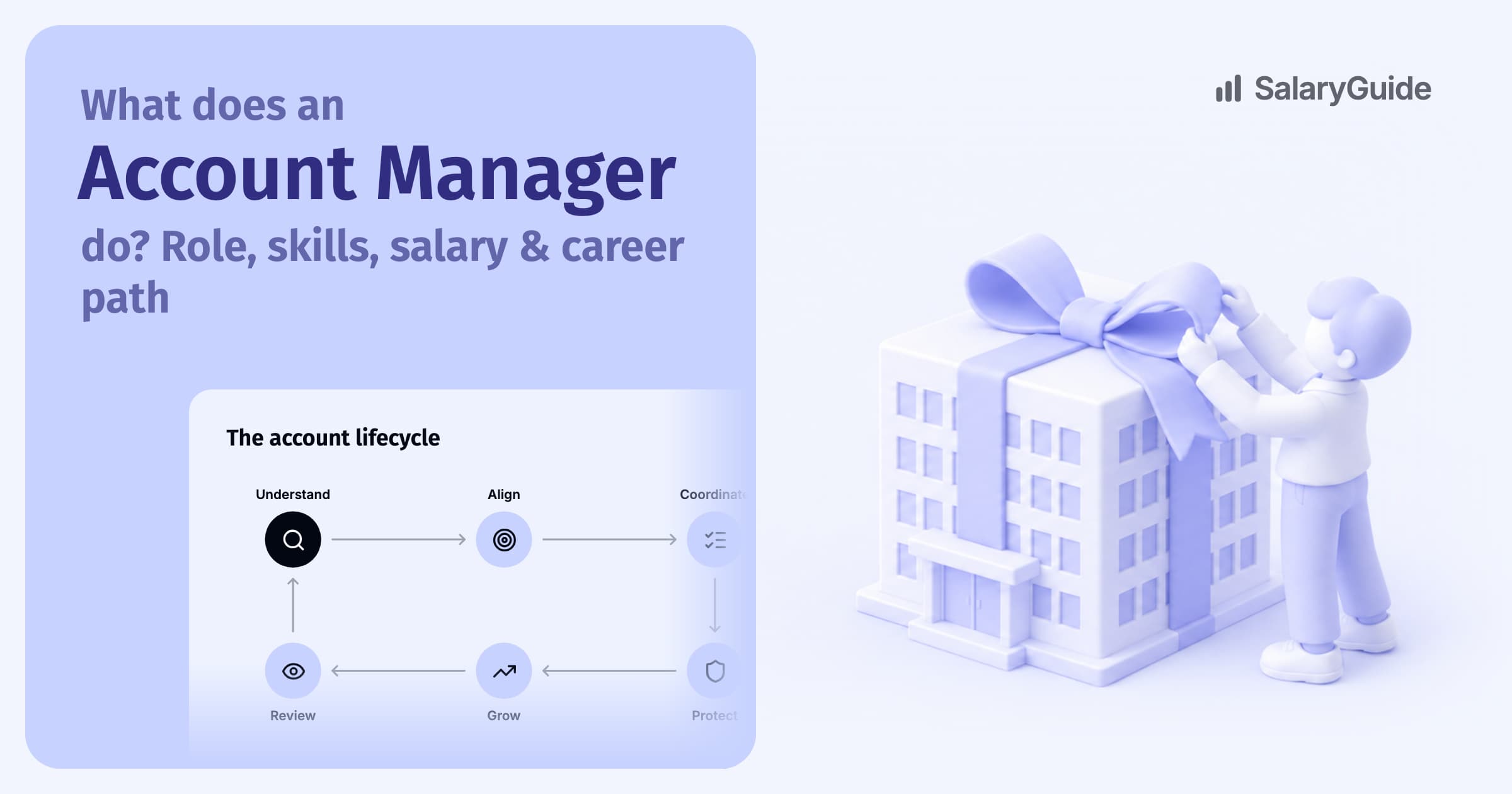
UNDERSTAND → ALIGN → COORDINATE → PROTECT → GROW → REVIEW
What does an Account Manager do?
An Account Manager usually owns an ongoing client relationship after, or alongside, the initial sale.
Depending on the organization, responsibilities may include:
- understanding the client’s objectives;
- maintaining regular communication;
- coordinating internal teams;
- managing expectations;
- monitoring delivery;
- handling changes in scope;
- identifying risks;
- reviewing performance;
- supporting renewals;
- identifying appropriate opportunities for additional work;
- maintaining accurate account records.
Some Account Managers have explicit revenue or renewal targets.
Others are primarily responsible for:
- relationship quality;
- delivery coordination;
- account health.
The job description matters more than the title.
The six core Account Manager responsibilities
| Responsibility | What it means |
|---|---|
| UNDERSTAND | Know the client’s objectives, priorities, stakeholders and constraints |
| ALIGN | Set clear expectations around scope, outcomes, responsibilities and communication |
| COORDINATE | Connect the client with the people responsible for delivering the work |
| PROTECT | Manage scope, risk and expectations without damaging either side of the relationship |
| GROW | Identify appropriate opportunities to deepen the relationship where genuine additional value exists |
| REVIEW | Assess performance, account health and what should happen next |
Not every Account Manager owns all six equally.
For example, one role may have substantial commercial responsibility while another separates account growth into a dedicated Sales team.
1. UNDERSTAND: know what matters to the client
Good account management requires more than knowing what the client bought.
The Account Manager may need to understand:
- what the client is trying to achieve;
- which stakeholders matter;
- how success is being judged;
- what constraints exist;
- what has already been agreed;
- where previous problems have occurred;
- what might change the relationship.
That context helps the Account Manager make better decisions when new requests or problems arise.
Understand the organization, not only the contact
Your day-to-day client contact may not be the only person influencing the relationship.
Depending on the account, useful stakeholder context might include:
- the decision-maker;
- budget owner;
- operational users;
- senior sponsor;
- procurement;
- specialist stakeholders.
You do not need a complicated stakeholder map for every client.
You do need to know who matters when an important decision needs to be made.
2. ALIGN: create clear expectations
Many client problems begin with different assumptions about:
- what is being delivered;
- when;
- by whom;
- at what cost;
- to what standard.
An Account Manager helps reduce that ambiguity.
That might involve clarifying:
Objective
What are we trying to achieve?
Scope
What is and is not included?
Ownership
What does the client need to provide?
What does the internal team own?
Timing
Which deadlines matter?
What dependencies could affect them?
Communication
Who needs updates?
How will important decisions be recorded?
Change
What happens when the client asks for something outside the original agreement?
Clear expectations do not remove every difficult conversation.
They make those conversations easier to handle.
3. COORDINATE: connect the client and delivery team
Account Managers often work across several groups.
In a marketing agency, that might include:
- SEO;
- paid media;
- content;
- design;
- strategy;
- analytics;
- project management.
Elsewhere, it could involve:
- Product;
- Engineering;
- Finance;
- Operations;
- Customer Success.
The Account Manager does not need to perform every specialist task.
They need enough context to make sure the right people understand:
- what the client needs;
- why it matters;
- what was agreed;
- what decision is required;
- what the relevant constraints are.
Translation matters
Clients and internal specialists may describe the same problem very differently.
A client might say:
“We need more leads next month.”
The delivery team may need much more information:
- which audience;
- what type of lead;
- which product;
- which market;
- which budget;
- what has already been tried;
- how lead quality is defined.
A useful Account Manager helps turn the original request into something the team can evaluate and act on.
4. PROTECT: manage scope, expectations and risk
An Account Manager represents the relationship, not one side at the expense of the other.
That means protecting the client’s interests and ensuring that the internal team is not being committed to unrealistic work.
Suppose a client requests additional work close to a deadline.
The Account Manager should not automatically say:
“Yes.”
or:
“No.”
They may need to establish:
- What exactly is being requested?
- Why is it needed?
- Is it inside the agreed scope?
- What resources would it require?
- What existing work would be affected?
- Is there a cost or timeline implication?
- What options can reasonably be offered?
The response can then explain the trade-off clearly.
For example:
“We can include that change, but it would move the current delivery date. Alternatively, we can keep the deadline and schedule the additional work immediately afterward.”
That is more useful than overpromising and attempting to solve the consequences later.
Handling difficult client conversations
Account management can involve conversations about:
- missed deadlines;
- disappointing results;
- scope changes;
- budget;
- conflicting expectations;
- client dissatisfaction;
- mistakes;
- renewal risk.
Useful principles include:
- establish the facts;
- avoid becoming defensive;
- explain what is known and unknown;
- clarify responsibility;
- present realistic options;
- agree the next action;
- follow through.
The goal is not to make every conversation comfortable.
It is to make the situation clear enough to resolve.
5. GROW: identify appropriate opportunities
Some Account Manager roles include explicit commercial responsibility.
That may involve:
- renewals;
- account expansion;
- cross-selling;
- upselling;
- identifying new projects.
But growth should follow value rather than become constant selling.
A useful opportunity exists when there is a credible connection between:
client need
and:
something the organization can genuinely help solve.
Example
Suppose a marketing agency manages paid search for a client.
During reviews, the team repeatedly finds that landing-page limitations are restricting campaign performance.
The Account Manager could explore whether:
- landing-page work;
- CRO;
- analytics;
would solve a genuine problem.
That is different from recommending an unrelated service simply because the account has additional budget.
6. REVIEW: understand account health
Account Managers often need to review more than individual project delivery.
Depending on the business model, useful account-health questions can include:
- Are the agreed objectives still relevant?
- Is delivery meeting expectations?
- Are there unresolved issues?
- Is scope still clear?
- Does the client understand the value being delivered?
- Are important stakeholders engaged?
- Are commercial commitments being met?
- Is the relationship likely to continue?
- Are there appropriate next opportunities?
The correct measures vary by role.
How is Account Manager performance measured?
There is no universal Account Manager scorecard.
Possible measures can include:
| Responsibility | Potential evidence |
|---|---|
| Relationship health | Client feedback, escalations, stakeholder engagement |
| Retention | Renewal or retention where the Account Manager influences it |
| Commercial growth | Expansion revenue where growth is part of the role |
| Delivery | Commitments met, issues resolved, scope managed |
| Financial management | Budget, margin or account profitability where owned |
| Client outcomes | Relevant campaign/project/service results where attributable |
| Operations | Accurate forecasting, account records, internal coordination |
The metric needs to match the role.
For example, net revenue retention can be highly useful in some recurring-revenue businesses.
It would be a poor universal measure for every Account Manager in every industry.
Likewise, Customer Lifetime Value can inform commercial decisions without necessarily being an individual Account Manager’s KPI.
What does an Account Manager do day to day?
There is no single daily routine.
A day could include:
- preparing for a client meeting;
- answering a question about delivery;
- reviewing project progress;
- coordinating specialists;
- resolving a scope issue;
- updating an account record;
- analyzing performance;
- preparing a business review;
- checking budget;
- discussing an upcoming renewal;
- briefing the internal team on a change.
The balance depends on:
- industry;
- account size;
- service;
- team structure;
- seniority;
- commercial model.
A Senior Account Manager responsible for a small number of strategic clients may work very differently from an Account Manager managing a larger portfolio of smaller accounts.
What skills does an Account Manager need?
Communication
Account Managers need to communicate with people who may have very different levels of technical or commercial knowledge.
That can involve:
- clarifying requests;
- summarizing decisions;
- explaining trade-offs;
- giving updates;
- raising problems;
- presenting recommendations.
Good communication is not simply being friendly.
It is making important information clear.
Relationship management
Strong professional relationships are built through:
- reliability;
- consistency;
- transparency;
- follow-through;
- understanding the client’s context.
Being agreeable all the time is not the same as managing a relationship well.
Sometimes protecting the relationship means challenging an unrealistic request rather than promising it.
Commercial awareness
Depending on the role, an Account Manager may need to understand:
- account value;
- scope;
- budgets;
- profitability;
- renewals;
- expansion opportunities.
They should understand which commercial decisions they actually own.
Project and priority management
Account Managers often need to keep track of:
- deadlines;
- dependencies;
- deliverables;
- stakeholders;
- outstanding decisions.
That does not make them automatically responsible for the full Project Manager role.
But they need enough operational awareness to recognize when delivery is at risk.
Problem solving
Client relationships produce ambiguity.
Useful Account Managers can:
- establish what happened;
- identify the real problem;
- involve the right people;
- evaluate options;
- explain the trade-offs;
- move the issue toward a decision.
Data and performance interpretation
In marketing or other performance-driven services, the Account Manager may need to understand:
- what was measured;
- what changed;
- which outcome matters;
- what can reasonably be attributed;
- what the specialist team recommends.
They do not need to be the deepest analyst in the organization.
They do need enough understanding to communicate performance accurately.
Negotiation and expectation management
This can involve:
- scope;
- timelines;
- pricing;
- resources;
- priorities.
Useful negotiation is not about “winning” against the client.
It is about reaching an agreement that both sides can realistically deliver.
What tools do Account Managers use?
Tooling depends on the organization.
Common categories can include:
- CRM;
- project-management software;
- communication tools;
- reporting/analytics;
- documents and spreadsheets;
- commercial/accounting systems.
The software itself is secondary.
The important capability is maintaining:
- accurate information;
- clear ownership;
- useful account history;
- visible decisions;
- reliable follow-up.
A particular CRM or project-management platform should not be treated as a universal requirement unless the job specifically requires it.
Account Manager vs Project Manager
These roles often work closely together, particularly in agencies and service businesses.
Their responsibilities can overlap, but their primary emphasis is usually different.
| Role | Primary emphasis |
|---|---|
| Account Manager | Ongoing client relationship, expectations, account health and commercial context |
| Project Manager | Delivery plan, timelines, resources, dependencies and project completion |
For example, a client may request a new campaign.
The Account Manager may clarify:
- what the client needs;
- why;
- scope;
- commercial implications.
The Project Manager may then own:
- schedule;
- resource planning;
- task dependencies;
- delivery process.
Some organizations combine both responsibilities into one role.
Always read the actual job description.
Account Manager vs Customer Success Manager
There can be substantial overlap.
A Customer Success Manager often concentrates more heavily on helping customers achieve value from an ongoing product or service.
That can include:
- onboarding;
- adoption;
- product usage;
- success planning;
- retention.
An Account Manager may have stronger responsibility for:
- the overall commercial relationship;
- account growth;
- contract renewal;
- cross-functional client needs.
But company definitions vary considerably.
In some businesses, Customer Success owns renewals.
In others, Account Management does.
Do not assume the title tells you the commercial model.
Account Manager vs Sales
Sales roles generally place more emphasis on winning new business.
Account Management generally places more emphasis on relationships that already exist.
That distinction is not absolute.
Some Account Managers have significant expansion targets.
Some Sales teams remain involved after the first contract.
The practical difference is often:
Sales
→ create a new commercial relationship.
Account Management
→ maintain and develop an existing commercial relationship.
Account Manager vs Marketing Manager
These titles describe different types of ownership.
An Account Manager usually owns a client relationship or account portfolio.
A Marketing Manager usually owns some combination of:
- marketing priorities;
- channels;
- campaigns;
- team;
- budget;
- performance.
In an agency, the two may work side by side:
- Account Manager → client relationship and requirements;
- Marketing Manager / specialist lead → marketing decisions and execution.
For deeper detail on the Marketing Manager role, see Marketing Manager Responsibilities: Duties, Skills & Salary.
What does the Account Manager career path look like?
There is no single fixed ladder.
A common pattern is:
SUPPORT → OWN → EXPAND → LEAD
SUPPORT
Possible titles:
- Account Coordinator;
- Account Executive;
- Client Services Executive.
Responsibilities may include:
- meeting preparation;
- client communication;
- account records;
- follow-up;
- delivery support.
OWN
Possible title:
- Account Manager.
The person increasingly owns:
- a client or account portfolio;
- communication;
- expectations;
- account planning;
- issue resolution.
EXPAND
Possible titles:
- Senior Account Manager;
- Key Account Manager.
Responsibility may expand through:
- larger accounts;
- more complex stakeholders;
- larger commercial responsibility;
- mentoring;
- more strategic client work.
LEAD
Possible titles:
- Account Director;
- Client Services Director;
- Head of Client Services.
Responsibility may move toward:
- account strategy;
- portfolio health;
- senior client relationships;
- commercial performance;
- team leadership;
- resource decisions;
- development of other Account Managers.
Titles vary significantly between organizations.
Progression should be judged through scope rather than a fixed number of years.
For the broader career architecture across marketing roles, see SalaryGuide’s Marketing Career Path Roadmap.
What evidence helps an Account Manager progress?
As responsibility increases, useful evidence changes.
Early career
Useful evidence might include:
- reliable follow-up;
- accurate communication;
- effective coordination;
- strong client feedback;
- issues resolved.
Account Manager
Evidence may include:
- independently managed accounts;
- improved account processes;
- successful renewals where attributable;
- appropriate expansion;
- difficult issues resolved;
- reliable forecasting.
Senior Account Manager
Evidence may include:
- complex stakeholder management;
- strategically important accounts;
- commercial decisions;
- mentoring;
- broader account planning.
Account Director / client-services leadership
Evidence may include:
- portfolio-level decisions;
- team development;
- senior stakeholder management;
- resource allocation;
- commercial performance;
- improvements to the client-services function.
At leadership level, capability increasingly involves developing other people rather than personally controlling every client interaction.
For deeper guidance on that transition, see How to Develop Marketing Leadership Skills.
What affects an Account Manager’s salary?
Account Manager pay can vary substantially because the title covers different levels of responsibility.
Relevant factors may include:
- location;
- industry;
- employer;
- account value;
- size/complexity of client portfolio;
- renewal responsibility;
- expansion/revenue responsibility;
- budget responsibility;
- strategic scope;
- direct reports;
- seniority.
A role managing routine client communication can have very different scope from one responsible for:
- strategic accounts;
- renewals;
- expansion;
- profitability;
- senior client stakeholders.
That makes title-only salary comparisons unreliable.
Do you need a degree to become an Account Manager?
Requirements vary by employer.
Some jobs may specify a degree.
Others may place more weight on:
- relevant client-facing experience;
- communication;
- commercial judgment;
- organization;
- problem solving;
- industry knowledge.
Transferable experience can come from roles involving:
- customers;
- clients;
- projects;
- service delivery;
- stakeholder management;
- sales support;
- hospitality;
- operations.
The important question is whether you can demonstrate the responsibilities required by the role.
Common Account Manager mistakes
Saying yes before checking feasibility
A quick promise can create a larger delivery problem later.
Check:
- scope;
- time;
- resource;
- implications;
before committing.
Acting as a message-forwarding service
The role is not simply:
client asks → Account Manager forwards.
Useful Account Managers clarify what the client means and help the internal team understand the context.
Avoiding difficult conversations
Delaying a conversation about:
- scope;
- poor performance;
- budget;
- delivery risk;
usually does not make the issue easier.
Treating relationship management as being agreeable
Professional trust depends on honest expectations.
You sometimes need to challenge a request.
Selling additional services without a real need
Account growth works best when the proposed work solves a genuine client problem.
Reporting without interpretation
Do not send performance data without understanding:
- what changed;
- what matters;
- what the specialist team recommends.
Becoming the only person who understands the account
Important context should exist in:
- records;
- briefs;
- decisions;
- processes;
rather than solely in one person’s memory.
Account Manager role checklist
When evaluating an Account Manager job, ask:
Clients
- How many accounts would I own?
- How large or complex are they?
- Which stakeholders would I work with?
Responsibility
- Do I own the relationship?
- Delivery?
- Renewals?
- Expansion?
- Budget?
Scope
- Where does Account Management stop?
- Is there a separate Project Manager?
- Customer Success team?
- Sales team?
Commercial expectations
- Is there a revenue target?
- Renewal target?
- Expansion target?
- Margin responsibility?
Delivery
- Which internal teams would I coordinate?
- How much specialist knowledge is expected?
Seniority
- Am I primarily supporting accounts?
- Owning them?
- Managing strategic accounts?
- Leading Account Managers?
Compensation
- Does the salary reflect the actual account complexity and commercial responsibility?
- Am I comparing it with genuinely similar roles?
Account management is not simply “keeping clients happy”.
It is the discipline of maintaining a workable commercial relationship between what the client needs, what the organization can deliver and what both sides have agreed to achieve.