A Marketer's Guide to the 30-60-90 Day Plan
A 30-60-90 day plan is your strategic playbook for the first three months in a new marketing role. It's much more than a simple to-do list; think of it as a detailed roadmap that shows you're proactive, helps you get on the same page with your new manager, and really sets the stage for both immediate wins and future growth.
Why Your Marketing Career Needs a 30-60-90 Day Plan

Starting a new marketing job can feel like trying to drink from a firehose. There's so much to learn, so many people to meet. A well-thought-out 30-60-90 day plan is your secret weapon, transforming that initial chaos into a clear, actionable path forward. It’s the tool that helps you move beyond just reading the job description and into a strategic mindset from your very first day.
This plan really works on multiple levels:
- For You: It gives you structure. You'll know exactly where to focus your energy—from learning the ropes to contributing meaningfully and eventually taking the lead on new projects.
- For Your Manager: It’s a fantastic communication tool. You’re showing them you've grasped the role's core responsibilities and have a solid strategy for making an impact.
- For the Company: It speeds up your integration into the team. This means you become a productive, contributing member much faster, which is a great return on their investment in hiring you.
To give you a quick overview, here's how the focus typically shifts over the first three months.
The 30-60-90 Day Plan At a Glance
| Phase | Primary Focus | Key Activities for Marketers |
|---|---|---|
| First 30 Days | Learning & Listening | Meet key stakeholders, understand current marketing tech stack, review past campaign performance, absorb brand guidelines. |
| Next 30 Days (60) | Contributing & Optimizing | Identify a quick win, begin executing on a small project, suggest improvements to existing processes, analyze initial data. |
| Final 30 Days (90) | Leading & Owning | Take ownership of a significant initiative, present findings and a forward-looking strategy, establish new KPIs, mentor others. |
This structured approach is about moving from absorbing information to actively shaping outcomes.
From Onboarding to Impact
The value of this kind of structured onboarding isn't just a gut feeling; the data backs it up. When managers are actively involved in a 30-60-90 day plan, new hires are a whopping 3.4 times more likely to say they had an exceptional onboarding experience. That feeling directly ties into long-term happiness and retention. In fact, a good structure can slash the time it takes for a new hire to become fully productive from an average of 8-12 months down to just 90 days.
A 30-60-90 day plan isn't about having all the answers. It's about showing you know which questions to ask and demonstrating a thoughtful process for finding those answers.
A Foundation for Growth
Remember, this document is a living framework, not a contract set in stone. You should expect it to change as you learn more about the company's culture, workflows, and shifting priorities. It’s the perfect starting point.
Think of your first 90 days as the foundation for your entire career at the company. A strong start, guided by a strategic plan, is what paves the way for future achievements and opens doors for advancement. It's also a critical piece of a larger professional strategy; beyond the day-to-day, every marketer needs to know how to build an online presence that gets results. You can take this even further by learning how to create a career development plan for the long haul.
Your First 30 Days: Learning and Listening

When you start a new marketing role, there's a huge temptation to make a splash right away. You want to prove you were the right hire. My advice? Fight that urge.
The first 30 days aren't about launching a massive campaign or rewriting the playbook. Your mission is to become a sponge. Soak up everything you can about the business, the people, and the processes. Think of yourself as an investigative journalist uncovering the company’s marketing story—the wins, the losses, and the unwritten rules.
Nailing this foundational phase is what makes the next 60 days strategic and impactful.
Building Your Internal Network
Your first move should always be connecting with people. Great marketing doesn't happen in a silo; it relies on strong partnerships across the company. Start by asking your manager for a list of the key people you absolutely need to meet.
Then, at the end of every conversation, ask this simple but powerful question: “Who else do you think I should talk to?” This little trick will help you quickly map out the entire ecosystem, not just the names on an org chart.
Make sure you're meeting a good mix of colleagues:
- Your immediate team: Get to know their roles, what they’re working on, and what their biggest headaches are.
- Cross-functional partners: Set up time with people in sales, product, and customer success. You need to understand how marketing's work affects their world (and vice-versa).
- Direct reports (if you have them): Learn about their strengths, career ambitions, and their unfiltered take on how things are going.
Come to these chats prepared with a few thoughtful questions, but your main job is to listen. Don't talk about what you're going to do; ask about what they do and what they need.
The most valuable asset you have in your first 30 days is your "newbie status." Use this limited-time opportunity to ask the 'dumb' questions no one else can, challenge long-held assumptions, and get an honest, outsider's perspective before you become part of the system.
Diving Into the Data and Tech Stack
While you're meeting people, you also need to get your hands dirty with the data and tools that power the marketing engine. This is where you uncover the real story behind the anecdotes. Ask for access to all the essential platforms and just start clicking around.
This isn't just about learning the software; it’s about understanding the "why" behind the numbers. Analyzing past performance gives you the context you need to make smart calls later on.
A good initial audit should cover:
- Analytics Platforms: Jump into Google Analytics, Adobe Analytics, or whatever the company uses. See where traffic comes from, how users behave, and where the conversion funnels leak.
- CRM System: Dig into the company’s CRM, whether it's Salesforce or HubSpot. See how leads are tracked, scored, and handed off to sales.
- Marketing Automation: Look at past campaigns and workflows in tools like Marketo. What worked? What bombed?
- Ad Platforms: Get into Google Ads and the social ad accounts. Review past campaign structures, creative performance, and the all-important return on ad spend (ROAS).
Putting the Pieces Together
As you gather all this information—from both people and platforms—you’ll start to see patterns emerge. Keep a running document of your notes. This will help you connect the dots between what the head of sales said about lead quality and what you're actually seeing in the CRM data.
This synthesis is the final, crucial step of your first month. It’s what turns you from a passive observer into a strategic contributor. By the time day 30 rolls around, you should be able to clearly articulate:
- The Current State: What are the team’s main goals, active projects, and established workflows?
- Key Challenges: What are the biggest pain points you've heard from multiple people?
- Potential Opportunities: Where is the low-hanging fruit you've already spotted?
This initial analysis is the raw material for a truly effective 30-60-90 day plan. You've built the foundation. Now you’re ready to start building on it.
Making an Impact in Your Next 30 Days
Alright, you've spent the first month absorbing everything you can—learning the systems, meeting the team, and really listening. Now, it's time to switch gears from observation to action.
The middle phase of your 30-60-90 day plan is where the rubber meets the road. You’re not just the new face in the room anymore; you're becoming an active contributor. The big goal for days 31-60 is to nail down a few "quick wins." These are the smart, visible, and relatively low-effort tasks that prove you're not just here to learn, but to deliver.
This is where all that initial groundwork starts to pay off, giving you the confidence to start making your mark.
Identifying Your Quick Wins
A quick win isn’t about boiling the ocean or launching a massive, paradigm-shifting project. Think smaller. Think smarter. It’s about spotting a contained problem you can solve or a clear opportunity you can seize, showing everyone you've been paying close attention.
Go back to your notes from those first few weeks. What were the common pain points you heard? Where's the low-hanging fruit just waiting to be picked?
Here’s what this might look like in practice for different marketing roles:
- For a PPC Manager: You spot an ad group that's burning cash with a sky-high cost-per-acquisition (CPA) and dismal conversions. Your quick win? Pause that underperformer, shift its budget to a campaign that's already crushing it, and report back with the immediate improvement in overall ROAS.
- For an SEO Specialist: You find a great blog post that’s stuck on page two of Google for a money-making keyword. Updating it with current stats, beefing it up with a new section, and rewriting the meta description is a perfect quick win that can often push rankings up fast.
- For a Content Marketer: You notice a handful of older, high-traffic articles have no clear call-to-action (CTA). Your quick win is to design a relevant CTA and get it implemented across those posts to immediately start generating more leads from existing traffic.
The trick is to choose something with a clear, measurable outcome. This isn't just about being busy; it's about making a tangible impact. If you need a refresher on defining those metrics, our guide on how to measure marketing performance is a great resource.
Shifting from Observer to Contributor
Beyond just ticking off tasks, this phase is about fundamentally changing how you engage. You've earned a seat at the table—now it's time to use it.
In team meetings, stop being just a note-taker. Start offering informed suggestions. For example, if the team is spitballing ideas for a new campaign, you can jump in with, "Based on my analysis of last quarter's data, our LinkedIn audience really engaged with video. Have we considered testing that format here?"
This transition is critical. It moves you from being perceived as a task-taker to a strategic partner. Your goal is to show you're not just waiting for assignments but are actively thinking about how to move the business forward.
This is exactly what great managers hope to see. In fact, top-performing new hires are often already applying new strategies by this point. According to research from Rippling, structured plans with clear goals can cut ramp-up time by 30-40%. This enables new marketers to contribute breakthrough ideas, like improving customer retention by 18% through smarter targeting.
Taking Ownership of Small Projects
As you rack up those quick wins and build credibility, you'll find more responsibility coming your way. Now is the time to step up and volunteer to own smaller, self-contained projects. It’s the natural next step.
This could mean things like:
- Running point on one specific channel for an upcoming product launch.
- Drafting the project brief and content outline for a new downloadable guide.
- Owning an A/B test on a key landing page from hypothesis to presenting the results.
Successfully steering a small project from start to finish proves you can work autonomously and deliver results without constant hand-holding. Make sure you document your process, the outcomes, and what you learned. This not only builds a strong case for your 90-day review but also perfectly sets the stage for the final phase of your plan: leading bigger, more impactful initiatives.
Taking the Lead in Your Final 30 Days
The first 60 days were about listening, learning, and finding your place. Now, in this final 30-day stretch, it's time to shift gears. You're no longer the new person finding their footing; you're here to stride forward, take ownership, and start leading.
You’ve spent two months gathering insights—you get the team's rhythm, the brand's voice, and the core business goals. Think of that knowledge as your launchpad. It’s what will fuel your new ideas and give you the confidence to take the reins on major projects.
From Contributing to Owning
The mission for this final phase is to move toward real autonomy. You're not just checking tasks off a list anymore. You’re actively hunting for opportunities and building the strategy to seize them. Your focus should now be on projects that create a lasting, measurable impact.
Forget quick wins. This is about shaping what comes next.
- For an SEO Manager: Don't just optimize old posts. Use your keyword gap analysis and competitor deep-dive to build out the entire content strategy for the next quarter.
- For a Paid Media Specialist: Go beyond tweaking campaigns. Pitch a completely new A/B testing framework for your most critical landing pages, laying out your hypotheses and a clear system for tracking and implementing the winners.
- For a Content Strategist: You've probably spotted an overlooked audience or an untapped distribution channel, like a niche podcast or a community forum. Now's the time to design a pilot program to prove its value.
Making this leap from "doer" to "driver" is what truly distinguishes a great hire. It signals that you can innovate, not just operate.
Showcasing Your Vision and Impact
As you start owning these bigger initiatives, clear communication becomes everything. Get some time on your manager’s calendar—maybe around day 75 or 80—to walk them through what you’ve accomplished and, more importantly, what you see on the horizon.
But don't just give them a laundry list of completed tasks. You have to connect your work back to the business's bottom line.
This final phase isn’t just about finishing your plan; it’s an audition for what's next. It’s where you demonstrate you can not only fix today's problems but also anticipate tomorrow's needs and start building the solutions.
Structure your update like a story. Start with what you did, then immediately hit them with the "so what?"—the tangible impact on the business. For example, instead of saying, "I updated five old blog posts," you say, "I optimized five of our most dated blog posts, and we've already seen a 15% lift in organic traffic to those pages, which generated two new inbound leads."
See the difference? This reframing cements your position as a strategic partner who gets how marketing drives real results.
Becoming the Go-to Expert
By the time you cross the 90-day finish line, you should be fully ramped up and making a real difference. With a solid plan, many professionals are already testing new strategies, fine-tuning conversion funnels, and delivering reports that get them to 50% of their quarterly goals.
In fact, one analysis found that a well-structured onboarding plan can slash employee downtime by 40%. It gets you to full productivity in 90 days, not the typical six months. By securing those early wins, you build the confidence and trust needed for long-term success. You can discover the full impact of a well-structured ramp-up plan to learn more.
When day 90 arrives, your manager shouldn't think of you as "the new hire" anymore. They should see you as the resident expert in your domain—the person who not only executes flawlessly but brings fresh, data-driven ideas that elevate the entire team. That's the real goal of any 30-60-90 day plan.
Real-World 30-60-90 Day Plan Examples for Marketers
It’s one thing to talk about the theory behind a 30-60-90 day plan, but it's another to actually build one. So, how does this translate into a real document you can use?
Let's look at what this plan looks like in practice for a few common marketing roles. Think of these less as strict templates and more as flexible blueprints you can borrow from and make your own.
At its core, every great plan follows a natural progression from learning, to contributing, to finally leading.
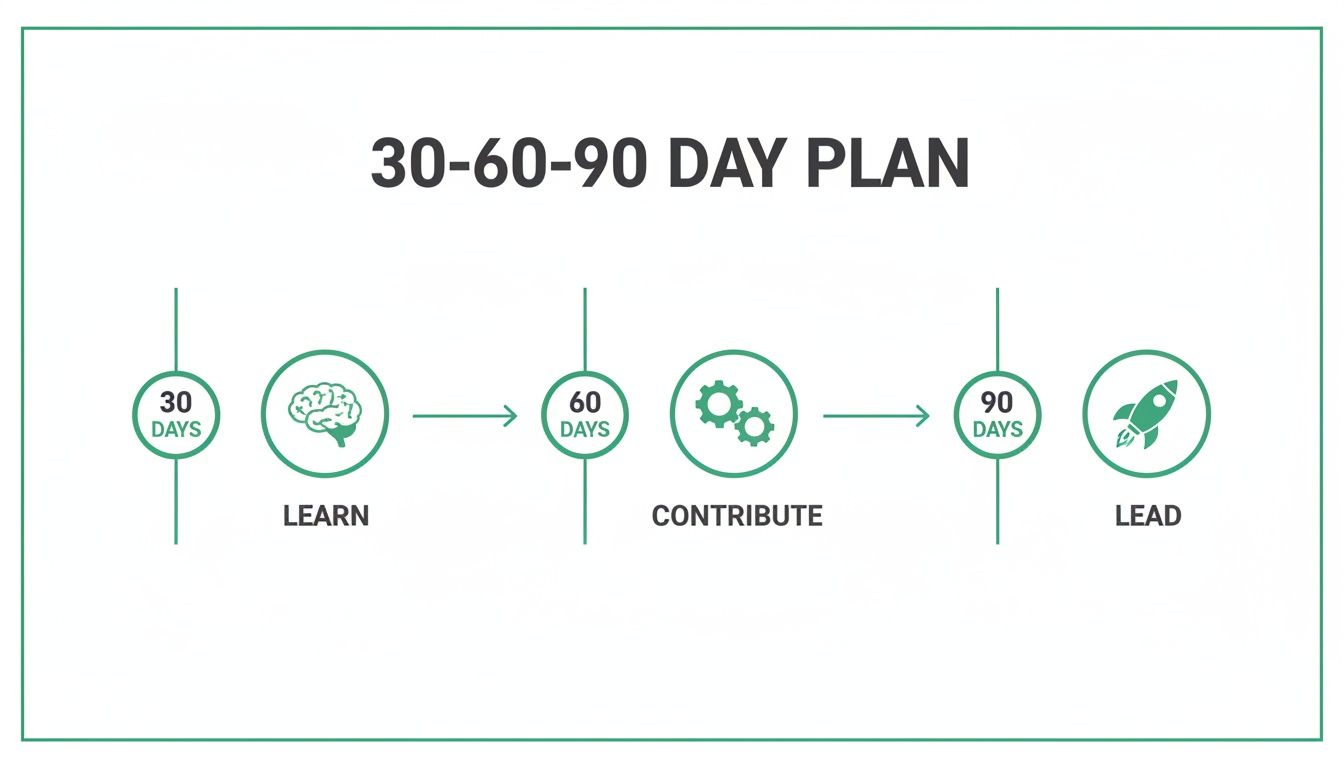
You can see how each phase logically builds on the last. You start by soaking up knowledge, which then empowers you to make meaningful contributions, which in turn gives you the credibility and insight to lead new initiatives. It’s all about creating momentum.
An SEO Specialist’s First 90 Days
For an SEO Specialist, the first three months are a sprint from deep technical and content analysis toward smart, strategic execution. The mission is to get a firm grasp of the current organic landscape and pinpoint the biggest opportunities for growth.
The First 30 Days: Learning and Auditing This initial month is a total immersion. Your job is to become an expert on the website's technical health, content inventory, and overall performance.
- Your Main Goal: Finish a full-scale audit of the website’s current SEO situation.
- What You’ll Do:
- Get access to and dig into Google Analytics, Google Search Console, and the company's SEO tools (like Ahrefs or Semrush).
- Run a comprehensive technical site audit to find things like crawl errors, slow page speed, and indexing problems.
- Start an initial content and keyword gap analysis. What’s working well? Where are competitors eating our lunch?
- How You’ll Measure Success: Deliver a prioritized list of technical fixes and content ideas to your manager.
The Next 30 Days (31-60): Contributing and Optimizing Now it’s time to switch from auditing to action. You’ll start tackling the low-hanging fruit you uncovered in your first month.
- Your Main Goal: Implement the highest-priority technical fixes and start on-page optimization.
- What You’ll Do:
- Partner with the development team to crush the critical technical bugs from your audit.
- Optimize meta titles, descriptions, and page content for a small group of high-potential pages.
- Pick an existing article that’s almost on page one and give it a "quick win" content update.
- How You’ll Measure Success: Show measurable improvements in site health scores and a 5-10% bump in organic traffic to the pages you optimized.
The Final 30 Days (61-90): Leading and Strategizing In this last phase, you leverage everything you’ve learned to build a proactive, forward-thinking strategy.
- Your Main Goal: Develop and pitch a data-driven SEO strategy for the upcoming quarter.
- What You’ll Do:
- Create a content roadmap that’s grounded in solid keyword research and aligns with business goals.
- Outline a scalable process for link-building or digital PR.
- Build a dashboard to track and report on the SEO KPIs that matter: keyword rankings, organic traffic, and conversions.
- How You’ll Measure Success: Get sign-off from your manager and key stakeholders on your Q-next SEO strategy.
A Paid Media Manager’s First 90 Days
A Paid Media Manager’s plan is all about understanding account history, ruthlessly optimizing for efficiency, and then strategically scaling what works. You’re moving from analysis to active, intelligent testing.
The First 30 Days: Analysis and Understanding Your first month is a deep dive. You need to understand the story the historical campaign data is telling you and get familiar with the account structure.
- Your Main Goal: Get a comprehensive understanding of current paid media strategies, performance, and internal processes.
- What You’ll Do:
- Audit every active ad account (Google Ads, Meta Ads, LinkedIn Ads) for structure, targeting, and creative performance.
- Review all tracking and attribution setups. Is the data accurate and trustworthy?
- Meet with the sales team. You need to know what a "good lead" actually looks like and understand the customer journey after the click.
- How You’ll Measure Success: Present a SWOT (Strengths, Weaknesses, Opportunities, Threats) analysis of the entire paid media program.
The Next 30 Days (31-60): Optimization and Quick Wins With a solid understanding of the landscape, you can now start making data-backed changes to improve efficiency and drive better results.
- Your Main Goal: Implement initial optimizations to improve the campaign ROAS (Return on Ad Spend).
- What You’ll Do:
- Find the consistently underperforming ad groups and pause them. Reallocate that budget to your proven winners.
- Launch a small, controlled A/B test on ad copy or a landing page CTA for a key campaign.
- Refine audience targeting based on your audit and what you learned from the sales team.
- How You’ll Measure Success: Achieve a 10% improvement in cost-per-acquisition (CPA) or a 15% lift in ROAS.
The Final 30 Days (61-90): Scaling and Innovation The final month is about looking to the future and proposing new, exciting avenues for growth.
- Your Main Goal: Develop a concrete plan to scale successful campaigns and test a completely new channel or initiative.
- What You’ll Do:
- Put together a budget proposal to scale the campaigns you’ve successfully optimized.
- Build a data-backed case for testing a new platform, like TikTok or programmatic display.
- Develop a new creative testing framework to make experimentation a systematic, ongoing process.
- How You’ll Measure Success: Get approval for a new channel test budget and successfully implement the new creative testing framework.
Marketing Role Plan Comparison
While the 30-60-90 day framework is consistent, the specific goals will vary significantly depending on the role. Here’s a quick look at how the Day 31-60 goals might differ across a few marketing specializations.
| Metric/Goal | SEO Specialist | Paid Media Manager | Content Marketing Manager |
|---|---|---|---|
| Primary Focus | On-page & technical fixes | Campaign efficiency | Content velocity & performance |
| Key Metric | Organic traffic to optimized pages | Cost-Per-Acquisition (CPA) | Blog traffic & lead generation |
| "Quick Win" Activity | Update a "striking distance" blog post | A/B test ad copy on a top campaign | Repurpose a high-performing asset |
| Collaboration | Work with developers on site health | Sync with sales on lead quality | Align with design on new visuals |
This comparison highlights how each role applies the same "contribute and optimize" mindset to their unique area of expertise during that critical middle phase.
A key takeaway: These examples are just starting points. The most effective 30-60-90 day plan is a living document. You should be reviewing it and tweaking it with your manager as you learn more about the role and the business. It’s a powerful tool to show initiative, strategic thinking, and a clear commitment to delivering results that matter.
Common Planning Mistakes and How to Avoid Them
Even the most buttoned-up 30-60-90 day plan can completely miss the mark if you fall into a few common traps. A plan that looks great on paper is useless if it’s unrealistic or totally disconnected from what your team is actually doing. Knowing what these missteps are ahead of time is the key to building a plan that gets results.
The biggest mistake I see? Trying to do way too much, way too soon. Your first 30 days are about absorbing information like a sponge, not launching some massive, game-changing project. If you come in trying to boil the ocean, you'll burn out fast and signal to your new colleagues that you haven't bothered to understand how things work.
Instead, zero in on a few smart learning goals and find one or two "quick wins"—high-impact, low-effort tasks—that you can knock out in your second month.
Working in an Echo Chamber
Another classic blunder is creating your plan all by yourself. Walking into your manager's office and presenting a finished document without ever asking for their input is a recipe for disaster. It immediately frames it as your plan, not our plan, creating a disconnect that can be hard to fix later.
Think of your plan as a collaborative tool, not a solo manifesto. Get time on your manager's calendar to walk through a draft, ask for their honest feedback, and get clarity on team and business priorities. That one conversation can turn your document from a simple to-do list into a shared vision for success.
A 30-60-90 day plan is a conversation starter, not a final decree. Its real value comes from the alignment it creates, ensuring your efforts are directed where the business needs them most.
The Rigidity Trap
Finally, don't treat your plan like it's carved in stone. Business goals change, a last-minute project always pops up, and new data can completely alter your priorities. A plan that can't bend will break, quickly becoming an irrelevant file saved somewhere on your computer.
The trick is to build in flexibility from the very beginning.
- Think in percentages, not hours: Instead of a rigid, hour-by-hour schedule, block out your time more fluidly. For example, aim for 50% learning, 30% execution, and 20% building relationships.
- Create a "flex" bucket: Acknowledge that the unexpected will happen. Dedicate a part of your plan to "unplanned tasks" or "new opportunities" so you have room to maneuver.
- Set up regular check-ins: Revisit the plan with your manager every couple of weeks. The goal isn't just to report progress but to adapt the plan as needed. This habit sets a great precedent for a productive 90-day review and helps you stay on track long-term.
By sidestepping these common errors, you can transform your plan from a simple document into a powerful tool that truly drives your success in a new role.
Your 30-60-90 Day Plan: Answering the Tough Questions
Even with the best template in hand, you probably still have a few questions rolling around in your head. That's normal. Let's tackle some of the most common ones I hear from marketers putting these plans into action.
How Should I Bring This Up in an Interview?
This is a delicate dance. You want to show you're a strategic thinker, not someone who thinks they have all the answers before even walking in the door. The key is to present it as a high-level approach, not a rigid, non-negotiable contract.
Instead of handing over a multi-page document, talk through your thinking. You could say something like:
"My goal in the first 30 days would be total immersion—getting to know the team, diving deep into the analytics, and really understanding the current marketing stack. From there, I'd use the next 30 days to identify a quick win, maybe by optimizing a high-potential ad campaign or refining a key landing page. By day 90, I'd use those early learnings to build a data-backed strategic proposal for the next quarter."
This shows you're proactive and thoughtful, but also flexible and ready to learn.
So, Who's Actually in Charge of This Plan?
Short answer: You are. But it’s not a solo mission.
You're the one who needs to draft the plan and drive the work, but it will fall flat without your manager's input and buy-in. Think of yourself as the project lead and your manager as your most important stakeholder. Your first draft is your best guess based on the job description and your interview conversations. The real plan comes to life after you've incorporated their feedback and aligned it with the team's immediate priorities.
A 30-60-90 day plan works best when it's a shared roadmap, not a personal to-do list. It’s the tool that turns "my goals" into "our goals" right from the start.
How Often Should I Look at This Thing Again?
A "set it and forget it" plan is a useless plan. Treat it as a living, breathing document.
The best cadence is to review it with your manager during your weekly one-on-ones. This isn't just about reporting on what you've done. These regular check-ins are your chance to:
- Celebrate small victories and keep the momentum going.
- Get quick feedback to ensure you're on the right track.
- Pivot and adjust the plan if priorities shift (which they always do).
This constant loop of feedback keeps the plan relevant and makes sure you and your manager are always on the same page.
Ready to map out your next career move? At SalaryGuide, we provide the job listings, salary data, and AI-powered tools you need to find your next marketing role with confidence. Explore real opportunities at https://salaryguide.com.
