Decoding Your Campaign Manager Salary
Alright, let's get right to it. You're here because you want to know what a campaign manager can expect to earn. The short answer? The average campaign manager salary in the United States is around $72,000 per year.
Of course, that's just an average. The reality is a much wider spectrum, starting around $48,000 for someone just breaking into the field and climbing north of $113,000 for seasoned pros running high-stakes campaigns.
Your Campaign Manager Salary Snapshot
Thinking about your salary isn't just about the money; it’s about understanding your value. A campaign manager's paycheck isn't arbitrary. It's a direct reflection of the immense impact they have. These are the people orchestrating complex marketing and advertising initiatives, and their compensation is tied directly to their ability to deliver real, measurable results for the business.
A Data-Driven Look at Compensation
To get a clearer picture, let's look at what the market data tells us. Campaign managers are on the front lines, tasked with boosting a brand's visibility, driving customer engagement, and ultimately, making the cash register ring. Their pay scales accordingly.
Recent data shows the average base salary sits at $71,815. But experience is the real game-changer here. A campaign manager with less than a year under their belt might see total compensation around $48,255, while someone with one to four years of experience can expect that to jump to an average of $67,161. This gap shows just how much companies are willing to pay for a proven track record of delivering a solid return on investment.
This infographic breaks down how those numbers typically progress.
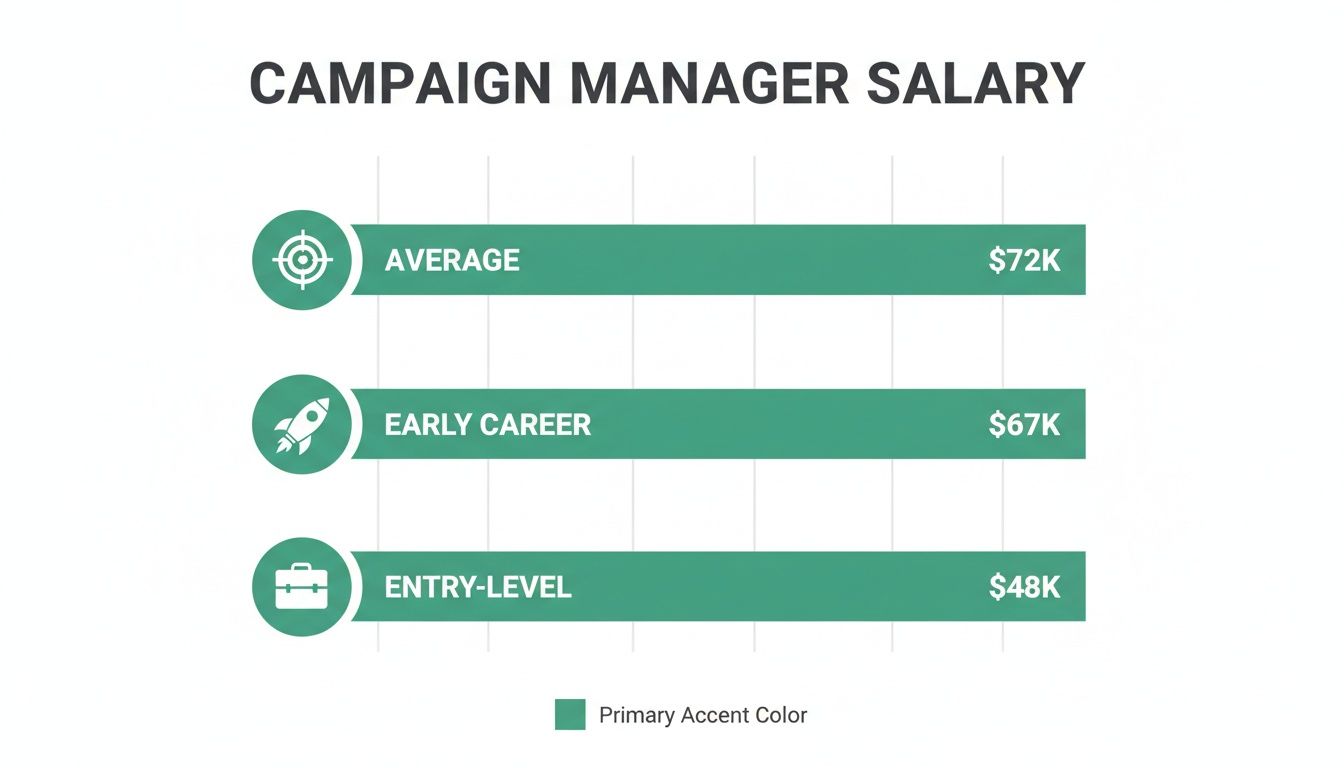
As you can see, making the leap from entry-level to an early-career position can mean a nearly 40% jump in pay. It's a period of rapid growth.
For a quick-glance summary, here’s a table outlining the typical compensation at different career stages.
Campaign Manager Salary by Experience Level
| Experience Level | Average Total Compensation | Typical Range |
|---|---|---|
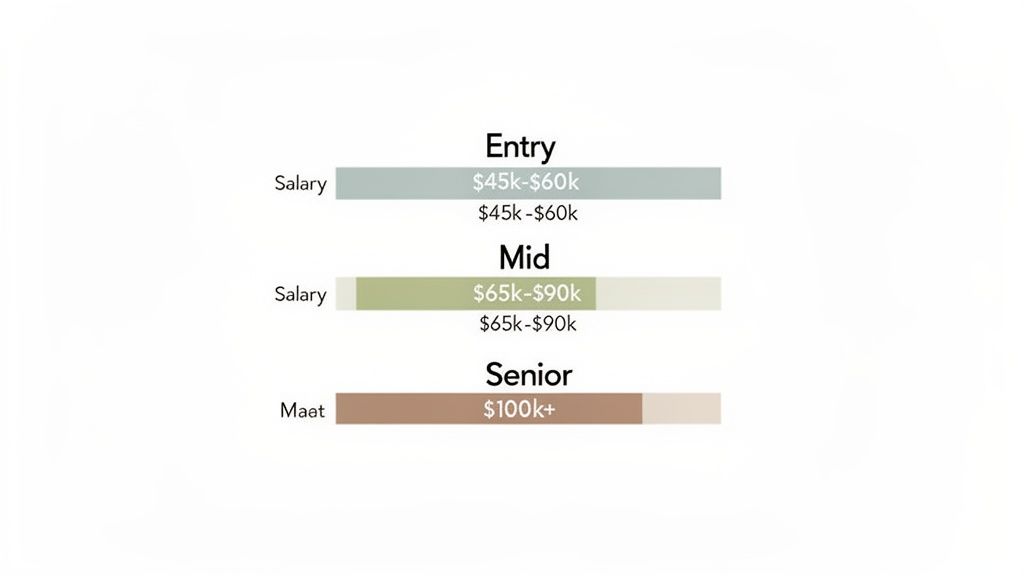
| Entry-Level (0-1 years) | $48,255 | $35,000 - $55,000 |
| Early Career (1-4 years) | $67,161 | $50,000 - $80,000 |
| Senior Level (5+ years) | $95,000+ | $85,000 - $115,000+ |
These figures give you a solid baseline, but remember they're just averages. Your actual earnings will hinge on factors we'll explore later, like location, industry, and the specific skills you bring to the table.
Understanding the Broader Marketing Pay Scale
It’s also helpful to zoom out and see where your role fits within the entire marketing world. Looking at benchmarks like the average marketing salary in Australia or other global markets gives you a much richer context. This helps you gauge your earnings not just against other campaign managers, but against the industry as a whole.
Think of your starting salary as the foundation of a building. It's solid, but the real value comes from the additional floors you build on top—bonuses, skill-based raises, and promotions—as your career progresses.
Every new skill you master and every successful campaign you launch adds another layer to your earning potential. To see how your role stacks up against others, check out our full guide on https://salaryguide.com/blog/how-much-do-marketers-earn. This is your starting point for understanding all the moving parts that will shape your paycheck.
How Experience Shapes Your Earning Potential
When it comes to a campaign manager's salary, nothing moves the needle more than experience. It's not just about the number of years you've been in the game; it’s about the value, strategic thinking, and tangible results you bring to the table. Think of it like leveling up—each successful campaign, new skill, and leadership win unlocks a higher pay grade.
Your career starts with mastering the nuts and bolts but quickly grows into orchestrating complex, multi-channel marketing symphonies. As you gain more experience, your ability to drive real business outcomes—like jacking up the return on ad spend (ROAS) or slashing customer acquisition costs (CAC)—becomes your biggest bargaining chip. And trust me, your paycheck will reflect that.
The Entry-Level Foundation (0-2 Years)
As an entry-level campaign manager, you're deep in the trenches, focused on tactical execution. This is where you learn the tools of the trade and prove you can get things done. It’s all about building your core skills.
Your day-to-day work will probably look something like this:
- Setting up campaigns on platforms like Google Ads or Meta Ads.
- Monitoring performance metrics and pulling together reports.
- Running A/B tests on ad copy, images, and landing pages.
- Supporting senior managers with research and keeping projects on track.
At this point, your salary is based on your potential and your ability to execute, not your strategic input. You're building the foundation for everything that comes next, and your pay will be a solid entry point into the marketing world.
The Mid-Level Leap (3-5 Years)
This is where your salary really starts to take off. After a few years in the field, you're no longer just following a checklist—you’re starting to write the playbook. Mid-level campaign managers shift from pure execution to developing their own strategies.
You’ll start owning bigger responsibilities, like managing budgets, planning entire campaigns, and working with other teams. Your value skyrockets because you can now connect the dots between your daily tasks and the company's bottom line. Employers will pay a premium for someone who can not only run a campaign but also explain why it worked (or didn't) and what to do better next time.
A mid-level manager's worth is proven by their ability to manage a budget effectively. Showing you can turn a $50,000 ad spend into $250,000 in revenue is the kind of math that gets you a significant pay raise.
This jump in responsibility directly translates to a significant bump in your salary, as you prove you can handle more complex, high-stakes projects.
The Senior-Level Strategy (6+ Years)
Welcome to the big leagues. At the senior level, you've graduated from a campaign specialist to a strategic leader. Your focus is no longer on individual campaigns but on the entire marketing engine. You're thinking about the whole picture, developing integrated strategies that hit major company goals.
Senior campaign managers, or those who have climbed to roles like Marketing Director, are typically tasked with:
- Mentoring junior team members and building a top-tier marketing team.
- Managing six- or even seven-figure budgets and being accountable for departmental ROI.
- Collaborating with C-suite executives to make sure marketing is driving the business forward.
- Forecasting performance and setting the strategic vision for the future.
Digging into broader compensation data, some sources paint an even more senior picture. For instance, research shows an average annual pay of $120,340 for seasoned managers, with a typical range falling between $82,794 and $146,936. This higher figure reflects the premium paid for experts handling massive, complex initiatives, where top earners can clear over $140,000 by overseeing huge budgets and leading cross-functional teams. You can discover more insights about these senior-level compensation trends and see how deep experience truly drives top-tier pay.
How Location and Industry Shape Your Paycheck
Your experience level is the bedrock of your salary, but two other factors can completely change the game: where you live and the industry you work in. Think of your skills as a high-performance engine. Your location and industry are the racetrack and the fuel. That same engine will go a lot faster on a professional track with high-octane fuel than it will on a bumpy dirt road.
It's the same idea in the job market. A campaign manager in a competitive tech hub like San Francisco or New York City will almost always make more than someone with the same skills in a smaller town. This isn't just about covering a higher rent; it’s about fierce competition for talent. Companies in these major metro areas are constantly fighting to hire and keep the best people, and they're willing to pay a premium for them. This geographic pull is so strong that it’s smart to make sure your professional presence, like your LinkedIn profile, reflects where you want to work. For anyone targeting these high-paying regions, it's worth optimizing your LinkedIn location settings to get on the right recruiters' radar.
Why Your Zip Code Dictates Your Salary
The most obvious reason pay differs by city is the cost of living. A $75,000 salary in Des Moines, Iowa, goes a lot further and affords a very different lifestyle than the same $75,000 in Los Angeles. Companies know this and adjust their salary bands for local economies to make sure their offers are genuinely competitive.
But it goes deeper than that. Certain cities become hotspots for specific industries, which creates concentrated demand for talent and drives salaries up. Take Boston—it's a hub for politics and non-profits. The constant need for sharp campaign managers in those sectors means the average pay there is around $84,000, which is well above what a typical early-to-mid-career professional might earn elsewhere.
A strategic move to a new city can be the single most powerful way to boost your salary. The trick is to research not just the cost of living, but also the concentration of your target industry to make a truly smart geographic jump.
This is a universal principle. Tech hubs pay top dollar for campaign managers who know the tech world, and financial centers offer bigger paychecks for marketing roles in FinTech. The takeaway is simple: to really maximize what you can earn, try to align your location with your industry specialty.
How Different Industries Value the Campaign Manager Role
Just as your location matters, the industry you choose can have a massive effect on your compensation. Not every sector sees or values marketing in the same way. A campaign manager's job is always to drive visibility, engagement, and revenue, but the scale of that revenue—and the budget available to achieve it—can vary dramatically.
Let’s look at a few examples:
- High-Growth Tech (SaaS, FinTech): These industries are often flush with cash from investors and have a high customer lifetime value, so they're willing to spend big to acquire new customers. Campaign managers are seen as direct lines to revenue, and they’re paid like it—with high base salaries and often some very attractive stock options.
- Retail and E-commerce: Here, the profit margins can be much thinner. Campaign managers are absolutely essential for driving sales, but their compensation might be more closely tied to performance. Think bonuses based on hitting specific sales goals or achieving a certain return on ad spend (ROAS).
- Non-Profit and Political Campaigns: In this world, "revenue" isn't dollars, but donations, votes, or public support. The work is incredibly important, but the budgets are usually much tighter. A campaign manager just starting out in this space might see a salary around $65,000, without the potential for the huge bonuses you'd find in the for-profit sector.
The work environment itself also plays a huge part. Getting a feel for how different workplaces structure their pay is crucial. For more context, check out the key differences between https://salaryguide.com/blog/agency-vs-in-house-marketing-salary. At the end of the day, picking an industry is a personal choice that requires balancing what you're passionate about with your financial goals.
Looking Beyond Base Pay To Total Compensation
When a job offer lands in your inbox, it's easy to fixate on that one big number: the base salary. But doing that is like judging a car by its paint job alone—you’re completely missing what’s under the hood. To truly understand what a campaign manager salary is worth, you have to look at the entire total compensation package.
This package is the sum of everything you get, from your steady paycheck to performance bonuses, stock options, and all the perks that have a real dollar value. Looking at an offer this way helps you see what it's really worth and can stop you from unknowingly leaving thousands on the table.
Let's break down what goes into a modern compensation package.
Components of a Campaign Manager's Total Compensation
Beyond your base salary, several other components can dramatically increase your overall earnings and financial well-being. Here’s a quick overview of the key pieces that make up the whole puzzle.
| Component | What It Is | Potential Impact on Total Earnings |
|---|---|---|
| Base Salary | The guaranteed, fixed amount you earn annually. | The predictable foundation of your income. |
| Variable Pay | Performance-based cash, like bonuses or commissions. | Can add 10-20% or more to your annual take-home pay. |
| Equity | A slice of ownership in the company (stock options or RSUs). | High-risk, high-reward; potentially life-changing in the long term. |
| Benefits | Health insurance, retirement plans, paid time off, etc. | "Hidden" income that can save you thousands in personal expenses. |
Each of these elements plays a critical role. While your base salary pays the bills day-to-day, the other components are where real wealth and security are built over a career.
Decoding Variable Pay: Performance Bonuses and Commissions
This is where your results turn directly into cash. Beyond your guaranteed salary, most campaign manager roles include variable pay, which is money tied directly to how well you perform.
You'll usually see it in two forms:
- Performance Bonuses: These are lump-sum payments, often paid out quarterly or annually, for hitting specific goals. For instance, your company might set a target to boost marketing-qualified leads (MQLs) by 20% or improve campaign ROI by 15%. Crush those goals, and you get the bonus.
- Commissions: Though more common in sales, some campaign manager roles have a commission structure, especially in companies laser-focused on lead generation. You might earn a small percentage for every qualified lead your campaigns deliver, creating a direct line between your marketing work and your paycheck.
Think of your base salary as your retainer and your bonus as your reward for a job well done. It’s the company's way of saying, "When you help us win, you win too."
This performance-based pay isn't just a small perk; it can easily add an extra 10-20% (or even more) to your annual earnings.
The Long-Term Game: Understanding Equity
In fast-growing sectors like tech, equity can become the most valuable part of your compensation over time. It’s a small piece of ownership in the company, giving you a real stake in its future success.
It sounds complicated, but equity typically comes in two main flavors:
- Stock Options: This gives you the right to buy company stock at a fixed price (the "strike price") down the road. If the company takes off and its stock value soars, you can buy shares at your old, lower price and sell them for a hefty profit.
- Restricted Stock Units (RSUs): These are straight-up grants of company shares that you’re given after you stick around for a certain amount of time (known as a "vesting schedule"). Unlike options, you don’t have to buy them—they become yours outright once vested.
When you're evaluating an equity offer, you have to put on your investor hat. A $10,000 grant of RSUs at a big, stable public company has a clear, immediate value. On the other hand, 20,000 stock options at a brand-new startup is more like a lottery ticket—it could end up being worth nothing, or it could be life-changing.
The Hidden Value of Benefits and Perks
Finally, whatever you do, don't sleep on the benefits package. While these perks don't appear as cash in your bank account, they represent thousands of dollars in savings and security, which absolutely counts toward your total compensation.
Just think about the real monetary value of these common benefits:
- Health Insurance: A great plan can easily save you thousands a year in premiums and out-of-pocket costs.
- Retirement Plans: A 401(k) with a company match is literally free money. A 4% match on an $80,000 salary is an extra $3,200 in your pocket every year.
- Professional Development: A stipend for courses, certifications, or conferences is a direct investment in your skills and future earning potential.
- Paid Time Off (PTO): A generous vacation policy is essential for avoiding burnout and maintaining a healthy work-life balance, which is priceless.
When an offer comes through, it's crucial to add up all these pieces to see the full picture. To get a better handle on the math, check out our guide on how to calculate total compensation. Analyzing the complete package is the only way to make sure you’re being fully rewarded for your talent and hard work.
What High-Impact Skills Get You Paid More?
Your core experience gets your foot in the door, but it's the high-impact skills that really move the needle on your salary. For campaign managers, this means getting past the basics and mastering the tools and strategies that directly create revenue and drive growth. Let's be honest, companies will happily write a bigger check for someone who can not only run a great campaign but also prove its worth with cold, hard data.
Think of it this way: anyone can have a basic toolbox. But the real pros have specialized, high-performance gear that lets them take on bigger, more complex projects and nail them with precision. In marketing, that specialized gear is your advanced skillset.
Becoming Fluent in Data and Analytics
The single biggest thing separating a good campaign manager from a great (and highly paid) one is the ability to connect what you do in a campaign to what the business gets out of it. This is flat-out impossible without getting deep into analytics. We're not just talking about glancing at a dashboard; we're talking about digging into the data to tell a compelling story about what's working, what’s a waste of money, and where the next big win is hiding.
If you want to boost your value, get serious about these:
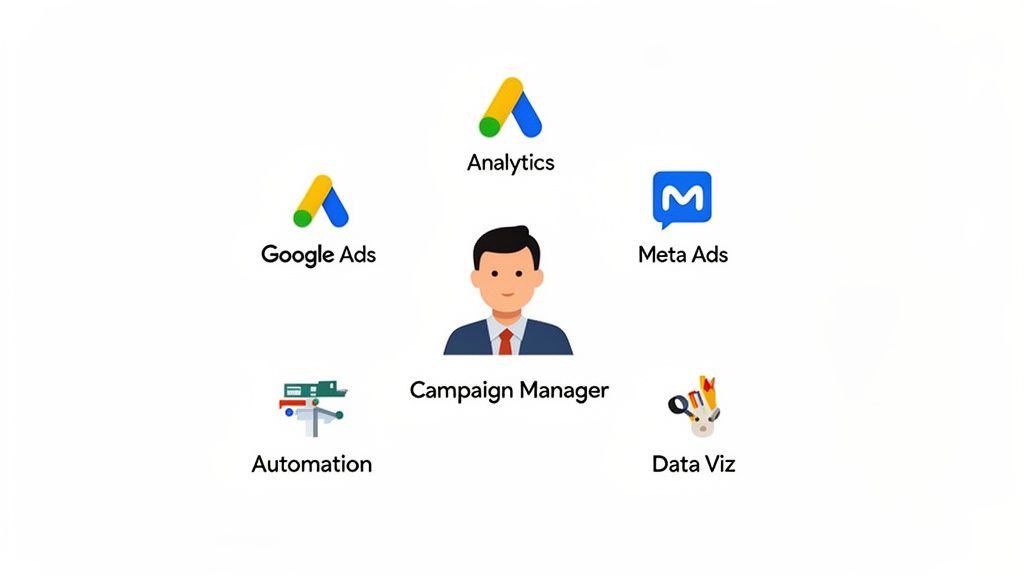
- Google Analytics 4 (GA4): Knowing your way around GA4 to track user journeys, build custom reports, and set up meaningful conversion events is non-negotiable now. A manager who can use GA4 to show exactly how a campaign led a user from a click to a checkout is an absolute asset.
- Data Visualization Tools (Tableau, Looker): Let's face it, raw data in a spreadsheet is ugly and overwhelming. Being able to use a tool like Tableau to transform that mess into a clean, intuitive dashboard is a superpower. It’s how you show campaign performance to a busy CEO who doesn’t have time to decipher a CSV file.
One manager says, "Our campaign got 1 million impressions." The other says, "Our campaign drove 500 high-intent leads with a 4:1 return on ad spend, and you can see the whole story live on this Tableau dashboard." Who do you think is more valuable?
Making that leap from just reporting metrics to delivering insights is exactly what separates a $70,000 campaign manager from one earning over $100,000.
Mastering the Core Ad Platforms
Knowing the basics of paid advertising is table stakes. Real expertise on the platforms where the company spends most of its money is what commands a top-tier salary. Businesses need a specialist who can squeeze every last drop of performance out of their ad budget.
Here’s where you need to go deep:
- Google Ads: This is so much more than setting up a few search campaigns. It's about mastering Performance Max, knowing which bidding strategy to use and when, and truly understanding audience segmentation to drive down your cost-per-acquisition (CPA).
- Meta Ads (Facebook & Instagram): True experts here can build sophisticated retargeting funnels that work, know which ad format to use for a specific goal, and can calmly troubleshoot a campaign when an algorithm change throws everything into chaos.
Proficiency on these platforms is expected. True mastery—the kind that consistently makes the company more money—is what makes you an indispensable hire.
Gaining Proficiency in Marketing Automation
Modern campaigns are a complex web of emails, ads, landing pages, and social posts. Marketing automation platforms are the central nervous system that keeps it all running smoothly. If you're the person who can design and build these automated workflows, you become incredibly efficient and valuable.
Getting really good with a system like HubSpot or Marketo means you can build lead nurturing sequences that guide a prospect from a curious visitor to a paying customer—all without someone having to press "send" every time. You become the architect of a machine that generates revenue 24/7. This skill shows you can think systematically and scale your efforts, which is a hallmark of a senior-level pro. Getting certified on these platforms is a smart move; it gives you tangible proof of your skills and some serious leverage when it's time to talk numbers.
How To Negotiate Your Salary With Confidence
Talking about money can be uncomfortable, but asking for what you're worth is one of the most critical moves you can make in your career. The secret isn't about what you feel you deserve; it's about what your results prove you're worth. For a campaign manager, that means building an undeniable business case for yourself.
Forget just listing your daily tasks. You need to speak the language of business impact. Frame every accomplishment in terms of dollars and cents. Did you boost the Return on Ad Spend (ROAS) or slash the Cost Per Acquisition (CPA)? Put a number on it. This simple shift turns a personal ask into a strategic conversation about the value you bring to the table.
Building Your Business Case
Before you even dream of a number, you need to gather your proof. Your mission is to show your undeniable value, making it a no-brainer for a hiring manager to approve the salary you want.
Start digging into your past roles and document your biggest wins. For every single one, tie it directly to a business outcome.
- Example 1: "At my last company, I completely overhauled our Google Ads strategy. The result? We cut our average CPA by 18% in six months, which saved over $40,000 in annual ad spend."
- Example 2: "I designed and launched a new lead nurturing sequence that boosted our MQL-to-SQL conversion rate from 5% to 8%. That directly added $150,000 to the sales pipeline."
These statements are powerful because they are specific, measurable, and tied to either making money or saving money. This is the ammunition you'll use to anchor the entire negotiation.
Navigating the Salary Question
Sooner or later, you’ll get the question: "What are your salary expectations?" How you answer this is crucial. The biggest mistake is throwing out a single number too early, which can box you in. Instead, offer a thoughtful, well-researched range based on real market data for a campaign manager salary in your city and industry.
A rock-solid answer sounds something like this: "Based on my research for a Campaign Manager role with this scope in the New York market, and considering my proven ability to improve campaign ROI by over 20%, I'm targeting a range between $85,000 and $95,000."
This response nails it. It shows you did your homework, connects your specific value to your request, and gives you room to negotiate. And don't forget—base salary is just one piece of the puzzle. Bonuses, benefits, and even a budget for professional development are all fair game.
Got Questions? We've Got Answers
Even with all this data, you probably still have a few specific questions about navigating your career and compensation as a campaign manager. Let's tackle some of the most common ones I hear.
What's a Realistic Career Path for a Campaign Manager?
Most people don't just land a Campaign Manager job on day one. The journey usually begins in a more junior role, like a Marketing Coordinator or a Digital Marketing Specialist. This is where you cut your teeth, getting your hands dirty with the nitty-gritty of executing campaigns and analyzing the results.
Once you’ve proven you can handle the tactical side of things, the Campaign Manager role is the logical next step. From there, the path opens up to more strategic leadership positions. You might become a Senior Campaign Manager, a broader Marketing Manager, or even a Director of Demand Generation, where your focus shifts from just running campaigns to building the entire strategy and leading a team.
How Does an Agency Salary Stack Up Against an In-House Role?
This is a classic question, and the answer isn't just about the final number. While your total earning potential can be similar in both worlds, the way you're paid often looks very different.
Agency life often comes with a slightly lower base salary but can offer juicy bonuses tied directly to client performance and retention. It's a fantastic environment for getting exposed to a ton of different industries and challenges in a short amount of time.
Working in-house, on the other hand, usually means a higher, more predictable base salary. Plus, you’re more likely to see long-term incentives like equity or stock options. Many professionals find that the broad experience they gain at an agency makes them incredibly valuable candidates for high-paying in-house roles later on.
Think of it this way: An agency is like a fast-paced residency where you learn to handle anything thrown at you. An in-house role is like becoming a specialist with deep, focused knowledge of one business.
Which Certifications Can Actually Help Me Earn More?
Certifications are more than just a piece of paper; they're proof. When you can show a potential employer that you've mastered the key platforms they rely on, you gain some serious leverage in salary talks.
If you're looking to make an impact on your paycheck, focus on these:
- Google Ads Certifications: Proving you're an expert in Search, Display, and Video is non-negotiable for most roles.
- Meta Certified Digital Marketing Professional: This credential shows you know your way around the massive advertising ecosystem of Facebook and Instagram.
- Automation Platform Certifications: Getting certified in a major platform like HubSpot or Marketo signals that you can build and manage the marketing engines that drive scalable growth.
These credentials tell employers you’re serious about your craft and have the technical chops to deliver real results. That's a direct line to increasing your earning potential.
Ready to find what you're worth? SalaryGuide provides the most accurate, up-to-date salary data and job postings specifically for marketing professionals. Explore real salary benchmarks and find your next role.
